<?xml version="1.0" encoding="utf-8" standalone="yes"?><feed xmlns="http://www.w3.org/2005/Atom" xml:lang="en"><title>Leadership Garden</title><subtitle>Engineering leadership, management guides, and actionable tips for tech leaders.</subtitle><link href="https://leadership.garden/atom.xml" rel="self" type="application/atom+xml"/><link href="https://leadership.garden/"/><id>https://leadership.garden/</id><updated>2026-10-24T13:30:44Z</updated><generator uri="https://gohugo.io/">Hugo</generator><rights>© Leadership Garden</rights><author><name>Csaba Okrona</name><uri>https://www.linkedin.com/in/ochronus/</uri></author><entry><title>AI Is Not Just A Tool</title><link href="https://leadership.garden/not-just-a-tool/"/><id>https://leadership.garden/not-just-a-tool/</id><published>2026-10-24T13:30:00Z</published><updated>2026-10-24T13:30:44Z</updated><author><name>Csaba Okrona</name></author><summary>“Just a tool” lets AI rollouts skip the hard question: what will your engineers stop learning?</summary><content type="html"><![CDATA[<p>Last week I asked an agent to read about 260 comments for me.</p>
<p>Rich Hickey had published a short piece called &ldquo;<a href="https://www.linkedin.com/pulse/ai-tool-rich-hickey-kjl8e/?ref=leadership.garden" target="_blank" rel="noopener noreferrer">&lsquo;AI&rsquo; is Not a Tool</a>&rdquo;, and it started two fights at once: 85 comments under the LinkedIn post and well over 170 on Hacker News. I wanted the shape of both threads without giving up an evening, so I pointed an agent at them and got back a tidy digest. Halfway through reading it, I realized I&rsquo;d just done the thing the essay is about. I didn&rsquo;t read the threads. Something else read them, and I read its summary.</p>
<p>(I went back and read the parts that mattered. That ate the evening anyway.)</p>
<p>If you run an engineering org, you&rsquo;ve heard &ldquo;it&rsquo;s just a tool&rdquo; in a rollout meeting, usually from someone who wanted the meeting to end. I think Hickey is right about that phrase. I also think managers should take him more seriously than anyone, because most of us already made this trade with our own careers.</p>
<h2 id="what-hickey-actually-argues">What Hickey actually argues</h2>
<p>Most of the angry replies argue with an essay he didn&rsquo;t write. On HN, people demanded rulings on gdb, cameras, catapults and ffmpeg, as if he&rsquo;d published a taxonomy. When someone on LinkedIn tried the same with lathes and CNC machines, he answered that sorting the world into two bins was never the point. He even agreed with a commenter who called the model itself a lossy knowledge base you query in plain English. His target is the chat products sold as tools for homework, research, writing and coding.</p>
<p>His test for a tool is narrow on purpose: &ldquo;A tool is something you wield.&rdquo; You hold it, it pushes back, you correct, and the correcting is where expertise comes from. A drive-thru is useful, but nobody learns to cook at one. You ask, something else does the work, and what you learn is how to phrase the order. The next model release can make even that knowledge worthless.</p>
<p>He also conceded in the replies that toolness is a spectrum. The more using a thing feels like ordering a sandwich, the less of a tool it is. That concession matters, because most of us use these products near the sandwich end, and the word &ldquo;tool&rdquo; hides it.</p>
<h2 id="where-the-objections-are-fair">Where the objections are fair</h2>
<p>I went through both threads looking for pushback that actually lands, and some of it does.</p>
<p>Power tools misbehave too. Several people pointed out that a table saw isn&rsquo;t deterministic, that no two boards are alike, and that a router can throw a workpiece back at you. All true. But nobody hands a table saw a description of a cabinet and walks off to get coffee. The saw goes wrong in your hands, while you watch, and you make the correction. One HN commenter drew the line better than I could: a lathe gets more useful as its operator gets more skilled, while the chat products mostly hand you an accept or reject decision on output you didn&rsquo;t shape.</p>
<p>&ldquo;It depends on how you use it&rdquo; is harder to wave away. A retired engineer on HN described building a data pipeline of close to 200,000 lines in about six weeks. He reads the agent&rsquo;s reasoning as it runs and interrupts when it heads somewhere he dislikes. He has it build competing prototypes and compare them. Half the codebase is tests, property checks, Lean proofs and TLA+ models. Another commenter framed it as a spec problem: one-shot a whole app and you have a wish machine, but give it a tight interface and your own test suite and it starts to behave like a tool.</p>
<p>I believe both of them, and I&rsquo;d happily work with either. Read what they actually do, though. They rebuilt the feedback loop by hand, through their own effort, against the defaults of the product. The retired engineer even granted that Hickey is probably right about it not being a tool for writing code. What he wields is the engineering around the code. Nothing in the product nudges anyone toward working that way, and one commenter offered a simple check: look at how these products get pitched to your employer.</p>
<h2 id="managers-already-made-this-trade">Managers already made this trade</h2>
<p>Hickey&rsquo;s essay describes the move I made when I went into management.</p>
<p>When I stopped shipping code for a living, I moved from wielding to requesting. I describe outcomes, other people do the work, and I review what comes back. Most of what Hickey says about automation applied to me. I lost the continuous feedback. My sense of how long things take began to drift. After a few years I could judge a design faster than I could write one, and now that I lead leaders, I sit two steps away from the code.</p>
<p>I don&rsquo;t regret it. I did make the trade knowingly, with a rough sense of what it would cost. Management has plenty of words for that cost, starting with the director who is &ldquo;out of touch&rdquo;. We built rituals against it too, like skip-levels and the occasional week spent back on the on-call rotation.</p>
<p>Two HN commenters got to the same place from opposite directions. One said an agent is closer to an employee than to <code>rm</code>, which is why the industry calls it an agent. Another, less charitably, said paying for Claude and paying a contractor amount to the same act: you&rsquo;ve stopped working. I&rsquo;d call both of those <strong>delegation</strong>, the one skill managers get trained on, badly, in their first year. Delegation buys you output and costs you contact with the work. <em>And it only holds up while the person delegating can still <a href="/dopamine-fracking/">tell good output from plausible output</a>.</em></p>
<p>That last condition is the one that worries me.</p>
<h2 id="the-judgment-has-to-come-from-somewhere">The judgment has to come from somewhere</h2>
<p>My judgment came from <a href="/cost-of-objection/">years of wielding</a>. I can review a pull request because I wrote hundreds of bad ones and had them torn apart in review. A senior engineer can steer an agent off a doomed approach because she tried that approach by hand once and watched it collapse.</p>
<p>Hickey&rsquo;s list of what you lose when something else does your reading (noticing things, learning how an argument hangs together, working out whose work to trust) reads a lot like a junior engineer&rsquo;s first three years. It&rsquo;s also the stock every delegator draws down later.</p>
<p>When a senior engineer hands a task to an agent, she&rsquo;s spending judgment she already has. When a junior does it, there&rsquo;s nothing to spend yet, and the task that would have built some just got done by something else. &ldquo;Just a tool&rdquo; flattens those two cases into one.</p>
<p>One line from the HN thread stuck with me: a camera is an excellent tool for producing photographs and a poor one for becoming a better painter. (I take a lot of photos. I never learned to paint, and the camera is part of why.) Whether that matters depends on whether your organization still needs painters. <strong><em>Every engineering org I know does</em></strong>. Somebody has to catch the bug the agent keeps putting back. Somebody has to hold a whole system in their head when the agent&rsquo;s context runs out, and notice when a confident answer is wrong.</p>
<h2 id="why-the-word-matters-in-a-rollout">Why the word matters in a rollout</h2>
<p>One HN commenter dismissed the whole essay as a stipulated definition followed by a &ldquo;so what?&rdquo; Inside a company, the &ldquo;so what&rdquo; is easy to find.</p>
<p>Another made the opposite case on political grounds. Keep calling it a tool, he argued, so humans stay accountable and nobody gets to blame the machine. I see the appeal in public debate. In a planning meeting, I think it backfires.</p>
<p>The usual rollout announcement says new tool, licenses for everyone, and an adoption target. Nobody in that meeting asks what the team will stop learning, because nobody asked that about the last IDE either. So the plan tracks adoption and has no line for skills.</p>
<p>Call it automation, or delegation, and different questions show up:</p>
<ul>
<li>What does this team stop practicing if the rollout works?</li>
<li>Who still needs to do the task by hand, and how do they keep that ability?</li>
<li>When the output is wrong in a plausible way, who notices, and what experience lets them notice?</li>
<li>If the vendor swaps the model next quarter, what do we lose?</li>
</ul>
<p>You&rsquo;d ask these before automating any other workflow. Calling it a tool is how a team gets to skip them.</p>
<h2 id="what-id-ask-of-other-leaders">What I&rsquo;d ask of other leaders</h2>
<p>I&rsquo;m not going to ban anything, and I doubt the no-AI Fridays fix much.</p>
<p>Start by naming the mode, task by task. The same product can sit anywhere on Hickey&rsquo;s spectrum. An engineer who asks it to explain an unfamiliar codebase while she traces the calls herself is close to the tool end. An engineer who prompts a feature, skims the diff and merges is ordering a sandwich. Either can be right for the task. I want people to know which one they&rsquo;re doing, and to have picked it.</p>
<p>For early-career engineers, keep some work by hand: debugging their own incidents, writing the first draft of a design, reading the actual RFC instead of a summary of it. Some of them will feel hazed. I&rsquo;d still rather they build the judgment now than <a href="/the-senior-engineer-crisis/">find out in five years that they never did</a>.</p>
<p>Count the feedback loop as work. The retired engineer spent a lot of those six weeks on proofs and property tests that no product asked him to write. In plenty of performance conversations, that effort would read as slowness. It should read as the job.</p>
<p>And drop &ldquo;just a tool&rdquo; from your own vocabulary. When someone on my team reaches for it, I&rsquo;d rather hear what they&rsquo;re automating and what it costs.</p>
<p>Hickey closes with a warning about what automation does to the people who rely on it. Managers learned the delegation version of that lesson the slow way. We&rsquo;re now handing the same trade to every engineer in the building, mostly without saying so out loud. They deserve to hear it plainly: you can stop doing the work, but know that you stopped.</p>
]]></content><category term="ai"/><category term="judgment"/><category term="growth"/><category term="management"/></entry><entry><title>You'll Know in Two Quarters</title><link href="https://leadership.garden/you-ll-know-in-two-quarters/"/><id>https://leadership.garden/you-ll-know-in-two-quarters/</id><published>2026-10-17T11:03:00Z</published><updated>2026-10-17T11:03:00Z</updated><author><name>Csaba Okrona</name></author><summary>Why "just ship faster" stops working when feedback takes months, and what engineering directors should measure instead.</summary><content type="html"><![CDATA[<p>Last quarter I nearly sent my manager a slide I&rsquo;m still slightly embarrassed by.</p>
<p>It had three numbers on it. Merged pull requests across my org were up a little more than double year over year. Median cycle time had dropped by about a third. Almost every engineer was using a coding agent every day. I had the speaker notes written, and I was going to call it our best half for delivery in years.</p>
<p>Then I tried to write the fourth bullet, the one about what customers got out of all this. I looked at that empty line for most of an evening. (I cut the slide in the end, which is the only reason I can write this post without wincing.)</p>
<p>If you run managers who run teams, there&rsquo;s a decent chance you have a slide like that open somewhere right now. I don&rsquo;t think the fourth bullet is blank because our teams are doing bad work. Something about the way evidence moves through an org this year makes the first three bullets easy to write and the fourth one close to impossible, and I want to work out what that something is.</p>
<p>Paulo André&rsquo;s essay <a href="https://hagakure.substack.com/p/quick-to-build-slow-to-know?ref=leadership.garden" target="_blank" rel="noopener noreferrer">Quick to Build, Slow to Know</a> is the best thing I&rsquo;ve read on this, and I&rsquo;d send it to anyone who owns a roadmap. His word for it is overshoot. The org learns in days that it can produce more and in months whether it should have, and in that gap sensible people keep expanding. I have one quibble. In his telling, overshoot is something &ldquo;the system&rdquo; does, which is true and lets everyone inside it off a little easy.</p>
<p>I sit in the middle of that system, between the teams who see the work and the executives who make commitments on it. From here, the system is mostly people like me deciding which line makes it onto the slide. He closes by asking what kind of leader this needs, and I&rsquo;ll try to answer from my chair.</p>
<h2 id="speed-reports-itself">Speed reports itself</h2>
<p>Every AI tool we bought this year came with a dashboard. Acceptance rates, sessions per developer, lines suggested, PRs touched. Our engineering metrics platform added an &ldquo;AI impact&rdquo; tab within a quarter. I didn&rsquo;t ask for any of it, and all of it updated daily.</p>
<p>Nothing in our stack updates daily on whether the work mattered.</p>
<p>Think about what would actually tell you. Did customers keep using the feature after the first week? Did support tickets about that flow go down? The integration someone built in an afternoon, does it still work now that the partner changed their API, and is the new service as cheap to run as we said? That evidence doesn&rsquo;t land on a dashboard. Some of it surfaces as a hunch in a retro six months later. Some of it never surfaces, because the people who would have noticed moved teams.</p>
<p>So the evidence is lopsided before anyone decides anything. I don&rsquo;t think most leaders consciously prefer the fast kind. A vendor just delivers it to their inbox every Monday, while the slow kind is a project somebody has to staff, usually somebody who already has a full week.</p>
<h2 id="the-overshoot-climbs-the-org-chart">The overshoot climbs the org chart</h2>
<p>The route overshoot takes through an engineering org is the reporting chain. Picture how it moves in an org of forty or fifty engineers. An engineering manager sees her team&rsquo;s throughput jump and mentions it in her monthly update. She&rsquo;s careful about it. She notes that review load on her two seniors has gone up and that she isn&rsquo;t sure the extra PRs are the ones that matter. Her director pulls together five of those updates. The caveats don&rsquo;t survive the merge. What survives is &ldquo;throughput roughly doubled across the group.&rdquo; The head of engineering turns that into a planning assumption: if we ship twice as much, next half&rsquo;s roadmap can absorb more. The roadmap goes to the business with dates on it. Sales starts mentioning features to customers.</p>
<p>Nobody in that chain did anything wrong. Go back and read the manager&rsquo;s original update, and her line about the two seniors is still the most important sentence in it. It just didn&rsquo;t fit the template the director was filling in, which had one cell per team for a headline number. By the time the chain reaches the people who make external commitments, a fast signal has turned into a promise, and the doubt that came with it is sitting in a monthly update nobody above the director will open.</p>
<p>(I&rsquo;ve been the director in that story, and I&rsquo;ve been the head of engineering. The caveats are always the first thing to go. I&rsquo;ve cut them myself, because the slide had room for one line.)</p>
<p>Some companies go one step further and wire the fast signal straight into incentives. Managers at JPMorgan reportedly <a href="https://synodus.com/thought-leadership/when-ai-writes-the-code-the-hidden-bottleneck-slowing-software-releases/?ref=leadership.garden" target="_blank" rel="noopener noreferrer">track how often developers use AI coding tools</a> and factor it into performance. I can see how a well-meaning finance partner gets there: the license line is big, and usage is the one number the vendor will happily hand you. But once usage counts in someone&rsquo;s review, you&rsquo;ve told the whole org which signal keeps score, and people will play to it. I would too.</p>
<h2 id="scarcity-was-doing-your-prioritization">Scarcity was doing your prioritization</h2>
<p>I&rsquo;ve sat in a lot of planning meetings where the most useful sentence anyone said was &ldquo;that&rsquo;s three engineers for six weeks.&rdquo;</p>
<p>It was a bad mechanism, and I don&rsquo;t miss those meetings. Estimates got padded by engineers who had been burned before, then haggled down by PMs who had already promised a date to someone, and the number everyone signed off on was a fiction both sides recognized. It also punished ideas for being expensive when it should have punished them for being wrong.</p>
<p>But it did one thing well. It put a price on yes. Somebody had to say out loud that an idea was worth six weeks, in front of the people who would spend those six weeks.</p>
<p>That price has mostly disappeared. A PM asks whether we can try something, and the honest answer is &ldquo;sure, it&rsquo;s an afternoon.&rdquo; The answer is accurate. It also answers the wrong question, because the afternoon was never the expensive part.</p>
<p>Most of what a yes costs shows up after the code exists, usually as somebody&rsquo;s on-call shift or somebody&rsquo;s help article, a year after the person who said yes has moved on to other things. AI made none of that cheaper. There&rsquo;s just more of it.</p>
<p>I saw this first with internal tooling, not product features. Over one quarter, one of my areas grew a handful of small services, scripts, and dashboards, each built by someone solving a real problem in an afternoon. I found out about most of them when an on-call engineer asked in Slack who owned the one paging her at 2am. Nobody answered for a day.</p>
<p>These days the question I ask in planning is who owns it in twelve months, and what would make us delete it. How long it takes barely comes up anymore. No owner means we don&rsquo;t build it. An owner without an answer to the second part still gets built, but with a date on the calendar when we decide its fate.</p>
<h2 id="just-ship-faster-fails">Just Ship Faster fails</h2>
<p>Stay SaaSy would tell me I&rsquo;m overthinking this. In <a href="https://blog.staysaasy.com/p/the-best-prioritization-is-no-prioritization?ref=leadership.garden" target="_blank" rel="noopener noreferrer">The Best Prioritization Is No Prioritization</a> they argue that scoring frameworks are theater and nobody can prove they prioritized well, so you&rsquo;re better off spending that time getting faster and letting shipping teach you. It&rsquo;s a good post, aimed at a real disease, and it reads like it was written by someone who has sat through one RICE session too many.</p>
<p>I agree with more of that than I&rsquo;d like to. Most scoring frameworks I&rsquo;ve watched in practice were a way to dress up a decision someone had already made. I&rsquo;ve also watched a team spend a month ranking a backlog that one week of building would have settled.</p>
<p>But the argument assumes that the lesson from shipping arrives before your next decision. If you change a pricing page on Monday and the conversion data is clear by Friday, speed really can replace judgment. You can choose badly, because you&rsquo;ll find out before it costs much.</p>
<p>Now stretch the loop. You ship an integration that enterprise customers will roll out over two quarters. Or an internal platform that other teams will adopt whenever their own roadmaps allow, which in practice means sometime next year. You won&rsquo;t know whether it worked for six months, maybe longer. Meanwhile you&rsquo;ve made twenty more decisions, most of them built on the assumption that the first one was right. If the first one was wrong, you find out about all twenty-one together.</p>
<p>The rule I&rsquo;ve landed on: <strong>speed can stand in for judgment only when time-to-know is shorter than the time between your decisions.</strong> Past that point, going faster mostly means more bets placed blind, and build time, the number we used to fight over in planning, becomes the least interesting thing about a proposal.</p>
<h2 id="time-to-know-is-a-number">Time-to-know is a number</h2>
<p>I used to treat &ldquo;will we ever find out if this worked&rdquo; as a philosophical question. I now treat it as something you can estimate, roughly, before you start.</p>
<p>For any bet worth a conversation, I want these written down before work starts:</p>
<ul>
<li>What would tell us this worked? I want a behavior, something like &ldquo;the forty accounts that asked for this export use it at least twice a month.&rdquo; &ldquo;Engagement&rdquo; doesn&rsquo;t count.</li>
<li>When is the earliest we could see that?</li>
<li>Who is going to look, and is it already on their calendar?</li>
</ul>
<p>The gap between the ship date and the answer to the second question is time-to-know. For a copy change, days. For a platform migration, or anything enterprise customers adopt on their own schedule, I&rsquo;d bet on two quarters, and I&rsquo;ve rarely lost that bet.</p>
<p>When we started writing this down, a surprising number of proposals couldn&rsquo;t answer the first question at all. Those were exactly the ones that most needed a no, and under the old regime most of them would have died at the six-week estimate. We also found work where time-to-know was far longer than anyone had assumed. Nobody wanted to stack three follow-up bets on a foundation we wouldn&rsquo;t be able to judge until spring, so we stopped doing it.</p>
<p>You can also shorten it, and right now I&rsquo;d put more leadership attention there than anywhere else. The cheap version is instrumenting before you ship, so that finance asking how the feature is doing isn&rsquo;t the first time anyone looks. The underrated version is shipping to five customers you can phone before shipping to five hundred you can&rsquo;t. Much of what we used to call velocity work, I&rsquo;d now call time-to-know work, and given the choice I&rsquo;d fund it over another round of seat licenses.</p>
<h2 id="write-down-what-is-enough-before-you-start">Write down what is <em>enough</em> before you start</h2>
<p>One of the questions Paulo ends on is how long the &ldquo;enough&rdquo; signal takes to show up. My worry is that most teams never decided what &ldquo;enough&rdquo; would look like in the first place. They decide afterward, once they&rsquo;re invested, and nobody invested in a feature has ever looked at mediocre adoption numbers and concluded it should go. So write the kill criteria before the work starts, with a date attached. &ldquo;If fewer than fifteen of the accounts that requested this use it by the end of February, we remove it.&rdquo; Put the review on the calendar on the day you approve the work.</p>
<p>The harder part is cultural. Removing a feature feels like admitting failure, so teams avoid it, and the product slowly fills with things nobody would build today. I&rsquo;ve started counting deletions as delivered results in quarterly reviews. People were suspicious of that at first, and a couple of managers asked if it was a trick to make the numbers look better. It wasn&rsquo;t. A removal that was planned from the start is the slow signal doing its job.</p>
<p>Will Larson makes the case that <a href="https://lethain.com/revised-rules-of-engineering-leadership/?ref=leadership.garden" target="_blank" rel="noopener noreferrer">quick, good, and durable decisions</a> are what lets a team cash in on AI&rsquo;s pace. I&rsquo;d push on &ldquo;durable&rdquo;, which most people hear as &ldquo;permanent&rdquo;. A decision with a review date on it lasts longer in practice, because reversing it later is a calendar item, not a political fight.</p>
<h2 id="what-i-report-upward-now">What I report upward now</h2>
<p>The version I eventually sent had the same throughput numbers on it. It also had a second column: for each major thing we shipped that half, the date we&rsquo;d know whether it worked and what we&rsquo;d be looking at. Three rows said January. One said &ldquo;we don&rsquo;t yet know how to measure this,&rdquo; which was the most honest line in the deck.</p>
<p>My manager asked about that row more than any other. Good. That&rsquo;s the conversation I wanted to be having.</p>
<p>I&rsquo;ve kept a few habits from that quarter, and I&rsquo;d push them on anyone in a similar seat:</p>
<ul>
<li>Pair every fast metric with its slow counterpart and the date it will be known. A throughput number on its own gets turned into a promise by someone two levels up.</li>
<li>When your managers send caveats up, keep at least one when you summarize. If the template only has room for one line, change the template.</li>
<li>Argue against putting AI usage into performance reviews. If the people above you insist, at least make sure they understand they&rsquo;re rewarding the fast signal on purpose.</li>
</ul>
<p>A column full of &ldquo;pending&rdquo; is not a comfortable thing to present when every peer in the room is reporting green. The alternative is committing next half&rsquo;s roadmap on the strength of a number that measures typing.</p>
<h2 id="the-leader-this-needs">The leader this needs</h2>
<p>Paulo&rsquo;s closing question was what kind of leader this system needs. My answer is less grand than I&rsquo;d like: someone who can wait for the slow signal without pretending it already arrived.</p>
<p>In practice that&rsquo;s fairly unglamorous. You&rsquo;re the person in planning who keeps asking who owns this in a year, long after people have stopped finding the question charming. Your managers&rsquo; doubts survive your summaries. And when your boss asks whether the big bet worked, you can say &ldquo;we&rsquo;ll know in January&rdquo; and then stop talking, without filling the silence with a projection you don&rsquo;t believe. (That last one is the hardest for me. I&rsquo;m working on it.)</p>
<p>This isn&rsquo;t a case for slower teams, and I&rsquo;d be annoyed if anyone used it as one. I want the speed. I just don&rsquo;t want an org that takes how fast it builds as proof of how fast it learns, and then makes promises on the difference.</p>
<p>We got dramatically faster at building this year, and I can&rsquo;t point to a single week we saved in finding out whether any of it mattered. That gap is most of the job now.</p>
]]></content><category term="ai"/></entry><entry><title>Get Really Good at Navigating Change</title><link href="https://leadership.garden/navigating-change/"/><id>https://leadership.garden/navigating-change/</id><published>2026-10-07T14:35:00Z</published><updated>2026-10-07T14:35:00Z</updated><author><name>Csaba Okrona</name></author><summary>Advice for engineering leaders on reorgs, AI churn, and change: respond to fewer things and prove you adapted by shipping.</summary><content type="html"><![CDATA[<p>Every few months someone on one of my teams asks me how I keep up. It usually comes the week a new model drops, or the week a reorg gets announced, and lately those have been the same week. I don&rsquo;t keep up. I stopped trying a while ago.</p>
<p>What I tell them instead is to get really good at navigating change. (The version I say out loud has a swear word in it.) In practice that means reacting less, learning principles instead of tools, and shipping more than you read. This is for engineers and engineering leaders who feel like they lose ground every time the ground moves.</p>
<p>I think most of them are tracking the wrong number. They count how current they are: which launch threads they&rsquo;ve read, which agent framework they tried last weekend, whether they recognized the thing someone mentioned in standup that everyone nodded at. Knowing about a change feels like adapting to it. Those are two separate skills, and the people I&rsquo;ve seen handle change well are mostly good at the second one.</p>
<h2 id="react-less">React less</h2>
<p>A <a href="/tags/culture/">Reddit post in r/AI_Agents</a> stuck with me last year. An AI engineer described taking in close to twelve hours of AI content a day: lectures, papers, newsletters, podcasts on the train. Most of the post was in capital letters. He still couldn&rsquo;t keep up, and judging by the replies, nobody else could either.</p>
<p>Leaders do a quieter version of the same thing. A reorg gets announced and a manager rewrites the team roadmap that afternoon, before anyone knows what the reorg means for that team. A VP mentions a metric in an all-hands, and by Friday two teams have dashboards for it. I&rsquo;ve done both. Each reaction looked responsible at the time.</p>
<p>The cost shows up a quarter later. A team whose roadmap changes every two weeks learns that roadmaps are suggestions and stops arguing about them, which is worse than arguing. Your team sets its alarm level by yours. Most of those announcements didn&rsquo;t change what anyone should do on Monday, and the ones that did were still there two weeks later, easier to read.</p>
<p>The filter I use is a single question: what does this change about a decision in front of me this month? Usually the honest answer is nothing, so I note it and move on. Sometimes it&rsquo;s &ldquo;I don&rsquo;t know yet&rdquo;, and then I wait until I do. Only an answer that names a specific decision gets action.</p>
<p>&ldquo;Keep up or get left behind&rdquo; is the pitch behind most of the AI courses being sold right now, and it has a grain of truth. If your company moves clouds or your biggest customer leaves, you don&rsquo;t get to wait it out. Nobody needed a newsletter to notice either of those, though. The changes that demand speed are almost always the ones you can&rsquo;t miss.</p>
<h2 id="master-principles-not-tools">Master principles, not tools</h2>
<p>I&rsquo;ve written production code in Python, Ruby, OCaml, Clojure, C#, Go, Rust, TypeScript, PHP, Java, and Haskell. Today I&rsquo;d need a reference open for half of them. What carried over between them was everything that wasn&rsquo;t syntax: how to model state, where to draw a boundary, how a failure travels through a system, why the boring option usually wins.</p>
<p>Tools have always expired. What&rsquo;s new is how fast. Sean Goedecke <a href="https://www.seangoedecke.com/you-have-to-beat-the-models-at-something/?ref=leadership.garden" target="_blank" rel="noopener noreferrer">pointed out in August</a> that &ldquo;make working changes to large codebases&rdquo; was on his list of things models couldn&rsquo;t do at the start of 2026, and had dropped off it by the time he wrote the post. If your edge is knowing the gaps in this quarter&rsquo;s tools, your edge has a shelf life of about a quarter.</p>
<p>Goedecke would push back on part of this. His short-term advice is to squeeze every advantage out of the tools, and he&rsquo;s right that refusing them is a losing position. I&rsquo;d go one step further. Fluency in this month&rsquo;s agent doesn&rsquo;t compound. The two durable skills he names, knowing your own system deeply and explaining it clearly, don&rsquo;t live inside any tool, and they&rsquo;re exactly what makes the next tool cheap to pick up.</p>
<p>Principles are also what make reacting less safe. If you understand why a queue decouples a producer from its consumers, a new streaming product is a variation you can judge in an afternoon. If all you know is the old product&rsquo;s config file, every release is a new world, and you&rsquo;re back to reading everything.</p>
<p>The same holds one level up. Every reorg I&rsquo;ve been through felt new, and none of them changed what people needed from me during it: to know who decides what, and to hear the truth from someone when the answer is bad. Knowing that, I can skip the change-management framework and spend the hour writing to my team instead.</p>
<h2 id="ship-more-than-you-read">Ship more than you read</h2>
<p>Reading is the comfortable way to feel current. You can do it on the couch and it never fails. It also gives you plenty to say in meetings, which is the trap. I&rsquo;ve sat in rooms where everyone could describe the new thing fluently and nobody had used it past the demo. This is also what you can see in most AI hype Youtube videos.</p>
<p>Most of what I actually know about coding agents I learned on weekends, building things nobody asked for: a process supervisor in Rust, a self-hosted analytics tool that does what Plausible does, and a weather app that pulls several forecasts and shows where they disagree. None of these will make money, and that was never the point. Each one hit walls no launch post mentions. I learned how often I&rsquo;d throw the agent&rsquo;s output away, and how often my own taste was the only thing between the codebase and a pile of defensive code nobody needed.</p>
<p>My rough rule is an hour of building for every hour of reading about a change. When I let that ratio slip, I can talk about the change well and make decisions about it badly.</p>
<p>For a leader, shipping doesn&rsquo;t always mean code. It means a decision written down, or a pilot with an end date. It can be as small as one change to how the team works that you can point at a month later. When a reorg lands, the manager who sends a one-page note on day two, covering what changes for the team and what doesn&rsquo;t, is navigating it. The manager who forwards the announcement with &ldquo;more details soon&rdquo; is still reading about it.</p>
<h2 id="pick-fewer-changes">Pick fewer changes</h2>
<p>Change will keep arriving faster than anyone can read about it. That&rsquo;s the one forecast in this post I&rsquo;m sure of, and it stopped bothering me once I stopped trying to absorb all of it. Pick fewer changes. Understand the ones you pick well enough that the lesson carries to the next one, then prove it with something you built.</p>
<p>Everything else is staying informed. Being informed was never the job.</p>
]]></content><category term="process"/><category term="learning"/><category term="leadership"/></entry><entry><title>Everyone Has a Recipe Now</title><link href="https://leadership.garden/everyone-has-a-recipe-now/"/><id>https://leadership.garden/everyone-has-a-recipe-now/</id><published>2026-09-29T08:54:41Z</published><updated>2026-09-29T08:54:41Z</updated><author><name>Csaba Okrona</name></author><summary>AI lowered the barrier to building software, not to understanding it. Why spec-first AI recipes look right in week one and fail by month nine.</summary><content type="html"><![CDATA[<p>Everyone has a recipe now. Write a more detailed spec, settle the design before anyone touches code, keep the thinking separate from the building, and run the tests at the end to confirm it all went to plan. Put an agent in the middle and Bob&rsquo;s your uncle.</p>
<p>This post is for engineering leaders who keep receiving these recipes. They usually arrive as a link from a founder, a product lead, or their own boss, with a one-line note asking whether we should be doing this too. I want to explain why the recipes sound right, where their evidence comes from, and what I think we should be doing with AI instead.</p>
<p>First, the part I&rsquo;m glad about. AI has opened software engineering to a much wider audience. People who have never had to design, evolve, or maintain a large system can now describe what they want and get something that runs. That matters, and I have no interest in standing at the door checking credentials.</p>
<p>But the tool lowered the barrier to creating software. It didn&rsquo;t hand anyone the knowledge, experience, and judgment needed to draw sound conclusions about engineering it. <em>A lot of the current methodology talk comes from people who haven&rsquo;t noticed that those are two separate things.</em></p>
<h2 id="why-the-recipes-sound-right">Why the recipes sound right</h2>
<p>Taken on their own terms, the recipes make sense, and the people pushing them aren&rsquo;t fools. Most things outside software get built this way. You finish the drawings before you pour the foundation, and nobody calls the architect naive for it.</p>
<p><strong>Then again, nobody asks the architect to add three floors every quarter to a building people already live in, while keeping the lifts running.</strong></p>
<p>They also answer a real frustration. Anyone who has watched an agent wander off, rename half a module, and call an API that doesn&rsquo;t exist wants to pin it down. More text in the prompt feels like more control, and a spec feels like a contract the agent has to honor.</p>
<p>Spec Kit, Kiro and their cousins turn this into a pipeline. An agent drafts a requirements document, then a design document, then a task list, and only then the code, followed by tests that check the code against the list. Every stage exists to remove uncertainty before the next one starts.</p>
<p>Follow that logic without a brake and you get what François Zaninotto at Marmelab <a href="https://marmelab.com/blog/2025/11/12/spec-driven-development-waterfall-strikes-back.html?ref=leadership.garden" target="_blank" rel="noopener noreferrer">described</a> when a developer used Spec Kit to show the current date in a time-tracking app. <em>The output was eight files and roughly 1,300 lines of text.</em> That&rsquo;s an extreme case, and I wouldn&rsquo;t judge every spec-first workflow by it. It does show where the reasoning ends up. If uncertainty is the enemy, there is always one more paragraph that could reduce it.</p>
<p><strong>The trouble is that most of the uncertainty in software doesn&rsquo;t live in the part you can write down in advance.</strong></p>
<h2 id="week-one-and-month-nine">Week one and month nine</h2>
<p>Most of what we call engineering practice exists because of what happens after the first version works. Small pull requests, tests and observability barely pay off in week one. They start paying with the third requirements change, or the integration that answers 200 with an error in the body. They pay most when someone who has never seen the code has to change it the night before a release.</p>
<p><a href="https://en.wikipedia.org/wiki/Manny_Lehman_%28computer_scientist%29?ref=leadership.garden" target="_blank" rel="noopener noreferrer">Manny Lehman</a> described the forces behind this in the 1970s. A system that people actually use has to keep changing, or it becomes steadily less useful. Each of those changes adds complexity unless someone spends effort removing it. Neither law shows up in a demo. Both show up in next year&rsquo;s roadmap, usually as the reason everything else got slower.</p>
<p>I don&rsquo;t think the recipe writers are lying. They report accurately on what they saw, but they saw it at the wrong time. A prototype built over a weekend, or a feature generated from a clean spec in a fresh repository, is a sample that ends just before the expensive part begins. The recipe did work. It just hasn&rsquo;t met the conditions the older practices were built to survive.</p>
<blockquote>
<p>AI makes this worse in a specific way. Getting to a working first version used to take weeks, which gave people time to run into at least a few of the later problems. Now it can take an afternoon. Far more people have seen the first week of a system, and far fewer have stayed for month nine. The demo got cheaper, and the evidence behind the conclusions people draw from it got thinner.</p>
</blockquote>
<p><strong>Producing something that works is not the same as showing that we know how to keep it working.</strong></p>
<h2 id="the-recipe-is-older-than-its-authors">The recipe is older than its authors</h2>
<p>These ideas are older than most of the people now presenting them as a discovery.</p>
<p>The paper usually cited as the origin of waterfall is Winston Royce&rsquo;s 1970 &ldquo;<a href="/tags/culture/">Managing the Development of Large Software Systems.</a>&rdquo; Royce drew the sequential diagram, requirements to design to code to test, and then called that approach &ldquo;risky&rdquo; and said it &ldquo;invites failure.&rdquo; The rest of the paper argues for stepping back to earlier phases, involving the customer throughout, and building a pilot version first so you learn what the real one needs. <em>The industry kept the diagram and dropped the argument.</em></p>
<p>Five years later Fred Brooks told us to plan to throw one away, because we would anyway. Then in 1986, David Parnas and Paul Clements published &ldquo;<a href="/tags/culture/">A Rational Design Process: How and Why to Fake It.</a>&rdquo; Their point was blunt. No real project moves cleanly from requirements to design to code, because nobody knows enough at the start to make that possible. They still recommended writing the documents as if it had happened that way, since a clean record helps whoever maintains the system later.</p>
<p>That detail is the one I keep coming back to. The tidy sequence of spec, design, build and verify was always a way to present the work once it was done. The new recipes take that after-the-fact account and run it forwards, as instructions.</p>
<h2 id="tests-are-how-you-find-out">Tests are how you find out</h2>
<p>The last step is where the recipe gets testing backwards. It treats tests as the final confirmation that everything was understood correctly up front. Write the spec, generate the code, generate the tests, see green, ship.</p>
<p><strong>In practice a test is one of the cheapest ways to find out that your understanding was wrong.</strong> Kent Beck&rsquo;s case for writing the test first was that the test is the first user of your code. If calling the code from a test feels clumsy, you learn that before the design sets. The value lives in the moment the test disagrees with you.</p>
<blockquote>
<p>Watch what happens when one agent writes both the code and the tests from the same spec. The tests inherit every assumption the spec got wrong, and so does the code. They agree with each other perfectly and can both disagree with reality. A green build in that setup tells you the agent was consistent. It tells you very little about whether the spec was right.</p>
</blockquote>
<p>Sometimes the agent doesn&rsquo;t even get that far. In the same Marmelab write-up, the agent ticked off its &ldquo;verify implementation&rdquo; task without writing a single unit test. It produced manual testing instructions instead, and the checklist still showed done.</p>
<p>Confidence is cheap to acquire in this setup. In <a href="https://the-decoder.com/ai-coding-can-make-developers-slower-even-if-they-feel-faster/?ref=leadership.garden" target="_blank" rel="noopener noreferrer">METR&rsquo;s 2025 study</a>, 16 experienced open source developers took about 19% longer on 246 real tasks when they could use AI tools. Afterwards, they estimated that AI had made them about 20% faster. I don&rsquo;t read that as proof that AI slows people down, since the study was small and the tools have moved on since early 2025.</p>
<p><strong>I read it as a measurement of how far someone&rsquo;s sense of progress can drift when nothing pushes back.</strong></p>
<h2 id="challenging-a-practice-versus-dismissing-it">Challenging a practice versus dismissing it</h2>
<p>None of this makes experience infallible. Some practices really were built around constraints that AI removes. Code review designed for a person writing a couple of hundred lines a day may not survive agents producing thousands. Estimation rituals that assume typing is the slow part deserve a hard look. I&rsquo;d worry about any engineering leader who defends every current practice on the grounds that it&rsquo;s current.</p>
<p>So I don&rsquo;t much care whether someone is challenging an old practice. I care whether they know what it was for. A challenge starts from that knowledge and brings evidence that something else does the job better. A dismissal starts from never having hit the problem the practice solves. <a href="/tags/culture/">Chesterton’s Fence much</a>?</p>
<p>The strongest version of the other side goes like this:</p>
<p><em>&ldquo;The old practices existed because code was expensive to write. Code is now cheap. So the practices can go.&rdquo;</em></p>
<p>That argument is half right. Writing code did get cheaper. <strong>Being wrong didn&rsquo;t</strong>. A bad data model still has to be migrated with live customer data inside it. A public API still carries every behavior someone came to depend on, whether you meant to promise it or not (Hyrum Wright gave that one his name). A wrong assumption about a payment provider still costs real money when it fails in production. None of those costs moved when the typing got faster.</p>
<p>When a recipe lands in your inbox, three questions separate the two cases quickly:</p>
<ol>
<li>What problem was the practice you&rsquo;re replacing designed to solve?</li>
<li>Where does that problem go in the new approach? Does it disappear, or does something else absorb it?</li>
<li>What&rsquo;s the evidence from after the system had to change? The second and the fifth change, not the first build.</li>
</ol>
<p>Someone who answers the first question well is usually worth listening to, even when I disagree with where they end up. Someone who can&rsquo;t answer it is guessing, however good the demo looks.</p>
<p>If you&rsquo;re the one deciding whether your organization adopts a recipe, don&rsquo;t settle it in a debate. Run it on a bounded piece of real work and measure past the demo: how long the third change took, how many people other than the author could make it, and what broke in the first month of production. Recipes that survive that are worth adopting. Most of the ones circulating right now have never been asked.</p>
<h2 id="what-we-could-be-doing-with-it">What we could be doing with it</h2>
<p>This is the part that frustrates me most. The practices that actually worked, the ones Royce and Brooks and Beck argued for, were mostly limited by cost. We knew we should build a pilot first, try more than one design, test harder, and understand a system before changing it. We usually skipped them because each one cost weeks that nobody would fund. <strong>Agents took most of that cost away, and so far we&rsquo;re spending the savings on volume.</strong></p>
<blockquote>
<p>Take Brooks&rsquo;s advice about throwing one away. It was hard to follow when a prototype cost a team a month. Today an agent can build two or three rough versions of the risky part of a design in a day, and you can delete all of them by the evening. What broke in each version tells you what the spec needs to say. A spec written after that exercise has something real under it. Written before, it&rsquo;s mostly a guess with good formatting.</p>
</blockquote>
<p>Most teams point their agents at the code. I&rsquo;d point more of them at the spec because <em>that&rsquo;s where the expensive assumptions live</em>. Ask the agent for the inputs the spec doesn&rsquo;t handle, the requirements that contradict each other, and the questions a skeptical colleague would raise in review. You don&rsquo;t have to accept any of it. You get the argument earlier, when it costs a paragraph instead of a data migration.</p>
<p>Verification can get much stronger. Property-based tests, mutation testing, fuzzing, and contract tests were always valuable and always the first thing cut when a deadline came. <strong>Agents can write them now, cheaply.</strong> The rule that matters is independence. Tests should come from a different source than the code: properties a person wrote and an agent expanded, or a separate agent working from the requirements without seeing the implementation. Otherwise you&rsquo;re back to one author agreeing with itself.</p>
<p>Understanding is where I see the most untapped value. <a href="/tags/culture/">Peter Naur argued in 1985</a> that the real product of programming is the programmer&rsquo;s theory of the system, and that the code is only a partial record of it. An agent that traces a request through six services, explains why a module is shaped the way it is, or maps everything that reads from a table is helping someone build that theory faster. Generating code so that nobody has to build the theory at all is a completely different use of the same tool.</p>
<p><a href="https://www.seangoedecke.com/programming-with-ai-agents-as-theory-building/?ref=leadership.garden" target="_blank" rel="noopener noreferrer">Sean Goedecke describes his own workflow</a> in almost exactly these terms. He rejects most of what his agents produce, and nearly all his time goes into judging their output against his model of the system. That&rsquo;s what expertise looks like with these tools: plenty of output, most of it thrown away, and the throwing away is the skill.</p>
<p>Then there&rsquo;s the complexity Lehman warned about. Every mature codebase has refactors nobody got to and a dependency or two stuck several major versions behind. Most also carry dead code that nobody dares to delete. With good tests around it, an agent can do a lot of that work, and AI ends up slowing the growth of complexity instead of feeding it.</p>
<blockquote>
<p><strong>For leaders, most of this comes down to what you reward.</strong> Count the code your agents produced, and you&rsquo;ll get more code. Measure how long the fifth change to a service takes; praise the engineer who threw away four agent attempts before accepting one, and you&rsquo;ll end up with a different kind of team.</p>
</blockquote>
<p>That list needs no new methodology. It needs people who spend the cheap part of the work, the typing, to buy more of the expensive part: finding out what&rsquo;s true before anything depends on it.</p>
<h2 id="confidently-wrong-at-scale">Confidently wrong, at scale</h2>
<p>I&rsquo;ve <a href="/ai-is-an-amplifier/">called AI an amplifier</a> before, and I stand by it. The uncomfortable corollary is that a poorly understood idea gets amplified too. It arrives with better prose, a slicker demo, and an audience it could never have reached on its own.</p>
<p>More people building software is good news, and I mean that. What worries me is how many of them take that ability as proof that they understand software engineering. It worries me more when the rest of us let them set the agenda because their demo looked better than our explanation.</p>
<p>We had a real chance to amplify our ability to learn, reason and engineer. So far we&rsquo;re mostly amplifying our ability to be confidently wrong. I don&rsquo;t think that&rsquo;s settled. It won&rsquo;t change on its own, though, and it won&rsquo;t change because somebody writes a better recipe.</p>
<p>Judge the next one you&rsquo;re forwarded by what happens on its tenth change. The first demo tells you almost nothing.</p>
]]></content><category term="ai"/><category term="process"/></entry><entry><title>The Cost of an Objection Went to Zero</title><link href="https://leadership.garden/cost-of-objection/"/><id>https://leadership.garden/cost-of-objection/</id><published>2026-09-12T14:50:00Z</published><updated>2026-09-12T14:50:00Z</updated><author><name>Csaba Okrona</name></author><summary>AI lets you produce work you can't evaluate. Worse, it lets everyone else critique yours. What engineering leaders should actually do about it.</summary><content type="html"><![CDATA[<p>A staff engineer on my platform team spent the better part of three weeks on a design document. Moving a set of services off a shared Postgres instance in an order that wouldn&rsquo;t take the whole thing down. Careful work. Failure modes were listed out, migration order was argued for rather than asserted, and the parts he wasn&rsquo;t sure about were left standing as open questions.</p>
<p>The first substantive comment came from someone in a different domain entirely. It opened with, &ldquo;I ran this past Claude, and it flagged a few things.&rdquo;</p>
<p>Nine things. Numbered, confidently worded, formatted better than the doc itself. Two were fair. One was a real catch, and I&rsquo;m glad it got raised. The other six were a language model pattern-matching to a generic database migration and missing everything specific to ours, which was the entire content of the document.</p>
<p>He answered all nine. It took him most of a day.</p>
<p>That day is what this post is about.</p>
<h2 id="what-you-can-do-and-what-you-can-judge">What you can do, and what you can judge</h2>
<p>Start with <em><strong>two</strong></em> measures, not one.</p>
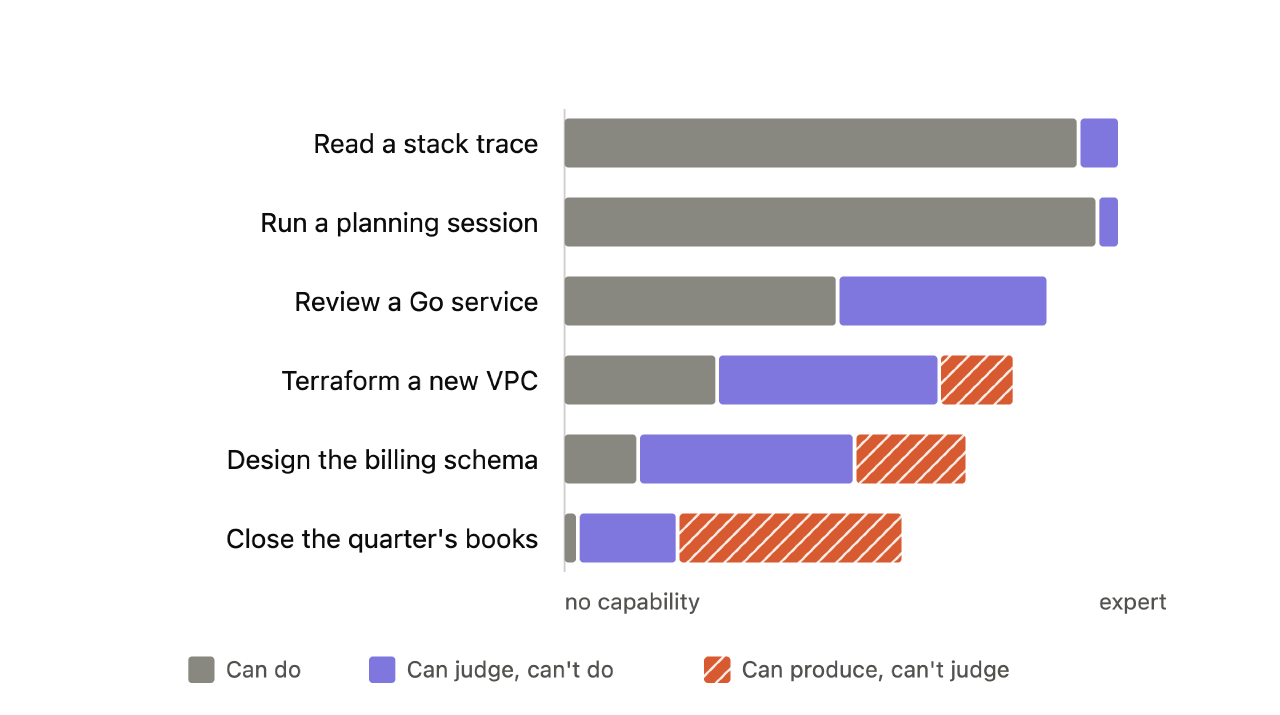
<p>You&rsquo;re good at a few tasks and bad at nearly everything else. Rank yourself across every task your company performs, and your proficiency falls off a cliff. I can run a planning conversation, and I can usually tell you why a team is stuck. I can&rsquo;t design our billing schema, produce a Figma file anyone would want to look at, or close the books for a quarter.</p>
<p>Now take a second measure: how well you can judge the output of a task rather than perform it. That one falls off much more slowly. I haven&rsquo;t written production code in our main repository in years, and I can still tell when a design doc is dodging its own hard question or when someone&rsquo;s confidence about a migration isn&rsquo;t supported by anything that has ever happened here.</p>
<p>The reason I can do that has nothing to do with being clever. I have sat through the postmortem for the version of that migration that went badly twice at two different companies. Judging is memory and memory is experience.</p>
<p><img
    src="/cost-of-objection/capability-bands-stacked-by-task-2_hu_b7c6ae8740d13e60.png"
    srcset="/cost-of-objection/capability-bands-stacked-by-task-2_hu_deef44abb5f52cae.webp 640w, /cost-of-objection/capability-bands-stacked-by-task-2_hu_839fb0549e4d199f.webp 960w, /cost-of-objection/capability-bands-stacked-by-task-2_hu_bcee9676dc314c4b.webp 1280w"
    sizes="(min-width: 1024px) 896px, 100vw"
    alt="Performing vs judging"
    width="1280"
    height="715"
    loading="lazy"
    decoding="async"
  /></p>
<p>The band between the two, the work you can assess but not produce, is where management lives. A PM who can&rsquo;t write a line of Go will still catch that the error states are wrong and be right about it. None of that requires being able to do the work. It requires being able to see it.</p>
<p>Every org chart I&rsquo;ve ever drawn assumes that band exists and holds still.</p>
<p>Then an agent lifts what you can do across most of that range. Not to expert level anywhere, but to roughly competent on a great many tasks where you used to sit at zero, and over a wide stretch of them producing now runs ahead of assessing.</p>
<p>You know that part. It&rsquo;s been written a dozen times, and I don&rsquo;t have a better version of it.</p>
<p>What I have is what comes <em><strong>after</strong></em>.</p>
<h2 id="you-cant-locate-the-edge-of-your-own-judgement">You can&rsquo;t locate the edge of your own judgement</h2>
<p>The comforting response is that sensible people know their limits and ask for help. I believed some version of that for years. The research isn&rsquo;t kind to it.</p>
<p>Kahneman and Klein spent a long time disagreeing about expert intuition and then wrote <a href="https://pubmed.ncbi.nlm.nih.gov/19739881/?ref=leadership.garden" target="_blank" rel="noopener noreferrer">a joint paper in 2009</a> about where they&rsquo;d converged. Buried in it is something they call fractionation of skill: professionals with real expertise in some tasks get asked to make judgements in adjacent areas where they have none, and the boundary between the two is hard to see. Hard for the professional, and, they add almost in passing, hard for anyone watching. Nothing in the experience of making a judgement tells you which side of the line it came from.</p>
<p>That second half is the one that should bother you if you run performance reviews, because it means I cannot see my engineers&rsquo; boundaries either. I have been rating people on judgement for a decade using a method that amounts to noticing when they sound sure.</p>
<p>Most writing on this reaches for Dunning-Kruger about here. I&rsquo;d rather not, for two reasons.</p>
<p>The literature is genuinely contested and has been for twenty years. <a href="https://www.sciencedirect.com/science/article/abs/pii/S0160289620300271?ref=leadership.garden" target="_blank" rel="noopener noreferrer">Gignac and Zajenkowski</a> ran the analysis in 2020 using tests designed to rule out regression to the mean and failed to find the effect at all. Later work goes back and forth. The pattern replicates, the mechanism is disputed, and citing it as settled is exactly the sort of borrowed confidence this post is about.</p>
<p>It&rsquo;s also the wrong shape. Dunning-Kruger describes people at the bottom of a single domain. What I&rsquo;m describing is people who are genuinely excellent in one domain walking into another without noticing they crossed anything. The engineer who sent those nine comments is excellent at what he does. That was never the issue.</p>
<p>The part of the Kahneman and Klein paper I keep returning to is a smaller observation. <em><strong>Subjective confidence</strong></em>, they write, <em><strong>is driven by the internal consistency of the evidence a judgement rests on, rather than by the quality of that evidence</strong></em>. Evidence that&rsquo;s flimsy but internally coherent produces judgements held with far too much confidence, stated too assertively, and believed by others more than they deserve to be.</p>
<p>Read that again as a description of what comes out of a language model.</p>
<p>Coherence is the thing it&rsquo;s optimised for. Coherence is also the only instrument most of us have for gauging our own confidence. So the tool now produces, at industrial volume, exactly the input that defeats the gauge.</p>
<h2 id="your-judgement-isnt-fixed-it-shrinks">Your judgement isn&rsquo;t fixed. It shrinks.</h2>
<p>Here&rsquo;s the assumption I hadn&rsquo;t examined: that my judgement is a property of me, earned once, sitting there permanently.</p>
<p>Kahneman and Klein are specific about where skilled judgement comes from, and it takes two conditions. The environment has to be regular enough for valid cues to exist, and you need prolonged practice with feedback that arrives fast and unambiguously. Chess has both. Firefighting mostly has both. Long-range strategy has neither, which is why confident five-year forecasts from senior people are worth approximately nothing.</p>
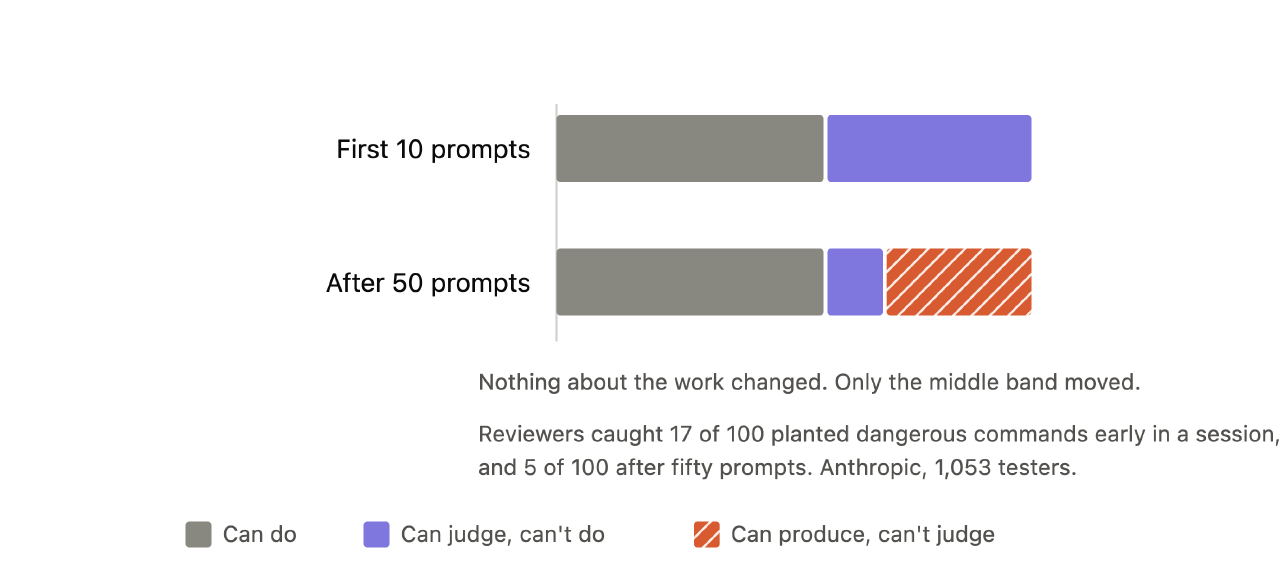
<p>Your ability to judge a code review was built by writing code and then finding out what happened (FAFO, in other words). The &lsquo;finding out&rsquo; is the part that did the work. <strong>Take it away, and the band narrows.</strong></p>
<p><strong>We now have a measurement of how fast, and it&rsquo;s worse than I expected.</strong></p>
<p>Anthropic <a href="https://www.anthropic.com/engineering/claude-code-auto-mode?ref=leadership.garden" target="_blank" rel="noopener noreferrer">ran a study</a> on 1,053 paid testers using Claude Code, swapping one ordinary permission prompt partway through each session for an obviously dangerous command. Human reviewers caught it 13.6 percent of the time, against 89 percent for the automated classifier. The number I care about is buried under those two: <em>human catch rates ran near 17 percent early in a session and fell to about 5 percent after fifty prompts, while the classifier held flat.</em></p>
<p>Fifty prompts is one afternoon.</p>
<p><img
    src="/cost-of-objection/judging-band-shrinks-within-a-session_hu_20d7c479b0019cbe.png"
    srcset="/cost-of-objection/judging-band-shrinks-within-a-session_hu_16d752ee0eb0aea7.webp 640w, /cost-of-objection/judging-band-shrinks-within-a-session_hu_3066c7f145a5d29a.webp 960w, /cost-of-objection/judging-band-shrinks-within-a-session_hu_4301bc3b8c453dbd.webp 1280w"
    sizes="(min-width: 1024px) 896px, 100vw"
    alt="Bar chart showing the &ldquo;can judge&rdquo; band shrinking and &ldquo;can produce, can"
    width="1280"
    height="579"
    loading="lazy"
    decoding="async"
  /></p>
<p>Treat it with the suspicion it deserves. This is vendor data supporting a vendor&rsquo;s product decision, and Anthropic has published two different figures for how often users approve prompts, 93 percent in one post and 97 percent in another, with no sample size disclosed for either. <em>I would rather have this study run by somebody with no product to ship</em>. Until then, the direction agrees with everything else available. <a href="https://www.sonarsource.com/blog/ai-coding-trust-gap/?ref=leadership.garden" target="_blank" rel="noopener noreferrer"><strong>Sonar surveyed</strong></a> <strong>over 1,100 developers and found 96 percent don&rsquo;t fully trust that AI-generated code is functionally correct, while only 48 percent always check it before committing</strong>. Thirty-eight percent said reviewing AI output takes more effort than reviewing a colleague&rsquo;s.</p>
<p>The reviewing costs more, we do it less, and we get worse at it the more of it we do.</p>
<h2 id="and-then-it-happens-to-other-peoples-work">And then it happens to other people&rsquo;s work</h2>
<p>Everything above is about judging your own output. The version that cost my engineer a day is second-order, and I think it&rsquo;s the more serious one.</p>
<p>The standard reassurance here is that people distrust machines, so a bot-sourced objection should land softer than a human one. <a href="https://escholarship.org/uc/item/9v38k9m6?ref=leadership.garden" target="_blank" rel="noopener noreferrer">Logg, Minson and Moore</a> tested that in 2019 across six experiments and found close to the opposite. Laypeople shifted their estimates further toward a piece of advice when they believed an algorithm produced it than when they believed a person did. Algorithm appreciation, they called it.</p>
<p>The detail I like best is that the researchers ran their own materials past a mailing list of judgement and decision-making academics, who predicted the opposite result. The people who study this for a living got the direction wrong.</p>
<p>The effect weakened in exactly one group: experienced professionals forecasting in their own field. Those people took less advice from anyone, and the paper is blunt that their accuracy suffered for it.</p>
<p>Sit with what that combination does to a room. The least qualified person&rsquo;s objection arrives pre-weighted because a machine produced it. The most qualified person is the one least likely to update on anything, including the occasional time the machine is right. As a distribution of who gets listened to, it&rsquo;s close to the worst one available.</p>
<p>Then there&rsquo;s volume, and the <a href="https://hbr.org/2025/09/ai-generated-workslop-is-destroying-productivity?ref=leadership.garden" target="_blank" rel="noopener noreferrer">workslop research</a> covers that well enough that I won&rsquo;t repeat it: 40 percent of people surveyed had received AI-generated filler in the previous month, costing them roughly two hours each. But that work is about output being dumped on colleagues, and critique is a worse object than output. You can ignore a bad document. A numbered list of objections against your design creates an obligation, and declining to answer it looks like you can&rsquo;t.</p>
<p>The cost of generating a plausible objection has gone to roughly zero. The cost of answering one hasn&rsquo;t moved at all. Anyone in the company can now open an unbounded line of credit against a specialist&rsquo;s week, and the specialist has no standing to refuse.</p>
<p>That asymmetry is what cost my engineer his day. The quality of the AI output barely mattered.</p>
<h2 id="what-im-actually-doing-about-it">What I&rsquo;m actually doing about it</h2>
<p>Eighteen months in, I&rsquo;m running experiments rather than reporting results. Some have earned their place.</p>
<h3 id="predict-then-look">Predict, then look</h3>
<p>The only way to find out where your judgement actually stops is to make a call and then learn whether it was right. So make the call in writing, before the answer is available.</p>
<p>Concretely, on my team: before you open the agent&rsquo;s review of your own diff, write down the two things you think it will flag. Before the incident review, write your one-line causal hypothesis. Before you read the vendor&rsquo;s benchmark, write the number you expect. Keep them in a file with dates on them.</p>
<p>Look at the file every few weeks. Your hit rate, split by domain, is your judgement rendered as data instead of as a feeling, and it&rsquo;s the only version of it you&rsquo;ll ever get, because subjective confidence is measuring the wrong thing.</p>
<p>The failures teach more than the hits. If you sit down to write the prediction and find you&rsquo;ve got nothing to write, you&rsquo;ve located the edge of your competence precisely in about fifteen seconds, without needing anyone&rsquo;s permission or a framework or a workshop. That blank line is the entire diagnostic.</p>
<p>There&rsquo;s a companion question I now ask before approving anything: what would have made me reject this? When I couldn&rsquo;t answer, what I did was processing rather than review. I&rsquo;ve been on the wrong side of that distinction plenty of times, usually on a Friday.</p>
<h3 id="calibrate-the-machine-before-trusting-it-as-a-judge">Calibrate the machine before trusting it as a judge</h3>
<p>Using AI to review AI is the obvious move, and it isn&rsquo;t automatically wrong. Look again at why Anthropic&rsquo;s classifier beat their humans. It&rsquo;s a different model from the one proposing the action; it evaluates a tool call it didn&rsquo;t generate, and it was measured against 1,053 planted known-bad commands. Independence and ground truth.</p>
<p>Most in-house AI reviews have neither. It&rsquo;s the same model family reading its own output, and nobody has ever checked whether it catches anything.</p>
<p>The failure mode there is not that the reviewer misses things. Researchers at Emory and Tokyo <a href="https://arxiv.org/pdf/2606.28438?ref=leadership.garden" target="_blank" rel="noopener noreferrer">watched code models</a> gate their own training data using their own confidence signals, and the gate slid into what they call a rubber-stamp regime: acceptance scores climbing while benchmark correctness fell. The reviewer got more satisfied as the work got worse. A metric that improves while the thing it measures degrades is the most expensive kind of instrument to own, and every team I know that has bolted AI review onto their pipeline is currently flying on one without having calibrated it.</p>
<p>The fix is cheap, and almost nobody does it. Once a month, hand your AI reviewer a diff with a known bug in it. Flip a comparison operator. Delete an authorisation check. See whether it says anything at all. If you&rsquo;ve never run that test, what you have isn&rsquo;t a reviewer; it&rsquo;s a reassurance generator. The same test works on your test suite, incidentally, and there it&rsquo;s called mutation testing.</p>
<h3 id="write-down-who-decides">Write down who decides</h3>
<p>This is the one I resisted longest because it sounds like the sort of process a company adds shortly before it loses the ability to ship anything.</p>
<p>For most of my career, the right to overrule someone was rationed by a friction nobody ever wrote down. You didn&rsquo;t challenge the database expert on index strategy because assembling a credible counter-argument would have cost you a week you didn&rsquo;t have. That friction was doing real organisational work. It allocated decision rights without anyone having to be explicit about them, and because it was invisible, nobody noticed it doing the job or thought to replace it.</p>
<p>It&rsquo;s gone. Ninety seconds now buys a credible-looking counter-argument on any topic in the company.</p>
<p>So the allocation has to become explicit, because the mechanism that used to handle it quietly has been removed. Who has the final call on schema changes, on what ships this quarter, on who carries the pager, and on when an incident is over? Written down, in the boring place where such things live.</p>
<p>And one rule attached to it, which is the part that actually helps: <strong>an AI-generated critique is an input to the owner, not a claim on the owner&rsquo;s time.</strong> The owner reads it and decides. No point-by-point rebuttal is owed to anyone, and silence on item seven is not a concession.</p>
<blockquote>
<p>That reads like bureaucracy. In practice, it&rsquo;s permission to not respond, which is currently the scarcest resource your specialists have.</p>
</blockquote>
<h2 id="the-strongest-objection">The strongest objection</h2>
<p>A tech lead I work with pushed back on all of this, and her version was sharp enough that I&rsquo;ve changed my mind about part of it.</p>
<p>Her argument: this is gatekeeping with better manners. Experts have always deflected challenges with &ldquo;you don&rsquo;t have the context,&rdquo; and a decent fraction of the time the challenge was right and the deflection was self-protection. AI has handed a voice to people who were locked out of technical conversations entirely. And now here&rsquo;s the head of engineering, explaining why their objections should be easier to dismiss.</p>
<p>She&rsquo;s right about the old system. I&rsquo;ve watched it work exactly the way she describes. A principal engineer once killed a proposal from a junior on my team by out-arguing her in a design review. He wasn&rsquo;t right. He was faster and had more standing, and she didn&rsquo;t have the vocabulary to defend a good instinct. I said nothing at the time. I&rsquo;ve thought about it a lot since.</p>
<p>The repair for that was never to make objections free, though. Free objections don&rsquo;t transfer power to the junior engineer with the good instinct. They transfer it to whoever has the most spare time to generate them, and in my experience that isn&rsquo;t the person with the sharpest read on the system. What she was actually asking for was that the decision-maker&rsquo;s reasoning be legible and their record visible. Both of those come from writing predictions down and comparing them to outcomes, which is where this started.</p>
<h2 id="where-this-leaves-me">Where this leaves me</h2>
<p>I don&rsquo;t have a number for how often I&rsquo;m right about work I couldn&rsquo;t do myself. Neither do you. Nobody has ever measured it, partly because until recently the question had no consequences and partly because the answer would be unflattering to a lot of people whose authority rests on the assumption.</p>
<p>Start measuring it on yourself. Write the prediction down before you look. You&rsquo;ll find the edge of what you can actually judge inside a month, which is considerably faster than thinking about it will ever get you there.</p>
<p>Then hold the same standard outward and stop accepting critique from people who have never checked where their own edge is. Including, on a bad week, me.</p>
]]></content><category term="ai"/><category term="judgment"/></entry><entry><title>You Get What You Reward</title><link href="https://leadership.garden/you-get-what-you-reward/"/><id>https://leadership.garden/you-get-what-you-reward/</id><published>2026-09-05T14:20:00Z</published><updated>2026-09-05T14:20:00Z</updated><author><name>Csaba Okrona</name></author><summary>Telling your team quality matters changes nothing. Here is what actually moves engineering culture, and the test for whether your fix is real.</summary><content type="html"><![CDATA[<p>You get the behavior you reward. Announcing the behavior you want does approximately nothing, and I say that as someone who has announced it several times.</p>
<p>Charlie Munger put it better in 1995: &ldquo;Show me the incentive, and I will show you the outcome.&rdquo; He was warning people about their advisors, and the line survives because it works anywhere people watch each other for signals about what counts. Engineering orgs are one of those places.</p>
<p>It matters most when you are trying to fix something in the culture.</p>
<h2 id="the-town-hall-does-not-work">The town hall does not work</h2>
<p>The instinct is to address the culture head-on. Quality matters. Slow down and do it right. Own your systems. You say it at an all-hands, then again in Slack, and then you write a doc on engineering standards and pin it in the channel. (I have written that doc. Twice.)</p>
<p>None of it moved anything, and not because anyone disagreed with me.</p>
<p>They agreed. They also knew who got promoted last cycle.</p>
<p>An engineer who stops caring about the fundamentals is usually behaving rationally. If product work is what gets seen, and seen work is what gets rated, then two weeks spent on a flaky test suite is two weeks spent invisible. Nobody sits down and decides to stop caring. They keep making the locally sensible choice over and over, and a year later you have a group of people who ship features quickly and cannot tell you how the system behaves under load.</p>
<p>Then somebody calls it a culture problem. Culture is where the problem shows up. Whatever is causing it sits one level down, in what the org actually rewards, and words aimed at the top layer never reach that far.</p>
<h2 id="what-you-actually-control">What you actually control</h2>
<p>Most writing on this ends at &ldquo;align the incentives,&rdquo; which in practice means redesign the ladder and the compensation plan. If you run a domain rather than a company, you usually own neither.</p>
<p>What you do own is attention. Attention is an incentive, and because it costs nothing on any budget line, leaders treat it as decoration.</p>
<p>So we started spotlighting deep engineering work the same way we spotlight product wins. Same demo slots, same all-hands, same language about impact, same audience. The main stage, not a side channel that eleven people have muted.</p>
<p>Once that path existed, people walked down it. That is the entire mechanism. There was never a shortage of engineers who wanted to do the harder, less visible work. There was a shortage of evidence that anyone would notice if they did.</p>
<h2 id="the-test-for-whether-the-path-is-real">The test for whether the path is real</h2>
<p>The fair objection, and I have heard versions of it from my own engineers, is that praise is cheap and everybody knows it. A shoutout costs me nothing. A promotion costs money and takes a slot away from somebody else.</p>
<p>That objection is correct, and it gives you the test.</p>
<p>Ask who was last promoted mainly for deep engineering work. If you cannot name the person, the second path is a rumor, and your team figured that out long before you did. Recognition with no promotion behind it is the same town hall with better staging.</p>
<h2 id="do-not-turn-it-into-a-metric">Do not turn it into a metric</h2>
<p>The next instinct is to measure the thing. Put tech health on the scorecard, count refactors, attach a number to reliability, and review it monthly.</p>
<p>Then Goodhart arrives, and you get the number without the work. Migrations get declared done at eighty percent. Coverage climbs while the new tests assert nothing in particular.</p>
<p><em>Keep recognition a judgment call</em>. Train your leaders/managers to recognize and celebrate. It is slower, it is harder to defend in a spreadsheet, and it is much more difficult to game, because a person has to look at the actual work and decide it was good.</p>
<h2 id="read-your-own-signals">Read your own signals</h2>
<p>If you do not like what you are seeing in your team, the answer is rarely in what you have been saying.</p>
<p>Look at your last three promotions and your last three demo slots, and read them the way your engineers read them. That list is your culture statement. Everything else is commentary.</p>
]]></content><category term="culture"/><category term="leadership"/></entry><entry><title>Specs Don't Drive Anything</title><link href="https://leadership.garden/spec-driven-delusion/"/><id>https://leadership.garden/spec-driven-delusion/</id><published>2026-08-29T12:45:00Z</published><updated>2026-08-29T12:45:00Z</updated><author><name>Csaba Okrona</name></author><summary>Spec-driven development's defenders describe a loop. Its diagrams draw a pipeline. An engineering leader on where the spec actually belongs.</summary><content type="html"><![CDATA[<p>One of my principal engineers sent me a link to <a href="https://github.com/github/spec-kit?ref=leadership.garden" target="_blank" rel="noopener noreferrer">spec-kit</a> with the message, &ldquo;Should we standardize on this?&rdquo; I said I&rsquo;d read it properly and get back to him. A few weeks later, <a href="https://www.linkedin.com/pulse/specification-driven-development-sdd-build-software-defining-omar-rskqf/?ref=leadership.garden" target="_blank" rel="noopener noreferrer">an article on Specification-Driven Development</a> came through my feed, and I read the whole thing, waiting to disagree with something.</p>
<p>Mostly I didn&rsquo;t. Write down what you want before you build it. Review it with product and engineering in the same room. Keep it in version control. Turn acceptance criteria into automated tests. All fine, and all roughly what a careful team already does on a good week.</p>
<p>Then I looked at the diagram again. Specification at the top, four arrows down from it: implementation, testing, validation, and maintenance. The spec governs all four.</p>
<p>That is where the word &ldquo;driven&rdquo; is doing work nobody has audited.</p>
<p>If you run an engineering org, someone is going to ask you this quarter whether you&rsquo;re &ldquo;doing SDD.&rdquo; This is what I told my principal engineer, eventually. Part of it is a practice I use every week and would defend to anyone. The rest is a positioning claim in a methodology costume, and telling them apart is worth an afternoon of your attention.</p>
<h2 id="the-defenders-describe-something-the-diagrams-do-not-show">The defenders describe something the diagrams do not show</h2>
<p>Start with the strongest version, because the weak version is easy, and I don&rsquo;t want to spend a post beating up a LinkedIn article.</p>
<p>Marc Brooker works on Kiro at AWS and has written <a href="https://brooker.co.za/blog/2026/04/09/waterfall-vs-spec.html?ref=leadership.garden" target="_blank" rel="noopener noreferrer">the best defence of SDD I&rsquo;ve read</a>. His line is that specs aren&rsquo;t about pulling designs up-front; they&rsquo;re about &ldquo;pulling designs up&rdquo;. You raise the level of abstraction from code to words, keep the artifact versioned and alive, and iterate on the spec rather than on the implementation. He&rsquo;s right, and the sentence I&rsquo;d underline in his piece is that you shouldn&rsquo;t develop the whole specification upfront. Hold onto that one. It&rsquo;s a concession the tools he&rsquo;s defending have not made.</p>
<p>Birgitta Böckeler at Thoughtworks did <a href="https://martinfowler.com/articles/exploring-gen-ai/sdd-3-tools.html?ref=leadership.garden" target="_blank" rel="noopener noreferrer">the most careful hands-on evaluation I know of</a>, and the useful thing she produced is a ladder. Spec-first: write it, use it, throw it away. Spec-anchored: it survives the change and evolves with the feature. Spec-as-source: a human never touches the code at all. I&rsquo;d take the first rung happily, the second with a named maintainer, and the third not at all, for reasons I&rsquo;ll get to. Note that almost everything marketed as SDD is sitting on rung one while quoting the brochure for rung three.</p>
<p>Yuval Yeret adds <a href="https://yuvalyeret.com/blog/spec-driven-development-isnt-waterfall-unless-youre-using-it-that-way/?ref=leadership.garden" target="_blank" rel="noopener noreferrer">the sharpest diagnosis</a>. The spec is a target for an adaptive loop, and the failure mode isn&rsquo;t sequencing; it&rsquo;s batch size.</p>
<p>Every one of those defenses describes a loop.</p>
<p>Now go look at any SDD marketing diagram. Specify, plan, tasks, implement. One direction, and no arrow comes back.</p>
<p><img
    src="/spec-driven-delusion/sdd-loop_hu_f9a965260600400f.png"
    srcset="/spec-driven-delusion/sdd-loop_hu_b123819ab75f6845.webp 640w, /spec-driven-delusion/sdd-loop_hu_12be0ef5f2c093c5.webp 960w, /spec-driven-delusion/sdd-loop_hu_fe91d55944f43939.webp 1280w"
    sizes="(min-width: 1024px) 896px, 100vw"
    alt=""
    width="1280"
    height="904"
    loading="lazy"
    decoding="async"
  /></p>
<p>The people who understand this best describe a cycle, and the thing being sold draws a pipeline. That gap is the subject of this post, and better diagrams would not close it, because the pipeline is not a bad drawing of the practice. It&rsquo;s an accurate drawing of the claim.</p>
<p>Böckeler has the right word for what&rsquo;s happening to the term: it is already <a href="https://martinfowler.com/bliki/SemanticDiffusion.html?ref=leadership.garden" target="_blank" rel="noopener noreferrer">semantically diffused</a>, Fowler&rsquo;s name for a phrase that spreads faster than its meaning. Thoughtworks&rsquo; own <a href="https://www.thoughtworks.com/en-us/radar?ref=leadership.garden" target="_blank" rel="noopener noreferrer">Technology Radar</a> now cites spec-driven development as a live example and says the hard part is telling a real methodology apart from ordinary use of a coding assistant. When the people who coined the vocabulary can&rsquo;t draw that line, you should be slow to reorganize around it.</p>
<h2 id="what-driven-is-smuggling">What &ldquo;driven&rdquo; is smuggling</h2>
<p>Every &ldquo;X-driven development&rdquo; name makes the same kind of assertion. When two artifacts disagree, X wins.</p>
<p>Test-driven development gets away with it because the test lives inside the loop. It&rsquo;s written minutes before the code; it fails first, and when it turns out to be wrong, you delete it without ceremony. Nobody escalates a deleted test. It never accumulates enough authority to be worth defending.</p>
<p>A specification does. It has been reviewed by product and engineering; it sits in the repo, and somebody&rsquo;s name is on it.</p>
<p>So here&rsquo;s the question I&rsquo;d put to any team proposing this before the tooling conversation starts. When the running system and the spec disagree, which one is wrong?</p>
<p>Answer &ldquo;the code, we regenerate it&rdquo; and you have a governing document, along with every failure mode of the last fifty years of upstream-artifact processes. Answer &ldquo;usually the spec, we go update it&rdquo; and the spec isn&rsquo;t driving anything. It&rsquo;s documentation. Useful documentation is a fine thing to want, and most orgs are bad at it. But then there&rsquo;s no methodology here, just a practice with an overclaiming name.</p>
<p>The best-practice list in that article gives the game away, and I don&rsquo;t think its author noticed. Write specifications before implementation, says one bullet. Update specifications whenever requirements change, says another, two lines later. Both are reasonable advice. Together they concede that requirements will change after the spec is written, which is the fact the opening paragraph treats as a pathology to be engineered away.</p>
<p>If the spec has to chase reality, reality is the source of truth.</p>
<h2 id="the-spec-doesnt-govern-the-agent-either">The spec doesn&rsquo;t govern the agent either</h2>
<p>There&rsquo;s a second problem with &ldquo;source of truth,&rdquo; and this one isn&rsquo;t philosophical.</p>
<p>A compiler is bound by its input. An LLM is not.</p>
<p>Böckeler ran spec-kit on a feature that built on existing code, and the tool did a research step that documented the classes already in the codebase. The agent then read those descriptions as new requirements and generated all of it again as duplicates. She saw the opposite failure too, where the agent followed one article of the constitution so eagerly that it went well past what anyone wanted. Bigger context windows have not fixed this, because putting something in the context is not the same as the model acting on it.</p>
<p>So the spec&rsquo;s authority over the implementation is <strong>a probability, not a guarantee</strong>, and it decays as the document grows.</p>
<p>Thoughtworks put spec-driven development in the Assess ring of the <a href="https://www.thoughtworks.com/en-us/radar/techniques/spec-driven-development?ref=leadership.garden" target="_blank" rel="noopener noreferrer">Technology Radar</a> in November 2025, which is roughly &ldquo;interesting, go look at it.&rdquo; What they wrote in the same entry is the part worth your time. The workflows are elaborate, the tools behave very differently depending on the size of the task, some of them produce spec files that are challenging to review, and when they generate PRDs or user stories, it isn&rsquo;t always clear who those are for. Then they land on the actual worry: we may be relearning the <a href="https://en.wikipedia.org/wiki/Bitter_lesson?ref=leadership.garden" target="_blank" rel="noopener noreferrer">bitter lesson</a>, that &ldquo;handcrafting detailed rules for AI ultimately doesn&rsquo;t scale.&rdquo;</p>
<p>That&rsquo;s the sentence I&rsquo;d put in front of anyone proposing an org-wide rollout. Not because it settles the question, but because the pattern it names has beaten every previous attempt to hand-author enough structure to make a model behave.</p>
<p>That matters more than it sounds, because it removes the one thing that would justify the ceremony. If the spec really did compile into the system, reviewing markdown instead of code would be a straight trade. It doesn&rsquo;t, so you review the spec and then review the code anyway to find out whether the spec was honored.</p>
<p>Böckeler reaches for the German word: <em><strong>Verschlimmbesserung</strong></em>. Making something worse in the attempt to make it better.</p>
<h2 id="verification-is-not-validation-and-only-one-of-them-has-an-owner">Verification is not validation, and only one of them has an owner</h2>
<p>The strongest practical claim for SDD is that acceptance criteria hand you tests almost for free. True, and worth having.</p>
<p>It&rsquo;s also verification. Does this software obey the rules we wrote down?</p>
<p>Validation is the other question. Were those the right rules? You can have complete automated coverage of a perfectly specified system that nobody wants, and every test in that suite will pass while the product fails.</p>
<p>The objection I get here is that the criteria came from a stakeholder, so checking them is validation by proxy. It isn&rsquo;t. A stakeholder signing off on a rule in February tells you what they believed in February about a system they had not used.</p>
<blockquote>
<p>That&rsquo;s a hypothesis with a signature on it, and treating a signature as evidence is how a good process turns into a bad one.</p>
</blockquote>
<p>Most of what&rsquo;s written about SDD uses those two words interchangeably, including the article I started with, which puts &ldquo;validation&rdquo; in its lifecycle diagram and then describes nothing but verification for three thousand words. Call that pedantry if you like. It&rsquo;s the difference between <strong>building the thing right and building the right thing</strong>, and we are blurring the one distinction the discipline most needs to keep sharp.</p>
<p>The reason it matters to you and not just to essayists is that only one of those questions has an owner.</p>
<p>Verification does. It has tests, a pipeline, a definition of done, a QA function or a testing guild, and someone whose approval blocks the merge. Validation usually has nobody. It&rsquo;s spread across a PM&rsquo;s judgment, a designer&rsquo;s instinct, and whether anyone remembered to look at the funnel three weeks after launch.</p>
<p>The most expensive quarter I&rsquo;ve been part of ended with a feature that passed everything. Every acceptance criterion met, every test green, a clean launch. Adoption in month two told us what nobody had asked in month zero, and we spent the following quarter unwinding it.</p>
<p>Adopt a vocabulary that calls verification &ldquo;validation&rdquo; and you get an organization that believes the second question is handled because the first one is green.</p>
<p>Take the example that article uses, chosen to demonstrate the method&rsquo;s strength. &ldquo;Users can upload files&rdquo; becomes a specification: 20 MB limit, PDF and PNG and JPG, virus scan before storage, reject encrypted files, store metadata, return a document ID, 30-second processing timeout. The article says this version leaves very little room for interpretation.</p>
<p><strong>It leaves enormous room</strong>. Why 20 MB? Does the customer with a 25 MB PDF get an error, or does a support engineer quietly raise their limit? When the virus scanner is unavailable, do we fail closed, fail open, or queue and retry? What happens at second 31? And what do we do in six weeks when sales finds out that half the pipeline wants to upload DOCX?</p>
<p>Someone defending the example will say a better analyst catches those with more effort. I don&rsquo;t think so. They&rsquo;re questions generated by contact with reality, and contemplation doesn&rsquo;t produce them in advance at any level of diligence.</p>
<blockquote>
<p>Precision about the wrong answers is not an improvement over vagueness about them. You don&rsquo;t escape that by specifying harder. You escape it by making the discovery cheap.</p>
</blockquote>
<h2 id="the-economics-moved-and-the-methodology-went-the-wrong-way">The economics moved, and the methodology went the wrong way</h2>
<p>Every development process is an answer to one question. What does it cost to be wrong?</p>
<p>Big Design Upfront™ made sense when it was invented, and it annoys me how often that gets treated as a joke. Compiler time was rationed. A change meant a rebuild, a test cycle, and a release train you caught or missed by weeks. Under those numbers, paying six people to argue in a room for a month was cheap insurance against paying two hundred to build the wrong thing. <strong>Correct arithmetic, wrong century</strong>.</p>
<p>AI broke that arithmetic, and not slightly.</p>
<p>An agent can produce a working version of a feature in an afternoon. So the cheapest way to find out whether a requirement is right is no longer to argue about it in a document with five reviewers. It&rsquo;s to build it, put it in front of somebody, and watch what they do with it. Prototypes are disposable now. <strong>Being wrong is truly cheap now, as long as you find out quickly.</strong></p>
<p>Look at what SDD does with that. It takes the first change in our field&rsquo;s history that makes feedback loops dramatically cheaper and spends the windfall on making the phase before any feedback exists longer and more ceremonial.</p>
<p>The observation underneath it is correct. Agents produce far better code from precise context than from vague prompts, and I run my own side projects this way and wouldn&rsquo;t go back. The right conclusion is that small specs are an excellent artifact inside a fast loop. Hypothesis, small spec, implementation, contact with reality, revised hypothesis. Not that the spec belongs upstream of the loop governing everything downstream, which is the one position fifty years of evidence warns against.</p>
<p>Brooker and Yeret would both broadly agree with that paragraph, which is exactly my point.</p>
<blockquote>
<p>The defensible version of this is iterative development with good context hygiene, and that is not what the word &ldquo;driven&rdquo; is claiming.</p>
</blockquote>
<h2 id="what-it-will-cost-your-org">What it will cost your org</h2>
<p>Start with review capacity, which is already your constraint whether or not you&rsquo;ve named it as one. Faros AI spent two years watching telemetry from 22,000 developers across more than 4,000 teams, and their <a href="https://www.faros.ai/research/ai-acceleration-whiplash?ref=leadership.garden" target="_blank" rel="noopener noreferrer">2026 report</a> is the least comfortable thing I&rsquo;ve read this year. Under heavy AI adoption, median review time rose fivefold. Bugs per developer went up 54%. The incidents-to-PR ratio more than tripled. And the number that should stop you: 31% more pull requests merged with no human review at all, because reviewers could not keep pace and something had to give.</p>
<p>Böckeler&rsquo;s account of spec-kit is that it produced a lot of markdown, repetitive with each other and with code that already existed. She&rsquo;d rather review code than review those files. When she pointed Kiro at one small bug, it generated four user stories and sixteen acceptance criteria.</p>
<p>If human attention on the way out is your bottleneck, adding a review stage on the way in doesn&rsquo;t help. It piles more work in front of the constraint. I&rsquo;ve watched a design-doc review stage do precisely this. Genuinely good documents, thoughtful comments, and a median time from ticket to first deploy that got worse every quarter for a year, because nobody asked what the new stage was supposed to be subtracting.</p>
<p><strong>Brownfield makes it worse, and brownfield is where you live.</strong> Almost every SDD tutorial builds an application from scratch, because that makes a clean tutorial, and Böckeler found the tools considerably more work to introduce into a codebase and product ecosystem that already exists.</p>
<p>Then there&rsquo;s the fact that spec review has no failing state. A code review can say, &ldquo;This doesn&rsquo;t work.&rdquo; You run it, it breaks, the argument is over. A spec review has taste, judgment, and whether the reviewer has the standing to push back on a document a PM wrote and a director already praised. In my experience, people approve specs. There&rsquo;s no principled ground to reject one; rejecting it means the feature slips, and everyone in the room can do that math.</p>
<p>The last cost is ownership. If PMs write the acceptance criteria that agents build against, you&rsquo;ve relocated a lot of technical judgment to people who don&rsquo;t carry the pager. Yeret thinks <a href="https://yuvalyeret.com/blog/is-spec-driven-development-a-step-forward-or-back-for-product-development/?ref=leadership.garden" target="_blank" rel="noopener noreferrer">expecting product managers to write the specs</a> makes very little sense, and I agree with him. That doesn&rsquo;t mean PMs stay out of it.</p>
<blockquote>
<p>It means the person accountable for the system being correct has to be the person whose judgment ends up in the artifact the agent obeys.</p>
</blockquote>
<h2 id="what-id-actually-do">What I&rsquo;d actually do</h2>
<p>I&rsquo;m not against writing things down. I write a spec before I let an agent touch anything nontrivial, and the output is better for it. The disagreement is about where the artifact sits, and that resolves into a handful of concrete choices.</p>
<ul>
<li><strong>Cap the spec by the thing it describes</strong>: one change, not one feature. If the spec takes longer to write and review than the change takes to build and try, you&rsquo;ve picked the wrong artifact for the work in front of you. That&rsquo;s a rule you can apply on a Tuesday without running a workshop about it.</li>
<li><strong>Measure</strong> <strong>time to first contradiction</strong>. Not cycle time, not spec coverage. How long from starting a piece of work to learning something that changes what you thought you were building. If that number lands in weeks, your spec is governing, whatever the diagram says, and if it lands in hours, then the spec is inside the loop, and you&rsquo;re fine. It&rsquo;s the only metric in this post I&rsquo;d put on a dashboard.</li>
<li><strong>Give validation a name.</strong> One person per initiative, accountable for the question &ldquo;Was this worth building,&rdquo; with the standing to answer no and kill it. A named individual, not a team or a pod or a triad, because shared accountability for that question has never once produced someone willing to say the word no in a room with a director in it. If you can&rsquo;t name them for your biggest current project, that&rsquo;s the finding, and you can stop reading here.</li>
<li><strong>Keep the spec after the change only if someone maintains it</strong>. Böckeler&rsquo;s spec-anchored level is genuinely valuable, and it&rsquo;s also a commitment. An abandoned spec is worse than no spec because it misleads the next engineer with confidence and a git history to back it up. If nobody owns it, delete it when the change ships and write a decision record instead.</li>
<li><strong>And stop saying &ldquo;driven&rdquo; internally</strong>. Say, &ldquo;We write a spec first.&rdquo; Four words longer, accurate, and it doesn&rsquo;t quietly assert that a document outranks a production system.</li>
</ul>
<h2 id="the-question-nobody-asked">The question nobody asked</h2>
<p>That article never asks the only question that matters in three thousand words. How much should we specify before building, and when do we stop specifying and start learning?</p>
<p>There&rsquo;s no general answer, which is the problem with selling this as a methodology. Payroll rules, tax logic, a protocol implementation: specify heavily, because <em>the what</em> is genuinely knowable in advance and feedback won&rsquo;t catch the mistakes in time. A new onboarding flow: specify almost nothing, ship something ugly on Thursday, watch what people do. Most of your work sits between those, and judging where is the job. It isn&rsquo;t delegable to a process, which is precisely why processes sell so well.</p>
<p>Royce drew the single-pass diagram in <a href="https://www.cs.huji.ac.il/w~feit/sem/se09/Waterfall.pdf?ref=leadership.garden" target="_blank" rel="noopener noreferrer">1970</a> and warned in the same paper that it invites failure because design flaws only surface through implementation. We took the diagram and left the warning. He had a better platform than I do, and it didn&rsquo;t stick for him either, so I&rsquo;m not expecting much.</p>
<p>Write the spec. Then keep it small enough that reality can overrule it.</p>
]]></content><category term="ai"/><category term="leadership"/></entry><entry><title>The Same Feature, Twice</title><link href="https://leadership.garden/same-feature-twice/"/><id>https://leadership.garden/same-feature-twice/</id><published>2026-08-22T15:41:00Z</published><updated>2026-08-22T15:41:00Z</updated><author><name>Csaba Okrona</name></author><summary>The same feature took a weekend on a laptop and a quarter in the product. The model was identical both times. Everything around it was not.</summary><content type="html"><![CDATA[<p>I watched the same feature get built twice this year.</p>
<p>The first build took a weekend. One engineer wanted to export the data behind a chart as a CSV, described it to an agent, got a working implementation back, and had it running on her laptop by Monday. She showed it around. Everyone agreed it was slightly absurd how fast that had been.</p>
<p>The second build was the same feature inside the actual product. It took most of a quarter.</p>
<p>Nothing in the second version was harder to write. The code was, if anything, duller. The model was equally good on both occasions, which means the difference had nothing to do with the model.</p>
<p>If you lead an engineering organization, somebody senior is going to ask you why the second number is not collapsing toward the first. You need a better answer than &ldquo;enterprise is complicated,&rdquo; because that answer sounds like an excuse and half the time it is one.</p>
<h2 id="the-claim-is-smaller-than-the-headline">The claim is smaller than the headline</h2>
<p>Every few weeks someone announces that coding is solved. If they mean that a clearly specified problem can be turned into working code with very little human effort, they are close to right and getting righter. I have stopped arguing with that part. Watching an agent produce a competent implementation of something I described in two sentences still lands somewhere between useful and unnerving.</p>
<p>But look at what got measured. A specified problem went in, and code came out. The specification was the input.</p>
<p>Somebody produced that specification. In the weekend version, it was the same person who wrote the prompt, in her head, in about four minutes, answerable to nobody. In the product version, it took eleven weeks and involved most of a department.</p>
<h2 id="what-actually-happened-to-the-csv-button">What actually happened to the CSV button</h2>
<p>The second build did not spend eleven weeks writing an exporter. It spent eleven weeks getting to the point where writing the exporter was a decision anyone could make.</p>
<p>An export already existed in an internal admin tool. It was built four years ago by a team that no longer exists in that shape, and it works, and nobody is sure what would break if it were reused.</p>
<p>Legal wanted to know whether this data was allowed to leave the product in a downloadable form at all. The answer lived in customer contracts, and the contracts did not agree with each other.</p>
<p>The service holding the data was not the service rendering the chart. The boundary between them was owned by a third team with a roadmap of their own and a strong opinion about what belonged on their side of it.</p>
<p>Then someone remembered that this had been shipped in 2023 and rolled back within a month. Nobody could produce the reason. Two people had two different stories, and both were plausible.</p>
<p>An agent could have written all four candidate implementations in an afternoon. What it could not do was tell anyone which one to write, and that was the entire eleven weeks.</p>
<p><img
    src="/same-feature-twice/four-layers-of-software-engineering-cost-2_hu_1c58b1131ecb249f.png"
    srcset="/same-feature-twice/four-layers-of-software-engineering-cost-2_hu_7aaeb61d0b69f898.webp 640w, /same-feature-twice/four-layers-of-software-engineering-cost-2_hu_9bb5b98b616274a8.webp 960w, /same-feature-twice/four-layers-of-software-engineering-cost-2_hu_c1863854006974b2.webp 1280w"
    sizes="(min-width: 1024px) 896px, 100vw"
    alt="Diagram of software development layers where Implementation cost has collapsed while higher-level design and business costs"
    width="1280"
    height="888"
    loading="lazy"
    decoding="async"
  /></p>
<h2 id="we-named-the-discipline-after-its-most-expensive-part">We named the discipline after its most expensive part</h2>
<p>For most of the history of this profession, producing the code was the slow step. Other steps were hard, but that one reliably dominated a schedule, so the discipline got named after it. We call ourselves software engineers and we mean, mostly, people who write software.</p>
<p>That naming was accurate for a long time and it is now doing damage, because when the expensive step gets cheap, the thing you named after it does not shrink. Everything else it was hiding becomes visible instead.</p>
<p>I keep seeing leaders read a productivity number, see that implementation got three times faster, and expect delivery to follow. Delivery moves a little. Then it stops. The tools did not fail. Implementation was never the whole cost, and the arrival of a cheap implementation is what makes that impossible to keep quiet about.</p>
<h2 id="four-layers-and-one-of-them-got-cheap">Four layers, and one of them got cheap</h2>
<p>Any change worth shipping has to survive four questions, and they do not all live in the same place.</p>
<p>At the bottom, how do we express this in code? Above it, how should the system produce that behavior, given what already exists? Above that, how should a person experience it? And underneath all of it, the one that decides whether the other three were worth answering: which problem are we solving, and for whom?</p>
<p>Models are becoming excellent at the bottom question. They are useful at the second one, if you tell them enough, but they usually can&rsquo;t make up for lacking judgment. They have opinions about the third that are worth roughly what an opinion from someone who has never met your users is worth.</p>
<p>The fourth question has not moved at all.</p>
<p>That is the shape of the thing. The layer that got automated is the layer that was always the most legible because it was the only one written down.</p>
<h2 id="context-is-everything-that-the-repository-does-not-contain">Context is everything that the repository does not contain</h2>
<p>What separated the weekend build from the product build was not talent, and it was not tooling.</p>
<p>An organization knows things. Which abstractions are load-bearing and which were abandoned in place? The domain language, including the two words that mean the same thing for a historical reason that annoys everyone. Which parts of the system are permitted to fail? Which single customer is the reason for that odd flag in the config? Whether a given architectural decision was a real choice or just something that happened while nobody was watching.</p>
<p>Almost none of that is in the repository. Some of it is in a wiki that was last accurate two directors and reorgs ago. Most of it is distributed across people, unevenly, and reassembled in meetings.</p>
<p>A startup grows this as it goes, which is why small companies feel so fast and why that feeling does not survive their first hundred engineers. An enterprise inherits decades of it from people who have left.</p>
<p>So asking a model to build something new is a fundamentally different request from asking it to change something old. The greenfield task has one specification. The brownfield task has one specification plus every decision the system has ever absorbed, and the second list is not written anywhere you can point at.</p>
<p>That is not a complaint about models. It is a description of what we have been asking senior engineers to hold in their heads, unpaid and unacknowledged, for their entire careers.</p>
<h2 id="what-i-would-actually-do-with-this">What I would actually do with this</h2>
<p>None of what follows is about tool selection.</p>
<p>Stop measuring adoption by output. Lines merged and pull requests opened tell you the bottom layer sped up, which you already knew. The number worth watching is how long a change waits between someone asking a question and someone being able to answer it. That gap is where your quarters are going. Measuring that gap is miserable, which is why almost nobody does it and why everyone reports merge counts instead.</p>
<p>Move your strongest people up a layer on purpose. This happens by accident anyway, and it happens badly. Your best engineer starts spending her week answering the questions the agents cannot answer, and because that work has no artifact, her next performance review is quieter than it should be. Make the move explicit. Say out loud that the job is now framing problems and adjudicating between plausible designs, and then evaluate her on that rather than on throughput; she is no longer producing.</p>
<p>Write down decisions instead of explanations. Documentation that describes what the code does has never had a shorter shelf life than it does now, since anyone can ask an agent that question and get a better answer than the wiki would have given. Documentation that records why a boundary is where it is, and what was rejected, is the only kind that still pays. Almost nobody writes it, because writing it means admitting a decision was made by a person who could have chosen otherwise.</p>
<h2 id="so-write-the-context-down">&ldquo;So write the context down&rdquo;</h2>
<p>The obvious objection, and I have had it put to me with some force by people who are better at this than I am, is that all of the above is a documentation problem wearing a philosophical hat. Put the conventions in a file the agents read. Record the boundaries. Solved.</p>
<p>Try it and watch what surfaces.</p>
<p>You sit down to write the rule about that service boundary, and you find there is no rule. There was a decision made in a hurry in 2022 by someone who has since left, which everyone has been treating as policy because it has survived. You go to record why the export was rolled back, and you get two accounts that cannot both be true. You try to write down which team owns the notification path, and you discover that the honest answer is a sentence with the word &ldquo;basically&rdquo; in it.</p>
<p>Writing it down is worth doing. An audit finds things, and that is the whole value of running one. What it is not is a weekend of technical writing, and anyone selling it that way has never tried to write the difficult page. The reason your context is undocumented is rarely that nobody got around to it. More often, documenting it requires somebody to decide something that has never actually been decided.</p>
<h2 id="every-layer-gets-its-turn">Every layer gets its turn</h2>
<p>There is a comfortable version of all this where the abstraction simply rises, the way it did when compilers took over machine code, and everyone moves up and gets on with their lives.</p>
<p>I would be careful with that story. Every previous step made the layer below genuinely invisible. Nobody reads compiler output. Nobody audits the assembly. This step has not done that, and might not for a while. The code is still yours, you still own it at three in the morning, and you still have to understand it well enough to know when the confident thing you were handed is wrong.</p>
<p>Which means the work above implementation did not get lighter. It got more crowded, and it got crowded faster than most organizations have adjusted their structure to handle.</p>
<h2 id="code-is-the-medium">Code is the medium</h2>
<p>Nobody has ever been paid to produce source code. They have been paid for what the code does once it is running, in front of people, inside a business that needed something to change.</p>
<p>We forgot that for a couple of decades because producing the code was hard enough to feel like the point. Code was never the point. Code was the expensive part, and expense makes a convincing impostor.</p>
<p>So is coding solved? For turning a clear specification into working software, close enough that arguing about it is a waste of a good afternoon. The interesting shortage was never there. It was in the eleven weeks it took to earn a specification worth handing to anything, and no one has automated that yet.</p>
<p>Go and look at where your last quarter actually went. If the answer is not &ldquo;writing the code,&rdquo; and I do not think it will be, then you already know which part of the job to get better at.</p>
]]></content><category term="product"/><category term="ai"/><category term="leadership"/></entry><entry><title>How I Decide Whether to Split a Team</title><link href="https://leadership.garden/splitting-teams/"/><id>https://leadership.garden/splitting-teams/</id><published>2026-08-15T14:29:00Z</published><updated>2026-08-15T14:29:00Z</updated><author><name>Csaba Okrona</name></author><summary>Most advice on splitting teams answers "is this team too big?" That's the wrong question when you're splitting into a strategy.</summary><content type="html"><![CDATA[<p>The product vision landed with three strategic streams in it, each on a multi-year horizon. I had six engineers, two open reqs, and one lead I would trust with a team on a bad week. The team design workshop was already on the calendar for the following week.</p>
<p>Covering three streams with eight people was the obvious agenda. I threw it out. Two hours on that question produces an org chart nobody can staff, and everybody leaves the room feeling productive.</p>
<p>What follows is the sanitized version of what I ran instead. Four scenarios, one number that decided all of them, and a shape you can reuse next week if somebody has just handed you a strategy with more bets in it than you have people.</p>
<h2 id="the-published-advice-answers-a-different-question">The published advice answers a different question</h2>
<p>Almost everything written about splitting teams answers one question. Is this team too big?</p>
<p>Chase Seibert states the default position most cleanly, in a post whose title is the whole argument: <a href="https://chase-seibert.github.io/blog/2017/12/19/dont-split-the-team.html?ref=leadership.garden" target="_blank" rel="noopener noreferrer">don&rsquo;t split the team until you have to</a>. If communication is straining, a split adds cross-team meetings rather than removing them. If the team is thrashing between products, cut the number of products or funnel the backlog through one owner. If it is simply too large, move an engineer somewhere else. He is right, and I have used his argument on myself twice to talk myself out of a split I would have regretted.</p>
<p><a href="https://lethain.com/sizing-engineering-teams/?ref=leadership.garden" target="_blank" rel="noopener noreferrer">Will Larson</a> supplies the numbers everyone quotes. Six to eight in steady state. Grow a team to eight or ten, then bud it into two teams of four or five. Never create empty teams. His sharpest line is the one people skip past: teams under four are a leaky enough abstraction that they behave like individuals, and he says he has regretted sponsoring one every time.</p>
<p>Both of them are describing a split that happens backwards. Something hurts, and you relieve it.</p>
<p>Nothing hurt yet in my case. A strategy had arrived with three multi-year bets in it, and the workshop existed to decide which of them I could resource. Size heuristics have nothing to say about that, because size was not the symptom.</p>
<p>Larson does have an answer for my situation, and it is the strongest objection to everything below. In <a href="https://lethain.com/how-to-evolve-eng-org/?ref=leadership.garden" target="_blank" rel="noopener noreferrer">How to evolve an engineering organization</a> he takes my exact case: you need to focus on more projects than you have properly sized teams. He notes that this pulls people toward creating small teams. His answer is to add workstreams to a proper team instead. Two streams, one team of eight, one manager.</p>
<p>That is correct more often than anyone in my workshop wanted it to be, and it is why Scenario 0 below gets a real seat rather than a courtesy mention. Where it stops short is accountability. A workstream has an owner in the planning sense and nobody in the &ldquo;this is your mandate for the next three years&rdquo; sense. When the quarter gets tight, a workstream loses to the team&rsquo;s headline roadmap every time, because it sits inside that roadmap and losing to it is a Tuesday. A multi-year bet parked as somebody&rsquo;s second workstream is not being run. Deferring it quietly is worse than deferring it out loud, because nobody ever has to say the sentence.</p>
<h2 id="the-constraint-is-leads">The constraint is leads</h2>
<p>My arithmetic fit on one slide. Eight people. A stream needs roughly four engineers to survive on-call, vacation, illness, the person who eventually resigns, and the basic requirement that more than one human understands the code. Eight buys two solid streams, or one solid and one thin. It does not buy three. Three real teams is a twelve to fourteen person destination, twelve to twenty-four months out.</p>
<p>That was uncomfortable, and it was not the interesting number. The interesting number was one, which was how many proven leads I had (product and engineering).</p>
<p>Every new team is a lead decision before it is a headcount decision. You can hire an engineer in a quarter. You cannot hire a lead who already knows the domain, the codebase, and which of your engineers goes quiet when they are overloaded. Growing one internally takes two or three quarters of deliberate work.</p>
<p>So the earliest honest split date is set by lead readiness. Everything after that is scheduling.</p>
<p>Once I said that out loud, the workshop question changed. Instead of covering three streams, the room had to answer which two start now, who leads the second team, and what gets us to three. Same people, same two hours, and a question they could actually finish.</p>
<h2 id="what-lead-ready-actually-means">What lead-ready actually means</h2>
<p>I have promoted people into first-team roles on the strength of their technical judgement and watched it go badly. Technical judgement is table stakes. It predicts almost nothing about the first six months.</p>
<p>What I watch for now is narrower.</p>
<p>Can they hold a plan they did not write? A lead who can only execute their own design will quietly rewrite the roadmap into something they find more interesting, and you will not notice for a quarter.</p>
<p>Do they deliver bad news early? Someone who tells me in week two that the estimate is wrong is ready. Someone who tells me in week nine with a recovery plan attached is not, and the recovery plan is the tell. It means they spent seven weeks managing my perception instead of the problem.</p>
<p>Conflict is the one I get wrong most often. When two of their engineers disagree in front of everybody, watch for the lead who defers to seniority, or to whoever pushed hardest, and calls that consensus.</p>
<p>None of this shows up in a normal quarter, which is the awkward part of the whole exercise. The evidence you need arrives during the weeks you would rather nobody was having. So I stop waiting for those weeks and manufacture a smaller version. Hand the candidate a workstream with a real deadline and a genuine dependency on another team. Let them run planning, and stay out of the room. Let them own the escalation when the dependency slips. It will.</p>
<p>Two quarters of that tells me more than two years of strong code review.</p>
<p>You can also hire the lead, and sometimes you should. Just cost it honestly. An external lead needs two quarters to build the trust an internal candidate already has, and you are asking them to spend that ramp on a brand new team carrying a multi-year mandate. That is two unknowns multiplied together, and the multiplication is the part that hurts.</p>
<h2 id="the-rules-i-do-not-negotiate">The rules I do not negotiate</h2>
<p>Before any scenarios, the constraints I bring into every one of these rooms:</p>
<ul>
<li>One team, one area. A team can carry two workstreams if each is staffed to survive on its own. Never three.</li>
<li>Only form a team for work that will still exist in a year. Anything shorter is a project, and projects do not need an org chart.</li>
<li>Every team has a named lead on day one. Acting leads by accident are how you burn a good engineer while congratulating yourself on their growth.</li>
<li>Every new team gets at least one established engineer, ideally two. A team of new hires and good intentions ships nothing for six months.</li>
</ul>
<p>Those four did most of the filtering before I drew a single box.</p>
<h2 id="find-the-fault-line-before-you-write-scenarios">Find the fault line before you write scenarios</h2>
<p>Two of my three streams were the same kind of work. Operator-facing platform, shared substrate, overlapping users. The product doc had already proposed one designer across both, which told me the product side had reached the same conclusion without writing it down. The third was a specialised data play with different skills and a different failure mode.</p>
<p>If any team was ever going to carry two streams, it had to be those two, and never one of them paired with the data work. That single observation deleted about half the possible org charts before anybody started arguing.</p>
<p>Do this part before the workshop. Otherwise you spend two hours debating combinations that were never viable, and the debate feels rigorous while producing nothing.</p>
<h2 id="scenario-0-stay-one-team-sequence-the-streams">Scenario 0: stay one team, sequence the streams</h2>
<p>One team of six growing to eight, under the existing lead, working one stream at a time in priority order.</p>
<p>Maximum resilience, no lead gap, lowest risk. Two multi-year bets also sit untouched for years, which breaks focus at the strategy level instead of the team level. Nobody on the team feels that pain, which is exactly what makes it dangerous.</p>
<p>I put it on the table as a real option with a review date attached, and I would do that again. Most workshops treat &ldquo;not yet&rdquo; as a failure to decide, so it never gets named. The room then drifts toward a split it cannot staff, because the alternative was never given a seat. Naming it, with an expiry, turns avoidance into a choice.</p>
<h2 id="scenario-1-three-teams-now">Scenario 1: three teams now</h2>
<p>The org chart the vision implies. One team per stream, everything funded, everybody happy for about ten days.</p>
<p>This is the option everyone wants and nobody can staff. Three teams out of eight people means teams of two and three, which Larson would tell you behave like individuals, and which I would tell you are one resignation away from a stalled stream. Three teams also need three leads. I had one, and two of the three would have been running their first team on their first day of a multi-year mandate.</p>
<p>I put it on the slide anyway. Killing the seductive option with arithmetic in front of the room beats killing it privately and spending the next six months being told you never considered it.</p>
<h2 id="scenario-2-data-plus-platform-defer-the-third-stream">Scenario 2: data plus platform, defer the third stream</h2>
<p>Two teams of roughly four. The specialised stream and the foundation stream both start now. The most operations-facing stream waits.</p>
<p>This was my recommendation. It funds the visible part of the strategy and the platform work at the same time, and the deferred stream should genuinely be built on top of that platform rather than beside it. The skill split was clean too: backend-heavy on one side, full-stack on the other, nobody cut in half.</p>
<p>Both costs are real and I named them in the room rather than letting them surface later as surprises. I would be holding two quite different domains in my head, which degrades both. The deferred stream keeps hurting operations in the meantime, and the people living with that pain were sitting at the table while I said it.</p>
<h2 id="scenario-3-platform-plus-the-third-stream-defer-data">Scenario 3: platform plus the third stream, defer data</h2>
<p>Same two-team shape, different pairing. Both teams sit on the same substrate and share infrastructure, design and vocabulary.</p>
<p>Lowest context-switching cost of anything on the list, and it removes a technical dependency on another team&rsquo;s roadmap. What it delays is the most visible part of the strategy, which is a sponsor problem rather than an engineering one. (Sponsor problems have a way of becoming engineering problems about two quarters later.)</p>
<p>I ranked it second and said exactly what would move it to first. If the platform dependency the data stream needed had not been ready, this one flips instantly, because the alternative is a new team spending its first months blocked on somebody else&rsquo;s delivery date.</p>
<h2 id="the-menu-is-not-there-so-the-room-can-vote">The menu is not there so the room can vote</h2>
<p>Scenarios exist to force one sentence into the open. Here is the bet we are parking, and here is roughly when we come back to it.</p>
<p>If a team design session ends without that sentence, nothing was decided. You rearranged boxes, everybody kept believing their favourite stream is funded, and three months later a PM asks why nobody has started on their thing. Consensus, it turns out, is what a room produces when it is avoiding a decision.</p>
<p>Two questions could have flipped my recommendation, and I said so in the room rather than presenting the analysis as finished.</p>
<p>Who is actually lead-ready. That call is mine, it is the one I am most likely to get wrong, and it decides whether the split happens in three months or nine.</p>
<p>Which stream is genuinely funded as the priority. That one belongs to me and the product sponsor jointly. It is an argument about revenue narrative versus foundation, and engineering does not get to settle it alone.</p>
<h2 id="watch-where-the-bottleneck-lands">Watch where the bottleneck lands</h2>
<p>One thing I nearly missed, and Seibert had already written it down years ago. The product side had a single PM across the whole area.</p>
<p>Split engineering into two teams under one PM and the coordination cost relocates to that person&rsquo;s calendar. You have recreated the focus problem on the product side, where you have no headcount lever at all. Design has the same failure mode and usually gets noticed even later.</p>
<p>Seibert lists exactly this as a reason not to split. You would need another product owner and another designer, going without either is not ideal, and neither is splitting one person across two teams. Reading it back after the workshop, I think he treats that as a cost weighing against the split. I treat it as a precondition. The difference matters, because his version leaves the decision inside engineering, and mine forces a conversation with whoever owns product headcount before anything gets announced.</p>
<p>So I made team formation conditional on the product side matching it one to one, and I said that with the PM in the room rather than in a polite follow-up message afterwards. (Say it in writing later and you have not raised it. You have created a paper trail for the argument you are going to lose in November.) A split that only exists in the engineering org chart is a rename with extra meetings.</p>
<h2 id="before-you-draw-the-boxes">Before you draw the boxes</h2>
<p>Count your leads before you count your engineers. Find the fault line before you write scenarios, because half the debate you are dreading is about combinations that were never viable anyway.</p>
<p>And if the honest answer turns out to be Scenario 0, take Scenario 0 and set the review date. A holding pattern you chose on purpose beats a split you cannot staff, and your engineers can tell the difference long before you admit it to yourself.</p>
]]></content><category term="teams"/><category term="leadership"/><category term="management"/></entry><entry><title>A hard job attached to an easy idea</title><link href="https://leadership.garden/the-hardest-thing/"/><id>https://leadership.garden/the-hardest-thing/</id><published>2026-08-08T08:11:25Z</published><updated>2026-08-08T08:11:25Z</updated><author><name>Csaba Okrona</name></author><summary>Most engineering orgs run a hard job attached to an easy idea. How to tell the difference, and what to do about it.</summary><content type="html"><![CDATA[<p>A team of mine shipped clean for four months. Every sprint closed, nothing slipped, on-call stayed quiet. I wrote the update to my SVP with real pride.</p>
<p>Then somebody outside the domain asked what had changed for the business, and I did not have an answer worth saying out loud.</p>
<p>That team worked hard. They worked hard on something any competent team at any competent company could have worked hard on.</p>
<h2 id="the-test">The test</h2>
<p>Justin Jackson published a post in June called <a href="https://justinjackson.ca/hard-thing?ref=leadership.garden" target="_blank" rel="noopener noreferrer">Do the hardest thing</a>. His phrase for the mistake is a hard job attached to an easy idea. He opened a snowboard shop in 2003, worked harder than he has at almost any time since, and closed it in debt by 2006. Inventory, theft, scheduling, stock turnover. All of the difficulty lived in the operating, and anyone could have had the idea. Plenty did.</p>
<p>He is writing for founders. The distinction transfers to anyone running an engineering org, and I think it bites harder here, because we have built an operating culture that can only see the job.</p>
<p>The test I use now: if I disappeared for six months, would the difficulty go away?</p>
<p><em>Hard-job</em> difficulty is made of my effort and my team&rsquo;s. Pull us out and it evaporates, because a replacement drops in and grinds the same grind. <em>Hard-problem</em> difficulty belongs to the problem. It survives reorgs and roadmap changes and both the managers who owned it leaving, and it is still sitting there when you get back.</p>
<h2 id="we-measure-the-job">We measure the job</h2>
<p>Sprint commitments, cycle time, DORA, the weekly delivery update. All of it answers one question: are these people working, and are they working in an orderly way?</p>
<p>Nothing in that stack asks whether the work was worth choosing.</p>
<p>(I have written a performance review praising someone for a heroic quarter on a project I now think should have been killed in week two. The review was accurate. That is the part that bothers me.)</p>
<p>Will Larson&rsquo;s <a href="https://lethain.com/work-on-what-matters/?ref=leadership.garden" target="_blank" rel="noopener noreferrer">Work on what matters</a> is the standard reference here, and it is good, but it aims at your calendar. Hunter Walk&rsquo;s <a href="https://www.intercom.com/blog/first-rule-prioritization-no-snacking/?ref=leadership.garden" target="_blank" rel="noopener noreferrer">snacking</a>, the easy low-impact work that feels productive when you are busy, describes how you spend your own hours. At forty-five people my hours are a rounding error. The portfolio that counts is what forty-five people are pointed at, and an org can run a well-instrumented grind at high morale on a problem nobody ever chose on purpose.</p>
<h2 id="your-hardest-problem-is-not-technical">Your hardest problem is not technical</h2>
<p>Ask an engineering leader at a scale-up to name the hardest problem in their org and most will reach for something technical. The monolith. The vendor migration. The test suite that fails twice a week.</p>
<p>Those are <em>hard jobs</em>. Well understood, well documented, and a few hundred teams have already done them. You can hire someone who has done it before, which is close to a definition of a job.</p>
<p>The problems that actually resist look more like this:</p>
<ul>
<li>A team that made sense two reorgs ago and now exists because dissolving it would embarrass the person who built it.</li>
<li>The senior engineer everyone routes around, whose net output has been negative for a year, who is well liked.</li>
<li>Two domains with a dependency that both leaders have agreed not to raise, because raising it means somebody loses headcount.</li>
<li>A product surface nobody owns that generates a third of your support load.</li>
</ul>
<p>Notice you did not have to go looking. You knew which one was yours before you finished the list.</p>
<p><a href="https://mostlytechnical.com/episodes/133-do-the-hardest-thing-with-jesse-hanley?ref=leadership.garden" target="_blank" rel="noopener noreferrer">Jesse Hanley</a>, quoted in Justin&rsquo;s post, says hard things attract little competition because most people do not want to do them. Inside a company that holds even more strongly, for a specific reason.</p>
<blockquote>
<p>The cost of touching an org&rsquo;s hard problem lands on whoever touches it, and the benefit spreads across everyone. So it sits there, year after year, getting more valuable to whoever finally picks it up.</p>
</blockquote>
<h2 id="you-do-not-get-to-just-pick-it">You do not get to just pick it</h2>
<p>This is where founder advice stops being portable, and where most attempts to translate it fall over.</p>
<p>Justin can decide to build podcast hosting. Nobody has to approve it. <em>I cannot decide that my domain spends two quarters unwinding a team that reports to a peer.</em></p>
<p>So the real work sits one level above the problem. You have to buy the right to own it, and I have never seen anyone name that as work, which is strange, because for most Heads/Directors of Engineering <strong>it is the work</strong>.</p>
<p>Say it out loud, early, in a room with the person who could kill it. These problems survive on being discussed in pairs, in kitchens, after the meeting ends. Naming it in front of leadership costs you something and permanently changes its status. <em>It becomes a thing that was said.</em></p>
<p>Turn it into a bet with a date and a number. &ldquo;Operator onboarding is bad&rdquo; gets nodded at and forgotten. &ldquo;We take time to first value from eleven days to three by the end of Q3&rdquo; gets argued with, which is what you want. The argument is how you find out who is actually opposed, and it is rarely who you expected.</p>
<p>Give something up in public. Nobody believes you are serious until they watch you stop doing something else to make room. It is also the fastest way to learn whether your leadership agrees with you or was just being polite.</p>
<p>Get one executive <em>on the hook</em> for the downside. <em>Approval is not the same thing</em>. I mean somebody senior whose name is attached to the failure case, because on your own you are a person with an opinion who might not be here next year, and everyone in the room knows it.</p>
<h2 id="where-this-gets-people-hurt">Where this gets people hurt</h2>
<p>Hanley spent seven years on <a href="https://bentonow.com/?ref=leadership.garden" target="_blank" rel="noopener noreferrer">Bento</a> before it paid off. He could afford to, because he owned it.</p>
<p>You have a performance cycle. Maybe eighteen months of runway with your current VP, less if they leave. Commit your org to a hard problem that does not resolve inside that window and you carry the cost while your successor collects the return. That asymmetry is real, and I am not going to pretend otherwise for the sake of a cleaner argument.</p>
<p>So pick hard problems that pay out in visible pieces. A bet that returns nothing until month twenty belongs to a founder. And <em>accept that some hard problems are not worth your career</em>. (I have walked past one I still think about. I would walk past it again.)</p>
<p>Walking past one is still a choice. What I am arguing against is the drift: falling into a hard job by default and then reading the exhaustion as evidence that you picked the right thing.</p>
<h2 id="ask-who-else-could-do-it">Ask who else could do it</h2>
<p>Look at what your org is grinding on this quarter and ask who else could grind on it. If the answer is any competent team anywhere, you are running a hard job. It will still be difficult, and it will still tire everyone out. It just will not be worth much.</p>
<p>You already know what the hard problem is. Everyone does. The question is whether you will be the one who says it in a room where saying it costs you something.</p>
]]></content><category term="leadership"/></entry><entry><title>Why Organizations Defend Failing Decisions</title><link href="https://leadership.garden/failing-decisions/"/><id>https://leadership.garden/failing-decisions/</id><published>2026-08-05T12:14:00Z</published><updated>2026-08-05T12:14:00Z</updated><author><name>Csaba Okrona</name></author><summary>Why do organizations defend failing decisions? Learn how to record assumptions, set review triggers, and change course without turning to blame.</summary><content type="html"><![CDATA[<p>I was sitting in a quarterly review when an engineering director looked at a slide saying a migration was 72 percent complete and asked, &ldquo;Which of the assumptions behind this are still true?&rdquo; We had spent eighteen months moving a large product to a new platform. At the time, the decision rested on a coming end-of-support date, a plan to double the engineering group, and a customer certification that appeared to require capabilities only the new platform provided.</p>
<p>By the day of the review, the vendor had extended support, hiring had stopped, and the certification team had found another route six months earlier. The program still had fourteen people assigned to it and a green status on the portfolio dashboard. Once the question was out in the room, however, the discussion moved away from customers and technology. We talked about the work already completed, what we had told the board, and how cancellation might land with the teams. One executive said that changing course would damage our credibility, and I wrote the sentence in the margin because it explained the meeting better than the slide did.</p>
<p>If you lead engineering, product, or a company, you will eventually inherit a decision like this. It may concern a platform migration, a reorganization, an acquisition, a pricing model, or a product that has never found a market. In each case, the original reasoning has weakened while the work created by the decision has become a substantial fact of organizational life. Asking whether the choice still makes sense can then sound less like routine management and more like an accusation.</p>
<h2 id="decisions-become-part-of-the-organization">Decisions become part of the organization</h2>
<p>A decision starts as a choice among alternatives, but it quickly produces consequences that are harder to move. Budgets shift, teams form, contracts get signed, and roadmaps absorb dependencies. Someone may get promoted for leading the work while another group is asked to wait because the organization has committed elsewhere. Within a few quarters, the choice has become part of the structure surrounding it, with employees and commercial obligations that remain even if the original argument weakens.</p>
<p>The reasoning rarely survives that process intact. A decision document may record what was approved and who approved it, followed by a few broad paragraphs about benefits, risks, and strategic fit. &ldquo;Improves scalability&rdquo; tells a future reader almost nothing about the scale problem that mattered, the growth forecast used, or the evidence that would have disproved it. People who join later therefore learn the decision as a settled fact: we are moving to the new platform, centralizing this function, or building for enterprise customers. They inherit an implementation plan without the uncertainty that surrounded the original choice.</p>
<p>That lost uncertainty matters because markets, regulations, customer preferences, and internal constraints continue to change. A decision that made sense two years ago may have little value now without having been foolish at the time. Leaders often feel pushed toward defending it because the apparent alternative is to confess a mistake, which is both inaccurate and personally costly when the old reasoning was sound. They may be right about the quality of the decision they made and still be wrong to keep funding it today.</p>
<h2 id="why-organizations-keep-going">Why organizations keep going</h2>
<p>The usual diagnosis is the sunk cost fallacy: we continue because we have already spent the money, time, and political capital. Barry Staw&rsquo;s work on escalation of commitment showed that people often increase their support after receiving negative feedback, especially when they were responsible for the initial choice. Self-justification, loss aversion, confirmation bias, and the urge to complete what we started all contribute. Inside an organization, however, persistence can also look like evidence that a leader is steady and dependable, which gives people another reason to prefer it.</p>
<p><a href="https://thedecisionlab.com/biases/commitment-bias?ref=leadership.garden" target="_blank" rel="noopener noreferrer">The Decision Lab</a> describes research in which participants trusted CEOs more when those CEOs kept funding product development after learning that a competitor had a better product. I understand why. Nobody wants a leader who rewrites strategy every time a metric dips, and most worthwhile efforts pass through periods when the evidence looks bad. The difficulty is that organizations are poor at distinguishing steadiness from attachment, particularly once the person interpreting the evidence also sponsored the original choice.</p>
<p>A public decision changes the social cost of information. Before approval, a troubling fact helps the group choose well. After approval, it can threaten the sponsor&rsquo;s judgment and undermine months of work by the team. People notice the difference, so status updates start to emphasize progress while risks become matters of execution. Another quarter, feature, customer segment, or enablement effort may be defensible on its own, but a series of those small extensions can convert evidence against the decision into a recurring request for more investment.</p>
<p>Stopping also creates costs that are immediate and easy to name: a write-off, a revised roadmap, a difficult board conversation, and a team that needs new work. The costs of continuing arrive gradually through missed opportunities, delayed hiring, added operational work, and capable people spending another year on a problem whose value has fallen. We rarely account for the product that was never built or the customer problem that waited because the team was occupied elsewhere. The leader proposing a stop must therefore own a visible disruption now, while the leader proposing continuation can spread the cost across several teams and future quarters.</p>
<p>Ordinary execution reporting reinforces the imbalance. Portfolio reviews tend to ask whether a program is on schedule, within budget, and delivering milestones, which tells you whether the team is carrying out the plan but says little about whether the plan remains worthwhile. A migration can hit every milestone after the vendor risk that justified it has vanished. A sales team can complete its hiring plan while acquisition costs ruin the business case. A reorganization can move every employee into the intended box even though it never resolves the ownership problem behind the change.</p>
<p>Freek Vermeulen and Niro Sivanathan describe this as escalation of commitment to a once successful strategy. Their <a href="https://hbr.org/2017/11/stop-doubling-down-on-your-failing-strategy?ref=leadership.garden" target="_blank" rel="noopener noreferrer">HBR article</a> uses HMV, whose store model had produced years of success before the market moved online. That history made contrary evidence easier to dismiss because leaders could point to a long period in which the same judgment had been correct. I have made a smaller version of this mistake myself by pushing a team harder because I trusted a pattern that worked in another company, at another scale, for a different customer. The team executed well, but my assumption did not travel with me, and extra effort merely made the mismatch more expensive.</p>
<h2 id="record-what-must-remain-true">Record what must remain true</h2>
<p>Most decision records tell us what was approved, who owns the work, and what happens next. They are much less likely to state what must remain true for the decision to keep its authority, even though that is the part a later team will need when circumstances change. Adding the question forces broad claims into a form that people can examine. &ldquo;We need a new platform for scale,&rdquo; for example, becomes &ldquo;The current platform will exceed its tested transaction limit within eighteen months, based on the approved growth forecast.&rdquo; An enterprise strategy can specify how many qualified prospects must accept the proposed security model and price. The language is less polished, but a future reader can see what evidence supported the choice.</p>
<p>Mark Hollingworth&rsquo;s <a href="https://iveybusinessjournal.com/revisiting-strategic-assumptions/?ref=leadership.garden" target="_blank" rel="noopener noreferrer">article on revisiting strategic assumptions</a> describes field research in which startups identified hypotheses, selected evidence thresholds, and changed course when the thresholds were not met. One company continued with its proposed business model only if four customer assumptions held, while another changed its target customer and its vehicle after testing exposed weaknesses in the original idea. The founders remained committed to building their companies. What changed was the precision with which they decided whether a particular model deserved more time.</p>
<p>I now want six things in a decision record:</p>
<ol>
<li>The outcome we want, stated in terms a customer or operator would recognize.</li>
<li>The assumptions that connect the decision to that outcome.</li>
<li>The evidence available when we made the choice.</li>
<li>The signals that would require us to review it.</li>
<li>The expected cost of continuing, changing, or stopping.</li>
<li>The person who can call for a review, especially if the original sponsor disagrees.</li>
</ol>
<p>This takes more effort than writing &ldquo;approved&rdquo; in a meeting note, although considerably less than funding obsolete work for several years. The record does not need to pretend that every uncertainty can be reduced to a clean metric. A qualitative assumption can be useful if people can describe the evidence that would weaken it. &ldquo;Customers will tolerate the migration&rdquo; is too vague, while &ldquo;our ten largest customers will accept one scheduled outage and no more than two required integration changes&rdquo; gives a team something it can investigate before memory reshapes the original reasoning.</p>
<h2 id="review-current-evidence-without-retrying-the-past">Review current evidence without retrying the past</h2>
<p>Asking &ldquo;Was this a bad decision?&rdquo; is a poor way to open a review because the meeting immediately becomes a trial of the original participants. People reconstruct old information, defend their intentions, and debate whether somebody should have predicted an event that looked unlikely at the time. A more useful sequence begins with the intended outcome, then examines each original assumption against current evidence before comparing the options available now.</p>
<p>This separates the quality of the old reasoning from the present value of the choice. A decision may have been sensible then and sensible now, sensible then but weak now, or poorly reasoned from the start and either lucky or costly in its results. The current evidence should determine what happens next, while the quality of the original process belongs in a later learning review. Keeping those conversations apart makes accountability more accurate because leaders can still answer for hidden risks and ignored evidence without being punished whenever a reasonable forecast fails. If every change of course requires a confession, most leaders will wait until the evidence becomes overwhelming.</p>
<p>Isabelle Royer, writing about <a href="https://hbr.org/2003/02/why-bad-projects-are-so-hard-to-kill?ref=leadership.garden" target="_blank" rel="noopener noreferrer">projects that organizations could not kill</a>, argued for an &ldquo;exit champion&rdquo; with enough standing to assemble the case for stopping. The original sponsor should remain involved because that person usually knows more about the decision than anyone else, but sole ownership makes an impartial review unlikely. I have found that a second credible leader can provide enough independence to test the current case without reducing the discussion to criticism from someone who lacks context.</p>
<h2 id="decide-in-advance-what-will-trigger-a-review">Decide in advance what will trigger a review</h2>
<p>Scheduled reviews help, but a calendar alone is a blunt instrument because the passage of six months does not necessarily make a decision questionable. A material change in one of its supporting conditions does. <a href="https://knowledge.wharton.upenn.edu/article/its-not-you-its-your-goals-knowing-when-to-quit/?ref=leadership.garden" target="_blank" rel="noopener noreferrer">Annie Duke calls the more decisive versions of these conditions kill criteria</a>: signals chosen while judgment is relatively clear that will cause you to modify or abandon a goal. A review trigger can be gentler. It does not dictate the outcome, but it obliges somebody to gather current evidence and recommend whether to continue, change, or stop.</p>
<p>The useful triggers depend on the decision. A product team might reopen its plan when adoption falls below an agreed threshold or acquisition cost changes substantially. A technical program could use a shift in vendor support, traffic forecasts, regulatory requirements, or the relative cost of migration and continued operation. After a reorganization, unchanged decision time or work continuing across the same boundaries may reveal that the structure did not address the problem it was designed to solve.</p>
<p>I would give material decisions both a review date and a small number of evidence-based triggers rather than an automatic expiry. Automatic expiry invites churn and encourages teams to wait out a direction they dislike, while an optional review is easily skipped when it becomes uncomfortable. Reaching a date or trigger should produce a recorded choice. If no one acts, the old decision should not renew itself by default.</p>
<h2 id="make-the-cost-comparison-honest">Make the cost comparison honest</h2>
<p>When a review finally happens, teams often compare the immediate cost of stopping with the total value they once expected from finishing. That comparison favors continuation because it mixes money already spent with benefits that may never arrive. Past spending can teach you about the original estimate and process, but it cannot improve the return on the next dollar. The current comparison should include:</p>
<ul>
<li>the remaining cost and likely value of continuing</li>
<li>the switching cost and likely value of the best alternative</li>
<li>the operating cost of delay</li>
<li>obligations to customers, employees, and partners</li>
<li>what the organization could do with the people, time, and attention released</li>
</ul>
<p>Switching costs are real. Contracts have termination clauses, migrations leave systems in awkward intermediate states, teams lose momentum, and customers may have planned around a promise. A review that ignores those facts becomes an abstract lesson in rationality rather than a management decision. Sometimes continuing remains the best available choice because a change would now cost too much, but leaders should reach that conclusion by comparing future options from the present instead of asking past investment to justify another round.</p>
<p>Opportunity cost deserves similar care because an imagined alternative has no defects yet. When somebody says, &ldquo;We could use the team elsewhere,&rdquo; I ask for a named piece of work, an owner, and a plausible first ninety days. The alternative should face the same scrutiny as the program under review rather than benefiting from its lack of history.</p>
<h2 id="the-leader-sets-the-price-of-changing-course">The leader sets the price of changing course</h2>
<p>Every organization says it wants people to surface bad news, but employees learn what that means by watching the first person who tries. If a director brings evidence that an executive&rsquo;s decision has aged badly, the executive&rsquo;s first response sets the price of candor for everyone else. Asking why the risk was not found earlier may sound like due diligence, yet it often turns the messenger into the subject before the group has considered the evidence.</p>
<p>I try to begin with &ldquo;What changed?&rdquo; and &ldquo;What do you recommend now?&rdquo; The first question distinguishes changed conditions from blame, while the second makes the person raising the issue responsible for a better choice rather than giving them permission to criticize from the sidelines. When revising my own decisions, I prefer a plain account of what happened: &ldquo;I approved this based on the evidence we had. Two assumptions no longer hold, so I am reopening it.&rdquo; That sentence names the decision maker without forcing an apology unless one is actually due.</p>
<p>Some leaders worry that revisiting a choice makes them look indecisive, and frequent changes without clear criteria certainly do erode trust. Teams usually react differently when they can see that the evidence crossed a threshold set in advance. Engineers know when a migration no longer solves its stated problem, product managers notice when every customer conversation requires a new justification, and frontline managers can tell when a reorganization moved names without changing decisions. They may continue doing the work, but they will no longer believe the status report if leadership refuses to acknowledge what they see.</p>
<h2 id="a-review-needs-a-threshold">A review needs a threshold</h2>
<p>There is a corresponding risk in making every decision easy to reopen. Teams can spend months repeating old debates, treat ordinary execution difficulty as evidence that the choice was wrong, and pull senior leaders into matters that were already settled. New evidence should connect to an assumption that materially influenced the decision, and the person asking for a review should propose a current alternative that includes the cost of switching.</p>
<p>A disappointing result may not meet that standard. A product can miss its first adoption target while the customer problem remains real, and a new architecture can take longer than planned while the old system still faces a firm end-of-life date. The early months after a reorganization are often awkward because people are learning new responsibilities. Leaders still have to judge whether the team is struggling with hard execution or working from a premise that has broken, which no process can do on their behalf.</p>
<p>The decision owner remains responsible for the final choice, and a review does not require consensus. It requires a good-faith examination of the current evidence and a recorded conclusion. Once the group decides, the team should understand what changed, what remained true, and which future trigger would warrant another discussion so that people can commit to the work again.</p>
<h2 id="a-practical-decision-review">A practical decision review</h2>
<p>I use a short written review before the meeting because it prevents the loudest person in the room from defining the history. The author answers five questions:</p>
<ol>
<li>What outcome did we intend, and what did we decide?</li>
<li>Which original assumptions still hold?</li>
<li>What material evidence has changed?</li>
<li>What options are available now, including the cost of switching?</li>
<li>What is the recommendation, owner, and next review trigger?</li>
</ol>
<p>The meeting can usually fit into forty-five minutes, with the first ten spent on the original objective and assumptions, the next fifteen on current evidence, and the rest on options and a decision. If people disagree about what the original assumption was, I record that as a flaw in the earlier process and work with the best evidence available instead of letting the meeting become an attempt to edit history. I also ask someone who was not involved in the original choice to read the review. They do not need veto power, only enough standing to ask the question that insiders have stopped noticing.</p>
<p>The final note should state whether the organization will continue, modify, or stop, along with the evidence, owner, and next trigger. The roadmap, budget, and team goals should change soon afterward. Otherwise the review becomes another document that everyone politely acknowledges and then ignores.</p>
<h2 id="what-happened-to-the-migration">What happened to the migration</h2>
<p>We did not cancel the platform migration during that quarterly review. Instead, the engineering director and a finance partner reconstructed the original case, compared the remaining work with two years of operating cost on the old platform, and spoke with both the certification team and the vendor. A week later, they recommended stopping most of the program while keeping a smaller part that still addressed a real reliability problem.</p>
<p>The announcement was uncomfortable. One team had just finished planning the next quarter and discarded much of its work, while the company wrote off contractor time and training. Several people said we had wasted eighteen months, and in part they were right. We had also learned enough about the new platform to make a more informed choice, and some components found uses elsewhere, but that did not make the disruption disappear.</p>
<p>Six months later, the board had asked its difficult questions and moved on. Most of the engineers were working on reliability and customer problems we had deferred. Looking back, I think our credibility had suffered more from continuing to report the program as healthy after its rationale had weakened than it did from changing course.</p>
<p>Since then, before approving a material decision, I have tried to ask what would have to change for us to revisit it. An inability to answer usually means the choice will become harder to undo than it deserves, while an answer that threatens the sponsor teaches the organization to hide evidence. Leaders who signed yesterday&rsquo;s decision have an added responsibility to review it honestly today.</p>
]]></content><category term="decisions"/><category term="leadership"/></entry><entry><title>Make Your Judgment Transferable</title><link href="https://leadership.garden/transferable-judgment/"/><id>https://leadership.garden/transferable-judgment/</id><published>2026-07-29T20:11:00Z</published><updated>2026-07-29T20:11:00Z</updated><author><name>Csaba Okrona</name></author><summary>Learn how managers can transfer context, judgment, and decision-making ability so their teams operate independently without losing direction.</summary><content type="html"><![CDATA[<p>Engineering management careers often begin through accumulation. You know the roadmap, so you take on hiring. You know the new hires, so you handle onboarding. You understand the team, so people ask you to coach them.</p>
<p>What interests me is how ordinary each request sounds. None feels like a career change on its own, but together they move your work somewhere else.</p>
<p>Most advice for new managers focuses on delegation: hand off tickets, leave critical work to the team, and make sure it can operate without you. That advice is sound. It also stops one step early. A team can keep shipping without its manager and still depend on judgment the manager never taught.</p>
<p>The harder job is to make that judgment transferable.</p>
<p>Every useful intervention should leave someone better able to understand the customer, weigh risk, or communicate a recommendation. Over time, they should make the next decision without waiting for permission. The work changes with the company and the team. That standard holds.</p>
<h2 id="the-role-moves">The role moves</h2>
<p>Engineering management moves across product, process, people, and programming. The balance changes constantly. A small team may need its manager in the code. A team without a product manager may need its engineering manager in customer calls. A large team may consume every available hour with hiring, coaching, and coordination.</p>
<p>I think this is why a universal job description for engineering managers tends to disappoint. The useful question is local: where is this team currently unable to make a sound decision?</p>
<p>Sometimes the answer is technical. More often, the team lacks context, authority, or confidence. A manager who responds to every gap by taking over may get a good result this week. The team learns to wait for the same rescue next week.</p>
<p>New managers often retreat toward technical work because they already know how to succeed there. Management remains the awkward work they do between coding sessions.</p>
<p>Three months later, I would ask one question: can more people make sound decisions without the manager stepping in?</p>
<h2 id="context-is-the-first-handoff">Context is the first handoff</h2>
<p>Managers often delegate work while keeping the reason for the work to themselves. The engineer receives a ticket, a deadline, and perhaps a mock-up. The manager keeps the customer complaint, the commercial pressure, the rejected alternatives, and the reason the deadline matters.</p>
<p>That is task distribution. It creates activity, though it does little for judgment.</p>
<p>Product context changes the quality of delegation. An engineer who understands the user and constraints can question a weak spec, choose a cheaper approach, or decide that no new code is needed. An engineer with only the ticket can deliver exactly what was requested, including its mistakes.</p>
<p>Before handing off meaningful work, I would want the person taking it to know:</p>
<ul>
<li>who has the problem and what they are trying to accomplish</li>
<li>which constraints are real and which ones are habits</li>
<li>what a poor outcome would cost</li>
<li>which decisions are reversible</li>
<li>when they should ask for help</li>
</ul>
<p>This takes longer than assigning a ticket because you are handing over the material someone needs to exercise judgment. That material rarely fits in a status update.</p>
<h2 id="process-can-preserve-fear">Process can preserve fear</h2>
<p>Consider a familiar example of process bloat. An engineer ships a broken interface, everyone reacts, and designer approval becomes mandatory for every pull request. One failure produces a permanent tax for the entire team.</p>
<p>Managers add controls because controls feel responsible. The cost arrives later, spread across enough people that nobody can point to it. The extra review becomes normal. Six months on, the team remembers the rule and forgets the incident. (The rule rarely comes with an expiry date.)</p>
<p>Before adding a process, write down the failure it is meant to prevent. Estimate how often that failure occurs, what recurrence would cost, and what the new control will cost every week. Set a date to review the trade. A control without a review date has a good chance of outliving the problem.</p>
<p>Process can transfer judgment when it records a lesson people can apply. A short release checklist may remind an engineer to inspect the failure modes that previously hurt users. Requiring another person to approve every routine choice sends a different message: judgment lives elsewhere.</p>
<p>Mature teams need useful constraints, with old controls removed once their purpose has passed.</p>
<h2 id="communication-teaches-people-how-to-think">Communication teaches people how to think</h2>
<p>Communicating down and communicating up require different kinds of discipline.</p>
<p>When speaking with the team, the manager owes people enough truth to understand their situation. If customers are unhappy or a project may be cancelled, hiding that information makes sensible planning impossible. People fill unexplained gaps with guesses, and their guesses are often worse than the facts.</p>
<p>Transparency does not require forwarding every anxious message from an executive. Share what is known, what remains uncertain, what decision has been made, and what the team can do next. That gives people a usable picture of reality.</p>
<p>Communication upward requires compression and a point of view. Managers sometimes present two half-formed options to executives, then leave with a third option nobody wanted. The executive made a decision because the manager brought a problem without a recommendation.</p>
<p>A useful upward brief contains the context, the problem, your recommendation, the alternatives you rejected, and the support you need. Writing it forces you to decide what you think. Sharing that reasoning with the team lets other people practice the same discipline.</p>
<p>After a few of these briefs, someone else on the team should be able to write one without you.</p>
<h2 id="follow-up-is-part-of-trust">Follow-up is part of trust</h2>
<p>Trust becomes vague advice surprisingly quickly. Managers hear that they should grant autonomy, so they step back. Then a project drifts for three weeks, and the same manager returns with daily status checks.</p>
<p>Trust and follow-up belong together when follow-up helps someone recover early. The purpose is to notice a missing dependency, a misunderstood goal, or an engineer who has been stuck too long to admit it comfortably.</p>
<p>Numbers can help, but they see a narrow part of the work. Pull requests and completed tickets will miss the engineer who catches weak requirements before implementation. They will miss the person who helps three teammates finish, or explains a difficult system well enough that another team can finally use it.</p>
<p>Qualitative judgment is slower. It requires being present in planning, reading the awkward thread, and noticing who people call when the work becomes confusing. This is one reason automated management dashboards promise more than they can deliver. They count visible artifacts while much of a team&rsquo;s value appears between them.</p>
<p>Good follow-up asks about the next decision, the evidence behind it, and where confidence is low. It gives the manager a chance to coach without taking the work back.</p>
<h2 id="give-away-the-next-decision">Give away the next decision</h2>
<p>Managers rarely set out to become bottlenecks. They keep a critical tool because they built it. They remain the contact for another team because they already know everyone. Technical decisions reach them because answering takes five minutes and teaching may take an hour.</p>
<p>That hour is the work.</p>
<p>Each recurring intervention should leave something behind: an owner, a written constraint, a decision rule, or a direct relationship between two people. Those people may have previously communicated through the manager. The immediate exchange may be slower. The fifth exchange should no longer require you.</p>
<p>A month away is often used as the test of a healthy team. I like the test, with one addition. A team can continue moving while its manager is absent and still make poor decisions. Continuity is useful. Independent judgment is better.</p>
<p>Look at the ordinary week instead. Do engineers make small, reversible choices without asking permission? Can they explain the customer problem behind their work? Do they know when a risk deserves escalation? Can they disagree by comparing tradeoffs instead of defending positions?</p>
<p>Listen to how the team argues when you stay quiet. If people compare customer impact, reversibility, and cost, the team has learned how you weigh a decision.</p>
<p>Managers will always retain obligations that cannot be delegated: performance decisions, staffing, organizational commitments, and some difficult conversations. Their reasoning should not remain trapped in their calendars.</p>
<blockquote>
<p>If every answer still lives with you, you have collected work rather than built leadership. Teach the reasoning, give away the decision, and stay close enough to see what people learn. Then give away the next one.</p>
</blockquote>
]]></content><category term="leadership"/></entry><entry><title>Dopamine Fracking Comes for Your Judgment</title><link href="https://leadership.garden/dopamine-fracking/"/><id>https://leadership.garden/dopamine-fracking/</id><published>2026-06-27T13:15:00Z</published><updated>2026-06-27T13:15:00Z</updated><author><name>Csaba Okrona</name></author><summary>Goodhart's law is only half the story. The real risk in engineering metrics isn't gaming, it's losing the palate to tell good work from the look of it.</summary><content type="html"><![CDATA[<p>I caught myself feeling good about a dashboard last quarter.</p>
<p>Deploy frequency up. Cycle time down. Every tile is green. I sat in the review and felt that small clean hit of satisfaction, the kind that tells you the work is going well. Then it occurred to me that I had no idea whether any of it was true. I knew the numbers were up. I didn&rsquo;t know if the engineering was good.</p>
<p>A writer who goes by german s. recently named the thing I was doing to myself. He calls it <a href="https://igerman.cc/blog/dopamine-fracking/?ref=leadership.garden" target="_blank" rel="noopener noreferrer">dopamine fracking</a>: pumping disproportionate resources into something layered and complex to forcefully extract the purest, most concentrated hit, with no regard for anything but the hit. Like oil fracking, the short-term yield is intense, and the long-term damage is the whole point you&rsquo;re ignoring. He wrote it as a piece about culture, hobbies, music, and the flattening of things people used to love. I read it as a description of my job.</p>
<p>This is for engineering leaders who measure teams for a living. Which is most of us. I want to make the case that the dashboards aren&rsquo;t the real risk, and that the thing actually at stake is something you won&rsquo;t see on any chart until it&rsquo;s already gone.</p>
<h2 id="goodharts-law-with-a-body">Goodhart&rsquo;s Law with a body</h2>
<p>We already have a sterile name for half of this. <a href="https://en.wikipedia.org/wiki/Goodhart%27s_law?ref=leadership.garden" target="_blank" rel="noopener noreferrer">Goodhart&rsquo;s Law</a>: when a measure becomes a target, it stops being a good measure. Every engineering blog has covered it (<a href="/tags/learning/">including me, from a different angle</a>). Lines of code get padded. Velocity gets inflated. Coverage hits ninety percent with tests that assert nothing.</p>
<p>All true, all known. The DORA team themselves <a href="https://dora.dev/guides/dora-metrics/?ref=leadership.garden" target="_blank" rel="noopener noreferrer">tell you not to use their metrics for league tables</a>. If gaming were the whole story we&rsquo;d have solved this years ago, because gaming is the easy part to catch. You can see padded commits. You can feel a sprint that hit its points and shipped nothing.</p>
<p>What &ldquo;dopamine fracking&rdquo; adds is the part Goodhart leaves out. Goodhart describes the mechanism. It doesn&rsquo;t describe what the mechanism does to you after years of standing next to it.</p>
<h2 id="the-part-everyone-skips">The part everyone skips</h2>
<p>german&rsquo;s strawberry example is the one that stuck with me, so I&rsquo;ll borrow it.</p>
<p>A real strawberry is absurdly complex. Hundreds of compounds, thousands of strains, every single one slightly different. You can isolate the one molecule that smells most like strawberry, synthesize it, and put it in everything from cheap candy to expensive dessert. Cheaper, more concentrated, and most people can&rsquo;t tell. That&rsquo;s the food industry. It&rsquo;s also your metrics program.</p>
<p>The move that matters here isn&rsquo;t the gaming. It&rsquo;s what the synthetic version does to your palate over time.</p>
<p>First you stop noticing the difference. Then you start to prefer the concentrated hit because it&rsquo;s cleaner and louder than the real thing. Then, eventually, you can&rsquo;t find the real thing at all, because nobody grew it. The market filled up with the cheap version, and the actual strawberries quietly went extinct.</p>
<p>Run that forward in an engineering org. You optimize for the legible signal long enough, and you lose the ability to tell good engineering apart from the performance of good engineering. A green board and a healthy team produce the same dopamine, so you stop distinguishing them. You promote the people who generate clean numbers over the people doing the quiet work that never charts, because the numbers are what you can see. After a few cycles of that, you&rsquo;ve selected an entire organization for how well it grows in synthetic soil. The people who knew how to grow the real thing left, or never got hired, or learned to stop bothering.</p>
<p>Nobody games their way there. They taste their way there, one reasonable quarter at a time.</p>
<h2 id="your-judgment-is-the-most-frackable-thing-you-own">Your judgment is the most frackable thing you own</h2>
<p>This is where I think the existing writing stops too early. It aims all of this at engineers: how we measure them, how we accidentally train them to pad and inflate.</p>
<p>Turn the rig around. Point it at yourself.</p>
<p>The least measurable substance in the entire building is leadership judgment. It has no dashboard. There&rsquo;s no tile for &ldquo;made a hard call that looks wrong for two quarters and right in year three,&rdquo; or &ldquo;spent six months developing someone&rsquo;s taste,&rdquo; or &ldquo;killed a project everyone wanted.&rdquo; So those are the things that get fracked hardest, precisely because they&rsquo;re illegible. They can&rsquo;t defend themselves with a number.</p>
<p>What you reach for instead is the concentrated hit. The status that goes green. The reorg you can announce. The &ldquo;we shipped&rdquo; post in the company channel. Each one is a real, clean shot of looking effective, and each one is far easier to feel good about than the actual work of leadership, which is slow and quiet and rarely legible in the moment.</p>
<p>I&rsquo;m not above this. I reach for the hit constantly. The Slack post feels better than the conversation. The dashboard feels better than the doubt.</p>
<h2 id="running-the-rig-and-standing-under-it">Running the rig and standing under it</h2>
<p>The trap is that you&rsquo;re doing both jobs at once.</p>
<p>You&rsquo;re the operator. Every metric you choose to elevate is a drill you&rsquo;re sinking into your own teams, training them toward the signal you reward. You&rsquo;re also standing under someone else&rsquo;s rig, reporting up, getting fracked by the dashboards your own leadership stares at. You optimize your teams for legibility because you&rsquo;re being optimized for legibility. It runs all the way up.</p>
<p>Some people will say the answer is better metrics. <a href="https://queue.acm.org/detail.cfm?id=3454124&amp;ref=leadership.garden" target="_blank" rel="noopener noreferrer">SPACE</a> instead of velocity. DORA done properly, three dimensions, qualitative balanced against quantitative. That&rsquo;s true, and I use all of it. But it isn&rsquo;t the interesting part, and on its own it won&rsquo;t save you. A better proxy is still a proxy. It still trains your palate toward what&rsquo;s countable. You can build the most balanced scorecard in the industry and still slowly forget what a real strawberry tastes like, because the whole apparatus is pointed at the legible by design.</p>
<p>The fix isn&rsquo;t a cleaner dashboard. It&rsquo;s keeping your palate alive on purpose, against the constant pull of the convenient version.</p>
<h2 id="what-i-actually-do-now">What I actually do now</h2>
<p>Awareness is most of it, and I want to be honest that I haven&rsquo;t got this solved. But a few things have helped.</p>
<p>I write down what I believe before I look at the numbers. Ahead of a review, I jot what I actually think is true about a team. Then I open the dashboard. The gap between the two is the real signal, and it&rsquo;s the one nobody charts. When the numbers and my gut agree, fine. When they disagree, that&rsquo;s the most useful thing I&rsquo;ll learn all week.</p>
<p>I name the illegible work out loud. In promotion cases, in calibration, in 1:1s, I force myself to articulate the mentoring, the glue work, and the well-judged no, even though none of it shows up on a board. If I won&rsquo;t say it, the org won&rsquo;t value it, and the people doing it will stop.</p>
<p>I treat the clean hit as suspect. This is the habit I took straight from german&rsquo;s piece. When a number gives me a pure, frictionless jolt of satisfaction, I now read that jolt as a warning rather than a reward. Real engineering health is rarely that smooth or that loud. The frictionless hit usually means I&rsquo;m tasting the synthetic version.</p>
<p>And I make myself eat real strawberries. I read the actual code sometimes. I sit in the actual incident. I talk to the actual customer instead of the summary of the customer. Not to micromanage, but to keep my own palate calibrated, because a leader who only ever consumes the dashboard is the first person in the building to lose the taste.</p>
<p>The synthetic version always wins on cost and convenience. That&rsquo;s the whole problem. So if you want the real thing to survive in your org, you have to protect it on purpose, and you have to start while you can still tell the two apart. That&rsquo;s the part that gets me. The window doesn&rsquo;t slam shut. It closes quietly, one good quarter at a time, and one day you go looking for a real strawberry and there just aren&rsquo;t any left.</p>
]]></content><category term="judgment"/></entry><entry><title>Pain Is a Proxy</title><link href="https://leadership.garden/pain-is-a-proxy/"/><id>https://leadership.garden/pain-is-a-proxy/</id><published>2026-06-20T12:14:00Z</published><updated>2026-06-20T12:14:00Z</updated><author><name>Csaba Okrona</name></author><summary>Pain is a side effect, not the active ingredient. Proximity to consequences is what teaches.</summary><content type="html"><![CDATA[<h2 id="stay-in-the-room">Stay in the Room</h2>
<p>The first time I had to end someone&rsquo;s job, I rehearsed the sentence in the elevator.</p>
<p>Three lines, agreed with HR the day before. Clear, kind, final. I had the words. What I didn&rsquo;t have was any idea what to do with my hands, or where to look when his face changed, or how to walk back to my desk afterward and sit among the people who still had theirs.</p>
<p>So I did the thing. Stared at my screen, clicked around, pretended to work. Left early. It sat with me for months.</p>
<p>Here is what that experience did to me, and it&rsquo;s the only reason I&rsquo;m writing this. It made me a much better hiring manager. Not in a vague, inspirational way. Specifically: the next time I was in a room with five people talking themselves into a candidate who was &ldquo;probably fine,&rdquo; I was the one who said no. Because I knew, in my body, what &ldquo;probably fine&rdquo; costs twelve months later.</p>
<p>That&rsquo;s the real subject here. Not pain. Proximity to the consequences.</p>
<h2 id="pain-is-a-proxy">Pain is a proxy</h2>
<p>There&rsquo;s a popular version of this argument that I want to take apart before I make my own, because it&rsquo;s half right in a way that&rsquo;s worse than being wrong. The version goes like this: people need to suffer to learn, big companies have made work too soft, real growth comes from feeling the full weight of your mistakes. No pain, no gain.</p>
<p>I get the appeal. I&rsquo;ve felt the thing it&rsquo;s pointing at. But &ldquo;you need pain&rdquo; is a sloppy stand-in for something more precise, and the sloppiness gives cover to managers who do real damage in the name of toughness.</p>
<p>The thing that taught me wasn&rsquo;t the suffering. The suffering was incidental. What taught me was the short distance between my decision and its result. I hired carelessly, I had to be the one to undo it, and the loop closed fast enough and close enough that I couldn&rsquo;t look away.</p>
<p>Plenty of pain teaches nothing at all. Getting humiliated in front of your peers teaches you to hide. A 60-hour crunch teaches you to resent the people who imposed it. Anxiety just teaches you to avoid. None of that is learning. It&rsquo;s cost with no lesson attached.</p>
<blockquote>
<p>So here&rsquo;s the precise claim. People learn from proximity to the consequences of their decisions. Pain is sometimes a side effect of that proximity. It is not the active ingredient, and optimizing for it is a mistake.</p>
</blockquote>
<h2 id="blame-and-distance-are-different-dials">Blame and distance are different dials</h2>
<p>Almost every conversation our industry has about this collapses onto one axis: blame versus blameless. We argue about whether to name the engineer in the postmortem, whether someone should get fired for the outage, whether psychological safety has made everyone soft.</p>
<p>Wrong argument. There are two dials here, not one.</p>
<p>The first dial is blame: how much individual fault and punishment we attach to a failure. The second is distance: how far someone sits from the consequences of what they did. We&rsquo;ve welded these together in our heads, as if turning blame down requires turning distance up. It doesn&rsquo;t.</p>
<p>You can run a completely blameless postmortem in which the engineer who shipped the bug is in the room, hears exactly what it did to a real customer, walks through their own reasoning out loud, and owns the follow-up. No fault assigned. Full proximity. That&rsquo;s the good quadrant, and it&rsquo;s available to anyone who wants it.</p>
<p>What actually happens in a lot of &ldquo;mature&rdquo; orgs is the other thing. We turn blame down and distance up at the same time, then congratulate ourselves on the first and never mention the second. The bug becomes &ldquo;an incident.&rdquo; The incident becomes &ldquo;a learning.&rdquo; The learning becomes a ticket. By the time it&rsquo;s written up it has the emotional texture of a weather report. Nobody got blamed. Nobody got changed either.</p>
<p>Opt in to a <a href="https://dora.dev/capabilities/generative-organizational-culture/?ref=leadership.garden" target="_blank" rel="noopener noreferrer">generative organizational culture</a> instead.</p>
<p>(The original blameless idea, the <a href="https://www.etsy.com/codeascraft/blameless-postmortems?ref=leadership.garden" target="_blank" rel="noopener noreferrer">Etsy</a> and <a href="https://sre.google/sre-book/postmortem-culture/?ref=leadership.garden" target="_blank" rel="noopener noreferrer">Google SRE</a> version, never argued for any of this. It said: don&rsquo;t punish people for honest mistakes, because punishment makes them hide the information you need. That part is correct. It said nothing about insulating people from what their mistakes actually did. We added that part ourselves, because it&rsquo;s comfortable.)</p>
<p><img
    src="/pain-is-a-proxy/blame-vs-distance-2x2-matrix_hu_f40dafabea25dbe7.png"
    srcset="/pain-is-a-proxy/blame-vs-distance-2x2-matrix_hu_6e78638afa411fc5.webp 640w, /pain-is-a-proxy/blame-vs-distance-2x2-matrix_hu_f0c98a11a041d57.webp 960w, /pain-is-a-proxy/blame-vs-distance-2x2-matrix_hu_43f226f871336d13.webp 1280w"
    sizes="(min-width: 1024px) 896px, 100vw"
    alt="A 2x2 grid of blame versus distance from consequences, highlighting &ldquo;Blameless and"
    width="1200"
    height="988"
    loading="lazy"
    decoding="async"
  /></p>
<h2 id="keep-people-close-to-the-consequences">Keep people close to the consequences</h2>
<p>If proximity is the active ingredient, then the manager&rsquo;s job is not to inflict pain and not to remove it. It&rsquo;s to protect the signal. Keep people close to what their decisions do, and clear away the noise that makes them hide.</p>
<p>Start with the hard conversation. When you have to tell someone their performance isn&rsquo;t working, or that the behavior in the last standup can&rsquo;t continue, or that their role is gone, be the one in the room. The pull to outsource this is strong and getting stronger. There&rsquo;s an HR partner who will &ldquo;lead the conversation.&rdquo; There&rsquo;s a script. Increasingly there&rsquo;s a video call, which I&rsquo;ve never had to do and hope I never do, because I&rsquo;ve watched enough of them happen to other people to know that talking into a webcam strips out the exact part that teaches you. <em><strong>The discomfort of doing it in person is not a defect to be engineered away. It is the feedback.</strong></em> It&rsquo;s the thing that makes you hire more carefully and give feedback earlier next time. Remove it and you get a manager who keeps making the same hire and feels nothing when it ends.</p>
<p>I want to be careful here, because this is where the &ldquo;no pain no gain&rdquo; crowd goes wrong. The goal is not to make these conversations traumatic. It is not to make you good at them through repetition until you go numb. The opposite. The managers I trust most have done this many times and feel it less now, not because they&rsquo;ve hardened, but because they know they did everything they could upstream. They hired well. They gave the hard feedback early, when it could still change something. They didn&rsquo;t let it rot for a year. The proximity made them better, and being better is what eventually lowers the pain. Numbness from avoidance and calm from competence can look identical from the outside. They are not the same thing, and you can usually tell which one you&rsquo;re looking at by checking whether the person did the upstream work.</p>
<p>The same logic runs straight through engineering. <strong>The best thing I&rsquo;ve seen for code quality is not a process.</strong> It&rsquo;s a customer on a call, describing in their own words and their own frustration the weekend they spent cleaning up data because of a bug someone on the team shipped. You cannot get that feeling from a Sentry alert. The phrase &ldquo;some customers were impacted&rdquo; is built, almost perfectly, to protect you from learning anything. Real names, real voices, real fallout. That&rsquo;s what makes a team hold the line on quality past the point where holding it is convenient.</p>
<p><strong>On-call</strong> is the cleanest version of this we have, and plenty of orgs quietly defang it. You build it, you carry the pager. When the people writing the code are the people getting paged at 3am by the code, the loop closes on its own. No values poster required. Split those two groups apart, one team shipping and another holding the pager, and you&rsquo;ve built a machine for producing things nobody has to live with.</p>
<p><strong>The last one is about you, not your team</strong>. When a project starts to wobble, the tempting move is to swoop in and fix it yourself. Feels like leadership. It&rsquo;s actually the surest way to keep your team distant from their own consequences, permanently. They never feel the wobble, so they never learn to steer. I&rsquo;ve done this more than once. It always feels generous in the moment, and it always looks, a year later, like a team that can&rsquo;t operate when I&rsquo;m not in the room.</p>
<h2 id="the-machinery-of-distance-is-mostly-invisible">The machinery of distance is mostly invisible</h2>
<p>Here&rsquo;s what makes this genuinely hard. Almost none of the distance in a modern org was added on purpose, and almost all of it was added for a good reason.</p>
<p>Feature flags are good. They are also a layer between you and the blast radius of a bad change. Staged rollouts are good. They also mean the thing you broke gets caught by a system instead of by a furious email landing in your inbox with your name on it. Blameless culture is good. Done lazily, it becomes a ritual whose actual function is making sure nobody feels anything. Remote work is good for a hundred reasons. It also turns the hardest human moments of the job into something you do through a screen, which is to say, badly.</p>
<p>I&rsquo;m not arguing to rip any of this out. That would be its own kind of toughness theater. The point is only to notice that distance accumulates by default, quietly, one reasonable decision at a time, and that it is nobody&rsquo;s job to notice it. So it becomes yours.</p>
<blockquote>
<p>When you find a spot where your team is fully insulated from the results of their own work, that is not a sign of a healthy system. It&rsquo;s a leak in the feedback loop. You should at least know the leak is there.</p>
</blockquote>
<h2 id="one-open-question">One open question</h2>
<p>I&rsquo;ll leave this one as a question, because I don&rsquo;t think I have the answer yet.</p>
<p>The biggest distancing machine I have ever watched get installed is the one we&rsquo;re all installing right now. When an engineer writes a function, they own it, and when it breaks they feel the tug of that ownership. When they accept a function an AI wrote, something shifts that I don&rsquo;t think we&rsquo;ve named well. The code passed review. It compiled. It was never really theirs. If proximity to consequences is what turns experience into judgment over a career, what happens to a generation whose relationship to most of their code is approval rather than authorship? Maybe nothing. Maybe judgment routes around it. But I&rsquo;d want every leader rolling this out at speed to at least sit with the question, because the distance is being added the same way it always is: for good reasons, by default, with nobody assigned to watch it.</p>
<p>Find the places your people are protected from what they do. Some of that protection is mercy, and you should keep it. Some of it is just <a href="https://itrevolution.com/articles/westrums-organizational-model-in-tech-orgs/?ref=leadership.garden" target="_blank" rel="noopener noreferrer">distance wearing mercy&rsquo;s clothes</a>. Learn to tell the two apart, and then stay in the room.</p>
]]></content><category term="feedback"/><category term="leadership"/><category term="growth"/><category term="learning"/></entry><entry><title>The Typing Was the Safety Harness</title><link href="https://leadership.garden/typing-was-the-safety-harness/"/><id>https://leadership.garden/typing-was-the-safety-harness/</id><published>2026-06-13T00:00:00Z</published><updated>2026-06-13T00:00:00Z</updated><author><name>Csaba Okrona</name></author><summary>Typing code was doing load-bearing QA work nobody invoiced for. Agents removed the slowness, and now the work has to live somewhere on purpose.</summary><content type="html"><![CDATA[<p>The hard parts of software engineering are still hard. The forcing functions moved. The work did not.</p>
<p>I have been trying to make this argument to colleagues for months. Most of the popular framings of the AI shift get it wrong in the same way. They focus on the visible surface changes: a new orchestrator role here, the death of the typing bottleneck over there, prompt engineering as its own specialty alongside the older disciplines, agent-fleet management starting to look like a real job. The underlying work, the part of engineering that distinguishes one practitioner from another, looks the same as it did three years ago. We just used to do most of it for free, by accident, as a side effect of typing.</p>
<p>The &ldquo;we are all orchestrators now&rdquo; framing has something real underneath it, but the framing itself is incomplete in a way that matters. The angle I want to argue is narrower and more useful than &ldquo;your job is now to manage agents.&rdquo; Your job is to recreate, on purpose, the safety pass that typing used to do for you for free.</p>
<p>Typing code was doing load-bearing work that nobody invoiced for, an implicit in-line form of design review and quality assurance. We removed it, and most teams haven&rsquo;t realized they still need it.</p>
<h2 id="the-bottleneck-was-never-typing">The bottleneck was never typing</h2>
<p>This is the uncontroversial part. If you can type 80 words a minute and you ship a few thousand lines on a great week, the math says typing was never the bottleneck. Maybe four hundred lines on a focused day. Out of six hours of deep work, the actual finger-on-keyboard time is small. The rest is something else.</p>
<p>Most people would call the something else &ldquo;thinking.&rdquo; That is true but vague. The something else is a stack of activities that happen while you are writing code, that happen <em>because</em> you are writing code, and that you do not do at any other time.</p>
<p>You notice when the shape of the problem is wrong.</p>
<p>You realize the boundary between two modules is in the wrong place because filling in the second module makes the first one&rsquo;s interface look stupid.</p>
<p>You fight with three lines of code for an hour and at the end of the hour you understand that the data model is broken, not the code.</p>
<p>You write a function signature and find that the inputs you thought you needed are wrong. Fixing the upstream call site forces you to fix the type definition, and the type definition surfaces a subtle assumption nobody had written down.</p>
<p>You read the previous engineer&rsquo;s code while you are touching it and fix the bug you spot, the one nobody filed a ticket for.</p>
<p>You write a test and discover, while writing the assertion, that the function you just wrote actually has three exit conditions instead of two, and one of them silently swallows errors.</p>
<p>None of this is typing. But it was happening <em>during</em> typing, which is why we never separated the two, and which is why we are mostly surprised now that the work didn&rsquo;t come along when the typing left.</p>
<p>The conventional split for software engineering used to be something like fifty percent writing code, fifty percent testing. That split was already wrong. In my experience watching senior engineers work, the writing is more like five or ten percent of the actual time spent, and the rest is the noticing. The noticing is what we are losing.</p>
<h2 id="slowness-was-load-bearing">Slowness was load-bearing</h2>
<p>The slowness of writing code was doing a kind of work we never named. It forced you to think carefully about each line, and when the slowness left, the thinking left with it.</p>
<p>Take a concrete comparison. In the old workflow, you sat down to write a small data model. Halfway through, you realized one field needed to be a discriminated union instead of an optional. You changed it. You moved on. The change cost you maybe ninety seconds of thinking and two lines of code. Nobody filed a ticket. Nobody wrote a design doc. The fix happened because you were the one writing the code and you noticed.</p>
<p>In the new workflow, you write a prompt that produces the data model. The model uses an optional. You scan the output, think &ldquo;looks fine,&rdquo; and move to the next thing. The bug ships. Or, worse, the model passes through a code review where the reviewer is also scanning at the same level of attention, because the volume of agent output has made deep review economically impossible. Two weeks later somebody hits a state the optional can&rsquo;t represent. Now you are debugging it as a runtime issue instead of catching it as a design issue.</p>
<p>Same bug, both workflows. The difference is when it surfaced. The old way caught it during writing, at the cheapest possible point in its lifecycle. The new way catches it in production, under load, with state already in the wrong shape on disk.</p>
<blockquote>
<p>Slowness was a free QA pass we ran on every line of code, paid for in our time. We never called it QA because it looked like writing.</p>
</blockquote>
<h2 id="we-have-always-done-stochastic-engineering">We have always done stochastic engineering</h2>
<p>One of the recurring complaints about agent-driven coding is that it makes software engineering stochastic. The same prompt produces different code on different days. You don&rsquo;t know what you&rsquo;re going to get.</p>
<p>That complaint is fine as far as it goes, but the framing is wrong. Software engineering, at any scale that matters, has always been stochastic. If you have ever run a project with three interns, or staffed a team mostly with new grads, you know this. You can write the most lovingly detailed ticket in the world, attach the cleanest mock, link the right design doc, and the code you get back will surprise you. Not because the engineer is bad. The engineer is fine. They just don&rsquo;t have your model of the system in their head. Their version of &ldquo;the right answer&rdquo; is shaped by their experience, which is not yours. So you get something close to what you asked for, with a few decisions you wouldn&rsquo;t have made, and you correct course in review.</p>
<p>This is not a degraded form of engineering. It is engineering. The way real systems get built at scale is by senior engineers specifying constraints, defining interfaces, owning the architecture, and accepting that the people filling in the boxes will sometimes color outside the lines. Code review exists for this reason. Type systems exist for this reason. Integration tests exist for this reason. The whole apparatus of professional software engineering, the part of it that isn&rsquo;t about typing, is a response to the stochastic nature of code produced by humans of varying experience working on the same system.</p>
<blockquote>
<p>When you accept that engineering has always been stochastic, the agents stop looking like a category change. They look like a new kind of contributor. The contributor is faster and cheaper than a human, and more willing to commit to a bad decision and stay committed to it.</p>
</blockquote>
<p>The job of the senior engineer is the same as it was. You specify constraints. You define interfaces. You own architecture. You run code review. What changed is the contributor on the other side of the contract.</p>
<h2 id="the-shape-an-agent-reaches-for-when-nobody-is-watching">The shape an agent reaches for when nobody is watching</h2>
<p>Here is the failure mode that does not show up in most of the writing on this topic. The cost of doing the wrong thing for ten thousand more lines is the same, for an agent, as the cost of doing the right thing for ten thousand lines. The agent doesn&rsquo;t feel the difference. The human used to.</p>
<p>What this means in practice is that agents will commit to architecturally absurd decisions and stay committed to them. The failure mode is real, even if it does not show up every time, and once you start seeing it you can&rsquo;t unsee it. I have watched agents pile every entity in a domain into one giant union type because that was the shape that satisfied the first few test cases. I have watched them build a manifest-of-manifests-of-manifests structure for a problem that wanted a flat list. I have watched them invent a parallel identifier scheme to track relationships the database was already tracking, then stack thirty features on top of that scheme before anyone noticed. A human engineer would not write any of these things, because the slowness of typing the wrong shape would have made the human stop, look around, and notice. The agent had no such forcing function. It produced text at a speed where the wrongness of the shape never became expensive enough to interrupt the production of more text.</p>
<p>I think about this every time I open a pull request from someone who has been heavily relying on an agent. The code is often fine at the line level. The bugs worth catching live one floor up. A data model with one too many concepts. A service boundary in the wrong place. An enum that swallows half its cases without comment, or an identifier scheme that conflates three different things into one type. The bugs that survived to PR did so because they happened at a level the human reviewer was no longer being forced to think about.</p>
<p>This is the same pattern I wrote about in <a href="https://leadership.garden/ai-didnt-break-prs/">No, AI didn&rsquo;t break PRs</a>. <a href="https://leadership.garden/ai-is-an-amplifier/">AI did not invent these failure modes. It amplified them</a> and the speed at which they reach you.</p>
<h2 id="the-qa-was-hidden-in-the-writing">The QA was hidden in the writing</h2>
<p>I am not the first person to notice that &ldquo;writing code&rdquo; was doing more than producing characters. Rubber-duck debugging is the cleanest version of the same idea. You talk through code to a rubber duck and the bug surfaces, not because the duck contributes anything but because the act of articulating the problem to something outside your head forces you to model the system carefully. Pair programming and design docs are doing related work. We have always sort of known that the medium of typing forced a kind of slow, careful thought we couldn&rsquo;t get any other way. We just never had to defend the practice, because the alternative wasn&rsquo;t available.</p>
<p>Now the alternative is available, and the defense matters.</p>
<blockquote>
<p>The QA that used to live in typing has to live somewhere now. If you don&rsquo;t put it somewhere, you don&rsquo;t have it.</p>
</blockquote>
<p>This is the <a href="https://leadership.garden/verification-debt/">verification debt</a> I&rsquo;ve written about before, viewed from a different angle. Most teams are discovering it in production, six months after they handed coding to agents, when they start tripping over architectural decisions nobody remembers making.</p>
<p>In my experience, this work goes into a small number of artifacts and rituals that you have to be willing to do by hand. I have come around to a set of practices that look, from the outside, like the kind of work a tech lead does. The naming convention &ldquo;everyone is a tech lead now&rdquo; is fine. The more useful framing is that the forcing functions that used to be implicit have to be made explicit, and the explicit version is more work in some ways and less work in others.</p>
<p>Here is what I have landed on, partly through my own work and partly through watching engineers I respect figure out their own version of the same thing.</p>
<p><strong>Write your schemas by hand</strong>, every one of them. If it lives at a system boundary and other people will rely on its shape, you should be the one typing it. This applies to database schemas, but also to protobuf definitions, OpenAPI specs, and GraphQL types. Even small schemas. I have spent days on schemas only a few hundred lines long, because the schema needed to be correct in a load-bearing way and I refused to let the agent touch it. Agents can write schemas. That is not the issue. The issue is that you want the slow QA to happen at the schema level, because every downstream bug worth debugging at 2 AM is traceable to a wrong shape in a load-bearing place. Get the schema right and you have fenced off the territory where the worst bugs live.</p>
<p><strong>Write your interface and API contracts by hand</strong>, for the same reason. Function signatures and request shapes. Error types, retry semantics, and idempotency guarantees on top of that. These are the artifacts that constrain everything downstream. If the contract is wrong, the implementation can be perfect and the system will still be broken.</p>
<p><strong>Write the tests in a separate context from the implementation</strong>. This one is non-obvious. If you ask an agent to write code and then ask the same agent to write tests for the code, the agent has the code in its context, and the tests will reify whatever the code already does. What you get is a hypothesis-free assertion of current behavior dressed up to look like coverage. So write the tests in a fresh session, against the API contract you have already pinned down. Then let an agent fill in the implementation against the tests. If the agent tries to modify the tests, push back hard. The tests are the contract for what the implementation has to do, and the moment the implementation is allowed to rewrite the contract you have lost the whole point.</p>
<p>The full pattern, in shorthand, is this. Schemas by hand. Interfaces by hand. Tests in isolation. Implementation by agent. Real correctness checks at the system boundary, not at the line level. The work that used to happen during typing now happens in a small number of artifacts that constrain everything downstream.</p>
<p>Some engineers go further and write all their tests by hand. They are probably right. Tests written by a careful human catch the bugs that tests written by an agent ratify. I find writing tests by hand miserable, so I split the difference and write them in an isolated context. The point is that <em>somewhere</em>, a human has to do the slow careful thinking, and the schemas-and-interfaces-and-tests triangle is where most engineers I trust have landed.</p>
<h2 id="the-shallow-systems-are-not-safer">The shallow systems are not safer</h2>
<p>It is tempting to read everything I have written so far as &ldquo;this only applies to deep systems like databases and infra.&rdquo; A common version of the argument from people who think the agent revolution is mostly fine goes: the failure modes only matter in narrow, deep systems with high implementation complexity. Broad shallow apps, where each feature has limited blast radius on the rest of the architecture, are different.</p>
<p>I want to push back on this, because the assumption that shallow systems are safer hasn&rsquo;t matched what I see when I review code. If anything, shallow systems are where this pattern is most insidious, because each individual mistake looks too small to be worth fixing.</p>
<p>I review code for friends building side projects. Practice trackers, recipe apps, personal finance dashboards, the small weekend kind of thing where the domain is familiar and the surface area is modest. What I see, in repo after repo, is the same shape of drift. The first few features are clean, because the human cared. By feature ten, the agent has introduced a parallel identifier system that shadows the one the database already provides. By feature twenty, the validation logic exists in three places, each subtly different. By feature thirty, the data model has accumulated enough redundancy that some operations work and others crash, depending on whether two redundant fields happen to be in sync.</p>
<p>None of this gets caught in code review, because each individual diff looks fine. The drift is cumulative. The human is waving things through, one ugly choice at a time, and after thirty waves the system is unrecoverable.</p>
<p>The lesson is that shallowness of feature surface is not the same as shallowness of data model. The data model is always deep, even in a small app. And the data model is exactly the thing that gets mangled when you stop doing the slow QA pass on every piece of code that touches it. Watch your data models. Hand-roll them. Don&rsquo;t let the agent touch them. This advice holds whether you are building a database or a hobby app, and it holds harder for the small projects, because nobody is watching small projects closely enough to catch the drift.</p>
<h2 id="how-the-noticing-gets-learned">How the noticing gets learned</h2>
<p>The honest question I get whenever I talk about any of this, usually from someone in their first or second job, is some version of: how is anyone supposed to learn it? The senior engineers in this conversation grew up typing. The noticing got built into their hands across years of unforgiving practice. If the typing has been outsourced to an agent, and the noticing was a side effect of typing, what does an engineer with three years of experience do? What does an engineer with zero years of experience do? This is, in a real way, <a href="https://leadership.garden/the-senior-engineer-crisis/">the senior engineer crisis arriving early</a> and from an angle nobody planned for.</p>
<p>My answer is partial. Here it is.</p>
<p>The first part is that the noticing can still be practiced directly. The way is the way I described above. Write the schema by hand. Write the interface by hand. Write the tests by hand or in a fresh context. Read what the agent produces and check the data model against the cases it has to support. Sit with the ugliness of a thing that looks like it works and ask whether it could be wrong. None of these require six years of typing experience. They require attention. The skill is the skill of <em>not waving things through</em>, of being willing to slow down at the artifacts that matter even when the agent is offering to skip them.</p>
<p>The second part is that we should be honest about what is lost. Some of the noticing came from spending years filling in code, day after day, and seeing the shapes of the bugs that recur. An engineer who has hand-written ten implementations of a key-value store knows in their bones that one-key implementations don&rsquo;t work. An engineer who has only read agent output of key-value stores might not. We need to find ways to give people this grounding without the slow apprenticeship of typing, and I don&rsquo;t think any of us has worked out a complete answer. Reading code carefully helps. Postmortems help. Putting people on call early helps. Asking junior engineers to design the schema before any code is generated helps. None of these on their own replace the kind of accumulated pattern-matching that years of typing produced.</p>
<p>What I am confident about is this. The temptation for less experienced engineers will be to lean harder on the agent because the agent is faster than they are. The agent is faster at producing characters, not at being right. If you outsource the noticing, you get further from the answer in less time. The engineers I have watched grow the most over the last year are the ones who use agents heavily but who refuse to outsource the parts of the work that look load-bearing, even when it would be cheaper in the short term to do so. They write their schemas. They review their own code before anyone else does. They stay in the loop on the architecture even when they could ask the model to draft it for them. It is more work, and it is also the only way I know to build the kind of judgment the work requires.</p>
<h2 id="what-changed-is-the-price-of-one-input">What changed is the price of one input</h2>
<p>What is changing is not the difficulty of software engineering. What is changing is the price of one specific input. Code production used to be expensive, and most of what we did as engineers was structured around that constraint. We wrote design docs because writing code to validate a design was costly. We did code review because writing buggy code was costly. We had architects because rewriting a system was costly.</p>
<p>Now code production is cheap. The other costs haven&rsquo;t moved at all. Designing the right data model still takes the same amount of careful thought it always did. Defining the right interface still requires the same number of arguments in a conference room. Knowing what to test for still requires you to have models of the system in your head. Operating the system in production is, if anything, more expensive than it used to be, because the systems are more complicated and the cost of getting paged at 3 AM has not dropped. The bottleneck has moved from where the code is produced to everywhere the code is produced <em>toward</em>: the shape of the answer, the contract of the interface, the test that proves it works.</p>
<p>Which means the job has not changed. The interesting part of the job, the part that distinguished a senior engineer from a junior one, was never the typing. It was the noticing. It was the catching the wrong shape in the wrong place at the wrong time. We got that for free, mixed in with the typing, and we never had to name it.</p>
<p>Now we have to name it. We have to put it somewhere. We have to do it on purpose.</p>
<p>If you take one thing from this, take this. The engineers who will look like wizards over the next two years are not the ones who prompt best. They are the ones who notice that typing was doing real work, who can recreate that work in artifacts the team can see, and who will hand-roll a schema or an interface even when the agent is right there offering to do it faster. The discipline has to come from somewhere. If you don&rsquo;t build it in deliberately, the system doesn&rsquo;t have it.</p>
<p>I have started insisting on this on every project I touch, including the small ones, including the ones where it feels like overkill. It is more work in some ways. It is less work in others, because the bugs that used to be caught in implementation now get caught at design, where they cost almost nothing. The trade is worth it. The work is mostly the same as it ever was. We just have to do it on purpose now.</p>
<p>Code is cheap. Being right is what is expensive, and that has always been the job.</p>
]]></content><category term="ai"/><category term="engineering"/><category term="quality"/></entry><entry><title>Productivity Is Not Speed</title><link href="https://leadership.garden/productivity-is-not-speed/"/><id>https://leadership.garden/productivity-is-not-speed/</id><published>2026-06-06T00:00:00Z</published><updated>2026-06-06T00:00:00Z</updated><author><name>Csaba Okrona</name></author><summary>A fast engineering team is not automatically a productive one. The real test is whether the work changes anything that matters.</summary><content type="html"><![CDATA[<p>I once sat through a quarterly review where engineering looked, on paper, excellent.</p>
<p>Cycle time was down. PRs were moving. The team had closed more tickets than the previous quarter, with no massaging of numbers. The dashboard looked better than it had in a year.</p>
<p>Then the product lead asked what had changed for customers.</p>
<p>The answer was embarrassingly thin. A few fixes. A few features in partial rollout. A dashboard cleanup nobody outside the company would ever notice. The team had been moving faster, and I had let myself feel good about it, because the alternative was admitting that a lot of energy had turned into little progress.</p>
<p>I have been suspicious of speed ever since.</p>
<p>Speed is seductive because it is visible. Managers get something to point at. Executives get a line for the update. Teams get the relief of feeling that the system is working.</p>
<p>Sometimes the system is working. More often, it is only moving.</p>
<h2 id="the-number-was-true">The number was true</h2>
<p>The annoying thing about bad productivity measures is that they are often accurate.</p>
<p>The team did merge more pull requests, move tickets faster, shrink the review queue, and tune the deployment pipeline. I am not interested in pretending those things do not matter.</p>
<p>They matter. They do not settle the question.</p>
<p>If the checkout flow gets slower, if support volume goes up, if the codebase becomes harder to change, if engineers spend the next two months cleaning up decisions nobody remembers making, then the speed was only one part of the story. Maybe the trade was deliberate. Maybe it was still worth it. But you cannot call that productivity just because the middle of the process got faster.</p>
<p>This is why I still respect the <a href="https://queue.acm.org/detail.cfm?id=3454124" target="_blank" rel="noopener noreferrer">SPACE framework</a>, even though frameworks usually make me itchy. It refuses to collapse developer productivity into one number. It puts activity next to performance, satisfaction, collaboration, and flow. That is the part people skip. They take the easiest column to instrument and let it stand in for the whole thing.</p>
<p>Activity is comforting because it looks like evidence. It only proves that activity happened.</p>
<h2 id="the-local-optimum-problem">The local optimum problem</h2>
<p>Most speed improvements are local.</p>
<p>Code generation gets faster. Reviews get faster. Builds get faster. Deployments get faster. Each improvement can help. I have spent a lot of time pushing on exactly those things.</p>
<p>Local speed has a habit of dumping work somewhere else.</p>
<p>A team shortens implementation time and finds review has become the bottleneck. It shortens review time and finds QA cannot keep up. It automates QA and discovers nobody knows whether the feature solved the original problem. Each layer celebrates its own improvement while the work waits somewhere else.</p>
<p>The first time I learned this properly was not from a book. It was from watching a team keep everyone busy and still miss every meaningful date. Each person had a plausible explanation. Design was waiting for product. Backend was waiting for architecture. Frontend was waiting for API shape. QA was waiting for anything stable enough to test. Nobody was idle. Nothing was flowing.</p>
<p>That is what most managers get wrong about productivity. They look for idle people. They should look for idle work.</p>
<p>The work is what matters. Find where it waits and who has to touch it next. Find the missing decision, the reopened ticket, the blocked handoff, the gap between &ldquo;done enough&rdquo; and &ldquo;actually useful.&rdquo;</p>
<p>Those checks are less pleasant than &ldquo;how fast are we moving?&rdquo;</p>
<p>They are also harder to game.</p>
<h2 id="ai-made-the-old-mistake-cheaper">AI made the old mistake cheaper</h2>
<p>AI has made this conversation more urgent. I do not think it changed the underlying mistake.</p>
<p>We already confused output with progress. AI just made output cheaper.</p>
<p>If your organization believes productivity means &ldquo;more implementation in less time,&rdquo; then AI looks like an easy win. I use these tools and would not go back. They are useful for scaffolding, exploration, test drafts, annoying transformations, and all the small bits of work that used to consume attention without deserving much of it.</p>
<p>I do not trust any productivity claim that stops at generation speed.</p>
<p>Google&rsquo;s <a href="https://cloud.google.com/blog/products/ai-machine-learning/announcing-the-2025-dora-report" target="_blank" rel="noopener noreferrer">2025 DORA report</a> has the tension I care about. AI adoption is widespread. Most respondents say it improves their productivity. DORA also says the benefit depends heavily on workflow clarity, internal platforms, fast feedback, and team alignment, while reporting a negative relationship with delivery stability.</p>
<p>That sounds right to me.</p>
<p>AI helps more when the surrounding system is already good. When the surrounding system is sloppy, it creates more material for the sloppy system to process.</p>
<p>I do not read <a href="https://metr.org/blog/2025-07-10-early-2025-ai-experienced-os-dev-study/" target="_blank" rel="noopener noreferrer">METR&rsquo;s early-2025 study</a> as &ldquo;AI makes developers slower.&rdquo; That would be too easy, and probably wrong as the tools improve. I take a narrower lesson from it. Experienced developers working in familiar, mature repositories lost time to prompting, waiting, reviewing, and cleaning up generated work. METR later <a href="https://metr.org/blog/2026-02-24-uplift-update/" target="_blank" rel="noopener noreferrer">changed its experiment design</a> because measuring task-level productivity had itself become messy.</p>
<p>That revision feels like progress. The work is messy.</p>
<p>If an AI tool saves three hours of typing and creates five hours of review, debugging, and second-guessing, the typing number is still true. It is also irrelevant by itself.</p>
<h2 id="where-the-time-went">Where the time went</h2>
<p>When a team tells me they are fast but frustrated, I look at the edges of the work. The visible part (code written, PRs reviewed, deployments through CI) is rarely the whole problem. The expensive time is quieter.</p>
<p>It lives in the two days before implementation when nobody has forced the product question. It lives in the Slack thread where three senior people nearly agree and still leave the decision unresolved. After release, it shows up when support learns the new behavior before the team does. Months later, it shows up in the rewrite that happens because the original work was correct against the ticket and wrong against the user.</p>
<p>I have made this mistake as a manager. More than once.</p>
<p>I pushed a team to make the visible part faster because the visible part was where I felt I had control. The real delay was upstream, in decision quality. We were feeding unclear work into a better machine and then acting surprised when the machine produced clearer versions of the wrong thing.</p>
<p>This is why DORA&rsquo;s own <a href="https://dora.dev/guides/dora-metrics/" target="_blank" rel="noopener noreferrer">software delivery metrics</a> pair throughput with instability. Deployment frequency and change lead time are useful only when read alongside failure, rework, and recovery. Speed without that counterweight flatters you. It should not.</p>
<h2 id="the-dashboard-i-want-to-see">The dashboard I want to see</h2>
<p>I do not want fewer metrics. I want less self-deception.</p>
<p>The <a href="https://queue.acm.org/detail.cfm?id=3595878" target="_blank" rel="noopener noreferrer">DevEx research</a> is useful here because it talks about feedback loops, cognitive load, and flow state. Those words sound soft until you watch a team lose a week to a test suite nobody trusts or a service boundary nobody understands. Then they stop sounding soft.</p>
<p>A good dashboard should make the real delays harder to hide.</p>
<p>Show me how long work sits after it is &ldquo;done&rdquo; but before anyone can use it. Show me how much rework came from unclear intent. Tell me which active projects have no named decision-maker, how often a shipped feature gets changed after evidence arrives, and which handoffs keep stopping the same kind of work.</p>
<p>None of those numbers is perfect. Some are barely numbers.</p>
<p>That is fine. The point is to start a better conversation.</p>
<p>After a project lands, I like asking what got easier.</p>
<p>If nothing got easier, be careful.</p>
<p>The work may still have been necessary. Compliance work often looks like that. Some migrations are mostly defensive. Some reliability work prevents pain instead of creating delight. Fine. Say that plainly. Be honest about the kind of value you produced.</p>
<p>But if every project ships and nothing gets easier for users, operators, support, future engineers, or future decisions, you are not looking at productivity. You are looking at organizational digestion.</p>
<p>The team is consuming work and producing artifacts.</p>
<p>That is not the same as progress.</p>
<h2 id="what-i-would-change-as-a-leader">What I would change as a leader</h2>
<p>I would start smaller than most productivity programs start.</p>
<p>I would stop asking teams to explain why they are not faster until I had a better answer for why the current work matters. This alone would improve many organizations. Half the pressure to move faster is discomfort with unclear priorities wearing a delivery costume.</p>
<p>I would make active work painfully visible. Not a beautiful portfolio dashboard. A plain list that a director can read and feel slightly embarrassed by. Too many teams carry work because nobody wants the social cost of stopping it.</p>
<p>I would ask for a real outcome review after delivery. No ceremony, no slide deck. The people who sponsored, built, supported, and operated the thing, looking at what actually happened. Did it help? What did it break? Did users care? What would you stop doing if you believed the evidence?</p>
<p>I would treat deletion as delivery. Removing a confusing feature, killing a stale project, simplifying a workflow, deleting code nobody understands. These are productivity moves. They rarely look like speed because the artifact gets smaller.</p>
<p>I would watch senior engineers for signs that speed is being bought with their attention. This is one of the more common hidden costs now. A team appears faster because the strongest engineers are silently absorbing more review, more cleanup, more architectural correction, more &ldquo;quick question&rdquo; interrupts. The dashboard says throughput improved. The senior engineer&rsquo;s calendar says otherwise.</p>
<p>You can run a team that way for a while. The cost eventually shows up in attrition, brittle architecture, or a senior engineer who suddenly has no patience left.</p>
<h2 id="what-to-say-out-loud">What to say out loud</h2>
<p>There is a sentence I wish more leaders would say in public:</p>
<p>&ldquo;We are moving faster. I do not know yet whether we are more productive.&rdquo;</p>
<p>That sentence creates the right kind of discomfort.</p>
<p>It respects the work that happened while keeping the standard honest. The team is not being insulted. The leader is refusing to confuse motion with value.</p>
<p>Most engineering teams are not full of people avoiding work. They are full of people spending too much effort on work that entered the system too casually, waited in the wrong places, or never got checked against reality after it shipped.</p>
<p>Telling that team to go faster is lazy management.</p>
<p>The harder job is making more of the effort count. Clearer intent before work starts. Smaller batches. Faster feedback. Less work in progress. Better tests. A little more willingness to stop work that no longer deserves the team&rsquo;s attention.</p>
<p>None of this is new. That is part of why it is annoying.</p>
<p>Productivity is not speed. It is what remains after the movement has been tested against something real.</p>
]]></content><category term="productivity"/><category term="leadership"/><category term="engineering"/><category term="process"/></entry><entry><title>Your Career Framework Can't Run Your Interviews</title><link href="https://leadership.garden/framework-cant-run-interviews/"/><id>https://leadership.garden/framework-cant-run-interviews/</id><published>2026-05-30T00:00:00Z</published><updated>2026-05-30T00:00:00Z</updated><author><name>Csaba Okrona</name></author><summary>Career frameworks describe outcomes, not behaviors; interviewers collect impressions, not evidence. Here's how to fix both.</summary><content type="html"><![CDATA[<p>The debrief was going sideways.</p>
<p>Five interviewers had spent four hours that day with the same Senior Engineer candidate. Now we were sitting around a meeting room arguing about whether to make the offer, and nobody had a single useful piece of paper between them.</p>
<p>Two said yes. They liked her. She was sharp, the conversation flowed, she &ldquo;got it.&rdquo; Two said no, with a vague unease about the depth of her answers. The fifth interviewer was quietly trying to remember which moments had been with this candidate and which had been with someone he had interviewed two days earlier.</p>
<p>I asked what each of them had seen, specifically, that pointed at the level we were hiring for. The room went quiet in the particular way rooms go quiet when everyone realises they have been working from impressions and hoping the impressions would line up.</p>
<p>I have run that meeting more times than I would like. So have you, probably.</p>
<p>This post is about why that meeting keeps happening, even at companies that have done the work of writing a serious career framework. It is for hiring managers, senior interviewers, and anyone who has ever sat in a debrief and realised that &ldquo;she seemed strong&rdquo; was the strongest argument anyone in the room could muster.</p>
<p>There are two layers to the problem. Most posts about interviewing fix one and ignore the other. You need both.</p>
<h2 id="the-wrong-layer-of-detail">The wrong layer of detail</h2>
<p>By the time a company reaches any meaningful size, it has a career framework. There are rows for each level: Junior, Mid, Senior, Staff, Principal. There are columns: Technical Skills, Scope, Communication, Impact, Ownership. Inside each cell there is a sentence.</p>
<p>&ldquo;Works independently on complex tasks.&rdquo;</p>
<p>&ldquo;Drives improvement in team processes and tools.&rdquo;</p>
<p>&ldquo;Influences technical direction across multiple teams.&rdquo;</p>
<p>These sentences are correct. They are also useless to the person trying to design an interview around them.</p>
<p>The framework is written for the wrong audience. It is written for promotion committees, performance review calibration, and HR systems. It describes outcomes you can measure if you have already worked with someone for two years. It does not describe behaviours you can observe in 45 minutes with someone you have never met.</p>
<p>A framework tells you <em>what</em> a Senior Engineer should be capable of. It is silent on <em>how</em> to find out whether the person sitting across from you actually is one.</p>
<p>This is the first half of the problem. Even good interviewers, given a vague level descriptor, will drift towards their own internal model of seniority. Their model is mostly an averaged memory of the last three Senior Engineers they liked. Two of them ask about system design because that is what the last good Senior was good at. Another asks behavioural questions because that is where the last bad Senior failed. None of them are testing the framework. They are testing their personal heuristic.</p>
<p>The result, predictably, is that whether someone gets hired at level depends mostly on which of your interviewers happen to be on the schedule that day.</p>
<h2 id="from-statement-to-behaviour-to-question">From statement to behaviour to question</h2>
<p>The fix for this half of the problem is a translation step that almost no company does explicitly.</p>
<p>I picked up a version of this from a recruiter I worked with years ago. I have since seen it reposted under various names in slide decks, but the method is the same and it is dead simple.</p>
<p>Three steps:</p>
<ol>
<li>Pick one statement from the framework at the level you are hiring for.</li>
<li>Ask: what does that look like as observable behaviour, in daily work, for this specific role?</li>
<li>Write a question that surfaces that behaviour.</li>
</ol>
<p>Sounds obvious. Almost nobody actually does it.</p>
<p>Take the Senior Engineer line: &ldquo;Drives improvement in team processes and tools.&rdquo;</p>
<p>Step two forces you to get concrete. What does &ldquo;driving improvement&rdquo; actually look like in the wild for someone on a backend platform team? It might look like this. Someone notices a deployment is taking longer than it should. They do not file a ticket and forget about it. They dig into why. They write up a one-page proposal. They get the team to try it in a sprint. They measure the difference. They share what they learned.</p>
<p>That is observable. You can ask about it.</p>
<p>Step three is then almost mechanical. &ldquo;Tell me about a piece of work you did that changed how your team or another team operates. How did that come about?&rdquo;</p>
<p>Notice what the question does. It is open enough that the candidate has room to tell their actual story. It is specific enough that they cannot just answer with a hypothetical or a slogan. And it directly probes the behaviour the framework cell is trying to capture.</p>
<p>Compare it with the question most interviewers actually ask, which is some variant of: &ldquo;Tell me about a time you showed leadership.&rdquo; Sure. The candidate will produce a story. The story might be about leadership. It might be about being on a team where someone else showed leadership. It might be a project they slightly oversold. You will not know which, because the question never asked the framework question in the first place.</p>
<p>You can do this exercise for every cell in your framework that matters for the role. It is tedious work. It pays for itself the first time you have a calibrated debrief.</p>
<h2 id="impressions-are-not-evidence">Impressions are not evidence</h2>
<p>Solving the first half only gets you so far.</p>
<p>Even if every interviewer walked into the room with the right questions tied to the right framework cells, most debriefs would still be a mess. The questions are only half of it. The other half is what the interviewer brings out of the room.</p>
<p>I think this is where most interview discourse gets stuck. We argue about question types, about whether take-homes are fair, about whether system design is a good filter. (I have written my own version of that argument in <a href="https://leadership.garden/dump-leetcode-interviews/">Why I Dumped LeetCode Interviews</a>, so I am not innocent.) We almost never argue about how interviewers <em>record</em> what they hear. And that is where the wheels come off.</p>
<p>Here is the test. Pick up your last three interview write-ups. How much of what is on the page is something the candidate actually did or said? How much of it is your interpretation of what they did or said?</p>
<p>In my experience, even thoughtful interviewers come back with notes that are 80% interpretation and 20% direct observation. Sentences like:</p>
<ul>
<li>&ldquo;She seemed nervous in the system design round.&rdquo;</li>
<li>&ldquo;He really knew his stuff on Postgres.&rdquo;</li>
<li>&ldquo;They had a strong opinion on testing.&rdquo;</li>
</ul>
<p>None of these are evidence. They are summaries of impressions. A different interviewer in the same room might write the opposite sentence and be just as confident in it.</p>
<p>I came across a post by Dan North a while back called <a href="https://dannorth.net/blog/interviewing-for-evidence/" target="_blank" rel="noopener noreferrer">Interviewing for Evidence</a>. It is the cleanest articulation I have seen of how to fix this side of the problem, and I have been quietly stealing from it ever since.</p>
<p>The core idea is exactly what it sounds like. Stop writing impressions. Start writing evidence. Things the candidate said. Things they did. Decisions they made out loud. Numbers they cited. Trade-offs they named. Questions they asked you.</p>
<p>&ldquo;She seemed nervous&rdquo; is not evidence.</p>
<p>&ldquo;She paused for almost twenty seconds before answering, then said she was not sure how she would approach it&rdquo; is evidence. The first is your interpretation. The second is something a video camera would have captured. The video camera version is what you want in your notes.</p>
<p>Once you start writing notes that way, two things happen. The first is that your debriefs get faster, because everyone is arguing from the same kind of material. The second, more important thing, is that you find out which of your interviewers were not actually paying attention. The ones who can only produce vague summaries usually were not capturing anything in real time. They were being polite for forty-five minutes and then writing down their general vibe afterwards.</p>
<p>That is a lot of decisions being made on vibes.</p>
<h2 id="four-kinds-of-evidence">Four kinds of evidence</h2>
<p>Dan&rsquo;s post unpacks this further. There are four kinds of evidence you can collect in an interview, and each tells you something different.</p>
<p>In rough order of weight:</p>
<p><img
    src="/framework-cant-run-interviews/four-kinds-of-evidence_hu_da4c32d5d7d6f87e.jpg"
    srcset="/framework-cant-run-interviews/four-kinds-of-evidence_hu_2a34f4ce677be0cb.webp 640w, /framework-cant-run-interviews/four-kinds-of-evidence_hu_8eb84835bc02ed18.webp 960w, /framework-cant-run-interviews/four-kinds-of-evidence_hu_864950116caa4695.webp 1280w"
    sizes="(min-width: 1024px) 896px, 100vw"
    alt="Four evidence quadrants: experiential, hypothetical, opinion, and credential evidence"
    width="1280"
    height="841"
    loading="lazy"
    decoding="async"
  /></p>
<p><strong>Experiential evidence.</strong> Things the candidate has actually done. &ldquo;Tell me about a time when&hellip;&rdquo; &ldquo;Can you give me an example of&hellip;&rdquo; &ldquo;Then what happened?&rdquo; This is the most valuable kind. It is also the easiest to push on, because real stories have specific details and contradictions and ambiguities. Polished stories that survive multiple follow-up questions are usually real.</p>
<p><strong>Hypothetical evidence.</strong> What the candidate thinks they would do. &ldquo;What would you do if&hellip;&rdquo; &ldquo;If you had to do that project again, what would you change?&rdquo; You cannot prove a hypothetical, but you can learn how someone reasons. How do they decompose the problem? What do they ask for? What trade-offs do they name without prompting? Hypotheticals are especially useful for more junior candidates who do not yet have the experience for a strong experiential answer.</p>
<p><strong>Opinion evidence.</strong> What the candidate thinks about things. &ldquo;What is your view on testing?&rdquo; &ldquo;What do you think makes a good code review?&rdquo; Opinion evidence is interesting in two layers. The first is the opinion itself, which tells you about taste and exposure. The second, often more telling, is what happens when you push back on it. Do they hold their ground with new arguments? Do they collapse and agree with whatever you said? Do they get defensive? I have learned more about candidates from the way they handled disagreement than from the opinion itself.</p>
<p><strong>Credential evidence.</strong> What they are formally qualified to do. Degrees, certifications, languages, tooling. Useful, sometimes load-bearing in regulated work, but the lightest of the four for most engineering hiring.</p>
<p>Most of the worst interviews I have run or watched were heavy on opinion and credential, light on experiential, and almost never explicitly hypothetical. That ratio is backwards. Opinion and credential are the easiest to fake. Experiential is the hardest, especially when you keep asking &ldquo;and then what did you do?&rdquo; until the story either holds together or does not.</p>
<p>A small thing that helps me: I keep a sheet of paper divided into four quadrants, labelled with the four evidence types. As I take notes during the interview, I drop each note into the relevant quadrant. Halfway through, I can glance down and see where I am thin. If I have nothing in the experiential quadrant, my next question should not be &ldquo;and what is your view on microservices?&rdquo; My next question should be &ldquo;give me an example of a service migration you led.&rdquo;</p>
<h2 id="the-calibrated-interview">The calibrated interview</h2>
<p>Now stitch the two halves together, because that is where the actual fix lives.</p>
<p>A calibrated interview is one where each question is doing two jobs at once. It is mapped to a specific cell in the framework. And it is structured to produce one of the four kinds of evidence.</p>
<p>If your framework says, for Senior level, &ldquo;Influences technical direction across multiple teams&rdquo;, you can build a small set of questions for that cell:</p>
<ul>
<li><em>Experiential</em>: &ldquo;Tell me about a technical decision you made or shaped that affected at least one team outside your own. Walk me through how it actually played out.&rdquo;</li>
<li><em>Hypothetical</em>: &ldquo;Suppose you joined our platform team and noticed two product teams had quietly built different solutions to the same problem. What would you do?&rdquo;</li>
<li><em>Opinion</em>: &ldquo;How do you think technical direction should be set in an org with multiple engineering teams? What is the role of an individual senior engineer in that?&rdquo;</li>
</ul>
<p>Three different angles on the same framework line. Each surfacing a different kind of evidence. Each grounded in something observable.</p>
<p>Now compare what your debrief looks like with this setup versus without it.</p>
<p>Without it: &ldquo;I think she was a strong Senior. She seemed to get it.&rdquo;</p>
<p>With it: &ldquo;On the framework line for cross-team influence, here is what I have. Experiential: she described a database migration involving two teams, named the political tension explicitly, told me how she handled the principal engineer who initially blocked it, and walked through what she would do differently now. Hypothetical: when I gave her the parallel-implementation scenario, she immediately asked who owned the platform charter and whether there was an existing forum for technical alignment. Opinion: she pushed back when I argued that staff engineers should make these calls unilaterally, and articulated a view about distributed decision-making with named trade-offs. I am ready to recommend hire at level on this dimension.&rdquo;</p>
<p>Those two paragraphs lead to different organisational outcomes over a year of hiring. The first one hires whoever the loudest interviewer in the room liked. The second one hires people whose evidence matches the level you said you wanted.</p>
<h2 id="worked-example-a-senior-engineer-loop">Worked example: a Senior Engineer loop</h2>
<p>Let me make this less abstract.</p>
<p>Suppose you are hiring a Senior Software Engineer for a backend team. Your framework, summarised, says they should be able to:</p>
<ol>
<li>Own a non-trivial system end to end.</li>
<li>Drive improvement in team processes and tools.</li>
<li>Mentor and grow more junior engineers.</li>
<li>Influence technical direction within the team and occasionally beyond.</li>
<li>Communicate clearly with non-engineering stakeholders.</li>
</ol>
<p>You have a four-stage loop: hiring manager screen, technical deep-dive, system design, and a behavioural round.</p>
<p>Without translation, each interviewer picks up the framework, reads it, and goes &ldquo;I will ask about ownership somehow.&rdquo; The behavioural round becomes a wandering conversation. The technical deep-dive turns into trivia. The system design defaults to whatever pet question the interviewer has been asking for years.</p>
<p>With translation, the loop looks different. Each stage owns specific framework cells, and each question in that stage is mapped to an evidence type.</p>
<p>The hiring manager screen takes <em>Ownership</em> and <em>Communication</em>. The questions are mostly experiential and opinion. &ldquo;Tell me about the last system you genuinely owned, end to end. Who else was involved? What did &lsquo;owning&rsquo; actually mean day to day?&rdquo; &ldquo;How do you usually communicate technical risk to a product manager who is pushing for a deadline?&rdquo;</p>
<p>The technical deep-dive takes <em>Drive improvement</em> and <em>Mentoring</em>. Hypothetical and experiential, mostly. &ldquo;Walk me through a time you noticed something the team should change and made it happen.&rdquo; &ldquo;If you joined our team and saw a junior engineer repeatedly making the same mistake in their pull requests, what would you do?&rdquo;</p>
<p>The system design takes <em>Influence technical direction</em>. Mostly hypothetical, with experiential pull-ins. &ldquo;Design a service that does X. As you go, tell me which decisions you would actually escalate to your team or other teams, and which you would just make yourself.&rdquo;</p>
<p>The behavioural round takes <em>Mentoring</em>, <em>Communication</em>, and <em>Drive improvement</em>, with deliberate cross-checks against earlier rounds. &ldquo;Earlier you mentioned a refactor you led. Tell me how you brought your team along on it.&rdquo; Cross-check signals from the technical deep-dive against the behavioural framing. Look for inconsistencies between hypothetical and experiential answers. Most candidates are not lying when they are inconsistent. They are revealing that the experience they described was actually shaped more by someone else than they let on.</p>
<p>The debrief at the end has structure. Every cell has been touched by at least two interviewers. Every interviewer has notes that mostly look like quotes and decisions, not summaries. Disagreement still happens. But disagreement happens over interpretation of evidence, not over whose vibes win.</p>
<h2 id="where-this-fails-most-often">Where this fails most often</h2>
<p>A few things will break this if you let them.</p>
<p><em>The framework itself is terrible.</em> If your framework is genuinely vague at every level, no amount of translation will save you. Some companies copy their levels from a cached version of an older framework, never tuned to their actual product or tech context. If you cannot pick a single sentence and turn it into a real behaviour for your engineers, the problem is the framework, not the interview. Fix that first. (I have written about a related version of this in <a href="https://leadership.garden/there-is-no-standard-em-role/">There Is No Standard EM Role</a>, and the same logic applies to engineers: if you have not defined the role for <em>your</em> context, you cannot interview for it.)</p>
<p><em>One interviewer trying to cover everything.</em> I have seen loops where a single 60-minute round was supposed to test ownership, communication, mentoring, technical depth, and cultural fit. That is not an interview. That is an opportunity to collect impressions across five things and be confident in none of them. Pick two or three framework cells per round. Cover the rest somewhere else in the loop.</p>
<p><em>Treating &ldquo;passes the bar&rdquo; as the unit.</em> The most common failure I see in evidence-based interviewing is the moment an interviewer realises they have evidence on three of the four cells they were supposed to cover and silently rounds up. The right move is the one that feels uncomfortable. Say &ldquo;I do not have evidence on cell X&rdquo; out loud in the debrief. Either someone else does, or you go back. Hiring at level when you have evidence on most cells but not the one that matters is how you end up with engineers who carry the title but not the responsibilities.</p>
<p><em>Senior interviewers who refuse to write evidence.</em> The ones who have been doing this for a decade sometimes treat the move from impressions to evidence as bureaucratic. &ldquo;I just <em>know</em> when someone is a Senior.&rdquo; Maybe they do. The problem is nobody else can audit that. And if their model is wrong, you will not find out for two years, by which point a lot of damage has compounded. If you are running interviews, you owe the rest of your hiring system written evidence. Your gut is welcome to weigh in. It does not get to vote alone.</p>
<p><em>Confusing the candidate&rsquo;s smoothness with their level.</em> A candidate who interviews well is not the same thing as a candidate who works well at the level you are hiring for. Smoothness is one signal. Evidence is the test. I have hired smooth candidates who did not have the experience. I have, more than once, almost passed on excellent engineers because they were nervous and inarticulate in a stressful conversation. If your loop only rewards smoothness, you will keep getting candidates who interview better than they perform. (I wrote a separate piece on the candidate-side mirror of this in <a href="https://leadership.garden/technical-interview-myths/">The Top 11 Technical Interview Myths</a>, if any of you are on that side of the table right now.)</p>
<h2 id="the-standard">The standard</h2>
<p>If I had to compress this into one rule, it would be: a hiring decision is only as good as the evidence you can put behind it.</p>
<p>Frameworks are necessary. They tell you what level you are aiming at and what that level should look like once someone is in the role. They are not sufficient. They do not tell you how to find out whether this candidate, in this conversation, is at that level.</p>
<p>You bridge the gap with two disciplines. You translate framework statements into observable behaviours, and then into questions. You collect evidence, by which I mean things you actually heard or saw, not generalised impressions. Then you debrief from the evidence and the framework, not from the vibe.</p>
<p>This sounds like more work, and it is. The first time you do it for a role, you will spend an extra hour on prep. The first calibrated debrief will take longer than your usual one. The second one will already be faster. Within a quarter, you will look back at how you used to run interviews and feel a quiet kind of horror.</p>
<p>I do not think hiring gets better when it gets more confident. I think it gets better when it gets more honest about the difference between what you saw and what you concluded.</p>
<p>Most interviews test the wrong things. The fix is not better instincts. The fix is better evidence, mapped to a framework that actually means something at your company.</p>
<p>That is the standard. Refuse to lower it.</p>
]]></content><category term="hiring"/><category term="interview"/><category term="career"/></entry><entry><title>No, AI didn't break PRs</title><link href="https://leadership.garden/ai-didnt-break-prs/"/><id>https://leadership.garden/ai-didnt-break-prs/</id><published>2026-05-23T00:00:00Z</published><updated>2026-05-23T00:00:00Z</updated><author><name>Csaba Okrona</name></author><summary>AI didn't break pull requests; it exposed the review queues, slow integration, and weak collaboration habits engineering teams already had.</summary><content type="html"><![CDATA[<p>&hellip; they were already broken&hellip;</p>
<p>LinkedIn is full of engineers who have just discovered that pull requests are impossible to review at the pace AI agents produce code.</p>
<p>Pull requests as a bottleneck. Imagine that.</p>
<p>Now they are searching for new ways of working to solve this brand new problem. New frameworks. New tools. New triage agents. New rituals.</p>
<p>There is nothing new about it.</p>
<p><a href="https://leadership.garden/ai-is-an-amplifier/">I keep writing this argument in different shapes</a>, so let me just say it plainly here. AI is an amplifier. It amplifies what you already do. If what you already do is slow and broken, you now have fast and broken. The queue was always there. Slow input was hiding the cost. Speed up the input, and the cost becomes visible overnight.</p>
<p>That is most of the story. Everything below is about why teams keep refusing to see it.</p>
<h2 id="the-cost-was-always-there">The cost was always there</h2>
<p>A batch of work sitting in a review queue for three days at best, two weeks at worst, was never healthy. Some of us have been saying this for almost twenty years. The teams that listened are now watching the AI surge with mild interest. The teams that did not are panicking and reaching for tools.</p>
<p>I want to be careful here, because pull requests are not the villain. They were a perfectly good answer to a different question.</p>
<p>GitHub-style PRs were designed for a specific situation: a contributor I have never met, who does not share my Slack, my standup, or my goal, sends me a patch over the internet. I do not know their intent. I cannot ask them a question and get an answer in the next ten seconds. I need a structured artifact, an audit trail, and a place to write my comments down. The pull request is excellent at all of that. It is one of the most successful pieces of social engineering in the history of software.</p>
<p>The problem is not the tool. The problem is that teams who do share a Slack channel, a standup, and a goal decided to behave like strangers throwing patches over a wall.</p>
<p>Once you operate that way, the dynamics are predictable. The reviewer either skims and stamps, because the queue is full and trust is high, or they go deep and become a martyr, because the queue is full and trust is not high enough. Neither outcome is good engineering. The PR was working as designed; the design was imported into a context where it does not pay rent.</p>
<p><a href="https://martinfowler.com/bliki/PullRequest.html" target="_blank" rel="noopener noreferrer">Martin Fowler made this argument long before AI showed up.</a> Pre-integration review has real cost: bigger batches, slower integration, deferred merges, more painful refactors. He cites a client who spent 130,000 hours in 2020 waiting on pull requests that received zero comments. Zero. Not &ldquo;few&rdquo;. Zero. The review never happened. The wait did.</p>
<h2 id="why-the-new-tools-cannot-fix-it">Why the new tools cannot fix it</h2>
<p>I am not against tooling. I have spent most of my career building it. But the current wave of &ldquo;AI code review at scale&rdquo; pieces are largely answers to the wrong question.</p>
<p>Look at where the energy is going. <a href="https://blog.cloudflare.com/ai-code-review/" target="_blank" rel="noopener noreferrer">Cloudflare deploys seven specialized reviewer agents per merge request.</a> <a href="https://techcrunch.com/2026/03/09/anthropic-launches-code-review-tool-to-check-flood-of-ai-generated-code/" target="_blank" rel="noopener noreferrer">Anthropic estimates roughly twenty-five dollars per AI review.</a> Vendors compete on agent count, prompt sophistication, and policy coverage. None of this is unreasonable on its own terms.</p>
<p>It is also a remarkable amount of effort spent paving over an architectural choice that was already wrong before AI showed up.</p>
<p>You are not solving a review problem. You are managing a queue you should not have. And the bottleneck moves, it does not vanish. If your humans cannot review fifty PRs a day, you bring in an AI reviewer. The AI reviewer flags fifteen of them as needing human attention. Now your humans are the bottleneck on a smaller batch with less context. Congratulations.</p>
<p><a href="https://leadership.garden/ai-the-work-moved/">I wrote earlier that the bottleneck moved.</a> This is what that actually looks like in the wild. And if you have read <a href="https://leadership.garden/theory-of-constraints/">the post on Theory of Constraints</a>, you already know the punchline: improving anything that is not the real constraint produces no real improvement at all. The real constraint here is not review throughput. It is the design choice that put a queue between writing code and integrating it.</p>
<h2 id="the-objections-are-real-and-they-are-not-arguments-for-prs">The objections are real, and they are not arguments for PRs</h2>
<p>When I make this case, four objections come back, every time. They are real. I am not waving them away. They are arguments for <a href="https://leadership.garden/chaos-vs-bureaucracy/">designed collaboration</a>, not for shipping work over a wall.</p>
<p><em>Compliance and four-eyes.</em> The audit requirement is that two pairs of eyes touch the change. Two engineers writing the code together, with commit history showing both authors and CI logs showing the test runs, satisfies that just as cleanly. A signed pair commit is a stronger audit trail than a tired &ldquo;LGTM&rdquo; left at 6:47 pm by someone who scrolled to the bottom. (I know which one would hold up better in a postmortem.)</p>
<p><em>Distributed teams.</em> This deserves nuance. If your team has two or three hours of overlap, pair in that overlap and use the rest for solo deep work. Short-lived branches that integrate daily, plus recorded async pairing, beat a week-long review thread on most measures. If your team has zero overlap, you have a deeper problem PRs cannot fix. The honest answer is to fix the team topology, not to industrialize the queue around an awkward split.</p>
<p><em>Junior engineers need room to attempt things on their own.</em> They do. I agree. Pairing is not surveillance. Let the junior drive. Let them struggle out loud with someone who can coach in the moment, instead of writing a thousand lines that get rejected in a comment thread three days later. A correction in real time builds independence. A delayed comment on a variable name builds delay.</p>
<p><em>Audit trails.</em> Already covered, but worth restating: trunk-based development with pair commits and CI logs produces a richer audit trail than a stamped PR. The audit is in the work, not in the wrapper around it.</p>
<p>None of this is anti-PR. It is anti using PRs as a substitute for talking to each other.</p>
<h2 id="what-hasnt-changed-in-twenty-years">What hasn&rsquo;t changed in twenty years</h2>
<p>The advice is not new. That is the entire point.</p>
<p>Pair, mob, ensemble. Whatever you want to call it. Produce code and review it while you produce it. Adopt test-driven development so the code arrives with its own evidence. Integrate continuously into trunk in small steps. <a href="https://trunkbaseddevelopment.com/" target="_blank" rel="noopener noreferrer">Trunk-based development has a perfectly good handbook</a> and has had one for years.</p>
<p>What changes when you do this is not subtle.</p>
<p>AI stops being a queue filler. It becomes a third navigator. The pair points it at the problem, watches what it produces, and accepts or rejects it on the spot. The conversation that used to happen three days late in a PR comment now happens in the moment, while context is fresh, before the tired-eye approval.</p>
<p>Throughput stops being terrifying. Two engineers and an AI agent producing code together can ship a remarkable amount of work in an afternoon, and they have already reviewed it. There is no second shoe to drop. The queue does not exist because the review already happened.</p>
<p>Reviews stop being choke points. They become conversations.</p>
<p>Tests catch what tired eyes cannot. This is the bit that most reliably catches AI drift. If your test suite is real, not the kind that passes by reflex but the kind that actually constrains behavior, then code arriving with passing tests carries real evidence with it. <a href="https://leadership.garden/verification-debt/">I have written before about verification debt</a>, the gap between what you ship and what you have actually validated. The most reliable way to keep that gap small is to write the test before the code, and to do it together. I have since written about <a href="https://leadership.garden/typing-was-the-safety-harness/">why hand-rolling your schemas, interfaces, and tests matters more than people think</a>, and how the slowness of typing was doing load-bearing QA work nobody invoiced for.</p>
<h2 id="what-this-would-have-looked-like">What this would have looked like</h2>
<p>Imagine a team that had quietly removed pull requests as the default flow five years ago. Pairs and mobs. Trunk. Continuous integration. TDD. Lots of small commits. Lots of conversation.</p>
<p>That team is having a different 2026 than the rest of us.</p>
<p>For them, AI showed up and slotted in as another voice at the keyboard. Their integration cadence did not change. Their review cadence did not change, because the review was already happening continuously. The volume of work shipped per pair went up; the cost per change did not. They did not need a triage agent. They did not need a review queue dashboard. They did not need a multi-agent orchestration framework with a budget line in next quarter&rsquo;s planning.</p>
<p>They are not running ahead because they predicted AI. They are running ahead because they took the friction out of integration before there was a tidal wave to absorb.</p>
<p>The teams in trouble are not in trouble because of AI. They are in trouble because they took an old problem, wrapped it in a new label, and built tools to manage the mess the previous tool created.</p>
<p>(I have seen versions of this play out before. Every &ldquo;new&rdquo; engineering problem of the past decade had an answer that someone had already written down in 2003. The answer was usually unfashionable.)</p>
<h2 id="a-return-not-a-discovery">A return, not a discovery</h2>
<p>I am not trying to be a contrarian about PRs. They are useful in the contexts they were designed for. If you are running an open source project, keep them. If you are accepting external contributions, keep them. If your team is genuinely composed of strangers throwing patches over a wall, well, you have a different problem worth naming, but PRs are still your tool.</p>
<p>For everyone else, AI is doing you a favor. It is making visible a cost you had been quietly absorbing for years. Three-day review latency. Half-read approvals. Review threads that resolve nothing. Refactors deferred because nobody wants to merge a wide diff. None of that started in the last twelve months. AI just turned the volume up until you could no longer ignore it.</p>
<p>The fix is not a new workflow. The fix is the workflow we already knew worked.</p>
<p>It is not a discovery. It is a return.</p>
]]></content><category term="ai"/><category term="engineering"/></entry><entry><title>Engineering Burnout Has Five Faces, and Your Career Ladder Walks You Through All of Them</title><link href="https://leadership.garden/engineering-burnout-five-faces/"/><id>https://leadership.garden/engineering-burnout-five-faces/</id><published>2026-05-16T00:00:00Z</published><updated>2026-05-16T00:00:00Z</updated><author><name>Csaba Okrona</name></author><summary>Burnout has a different shape at every rung of the engineering ladder, and promotion doesn't cure it: it just trades one variant for another.</summary><content type="html"><![CDATA[<p>A senior engineer pinged me a couple of years back. Just &ldquo;got a sec?&rdquo; with no other context. We hopped on a call.</p>
<p>She had been promoted to Staff six months earlier. Her review cycle was glowing. She was leading the most strategic project in the org. And she told me, in that flat tone people use when they have been rehearsing the sentence in their head for weeks, that she thought she was burning out.</p>
<p>I asked her what it felt like. She paused. &ldquo;Different than last time.&rdquo;</p>
<p>She had burned out before in a different company, as a mid-level IC. That one had a familiar shape: too many tickets, too few hours, weekends bleeding into Mondays. She fixed it the way most people do. She set boundaries, took two weeks off, switched teams. It worked.</p>
<p>This time was nothing like that. She wasn&rsquo;t tired. She was hollow. The work was technically fine. The team was fine. Nothing was on fire. She just couldn&rsquo;t find a reason to care about any of it, and the absence of that reason was its own slow horror.</p>
<p>&ldquo;I thought this was supposed to get better when I got senior,&rdquo; she said.</p>
<p>It doesn&rsquo;t. It just changes shape. And almost nobody tells you that.</p>
<p>That conversation has stayed with me, because I&rsquo;ve had some version of it dozens of times now. Different titles. Different orgs. The same confusion: why does the burnout I&rsquo;m experiencing right now look nothing like the burnout I&rsquo;ve been trained to recognize?</p>
<p>The honest answer is in <a href="https://hbr.org/2026/04/burnout-looks-different-across-the-org-chart-watch-for-these-signs" target="_blank" rel="noopener noreferrer">a piece Daisy Auger-Domínguez published in HBR earlier this month</a>, which I think is the most useful thing I&rsquo;ve read on burnout in years. Her central claim: burnout isn&rsquo;t one illness. It&rsquo;s four. They look different. They feel different. They have different root causes and different fixes. And which one you get is largely a function of where you sit on the org chart.</p>
<p>I want to take her framework and translate it into the specific shape it takes inside engineering organizations, because the translation is where most of the useful detail lives. Engineering has its own ladder, its own incentives, its own particular way of building each variant of burnout. We also have a dual ladder, which produces a fifth pattern she doesn&rsquo;t quite name.</p>
<p>Then I want to address the question that almost nobody else does honestly: what do you do when you are the one burning out and you don&rsquo;t have the authority to redesign the work?</p>
<p>This will be uncomfortable. Burnout coverage in our industry is overwhelmingly about either symptoms (the <a href="https://jellyfish.co/blog/engineering-burnout/" target="_blank" rel="noopener noreferrer">seven warning signs of engineering burnout</a>, the 10 tips for engineers) or about exhortations to leadership to &ldquo;fix the system.&rdquo; Both are useful, and I have spent time on the symptoms angle myself in <a href="https://leadership.garden/demystifying-burnout/">Demystifying Burnout</a>. But neither tells you what to do at 11pm on a Thursday when you&rsquo;ve just realized you&rsquo;ve been in survival mode for nine months and the system has no plans to fix itself.</p>
<p>So let&rsquo;s talk about the five faces. Then let&rsquo;s talk about the AI overlay. Then let&rsquo;s talk about what to do when you cannot redesign the design.</p>
<h2 id="face-one-ambiguity-the-burnout-of-the-early-career-engineer">Face one: ambiguity (the burnout of the early-career engineer)</h2>
<p>Auger-Domínguez calls this <strong>Invisible Overload</strong>. Her description: constantly guessing what &ldquo;good&rdquo; looks like. Spending more time decoding expectations than doing the work. Anxiety about being replaceable.</p>
<p>I have watched this play out in person more times than I can count.</p>
<p>The pattern in engineering: a junior or mid-level engineer who, by all visible measures, is doing fine. PRs land. Standups go normally. They show up. But every conversation with them has a faint undercurrent of dread. They ask &ldquo;is this what you wanted?&rdquo; three times a day. They rewrite their Slack messages four times before sending them. They spend 40 minutes on a one-line code change because the <em>meaning</em> of the change is unclear.</p>
<p>They are not lazy. They are not disengaged. They are doing an enormous amount of invisible work that has nothing to do with the actual code: reading the room, decoding norms, figuring out who actually decides things, calibrating what &ldquo;fast enough&rdquo; means here, modeling what their tech lead actually wants when they say &ldquo;use your judgment.&rdquo;</p>
<p>In an office, this work is largely automatic. You absorb most of it from proximity. You overhear the staff engineer arguing with the PM. You see what your manager rolls their eyes at. You learn what gets praised and what gets quietly fixed by someone else.</p>
<p>In hybrid and remote engineering orgs, that absorption layer is gone, and we have not replaced it with anything. So the work doesn&rsquo;t disappear. It moves into the engineer&rsquo;s head, where it sits there draining cognitive energy 10 hours a day with no name.</p>
<p>Research consistently shows that lack of control and unclear expectations are stronger predictors of burnout than hours worked. The early-career engineer isn&rsquo;t burning out from coding too much. They&rsquo;re burning out from being asked to operate as a senior engineer (figuring out priorities, navigating ambiguity, making judgment calls) without yet having the model to do so cheaply.</p>
<p>The cruel part is that this burnout is invisible to managers because <em>the work is still getting done</em>. They&rsquo;re still shipping. They&rsquo;re just dying inside while doing it. By the time anyone notices, the engineer has either quit or hardened into the cynical, defensive shape that takes years to repair.</p>
<p>What actually helps at this layer:</p>
<ul>
<li><strong>Make the implicit explicit.</strong> Write down decision rights. Say out loud who has authority for what. Tell people what &ldquo;good&rdquo; looks like with specifics, not vibes. The cost of explicit norms is some boring documentation. The cost of implicit ones is your team&rsquo;s nervous systems.</li>
<li><strong>Cap weekly priorities at three.</strong> Not five. Not &ldquo;everything is important.&rdquo; Three. People can hold three things in their head and still feel like they&rsquo;re winning. They cannot hold seven.</li>
<li><strong>Normalize asking.</strong> Demonstrate that asking &ldquo;what do you actually want?&rdquo; is a sign of engineering maturity, not weakness. Then catch yourself when you punish it.</li>
<li><strong>Real-time feedback, not review-cycle assessments.</strong> If someone is operating off the wrong mental model, the cost compounds daily. Telling them at the next half-yearly review is not feedback. It&rsquo;s a postmortem.</li>
</ul>
<h2 id="face-two-compression-the-burnout-of-the-engineering-manager">Face two: compression (the burnout of the engineering manager)</h2>
<p>Auger-Domínguez calls this <strong>Compression</strong>. The shape: absorbing pressure from above while protecting the team below. Working off-hours to catch up, compensating for unclear decisions. Carrying team emotion without structural support.</p>
<p>In engineering, this is the EM and the senior EM, and it is the single most underappreciated burnout pattern in the industry.</p>
<p>The EM&rsquo;s job, in practice, is to translate. From product into eng. From strategy into roadmap. From the VP&rsquo;s vague directive into something the team can actually execute. They are the load-bearing wall between two layers of the org that don&rsquo;t quite speak the same language.</p>
<p>The job depends on a quiet contract: the EM gets enough authority to make decisions on behalf of their team, and the team gets enough protection to focus on the work. When the contract holds, the EM sweats but doesn&rsquo;t burn. When it breaks, the EM becomes a pressure-release valve with no exhaust.</p>
<p>The contract breaks in predictable ways. The reorg that adds two more teams to the EM&rsquo;s portfolio without adding direct reports of their own. The new VP who wants to be looped into &ldquo;all major technical decisions&rdquo; but won&rsquo;t define what major means. The promotion that comes with a bigger budget number but no real say in headcount. The matrix structure where the EM owns the team&rsquo;s outcomes but the staff engineer owns the technical direction and the PM owns the priorities, and somehow when everything goes sideways the EM is the one in the postmortem.</p>
<p><a href="https://medium.com/@tcaseylafrance/when-responsibility-outruns-authority-why-middle-management-breaks-first-a85c615eec51" target="_blank" rel="noopener noreferrer">One survey found middle managers report higher burnout (36%) than non-managers, and 71% report being &ldquo;sometimes or always&rdquo; overwhelmed.</a> That gap isn&rsquo;t because EMs are weaker. It&rsquo;s because the role, as currently designed, is a structural burnout factory.</p>
<p>I have been here. I will be here again. Every EM I respect has been here at some point. The honest version of the job sounds like this: you are paid to absorb chaos so that twelve other people can focus, and the price of doing it well is that nobody, including you, can clearly see how much you are absorbing.</p>
<p>The EM&rsquo;s burnout doesn&rsquo;t look like exhaustion. It looks like Sunday anxiety. It looks like checking Slack at 10pm because if you don&rsquo;t, you&rsquo;ll find out tomorrow morning that something blew up and three of your reports are in DM with each other trying to figure out what to do. It looks like decision quality slowly dropping because every decision is being made under low-grade adrenaline. It looks like the EM no longer being able to write the strategy doc, because <a href="https://leadership.garden/your-big-brain-needs-breathing-room/">there is no quiet anywhere in the schedule for the kind of thinking strategy requires</a>.</p>
<p>What helps:</p>
<ul>
<li><strong>Reduce meeting load from the top.</strong> Not as an EM hack. As an explicit executive choice. If your EMs have eight hours of meetings a day, you don&rsquo;t have managers, you have meeting attendees with managerial titles.</li>
<li><strong>Clarify decision rights so the EM doesn&rsquo;t have to manufacture them.</strong> &ldquo;You can spend up to X without approval.&rdquo; &ldquo;You can make the call on Y.&rdquo; &ldquo;Z escalates.&rdquo; Specificity is a love language for managers.</li>
<li><strong>Build a regular check-in that asks about obstacles, not status.</strong> Status updates are theater. &ldquo;What is in your way that you can&rsquo;t move yourself?&rdquo; is the only question that surfaces compression early enough to help.</li>
<li><strong>Stop calling availability commitment.</strong> The EM who answers Slack at 10:30pm is not your most committed manager. They are the one whose role is the most broken. Reward depth, not response time.</li>
</ul>
<h2 id="face-three-the-dual-ladder-trap-the-burnout-hbr-doesnt-quite-name">Face three: the dual-ladder trap (the burnout HBR doesn&rsquo;t quite name)</h2>
<p>Here&rsquo;s where the HBR framework needs an engineering-specific addition.</p>
<p>Engineering organizations have something most other professions don&rsquo;t: a real, structural dual ladder. Past senior, the path forks. Some people become EMs and head into the manager track. Others become Staff, then Principal, then Distinguished, and stay on the IC ladder. Both ladders are supposed to lead to seniority and influence. In well-designed orgs, they do.</p>
<p>In poorly designed orgs (which is most of them), the IC ladder produces its own brutal burnout pattern that combines the worst features of two of HBR&rsquo;s other categories.</p>
<p>The Staff or Principal engineer is asked to operate at the strategic horizon of an executive: think across the org, influence roadmap, sniff out architectural risk three quarters out, mentor four EMs&rsquo; worth of engineers. They are evaluated on impact, scope, and &ldquo;tech leadership,&rdquo; none of which are things they can do without authority over other people&rsquo;s time and priorities. But they don&rsquo;t have direct reports. They cannot say &ldquo;do this.&rdquo; They can only convince, persuade, model, write, and influence. And when the persuasion fails, the impact suffers, and they get told they need to &ldquo;level up their tech leadership.&rdquo;</p>
<p>This is <strong>moral injury without the title to absorb it</strong>. They see what&rsquo;s wrong. They have been telling everyone for nine months. The org chooses not to act, because the org has different priorities and the Staff engineer doesn&rsquo;t have the executive authority to force the issue. The codebase they&rsquo;re responsible for keeps degrading in a direction they predicted. Eventually they stop predicting, because what&rsquo;s the point.</p>
<p>I have watched extraordinarily talented Staff and Principal engineers burn out this way. The pattern looks like a slow, gradual disengagement from the organization-shaping work, followed by a retreat into deep-IC mode, followed by leaving. From the outside, this looks like &ldquo;they decided they&rsquo;d rather just code.&rdquo; From the inside, it&rsquo;s grief. They cared. They tried. They got tired of their care being treated like a free resource.</p>
<p>The fix the IC ladder needs is genuinely hard, because it requires the org to do something it usually does badly: give Staff+ engineers actual decision authority over the technical direction in their domain, and back them when they use it. Most orgs don&rsquo;t. They give Staff engineers visibility and weight, but reserve the actual decision rights for VPs and directors who have less context.</p>
<p>If you are a Staff engineer reading this and any of it sounds familiar, the thing I want you to know is this: the burnout you have isn&rsquo;t a sign you&rsquo;re insufficiently resilient. It is a signal that the role, as your org has structured it, is not actually possible. That doesn&rsquo;t mean leave. It means stop blaming yourself for failing to do an impossible job, and start having very direct conversations about what authority you would need for the role to be sustainable.</p>
<h2 id="face-four-moral-injury-the-burnout-of-the-executive">Face four: moral injury (the burnout of the executive)</h2>
<p>Auger-Domínguez calls this <strong>Moral Injury</strong>, borrowing a term from Jonathan Shay&rsquo;s research on combat veterans. The original definition: the lasting damage done by perpetrating, witnessing, or failing to prevent acts that violate one&rsquo;s deeply held moral beliefs.</p>
<p>Inside engineering executive ranks (directors, VPs, CTOs), this is increasingly the dominant flavor of burnout. The shape: chronic vigilance. Isolation at the top. Values conflict masked as &ldquo;strategy.&rdquo; A sense of carrying consequences alone.</p>
<p>The classic example: the layoff. You are a director. Your VP tells you to cut 15% of your org. You disagree with both the number and the criteria. You raise your concerns. You get heard, partially. The number changes from 15% to 12%. You go back to your team and execute the layoff. You are the one who tells five engineers, three of whom you hired, that their roles are eliminated. They cry. One of them is a single parent. You do this on a Thursday and then chair a roadmap meeting on Friday morning where everyone pretends Thursday didn&rsquo;t happen.</p>
<p>You did not make the decision. You disagreed with it. You executed it anyway, because that is what the job requires. And you carry it.</p>
<p>That&rsquo;s moral injury. It is not stress. It is not workload. It is the slow, accumulating cost of acting against your own values at a scale and in a way that you can never fully metabolize. <a href="https://ctocraft.com/blog/what-about-tech-leadership-makes-burnout-more-likely/" target="_blank" rel="noopener noreferrer">Recent research on tech leadership notes that 26% of executives report symptoms consistent with clinical depression, compared to 18% in the general workforce.</a> The gap is not because executives have it harder. It&rsquo;s because their burnout is shaped by something most workplaces don&rsquo;t even have a vocabulary for.</p>
<p>The cruel part of moral injury is that the standard burnout fixes make it worse. &ldquo;Take a vacation&rdquo; doesn&rsquo;t help, because the moral residue doesn&rsquo;t decay with rest. &ldquo;Set boundaries&rdquo; doesn&rsquo;t help, because the problem isn&rsquo;t volume of work, it&rsquo;s the content of the decisions you&rsquo;ve made. &ldquo;Do more self-care&rdquo; lands as condescension, because the executive knows perfectly well what self-care is. They are not in distress because they&rsquo;re insufficiently rested. They&rsquo;re in distress because they have done things that they can no longer pretend not to have done.</p>
<p>What helps, and this is genuinely hard:</p>
<ul>
<li><strong>Trusted peer forums.</strong> Not your direct reports. Not your boss. Not your spouse, who shouldn&rsquo;t have to absorb this. Other executives, ideally outside your company, who have made versions of the same decisions and can talk about them honestly. If you don&rsquo;t have this, build it. Other CTOs are your peers in a way nobody inside your company can be.</li>
<li><strong>Slow the decision pace.</strong> Most executive burnout I&rsquo;ve seen comes from too many irreversible decisions made too quickly. Build in structured reflection time before high-stakes calls. The cost of waiting 48 hours on a hard decision is almost always lower than the cost of getting it wrong.</li>
<li><strong>Name the values conflict explicitly.</strong> When you are being asked to do something you disagree with, the moral cost is lower if you have named the disagreement out loud, even if you still execute. The damage compounds when you pretend, even to yourself, that you agree.</li>
<li><strong>Stop confusing composure with health.</strong> The fact that nobody can tell you are suffering is not a sign that you aren&rsquo;t.</li>
</ul>
<h2 id="face-five-identity-collapse-the-burnout-of-the-founder-and-the-head-of-engineering-who-acts-like-one">Face five: identity collapse (the burnout of the founder, and the head of engineering who acts like one)</h2>
<p>The final shape Auger-Domínguez names is <strong>Identity Collapse</strong>, which she places primarily with founders and nonprofit leaders. The pattern: inability to rest without guilt. Personal worth tied to organizational survival. Staying in chronic crisis mode.</p>
<p>I want to extend this to a category she doesn&rsquo;t quite cover: the head of engineering at a small or mid-stage company who has fused their identity with the engineering organization itself. The CTO who can&rsquo;t take a real vacation because &ldquo;what if something happens.&rdquo; The VP of Eng who answers Slack from their kid&rsquo;s recital. The first-engineering-hire-now-running-the-show whose entire sense of self is bound up in whether the next release goes well.</p>
<p>This isn&rsquo;t rare. It&rsquo;s the modal failure mode of the leader who built the thing they now run. The work used to be something they did. It is now something they are. When the two collapse, rest stops feeling like recovery and starts feeling like betrayal.</p>
<p>The signal is usually something a partner notices first. They can&rsquo;t put their phone down. They go on vacation but they&rsquo;re not actually there. A small production incident on Saturday consumes the entire weekend, including the part where they were supposed to be at their kid&rsquo;s birthday party.</p>
<p>If this is you, the only durable fix is to deliberately, structurally build the org so that you are not the single point of failure for it. Not as an exercise in delegation. As an exercise in your own continued ability to function as a human. &ldquo;If I rest, I worry no one will carry the mission&rdquo; is a sign you have built something dependent on your overextension, and the most generous thing you can do for the mission is to make it less dependent on you.</p>
<h2 id="the-ladder-doesnt-cure-burnout-it-changes-its-shape">The ladder doesn&rsquo;t cure burnout. It changes its shape.</h2>
<p>This is the implicit truth in Auger-Domínguez&rsquo;s framework, and it&rsquo;s the part I think more engineers need to hear out loud.</p>
<p>The mid-level engineer who burns out from too many tickets often consoles themselves with: &ldquo;this will get better when I&rsquo;m senior. Senior engineers don&rsquo;t get pulled into every fire.&rdquo; Then they get to senior and the fires are different but they&rsquo;re still on fire.</p>
<p>The senior who burns out from being on call for everything tells themselves: &ldquo;this will get better when I&rsquo;m Staff. Staff engineers get to focus.&rdquo; Then they get to Staff and discover they are now responsible for things they cannot control, and that the lack of authority is a worse burnout than the lack of focus was.</p>
<p>The Staff engineer thinks: &ldquo;this will get better when I move into management and have actual reports.&rdquo; Then they become an EM and discover compression, and Sunday anxiety, and the strange experience of having authority over people but not over the conditions of their work.</p>
<p>The EM thinks: &ldquo;this will get better at director, when I&rsquo;m shaping strategy instead of executing it.&rdquo; Then they become a director and discover moral injury, and isolation, and the slow weight of decisions they cannot fully make.</p>
<p>The director thinks: &ldquo;this will get better when I&rsquo;m VP, when I have real authority.&rdquo; And the VP, who has more authority than they&rsquo;ve ever had, finds out that authority is the thing that creates moral injury, not the cure for it.</p>
<p>The ladder is not a treatment plan. Each rung is a different illness. Promotion does not heal you. It changes which symptoms you have.</p>
<p>This is not a counsel of despair. It&rsquo;s a counsel of accuracy. Once you know the burnout you have is structurally different at each level, you can stop waiting to be promoted out of it and start actually addressing the version you have right now.</p>
<h2 id="the-2026-ai-overlay">The 2026 AI overlay</h2>
<p>I want to add one piece the HBR framework doesn&rsquo;t cover, because it&rsquo;s relevant to anyone in engineering reading this in 2026.</p>
<p>AI is amplifying every layer of the burnout map. Not equally. Differently.</p>
<p>For the early-career engineer, AI has dramatically increased the ambient ambiguity. What does &ldquo;good&rdquo; look like when 80% of your code can be generated, and the remaining 20% is the part that requires judgment you don&rsquo;t yet have? &ldquo;Junior engineer&rdquo; used to mean &ldquo;person learning to code.&rdquo; Now it means &ldquo;person learning to evaluate code,&rdquo; which is a much harder job to learn cheaply. The decoding load has gone up, not down.</p>
<p>For the EM, AI has <a href="https://leaddev.com/culture/engineering-burnout-rising-2025-layoffs-reshape-tech-industry" target="_blank" rel="noopener noreferrer">multiplied the throughput of their team without multiplying their decision capacity</a>. PR volume goes up. Review burden goes up. The number of small decisions per day goes up. The EM&rsquo;s own brain stays exactly the same size. Compression intensifies.</p>
<p>For the Staff engineer, AI has made the architectural risk landscape genuinely harder to model. Codebases are growing faster. Coupling is being introduced by people who don&rsquo;t fully understand what the AI generated for them. The Staff engineer can see the systemic risk earlier than anyone else, but their authority to act on it has not grown. Moral injury accelerates.</p>
<p>For the executive, AI is the topic on which they are being asked to make the most consequential decisions of their career, with the least clear evidence, on the shortest timeline, in front of boards that don&rsquo;t fully understand the technology and employees who rightly fear what those decisions will mean for them. Layoffs framed as &ldquo;AI efficiency.&rdquo; Hiring freezes framed as &ldquo;we&rsquo;ll see what AI does.&rdquo; Each of those is a moral-load decision, and there are now a lot more of them per quarter.</p>
<p>I&rsquo;m not saying AI causes burnout. I&rsquo;m saying the five faces are all currently being amplified by it. Anyone diagnosing their own burnout in 2026 should factor this in.</p>
<h2 id="what-to-do-when-you-cant-redesign-the-system">What to do when you can&rsquo;t redesign the system</h2>
<p>This is the question almost no one writes about honestly.</p>
<p>Most burnout coverage assumes you have the authority to fix the conditions producing it. &ldquo;Cap priorities at three.&rdquo; &ldquo;Clarify decision rights.&rdquo; &ldquo;Reduce meeting load from the top.&rdquo; Wonderful. What if you&rsquo;re the EM whose VP has not heard of any of this and won&rsquo;t?</p>
<p>Here is the honest answer, in three parts.</p>
<p><strong>First, get accurate about which face you have.</strong> This sounds trivial. It isn&rsquo;t. Most people I&rsquo;ve talked to about their burnout were misdiagnosing it, which meant they were also applying the wrong fix. The mid-career engineer trying to fix moral injury with vacation. The Staff engineer trying to fix compression with focus time. The executive trying to fix moral injury with workouts. The fix that maps to the wrong burnout is worse than no fix, because it consumes the energy you needed for the right fix and produces no relief, which then becomes evidence in your own head that you&rsquo;re broken.</p>
<p><a href="https://hbr.org/2026/04/burnout-looks-different-across-the-org-chart-watch-for-these-signs" target="_blank" rel="noopener noreferrer">Read the HBR piece.</a> Sit with it. Figure out, with as much honesty as you can, which face you have right now. If you also want a numerical read on the underlying exhaustion, the <a href="https://leadership.garden/quantifying-burnout/">Maslach inventory I shared earlier</a> is the standard tool for scoring it. Notice that the face you have is probably not the same one you had two years ago.</p>
<p><strong>Second, do the things you can do, even when they feel insufficient.</strong> You may not be able to redesign your org. You can, almost always, do some of the following:</p>
<ul>
<li>Get your own decision rights in writing, even informally. &ldquo;Just to confirm, I have authority on X up to Y. Anything beyond that, I&rsquo;ll bring to you.&rdquo; Send it as a Slack message. Save it.</li>
<li>Cap your own priorities at three. Even if your boss has given you ten. You can only do three well, anyway.</li>
<li>Pick one recurring meeting you can decline. Decline it.</li>
<li>Have one honest conversation per week with someone outside your company who understands your role. Not advice. Witness. Burnout that is named is half its weight.</li>
<li>Notice when you&rsquo;re doing emotional labor that nobody asked for and nobody will reward. Stop doing some of it.</li>
</ul>
<p>These are small. They are not transformative. They are also, in my experience, the difference between burning out in six months and lasting long enough to either change your situation or change your circumstances.</p>
<p><strong>Third, accept that some roles, as currently structured, are not survivable, and leaving is sometimes the correct fix.</strong> I am suspicious of every burnout post that ends with &ldquo;and so I quit and started a substack.&rdquo; I&rsquo;m equally suspicious of the ones that pretend you can yoga your way out of an unsurvivable role. Both are dishonest. The truth is that some roles, in some orgs, at some moments, are designed in a way that no amount of personal practice will redeem. If you have named the problem, asked for the redesign, and watched the org choose not to redesign, leaving is not failure. It&rsquo;s accurate.</p>
<p>That said, leaving should be a clear-eyed decision, not a panic move. The job after this one will have one of the five faces too. Pick the one whose shape you can actually carry.</p>
<h2 id="a-final-note">A final note</h2>
<p>I started this post with the staff engineer who told me her burnout felt different this time. I want to come back to her, because I think the most important thing I told her in that conversation is the thing I want you to take away.</p>
<p>I told her: the burnout you have right now is not the burnout you&rsquo;ve been trained to recognize. The version you have is real. It has a name. It has a shape. The fact that it doesn&rsquo;t look like the kind of exhaustion you&rsquo;ve been taught to spot doesn&rsquo;t mean you&rsquo;re imagining it. It means the map you were handed was incomplete.</p>
<p>Engineering as an industry has gotten reasonably good at noticing the early-career version of burnout. We&rsquo;ve learned to talk about workload, hours, on-call rotation. We are getting better, slowly, at talking about the EM version. We are barely beginning to talk about the Staff version, the director version, the VP version. We have almost no public vocabulary for moral injury at the executive layer.</p>
<p>The five faces are all real. They are all happening at your company right now. They are all under-named, under-treated, and routinely misdiagnosed.</p>
<p>If you are in any kind of leadership role in an engineering org, the most useful thing you can do is learn to tell the five apart in yourself first, then in the people you&rsquo;re responsible for. The fix that maps to the wrong burnout is the fix that doesn&rsquo;t help. The fix that maps to the right one, even when it&rsquo;s small, is the fix that buys you years.</p>
<p>The work is not to be more resilient. The work is to be more accurate.</p>
]]></content><category term="burnout"/><category term="leadership"/><category term="engineering"/><category term="career"/></entry><entry><title>The Senior Engineer Crisis Isn't Coming. It's Already Here.</title><link href="https://leadership.garden/the-senior-engineer-crisis/"/><id>https://leadership.garden/the-senior-engineer-crisis/</id><published>2026-05-08T18:37:07Z</published><updated>2026-05-08T18:37:07Z</updated><author><name>Csaba Okrona</name></author><summary>AI is cutting junior hiring. But the engineers that won't exist in 10 years are being decided right now. Here's what I think actually happens next.</summary><content type="html"><![CDATA[<p>The question everyone is asking is: who will be the senior engineers in 10 years?</p>
<p>It&rsquo;s a reasonable question. But I think it&rsquo;s the wrong timeframe. The decisions shaping what your senior engineering pool looks like in a decade are not future decisions. They were made in 2023. They are being made right now, this quarter, in budget reviews and headcount conversations happening in meeting rooms and Zoom calls at companies you&rsquo;ve heard of. And most of those rooms are making the same call without realizing the long-term consequences.</p>
<p>I&rsquo;ve managed engineering teams long enough to have lived through a few versions of this panic. The talent war of 2021-2022, when we were outbid for mid-levels by companies throwing RSUs around like confetti. The post-pandemic correction, when those same companies collapsed their hiring overnight. You develop a feel for when the industry is about to step on a rake. This feels like that.</p>
<p>What follows is my honest attempt to think through where we&rsquo;re actually headed, why the optimistic reading keeps getting things wrong, and what I think is the most likely future for engineering talent in the next decade. I&rsquo;m going to be more specific than &ldquo;it could go several ways.&rdquo;</p>
<p>I have opinions. I&rsquo;ll share them.</p>
<h2 id="the-pipeline-nobody-noticed">The pipeline nobody noticed</h2>
<p>For decades, the junior-to-senior progression worked almost automatically.</p>
<p>Not because companies were particularly good at developing talent. Most weren&rsquo;t. It worked because the <em>environment</em> did the development work. Codebases were messy and undocumented. There was no AI to ask. Production incidents were your responsibility to debug with the logs you had. You sat next to someone more experienced and absorbed how they thought, not because your manager had a development plan for you, but because that was just how offices worked.</p>
<p>I learned more in my first two years from reading other people&rsquo;s code reviews than I did from any deliberate training my employer offered. The environment created friction. The friction created learning. Managers got credit for development that the situation was quietly doing for them.</p>
<p>Here&rsquo;s what&rsquo;s changed: AI has removed most of that natural friction. Junior engineers can now get an implementation in 30 seconds that would have taken them two hours to work through. That&rsquo;s obviously good for output. It&rsquo;s not obviously good for learning. When you skip the struggle, you skip the part where the mental model forms.</p>
<p>And simultaneously: there are fewer juniors to speak of. Entry-level tech job postings <a href="https://www.rezi.ai/posts/entry-level-jobs-and-ai-2026-report" target="_blank" rel="noopener noreferrer">have dropped by more than 60% since 2022</a>. <a href="https://spectrum.ieee.org/ai-effect-entry-level-jobs" target="_blank" rel="noopener noreferrer">Stanford researchers tracked</a> a nearly 20% decline in employment for software developers aged 22-25 from late 2022 to mid-2025. A <a href="https://papers.ssrn.com/sol3/papers.cfm?abstract_id=5425555&amp;__cf_chl_tk=gXaHUKS5rCMqzBLtPt6xq9ls2Ha7V0TK_Us130bpnEU-1776103843-1.0.1.1-3SwXc4Xs8nwCv434tjLWbHL4xQeepXWuCRXFtm_z81k" target="_blank" rel="noopener noreferrer">Harvard study</a> found that in firms actively adopting AI tools, junior employment fell by nearly 8% relative to non-adopters within six quarters. These aren&rsquo;t rounding errors. An entire cohort is missing.</p>
<p>So we have two things happening at once: fewer people entering the pipeline, and the pipeline itself working less reliably for those who do enter. The compounding effect of that combination is what nobody is quite willing to say out loud.</p>
<h2 id="why-the-optimistic-reading-keeps-failing">Why the optimistic reading keeps failing</h2>
<p>The hopeful version of this story usually goes like this: every abstraction layer was supposed to be the end of entry-level programming, and it never was. Machine code gave way to assembly, assembly to higher-level languages, the browser brought JavaScript, the cloud abstracted away infrastructure. Each time, instead of collapsing the entry points, the new layer created different ones.</p>
<p>I find this argument genuinely compelling as history. I find it much less compelling as forecast.</p>
<p>The thing about previous abstraction layers is that they made programming <em>accessible to more people</em>, not just faster for existing programmers. BASIC on home computers meant a generation of teenagers could start coding on their own. JavaScript in browsers meant designers could learn to program without setting up a build environment. Each layer lowered the floor and expanded the population.</p>
<p>AI does something categorically different. It doesn&rsquo;t lower the floor by making concepts easier to learn. It lowers the floor by letting you <strong><em>skip the concepts entirely</em></strong>. You can ship working software without understanding what it does. That is genuinely new (and harmful/dangerous on many levels, but that&rsquo;s for another post&hellip;).</p>
<p>There&rsquo;s a real version of the optimistic scenario where new entry points emerge that we haven&rsquo;t imagined yet. Maybe product engineers who orchestrate AI become the new juniors. Maybe the skills required shift enough that a whole new population can participate. I hold that possibility open.</p>
<p>But I don&rsquo;t think you can bet a talent strategy on &ldquo;maybe.&rdquo; And more importantly, I think we need to be honest about what the data is already showing.</p>
<h2 id="three-predictions-not-three-scenarios">Three predictions, not three scenarios</h2>
<p>Most writing on this topic offers you a menu of scenarios and declines to pick one. That&rsquo;s intellectually safe. It&rsquo;s also not very useful.</p>
<p>Here&rsquo;s what I actually think is going to happen, in roughly the order I expect it to unfold.</p>
<h3 id="first-a-two-tier-labor-market-arriving-faster-than-expected"><strong>First: a two-tier labor market, arriving faster than expected</strong></h3>
<p>This is already beginning. It won&rsquo;t look like a sudden bifurcation. It will look like a gradual widening.</p>
<ul>
<li><strong>On one side</strong>: engineers who have judgment, system intuition, the ability to debug things they&rsquo;ve never seen before. Engineers who were formed by years of actual struggle with real systems, who can hold the architecture of a large codebase in their head, who have a feel for when something is about to go wrong before it does. <strong>These people are already scarce</strong>. They will become scarcer.</li>
<li><strong>On the other side</strong>: engineers who are highly productive with AI tools, competent at composing features from components, good at moving fast. Not incapable, but shallow in ways that don&rsquo;t show up until you hit a real systems problem, a production incident at 2am, a migration that needs careful sequencing across a distributed system with three years of accumulated decisions baked in.</li>
</ul>
<p>The gap between these two groups is already visible to anyone managing teams. What changes by 2028 or so is that the gap becomes a chasm. The companies that have been running lean on senior headcount for a few years start to feel the absence. The engineers who can do the hard things become significantly more expensive. And the engineers who grew up purely on AI assistance hit ceilings they don&rsquo;t fully understand.</p>
<p>I want to be careful here. I&rsquo;m not saying the AI-native engineers are less valuable. In many roles they&rsquo;ll be more than enough. But for the work that actually requires engineering judgment - and that work will still exist, probably more of it as systems become more complex - the shortage will be real.</p>
<h3 id="second-a-talent-war-in-2029-2031-that-makes-2021-look-mild"><strong>Second: a talent war in 2029-2031 that makes 2021 look mild</strong></h3>
<p>The 2021-2022 hiring boom happened against a backdrop where the pipeline was still functioning. There were plenty of engineers at every level; the issue was that everyone wanted them at once.</p>
<p>What happens when you add a structural pipeline shortage to high demand? The competition concentrates at the top of the distribution. Senior engineers with genuine systems depth will be fought over by companies who realize, too late, that they don&rsquo;t have enough of them. Compensation will spike in ways that feel absurd at the time. Retention will become the primary engineering leadership challenge for several years.</p>
<p>I&rsquo;ve been in that environment before, and it&rsquo;s grinding. You spend more time on compensation strategy and counteroffers than on anything technical. Your best engineers get calls weekly. The institutional knowledge embedded in the people you&rsquo;ve developed walks out the door when someone offers them a 40% raise.</p>
<p>The companies that will be in the best position are the ones that kept developing engineers through the lean years, even when it felt expensive and unnecessary. They&rsquo;ll have mid-levels they grew into seniors. They&rsquo;ll have seniors who know their systems deeply because they&rsquo;ve been there long enough to accumulate the context. Everyone else will be competing for the same thin pool of external hires.</p>
<h3 id="third-a-correction-in-how-the-industry-thinks-about-ai-and-skill-formation-probably-around-2030-2032"><strong>Third: a correction in how the industry thinks about AI and skill formation, probably around 2030-2032</strong></h3>
<p>I think we will look back on the 2024-2027 period the way we now look back on the early days of GPS in cars. Remember when people thought GPS would make navigation skills obsolete? Then people started driving into lakes because they followed their satnav off a pier. There was a period of recalibration.</p>
<p>I expect something similar with AI and engineering skill formation. Not a rejection of the tools. The tools are genuinely transformative, and <em>some</em> productivity gains are real. But a serious reckoning with the second-order effects.</p>
<p>The evidence is already starting to accumulate. <a href="https://stackoverflow.blog/2025/12/26/ai-vs-gen-z/" target="_blank" rel="noopener noreferrer">Stack Overflow&rsquo;s data</a> shows positive sentiment toward AI tools dropped from above 70% in 2023-2024 to 60% in 2025. A large share of developers report that debugging AI-generated code takes longer than writing code from scratch. The bugs are different: they look plausible, they often pass review, and they fail in edge cases that require understanding the system to catch.</p>
<blockquote>
<p>My prediction is that by the early 2030s, the most forward-thinking engineering organizations will have developed explicit curricula for building judgment - not just productivity. They&rsquo;ll treat AI assistance and depth-of-understanding as separate axes to develop deliberately, rather than assuming the first produces the second.</p>
</blockquote>
<p>The organizations that figure this out first will develop stronger engineers faster than the ones that don&rsquo;t. Not because they reject AI, but because they use it with a clear model of what it does and doesn&rsquo;t teach.</p>
<h2 id="what-the-2035-picture-actually-looks-like">What the 2035 picture actually looks like</h2>
<p>Put all three of these together and here&rsquo;s what I think the engineering talent landscape looks like in ten years.</p>
<p>The sheer number of people writing code will have expanded significantly. AI tools will have lowered the floor enough that product managers, designers, and domain experts routinely build functional software. In that sense, the optimistic &ldquo;democratization&rdquo; reading will have come <em>partially</em> true.</p>
<p>But the engineers who can reason about complex systems, manage large codebases over time, make architectural decisions with long-term consequences, and debug hard failures under pressure - those engineers will be a smaller proportion of the overall field than they are today. And the absolute number in that category will depend heavily on choices being made between now and 2028.</p>
<p><a href="https://www.infoworld.com/article/3509197/junior-developers-and-ai.html" target="_blank" rel="noopener noreferrer">Charity Majors put it well</a>: &ldquo;Being a senior engineer is not primarily a function of your ability to write code. It has far more to do with your ability to understand, maintain, explain, and manage a large body of software in production over time.&rdquo; AI has accelerated code writing significantly. It has done very little for the rest of what seniority actually means.</p>
<blockquote>
<p>The companies that understand this distinction - and act on it now - will be positioned well. The ones that conflate productivity with capability will feel fine through 2027 and start hurting around 2030.</p>
</blockquote>
<hr>
<h2 id="the-thing-that-worries-me-most">The thing that worries me most</h2>
<p>I&rsquo;ve watched a few rounds of the industry eating its seed corn and convincing itself it was making a rational trade. The post-2022 layoffs hit engineering managers and tech leads disproportionately hard. The implicit logic was: we can run leaner, we have AI, the seniors can cover more ground.</p>
<p>What got cut in many of those rounds wasn&rsquo;t just headcount. It was the connective tissue of a team: the people who did the knowledge transfer, who ran the design reviews, who had enough context to mentor early-career engineers while still shipping. When you cut that layer, you don&rsquo;t see the damage immediately. You see it eighteen months later when your juniors are blocked on things nobody knows how to answer, when your senior engineers are burning out because they&rsquo;re carrying the entire weight of technical decision-making alone, when the institutional knowledge that was being passed down just&hellip; stops.</p>
<p>The same dynamic is playing out at the junior level, and I think the timescales involved mean we won&rsquo;t fully see the consequences for years. A 22-year-old who couldn&rsquo;t get a job in 2024 didn&rsquo;t disappear. Some of them found their way in eventually. Some changed careers. Some are brilliant engineers who just needed a different entry point.</p>
<p>But there&rsquo;s a cohort - I genuinely don&rsquo;t know how large - who got priced out of the profession entirely during the hiring freeze. Those are the engineers who would have been mid-levels by 2028 and seniors by 2033. That pool is smaller than it should be. And the knowledge and habits they would have built during those early, formative years can&rsquo;t be reconstructed later.</p>
<p>I find this genuinely sad, not just strategically worrying. The early years of an engineering career are formative in ways that go beyond skills. The sense of what good engineering culture looks like, the norms around code quality and documentation and incident response - these get embedded early. A generation that missed that formation is navigating its careers without a north star that many of us take for granted.</p>
<hr>
<h2 id="what-i-think-you-should-actually-do">What I think you should actually do</h2>
<p>The honest answer is that individual companies can&rsquo;t fix a systemic pipeline problem. If the industry collectively under-hired juniors for four years, no single organization can compensate for that. What you can do is position your team well relative to the broader shortage.</p>
<p>A few things I think are worth doing now, not as a checklist but as a genuine shift in how you think about talent.</p>
<p><strong>Treat junior hiring as risk mitigation.</strong> Not charity, not altruism. The engineers you develop over the next three years are your insurance against the talent war I think is coming. The cost of growing someone from junior to senior over four years is significantly lower than the cost of competing for experienced engineers in a constrained market. (Run that math explicitly in your planning. Leadership tends to respond better to projected future cost than to abstract arguments about pipelines. &ldquo;Here&rsquo;s what we&rsquo;ll be paying a senior engineer in 2029 if we haven&rsquo;t grown any internally&rdquo; lands differently than &ldquo;we should invest in people.&rdquo;)</p>
<p><strong>Don&rsquo;t assume the conditions for growth are present.</strong> This is the part I see most managers miss. They hire a junior, point them at a Jira board, and assume the environment will do the development work. It used to. It doesn&rsquo;t anymore.</p>
<p>The natural friction that formed engineers - the undocumented codebase, the slow feedback loops, the production incident you had to debug with nothing but logs and intuition - has been reduced by AI tooling. That friction was annoying. It was also pedagogically essential. When you skip the struggle, you skip the part where the mental model forms.</p>
<p>So you have to reconstruct the friction deliberately. Not by withholding AI tools - that&rsquo;s counterproductive - but by designing the work for learning, not just output. Give people ownership of problems where the hard part is figuring out what to build, not just how to build it. Pair them on architecture discussions where the ambiguity is real. Let them run the post-incident review rather than just attending it. Make them write the runbook before the incident happens. The goal is to ensure AI is <a href="/not-just-a-tool/">a tool they&rsquo;re steering</a>, not a crutch doing the thinking.</p>
<p>I&rsquo;ve seen this done well a few times. The managers who do it well share a common trait: they think explicitly about what skills they&rsquo;re trying to build in each person, and they choose work assignments accordingly. They&rsquo;re playing a longer game than the sprint.</p>
<p><strong>Invest in making knowledge visible.</strong> The institutional knowledge in your most experienced engineers&rsquo; heads is the most irreplaceable asset you have. It can&rsquo;t be hired externally. It degrades slowly when people leave or move into management. And most organizations have almost no systematic way to transfer it.</p>
<p>The barrier to doing this has genuinely never been lower. AI makes writing, diagramming, and explaining dramatically easier. A two-hour architecture review where a senior engineer talks through a system can be transcribed, summarized, and turned into documentation before the meeting ends. What used to require significant willpower to produce can now happen almost as a side effect of normal work, if you build the habit. Make it a first-class expectation, not an optional nicety.</p>
<p><strong>Track your knowledge concentration.</strong> How many people on your team can independently debug your three most critical services? What&rsquo;s your bus factor on your oldest, most important codebase? If the answer to either question is &ldquo;one or two,&rdquo; you have a fragile organization - and the fragility compounds over time if you&rsquo;re not actively moving knowledge around.</p>
<p>And if you&rsquo;re an individual contributor: the gap between those who have genuine depth and those who have AI-assisted productivity will widen for the next several years. The engineers who will be most valuable are <strong><em>not</em></strong> the ones who ship the most features today. They&rsquo;re the ones who can reason about hard problems independently, who understand why systems fail, who have accumulated enough context about real software in production to have genuine instincts.</p>
<p>Seek the hard problems. Volunteer for the migration nobody else wants. Stay on the post-incident review long enough to actually understand what happened, not just to mark it resolved. When the AI gives you an answer, take the time to understand why it&rsquo;s right - or whether it&rsquo;s right at all. The discomfort of not immediately knowing is exactly where the growth happens. Don&rsquo;t outsource it.</p>
<h2 id="the-choice-thats-already-being-made">The choice that&rsquo;s already being made</h2>
<p>Here&rsquo;s what I keep coming back to.</p>
<p>The senior engineers of 2035 are not a future problem. They are people who are somewhere in the industry right now, or who tried to enter the industry and were turned away, or who are making decisions right now about whether software engineering is a viable career. The conditions that will determine whether they develop into exceptional engineers are being created today.</p>
<p>Every company that freezes junior hiring is making a choice about 2033. Every manager who stops investing in early-career development because AI covers the gap is making a choice about 2031. Every organization that measures engineering output purely in velocity without asking whether the people producing that output are growing is making a choice it won&rsquo;t fully feel for years.</p>
<p>I think most of those choices are being made without a clear view of their consequences. Not maliciously. Just with the usual human preference for short-term clarity over long-term uncertainty.</p>
<p>The irony is that the companies best positioned for 2035 won&rsquo;t look obviously superior in 2026. They&rsquo;ll look slightly less efficient. They&rsquo;ll be carrying some overhead in the form of junior engineers who aren&rsquo;t yet fully productive. Their senior engineers will spend some time on mentorship that doesn&rsquo;t show up in sprint velocity.</p>
<p>And then 2029 arrives, and the talent war starts, and those are the teams that already have the people they need.</p>
]]></content><category term="career"/><category term="growth"/><category term="hiring"/><category term="ai"/></entry><entry><title>Your Team Is Not a School</title><link href="https://leadership.garden/your-team-is-not-a-school/"/><id>https://leadership.garden/your-team-is-not-a-school/</id><published>2026-05-01T12:13:11Z</published><updated>2026-05-01T12:13:11Z</updated><author><name>Csaba Okrona</name></author><summary>Your team is not a school. You are not a teacher. The studio model is what actually grows engineers, and most of us are running classrooms.</summary><content type="html"><![CDATA[<p>The junior engineer on my team was great. Fast learner, sharp instincts, the kind of person who makes you feel smug about a hiring decision. Six months in, I was proud of the progress she had made.</p>
<p>Then she told me she was leaving.</p>
<p>When I asked why, she said something I haven&rsquo;t forgotten: &ldquo;I feel like I&rsquo;m still waiting to do real work.&rdquo;</p>
<p>She wasn&rsquo;t being ungrateful. She wasn&rsquo;t wrong. I had run a textbook onboarding: graduated her through a learning path, assigned well-scoped tickets, shielded her from ambiguity while she &ldquo;found her footing.&rdquo; I had read the right blog posts, used the right frameworks, done everything a thoughtful engineering manager is supposed to do.</p>
<p>I had also accidentally built a school. And she had spotted it.</p>
<h2 id="the-school-we-built-without-noticing">The School We Built Without Noticing</h2>
<p>Most engineering teams grow people with school logic.</p>
<p>New engineers get a learning phase full of bounded tasks. Sprints become curriculum. Code reviews feel graded. Access still moves level by level, with someone else deciding when the next gate opens. The backlog comes with a reading list of internal wikis, architecture docs, and &ldquo;<em>here&rsquo;s the ten things you need to understand before we trust you with anything real.</em>&rdquo;</p>
<p>We do this for understandable reasons. We want to lower the odds of public failure, so we remove ambiguity and sequence the hard parts.</p>
<p><strong><em>But the effect is the same as any classroom: we have placed the learning before the doing.</em></strong></p>
<p>Simon Sarris made the point well in 2024 in <a href="https://map.simonsarris.com/p/school-is-not-enough" target="_blank" rel="noopener noreferrer">School Is Not Enough</a>. People learn through the work itself.</p>
<h2 id="what-the-school-model-looks-like-in-a-codebase">What the school model looks like in a codebase</h2>
<p>On an engineering team, the school model shows up as pre-decomposed tickets.</p>
<p>A senior engineer turns a project into small, bounded tasks before handing it to a junior. That feels generous. It also strips out the part of the job that grows senior judgment.</p>
<p>I&rsquo;ve done this plenty of times. It makes contribution easier, but it also lets the senior keep running the project. The junior executes pieces of a design someone else already made.</p>
<p>That is staffing, not growth.</p>
<p>Senior engineers earn judgment by defining success and sizing scope. They also choose risks and explain uncertainty. They learn that by working through vague briefs, not by clearing neat tickets.</p>
<p>Bradford Cross makes a similar point about the damage of &ldquo;just take the next ticket.&rdquo; The deeper problem is the model it teaches. Engineers start to think their job is execution. They wait for someone else to define the problem. Then they stall when the edges disappear.</p>
<p>I&rsquo;ve hired technically strong engineers from competent teams who froze the first time a problem arrived without predefined edges.</p>
<h2 id="the-fake-work-problem">The Fake Work Problem</h2>
<p>People can tell when the work is fake.</p>
<p>Starter projects and learning tickets tell the engineer that nothing important is at stake. We assign them because they seem educational, not because the team needs them done. Engineers can feel that difference.</p>
<p>I saw it with two onboarding engineers. One got our standard learning path, a sequence of scoped tickets designed to build context. The other got a real project with a fuzzy brief, real users, and a deadline that mattered. I gave her a senior as a backstop and made clear that a stumble would not count against her.</p>
<p>Three months later, their technical knowledge was roughly similar. Their behavior was not. The engineer on real work thought about outcomes. The engineer on the learning path thought about tasks.</p>
<p>Real work created care; the learning path created compliance.</p>
<h2 id="safe-is-the-most-expensive-word-in-your-vocabulary">&ldquo;Safe&rdquo; Is the Most Expensive Word in Your Vocabulary</h2>
<p>Managers often say, &ldquo;They&rsquo;re not ready for that yet. Let them build confidence first.&rdquo;</p>
<p>I think that gets the sequence wrong.</p>
<p>Confidence comes from surviving hard work, not from completing safe tasks. Real confidence is what lets an engineer walk into ambiguity, make a call, and stand behind it. K. Anders Ericsson&rsquo;s <a href="https://pubmed.ncbi.nlm.nih.gov/18778378/" target="_blank" rel="noopener noreferrer">research on expert performance</a> points the same way. Expertise grows at the edge of current ability, with feedback from real outcomes. Safe tasks do not produce that.</p>
<p>Sarris puts it plainly. &ldquo;It is building skill itself that builds self-possession.&rdquo;</p>
<p>In engineering, that shows up when someone owns an incident from detection through post-mortem. It also shows up when someone carries a project from fuzzy brief to shipped feature and handles the stakeholder conversations that come with it.</p>
<p>Those experiences are the development. Engineers can pick up technical facts on demand, but judgment grows when someone makes a call and then lives with the result.</p>
<p>When you shield engineers from that work, you are postponing the bill. It comes due when they are nominally senior and still have never made a hard call.</p>
<h2 id="the-apprentice-model">The Apprentice Model</h2>
<p>The alternative I&rsquo;m reaching for isn&rsquo;t &ldquo;throw juniors in the deep end and see who swims.&rdquo; That&rsquo;s not how apprenticeships historically worked, and it&rsquo;s not what I&rsquo;m advocating.</p>
<p>The apprentice model is different. In Verrocchio&rsquo;s studio, da Vinci didn&rsquo;t show up and immediately produce masterworks. He mixed pigments. He prepared canvases. He did the unglamorous, real work of an actual studio. But the work was <em>real</em>: not simulated, not graded, not designed for his education. It existed because the studio needed it. And he was in proximity to people doing more complex work - watching how decisions got made, occasionally doing pieces of it himself, eventually being trusted with more.</p>
<p>The studio metaphor is more useful than the school metaphor for engineering teams, and I&rsquo;d encourage you to spend some time with it. It also has a serious theoretical grounding: Lave and Wenger&rsquo;s <a href="https://www.cambridge.org/highereducation/books/situated-learning/6915ABD21C8E4619F750A4D4ACA616CD" target="_blank" rel="noopener noreferrer">situated learning research</a> found that newcomers in craft communities didn&rsquo;t learn by being taught - they learned by participating, starting at the periphery and moving toward full membership as their competence grew. The community of practice was the curriculum.</p>
<p>In a school, the point is the curriculum. The work exists to teach.</p>
<p>In a studio, the point is the work. Learning is what happens when you do real work seriously.</p>
<p>Your job as an engineering manager is not to be a teacher. Teachers transfer knowledge deliberately, sequentially, to students who are temporarily exempt from the demands of the real world. That model made sense when knowledge was scarce and expertise was hard to access. It doesn&rsquo;t map well to an environment where any engineer can learn almost anything on demand.</p>
<p>Your job is to be a studio owner. You find real work worth doing. You make sure your engineers have enough context to attempt it. You are a backstop when they go off the edge, not a railing that prevents them from going anywhere interesting.</p>
<p>Will Larson writes about the art of finding &ldquo;safe learning projects that also provide real value to the business.&rdquo; I&rsquo;ve long admired how precisely Will thinks about organizational problems, and he&rsquo;s right that this is an art. But I&rsquo;d push back on the framing. The goal isn&rsquo;t to make the project safe. The goal is to make the <em>environment</em> safe for learning, which is a different thing. A project with real stakes, a patient senior as a backstop, and a manager who will not punish honest failure - that&rsquo;s a safe learning environment. A project with artificially reduced complexity is just school with a paycheck.</p>
<p><img
    src="/your-team-is-not-a-school/stakes-vs-support_hu_152883481c8e8f9f.png"
    srcset="/your-team-is-not-a-school/stakes-vs-support_hu_6cff1bb3523df9aa.webp 640w, /your-team-is-not-a-school/stakes-vs-support_hu_402e649e8b947c14.webp 960w, /your-team-is-not-a-school/stakes-vs-support_hu_66802d7fe4352d55.webp 1280w"
    sizes="(min-width: 1024px) 896px, 100vw"
    alt=""
    width="1280"
    height="986"
    loading="lazy"
    decoding="async"
  /></p>
<h2 id="the-permissionless-principle">The Permissionless Principle</h2>
<p>There&rsquo;s a specific point Sarris makes about software that I keep returning to when I think about engineering culture.</p>
<p>He argues that programming thrives because of its &ldquo;permissionless culture.&rdquo; You don&rsquo;t need a building permit. You don&rsquo;t need an audience or a patron. You don&rsquo;t have to ask anyone. You can just create. He argues this is one of the reasons precocious children are drawn to it: it is one of the few domains that doesn&rsquo;t make them wait.</p>
<p>He&rsquo;s right. And most engineering managers are quietly dismantling this.</p>
<p>The permission creep is subtle. It starts with process: tickets must be groomed before you work on them, PRs need two approvals, production access requires a six-week onboarding milestone, architectural decisions require an RFC. Some of this is necessary. Infrastructure has real blast radius. But at some point, you&rsquo;ve built a bureaucracy that requires explicit permission at every step, and you&rsquo;ve sucked the agency out of what should be the most agentive environment in any company.</p>
<p>The engineers who grow fastest are almost always the ones who don&rsquo;t wait to be handed problems. They notice something broken in the codebase and fix it. They read the roadmap and find an inconsistency and bring you a proposal. They implement the improvement that wasn&rsquo;t in the sprint and show you the metrics afterward. They move ahead and course-correct when needed.</p>
<p>Your job is not to make this harder in the name of process. Your job is to create conditions where this happens. That means being explicit about what engineers can do without permission. It means celebrating the engineer who shipped an unrequested improvement more than the engineer who waited patiently for a ticket. It means tolerating - even welcoming - a certain amount of productive noise.</p>
<p>(<em>I&rsquo;ve worked at places where shipping unrequested code was a fireable offense. Those places did not grow good engineers. They grew compliant ones. Compliant is not a career outcome.</em>)</p>
<p>The permissionless principle also extends to how you define scope when you do assign work. Leave something undefined. Leave the hard question unanswered. Not because you&rsquo;re being lazy - and this is important, because there&rsquo;s a real difference between generous ambiguity and careless ambiguity - but because the act of the engineer having to find the answer is part of the education. Carnegie didn&rsquo;t learn the telegraph because someone designed a learning path for him. He convinced his boss to let him try, and then he figured it out.</p>
<h2 id="what-real-stakes-actually-feel-like">What Real Stakes Actually Feel Like</h2>
<p>Real stakes don&rsquo;t require catastrophic risk. I&rsquo;m not suggesting you put a junior engineer on-call for a P0 service in their first month.</p>
<p>Real stakes means: the work matters. The outcome affects something real. The engineer can feel the difference between doing it well and doing it poorly, without needing a code review comment to tell them. Someone, somewhere, actually cares whether this gets done right.</p>
<p>In practice, I&rsquo;ve found this shows up in a few specific forms.</p>
<p>One is owning a user-facing feature end to end - not just implementing the code someone else designed, but making the product decisions about scope, communicating about trade-offs with the PM, and being the person who explains in the post-release review what shipped and why.</p>
<p>Another is writing the post-mortem after something they own breaks in production. This one is uncomfortable and I&rsquo;ve had to resist every instinct to do it for them. But there is no substitute for the experience of writing a document that explains, to stakeholders and colleagues, what went wrong on your watch and what you&rsquo;re going to do about it. It develops a kind of seriousness about reliability that no training module comes close to.</p>
<p>A third form, and this one is underrated: becoming the person other people route questions to. When an engineer becomes the domain expert that their colleagues ping before pinging you, something shifts. They start thinking about their work differently. They notice the edge cases at the boundary of their domain. They start caring whether the thing is actually good, not just whether it passes review.</p>
<p>That shift - from executing to owning - is the thing you&rsquo;re trying to produce. And it only happens when someone else depends on you for real.</p>
<h2 id="the-senior-engineers-role-in-all-this">The Senior Engineer&rsquo;s Role in All This</h2>
<p>Senior engineers often get the wrong instruction.</p>
<p>We tell them to mentor juniors, review code, and stay available. That pushes them toward the role of teacher.</p>
<blockquote>
<p>The more useful framing: the senior engineer&rsquo;s job is to be the studio, not the classroom. They model the work, not the curriculum.</p>
</blockquote>
<p>Bring junior engineers into real decisions. When you scope a project, think out loud with them in the room. They learn how good engineers handle ambiguity by watching the work happen.</p>
<p>Review PRs like conversations between peers. Code review should feel like joint problem-solving, not grading.</p>
<p>Sometimes a senior engineer has to step back and let a junior wrestle with the hard part. It is slower in the moment. It is still the better trade.</p>
<h2 id="an-honest-note-on-ai">An Honest Note on AI</h2>
<p>I can&rsquo;t write this post in 2026 without acknowledging the AI acceleration context, because I think it changes the argument slightly.</p>
<p>If your theory of the world is that senior engineers are valuable primarily for their execution speed - their ability to produce correct code quickly - then you might worry that AI is compressing that value. You&rsquo;d be at least partly right.</p>
<p>But if your theory is that the real value of a senior engineer is <em>judgment</em> - knowing which problem to solve, when to push back on a product decision, how to frame a technical risk so leadership can actually reason about it, when a simple solution beats an elegant one - then AI makes the apprentice model <em>more</em> important, not less. The work that remains most distinctively human is exactly the work you can only learn by doing it under real conditions.</p>
<blockquote>
<p><strong>Training an engineer to complete pre-defined tasks is now, more than it has ever been, a mistake.</strong> The tasks are the part that will be automated. The judgment is the part that won&rsquo;t be. And judgment only grows through experience with real stakes.</p>
</blockquote>
<h2 id="what-to-actually-change">What to Actually Change</h2>
<p><strong>Stop pre-decomposing everything.</strong> When you&rsquo;re tempted to break a project into tasks before handing it to a junior, ask yourself: what&rsquo;s the minimum scoping I can do here and still have this be viable? Can I give them the (sub)problem instead of the tasks? What do they need to know, and what is it more valuable for them to discover?</p>
<p><strong>Give ownership of outcomes, not activities.</strong> &ldquo;You own the reliability of this service&rdquo; is different from &ldquo;you own the on-call rotation for this service.&rdquo; The first creates an engineer who thinks about the system. The second creates an engineer who rotates through tasks and runbooks. The language you use sets the frame for how people think about their work.</p>
<p><strong>Make the stakes visible.</strong> Engineers often don&rsquo;t know that what they&rsquo;re working on matters to real people. They don&rsquo;t know the customer has been complaining about this bug for six months. They don&rsquo;t know the PM has been asking for this feature in every planning meeting for a year. Tell them. Let the real weight of the work land. Some engineers will rise to it. The ones who don&rsquo;t are telling you something useful early. Of course, do this in a safe environment, acknowledging what&rsquo;s actually feasible.</p>
<p><strong>Explicitly carve out permissionless space.</strong> Tell your team: if you see something broken and you have a fix, ship it. If you have an idea for an improvement that fits in an afternoon, try it. Make a clear distinction between &ldquo;things you can do without asking&rdquo; and &ldquo;things that need coordination,&rdquo; and make the first category as large as possible.</p>
<p><strong>Bring people into the room when decisions get made.</strong> When you&rsquo;re making a hard call about technical direction or navigating a difficult stakeholder conversation, bring a junior engineer with you. Not to vote, but to watch. They should see how a good engineer handles a situation that isn&rsquo;t clean. You will teach them more in that hour than in a month of tickets.</p>
<p><strong>Make the onboarding project real.</strong> This one is uncomfortable. It&rsquo;s tempting to design a perfect starter project: safe, bounded, non-critical, pedagogically structured. Resist it. The best onboarding projects are the ones where the engineer is doing a thing that actually needs to happen, and someone else on the team genuinely cares whether it gets done well. The sense of contribution has to be real. Fake contribution produces fake confidence, and fake confidence is worse than no confidence because it&rsquo;s invisible until it fails.</p>
<hr>
<p>There&rsquo;s a question underneath all of this that&rsquo;s worth sitting with honestly: what are you actually trying to produce?</p>
<p>If the answer is &ldquo;engineers who can reliably complete the tasks on their backlog,&rdquo; the school model is fine. It&rsquo;s efficient. It produces people who are skilled at defined tasks and comfortable in defined environments.</p>
<p>If the answer is &ldquo;engineers who can figure out what to build and why, who can navigate genuine ambiguity, who can grow into senior and staff roles and eventually solve problems you haven&rsquo;t encountered yet&rdquo; - then you need something different.</p>
<p>Sarris writes that &ldquo;the purpose of education is to develop agency within a child. Purposeful work and achieving mastery are tools to getting there. They aren&rsquo;t the results of learning and imagination, it&rsquo;s the other way around.&rdquo; Swap &ldquo;child&rdquo; for &ldquo;engineer&rdquo; and you&rsquo;ve described what most of us should be doing differently.</p>
<blockquote>
<p>Agency is learnable. But only through agency. You cannot teach it by proxy. The engineer who spends three years completing pre-decomposed tickets has learned to complete pre-decomposed tickets. The engineer who spends three years owning real problems has learned to own real problems.</p>
</blockquote>
<p>That&rsquo;s the only kind of growth that actually transfers.</p>
]]></content><category term="growth"/><category term="teams"/></entry><entry><title>Why Your 360 Feedback Isn't Working</title><link href="https://leadership.garden/why-your-360-feedback-isnt-working/"/><id>https://leadership.garden/why-your-360-feedback-isnt-working/</id><published>2026-04-24T09:07:32Z</published><updated>2026-04-24T09:07:32Z</updated><author><name>Csaba Okrona</name></author><summary>Most 360 feedback fails not because leaders don't try to change, but because changed behavior doesn't automatically update other people's mental models.</summary><content type="html"><![CDATA[<p>I got my first proper 360 report in my first year as an engineering manager. Forty-two pages. Color-coded charts. Numerical breakdowns by relationship type - peers, directs, stakeholders. Someone had clearly put a lot of work into this thing.</p>
<p>I read it in a single sitting, highlighted maybe a dozen items, had a somewhat uncomfortable conversation with my manager, and filed it in a folder labeled &ldquo;Development - 2015.&rdquo;</p>
<p>I changed nothing. My manager never followed up. The folder still exists somewhere in a Google Drive I no longer have access to.</p>
<p>I share this not because I&rsquo;m uniquely bad at follow-through - though I&rsquo;ve had my moments - but because this is the almost universal experience of 360 feedback in most organizations. The data gets collected. The report gets generated. And then everyone quietly moves on and acts surprised twelve months later when the same themes show up in the next cycle.</p>
<p>There&rsquo;s a better way. But I want to challenge something first.</p>
<hr>
<h2 id="the-dirty-secret-nobody-talks-about">The Dirty Secret Nobody Talks About</h2>
<p>Most 360 improvement advice focuses entirely on the behavior change side of the equation. Get specific. Build habits. Track your progress. Find an accountability partner. And yes, all of that matters.</p>
<p>But there&rsquo;s a second problem nobody addresses, and it&rsquo;s the one that kills most genuine improvement efforts.</p>
<p><strong>You can actually change, and nobody notices.</strong></p>
<p>Here&rsquo;s what happens. Let&rsquo;s say your 360 surfaces that you&rsquo;re perceived as dismissive in meetings - you cut people off, move on before ideas are fully heard, visibly check out when the conversation leaves your domain. You take that seriously. You build a real practice around it. You stop interrupting. You ask follow-up questions. You let meetings breathe.</p>
<p>Three months later, your directs still think of you as dismissive.</p>
<p>Not because they&rsquo;re cruel or unobservant. Because the human brain doesn&rsquo;t naturally run a continuous reassessment of the people it has already formed opinions about. Confirmation bias is aggressive. Once someone has filed you under &ldquo;dismissive leader,&rdquo; their brain will continue to notice evidence that confirms that label and unconsciously minimize evidence that doesn&rsquo;t. They&rsquo;ll remember the one time you cut someone off and forget the six times you didn&rsquo;t.</p>
<p>The <a href="https://pubmed.ncbi.nlm.nih.gov/10707330/" target="_blank" rel="noopener noreferrer">spotlight effect</a> makes it worse. You think people are paying close attention to your behavior. They&rsquo;re not. They&rsquo;re busy. They&rsquo;re focused on themselves. They&rsquo;re managing their own careers and their own anxieties. Your deliberate change registers to you as a major life event. To your peers, it barely registers at all.</p>
<p>This is why behavior change is actually two jobs. There&rsquo;s the change itself - the specific, disciplined work of doing things differently. And then there&rsquo;s the social work of making sure the people who formed their opinion of you actually get a chance to update it.</p>
<blockquote>
<p>Most people only do the first job. This is why most 360 improvement efforts quietly die.</p>
</blockquote>
<hr>
<h2 id="choose-who-gets-to-watch-you-change">Choose Who Gets to Watch You Change</h2>
<p>The standard 360 advice on rater selection goes something like this: pick a diverse group, avoid people who like you too much, aim for seven to fifteen respondents. It&rsquo;s fine advice if your goal is collecting valid data.</p>
<p>But if your goal is actually changing your reputation - which is what you&rsquo;re trying to do, whether you admit it or not - the selection criteria are different.</p>
<p>I now think about rater selection in terms of two questions.</p>
<ul>
<li><strong>First</strong>: who gave me this feedback? If your directs told you they don&rsquo;t feel heard, those directs need to be in the group. If your peers said you&rsquo;re hard to collaborate with, include the peer who said it most loudly. The people who have the most charged version of the old story about you are exactly the people whose updated story matters most.</li>
<li><strong>Second</strong>: who do I actually want to influence? This is the question most people don&rsquo;t ask out loud, but it&rsquo;s real. Changing how your directs experience you matters. Changing how a senior cross-functional partner experiences you matters. Both have career implications. Both affect your day-to-day work environment. There is nothing cynical about being intentional here - it&rsquo;s just honest about what&rsquo;s actually at stake.</li>
</ul>
<p>The right number is smaller than most people think. Three to seven people. Enough that patterns can emerge, small enough that the relationships are real. A group of fifteen reviewers sounds thorough. In practice, it means your change effort is scattered across too many relationships to go deep with any of them.</p>
<hr>
<h2 id="not-all-feedback-deserves-your-commitment">Not All Feedback Deserves Your Commitment</h2>
<p>When the feedback comes back, the instinct is to treat it like a verdict. Nobody told me what I&rsquo;m about to tell you, and I wish someone had. Someone said you&rsquo;re impatient, so now you&rsquo;re working on patience. Someone said you don&rsquo;t delegate enough, so delegation goes on the list. Someone said you need to be more strategic, so you add &ldquo;be more strategic&rdquo; to your development plan and promptly have no idea what to do with it.</p>
<p>I&rsquo;ve sat in enough conversations with people reading their 360 reports to know what this looks like in practice. It&rsquo;s someone staring at a printout, feeling a low-grade shame spiral, and trying to figure out which version of themselves they need to become in order to satisfy every piece of input on the page.</p>
<p>That&rsquo;s not development. That&rsquo;s self-erasure.</p>
<p>The more useful move is to go line by line and consciously sort each piece of feedback into one of three buckets.</p>
<p><strong>Sign it.</strong> This is real. You recognize it. You want to change it. When you sit with it honestly, it describes something you&rsquo;ve half-known about yourself for years. Commit fully. These are your actual development targets.</p>
<p><strong>Realign it.</strong> The underlying point is valid, but the framing doesn&rsquo;t fit who you are or how you work. &ldquo;Be less blunt&rdquo; might become &ldquo;choose the right moments for directness.&rdquo; Same direction, different execution. You&rsquo;re not declining the feedback - you&rsquo;re translating it into something authentic enough that you&rsquo;ll actually do it.</p>
<p><strong>Decline it.</strong> This exists. Some feedback conflicts with your values. Some of it reflects someone else&rsquo;s preferences more than your actual impact. Some of it is asking you to be a different person, not a better version of the person you are. Fake commitments never produce real change - they produce polished performance of change until the performance becomes exhausting and you stop. Better to be honest with yourself about what you&rsquo;ll actually do.</p>
<p>This is harder than it sounds, because &ldquo;decline&rdquo; can easily become &ldquo;I&rsquo;m too proud to hear difficult feedback.&rdquo; The way I try to tell the difference: am I declining because this doesn&rsquo;t fit how I work, or am I declining because it&rsquo;s uncomfortable? The first is legitimate. The second is ego.</p>
<p>When you&rsquo;ve sorted honestly, you probably have two or three real commitments. Maybe four. That&rsquo;s the right number. Enough to work on meaningfully, few enough to actually track.</p>
<hr>
<h2 id="be-more-strategic-is-not-a-behavior">&ldquo;Be More Strategic&rdquo; Is Not a Behavior</h2>
<p>We cannot change concepts. We can only change specific, observable actions.</p>
<p>&ldquo;Be more strategic&rdquo; is a concept. &ldquo;Send a written summary after every major decision that includes the business rationale and trade-offs&rdquo; is an action. &ldquo;Be less emotional&rdquo; is a concept. &ldquo;Wait twenty-four hours before responding to any message that triggers a strong reaction&rdquo; is an action. &ldquo;Be a better communicator&rdquo; is a concept. &ldquo;Open every one-on-one by naming one specific thing the person did well since we last spoke&rdquo; is an action.</p>
<p>The action version has three properties that matter. You can do it - it&rsquo;s concrete enough to execute, not just intend. You can schedule it - it has a natural trigger, a context in which it occurs. You can track it - at the end of the week, you either did it or you didn&rsquo;t.</p>
<p>I&rsquo;ve found it helps to use your own history of successful change here. Think about something you actually changed about how you work. Not what you planned to change - what you actually changed and sustained. What made that work? Some people build habits through streaks and tracking. Some do it through social commitment. Some need to tie new behaviors to existing routines. Whatever worked before is the system worth applying here.</p>
<p>The failure mode is making this step too conceptual. A development plan that says &ldquo;I will work on strategic communication in my leadership interactions&rdquo; is not a plan. It&rsquo;s an intention dressed up as a plan. The question to keep asking until you can&rsquo;t subdivide anymore: what will I actually do, when, and how will I know if I did it?</p>
<p><strong>You might be interested in <a href="https://leadership.garden/goal-setting/">my earlier post about goal setting</a>.</strong></p>
<hr>
<h2 id="the-step-that-changes-everything">The Step That Changes Everything</h2>
<p>This is the part most people skip. It&rsquo;s also the single most important thing you can do.</p>
<p>Go back to your feedback givers individually. Before you&rsquo;ve done all the work. Before you&rsquo;ve accumulated a track record of change. Early, when you&rsquo;re still in the uncomfortable place of having heard the feedback and not yet having responded to it.</p>
<p>Tell them what you heard. Tell them what you&rsquo;re committing to change. Tell them where you&rsquo;d like their help.</p>
<p>That last part matters. Help is not the same as accountability. &ldquo;Hold me accountable&rdquo; sounds serious, but it puts the relationship into an evaluative frame. &ldquo;I&rsquo;d like your help&rdquo; is vulnerable. It acknowledges that you can&rsquo;t do this alone. Almost no one will refuse a genuine ask for help.</p>
<blockquote>
<p>What you&rsquo;re specifically asking for is simple: if you see me doing this well, tell me. If you see me drifting back, tell me that too.</p>
</blockquote>
<p><strong>This does two things, and the less obvious one matters more.</strong></p>
<p>Obviously, it creates a feedback loop that most change efforts don&rsquo;t have. You&rsquo;re no longer trying to self-assess whether you&rsquo;re improving while simultaneously doing the thing you&rsquo;re trying to improve. You have real-time input from people who were close enough to the original problem to notice the change.</p>
<p>Less obviously, you&rsquo;re nudging the other person to pay attention. Not manipulating them - just acknowledging that they&rsquo;re busy and their brain isn&rsquo;t running continuous reassessments of your leadership on its own. When someone knows you&rsquo;re working on something and has agreed to watch for it, they actually watch for it. When they see it, they update their mental model of you. When they update their mental model of you, your reputation shifts.</p>
<p>This is the mechanism by which genuine change actually becomes visible. It doesn&rsquo;t happen automatically. It happens because you made it possible for the update to occur.</p>
<p>(I realize this sounds almost embarrassingly obvious when described this way. But I&rsquo;ve been in enough post-360 planning conversations to know that the vast majority of leaders never do this step. They do their work in private and hope someone notices.)</p>
<hr>
<h2 id="the-problem-with-motivation">The Problem With Motivation</h2>
<p>The period immediately after receiving feedback is the worst time to judge your own commitment. I&rsquo;ve learned this the hard way.</p>
<p>In the first few days after a difficult 360, motivation is often genuinely high. The feedback is fresh. The gap between who you are and who you want to be feels vivid and real. You&rsquo;ve had the uncomfortable conversation. You&rsquo;ve made a plan. You&rsquo;re going to do this.</p>
<p>Six weeks later, the motivation has faded. The work is the same. The initial discomfort that drove the commitment has worn off. There are a hundred other things demanding your attention. And the change effort quietly dies.</p>
<p>This is not a character flaw. It&rsquo;s how humans work. The mistake is designing a change effort that depends on motivation staying high, when motivation is by definition a depletable resource.</p>
<p>Which is why the behavior change work needs a system that functions independently of how motivated you happen to feel on any given week.</p>
<p>There are a few approaches that actually work here. The simplest is self-scoring: at the end of every week, for each commitment you&rsquo;ve made, just answer yes or no. Did you do what you said you&rsquo;d do? Not a narrative. Not a reflection. Just a score. The score creates a feedback loop that&rsquo;s honest in a way that intentions rarely are.</p>
<p>If you want to go further - and I think this is underutilized - feed your meeting recordings or transcripts into an AI tool against your stated commitments. Ask it to score your behavior week to week. It&rsquo;s cheap. It&rsquo;s consistent. It has no personal history with you and no interest in protecting your feelings. I&rsquo;ve used this myself and it surfaces things that I was convinced I had addressed and hadn&rsquo;t.</p>
<p>The minimum viable version of this is ten minutes every Friday. Am I making progress? What got in the way? What will I do differently next week? That&rsquo;s it. Ten minutes to maintain the loop. Most people won&rsquo;t even do that.</p>
<p>Oh, by the way, I&rsquo;ve <a href="https://leadership.garden/motivation-and-engineering-management/">written about motivation</a> in the past.</p>
<hr>
<h2 id="what-youre-actually-trying-to-do">What You&rsquo;re Actually Trying to Do</h2>
<p>I want to be direct about the goal here, because I think it often gets obscured by the development language that surrounds 360 feedback.</p>
<p>You are not trying to optimize your survey scores in the next cycle. You are not trying to satisfy HR&rsquo;s annual process. You are not even, primarily, trying to become a better leader in the abstract.</p>
<blockquote>
<p><strong>You are trying to build a better reputation, earned through genuine change, with the specific people who matter to your work.</strong></p>
</blockquote>
<p>That sounds mercenary if you say it out loud, so people usually don&rsquo;t. But it&rsquo;s the honest description of what&rsquo;s at stake.</p>
<p>To be clear: I&rsquo;m not arguing that reputation is the only reason to do this work, or even the primary one. Genuine growth - actually becoming less reactive, more communicative, more present as a leader - matters independently of whether anyone notices. The people who benefit from your change don&rsquo;t care why you made it. Your directs don&rsquo;t need to know you were motivated by a 360 report. The improvement in how you lead them is real regardless.</p>
<p>But <strong><em>caring about reputation isn&rsquo;t vanity</em></strong>. It&rsquo;s something more specific and more defensible than that. The people giving 360 feedback are working from a handful of data points — more than most recipients realize. Marcus Buckingham made a version of this argument in his <a href="https://hbr.org/2011/10/the-fatal-flaw-with-360-survey" target="_blank" rel="noopener noreferrer">2011 HBR piece on 360 surveys</a> - when someone rates your behavior, what they&rsquo;re actually measuring is their own experience of you relative to themselves, not some objective truth. Your peer who said you&rsquo;re hard to collaborate with probably formed that impression from three or four interactions - maybe a contentious roadmap meeting, a Slack exchange that landed wrong, a moment where you pushed back harder than the situation warranted. That&rsquo;s it. Three interactions, out of hundreds, now generalized into a label that will follow you through every future interaction with that person.</p>
<p>This is not a flaw in 360 feedback. It&rsquo;s how human beings form impressions - quickly, from thin evidence, and then self-confirmingly. Buckingham and Goodall&rsquo;s <a href="https://hbr.org/2019/03/the-feedback-fallacy" target="_blank" rel="noopener noreferrer">Feedback Fallacy piece in HBR</a> puts it well: when someone rates you, the data reflects their own perceptions and filters at least as much as it reflects your actual behavior. The feedback you received was based on incomplete data, because all feedback always is. Which means the label attached to you may be accurate in what it observed and still be a significant distortion of who you actually are and how you typically show up. Actively working to update that picture isn&rsquo;t reputation management in the PR sense. It&rsquo;s asking for a fair assessment based on a fuller data set.</p>
<p>But I&rsquo;ve watched too many people do real, honest personal development work and then wonder why nothing seems to have shifted in how they&rsquo;re perceived or treated. The work was real. The gap was in understanding that behavioral change and reputation change are two separate processes, and one doesn&rsquo;t automatically produce the other. <strong><em>Your reputation is not your personality or your intentions - it&rsquo;s the story other people tell about you when you&rsquo;re not in the room</em></strong>. That story determines whether talented people want to work with you, whether senior leaders trust you with bigger problems, whether your directs give you their real work or their performance of their real work.</p>
<p><strong><em>360 feedback, at its best, gives you a rare honest look at what that story currently sounds like.</em></strong> It&rsquo;s a gift, even when it doesn&rsquo;t feel like one. But the data is only the starting point. What comes after - the sorting, the behavioral translation, the uncomfortable conversations, the system, the discipline - that&rsquo;s where the actual work is.</p>
<p>Most organizations treat the feedback collection as the thing. The collection is nothing. It&rsquo;s expensive data you paid for and then filed.</p>
<p>The change is the thing. The change that specific, real people in your actual work context will see, recognize, and update their picture of you based on.</p>
<p>Everything else is just expensive data you collected.</p>
<p>And those conversations you hoped you&rsquo;d never have to have again? They don&rsquo;t go away because you survived one review cycle. They come back, slightly reworded, with the same underlying truth about how you&rsquo;re showing up.</p>
<p>Until you actually do the second job.</p>
<hr>
<p><em>If this resonated, I write about engineering leadership, feedback systems, and the parts of management nobody puts in the job description. New post every week.</em></p>
]]></content><category term="feedback"/><category term="management"/></entry><entry><title>AI Is an Amplifier. What Are You Amplifying?</title><link href="https://leadership.garden/ai-is-an-amplifier/"/><id>https://leadership.garden/ai-is-an-amplifier/</id><published>2026-04-15T09:17:11Z</published><updated>2026-04-15T09:17:11Z</updated><author><name>Csaba Okrona</name></author><summary>AI doesn't care about quality. It accelerates whatever direction your team was already heading. Here's what engineering leaders need to change.</summary><content type="html"><![CDATA[<p>There&rsquo;s a debate happening right now about whether AI makes engineering better or worse. I think it&rsquo;s the wrong debate. The better question is: what was your engineering like <em>before</em> AI showed up?</p>
<p>Because AI doesn&rsquo;t have opinions about quality. It doesn&rsquo;t care whether your team writes clear specs, runs rigorous reviews, or actually validates what it ships. It just moves faster in whichever direction you were already pointed. If you were building carefully, it helps you build carefully, faster. If you were cutting corners, it helps you cut corners at scale.</p>
<p>AI is an amplifier. And most engineering leaders haven&rsquo;t stopped to ask what exactly they&rsquo;re amplifying.</p>
<h2 id="the-amdahls-law-problem">The Amdahl&rsquo;s Law Problem</h2>
<p><a href="https://en.wikipedia.org/wiki/Amdahl%27s_law" target="_blank" rel="noopener noreferrer">Amdahl&rsquo;s Law</a> is usually invoked in conversations about parallelism: if only part of a task can be sped up, the overall speedup is limited by the part that can&rsquo;t. It applies just as cleanly here, and I haven&rsquo;t seen enough people make this argument explicitly.</p>
<p>Good engineering requires that you actually understand and validate what the AI produces. Bad engineering skips that step. When you shorten only the steps that don&rsquo;t require deep validation, you give a proportionally bigger speedup to the engineers who weren&rsquo;t validating anyway.</p>
<p><strong>The gap between good and bad engineering just got wider.</strong></p>
<p>This reframes the whole conversation. The question isn&rsquo;t whether AI produces good or bad code. It&rsquo;s whether the humans using it are doing the hard work of understanding what came out. That work, reading carefully, reasoning about behavior, catching drift before it compounds into something unmanageable, isn&rsquo;t something AI speeds up at all. It requires the same concentration it always did. Probably more, because there&rsquo;s simply more code to read.</p>
<blockquote>
<p><a href="https://leadership.garden/ai-the-work-moved/">The bottleneck moved</a>. Most teams haven&rsquo;t noticed yet.</p>
</blockquote>
<h2 id="the-incentive-problem-is-worse-than-the-tool-problem">The Incentive Problem Is Worse Than the Tool Problem</h2>
<p>I&rsquo;ve watched something uncomfortable happen in teams over the past year: engineers who were doing genuinely good work before AI have since opted to ship three times as much mediocre work, rather than ten percent more excellent work.</p>
<p>I don&rsquo;t blame them. That&rsquo;s a rational response to incentives.</p>
<p>If your delivery culture rewards velocity over correctness, if your code review is a rubber stamp, if nobody tracks alignment between what was specified and what was actually built, then of course engineers will use AI to go faster rather than go deeper. You built a system that rewards throughput. They&rsquo;re delivering throughput. The tool is just making the mismatch more visible.</p>
<p>I&rsquo;ve seen this in review meetings. PRs are bigger, they arrive faster, and the diff makes less intuitive sense because nobody fully authored it. The reviewer is now reconstructing intent from generated output, which is a harder cognitive task than reviewing code a human wrote with full knowledge of the surrounding system. You&rsquo;ve shifted the cognitive load downstream without changing downstream capacity.</p>
<p><strong>That is a leadership problem. Not an AI problem.</strong></p>
<h2 id="spec-drift">Spec Drift</h2>
<p>There&rsquo;s a phenomenon I&rsquo;ve started calling <a href="https://leadership.garden/verification-debt">verification debt</a>, related to but distinct from the technical debt most of us are already tracking. Technical debt is visible, at least in principle: you can point at the legacy module, the missing abstraction, the thing you&rsquo;re going to fix next quarter. Verification debt is more insidious. It lives in the gap between what you think the system does and what it actually does.</p>
<p>The mechanism is straightforward. When code can be produced faster than the thinking that should precede it, you get more code and proportionally less specification. The shape of the system changes before anyone has updated the mental model of the system. Tests written against an earlier version of intended behavior now verify the wrong things, or nothing meaningful at all. Spec, tests, and implementation quietly drift apart.</p>
<p>AI is exceptional at creating that gap without obvious warning signs, because the code it produces often looks correct, compiles cleanly, and passes existing tests. The problem is invisible until it isn&rsquo;t.</p>
<p>The <a href="https://dora.dev/research/" target="_blank" rel="noopener noreferrer">DORA research</a> has consistently shown that the highest-performing engineering teams combine speed with stability, and that stability is primarily a function of process discipline: clear change management, reliable testing, and fast recovery mechanisms. None of that comes from the tool. All of it comes from the conditions leaders create. AI changes the speed at which code enters the system. It doesn&rsquo;t change what happens when that code is misaligned.</p>
<p>The solution isn&rsquo;t to use AI less. It&rsquo;s to treat specification and alignment as first-class engineering work, which most teams still don&rsquo;t.</p>
<h2 id="the-four-questions-you-should-be-asking-your-teams">The Four Questions You Should Be Asking Your Teams</h2>
<p>I want to be concrete, because &ldquo;strengthen your engineering process&rdquo; is the kind of advice that sounds good and changes nothing.</p>
<p>When I look at how AI is actually changing the work, four questions separate teams that are getting stronger from those quietly accumulating debt:</p>
<ol>
<li><strong>Who owns the specification?</strong> Not the AI. Not the product manager via a ticket. Somebody on the engineering side has to be accountable for a written, current description of what the system is supposed to do. If that document doesn&rsquo;t exist, or nobody reads it, or it hasn&rsquo;t been touched in months, you are flying blind. AI makes that worse by an order of magnitude.</li>
<li><strong>What does your code review actually verify?</strong> If the answer is &ldquo;roughly whether it does what the PR description says,&rdquo; that&rsquo;s not enough anymore. Reviewers need to be asking: does this change preserve the alignment of the system? Does the behavior described in the spec still match the behavior in the tests? Does the test still mean something? <a href="https://google.github.io/eng-practices/review/" target="_blank" rel="noopener noreferrer">Good code review</a> has always required this. AI makes skipping it far more costly.</li>
<li><strong>Is validation a gate or a formality?</strong> Teams treating a green CI pipeline as a proxy for correctness have been getting away with it for years. With AI-generated code, it becomes actively dangerous, because the AI will write tests that pass without validating much. A passing test suite is not evidence of a correct system. It&rsquo;s evidence of a test suite that passes. Those are different things. <a href="https://charity.wtf/2021/02/04/testing-in-the-twenties/" target="_blank" rel="noopener noreferrer">Charity Majors has written about this</a> more sharply than I can: testing strategy has to be intentional or it&rsquo;s just confidence theater.</li>
<li><strong>Are your engineers slowing down anywhere?</strong> This is the most important question and the hardest to answer honestly. AI lets people move faster across the board. The engineers using it well are choosing to spend some of that reclaimed time going deeper: on design, on review, on genuine understanding of what they&rsquo;re shipping. The engineers who aren&rsquo;t are spending all of it on velocity. You can usually tell which is which by looking at their PRs over the last three months. The question is whether you&rsquo;re looking.</li>
</ol>
<h2 id="the-leaders-job-didnt-get-simpler">The Leader&rsquo;s Job Didn&rsquo;t Get Simpler</h2>
<p>There&rsquo;s a fantasy version of AI in software engineering where the machines write the code and humans do the &ldquo;interesting parts.&rdquo; I find this fantasy genuinely appealing. I also think it fundamentally misunderstands what the interesting parts are.</p>
<p>The interesting parts of software engineering aren&rsquo;t &ldquo;above&rdquo; the code. They&rsquo;re tangled up with it. The judgment about whether a behavior is correct requires understanding the system. The decision about which tradeoff to make requires understanding both the tradeoff and its downstream consequences. Those things require someone who has built an accurate mental model of what the system is actually doing. AI doesn&rsquo;t build that model. It generates statistically plausible code based on what similar systems have looked like before.</p>
<p>Your engineers are still the ones who have to build that model. Your job is to create the conditions in which they actually do.</p>
<p>That means resisting the pressure to measure productivity by output volume alone. (I know that&rsquo;s hard when your own leadership is looking at deployment frequency and feature counts. I&rsquo;m not pretending otherwise.) It means maintaining review processes that have real teeth, even when it slows things down. It means insisting on specs that are current and owned. It means asking, regularly, whether your team understands the systems they&rsquo;re shipping, or whether they&rsquo;re shepherding code they couldn&rsquo;t fully explain under pressure.</p>
<p><a href="https://lethain.com/sustainable-pace/" target="_blank" rel="noopener noreferrer">Will Larson&rsquo;s framing on sustainable pace</a> applies here too: the teams that compound over time are the ones who build durable understanding, not just durable output. AI can help you build output faster. It cannot substitute for the understanding.</p>
<p>I don&rsquo;t think those leadership responsibilities changed because of AI. I think AI made the consequences of ignoring them arrive faster.</p>
<h2 id="a-note-on-the-historical-cycle-argument">A Note on the Historical Cycle Argument</h2>
<p>The &ldquo;we&rsquo;ve seen this before&rdquo; argument is popular right now, and it&rsquo;s not wrong. Every decade has had its version of &ldquo;expertise is no longer necessary&rdquo;: fourth-generation languages, CASE tools, visual programming environments, offshore arbitrage. And every time, the complexity was still there waiting, deferred and disguised but not dissolved.</p>
<p>That pattern will hold this time too. The interesting question isn&rsquo;t whether complexity will reassert itself. It will. The interesting question is: when it does, will your team have the skills and the discipline to handle it? Or will you have spent two years in a mode where nobody had to think that hard, and you&rsquo;re now facing a hairball that nobody really understands?</p>
<p>That&rsquo;s not a question for your engineers. That&rsquo;s a question for you.</p>
<h2 id="what-id-actually-change">What I&rsquo;d Actually Change</h2>
<p>If I were designing this from scratch today, three things would be non-negotiable.</p>
<ol>
<li><strong>First</strong>: every meaningful service or domain gets a living spec document, written in plain language, that engineers are expected to read before touching the code and update before merging changes. Not a wiki page nobody has opened in a year. A document with a named owner, reviewed on a cadence. The act of writing down what a system should do is not bureaucracy. It&rsquo;s the forcing function that makes verification possible.</li>
<li><strong>Second</strong>: code review checklists get updated to explicitly ask about behavioral alignment. Not just &ldquo;does this work&rdquo; but &ldquo;does this still match what we said it should do.&rdquo; That question forces someone to look at the spec. The spec forces someone to update it if the behavior changed intentionally. That loop, closed deliberately, is what keeps spec drift from compounding.</li>
<li><strong>Third</strong>: I&rsquo;d track verification debt the same way I&rsquo;d track technical debt, named, visible, in the backlog. When tests are superficial, when specs are stale, when nobody can clearly articulate what a system is supposed to do, that gets surfaced explicitly. Not because I&rsquo;m idealistic about backlogs, but because naming something changes how seriously a team takes it. Invisible debt grows. Named debt gets paid down.</li>
</ol>
<p>None of this is complicated. None of it is new. It&rsquo;s the work good engineering has always required. The difference is that without it, AI will surface the gap much, much faster.</p>
<blockquote>
<p><strong>Amplifiers are neutral. What you point them at is not.</strong></p>
</blockquote>
]]></content><category term="ai"/><category term="leadership"/><category term="quality"/></entry><entry><title>Verification Debt Is Your Next Headache</title><link href="https://leadership.garden/verification-debt/"/><id>https://leadership.garden/verification-debt/</id><published>2026-04-08T09:16:54Z</published><updated>2026-04-08T09:16:54Z</updated><author><name>Csaba Okrona</name></author><summary>Verification debt is accumulating quietly in AI-assisted codebases. What engineering leaders need to watch for.</summary><content type="html"><![CDATA[<p>The bottleneck didn&rsquo;t disappear when AI started writing code. It moved.</p>
<p>I used to deal with complaints about slow delivery. Tickets sat too long in development. Engineers were stuck, blocked, waiting on review. The work was the bottleneck. Fix the work, fix the speed.</p>
<p>Now I sit in planning sessions where we talk about how many agents we&rsquo;re spinning up per engineer. Our output has visibly accelerated. PRs are flying in. Tickets close faster. And yet I have a quiet, growing feeling that something is off.</p>
<p>It&rsquo;s not that the code is bad, exactly. It&rsquo;s that I&rsquo;m not sure anymore.</p>
<h2 id="the-trap-inside-the-green-build">The Trap Inside the Green Build</h2>
<p>There&rsquo;s a term for what&rsquo;s accumulating: <strong>verification debt</strong>. <a href="https://fazy.medium.com/agentic-coding-ais-adolescence-b0d13452f981" target="_blank" rel="noopener noreferrer">Lars Janssen put it well in a recent post</a>: it&rsquo;s the gap between how fast you can generate output and how fast you can validate it. Every time someone approves a diff they haven&rsquo;t fully understood, they&rsquo;re borrowing against the future.</p>
<p>What makes this sneaky is that it doesn&rsquo;t feel like debt. Technical debt announces itself. Slow builds, tangled modules, that one service nobody wants to touch. You feel it. Verification debt is quiet. The tests are green. The PR looks clean. The commit message is actually better than what your average human writes. It looks like progress.</p>
<p>And six months later you discover you built exactly what the spec said, and nothing the user actually needed.</p>
<p>I&rsquo;ve been there without AI. We&rsquo;ve all shipped something &ldquo;correct&rdquo; that was wrong. AI just made it faster and easier to get there at scale.</p>
<h2 id="everyones-50-more-productive-and-thats-the-problem">Everyone&rsquo;s 50% More Productive, And That&rsquo;s The Problem</h2>
<p>Here&rsquo;s the math nobody wants to talk about. If AI makes every engineer 50% more productive, you don&rsquo;t get 50% more output. You get 50% more pull requests. 50% more documentation. 50% more design proposals. And someone, somewhere, still has to review all of it.</p>
<p>When two or three early adopters start generating more PRs than before, the team absorbs it. No big deal. When everyone does it, review becomes the constraint. The bottleneck doesn&rsquo;t vanish. It moves upstream, to the parts of the job that are irreducibly human: deciding what to build, defining &ldquo;done,&rdquo; understanding the domain, making judgment calls about risk.</p>
<p>I&rsquo;ve written about this pattern before: <a href="https://leadership.garden/ai-the-work-moved/">the work didn&rsquo;t disappear, it moved</a>. What&rsquo;s new here is that it moved specifically into verification - and most teams haven&rsquo;t consciously staffed or structured for that yet.</p>
<p>As an engineering leader, this is the thing I keep turning over. I&rsquo;ve been thinking about team capacity in terms of writing capacity for years. Story points, cycle time, sprint velocity. All of those metrics were proxies for human time spent building. They&rsquo;re not good proxies for a world where building is cheap.</p>
<p>The question isn&rsquo;t &ldquo;how do we produce more code?&rdquo; anymore. The question is &ldquo;how do we verify more code?&rdquo; And I don&rsquo;t think most teams have a real answer to that yet.</p>
<h2 id="what-im-actually-watching-for">What I&rsquo;m Actually Watching For</h2>
<p>I&rsquo;ve started framing verification as a first-class engineering skill, not a phase in the process.</p>
<p>The checklist matters. Before anything ships: Is the agent implementing the right logic, or faithfully coding a flawed spec? What assumptions did it make about the domain? What permissions or side effects did this introduce? Would you stake your name on this doing what the user actually needs, not just what the ticket says?</p>
<p>That last question is the one. &ldquo;Probably&rdquo; is not good enough.</p>
<p>(I&rsquo;ve started asking this in code review discussions and the silence is instructive. Nobody wants to be the one to say &ldquo;I pressed approve and moved on.&rdquo;)</p>
<p>The agents won&rsquo;t question your intentions unless you explicitly ask them to. That asymmetry is the thing most people are still underestimating. The model is remarkably good at implementing what you described. It is not trying to tell you that you described the wrong thing.</p>
<h2 id="the-skill-hasnt-shrunk-its-shifted">The Skill Hasn&rsquo;t Shrunk, It&rsquo;s Shifted</h2>
<p>People keep saying AI is making engineers dumber. I don&rsquo;t think that&rsquo;s the right frame.</p>
<p>We stopped memorizing API signatures when search engines appeared. The cognitive load didn&rsquo;t disappear. It shifted toward synthesis, architecture, judgment. The skill changed, but it didn&rsquo;t shrink.</p>
<p>What I see with AI is the same pattern, one level up. The skill isn&rsquo;t &ldquo;write code.&rdquo; It&rsquo;s &ldquo;understand what the code should do and verify that it does it.&rdquo; That requires knowing the domain. Reading the diff and actually following the logic. Catching the places where the agent made a confident wrong assumption.</p>
<p>That&rsquo;s harder, not easier. The volume of output to understand has gone up. The quality bar for review has gone up. The penalty for rubber-stamping has gone up.</p>
<p>Most of my day is asking agents questions and then validating their answers. It sounds efficient. In practice it&rsquo;s a different kind of exhausting.</p>
<h2 id="what-this-means-for-how-you-run-your-team">What This Means for How You Run Your Team</h2>
<p>If you&rsquo;re managing engineers right now, I&rsquo;d argue the most valuable thing you can do is resist the instinct to measure AI impact through output metrics. PRs per engineer, velocity, closed tickets. Those numbers will go up. They should go up. They&rsquo;re not the thing to watch.</p>
<p>Watch the things that tell you whether the output is right. Review latency. Defect escape rate. Incidents that trace back to &ldquo;we shipped something that looked fine.&rdquo; Those will tell you whether your team is accumulating verification debt or actually managing it.</p>
<p>Build review capacity explicitly. Don&rsquo;t assume it scales with generation capacity. It doesn&rsquo;t.</p>
<p>And create space for engineers to say &ldquo;I don&rsquo;t fully understand what this does.&rdquo; That admission is worth a lot more than a fast approval.</p>
<hr>
<p>The agents make output cheap. They don&rsquo;t make responsibility cheap.</p>
<p>That&rsquo;s the job now: keeping those two things from drifting too far apart. I have since written about <a href="https://leadership.garden/typing-was-the-safety-harness/">the practical side of this</a>, the schemas, interfaces, and tests you have to hand-roll to recreate the QA that used to come along with typing.</p>
]]></content><category term="ai"/><category term="engineering"/><category term="quality"/></entry><entry><title>There Is No Standard EM Role</title><link href="https://leadership.garden/there-is-no-standard-em-role/"/><id>https://leadership.garden/there-is-no-standard-em-role/</id><published>2026-04-02T09:16:36Z</published><updated>2026-04-02T09:16:36Z</updated><author><name>Csaba Okrona</name></author><summary>There is no standard Engineering Manager role. The job is defined by your team's biggest bottleneck - and it shifts constantly. Here's what that actually looks like.</summary><content type="html"><![CDATA[<p>Every job description for an Engineering Manager reads roughly the same. Lead a team. Drive delivery. Grow people. Collaborate with product. Own the technical roadmap.</p>
<p>It&rsquo;s fiction.</p>
<p>I&rsquo;ve been an Engineering Manager at multiple companies. The role has never been the same twice - not even close. And I&rsquo;m not just talking about startup-versus-enterprise differences. I mean two managers at the same company, same level, same title, doing completely different jobs.</p>
<p>The standard definition is a myth we keep telling ourselves because it makes hiring easier. The reality is messier and more interesting.</p>
<hr>
<h2 id="the-four-pillars-nobody-told-you-about">The Four Pillars Nobody Told You About</h2>
<p>In every context I&rsquo;ve worked in, the EM role pulls across four areas: <strong>Product, Process, People, and Programming</strong>. The mistake is assuming they&rsquo;re balanced equally. They never are.</p>
<p>What changes - radically - is which pillar consumes your week.</p>
<p>Large team? Programming disappears. You&rsquo;re building careers, coordinating across teams, and navigating the organization to secure resources. Your calendar looks like a war zone of 1:1s and stakeholder meetings. That&rsquo;s not a failure of time management. That&rsquo;s the job.</p>
<p>Small team? Suddenly you&rsquo;re managing scope against reality, trimming the roadmap, and - if the stars align - actually writing some code. The communication overhead is lower. You have breathing room.</p>
<p>No product manager? You&rsquo;re the PM now. Validating features, prioritizing the backlog, sitting in on client calls. This takes over everything else, and it should. Shipping features nobody wants makes everything else pointless. I&rsquo;ve seen teams work beautifully on the inside while slowly dying on the outside because nobody was checking whether the work mattered.</p>
<p>Reporting directly to the CEO? You&rsquo;re suddenly the interface to sales, operations, and clients. You&rsquo;ll spend more time explaining engineering tradeoffs to non-engineers than you ever expected. Your ability to translate is the job.</p>
<p>None of this is surprising in isolation. But somehow we still treat the EM role as if there&rsquo;s a canonical version of it.</p>
<hr>
<h2 id="the-real-job-is-bottleneck-detection">The Real Job Is Bottleneck Detection</h2>
<p>Here&rsquo;s what I&rsquo;ve come to believe after years of doing this: <strong>the Engineering Manager&rsquo;s primary job is to identify where the team&rsquo;s bottleneck sits in the software development lifecycle, and fill it.</strong></p>
<p>Not permanently. Not because you&rsquo;re the most qualified person for it. But because the team&rsquo;s ability to move forward depends on someone owning that constraint right now.</p>
<p>Sometimes that bottleneck is technical leadership. Sometimes it&rsquo;s product clarity. Sometimes it&rsquo;s someone willing to have hard conversations with stakeholders. Sometimes - honestly - it&rsquo;s someone sitting down and writing the spec nobody else will write.</p>
<p>The pillar you focus on shifts as circumstances change. That&rsquo;s not role ambiguity. That&rsquo;s the design.</p>
<p>Will Larson has <a href="https://lethain.com/good-eng-mgmt-is-a-fad/" target="_blank" rel="noopener noreferrer">written</a> about how &ldquo;good engineering management&rdquo; is essentially a series of fads - each era of the industry redefines what a manager should be based on business realities, then retrospectively frames the change as moral progress. He&rsquo;s right. In hypergrowth, the manager was a talent magnet and coach. Post-ZIRP, suddenly managers need to be hands-on contributors again. The definition moves with the market.</p>
<p>What doesn&rsquo;t move is this: your team has a constraint somewhere, and your job is to find it and resolve it. That stays true across every era, every company size, every reporting structure.</p>
<hr>
<h2 id="the-interview-trap">The Interview Trap</h2>
<p>Here&rsquo;s a mistake I see managers make, especially early in their careers: asking the interviewer &ldquo;what do you expect from an Engineering Manager here?&rdquo;</p>
<p>It sounds like a thoughtful question. It isn&rsquo;t.</p>
<p>Most managers believe their own experience is the industry standard. They&rsquo;ve been doing the job a certain way for years. If you ask what they expect, you&rsquo;ll get a description of what they&rsquo;ve seen - not what the role actually requires in that specific context. The answer will be confident and incomplete.</p>
<p>Ask instead about their daily life. What&rsquo;s taking up most of their time right now? What problems keep coming back? Where does the team get stuck?</p>
<p>That conversation will tell you more about what the role actually is than any job description or generic answer about &ldquo;ownership&rdquo; and &ldquo;technical leadership.&rdquo;</p>
<p>You&rsquo;re not just evaluating fit. You&rsquo;re doing early bottleneck detection.</p>
<hr>
<h2 id="the-uncomfortable-part">The Uncomfortable Part</h2>
<p>Accepting that the role is context-defined rather than fixed puts the burden on you.</p>
<p>You can&rsquo;t just get good at &ldquo;being an EM&rdquo; in the abstract. You have to get good at reading your situation, identifying the constraint, and shifting your focus accordingly - even when that means spending six months deep in product work when you&rsquo;d rather be building engineering culture. Even when it means giving up coding for a year because the team needs a different kind of leadership right now.</p>
<p>The managers who struggle most are the ones who have a fixed idea of what their job looks like and try to impose it on every context. I&rsquo;ve done it. It doesn&rsquo;t end well.</p>
<p>The role requires flexibility not as a soft skill, but as a core operating principle.</p>
<p>That&rsquo;s not what the job descriptions say. But it&rsquo;s what the job is.</p>
]]></content><category term="career"/><category term="management"/><category term="leadership"/></entry><entry><title>The Finger Is Not the Moon</title><link href="https://leadership.garden/the-finger-is-not-the-moon/"/><id>https://leadership.garden/the-finger-is-not-the-moon/</id><published>2026-03-26T10:16:18Z</published><updated>2026-03-26T10:16:18Z</updated><author><name>Csaba Okrona</name></author><summary>The finger is not the moon. A guide for engineering leaders on recognizing when your ceremonies, OKRs, and 1:1s have become performance instead of practice.</summary><content type="html"><![CDATA[<p>There is a Buddhist idea that has lived in my head for decades now. The image is simple: a teacher raises their finger to point at the moon. The student stares intently&hellip; at the finger.</p>
<p>The teaching isn&rsquo;t about the finger. The finger is pointing at something. But the student, eager and well-intentioned, has confused the pointer with the thing being pointed at. They are sucking the finger, <a href="https://taylor.town/finger-moon" target="_blank" rel="noopener noreferrer">as Alan Watts put it</a>, for comfort - instead of looking at where it points.</p>
<p>I keep thinking about this because I keep watching it happen. Not in meditation halls. In engineering organizations.</p>
<h2 id="we-are-very-good-at-optimizing-the-wrong-thing">We Are Very Good at Optimizing the Wrong Thing</h2>
<p>Engineers are trained to measure. To make things precise. To track. This is a superpower in the right context and a slow-moving catastrophe in the wrong one.</p>
<p>The problem is that almost every useful practice in engineering leadership is a finger. Scrum is a finger. OKRs are a finger. 1:1s are a finger. Career ladders are a finger. Code coverage targets are a finger. Post-mortems are a finger. The finger is real; it has value, and at some point someone designed it carefully to point at something genuinely important.</p>
<p>But fingers are concrete. You can measure a finger. You can report on a finger. You can build a dashboard for a finger. The moon - the actual outcome or underlying concept the practice was supposed to serve - is harder. It requires judgment. It requires you to hold ambiguity. It can&rsquo;t be automated.</p>
<p>So we optimize the finger. And after long enough, the finger becomes the point.</p>
<p>I&rsquo;ve done this. More than once.</p>
<h2 id="the-agile-ceremony-that-eats-your-team">The Agile Ceremony That Eats Your Team</h2>
<p>I inherited a team a few years ago that ran textbook Scrum. Standups every morning at 9:45, retrospectives every two weeks, planning sessions that started on time, and burndown charts updated religiously. The team&rsquo;s Jira hygiene was impeccable.</p>
<p>The team was miserable and shipping slowly.</p>
<p>When I actually talked to people, the standups had become status theater: three sentences for the PM, delivered without real communication. The retros produced action items that lived in a Confluence page no one revisited. Planning was a negotiation over story points with no connection to what actually mattered. The velocity metric was healthy; the team&rsquo;s sense of purpose was not.</p>
<p>The ceremonies had been the moon once. Someone put them in place to create rhythm, transparency, and continuous improvement. But they had calcified into the finger. The team was performing Agile instead of being agile.</p>
<p>This is the most common form of finger-worship I see. It&rsquo;s particularly hard to spot because the ceremonies <em>look</em> like discipline. From the outside, from a director&rsquo;s report, from a maturity assessment - everything checks out. The process is healthy. The patient is dying. There&rsquo;s even a name for it: <a href="https://www.scrum.org/resources/blog/breaking-out-agile-theater-communicating-strategic-value" target="_blank" rel="noopener noreferrer">Agile theater</a> - when teams adopt all the motions of agility while optimizing for ceremonies instead of outcomes.</p>
<p>Ask yourself when a ceremony last actually changed something. Not when it produced an action item. When it changed behavior, direction, or understanding in a way that mattered. If you can&rsquo;t remember, you&rsquo;re probably managing the finger.</p>
<h2 id="okr-season-as-performance-art">OKR Season as Performance Art</h2>
<p>I have a complicated relationship with OKRs&hellip;</p>
<p>The idea is genuinely good: write down what matters, make it measurable enough to know if you achieved it, and let teams figure out how. Separate goals from tasks. Think in outcomes, not outputs. John Doerr&rsquo;s pitch is compelling, and I&rsquo;ve seen OKRs work. Will Larson&rsquo;s <a href="https://lethain.com/goals-and-baselines/" target="_blank" rel="noopener noreferrer">take on goals and baselines</a> captures the real intent well: <em>goals should decouple the &ldquo;what&rdquo; from the &ldquo;how,&rdquo;</em> not become a bureaucratic layer on top of them.</p>
<p>But inside most engineering organizations, OKR season has become something else. It&rsquo;s a quarterly ritual. Six weeks of workshops, alignment meetings, cascading conversations, spreadsheet templates, and final-hour wrangling over whether a metric is aspirational enough. Then the quarter starts, and the team works on whatever they were going to work on anyway (or the next &ldquo;super important&rdquo; project that a senior stakeholder pushes in from the side).</p>
<p>The key results - the finger - consume enormous organizational energy. The actual performance shift that OKRs were supposed to unlock rarely materializes.</p>
<p>I&rsquo;ve sat in OKR review meetings where a team hit 80%+ on every key result, and nobody could tell me whether the product had actually improved for users. The number had become the thing. The thing had been forgotten.</p>
<p>There&rsquo;s a version of this that&rsquo;s even more insidious: <em>teams learn to set key results they know they can hit</em>. The ambition drains out slowly. You end up with a rigorous process for measuring things nobody really cares about. The moon is now completely out of view. The finger is beautifully documented.</p>
<p>If your OKR process mostly generates anxiety and alignment theater, it is pointing somewhere. Follow where it points. It usually points at a trust problem, or a strategy problem, or a prioritization problem that OKRs can&rsquo;t actually fix.</p>
<h2 id="the-11-that-doesnt-do-anything">The 1:1 That Doesn&rsquo;t Do Anything</h2>
<p>I believe in 1:1s. I run them regularly, I prepare for them, and I think managers who skip them are making a mistake.</p>
<p>That said, I&rsquo;ve also sat in enough 1:1s - including ones I ran myself - that were essentially nothing. A status update. A venting session with no follow-up. A polite ritual that both people felt good about completing.</p>
<p>The 1:1 is a finger pointing at something specific: the growth, wellbeing, and effectiveness of a person on your team. When it&rsquo;s working, the person leaves the room slightly clearer, slightly more capable, slightly more connected to what matters. When it&rsquo;s not working, it&rsquo;s just a recurring calendar event.</p>
<p>The failure mode I&rsquo;ve noticed most is confusing <em>the conversation</em> with <em>the outcome</em>. A manager holds a 1:1, the report raises a concern, the manager listens empathetically, the meeting ends. The manager feels like they did the work. The concern goes unaddressed.</p>
<p>Listening is the finger. The moon is the person actually growing and solving the problem. (And yes, I&rsquo;ve done this too. The listening feels like the act because listening is where the effort is visible.)</p>
<p>The other version: 1:1s that are entirely about the manager&rsquo;s agenda. Status, blockers, updates. The manager walks away informed. The report walks away feeling managed. This is also finger-worship, just from a different angle.</p>
<p>After your 1:1s, are the people you manage measurably more capable over time? Are they solving problems they couldn&rsquo;t solve before? Are they more confident in their judgment? If not, the recurring invite is just a recurring invite.</p>
<h2 id="career-ladders-and-the-level-theater">Career Ladders and the Level Theater</h2>
<p>Career frameworks are useful. I&rsquo;ve helped build a few. Done right, they create shared language, reduce subjectivity, and give engineers a map for their own development.</p>
<p>Done wrong, they create a new game to play.</p>
<p>You&rsquo;ve seen this: the engineer who spends 18 months optimizing their promotion case rather than doing great work. The senior engineer who carefully documents their &ldquo;cross-team impact&rdquo; in language that mirrors the level rubric. The staff engineer candidate who leads exactly the kind of project that happens to be described as a &ldquo;staff-level initiative&rdquo; in the framework, regardless of whether that project is the highest-leverage thing they could be doing.</p>
<p>The level is not the career. The career ladder is pointing at something: actual growth, actual capability, and actual impact. The number is a proxy. But the proxy becomes the target, and <a href="https://en.wikipedia.org/wiki/Goodhart%27s_law" target="_blank" rel="noopener noreferrer">Goodhart&rsquo;s Law</a> does the rest: when a measure becomes a target, it ceases to be a good measure.</p>
<p>I&rsquo;ve managed engineers who were technically underpromoted by their rubric score and doing extraordinary work. I&rsquo;ve managed engineers who hit every level criteria and were not particularly good. The map is not the territory. The ladder is not the growth. Will Larson documents this well in his piece on <a href="https://lethain.com/promo-pathologies/" target="_blank" rel="noopener noreferrer">promotion pathologies</a> - the recurring ways that level systems develop a life of their own, disconnected from the actual performance they were meant to reflect.</p>
<p>The fix is not to abandon career frameworks. They&rsquo;re necessary at scale. The fix is to hold them lightly - to remember that when the level rubric says &ldquo;leads projects with ambiguity,&rdquo; the <em>moon</em> is actually &ldquo;comfortable and effective in ambiguous situations&rdquo;. Not someone who has learned to narrate ambiguity well in a promo doc.</p>
<h2 id="the-post-mortem-that-closes-itself">The Post-Mortem That Closes Itself</h2>
<p>Post-mortems might be the clearest example of finger-worship in engineering culture.</p>
<p>The original moon: learn from failures, prevent recurrence, and build psychological safety so people share what went wrong. <a href="https://sre.google/sre-book/postmortem-culture/" target="_blank" rel="noopener noreferrer">Google&rsquo;s SRE book</a> describes the aspiration perfectly: a postmortem is not written as a formality to be forgotten, but as an opportunity to make the organization more resilient as a whole.</p>
<p>The finger: a document. A structured template. A meeting with a facilitator. A list of action items assigned with due dates.</p>
<p>The moon disappears very quickly. The finger is what we have meetings about.</p>
<p>I have read countless post-mortem documents. The ones that change anything have a clear owner for the root cause, real organizational will to fix it, and someone who follows up three months later. These are rare. More commonly, the post-mortem document is written, reviewed, stored in Confluence, and quietly forgotten. The same incident happens again six months later. A new post-mortem is written.</p>
<p>We are very good at running the process. The process is not working.</p>
<p>Post-mortem culture that actually learns requires something that can&rsquo;t be templated: leadership that treats the findings seriously, that changes roadmaps based on reliability problems, and that funds the unglamorous work that prevents the next incident. The document can&rsquo;t do that. The document is just the finger.</p>
<h2 id="what-mentoring-gets-wrong">What Mentoring Gets Wrong</h2>
<p>This one is personal.</p>
<p>I&rsquo;ve been mentored well and mentored badly. The bad mentoring had something in common: the mentor was more invested in sharing their perspective than in the mentee&rsquo;s actual development.</p>
<p>Good advice is a finger. It points at a capability, a mindset, a way of seeing problems that the mentee doesn&rsquo;t yet have. The moon is the mentee developing that capability themselves - internalizing it, making it their own, and applying it in contexts the mentor never anticipated.</p>
<p>But advice feels good to give. It feels like helping. The mentor leaves the session feeling useful. The mentee leaves with a list of things the mentor would do.</p>
<p>The failure pattern: the mentee keeps coming back with the same types of problems, and the mentor keeps providing answers. It feels like a productive relationship. What it actually is: dependency. The finger is being pointed, and the mentee is staring at the finger.</p>
<p>Real mentoring is less comfortable. It involves sitting with the mentee&rsquo;s discomfort longer than feels natural. Asking questions instead of answering them. Resisting the urge to solve, because solving trains someone to be solved-for.</p>
<p>I have a mentor who does this better than anyone I know. Early in our relationship, I would describe a situation and wait for his read. He would ask me what I thought. I found this frustrating. (I was there for his opinion, not mine.) Over time I realized what he was pointing at: my own judgment. He was trying to make me trust it. The answer was never the moon. My developing ability to find answers was the moon.</p>
<h2 id="the-diagnostic">The Diagnostic</h2>
<p>Here is the question I now ask myself when I&rsquo;m running a process, a ceremony, a framework, or a practice that I believe in:</p>
<p><em>If this process disappeared tomorrow, what would get worse?</em></p>
<p>If the answer is &ldquo;the process would disappear,&rdquo; you&rsquo;re worshipping the finger. The finger is its own justification.</p>
<p>If the answer is &ldquo;the team would lose clarity, rhythm, or growth opportunity,&rdquo; you&rsquo;re probably still connected to the moon. The process is doing what it&rsquo;s supposed to do.</p>
<p>The second question: <em>When did this practice last change something?</em> Not produced something. Changed something. Altered behavior, direction, understanding, or outcomes in a way that mattered to someone outside the room.</p>
<p>If you can&rsquo;t answer that, the practice may have drifted. Not because it was bad. Because practices drift. Because the organization changed. Because what once pointed helpfully now just points.</p>
<h2 id="the-harder-problem">The Harder Problem</h2>
<p>Here&rsquo;s what makes this genuinely difficult: you cannot see the moon without the finger.</p>
<p>The ceremonies, the frameworks, the 1:1s, the post-mortems - they are not the enemy. They are necessary. A team with no ceremonies has no rhythm. A manager with no framework has no consistency. A mentor with no structure helps no one.</p>
<p>The finger is how you find the moon in the first place. That&rsquo;s the whole point of the Buddhist image. Without the pointing, you wouldn&rsquo;t know where to look.</p>
<p>The discipline is holding the finger lightly. Using it as long as it serves and letting it go when it stops pointing at anything real. This is harder than it sounds, because organizations develop immune systems around their fingers. The sprint ceremony has been running for four years. The OKR template is the way we do things. Suggesting that the post-mortem process isn&rsquo;t working feels like attacking culture.</p>
<p>But the question isn&rsquo;t whether the finger is legitimate. The question is whether it&rsquo;s still pointing at anything.</p>
<p>Ryokan, the Zen poet, wrote something that has stayed with me:</p>
<p><em>Relying upon a finger, we see the moon. Relying upon the moon, we understand the finger.</em></p>
<p>(The <a href="https://dogeninstitute.wordpress.com/2021/09/26/ryokan-interpreted-finger-pointing-at-the-moon/" target="_blank" rel="noopener noreferrer">full poem and context</a> from Okumura Roshi are worth sitting with.) The relationship goes both ways. You need the finger to find the moon, and you need the moon to know what the finger was actually for.</p>
<p>Most engineering organizations stop at the finger. The work of leadership - the actual work, the hard part - is keeping the moon in view even when you can&rsquo;t measure it. Even when the dashboard shows green. Even when the quarterly report looks fine.</p>
<p>Look up from the finger. See where it&rsquo;s pointing. Go there.</p>
]]></content><category term="management"/></entry><entry><title>What Actually Breaks at 30 People</title><link href="https://leadership.garden/what-actually-breaks-at-30-people/"/><id>https://leadership.garden/what-actually-breaks-at-30-people/</id><published>2026-03-21T16:49:26Z</published><updated>2026-03-21T16:49:26Z</updated><author><name>Csaba Okrona</name></author><summary>When your engineering team grows past 15-20, what breaks first isn't documentation. It's that you were the routing layer and nobody knew it.</summary><content type="html"><![CDATA[<p>There&rsquo;s a <a href="https://news.ycombinator.com/item?id=47386284" target="_blank" rel="noopener noreferrer">thread</a> on Hacker News asking what breaks first when an engineering team grows from 10 to 50 people. The answers are predictable: <em>documentation, communication overhead, tribal knowledge, early hires having identity crises</em>. All true. All missing the point.</p>
<p>The thing that actually breaks first is <strong><em>you</em></strong>.</p>
<h2 id="the-invisible-routing-layer">The invisible routing layer</h2>
<p>At 10 people, a good engineering leader is the connective tissue of the entire org. Not because they&rsquo;re a control freak (well, some are), but because it&rsquo;s just efficient. Someone asks you about a product decision from six months ago: you remember it. Two engineers are building on conflicting assumptions: you catch it in a one-on-one and fix it before it becomes a PR conflict. A new hire doesn&rsquo;t know who owns the auth service: they ask you, and you tell them in thirty seconds.</p>
<p>You are the <strong>context routing layer</strong>. Every ambiguous question eventually reaches you, gets resolved, and you carry the resolution forward in your head. This works extraordinarily well at a small scale. It requires almost no process overhead, it&rsquo;s fast, and it produces consistent decisions because one brain is making most of them.</p>
<p>The problem is that the team has no idea this is happening. To them, things just&hellip; work. Decisions get made. Context flows. Problems resolve.</p>
<p>They think the org is functional. It&rsquo;s not. It&rsquo;s <strong><em>you</em></strong>.</p>
<h2 id="when-the-routing-layer-saturates">When the routing layer saturates</h2>
<p>I remember the moment I understood this clearly back in 2010. We had grown from a single team I could hold in one meeting room to three teams with their own leads. I was excited - this was the goal. More people, more scope, more output.</p>
<p>What I hadn&rsquo;t prepared for: suddenly there was an entire team whose daily context I no longer carried. Their lead was solid. But the questions that used to reach me invisibly - the ones I&rsquo;d answer while walking to get coffee - now either got escalated through a whole chain, sat unanswered, or got answered wrong by someone filling the gap with their best guess.</p>
<p>The org felt slow. Decisions felt inconsistent. I kept getting pulled into things I thought I&rsquo;d delegated. I blamed the leads at first. (I was wrong. And yes, I&rsquo;ve done that too.)</p>
<p>What had actually happened: the team had grown beyond my cognitive bandwidth, and nobody - including me - had built anything to replace what I was doing unconsciously.</p>
<h2 id="what-you-were-doing-unconsciously">What you were doing unconsciously</h2>
<p>It&rsquo;s worth being specific, because the fix depends on naming it accurately.</p>
<p>Tanya Reilly&rsquo;s <a href="https://noidea.dog/glue" target="_blank" rel="noopener noreferrer">&ldquo;Being Glue&rdquo;</a> is the closest thing I know to a map of this territory. She wrote it for individual contributors - engineers who spend most of their time in meetings, unblocking people, noticing what got dropped - but the description fits small-team EMs almost exactly. The work is real. It&rsquo;s high-impact. And it&rsquo;s almost entirely invisible on a good day.</p>
<p>When you were the routing layer, you were doing at least four things that now need explicit structure:</p>
<p><strong>Decision logging.</strong> You remembered why things were decided the way they were. Now that history lives in your head and nowhere else. The minute a decision maker is out of the loop - on vacation, in back-to-back meetings, running a different team - that institutional memory is inaccessible.</p>
<p><strong>Synchronizing assumptions.</strong> You knew what each team believed about the system, the product, and the customer. When two beliefs diverged, you corrected it. Nobody else was doing this work. It was invisible because you did it continuously and informally.</p>
<p><strong>Absorbing ambiguity.</strong> Every organization produces ambiguous situations constantly. At 10 people, you resolved most of them fast, in conversation, before they turned into real problems. At 30, ambiguity piles up in corners you no longer visit.</p>
<p><strong>Social cohesion.</strong> You knew everyone. You knew who was frustrated, who was thriving, who needed more challenge. You maintained the team&rsquo;s social fabric without anyone calling it that. (This one is the last to break, and the hardest to rebuild once it does.)</p>
<h2 id="the-wrong-fix-and-the-right-one">The wrong fix and the right one</h2>
<p>The standard advice at this point is: document everything. Write it down. Build a Notion wiki. That advice isn&rsquo;t wrong, but it&rsquo;s treating a symptom while the disease progresses.</p>
<p>Documentation without ownership decays into archaeology within months. I&rsquo;ve seen teams build enormous wikis that new hires learn to ignore within their first week, because they quickly discover the pages are stale and the real answers still live in someone&rsquo;s head. You haven&rsquo;t solved the routing problem - you&rsquo;ve just created a fake routing system that gives everyone false confidence.</p>
<p>The real fix is to <strong>externalize the four functions above</strong> into lightweight, maintained systems - and then get out of the way enough that those systems actually get used.</p>
<p>Will Larson has a useful frame for this he calls <a href="https://lethain.com/model-document-share/" target="_blank" rel="noopener noreferrer">&ldquo;Model, Document and Share&rdquo;</a>: start doing the thing yourself, document what you learned, then share it so others can adopt it without a mandate. It was written for influencing without authority, but it applies here just as well. The goal is the same: take something that lives in one person&rsquo;s head and make it reproducible.</p>
<p>Some of what that looks like in practice:</p>
<ul>
<li><strong>Decision logs</strong> that live in the work artifacts themselves, not a separate document: in the PR, the ticket, the RFC. The closer the context is to the change, the more likely it gets read and updated.</li>
<li><strong>Team leads</strong> who are explicitly responsible for assumption synchronization between their team and adjacent teams - not because it&rsquo;s on a job description, but because you&rsquo;ve talked about why it matters and they&rsquo;ve internalized it.</li>
<li><strong>A lightweight escalation habit</strong>: when something is ambiguous, the right move is to write down the ambiguity and make it visible, not resolve it silently and move on.</li>
</ul>
<p>None of this is novel. What&rsquo;s novel is understanding <em>why</em> you&rsquo;re doing it: not because scale requires process, but because you were doing all of this yourself and it needs a new home.</p>
<h2 id="the-thing-worth-naming-to-your-team">The thing worth naming to your team</h2>
<p>Here&rsquo;s what I&rsquo;ve started doing that I wish I&rsquo;d done earlier: telling teams explicitly what used to happen and what needs to happen now.</p>
<p>Not as a lecture, just as a fact. Something like: &ldquo;When we were smaller, I held a lot of context that let us move fast without much coordination overhead. We&rsquo;re past the point where that scales. Here&rsquo;s what I need from each of you to replace it.&rdquo;</p>
<p>Most engineers find this clarifying rather than alarming. They suspected something was off. They just didn&rsquo;t have the frame.</p>
<p>What they didn&rsquo;t know - and what most managers never say out loud - is that the org&rsquo;s apparent smoothness was load-bearing on one person. Once you name it, you can share the weight.</p>
<p>The HN thread will keep producing answers about documentation and communication bandwidth and <a href="https://leadership.garden/dunbars-numbers/">Dunbar&rsquo;s number</a>. Those aren&rsquo;t wrong.</p>
<p>But if you&rsquo;re an EM watching things crack as your team grows, start by asking a harder question: <strong><em>what was I doing that nobody else knew I was doing</em></strong>?</p>
<p>The answer is usually longer than you expect.</p>
]]></content><category term="management"/><category term="leadership"/><category term="teams"/></entry><entry><title>Why Estimates Fail (And Why You Still Need Them)</title><link href="https://leadership.garden/estimation/"/><id>https://leadership.garden/estimation/</id><published>2026-03-19T10:16:00Z</published><updated>2026-03-19T10:16:00Z</updated><author><name>Csaba Okrona</name></author><summary>Why refusing to estimate doesn't solve your team's coordination problems - and what to do instead. For engineering leaders who are tired of broken planning.</summary><content type="html"><![CDATA[<blockquote>
<p><em>The Cone of Uncertainty, Fibonacci scale, and Cynefin walk into a sprint planning session&hellip;</em></p>
</blockquote>
<p>A product manager walked into a refinement session a few years back, dropped a one-pager on the table, and said: &ldquo;How long will this take?&rdquo; The team I was leading had been through enough of these moments to know the ritual. Someone would say a number. That number would get written down. Two weeks later, it would become a deadline.</p>
<p>I stopped the session. I told her we couldn&rsquo;t answer that question yet - not because we were hiding something, but because the honest answer was &ldquo;<em>somewhere between three weeks and five months, and I&rsquo;m not joking.</em>&rdquo; What followed was an uncomfortable thirty minutes that probably saved us three months of political fallout. We talked about what we actually knew versus what we were assuming. We agreed on what had to be true before the estimate could meaningfully narrow. We walked out with a plan to answer the question - not an answer.</p>
<p>That&rsquo;s the conversation most engineering teams never have. And it&rsquo;s the conversation the #NoEstimates movement, for all its righteous frustration, accidentally makes harder to have.</p>
<hr>
<h2 id="the-problem-noestimates-actually-solved">The Problem #NoEstimates Actually Solved</h2>
<p>I want to be fair here. The people who built the #NoEstimates movement weren&rsquo;t being irresponsible. They were reacting to something real and genuinely damaging: the industrial-scale misuse of estimates as performance targets.</p>
<p>The pattern they were fighting goes like this. A team, knowing very little about a problem, is asked for an estimate. They give one - probably optimistic, because there&rsquo;s social pressure to be bold. That number gets written into a Confluence document, escalated to a VP, packaged into a roadmap, and committed to a customer. Six months later, when reality diverges from the estimate (as it always does), the team gets blamed for &ldquo;missing&rdquo; a deadline they never agreed to. The estimate was not a forecast. It was, from the moment it left their mouths, a commitment - they just didn&rsquo;t know it yet.</p>
<p><strong>That pathology is real. I&rsquo;ve lived it. The frustration is valid.</strong></p>
<p>But the solution - don&rsquo;t estimate - is like responding to a broken thermometer by deciding temperature doesn&rsquo;t exist. The thermometer was the problem. Not the concept of heat.</p>
<p>What often gets lost in that frustration: <em>your estimate doesn&rsquo;t change the actual work</em>. Maarten Dalmijn puts it well in <a href="https://mdalmijn.com/p/11-laws-of-software-estimation-for-complex-work" target="_blank" rel="noopener noreferrer">his writing</a> on estimation - reality is unaffected by your guess (really great article btw., you should read it). The jar contains whatever number of pennies it contains, regardless of what you said. <strong>Delivering a feature takes as long as it takes</strong>. What the estimate influences is not the work itself but the <strong><em>expectations</em></strong> around it - and managing those expectations, honestly and clearly, is <em>very much</em> worth doing (and it&rsquo;s part of the job).</p>
<hr>
<h2 id="why-organizations-actually-need-estimates">Why Organizations Actually Need Estimates</h2>
<p>Here is the thing that the #NoEstimates literature almost always sidesteps: <strong>estimates are not primarily for the team doing the work.</strong> They are for the organization around the team.</p>
<p>Three specific situations make estimation non-negotiable for anyone operating inside a larger organization.</p>
<p><strong>External commitments.</strong> When your product is part of a customer contract, when a launch is tied to a marketing campaign, when a regulatory deadline exists that your company cannot move: someone has to make a call about what&rsquo;s feasible. That call requires some model of how long things take. &ldquo;We don&rsquo;t estimate&rdquo; is not an answer a business can give a customer. It&rsquo;s a sentence that ends contracts.</p>
<p><strong>Inter-team dependencies.</strong> As soon as you have more than one team, you have coordination problems. Team B cannot start their work until Team A finishes theirs. If Team A refuses to give any forecast of when they&rsquo;ll be done, Team B cannot plan. Not because planning is sacred, but because people - real people - need to make decisions about where to point their attention next. A rough signal (&ldquo;probably six weeks, could be eight&rdquo;) is infinitely more useful than silence. This is not about control. It&rsquo;s about <em>respect</em> <em>for the humans downstream of you</em>.</p>
<p><strong>ROI calculations.</strong> Every product decision is implicitly a resource allocation decision. Should we build Feature X or Feature Y? To answer that, you need some model of relative cost. If everything is unknowable, you cannot make reasoned trade-offs - you&rsquo;re just guessing. And if you&rsquo;re going to guess anyway, you might as well make it a structured guess with explicit assumptions attached.</p>
<blockquote>
<p>None of these needs require <em>precise</em> estimates. They require <em>useful</em> ones. That distinction is everything.</p>
</blockquote>
<hr>
<h2 id="what-joseph-pelrine-showed-us-about-why-this-is-hard">What Joseph Pelrine Showed Us About Why This Is Hard</h2>
<p>Joseph Pelrine is Europe&rsquo;s first Certified Scrum Trainer (and someone with really-really down-to-earth, no-BS talks!) and spent years researching software agility through the lens of social complexity science. In <a href="https://www.youtube.com/watch?v=XnaVsiqLPwQ" target="_blank" rel="noopener noreferrer">this talk</a>, he describes a fascinating exercise he ran with over 300 people working in Agile software development. Using the <a href="https://en.wikipedia.org/wiki/Cynefin_framework" target="_blank" rel="noopener noreferrer">Cynefin framework</a> - Dave Snowden&rsquo;s sense-making model that classifies problems into domains: Clear, Complicated, Complex, and Chaotic - he asked participants to place their everyday work activities into the appropriate domain.</p>
<p><img
    src="/estimation/cynefin_hu_2935ba01851c342a.png"
    srcset="/estimation/cynefin_hu_a0b7b3dc7497189.webp 640w, /estimation/cynefin_hu_f5a590938145306d.webp 960w, /estimation/cynefin_hu_4fcff655ed9b4786.webp 1280w"
    sizes="(min-width: 1024px) 896px, 100vw"
    alt=""
    width="1280"
    height="1024"
    loading="lazy"
    decoding="async"
  /></p>
<p>The Cynefin framework</p>
<p>Task estimation, consistently and repeatedly, landed in the <strong>Complex</strong> domain.</p>
<p><strong><em>Not Complicated. Complex.</em></strong></p>
<p>This distinction matters enormously. In the Complicated domain, cause and effect are knowable - you might need an expert to trace the relationship, but it&rsquo;s traceable. A bridge engineer can calculate load tolerances. A surgeon can estimate recovery time based on procedure type and patient profile. Expertise produces reliable forecasts.</p>
<p>In the Complex domain, cause and effect are only knowable <em>in retrospect</em>. The system is too entangled, too context-dependent, too sensitive to small changes. You don&rsquo;t analyze and then act. You probe, observe what happens, and respond. Your knowledge is inherently local and temporary.</p>
<p>Task estimation sits here because software development is not manufacturing. We are, almost always, building something that has never existed before, on top of a codebase that is unique, with a team whose dynamics are unique, solving a problem that is slightly different from every previous problem. The carpenter analogy doesn&rsquo;t work: cabinets are roughly like other cabinets. Features are not roughly like other features.</p>
<blockquote>
<p>What Pelrine&rsquo;s work tells us is not &ldquo;don&rsquo;t estimate.&rdquo; It tells us: <strong>you are applying an ordered-domain tool to an unordered-domain problem.</strong> The answer is not to throw away the tool. It&rsquo;s to use it with the appropriate epistemic humility - and to stop pretending the output is a commitment.</p>
</blockquote>
<p>This also reframes an honest truth that most estimation advice dances around. <strong><em>Even great teams only produce mediocre estimates</em></strong>. Not because they&rsquo;re not skilled, but because there&rsquo;s a hard ceiling on how accurate you can be in a Complex domain. The goal is not to get estimates right. The goal is to make useful decisions despite their inherent inaccuracy. Confusing those two goals is where most estimation dysfunction begins.</p>
<hr>
<h2 id="the-cone-doesnt-lie-but-youre-ignoring-what-its-saying">The Cone Doesn&rsquo;t Lie, But You&rsquo;re Ignoring What It&rsquo;s Saying</h2>
<p>Steve McConnell&rsquo;s <a href="https://www.construx.com/books/the-cone-of-uncertainty/" target="_blank" rel="noopener noreferrer">Cone of Uncertainty</a> is one of those concepts that everyone nods at and almost no one actually applies.</p>
<p>The basic shape is simple: early in a project, your estimates can be off by a factor of 4x in either direction (and this number is still just an estimate). That&rsquo;s a 16x total range. As the project progresses and unknowns get resolved - requirements clarify, architecture solidifies, the hard problems surface and get solved - the cone narrows. By the time you&rsquo;re close to done, your estimates are nearly exact. (You also, at that point, no longer need them.)</p>
<p><img
    src="/estimation/cone-of-uncertainty-graphic_hu_3560979287bda868.jpg"
    srcset="/estimation/cone-of-uncertainty-graphic_hu_347dde12fa6fdbfb.webp 640w, /estimation/cone-of-uncertainty-graphic_hu_b0ba2ad6c3f0a035.webp 960w, /estimation/cone-of-uncertainty-graphic_hu_819bae3a68da8c40.webp 1280w"
    sizes="(min-width: 1024px) 896px, 100vw"
    alt=""
    width="1280"
    height="998"
    loading="lazy"
    decoding="async"
  /></p>
<p>That last part is the irony: estimates become more reliable closer to completion, which is also when they&rsquo;re least useful. Early on, when you&rsquo;d most benefit from knowing the effort involved - when you can still change course or kill the project without wasted months - is precisely when you know the least. Most organizations make their firmest commitments at exactly that point.</p>
<p><strong>Two more things are worth sitting with.</strong></p>
<ul>
<li>First: <strong>the cone represents the best case for skilled estimators.</strong> It is not describing average teams with average practices. It&rsquo;s describing what&rsquo;s possible when you&rsquo;re actually good at this. Most teams do worse. If your team commits to a date at the initial concept stage, <em>you are not making a plan. You are making a wish - and then arranging your calendar around it.</em></li>
<li>Second: <strong>the cone narrows only when you make decisions that eliminate variability.</strong> Time alone does not narrow it. Defining scope narrows it. Resolving architectural unknowns narrows it. Actually writing code and discovering what&rsquo;s hard narrows it. Spending three weeks in meetings does not. Building something teaches you more about its complexity than any amount of pre-work analysis. You quickly hit diminishing returns trying to reason your way to certainty. The real problems only surface when you start.</li>
</ul>
<p>The practical consequence is something I&rsquo;ve started saying long ago explicitly to stakeholders: <strong>the quality of our estimate depends on how far we are in the cone.</strong> I won&rsquo;t give you a two-week number in week one. I will give you a range, and I&rsquo;ll tell you what has to be true for us to narrow it.</p>
<p>Most stakeholders, when you explain the cone to them, accept this. They&rsquo;re not asking for false precision because they enjoy it. They&rsquo;re asking because nobody ever told them they were allowed to ask for a range.</p>
<hr>
<h2 id="why-fibonacci-and-not-hours">Why Fibonacci and Not Hours</h2>
<p>When teams do estimate, the Fibonacci scale - 1, 2, 3, 5, 8, 13, 21 - often gets taught as a quirky Agile ritual without an explanation that actually satisfies anyone. Let me try to give you one.</p>
<p>The non-linearity is doing epistemic work.</p>
<p>When you estimate something as a 2 versus a 3, you&rsquo;re saying: &ldquo;I have a rough sense of the difference, but it&rsquo;s marginal.&rdquo; When you jump from 8 to 13, you&rsquo;re encoding something much more important: <strong>the uncertainty band around this estimate is wider than the estimate itself.</strong> A 13-point story doesn&rsquo;t mean &ldquo;I know exactly how big this is, and it&rsquo;s 13.&rdquo; It means &ldquo;I think this is in a category of work that is significantly more uncertain than an 8, and probably not as uncertain as a 21. Don&rsquo;t ask me to be more precise than that.&rdquo;</p>
<p>The gaps between Fibonacci numbers grow in a way that mirrors how complexity actually scales. Small things are roughly estimable. Large things become exponentially harder to predict because they contain more unknowns, more integration points, more opportunities for surprise. By the time a story is a 21 (or, some would say, 13), the honest conversation is: &ldquo;This story should probably be split, because an estimate of 21 is essentially us saying we don&rsquo;t understand the work yet.&rdquo;</p>
<p>The other underappreciated function of Fibonacci estimation is what happens <em>during</em> the estimation conversation. When one person says 3 and another says 13, the point value is almost irrelevant. What matters is why two people on the same team, looking at the same story, saw it so differently. Maybe one saw a dependency the other missed. Maybe one knew about a technical constraint that wasn&rsquo;t in the ticket.</p>
<blockquote>
<p>That conversation - the one forced by disagreement - is often where the real work of refinement happens.</p>
</blockquote>
<p><strong>The biggest value in estimating isn&rsquo;t the estimate. It&rsquo;s checking whether there is a common understanding.</strong> The number is almost a side effect. Remove the forcing function, and that shared understanding often doesn&rsquo;t form until someone is three days into a task and hits the hidden complexity.</p>
<p>This is why I find the #NoEstimates argument that &ldquo;estimation meetings are waste&rdquo; unpersuasive. Done right, those conversations are where alignment happens. You can absolutely run them badly - and most teams do. But the answer to a badly run meeting is not to cancel the meeting.</p>
<hr>
<h2 id="the-commitment-trap-and-how-to-avoid-it">The Commitment Trap (And How to Avoid It)</h2>
<p>The deepest dysfunction the #NoEstimates movement was responding to is this: <strong>estimates become commitments through social pressure, not logic.</strong> Nobody in a healthy organization should be able to take an estimate made under uncertainty and treat it as a promise. But it happens constantly, for understandable reasons: people need to plan, plans need dates, and dates need to come from somewhere.</p>
<p>There&rsquo;s a related failure mode that&rsquo;s just as damaging, and it&rsquo;s about <em>who</em> creates the estimate. When people who aren&rsquo;t doing the work invent a timeline and throw it over the fence to the teams, you get the worst of all worlds: an inaccurate estimate <em>and</em> a team with no ownership of the number. Now, when reality diverges - and it will - nobody knows whose fault it is, so everyone blames everyone. The people executing the work must always own the estimate. Imposing estimates on others is not optimism. It&rsquo;s a blame-game waiting to happen.</p>
<p>When deadline obsession takes hold, something else happens too. Like a mirage in the desert, the looming date becomes the only thing anyone can see. Every conversation collapses into &ldquo;how do we hit the deadline?&rdquo; The question of whether you&rsquo;re building the right thing - whether the work is actually good - slides quietly out of view. The deadline wasn&rsquo;t wrong because the estimate was imprecise. It was wrong because the estimate became the mission.</p>
<p>The way I&rsquo;ve navigated this is by separating three things (and working with my stakeholders to have agreement on this) that most organizations conflate:</p>
<ol>
<li>An <strong>estimate</strong> is a probabilistic forecast made under current levels of uncertainty. It should come with a range and an explicit statement of what assumptions it rests on. &ldquo;We think this is 4-6 weeks, assuming requirements don&rsquo;t change and we get answers on the API question by next Friday.&rdquo;</li>
<li>A <strong>plan</strong> is a commitment to a process, not an outcome. &ldquo;We will work for two weeks, review progress, and give you an updated forecast.&rdquo; Plans are things you can keep. Estimates are things you can only be more or less accurate about.</li>
<li>A <strong>commitment</strong> is a promise with consequences. It should be made rarely, deliberately, and only when the cone has narrowed enough to warrant it. Committing at the initial concept stage is not bold. It&rsquo;s reckless. When somebody forces you to commit to something, try only committing to priorities, not timelines. If that doesn&rsquo;t work, make the level of confidence part of the commitment.</li>
</ol>
<p>The dysfunction happens when organizations treat estimates as commitments from the moment they&rsquo;re spoken. The political solution to that - which is what #NoEstimates often actually is, in practice - is to never speak a number at all. I understand the instinct. But the cost is that your organization loses its ability to reason about resource allocation, sequence dependencies, or have honest conversations with external stakeholders.</p>
<p>The better solution is to teach the cone. Teach the stakeholders. Make the distinction between estimate and commitment explicit every single time you give a number. It&rsquo;s harder than refusing to estimate, and it takes longer to work. But it builds trust, instead of just avoiding the situations where trust could be broken.</p>
<hr>
<h2 id="what-good-estimation-practice-actually-looks-like">What Good Estimation Practice Actually Looks Like</h2>
<p>I won&rsquo;t pretend I have a perfect system. I don&rsquo;t. But across the teams I&rsquo;ve managed, a few patterns have consistently made estimation more honest and more useful.</p>
<p><strong>Estimate late, not early.</strong> The cone narrows only through learning. Do spikes. Write some exploratory code. Talk to the teams whose systems you&rsquo;ll integrate with. Work with what you do know to discover what you don&rsquo;t know. Resist the pressure to give numbers before you&rsquo;ve done the learning that would make them meaningful.</p>
<p><strong>Don&rsquo;t over-decompose before starting.</strong> This one is counterintuitive, and I&rsquo;ve watched teams fall into it repeatedly. The instinct when facing uncertainty is to break the work down into ever-smaller pieces, hoping that enough decomposition will produce a reliable estimate. It won&rsquo;t - and the time spent in those sessions is time you&rsquo;re not spending learning from actual work. There&rsquo;s a real cost here that&rsquo;s easy to miss: elaborate pre-work plans also calcify. Teams cling to them past the point where they reflect reality, which makes the eventual divergence more disorienting, not less. Start with simpler plans that are easier to adjust.</p>
<p><strong>Give ranges, not points.</strong> &ldquo;Three to five weeks&rdquo; is more honest than &ldquo;four weeks&rdquo; and almost as actionable. If someone says they can only work with a single number, give them the midpoint of your range - but tell them it&rsquo;s a midpoint. Never let a range collapse into a point estimate in their mind without your knowledge. Agree on using the cone of uncertainty with your stakeholders and refer to it whenever you&rsquo;re communicating estimates.</p>
<p><strong>Make your assumptions visible.</strong> An estimate is only as good as what it assumes. If the estimate assumes no scope changes, say so. If it assumes a particular technical approach, say so. If it assumes someone else&rsquo;s team delivers something by a certain date, say so. Assumptions that live in your head become misunderstandings that surface at the worst moment.</p>
<p><strong>Track accuracy over time - without punishment.</strong> Not to blame people. To calibrate. Teams that have been estimating together for six months and reviewing their accuracy develop a shared sense of where they systematically over- or underestimate. That calibration is genuinely useful, and it compounds over time. But punishing inaccurate estimates achieves the opposite: it teaches teams to pad estimates defensively, and padded estimates are even less useful than honest uncertain ones. Wrong estimates in a complex domain are not a character failing. They&rsquo;re a property of the domain.</p>
<p><strong>Split anything over 8.</strong> A story that&rsquo;s a 13 or a 21 on the Fibonacci scale is almost always a story that contains hidden complexity you haven&rsquo;t surfaced yet. The act of splitting it forces you to articulate what you actually know. Often, you discover that two of the three sub-stories are actually small, and one is where all the uncertainty lives. Now you have useful information.</p>
<hr>
<h2 id="the-uncomfortable-truth-for-both-camps">The Uncomfortable Truth for Both Camps</h2>
<p>Here&rsquo;s what I think is actually true, and I&rsquo;ve found it unpopular in equal measure with both estimation enthusiasts and #NoEstimates advocates.</p>
<p>Estimates are a form of communication, not calculation. Their purpose is to enable coordination and decision-making under uncertainty - not to predict the future. The failure modes of estimation are not random. They are systematic: estimating too early, treating ranges as points, treating estimates as commitments, ignoring what the Cone of Uncertainty tells you about epistemic position, imposing estimates on the people who have to execute them.</p>
<p>There&rsquo;s a trap worth naming here - what Dalmijn calls the <a href="https://mdalmijn.com/p/11-laws-of-software-estimation-for-complex-work" target="_blank" rel="noopener noreferrer"><em>Complex Work Estimation Fallacy</em></a>: the belief that by estimating more often, refining the process, and working together longer, a team will eventually produce accurate estimates. It won&rsquo;t. The ceiling on estimation accuracy in a Complex domain is not a function of team maturity. It&rsquo;s a function of the domain itself. You can get better. You will not get accurate. Confusing those two outcomes is how organizations end up punishing teams for things that are fundamentally outside their control.</p>
<p>Refusing to estimate doesn&rsquo;t fix any of this. It just opts out of the coordination game. For a team that truly operates independently, ships constantly, and has no external commitments - that might work. Those teams exist. I&rsquo;ve been on one. It was a specific organizational context that most of us will not be in for most of our careers.</p>
<p>For everyone else, the choice is not between &ldquo;bad estimates&rdquo; and &ldquo;no estimates.&rdquo; The choice is between <strong>unconscious, low-quality estimates</strong> (which your organization will make anyway, with or without you) and <strong>explicit, humble, range-based, assumption-visible estimates</strong> that give the people around you something real to work with.</p>
<p>Joseph Pelrine was right that task estimation lives in the Complex domain. That&rsquo;s exactly why we need to approach it with a complexity mindset: probe, observe, respond. Estimate, track, calibrate. Do it again. The cone doesn&rsquo;t narrow by waiting. It narrows by learning.</p>
<p>Stop trying to get out of estimating. Start getting better at it - and clear-eyed about how good &ldquo;better&rdquo; can actually get.</p>
]]></content><category term="estimation"/><category term="communication"/><category term="conflict"/></entry><entry><title>The Constraint You Won't Find on a Jira Board</title><link href="https://leadership.garden/theory-of-constraints/"/><id>https://leadership.garden/theory-of-constraints/</id><published>2026-03-14T14:14:28Z</published><updated>2026-03-14T14:14:28Z</updated><author><name>Csaba Okrona</name></author><summary>Your Jira board shows process bottlenecks. It won't show you the approval chains, implicit rules, and leadership behaviors killing your team's throughput.</summary><content type="html"><![CDATA[<p>A few years ago I was convinced we had a delivery problem. The evidence was everywhere. Features took weeks longer than estimated. The team was visibly busy, always in motion, always context-switching. Sprint reviews felt like triage sessions. My instinct was to look at the board, find where work was piling up, and fix that stage in the pipeline. I identified a bottleneck in code review. Senior engineers were overloaded. We redistributed review assignments, set <a href="https://kanbanize.com/kanban-resources/getting-started/what-is-wip" target="_blank" rel="noopener noreferrer">WIP limits</a>, started tracking review cycle time. It helped, a little, for a few sprints.</p>
<p>Then the same symptoms came back. Just upstream now.</p>
<p>It took me longer than I&rsquo;d like to admit to realize I was solving the wrong problem. The real constraint wasn&rsquo;t on anyone&rsquo;s Jira board. It was in a recurring meeting I ran every Tuesday, where nothing got decided without my sign-off. It was in a deployment process that required three approvals, two of which routed to me. It was in the implicit rule, never written down, that architectural decisions needed to go through my inbox before moving forward.</p>
<p><strong>I was the constraint.</strong> And I was the last person to see it.</p>
<p>This post is about the <a href="https://en.wikipedia.org/wiki/Theory_of_constraints" target="_blank" rel="noopener noreferrer">Theory of Constraints</a> and why most engineering teams apply it too shallowly. If you manage a team or run an engineering organization, you&rsquo;ve almost certainly read about TOC at the five-steps level. You&rsquo;ve heard about identifying your bottleneck, exploiting it, and subordinating everything else.</p>
<p>What I want to talk about is the class of constraints that never appears in your metrics, never shows up in a retrospective, and is actively invisible to the person who created it: <strong>policy constraints</strong> and the leadership behaviors that produce them.</p>
<h2 id="what-toc-actually-says-briefly">What TOC actually says, briefly</h2>
<p><a href="https://en.wikipedia.org/wiki/Eliyahu_M._Goldratt" target="_blank" rel="noopener noreferrer">Eliyahu Goldratt</a> introduced the Theory of Constraints in 1984 through a novel called <a href="https://en.wikipedia.org/wiki/The_Goal_%28novel%29" target="_blank" rel="noopener noreferrer"><em>The Goal</em></a>. The core idea is simple enough to fit in one sentence: every system has exactly one primary constraint limiting its throughput, and improving anything that isn&rsquo;t that constraint produces no real improvement in overall output.</p>
<p>The <a href="https://en.wikipedia.org/wiki/Theory_of_constraints#The_five_focusing_steps" target="_blank" rel="noopener noreferrer">five focusing steps</a> follow from this: identify the constraint, exploit it (squeeze more out of it without adding resources), subordinate everything else to it, elevate it if needed, then repeat because a new constraint will always emerge.</p>
<p>I&rsquo;m not going to walk you through each step in detail. That content exists in abundance. What I want to focus on is what the framework says about <em>types</em> of constraints, because this is where most engineering teams stop reading too early.</p>
<p>Goldratt distinguished between physical constraints, resource constraints, and <a href="https://en.wikipedia.org/wiki/Theory_of_constraints#Types_of_constraints" target="_blank" rel="noopener noreferrer">policy constraints</a>. Physical and resource constraints are the ones everyone talks about: the single DBA, the slow CI build, the overwhelmed QA engineer. Policy constraints are different. They&rsquo;re written or unwritten rules, explicit or implicit, that prevent the system from achieving higher performance. They don&rsquo;t show up as a queue building somewhere. They show up as decisions that can&rsquo;t get made, work that can&rsquo;t start, and autonomy that never quite materializes.</p>
<p>Policy constraints are almost always the hardest to identify and the most common in mature engineering organizations. They&rsquo;re also almost always created, sustained, and invisible to leadership.</p>
<h2 id="the-visible-bottleneck-is-not-the-real-problem">The visible bottleneck is not the real problem</h2>
<p>Here&rsquo;s a pattern I&rsquo;ve seen repeatedly. A team identifies slow code review as their bottleneck. They fix it: better tooling, clearer standards, review rotation. Throughput improves for a sprint or two. Then it stalls. They look again and find a new bottleneck: integration testing, or handoff to QA, or waiting for product clarification before the next feature can begin.</p>
<p>They celebrate fixing bottlenecks and keep moving them downstream. The team feels productive. The metrics actually improve. But delivery time stays stubbornly long and nobody can quite explain why.</p>
<p>The explanation, usually, is that the technical bottlenecks were real but secondary. The primary constraint was sitting somewhere else: in approval structures, in unclear ownership, in a process where certain decisions require a certain level of sign-off that isn&rsquo;t available on the team&rsquo;s timescale. Fixing code review speeds up work flowing into the constraint. It does nothing to the constraint itself.</p>
<p>Goldratt&rsquo;s point was precise: <strong>any improvement made anywhere besides the constraint is an illusion</strong>. Not a small win, not progress with caveats. An illusion. That&rsquo;s a strong claim and it&rsquo;s worth sitting with.</p>
<p>I&rsquo;ve spent time mapping delivery pipelines in detail, tracking cycle times at each stage, building dashboards that show where work queues up. The honest lesson I came away with is that the data almost always points to a symptom rather than a root cause. The queue in front of QA is a symptom. What&rsquo;s causing the queue? Sometimes it&rsquo;s QA capacity. Often it&rsquo;s that tickets arrive without adequate acceptance criteria because the product process is broken. Sometimes it&rsquo;s that certain work bypasses normal flow entirely because a senior leader wants it fast-tracked, which shunts everything else backward without anyone noticing at the aggregate level.</p>
<blockquote>
<p>These causes don&rsquo;t appear on your Jira board. They require a different kind of investigation.</p>
</blockquote>
<p><img
    src="/theory-of-constraints/viz3_wait_vs_work_1_hu_c41998d1ee0cb06e.png"
    srcset="/theory-of-constraints/viz3_wait_vs_work_1_hu_8f5bd152fb36ba2f.webp 640w, /theory-of-constraints/viz3_wait_vs_work_1_hu_592424d84795013b.webp 960w, /theory-of-constraints/viz3_wait_vs_work_1_hu_cf2ceefa0b83b685.webp 1280w"
    sizes="(min-width: 1024px) 896px, 100vw"
    alt=""
    width="1280"
    height="592"
    loading="lazy"
    decoding="async"
  /></p>
<h2 id="how-to-actually-find-policy-constraints">How to actually find policy constraints</h2>
<p>The technique I find most useful is what I think of as the &ldquo;why can&rsquo;t we just&rdquo; test. Walk through your delivery process and ask that question at every point of friction.</p>
<p>Why can&rsquo;t we just deploy when the feature is ready? &ldquo;We need a release window sign-off.&rdquo; Why does that sign-off exist? &ldquo;Because a VP wants visibility before anything goes to production.&rdquo; Why does that VP want visibility at that point rather than earlier? &ldquo;Because there was an incident three years ago and they added the step.&rdquo;</p>
<p>That&rsquo;s a policy constraint. Nobody intended to slow the team down. The incident was real. The response felt proportionate at the time. But the policy outlived the situation that created it and is now a permanent drag on throughput.</p>
<p>The questions to ask systematically:</p>
<ul>
<li>Where do teams wait for a decision from someone not on the team?</li>
<li>Where does work require approval from someone unavailable during normal working hours?</li>
<li>What cannot happen without a specific person&rsquo;s involvement, not because of expertise, but because of authority?</li>
<li>What process exists because of a past incident, and has anyone evaluated whether it still makes sense?</li>
<li>What would the team do differently if the leader weren&rsquo;t watching?</li>
</ul>
<p>That last question is the most revealing. In my experience, engineers are exceptionally good at working around policy constraints when the alternative is shipping nothing. They find informal paths. They batch decisions to minimize approval wait time. They under-document to avoid triggering a review process. These adaptations are rational responses to a system that doesn&rsquo;t trust them. The workarounds are the signal.</p>
<h2 id="the-leader-as-constraint">The leader as constraint</h2>
<p>I want to be direct here, because most writing on this topic stays diplomatic.</p>
<p>Senior engineering leaders are among the most common constraints in their own organizations. Not because they&rsquo;re bad leaders. Not because they don&rsquo;t care about throughput. Because the same instincts that make someone good at leading a small team, being involved, having standards, wanting visibility, become system-level bottlenecks as the organization scales.</p>
<p>The approval that gave a junior team confidence at 10 people becomes a queue at 50. The architectural opinion that produced good decisions when one person could hold the whole system in their head becomes a gatekeeping mechanism when the system is too large for that. The &ldquo;quick sync before we finalize this&rdquo; that saved a project once is now a recurring tax on every decision.</p>
<p>(I&rsquo;ve caught myself doing all of these. None of it felt like creating a constraint in the moment. It felt like being a responsible leader.)</p>
<p>The TOC framework applied honestly to leadership behavior asks a specific question: what decisions and activities require my unique capability, and which ones just require my permission? The former are genuinely hard to delegate. The latter are almost always policy constraints you can dissolve.</p>
<p><strong>The test is simple: if you were unavailable for two weeks, what would stop?</strong></p>
<p>Not what would go worse. Not what would benefit from your input. What would actually, operationally stop? Those are your constraints. Everything that would continue, perhaps differently than you&rsquo;d like but continue, is subordination you&rsquo;ve imposed on the system unnecessarily.</p>
<h2 id="why-subordination-is-politically-hard">Why subordination is politically hard</h2>
<p>Goldratt&rsquo;s third step, subordinating everything else to the constraint, is the one most organizations skip or misapply. The instruction is straightforward: align all non-constraint activities to support the constraint&rsquo;s maximum throughput, even if that means deliberately operating some resources below full capacity.</p>
<p>In practice, this is deeply uncomfortable.</p>
<p>It means telling a high-performing team to slow their output because feeding work faster into the constraint doesn&rsquo;t help, it just builds a queue. It means some people look less busy. It means local efficiency metrics get worse for the sake of global throughput. And it means someone has to explain to an ambitious engineer or a driven team lead why they should do less.</p>
<p>Most engineering organizations reward local optimization. The team that ships most features, the individual who closes most tickets, the service with the best uptime. These metrics are visible and feel meaningful. TOC says they are often measuring the wrong thing, and that optimizing them can actively hurt overall system performance by hiding where the real work needs to happen.</p>
<p>I&rsquo;ve tried to make this concrete by reframing the goal explicitly with my teams. The goal is not utilization. The goal is throughput. A team that is &ldquo;only&rdquo; 60% utilized but consistently unblocking the constraint is contributing more than a team running at 100% on work that queues behind a bottleneck they&rsquo;re not helping to fix.</p>
<p>That&rsquo;s a hard sell. It requires trust. It requires people to believe you&rsquo;re measuring what matters rather than what&rsquo;s easy. And it requires that the constraint actually gets fixed, not just identified and left.</p>
<h2 id="identifying-your-real-constraint-a-practical-approach">Identifying your real constraint: a practical approach</h2>
<p>I want to give you something concrete you can do after reading this.</p>
<p>Map your <a href="https://en.wikipedia.org/wiki/Value-stream_mapping" target="_blank" rel="noopener noreferrer">value stream</a>. Not the happy path. The actual, messy path that work takes from idea to production. Include the informal steps: the Slack message asking for clarification, the meeting scheduled to get alignment, the ticket that waits because the relevant engineer is in planning all week. Include wait time, not just active work time. In my experience, the ratio of wait time to active work time in most software organizations is somewhere between 3:1 and 10:1. The bottleneck is almost always in the waiting, not the doing.</p>
<p>Then look for decisions that require specific authority. Not expertise: authority. These are almost always policy constraints rather than resource constraints. A resource constraint can be addressed by adding capacity or redistributing work. A policy constraint requires someone with the authority to change the policy to do so, and that person is frequently the one who benefits from the policy existing.</p>
<p>Then run the &ldquo;why can&rsquo;t we just&rdquo; exercise from the end of the pipeline backwards. Start at deployment, work back toward ideation. Every friction point is either a genuine technical constraint, a resource constraint, or a policy constraint. Label them. You&rsquo;ll find that the policy constraints cluster around the middle of the process, around the points where decisions cross team or organizational boundaries.</p>
<p>Finally, and this is the uncomfortable part: <strong>ask someone junior to do this analysis for you</strong>. Engineers two or three levels below you see the constraint with perfect clarity. They&rsquo;ve been adapting to it for months. They&rsquo;ve built workarounds. They have opinions about exactly what would change if leadership removed itself from the critical path. They often won&rsquo;t volunteer this information unprompted because doing so feels presumptuous or unsafe.</p>
<p>Ask directly. Create conditions where the honest answer is welcome. The information is already in your organization. It&rsquo;s just waiting for permission to surface.</p>
<p><img
    src="/theory-of-constraints/viz2_policy_map_hu_4e00e189e8160493.png"
    srcset="/theory-of-constraints/viz2_policy_map_hu_386f78154e180685.webp 640w, /theory-of-constraints/viz2_policy_map_hu_f473a71cfd082fa8.webp 960w, /theory-of-constraints/viz2_policy_map_hu_f6fe158335f282d6.webp 1280w"
    sizes="(min-width: 1024px) 896px, 100vw"
    alt=""
    width="1280"
    height="745"
    loading="lazy"
    decoding="async"
  /></p>
<h2 id="what-actually-changes-when-you-fix-a-policy-constraint">What actually changes when you fix a policy constraint</h2>
<p>When I eventually addressed the approval chain that was running through me, the change felt smaller than I expected and larger than I could have predicted.</p>
<p>The immediate effect was that certain decisions got made faster. Not dramatically faster, within the span of a few hours rather than a day or two. It didn&rsquo;t feel revolutionary. But the compounding effect over several months was significant. Engineers started making decisions earlier in the process rather than waiting until the last moment to ask permission. They took more ownership of outcomes because they bore more responsibility for choices. The quality of the decisions, to my pleasant surprise, was fine.</p>
<p>The second-order effect was the one I hadn&rsquo;t anticipated: teams started surfacing problems earlier. When the path from &ldquo;I see an issue&rdquo; to &ldquo;we can address it&rdquo; is short and doesn&rsquo;t require escalation, people bring things up when they&rsquo;re small. When every decision requires approval, people solve what they can locally and escalate only when a problem has grown large enough to justify the overhead. You end up discovering problems later, when they&rsquo;re more expensive to fix.</p>
<p>Goldratt described this dynamic as the constraint suppressing information about the system&rsquo;s actual state. When you remove a policy constraint, you don&rsquo;t just increase throughput. You improve the quality of your organizational signal. You find out earlier what&rsquo;s actually happening.</p>
<h2 id="the-constraint-will-move-be-ready">The constraint will move. Be ready.</h2>
<p>One thing TOC gets right that most improvement frameworks ignore: the constraint moves when you fix it. This is not a failure. This is the system working.</p>
<p>When you remove a policy constraint from your own behavior, you should expect a new constraint to emerge somewhere else in the system. Maybe QA actually does become the bottleneck once the approval overhead is removed. Maybe the team&rsquo;s architectural decision quality drops because they&rsquo;ve been operating inside tight guardrails for so long that the muscle for independent judgment hasn&rsquo;t developed. These are real and solvable problems, and they&rsquo;re much better problems to have than a permanent constraint baked into leadership behavior.</p>
<p>The mistake is treating constraint resolution as a project with an end state. You removed the bottleneck, you declare victory, you move on. A few months later the same symptoms reappear and leadership is confused. TOC is a process of ongoing improvement, not a one-time fix. The five steps are a cycle, not a checklist.</p>
<p>I try to run a lightweight constraint review every quarter. Not a formal process. Just a structured conversation with team leads: where is work consistently getting stuck, and why? What decisions require input from outside the team that could be made inside the team if the right guardrails were in place? What permissions are people waiting for that could be pre-granted through a clearer policy?</p>
<p>This is the practice that makes TOC useful rather than just interesting as a framework.</p>
<p><img
    src="/theory-of-constraints/viz4_constraint_moves_hu_11258cde523c5ae.png"
    srcset="/theory-of-constraints/viz4_constraint_moves_hu_e9d97a8d6baca742.webp 640w, /theory-of-constraints/viz4_constraint_moves_hu_a5c7082e9d34343d.webp 960w, /theory-of-constraints/viz4_constraint_moves_hu_f586fe8d900f60fc.webp 1280w"
    sizes="(min-width: 1024px) 896px, 100vw"
    alt=""
    width="1280"
    height="609"
    loading="lazy"
    decoding="async"
  /></p>
<h2 id="on-not-confusing-busyness-with-throughput">On not confusing busyness with throughput</h2>
<p>There&rsquo;s a deeper idea underneath all of this that I want to name explicitly, because it affects how engineering leaders think about their job.</p>
<p>Most of us were promoted because we were individually effective. We solved problems, shipped features, made good technical decisions. The incentives that shaped us rewarded doing: output, velocity, completion. Management asks us to shift that orientation toward <em>enabling</em> rather than <em>doing</em>, but it doesn&rsquo;t always give us a clear signal for when we&rsquo;re succeeding.</p>
<p>TOC provides one such signal: throughput. Not the throughput of any individual or team, but of the whole system from idea to delivered value. If that number is improving, something is working. If it&rsquo;s stagnant despite local improvements, you have a constraint you haven&rsquo;t found yet.</p>
<p><strong>The most important question an engineering leader can ask isn&rsquo;t &ldquo;Is the team busy?&rdquo; It&rsquo;s &ldquo;Is value flowing?&rdquo;</strong></p>
<p>TOC even offers a concrete accounting lens for this: <a href="https://en.wikipedia.org/wiki/Throughput_accounting" target="_blank" rel="noopener noreferrer">throughput accounting</a>, which shifts focus from cost-cutting to measuring how fast value moves through the whole system. It&rsquo;s a different way of evaluating decisions, and it reframes what &ldquo;good&rdquo; looks like for a leader.</p>
<p>Those two things can look identical from the outside and produce completely different outcomes. A team generating a lot of local activity while work piles up at an unaddressed constraint is busy and low-throughput at the same time. It&rsquo;s an exhausting and demoralizing place to work, even if the sprint burndown looks healthy.</p>
<p>When I&rsquo;ve been most effective as a leader, it wasn&rsquo;t because I was maximally involved. It was because I had identified where my involvement was a bottleneck and deliberately removed it. That felt, at first, like doing less. It was actually doing the right thing.</p>
<h2 id="start-here">Start here</h2>
<p>If you want to apply this, start with one question this week.</p>
<p>Pick the last feature or project that took significantly longer than it should have. Map, informally and honestly, where time was spent. Not just active development time: total elapsed time, from the decision to start to the moment it was delivered. Find the longest wait. Ask why that wait existed. Follow the answer until it reaches either a person, a process, or a rule.</p>
<p>If it reaches a person: is that a capacity problem, or is that person a decision chokepoint? If the latter, that&rsquo;s a policy constraint.</p>
<p>If it reaches a process: who created the process, and does it still solve the problem it was created to solve?</p>
<p>If it reaches a rule: where is the rule written down, and when was it last revisited?</p>
<p>The answer is already in your organization. You don&rsquo;t need a consultant, a new tool, or a workshop. You need to ask honestly and then be willing to hear what comes back.</p>
<p>The constraint you&rsquo;re looking for probably isn&rsquo;t on any board. But the people on your team know exactly where it is. They&rsquo;ve been working around it for months.</p>
<p>Go ask them.</p>
]]></content><category term="productivity"/><category term="teams"/><category term="process"/></entry><entry><title>You're Coaching Too Much</title><link href="https://leadership.garden/youre-coaching-too-much/"/><id>https://leadership.garden/youre-coaching-too-much/</id><published>2026-03-08T00:00:00Z</published><updated>2026-03-08T00:00:00Z</updated><author><name>Csaba Okrona</name></author><summary>Most engineering managers coach too much, not too little, and they often do it for themselves, not their reports. Here's when managing is the more generous act.</summary><content type="html"><![CDATA[<p>Most engineering managers I&rsquo;ve worked with have the same problem, and it&rsquo;s not the one they think.</p>
<p>They think they need to coach more. They&rsquo;ve read the books, attended the workshops, internalized the message that great managers ask questions instead of giving answers. They&rsquo;ve been told, repeatedly, by people they respect, that their job is to &ldquo;unlock potential&rdquo; and &ldquo;empower their teams.&rdquo; If someone on their team is struggling, the prescription is always the same: ask better questions. Be curious. Hold space. Coach.</p>
<p>I think a lot of them are coaching too much. And I think many of them are doing it for themselves, not for the people they manage.</p>
<p>This is a post for engineering managers, new and experienced, who have a nagging feeling that something about the coaching-first orthodoxy doesn&rsquo;t quite fit. Who have sat in a 1:1, asked a string of open-ended questions, and watched their report&rsquo;s face go from hopeful to frustrated. Who suspect that sometimes, the most helpful thing they could do is just <em>say the thing</em>.</p>
<h2 id="how-we-got-here">How we got here</h2>
<p>The coaching-first movement in management isn&rsquo;t wrong. It emerged from a real problem.</p>
<p>For decades, the default management style, especially in engineering, was command and control. Managers hoarded context, made decisions unilaterally, and treated their reports as executors of their vision. The senior engineer would come to their manager with a technical problem, and the manager would say &ldquo;do it this way&rdquo; without understanding the constraints. Or worse, the manager had been promoted out of their technical depth and was directing work they couldn&rsquo;t actually evaluate.</p>
<p>The coaching model was a corrective to this. And it&rsquo;s a good corrective. When you ask questions instead of giving answers, you force yourself to listen. You help people develop their own judgment instead of creating dependency on yours. You learn things about the problem that you wouldn&rsquo;t have learned if you&rsquo;d just started talking.</p>
<p>I practiced this heavily at my last two companies, and it genuinely made me a better manager. I learned to shut up in 1:1s. I learned to ask &ldquo;what have you tried?&rdquo; before jumping to solutions. I learned that the best outcome of a conversation is often the other person arriving at an insight they own, rather than one I handed them.</p>
<p>But here&rsquo;s what I&rsquo;ve also learned: <strong>the coaching model has become so dominant that questioning it feels almost heretical.</strong> It&rsquo;s the water we swim in. Every management book, every leadership course, every conference talk reinforces the same message. Coach, don&rsquo;t tell. Ask, don&rsquo;t direct. Empower, don&rsquo;t decide.</p>
<p>And when something becomes orthodoxy, people stop thinking about when it doesn&rsquo;t apply.</p>
<h2 id="the-three-failure-modes">The three failure modes</h2>
<p>I&rsquo;ve seen coaching go wrong in three distinct ways. Each one is common enough that I&rsquo;d bet most engineering managers reading this have done at least one of them in the past month.</p>
<p><strong>Failure mode 1: Coaching when someone needs an answer.</strong></p>
<p>An engineer comes to you and asks: &ldquo;Should I use approach A or approach B for this migration?&rdquo; They&rsquo;ve thought about it. They have context. They&rsquo;re not stuck because they lack critical thinking skills. They&rsquo;re stuck because they lack a piece of information you have, or because they need someone with authority to make a call so the team can move forward.</p>
<p>And instead of answering, you say: &ldquo;Well, what do you think? What are the tradeoffs of each approach?&rdquo;</p>
<p>I&rsquo;ve done this. It feels like good management. It feels like you&rsquo;re developing their decision-making skills. But from the other side of the table, it often feels like something else entirely: <em>Why won&rsquo;t my manager just tell me what they think?</em></p>
<p>There&rsquo;s a particular look people get when they&rsquo;re being coached and they didn&rsquo;t want to be coached. It&rsquo;s subtle. A slight deflation, a beat of silence before they gamely try to answer your question. I&rsquo;ve learned to watch for it. It means I&rsquo;ve misread the situation.</p>
<p>Sometimes people need information. Sometimes they need a decision. Sometimes they need your opinion, not as a coaching prompt, but as actual input from someone they respect who has more context than they do. Responding to those moments with questions isn&rsquo;t coaching. It&rsquo;s withholding.</p>
<p><strong>Failure mode 2: Coaching as avoidance.</strong></p>
<p>This one is harder to see in yourself, because it feels so much like doing the right thing.</p>
<p>An engineer on your team is underperforming. Their code quality has dropped. They&rsquo;re missing commitments. Other team members are starting to notice and compensate. You know you need to address it.</p>
<p>So you set up a 1:1. And you open with: &ldquo;How do you feel things are going?&rdquo; You ask about their goals. You ask what obstacles they&rsquo;re facing. You ask what support they need from you. You&rsquo;re coaching.</p>
<p>Except what you&rsquo;re actually doing is hoping they&rsquo;ll say the hard thing so you don&rsquo;t have to.</p>
<p>I&rsquo;ve evolved my thinking on this a lot over the years. I used to think coaching through performance issues was more respectful than direct feedback. I thought I was treating people like adults by letting them self-diagnose. What I eventually realized is that I was being a coward. I was using coaching as a way to avoid the discomfort of telling someone, clearly and directly, that their work wasn&rsquo;t meeting the bar.</p>
<p>The engineer in that conversation often knows something is wrong, but they don&rsquo;t know <em>how wrong</em>, because you haven&rsquo;t told them. They walk out of a coaching conversation thinking it was a normal 1:1. They walk out of a direct conversation knowing exactly where they stand.</p>
<p>Which one is actually more respectful?</p>
<p><strong>Failure mode 3: Coaching as status performance.</strong></p>
<p>This is the subtlest one. It&rsquo;s when managers adopt coaching behaviors because it signals a particular kind of leadership identity (thoughtful, empowering, modern) rather than because it&rsquo;s what the situation calls for.</p>
<p>I&rsquo;ve sat in skip-levels where an engineering manager spent 45 minutes asking me Socratic questions about a problem I&rsquo;d already solved. They weren&rsquo;t trying to help me think. They were performing the role of &ldquo;leader who coaches.&rdquo; The questions weren&rsquo;t curious. They were procedural. They were going through the motions of a coaching framework they&rsquo;d learned somewhere.</p>
<p>The tell is this: if your questions have predetermined right answers, you&rsquo;re not coaching. You&rsquo;re giving a quiz.</p>
<h2 id="your-manager-is-not-your-coach">Your manager is not your coach</h2>
<p>Here&rsquo;s the thing nobody in the coaching literature wants to talk about: <strong>the relationship between a manager and their report is not a coaching relationship.</strong> It has a fundamental asymmetry that no amount of psychological safety can erase.</p>
<p>Your manager decides your compensation. They influence your promotion. They choose what projects you get. They can fire you. A real coach, an external coach, has none of that power. That&rsquo;s what makes coaching work. You can be fully honest with a coach because there are no consequences to vulnerability. You can say &ldquo;I have no idea what I&rsquo;m doing&rdquo; to a coach. Saying that to your manager carries risk, no matter how good your manager is.</p>
<p>I&rsquo;m not saying managers shouldn&rsquo;t use coaching techniques. They absolutely should. The question-asking, the active listening, the &ldquo;keep the thought bubble over their head&rdquo; approach: these are valuable skills. But we should be honest about what we&rsquo;re doing. When a manager coaches a report, it&rsquo;s management that borrows from coaching. It&rsquo;s not coaching.</p>
<p>The distinction matters because when managers fully inhabit the &ldquo;coach&rdquo; identity, they sometimes abdicate the parts of management that coaching doesn&rsquo;t cover. A coach doesn&rsquo;t need to give you a performance rating. A coach doesn&rsquo;t need to make a decision about headcount. A coach doesn&rsquo;t need to tell you that your project is being cancelled. Those are management acts. They require directness, clarity, and the willingness to be the person with authority.</p>
<p>Some of the worst managers I&rsquo;ve worked with were the most &ldquo;coach-like.&rdquo; They created an environment that felt warm and supportive and psychologically safe, but they never told you where you actually stood. They never made the hard calls. They facilitated endlessly. And their teams drifted.</p>
<h2 id="when-managing-is-the-generous-act">When managing is the generous act</h2>
<p>There&rsquo;s a framing I keep coming back to: <strong>sometimes the most generous thing you can do is be direct.</strong></p>
<p>I had a report once, a senior engineer, smart, capable, who was agonizing over whether to accept a tech lead role. They&rsquo;d been going back and forth for weeks. In our 1:1s, I&rsquo;d been coaching: asking about their fears, exploring what they wanted from their career, helping them think through the tradeoffs.</p>
<p>After the third conversation that covered the same ground, I stopped and said: &ldquo;I think you should take it. You&rsquo;re ready. The reason you&rsquo;re hesitating isn&rsquo;t that you don&rsquo;t know the answer. It&rsquo;s that the answer is scary. But you&rsquo;re going to be good at this.&rdquo;</p>
<p>They took the role. Months later, they told me that conversation was the most helpful one we&rsquo;d ever had. Not the coaching. The moment I dropped the questions and just told them what I saw.</p>
<p>I think about this a lot. Coaching assumes that the person has the answer inside them and just needs help finding it. That&rsquo;s often true. But sometimes people don&rsquo;t have the answer. Sometimes they have the answer but need someone they trust to confirm it. Sometimes they need permission, or a push, or just the simple reassurance of someone with more experience saying &ldquo;yes, this is the right call.&rdquo;</p>
<p><strong>Coaching helps people find their own path. Managing sometimes means pointing at the path and saying &ldquo;that one, go.&rdquo;</strong></p>
<p>Neither is inherently better. The skill is reading which one the moment requires.</p>
<h2 id="engineers-are-not-generic-employees">Engineers are not generic employees</h2>
<p>Most of the coaching-vs-managing literature is written for a generic corporate context. It assumes a median employee in a median role at a median company. It doesn&rsquo;t account for the specific culture and communication norms of engineering teams.</p>
<p>In my experience, engineers tend to value a few things that the coaching orthodoxy sometimes conflicts with:</p>
<p><strong>Directness.</strong> Most engineers I&rsquo;ve managed prefer clear, direct communication over Socratic dialogue. They want to know what you think. They want your opinion to be on the table alongside theirs, not hidden behind a series of questions. When I ask &ldquo;what do you think?&rdquo; an engineer will often answer, then immediately follow up with &ldquo;but what do <em>you</em> think?&rdquo; They want the exchange, not the facilitation.</p>
<p><strong>Speed.</strong> Engineering work often has genuine time pressure. When there&rsquo;s an incident, when a deadline is real, when a decision is blocking three other teams: that&rsquo;s not the moment for coaching. That&rsquo;s the moment for clarity. &ldquo;Here&rsquo;s what we&rsquo;re doing. Here&rsquo;s why. Let&rsquo;s go.&rdquo; You can debrief and coach after.</p>
<p><strong>Technical respect.</strong> Engineers notice when you ask questions you could answer yourself. If you know the answer to a technical question and you withhold it to &ldquo;let them discover it,&rdquo; many engineers will read that as condescension, not empowerment. They&rsquo;d rather you share what you know and have a real discussion about the tradeoffs.</p>
<p><strong>Honesty about uncertainty.</strong> I&rsquo;ve found that engineers respond well to &ldquo;I don&rsquo;t know, let&rsquo;s figure it out together,&rdquo; which is neither coaching nor directing, but collaborating. The coaching model doesn&rsquo;t have a great mode for this. It assumes the manager is the facilitator, not a participant. But some of the best engineering conversations happen when the manager drops the facilitator role and just thinks alongside their team.</p>
<p>None of this means coaching doesn&rsquo;t work with engineers. It does. But the vanilla coaching playbook (open-ended questions, reflective listening, GROW model) needs significant adaptation for an engineering context where people expect and respect directness.</p>
<h2 id="a-framework-for-reading-the-room">A framework for reading the room</h2>
<p>So how do you know when to coach and when to manage? I don&rsquo;t have a perfect model, but I&rsquo;ve developed some heuristics over the years.</p>
<p><strong>Coach when:</strong></p>
<ul>
<li>The person has the skills and context to solve the problem, but hasn&rsquo;t connected the dots yet</li>
<li>The goal is long-term development, not immediate output</li>
<li>There&rsquo;s genuine room for multiple good answers, and you want them to develop judgment</li>
<li>The person is explicitly asking for help thinking through something (not asking for an answer)</li>
<li>You honestly don&rsquo;t know the best answer and believe they&rsquo;re closer to it than you are</li>
</ul>
<p><strong>Direct when:</strong></p>
<ul>
<li>The person is missing context or information that you have</li>
<li>There&rsquo;s time pressure and a decision needs to happen now</li>
<li>The person has been going in circles and needs someone to break the loop</li>
<li>You&rsquo;re addressing a performance issue. Be clear, be specific, be kind, but be direct</li>
<li>The person is new and needs orientation, not exploration</li>
<li>There is a genuinely right answer and you know what it is</li>
</ul>
<p><strong>Collaborate when:</strong></p>
<ul>
<li>Neither of you has the full picture</li>
<li>The problem is genuinely novel and requires real-time thinking together</li>
<li>You want to model how you reason through hard problems</li>
<li>The person is senior enough that the manager-report dynamic matters less than the &ldquo;two smart people working on a hard problem&rdquo; dynamic</li>
</ul>
<p>The mistake most managers make isn&rsquo;t being in the wrong mode. It&rsquo;s being in the same mode all the time. The manager who always coaches is as limited as the manager who always directs. Flexibility is the actual skill.</p>
<h2 id="the-coaching-question-you-should-ask-yourself">The coaching question you should ask yourself</h2>
<p>If I had to distill this into one piece of advice, it would be this: <strong>before you coach, ask yourself why you&rsquo;re coaching.</strong></p>
<p>Is it because this is genuinely the best way to help this person, right now, with this specific problem? Or is it because coaching is your default, the mode that feels safe, the approach that makes you feel like the kind of manager you want to be?</p>
<p>If it&rsquo;s the former, great. Coach away.</p>
<p>If it&rsquo;s the latter, if you&rsquo;re reaching for questions because making a statement feels risky, because you&rsquo;re not sure of your own opinion and coaching lets you hide that, because directing feels &ldquo;old school&rdquo; and you&rsquo;d rather be the cool, empowering manager: then you owe your report more than that.</p>
<p>I&rsquo;ve been that manager. I&rsquo;ve sat in 1:1s where I coached someone through a problem I could have just helped them solve in five minutes, because I thought coaching was always the right answer. I&rsquo;ve watched people flounder while I asked open-ended questions, telling myself I was developing their skills when really I was avoiding the harder work of having a real opinion and sharing it.</p>
<p>The best managers I&rsquo;ve worked for, the ones I learned the most from, weren&rsquo;t the ones who coached me. They were the ones who <em>saw me clearly</em> and responded to what I actually needed. Sometimes that was a question. Sometimes it was an answer. Sometimes it was &ldquo;I disagree, and here&rsquo;s why.&rdquo; Sometimes it was &ldquo;I trust you, go do it.&rdquo;</p>
<p>They weren&rsquo;t performing a management style. They were paying attention.</p>
<h2 id="managing-is-not-a-dirty-word">Managing is not a dirty word</h2>
<p>I think we&rsquo;ve accidentally created a culture, especially in tech, where &ldquo;managing&rdquo; has become a slightly pejorative term. It implies control, bureaucracy, micromanagement. &ldquo;Coaching&rdquo; and &ldquo;leading&rdquo; are the aspirational words. Nobody puts &ldquo;I&rsquo;m a great manager&rdquo; on their LinkedIn bio. They say &ldquo;servant leader&rdquo; or &ldquo;people-first leader&rdquo; or &ldquo;I grow teams.&rdquo;</p>
<p>But managing is the job. It includes coaching, sure. It also includes deciding. Prioritizing. Saying no. Giving feedback that makes people uncomfortable. Making calls that not everyone agrees with. Owning outcomes, not just facilitating processes.</p>
<p>The best engineering managers I&rsquo;ve known weren&rsquo;t the best coaches or the best directors. They were the most <em>situationally aware</em>. They could read a room, read a person, read a moment, and respond with whatever that situation actually needed. Sometimes it was a question. Sometimes it was an answer. Often it was something in between: sharing context, thinking aloud, being honest about uncertainty.</p>
<p>If you take one thing from this post, let it be this: your job isn&rsquo;t to coach. Your job isn&rsquo;t to manage. Your job is to help your team do their best work. Coaching is one tool for that. Managing is another. The fixation on one over the other is what gets people into trouble.</p>
<p>Pay attention to the person in front of you. Respond to what they need, not to what your management philosophy prescribes. That&rsquo;s the whole thing.</p>
]]></content><category term="coaching"/><category term="management"/><category term="feedback"/></entry><entry><title>Chaos vs. Bureaucracy: Pick Your Poison</title><link href="https://leadership.garden/chaos-vs-bureaucracy/"/><id>https://leadership.garden/chaos-vs-bureaucracy/</id><published>2026-02-26T00:00:00Z</published><updated>2026-02-26T00:00:00Z</updated><author><name>Csaba Okrona</name></author><summary>Most software engineering teams swing between chaos and bureaucracy. Here's a framework to find the edge where scaling actually happens.</summary><content type="html"><![CDATA[<h2 id="the-process-that-ate-your-team">The Process That Ate Your Team</h2>
<p><strong>Who this is for:</strong> Engineering managers, team leads, and founders who feel their team is either drowning in firefights or suffocating under process. <strong>What you&rsquo;ll get:</strong> A framework for diagnosing which failure mode you&rsquo;re in, and the smallest possible interventions to fix it.</p>
<hr>
<p>Imagine two teams. The first: six brilliant engineers, who shipped almost nothing for an entire semester.</p>
<p>They weren&rsquo;t lazy. They weren&rsquo;t distracted. They had a roadmap, a project tracker, a weekly planning ceremony, a biweekly retrospective, a definition of done, a review checklist, and a sign-off chain that required three approvals before anything touched production.</p>
<p>They had <em>so much process</em> that the process itself had become the work.</p>
<p>Now, imagine another team. Roughly the same size, roughly the same caliber; was shipping constantly but breaking things just as fast. No documentation. No onboarding guide. The senior engineer who&rsquo;d built the core system held everything in his head, and when he went on paternity leave, two junior devs stared at his code like archaeologists trying to decipher a dead language.</p>
<p>Two teams. Two opposite problems. And both would tell you, with total sincerity, that they needed &ldquo;better process.&rdquo;</p>
<p><strong>They are both right. They are both wrong.</strong></p>
<hr>
<p>Here&rsquo;s the thing I&rsquo;ve come to believe after fifteen years of building and leading engineering teams: <strong>the problem is almost never &ldquo;too much process&rdquo; or &ldquo;too little process.&rdquo;</strong></p>
<blockquote>
<p><strong>The problem is that most teams have no idea where they actually sit on the spectrum, with no vocabulary for talking about it.</strong></p>
</blockquote>
<p>So let me give you one.</p>
<hr>
<h2 id="the-question-underneath-the-question">The Question Underneath the Question</h2>
<p>When someone says &ldquo;we need better process,&rdquo; what are they actually saying?</p>
<p>Sometimes they mean: <em>I&rsquo;m exhausted from putting out fires, and I want things to be more predictable.</em></p>
<p>Sometimes they mean: <em>I&rsquo;m frustrated that I can&rsquo;t get anything done because there are too many gates between me and shipping.</em></p>
<p>And sometimes (more often than you&rsquo;d think) they mean: <em>I don&rsquo;t trust the people around me to make good decisions, so I want rules that constrain them.</em></p>
<p><strong>That last one is worth sitting with for a second.</strong></p>
<p>A lot of process gets created not because it solves a real problem, but because someone experienced a bad outcome once and decided the way to prevent it from happening again was to add a checkpoint. A review. An approval. A meeting. A form.</p>
<p><strong>And each individual checkpoint feels reasonable</strong>. Each one, on its own, is defensible. But they accumulate. They compound. And eventually you wake up one morning and your team is spending more time <em>talking about work</em> than <em>doing work</em>, and nobody can point to the moment it went wrong because it happened one sensible-sounding decision at a time.</p>
<hr>
<h2 id="two-axes-four-worlds">Two Axes, Four Worlds</h2>
<p>Picture a two-by-two grid. (I know, I know. Stay with me.)</p>
<p><strong>The horizontal axis is <em>Standardization</em>.</strong> This is the degree to which your team has documented, repeatable, automated ways of doing things. Templates, runbooks, CI/CD pipelines, decision criteria, onboarding checklists. The plumbing that lets knowledge compound instead of evaporate.</p>
<p><strong>The vertical axis is <em>Judgment</em>.</strong> This is the degree to which people on your team can think critically, adapt to novel situations, make good calls under uncertainty, and exercise real ownership over outcomes. It&rsquo;s the human layer, the part that no process can replace.</p>
<p>Now look at the four quadrants these axes create:</p>
<p><img
    src="/chaos-vs-bureaucracy/bureaucracy_hu_dc304ff24f7d847f.png"
    srcset="/chaos-vs-bureaucracy/bureaucracy_hu_5e6cbc2108c22212.webp 640w, /chaos-vs-bureaucracy/bureaucracy_hu_9769894dc0b45d1d.webp 960w, /chaos-vs-bureaucracy/bureaucracy_hu_c6c3c370f14b478f.webp 1280w"
    sizes="(min-width: 1024px) 896px, 100vw"
    alt="The four quadrants: Chaos, Optimal Scaling, Dysfunction, and Bureaucracy"
    width="1280"
    height="1105"
    loading="lazy"
    decoding="async"
  /></p>
<p><strong>Top right: Optimal Scaling.</strong> High judgment <em>and</em> just enough standardization. People think for themselves but don&rsquo;t reinvent wheels. Processes exist to capture and share learning, not to control behavior. This is where you want to live. Scaling (growing) is encoded into the mindset and the culture.</p>
<p><strong>Top left: Chaos.</strong> High judgment but almost no coordination. Everyone&rsquo;s smart, and everyone&rsquo;s going in a different direction. Knowledge is tribal. Success depends on heroes showing up. Nothing compounds. Your team might be individually excellent, but collectively mediocre at best.</p>
<p><strong>Bottom right: Bureaucracy.</strong> Lots of standardization, but people have stopped thinking. &ldquo;That&rsquo;s not how we do it here&rdquo; is the most common sentence you hear. Innovation dies not from rejection, but from delay and from a thousand cuts of processes/gates. Your best people are either frustrated or already interviewing somewhere else.</p>
<p><strong>Bottom left: Dysfunction.</strong> No process <em>and</em> no judgment. I won&rsquo;t spend much time here because no team survives in this quadrant for long. If you&rsquo;re here, you have bigger problems than this post can solve.</p>
<p>The insight that took me years to realize is this: <strong>most teams (and organizations!) oscillate between Chaos and Bureaucracy.</strong> They swing back and forth like a pendulum, overcorrecting each time.</p>
<p>They start in Chaos: scrappy, fast, unstructured. Something breaks badly. So they add process. A lot of process. They swing into Bureaucracy. Things slow to a crawl. Someone (usually a new leader) comes in and &ldquo;cuts the red tape.&rdquo; They swing back to Chaos.</p>
<p>And so on. Forever. Unless you learn to find the edge.</p>
<hr>
<h2 id="how-to-know-youre-in-chaos">How to Know You&rsquo;re in Chaos</h2>
<p>Here&rsquo;s the thing about Chaos: it feels <em>exciting</em>. For a while. It feels like velocity. People are moving fast, making decisions, shipping things. There&rsquo;s an energy to it that&rsquo;s genuinely intoxicating, especially if you came from a bureaucratic environment.</p>
<p>But there are tells. And if you&rsquo;re honest with yourself, you already recognize them:</p>
<ul>
<li><strong>Fire drills are your operating rhythm, not an exception.</strong> You&rsquo;re constantly reacting. Every week has at least one &ldquo;drop everything&rdquo; moment that wasn&rsquo;t on anyone&rsquo;s calendar.</li>
<li><strong>New hires take forever to become productive.</strong> Not because they&rsquo;re slow, but because there&rsquo;s nothing written down. They learn by osmosis, by watching, by asking the right person the right question at the right time. Which means they&rsquo;re learning randomly, not systematically.</li>
<li><strong>You&rsquo;re solving the same problems on repeat.</strong> Someone figured out the best way to handle X six months ago. But they didn&rsquo;t document it, or the document lives in a Notion page nobody knows about, so someone else is figuring it out from scratch right now.</li>
<li><strong>The team has heroes, and the heroes are exhausted.</strong> There are two or three people who hold everything together. If any of them get sick, go on vacation, or (heaven forbid) quit, whole systems of knowledge walk out the door with them.</li>
<li><strong>Quality is wildly inconsistent.</strong> Some things are beautiful. Some things are held together with duct tape and good intentions. There&rsquo;s no baseline, just individual standards.</li>
<li><strong>You can&rsquo;t take a week off without everything catching fire.</strong> This is the acid test. If your absence causes visible disruption, your team is running on you, not on systems. That&rsquo;s not leadership. That&rsquo;s a single point of failure.</li>
</ul>
<p>What&rsquo;s actually happening underneath all of this is deceptively simple: <strong>individual excellence isn&rsquo;t translating into team performance.</strong> You have talented people burning energy on delivery that should be going toward building systems. They&rsquo;re doing the work <em>and</em> reinventing the infrastructure to do the work, every single time.</p>
<p>I ran a team like this for almost two years early in my career. I was proud of how fast we moved. I bragged about our lack of process. &ldquo;We&rsquo;re not bureaucrats,&rdquo; I&rsquo;d say. &ldquo;We just ship.&rdquo;</p>
<p>What I didn&rsquo;t see (what I couldn&rsquo;t see, because I was one of the heroes keeping the whole thing afloat) was how fragile it all was. The moment I got pulled onto a different project for three weeks, two major things broke that never should have broken, because the only reason they hadn&rsquo;t broken before was that I was personally checking them every day.</p>
<p>That&rsquo;s when I started to understand: <strong>speed without systems isn&rsquo;t velocity. It&rsquo;s just motion. It barely works, and definitely won&rsquo;t scale.</strong></p>
<hr>
<h2 id="how-to-know-youre-in-bureaucracy">How to Know You&rsquo;re in Bureaucracy</h2>
<p>Bureaucracy is sneakier than Chaos. Chaos announces itself with alarms and fire drills. Bureaucracy creeps in quietly, one reasonable-sounding rule at a time, until one day you realize your team is moving at half speed and nobody can explain exactly why.</p>
<p>The indicators:</p>
<ul>
<li><strong>Decisions that should take hours take weeks.</strong> Not because the decisions are complex, but because they need to pass through three layers of review and two approval chains. The actual decision-maker has been abstracted away behind a process.</li>
<li><strong>People ask permission for things they clearly own.</strong> An engineer wants to refactor a module they built and maintain. They open a ticket, request a review, wait for approval. Why? Because &ldquo;that&rsquo;s the process.&rdquo; The process has become a proxy for trust — and the implicit message is: <em>we don&rsquo;t trust you.</em></li>
<li><strong>&ldquo;We&rsquo;ve always done it this way&rdquo; is a conversation ender.</strong> It shouldn&rsquo;t be. It should be a conversation <em>starter</em>. If the best justification for a process is its own existence, that&rsquo;s not a reason. It&rsquo;s inertia.</li>
<li><strong>New ideas die from delay, not from deliberate rejection.</strong> Nobody says &ldquo;no.&rdquo; They say &ldquo;let&rsquo;s put it through the review cycle.&rdquo; And then the review cycle takes eight weeks, and by the time it comes out the other end, the moment has passed, the energy is gone, and the person who proposed it has learned that proposing things isn&rsquo;t worth the effort.</li>
<li><strong>Your best performers are visibly frustrated or already gone.</strong> High-judgment people have options. When they feel micromanaged or constrained by processes that don&rsquo;t serve them, they leave. And what you&rsquo;re left with is a team of people who are comfortable being told what to do. Which means you need <em>even more process</em> to compensate for the judgment you&rsquo;ve lost. It&rsquo;s a vicious cycle.</li>
<li><strong>More time goes to reviews and checks than to actual work.</strong> If your team spends more hours per week in approval meetings, code review queues, and documentation reviews than in building, designing, or solving problems, you&rsquo;ve optimized for control, not for outcomes.</li>
</ul>
<p>I have a friend who works at a company where deploying a single configuration change required approval from three people across different teams. The change itself took four minutes. The approval process took eleven days. When she asked why, the answer was, &ldquo;Two years ago, a bad config change caused an outage.&rdquo; So they built a process to prevent that <em>specific</em> failure from ever happening again. And it worked: that specific failure never recurred. But the <strong><em>cost</em></strong> of preventing it was that every config change, no matter how trivial, now took eleven days. The cure was worse than the disease, but nobody had ever done the math.</p>
<p>Here&rsquo;s the uncomfortable truth about bureaucracy: <strong>it&rsquo;s often created by well-intentioned people who are trying to prevent real problems.</strong> That&rsquo;s what makes it so challenging to fight. Every rule has a story. Every approval chain has an origin. And telling someone &ldquo;this process is slowing us down&rdquo; feels like telling them &ldquo;that thing you&rsquo;re worried about doesn&rsquo;t matter.&rdquo;</p>
<p>But that&rsquo;s not what you&rsquo;re saying. What you&rsquo;re saying is: &ldquo;The cost of this prevention has exceeded the cost of the original risk, and we need to recalibrate.&rdquo;</p>
<hr>
<h2 id="the-edge-where-scaling-actually-happens">The Edge: Where Scaling Actually Happens</h2>
<p>The edge between Chaos and Bureaucracy is narrow, and it&rsquo;s not a place you arrive at and stay forever. It&rsquo;s more like balancing on a surfboard: you&rsquo;re constantly making small adjustments, leaning one way and then the other, reading the wave.</p>
<p>What does it look like when a team is on the edge?</p>
<p><strong>Clear outcomes, flexible methods.</strong> People know <em>what</em> they&rsquo;re trying to achieve and <em>why</em>, but they have real latitude in <em>how</em> they get there. The goal is specified. The path is not.</p>
<p><strong>Processes that make good decisions easier.</strong> A decision framework isn&rsquo;t an approval gate. It&rsquo;s a tool. It says: &ldquo;Here are the criteria that tend to lead to good outcomes in this kind of situation. Use them if they help. Discard them if they don&rsquo;t.&rdquo; The difference between a guardrail and a cage is that a guardrail still lets you steer.</p>
<p><strong>People are empowered to edit and delete, not just add.</strong> This is one of the most underappreciated indicators of a healthy team. Anyone can create a process. The question is: can anyone <em>remove</em> one? If adding a rule requires a Slack message but removing one requires a committee review, your process is going to grow like weed.</p>
<p><strong>Principles instead of policies.</strong> &ldquo;We deploy with confidence&rdquo; is a principle. &ldquo;All deployments require sign-off from a senior engineer, a QA lead, and the team manager&rdquo; is a policy. Principles scale. Policies calcify. Principles require judgment. Policies replace it.</p>
<p><strong>Automation that frees people to think, not automation that replaces thinking.</strong> The best automation handles the mechanical parts: running tests, checking formatting, deploying to staging, and sending notifications. It doesn&rsquo;t make decisions. It clears the runway so humans can focus on the decisions that actually need a brain.</p>
<p>The underlying idea is <strong>Minimum Viable Process.</strong> Just enough structure to trigger compounding. Just enough coordination to prevent repeated failures. Nothing more.</p>
<p>It sounds too simple to work. And in a way, that&rsquo;s the point. The instinct when something goes wrong is always to add. Add a review. Add a check. Add a step. The discipline of Minimum Viable Process is in asking: &ldquo;What is the <em>least</em> we can add that solves this problem?&rdquo; And then actually stopping there.</p>
<hr>
<h2 id="getting-out-of-chaos">Getting Out of Chaos</h2>
<p>If you&rsquo;ve read the indicators above and recognized your team in the Chaos column, here&rsquo;s where to start. And I want to emphasize <em>start,</em> because the biggest mistake I see managers make is trying to fix everything at once, which ironically just creates a different kind of chaos.</p>
<p><strong>1. Document the decisions you make most often.</strong></p>
<p>Pick the three to five decisions your team makes repeatedly — the ones that come up every week or every sprint. Deployment criteria. Incident response priorities. Feature scoping trade-offs. Whatever your recurring decisions are.</p>
<p>Now write down the criteria you <em>actually use</em> when making those decisions. Not the criteria you think you should use. The real ones. The messy, intuitive heuristics that live in your head.</p>
<p>This alone is transformative. Not because the document is magic, but because it makes implicit knowledge explicit. It means the next time someone faces that decision and you&rsquo;re not in the room, they have something to work with.</p>
<p><strong>2. Create templates for recurring work, but treat them as starting points, not mandates.</strong></p>
<p>A template that says &ldquo;here&rsquo;s a good structure for a design doc&rdquo; is a gift. A template that says &ldquo;every design doc must follow this exact structure or it won&rsquo;t be reviewed&rdquo; is a cage. The difference is in how you frame it and enforce it. Frame it as: &ldquo;This is what we&rsquo;ve found works. Start here. Adapt as needed.&rdquo;</p>
<p><strong>3. Establish one single source of truth for key information.</strong></p>
<p>Doesn&rsquo;t matter if it&rsquo;s Notion, Confluence, a Google Doc, or a text file in your repo. Pick one place where the important stuff lives. Architecture decisions. Team norms. Onboarding steps. Who owns what.</p>
<p>The format doesn&rsquo;t matter. The <em>singularity</em> matters. One place. Not five. Not &ldquo;check Slack and also the wiki and also that doc Sarah wrote last quarter.&rdquo;</p>
<p><strong>4. Run a short weekly sync to align on priorities, and actually use it.</strong></p>
<p>Fifteen minutes. What are the top three things this week? What&rsquo;s blocked? What changed since last week? That&rsquo;s it. Not a status report. Not a performance review. Just alignment.</p>
<p>The key to all of this: <strong>add the minimum structure that prevents your most repeated problems. Then stop.</strong> Resist the urge to systematize everything. You&rsquo;re not building a machine. You&rsquo;re building a team that has just enough shared infrastructure to work together effectively.</p>
<hr>
<h2 id="shifting-out-of-bureaucracy">Shifting Out of Bureaucracy</h2>
<p>If your team is in the Bureaucracy quadrant, the prescription is the opposite. And it&rsquo;s scarier. Adding process feels safe. Removing it feels dangerous. What if we take away the guardrail and someone drives off a cliff?</p>
<p>Here&rsquo;s what I&rsquo;ve learned: they almost never do.</p>
<p><strong>1. Audit every process that exists &ldquo;because we&rsquo;ve always done it.&rdquo;</strong></p>
<p>Set aside a day (I&rsquo;m serious, block an actual day!) and walk through your team&rsquo;s processes with one question: &ldquo;If we removed this tomorrow, what specifically would break?&rdquo; Not &ldquo;what <em>could</em> break&rdquo; in some hypothetical worst case. What <em>would</em> break, based on what we know about how the team actually works TODAY.</p>
<p>You&rsquo;ll find that a surprising number of processes exist to prevent problems that haven&rsquo;t occurred in years, or that were caused by people who no longer work there, or that are already prevented by something else you built later.</p>
<p><strong>2. Replace approval chains with clear decision rights.</strong></p>
<p>Instead of &ldquo;this needs to be approved by three people,&rdquo; try &ldquo;this decision belongs to [specific person or role]. They inform these other people when it&rsquo;s made.&rdquo;</p>
<p>The shift from &ldquo;approve&rdquo; to &ldquo;inform and proceed&rdquo; is massive. It says: <em>we trust you to make this call. We want to know about it, but we&rsquo;re not going to gate it.</em> This single change, in my experience, has a bigger impact on team speed than almost any other intervention.</p>
<p>(For a more full-fledged solution, create a <a href="https://en.wikipedia.org/wiki/Responsibility_assignment_matrix" target="_blank" rel="noopener noreferrer">Responsibility assignment matrix</a>)</p>
<p><strong>3. Turn reviews into feedback loops, not gates.</strong></p>
<p>Code review should make code better. Design review should make designs better. If a review process doesn&rsquo;t materially alter the outcome at least 30% of the time, it&rsquo;s probably not earning its keep. It&rsquo;s a ritual, not a tool.</p>
<p>Ask yourself: what percentage of reviews actually change the work? If the answer is low, you might be running reviews for compliance, not for quality.</p>
<p><strong>4. Make a recurring appointment to prune.</strong></p>
<p>This is the one that makes the biggest long-term difference. Every six to eight weeks, block a half-day for the team to ask: &ldquo;What process is no longer serving us?&rdquo; Make it safe to challenge existing systems. Celebrate deletion as much as creation.</p>
<p>The mantra: <strong>Remove steps until something breaks. Then take one step back.</strong> Not two. Not five. One.</p>
<hr>
<h2 id="why-this-is-harder-than-it-sounds">Why This Is Harder Than It Sounds</h2>
<p>I&rsquo;ve presented this as a fairly clean framework: diagnose your quadrant, apply the corresponding interventions, adjust as needed. And at the conceptual level, it <em>is</em> that simple.</p>
<p>But in practice, it&rsquo;s hard. And I want to be honest about why.</p>
<p><strong>People have emotional attachments to process.</strong> If someone designed the current review workflow, telling them it&rsquo;s unnecessary feels personal. If a team survived a brutal outage and built an extensive post-incident process in response, suggesting that process is now overkill feels like dismissing the trauma of the outage. You&rsquo;re not just editing a Confluence page. You&rsquo;re navigating people&rsquo;s identities and fears.</p>
<p><strong>Different parts of your team may be in different quadrants.</strong> Your infrastructure team might be in Bureaucracy while your product team is in Chaos. Applying the same intervention everywhere will overcorrect one while undercorrecting the other. You need to diagnose at the team level, sometimes even at the sub-team level.</p>
<p><strong>The optimal point shifts over time.</strong> As your team grows or your business changes, the right amount of process changes. What worked for eight people won&rsquo;t work for thirty. What worked when everyone was in the same room won&rsquo;t work when you&rsquo;re distributed across three time zones. If you enter a highly regulated market, you will need more compliance. The edge is a moving target, and the only way to stay on it is to keep checking.</p>
<p><strong>Leaders often <em>are</em> the process problem.</strong> This was the hardest lesson for me. I realized, embarrassingly late, that I was personally the bottleneck in several decision chains. Not because the process required it, but because I hadn&rsquo;t let go. I said I wanted the team to be autonomous. But I also wanted to be consulted on everything. Those two desires are incompatible, and the team was paying the tax for my inability to reconcile them.</p>
<p>If you&rsquo;re a leader reading this, the most productive thing you might do today is ask your team: &ldquo;What decisions are you waiting on me for that you shouldn&rsquo;t have to?&rdquo; And then actually listen to the answer.</p>
<hr>
<h2 id="the-smallest-possible-step">The Smallest Possible Step</h2>
<p>I&rsquo;ve given you a lot to think about. So let me end with something small and concrete.</p>
<p>This week, do one thing:</p>
<p><strong>If you see chaos indicators on your team:</strong> pick the one problem that keeps recurring and create the minimum process to prevent it. A short checklist. A documented decision criterion. A template. Something lightweight that takes less than an hour to create and saves more than an hour next time the problem comes up.</p>
<p><strong>If you see bureaucracy indicators:</strong> pick one approval, one review, or one gate and remove it. Just delete it. See what happens over the next two weeks. (Prediction: nothing bad will happen. And something good might.)</p>
<p>The goal isn&rsquo;t perfect process. Perfect process is a myth - a destination that keeps receding as you approach it.</p>
<p>The goal is <em>optimal</em> process. Just enough to coordinate. Just enough to compound. Not enough to control.</p>
<p>That narrow edge, that uncomfortable, exhilarating, constantly shifting balance between too little and too much — is where high-performing teams actually live.</p>
<p>It&rsquo;s not a place you get to. It&rsquo;s a practice.</p>
<p>And the practice starts with seeing clearly where you are right now.</p>
<hr>
<p><em>If you found this useful, I&rsquo;d appreciate you sharing it with another leader who&rsquo;s wrestling with the same tension. The best process insights I&rsquo;ve ever gotten came from someone who was one step ahead of me in solving the same problem.</em></p>
]]></content><category term="teams"/><category term="process"/><category term="management"/></entry><entry><title>The Work Moved: What the AI Coding Debate Actually Agrees On</title><link href="https://leadership.garden/ai-the-work-moved/"/><id>https://leadership.garden/ai-the-work-moved/</id><published>2026-02-17T00:00:00Z</published><updated>2026-02-17T00:00:00Z</updated><author><name>Csaba Okrona</name></author><summary>AI agents generate 98% more PRs but reviews take 91% longer. The work didn't disappear — it moved. A synthesis of eight perspectives on where it actually went.</summary><content type="html"><![CDATA[<p>I manage an engineering organization. I also build side projects with AI agents on evenings and weekends. This means I occupy a strange position in the current debate about AI-assisted development: I&rsquo;ve felt the dopamine hit of shipping something in an afternoon that would have taken a week, and I&rsquo;ve also watched the downstream effects ripple through teams in ways that nobody seems to have good answers for.</p>
<p>So far, I&rsquo;ve been awfully quiet about AI, specifically agentic coding. I&rsquo;ve been watching, experimenting, and learning.</p>
<p>Over the past few weeks, I&rsquo;ve read a cluster of articles about AI coding that span the full spectrum from deeply skeptical to fully committed. Cory Doctorow warns about an AI bubble and the rise of &ldquo;reverse centaurs&rdquo;: humans reduced to squishy appendages for machines. Armin Ronacher diagnoses an &ldquo;agent psychosis&rdquo; sweeping the developer community. Addy Osmani documents what he calls the 80% problem and comprehension debt. Bicameral AI argues that coding assistants are solving the wrong problem entirely. Meanwhile, Dmytro Gaivoronsky reports from inside Steve Yegge&rsquo;s Gas Town, running 20-30 agents simultaneously, and Jake Quist offers a clean conceptual frame that tries to explain why AI nails a RingBuffer implementation but falls apart on a simple CRM.</p>
<p>What struck me isn&rsquo;t where they disagree. <strong><em>It&rsquo;s how much they agree on the facts AND how differently they interpret them.</em></strong></p>
<h2 id="the-productivity-paradox-nobody-can-escape">The productivity paradox nobody can escape</h2>
<p>Let&rsquo;s start with the numbers, because nearly every author reaches for the same datasets.</p>
<p>Faros AI and Google&rsquo;s DORA report found that teams with high AI adoption merged 98% more PRs, but review times ballooned 91%, and PR size increased 154% on average. The bottleneck just moved from generation to review.</p>
<p>Atlassian&rsquo;s 2025 survey, cited by both Osmani and Bicameral, found the paradox in stark terms: 99% of AI-using developers reported saving 10+ hours per week, yet most reported no decrease in overall workload. The time saved writing code was consumed by coordination overhead and context switching.</p>
<p>Index.dev reported that teams using AI completed 21% more tasks, yet company-wide delivery metrics showed no improvement. And METR, in a controlled study, found that experienced developers were 19% slower when using AI coding assistants - yet believed they were faster.</p>
<p>Stack Overflow&rsquo;s 2025 survey showed only 16% of developers reported &ldquo;great&rdquo; productivity improvements from AI. The top frustrations: AI solutions that are almost right but not quite (66%) and debugging AI code taking longer than writing it yourself (45%). SonarSource found that only 48% of developers consistently check AI-assisted code before committing it, while 38% said reviewing AI-generated logic requires more effort than reviewing human-written code. And Apiiro reported that 48% of AI-generated code contains security vulnerabilities.</p>
<p>These numbers aren&rsquo;t contested. Bulls and bears cite the same data. The disagreement is about what to do with it.</p>
<h2 id="where-the-work-went">Where the work went</h2>
<p>Here&rsquo;s where the interpretations diverge, and where I think reading these pieces together is more illuminating than reading any of them alone.</p>
<p>Gaivoronsky, writing from inside Gas Town, puts it most directly:</p>
<blockquote>
<p>&ldquo;AI-assisted coding has increased my productivity and the distance between me and the code. These aren&rsquo;t separate effects. The productivity gain <em>is</em> the distance.&rdquo;</p>
</blockquote>
<p>For him, the work moved upstream: into design, guardrails, and feedback loops. He splits his attention into two modes: autopilot (70% of tasks, where CI and linting provide the quality gate) and deliberate (30%, where he brainstorms with AI before writing anything, sketches designs, and reviews code carefully). He&rsquo;s not worried about the distance because he&rsquo;s invested heavily in the infrastructure that catches falls.</p>
<p>Osmani sees the same shift but focuses on its cost. He coined (via Jeremy Twei) what I think is the most useful concept in this whole debate: <strong><em>comprehension debt</em></strong>. Generation and comprehension are different cognitive capabilities. You can review code competently long after your ability to write it from scratch has atrophied. But there&rsquo;s a threshold where &ldquo;review&rdquo; becomes rubber stamping. Osmani confesses to crossing it himself: &ldquo;Claude implemented a feature I&rsquo;d been putting off for days. The tests passed. I skimmed it, nodded, merged. Three days later I couldn&rsquo;t explain how it worked.&rdquo;</p>
<p>Bicameral pushes back on the entire frame. Their argument, backed by IDC&rsquo;s 2024 data showing developers spend only 16% of their time writing code, is that the bottleneck was never code generation. It was always an ambiguity: the gap between business intent and technical implementation. As they quote from r/ExperiencedDevs:</p>
<blockquote>
<p>&ldquo;A developer&rsquo;s job is to reduce ambiguity. We take the business need and outline its logic precisely so a machine can execute. The act of writing the code is the easy part.&rdquo;</p>
</blockquote>
<p>Their concern is that AI agents bury requirement gaps within hundreds of lines of code rather than surfacing them the way a human developer would escalate to product.</p>
<p>Quist offers what I think is the cleanest conceptual frame. He asked an LLM to write a RingBuffer - a self-contained data structure with clear boundaries - and it did it flawlessly, better than he could have. Then he asked it to build a personal CRM, and it fell apart. His hypothesis: the dividing line isn&rsquo;t frontend versus backend or simple versus hard. It&rsquo;s <em>complexity</em>: meaning interconnected concerns that require holding multiple contexts simultaneously. Humans are remarkably good at context-switching across these concerns. Current AI architectures aren&rsquo;t. &ldquo;Humans will own whatever is complex; LLMs will handle whatever isn&rsquo;t.&rdquo;</p>
<p>These aren&rsquo;t contradictory views. They&rsquo;re describing the same elephant from different vantage points. The work moved. Whether that&rsquo;s liberating or terrifying depends on where you&rsquo;re standing and what infrastructure you have in place.</p>
<h2 id="the-spectrum-of-coping-strategies">The spectrum of coping strategies</h2>
<p>What&rsquo;s more useful than picking a side is recognizing that practitioners are developing a spectrum of strategies, and your position on it depends on your risk tolerance, your guardrails, and the maturity of your codebase.</p>
<p>On one end, Osmani lays out a comprehensive spec-driven development workflow. Start in read-only plan mode. Draft specifications before touching code. Structure them like professional PRDs with commands, testing expectations, project structure, code style, git workflow, and boundaries. Use GitHub&rsquo;s Spec Kit four-phase gated workflow (specify, plan, tasks, implement). Break work into modular prompts. Build in self-checks, three-tier boundaries (always do, ask first, never do), and LLM-as-a-judge review patterns. GitHub&rsquo;s analysis of over 2,500 agent configuration files confirmed that the most effective specs cover six areas: commands, testing, project structure, code style, git workflow, and boundaries.</p>
<p>Osmani cites Andrej Karpathy&rsquo;s observation about the shift from imperative to declarative development: don&rsquo;t tell the AI what to do - give it success criteria and let it iterate. Write tests first, let the agent loop until they pass. Define the API contract, let it implement to spec. The developers succeeding with this approach spend 70% of their time on problem definition and verification, 30% on execution. The ratios inverted from traditional development, but total time decreased.</p>
<p>On the other end, Gaivoronsky has embraced what he calls &ldquo;autopilot mode&rdquo; for the majority of his work, relying on deterministic feedback loops - unit tests, linters, formatters, type checking, CI gates, pre-commit hooks - as the quality net. He&rsquo;s codified his patterns into Claude commands, skills, and custom prompts. When he spots something working reliably, he encodes it. The codified workflows compound. His numbers from January 2026: 1,130 sessions, 37,562 prompts, failure signals in about 16% of sessions, mostly CI-related. He&rsquo;s not reviewing every line anymore, and he&rsquo;s made peace with that: &ldquo;Less intimate, more managerial. I know what&rsquo;s there at an architectural level, but I don&rsquo;t have line-by-line familiarity anymore.&rdquo;</p>
<p>Between these two poles, there&rsquo;s a pattern that both converge on: asking AI to verify its own work in a fresh context window. Have the model review its output with a clean slate and it catches its own mistakes. It sounds strange - the same model critiquing itself - but both Osmani and Gaivoronsky report that it works. The key is the fresh context: it breaks the coherence bias that made the model confident in the first place.</p>
<h2 id="what-goes-wrong-when-you-get-it-wrong">What goes wrong when you get it wrong</h2>
<p>Ronacher&rsquo;s piece is the necessary cold water. As a maintainer of popular open-source projects, he sees the downstream consequences when people skip the guardrails entirely and enter what he calls &ldquo;slop loops.&rdquo;</p>
<p>The asymmetry is brutal. It takes someone a minute of prompting and a few minutes of waiting for code to come out. Actually reviewing a pull request takes many times longer. The contributor felt good about it - their AI companion validated them. But the maintainer sees code that looks plausible on the surface and takes real effort to evaluate. Some projects now prefer receiving the prompts rather than the code, because prompts reveal intent more clearly than AI-generated implementations.</p>
<p>Ronacher describes a dynamic that resonates with something Doctorow named more precisely: the <em>reverse centaur</em>. In Doctorow&rsquo;s formulation, a centaur is a person assisted by a machine - autocomplete, driving a car. A reverse centaur is a machine head on a human body: a person serving as a squishy appendage for an uncaring system. He points to Amazon delivery drivers surrounded by AI cameras, monitored and driven at superhuman speed. In what Dan Davies calls an &ldquo;accountability sink,&rdquo; the human&rsquo;s job isn&rsquo;t to oversee the machine&rsquo;s work - it&rsquo;s to take the blame for the machine&rsquo;s mistakes.</p>
<p>You don&rsquo;t have to buy Doctorow&rsquo;s full macro thesis about the AI bubble to find this concept useful at the micro level. When a developer merges AI-generated code they don&rsquo;t understand because the tests passed and they&rsquo;re under pressure to ship, they&rsquo;ve become a reverse centaur. They&rsquo;re not overseeing the AI. They&rsquo;re providing the accountability surface for its output. That&rsquo;s a different relationship than the orchestrator-builder role that Osmani and Karpathy describe, and the line between them is thinner than anyone wants to admit.</p>
<p>Osmani cites Yoko Li capturing the addiction loop: &ldquo;The agent implements an amazing feature and got maybe 10% of the thing wrong, and you&rsquo;re like &lsquo;hey I can fix this if I just prompt it for 5 more mins.&rsquo; And that was 5 hours ago.&rdquo; You&rsquo;re always almost there. The psychological hook is real.</p>
<p>Karpathy, via Osmani, catalogs the failure modes that persist despite system prompts, despite CLAUDE.md instructions, despite plan mode: assumption propagation (misunderstanding something early and building on faulty premises), abstraction bloat (1,000 lines where 100 would suffice), dead code accumulation, and sycophantic agreement - no pushback, just enthusiastic execution of incomplete or contradictory instructions. As Osmani puts it: &ldquo;Agents optimize for coherent output, not for questioning your premises.&rdquo;</p>
<h2 id="what-this-means-for-your-team-and-for-you">What this means for your team (and for you)</h2>
<p>I don&rsquo;t have a tidy conclusion. Nobody does, and anyone claiming otherwise is selling something. But reading these pieces together surfaced a few things I keep returning to.</p>
<p><strong>The split is real, and it&rsquo;s not just about tools.</strong> Karpathy, via Osmani, predicts that AI coding &ldquo;will split up engineers based on those who primarily liked coding and those who primarily liked building.&rdquo; Armin Ronacher&rsquo;s poll of 5,000 developers shows it&rsquo;s already happening: 44% write less than 10% of their code manually, while 20% still write over 90% by hand. That&rsquo;s a bimodal distribution, not a bell curve. As Osmani notes, there&rsquo;s an uncomfortable truth here: orchestrating agents feels a lot like management. If you became an engineer because you didn&rsquo;t want to be a project manager, this shift might feel like a betrayal.</p>
<p><strong>Guardrails are the prerequisite, not the afterthought.</strong> Gaivoronsky is the most bullish practitioner in this group, and his entire argument rests on infrastructure: tests, linting, CI gates, pre-commit hooks, type checking. Without those, he says, &ldquo;<em>you cannot put anything on autopilot. You end up reviewing every line because that is your only quality gate</em>.&rdquo; This maps directly to the DORA 2025 finding that AI amplifies your existing practices - good processes get better, bad processes accumulate debt at unprecedented speed.</p>
<p><strong>The bottleneck probably isn&rsquo;t where you think.</strong> Bicameral&rsquo;s argument haunts me, because it matches my experience from the past 25+ years: most tech debt isn&rsquo;t created in the code. It&rsquo;s created in product meetings. Deadlines, scope cuts, &ldquo;ship now, optimize later.&rdquo; AI agents that bury requirement gaps instead of surfacing them accelerate this. If your product-engineering handoff is already messy, AI coding tools will make it worse, not better. The IDC data showing developers spend only 16% of their time writing code should make everyone pause before celebrating 10x improvements in that 16%.</p>
<p><strong>Comprehension debt compounds silently.</strong> Of everything I&rsquo;ve read, this is what I worry about most for my teams. The risk isn&rsquo;t that AI produces bad code. It&rsquo;s that it produces <em>confident</em> code in the wrong direction, and that over time, the people responsible for the system understand less and less of it. As Osmani puts it:</p>
<blockquote>
<p>&ldquo;If your ability to &lsquo;read&rsquo; doesn&rsquo;t scale with the agent&rsquo;s ability to &lsquo;output,&rsquo; you aren&rsquo;t engineering anymore. You&rsquo;re hoping.&rdquo;</p>
</blockquote>
<p>As one commenter on Hacker News wrote: &ldquo;It&rsquo;s been like the boiling frog for me. Started by copy-pasting more into ChatGPT. Then more in-IDE prompting. Then agent tools. Suddenly I barely hand code anymore. The transition was so gradual I didn&rsquo;t notice until I was already there.&rdquo;</p>
<p><strong>Complexity is the moat, for now.</strong> Quist&rsquo;s frame is the one I find most durable. AI commoditizes the simple, self-contained parts of software. Humans retain ownership of the interconnected, context-heavy parts. This applies at every level: within a codebase, within a team, within an organization. The question for any engineering leader isn&rsquo;t &ldquo;should we use AI agents?&rdquo; It&rsquo;s &ldquo;where in our system does the real complexity live, and how do we make sure humans still own that?&rdquo;</p>
<hr>
<p>The work moved. It didn&rsquo;t disappear. Whether your organization thrives or drowns depends on whether you&rsquo;ve moved with it upstream into design, specifications, guardrails, and the messy human work of reducing ambiguity, or whether you&rsquo;re still standing where the code used to be, wondering why everything feels faster and worse at the same time.</p>
]]></content><category term="ai"/><category term="business"/><category term="engineering"/></entry><entry><title>False Consensus: Why We Think We're The Baseline</title><link href="https://leadership.garden/false-consensus/"/><id>https://leadership.garden/false-consensus/</id><published>2025-12-09T00:00:00Z</published><updated>2025-12-09T00:00:00Z</updated><author><name>Csaba Okrona</name></author><summary>Why do we assume everyone agrees with us? A deep dive into the False Consensus Effect, the Availability Heuristic, and how to fix cognitive bias in tech leadership.</summary><content type="html"><![CDATA[<p>I once bet my PM a bottle of decent scotch that our users would revolt if we removed the command-line export feature. I argued that &ldquo;everyone&rdquo; uses the CLI for batch processing. It was obvious. It was intuitive. It was the only way <em>I</em> used the product.</p>
<p>We removed it. Support received exactly zero tickets. I bought the scotch.</p>
<p>This wasn’t a technical failure; it was a failure of imagination. I had projected my own workflow onto ten thousand strangers and assumed it was universal law.</p>
<p>If you lead a team, build a product, or write code, your intuition is likely lying to you about what is &ldquo;normal.&rdquo; This is a dissection of the <a href="https://en.wikipedia.org/wiki/False_consensus_effect?ref=leadership.garden" target="_blank" rel="noopener noreferrer"><strong>False Consensus Effect</strong></a>, the psychological glitch that convinces us that our weird habits are the industry standard, and how it’s silently killing your product-market fit.</p>
<h2 id="the-mirror-house">The Mirror House</h2>
<p>The False Consensus Effect is the tendency to overestimate how much other people agree with our beliefs, behaviors, and preferences. We assume our internal narrative is the default setting for humanity.</p>
<p>It’s easy to spot in others. You see the junior dev who assumes everyone knows the obscure shortcuts in Vim. You see the CEO who thinks everyone is willing to work on Saturday because &ldquo;we&rsquo;re changing the world.&rdquo;</p>
<p>It is terrifyingly hard to spot in yourself.</p>
<p>In 1977, Stanford psychologists asked students if they’d walk around campus wearing a sign that said &ldquo;Eat at Joe’s.&rdquo; The results were binary. Those who agreed to wear the sign estimated that 62% of their peers would also agree. Those who refused estimated that 67% of their peers would also refuse.</p>
<p>Both groups thought they were the majority. Both groups were statistically impossible to reconcile.</p>
<p>We anchor the world to our own position. If you think $100 is expensive for SaaS, you assume your customers do too. If you think privacy is dead, you assume your users don&rsquo;t care about data tracking. You are looking in a mirror and calling it a window.</p>
<h2 id="the-availability-trap">The Availability Trap</h2>
<p>Why does a smart brain do this dumb thing? It comes down to the <a href="https://en.wikipedia.org/wiki/Availability_heuristic?ref=leadership.garden" target="_blank" rel="noopener noreferrer"><strong>Availability Heuristic</strong></a>.</p>
<p>Your brain is a lazy pattern-matching machine. When asked to estimate what &ldquo;most people&rdquo; think, it doesn&rsquo;t run a SQL query on the global population. It queries the cache.</p>
<p>And what’s in your cache?</p>
<ol>
<li>Your own thoughts (highest availability).</li>
<li>Your friends and colleagues (high availability).</li>
<li>That one article you read yesterday (medium availability).</li>
</ol>
<p>In tech, this is exacerbated by our tendency to cluster. We build monocultures. We hire for &ldquo;culture fit.&rdquo; We live in San Francisco or hang out in the same subreddits. When everyone you know hates Facebook, you assume &ldquo;Facebook is dying.&rdquo; meanwhile, they add another hundred million users in markets you’ve never visited.</p>
<p>This creates a feedback loop. You validate your opinions with people who share your opinions, which solidifies the belief that your opinions are facts.</p>
<h2 id="the-ego-component">The Ego Component</h2>
<p>There is a darker, more fragile element here: <strong>Self-Esteem Maintenance.</strong></p>
<p>Acknowledging that our worldview is niche makes us feel isolated. If I believe that clean code is more important than shipping speed, and the rest of the world disagrees, I have to confront the possibility that I might be wrong. Or, at the very least, that I am weird.</p>
<p>To protect our ego, we project our values onto the masses. We convince ourselves that the &ldquo;silent majority&rdquo; agrees with us, and the dissenters are just a loud, irrational minority.</p>
<p>I’ve seen this destroy marketing campaigns. A founder writes copy that appeals to <em>themselves</em>. It’s witty, cynical, and full of jargon. They love it. Their team loves it. The market stares at it blankly because the market doesn’t have the founder&rsquo;s context.</p>
<p>When the campaign fails, the founder rarely blames the copy. They blame the algorithm. They blame the timing. They blame the &ldquo;stupidity&rdquo; of the customer.</p>
<h2 id="the-one-right-way-fallacy">The &ldquo;One Right Way&rdquo; Fallacy</h2>
<p>In engineering, false consensus manifests as dogmatism.</p>
<p>I watched a team rewrite a perfectly functional REST API into GraphQL because &ldquo;everyone is moving to GraphQL.&rdquo; They weren&rsquo;t solving a performance problem; they were solving a social anxiety problem. They assumed that because their Twitter feed was talking about graph edges, the entire industry had shifted overnight.</p>
<p>The reality was that 99% of the industry was still running on boring, profitable REST endpoints.</p>
<p>When we assume consensus, we stop looking for alternatives. We stop A/B testing because we &ldquo;know&rdquo; the winner. We skip the user research because &ldquo;I am the user.&rdquo;</p>
<p><strong>You are not the user.</strong> You are a power user with equity, insider knowledge, and a specific bias toward the solution you built. You are the least representative person in the room.</p>
<h2 id="breaking-the-hallucination">Breaking the Hallucination</h2>
<p>You cannot cure yourself of this bias. It’s hardwired. But you can build systems to bypass it.</p>
<p><strong>1. The Pre-Mortem</strong> Before launching a feature or a policy, ask the room: &ldquo;Let’s assume this fails spectacularly. Why did the users hate it?&rdquo; This forces the team to step outside their own optimism. It compels you to simulate a user who <em>doesn&rsquo;t</em> think like you.</p>
<p><strong>2. Seek Disconfirming Evidence</strong> The natural instinct is to look for data that supports your view. Invert it. If you believe your pricing is fair, explicitly hunt for data that suggests it’s too high. If you think the UI is intuitive, put it in front of a drunk person or a relative over 60. Watch them struggle. That struggle is reality; your Figma file is theory.</p>
<p><strong>3. Diversify the Input Stream</strong> If all your news comes from Hacker News and all your friends are developers, your sample size is effectively 1. Read things written by people who hate your industry. Talk to customers who churned. The goal isn&rsquo;t to agree with them, but to realize that they exist in large numbers.</p>
<p><strong>4. The &ldquo;100 People&rdquo; Heuristic</strong> Whenever you make a generalization (&ldquo;Nobody uses email anymore&rdquo;), visualize a stadium of 100 randomly selected humans. Not 100 tech workers. 100 humans. How many of <em>them</em> use email? Suddenly, your &ldquo;nobody&rdquo; looks a lot like &ldquo;everybody except my three friends on Discord.&rdquo;</p>
<h2 id="the-ambiguity-of-leadership">The Ambiguity of Leadership</h2>
<p>There is a nuance here. Leadership requires vision, and vision often requires ignoring the consensus.</p>
<p>If Steve Jobs had listened to the consensus, he wouldn’t have removed the floppy drive. If Henry Ford asked people what they wanted, they would have said faster horses.</p>
<p>But there is a difference between <strong>betting against the consensus</strong> and <strong>falsely assuming the consensus is on your side.</strong></p>
<p>The former is a calculated risk. The latter is a delusion.</p>
<p>Great leaders know they are outliers. They know their vision is weird. They know the market doesn&rsquo;t &ldquo;get it&rdquo; yet. They accept the friction. They don&rsquo;t pretend that the friction doesn&rsquo;t exist.</p>
<p>Don’t confuse conviction with consensus. You can be right when everyone else is wrong, but you better be sure you aren&rsquo;t just projecting your own shadow on the wall and calling it a crowd.</p>
<h2 id="final-thought">Final Thought</h2>
<p>The next time you find yourself saying &ldquo;It’s obvious that&hellip;&rdquo; or &ldquo;Surely everyone knows&hellip;&rdquo;, stop.</p>
<p>That is the sound of your brain trying to save energy. It’s the sound of the False Consensus Effect taking the wheel.</p>
<p>Pause. Check the data. Ask someone who disagrees with you.</p>
<p>You might still be right. But at least you won’t be betting the company on a reflection in the mirror.</p>
]]></content><category term="leadership"/><category term="product"/></entry><entry><title>In defense of office gossiping</title><link href="https://leadership.garden/in-defense-of-office-gossiping/"/><id>https://leadership.garden/in-defense-of-office-gossiping/</id><published>2025-12-05T00:00:00Z</published><updated>2025-12-05T00:00:00Z</updated><author><name>Csaba Okrona</name></author><summary>Stop fighting the rumor mill and start using it. Learn why talking behind your team's back can be a good way to build trust and morale.</summary><content type="html"><![CDATA[<p>The only thing faster than a production outage alert is the speed at which a rumor travels through an engineering team. This article is for team leads, managers, and executives who are exhausted by the sterile, forced nature of corporate recognition programs. You will learn how to hijack the most efficient communication protocol in your company - the rumor mill - to build trust and spread genuine appreciation.</p>
<p>I remember walking past a glass-walled conference room in our old Budapest office and seeing three of my senior engineers huddled inside. The door was shut. The whiteboard was covered in diagrams. Their body language was intense: leaning in, hushed tones, quick glances at the door.</p>
<p>My stomach dropped. In my head, I immediately ran the <code>git blame</code> on my recent management decisions. Were they quitting? Were they forking the codebase? Were they planning a mutiny because I swapped the coffee vendor?</p>
<p>I knocked and cracked the door, bracing for the impact.</p>
<p>&ldquo;We&rsquo;re trying to figure out how Dave fixed that concurrency bug in the legacy payment gateway,&rdquo; one of them whispered, eyes wide. &ldquo;The man is a wizard. Look at this race condition handling. It’s filthy. It’s beautiful.&rdquo;</p>
<p>They weren&rsquo;t conspiring. They were fanboying. They were gossiping about competence.</p>
<p>It changed how I viewed the &ldquo;shadow org chart&rdquo; - the invisible lines of communication that actually run the company.</p>
<p><strong>What if the problem isn’t that people talk behind each other’s backs, but that they usually only do it when something is on fire?</strong></p>
<p>We spend a fortune on &ldquo;Kudos&rdquo; platforms, Slack integrations that force public praise, and quarterly review cycles that feel about as organic as a plastic plant. We try to formalize appreciation. But in doing so, we strip it of the one thing that makes feedback actually stick: authenticity.</p>
<h2 id="the-physics-of-the-whisper-network">The Physics of the Whisper Network</h2>
<p>There is a strange paradox in human psychology: we trust information more when we think we weren&rsquo;t supposed to hear it.</p>
<p>If I look you in the eye in a 1:1 and say, &ldquo;You&rsquo;re doing a great job,&rdquo; you process that through a filter. You know I&rsquo;m your manager. You know I want to retain you. You know I read a book that told me to start meetings with positive reinforcement. You accept the data, but you doubt the source&rsquo;s neutrality.</p>
<p>But if you hear from Sarah in Marketing that she heard me telling the VP of Product that you &ldquo;saved our ass on the Q3 launch,&rdquo; that hits different. That’s raw data. That’s unencumbered by the power dynamic of the direct report relationship.</p>
<p>I used to think my job was to suppress the rumor mill to control the narrative. Now, I realize that the rumor mill is just a high-bandwidth, low-latency network. The network isn&rsquo;t the problem; the packets we’re sending are.</p>
<p>If you treat gossip as a neutral transport layer, you can start injecting positive payloads.</p>
<h2 id="the-architecture-of-positive-gossip">The Architecture of Positive Gossip</h2>
<p>It sounds too simple to work, but the most effective cultural intervention I’ve ever made didn’t involve a slide deck or a consultant. It involved me wandering around the office (and later, DMing people) and &ldquo;confessing&rdquo; admiration.</p>
<p>This isn&rsquo;t about being nice. It&rsquo;s about data propagation.</p>
<p>Here is the mechanism:</p>
<ol>
<li><strong>Identify the Signal:</strong> You see someone do high-quality work.</li>
<li><strong>Select the Carrier:</strong> Find someone <em>else</em> who knows the subject but wasn&rsquo;t involved.</li>
<li><strong>Transmit the Packet:</strong> Tell the Carrier about the work, with high emotion and specificity.</li>
<li><strong>The Echo:</strong> Wait for it to get back to the subject.</li>
</ol>
<p>When I tell <em>you</em> that you’re smart, it’s feedback. When I tell <em>your peer</em> that you’re smart, it’s me building your reputation.</p>
<h2 id="why-authentic-is-a-heavy-word">Why &ldquo;Authentic&rdquo; is a Heavy Word</h2>
<p>We throw the word &ldquo;authentic&rdquo; around until it loses meaning, but in the context of engineering culture, authenticity is simply the <em>absence of an agenda</em>.</p>
<p>Negative gossip spreads fast because it feels like a survival mechanism. &ldquo;Did you hear the layoffs are coming?&rdquo; &ldquo;Did you hear the new CTO hates Go?&rdquo; We share this to protect the tribe.</p>
<p>Positive gossip requires a different energy. It requires you to be delightfully irresponsible with praise.</p>
<p>I recall a situation with a junior designer who was struggling with confidence. I could have pulled him into a room and given him a pep talk. Instead, after he presented a new UI mock, I waited until he left the Zoom call. Then I stayed on with the Product Managers and said, &ldquo;Honestly, I didn&rsquo;t think he had that in him. That navigation flow is better than anything we had before. I’m actually kind of jealous I didn&rsquo;t think of it.&rdquo;</p>
<p>I knew exactly what would happen. Within twenty minutes, a PM messaged the designer: &ldquo;Hey, you should have heard what Csaba just said about you after you left.&rdquo;</p>
<p>That message meant more to him than my official performance review ever could. Because it was &ldquo;stolen&rdquo; information. It felt true because it was said &ldquo;behind his back.&rdquo;</p>
<h2 id="debugging-your-own-hesitation">Debugging Your Own Hesitation</h2>
<p>You might be reading this and thinking, &ldquo;This sounds manipulative.&rdquo; Or perhaps, &ldquo;I don&rsquo;t have time to play 4D chess with compliments.&rdquo;</p>
<p>I get that. I nearly always resist &ldquo;soft skill&rdquo; tactics that require calculation. But consider the alternative.</p>
<p>The alternative is a culture where the only things discussed in private are complaints. If you don&rsquo;t seed the network with positive gossip, the vacuum will be filled with entropy—complaints about technical debt, leadership, or the snack selection.</p>
<p><em>You have to manually override the default setting of the group.</em></p>
<p>Think of this like a multi-armed bandit problem. You have limited resources (time, attention, social capital). You can spend them on:</p>
<ul>
<li><strong>Formal rewards</strong> (bonuses, promotions): High cost, low frequency, medium impact.</li>
<li><strong>Direct praise</strong>: Low cost, medium impact.</li>
<li><strong>Positive Gossip</strong>: Low cost, viral impact.</li>
</ul>
<p>The trick is that positive gossip pins your thoughts to the table. When you tell a third party that someone is excellent, you are staking your own reputation on that claim. You are co-signing their code, socially.</p>
<h2 id="implementation-details-how-to-gossip-responsibly">Implementation Details: How to Gossip Responsibly</h2>
<p>If you want to try this, don&rsquo;t make a grand announcement. Please, for the love of God, do not write a Confluence page about &ldquo;The New Positive Gossip Initiative.&rdquo;</p>
<p>Just start doing it. But follow these rules:</p>
<p><strong>1. Specificity is the key (like with all feedback).</strong> &ldquo;Jane is great&rdquo; is noise. It will be dropped by the network. &ldquo;Jane refactored that entire module without breaking the API contract, and she did it on Monday without anyone asking&rdquo; is a signal. It travels.</p>
<p><strong>2. Don&rsquo;t fake the funk.</strong> Engineers have the best bullshit detectors on the planet. If you gossip about someone being good when they are actually mediocre, you destroy the integrity of the network. You become an unreliable node. Only gossip about things that actually impressed you for a good reason.</p>
<p><strong>3. Target the connectors.</strong> Every organization has &ldquo;routers&rdquo;—people who talk to everyone. The QA lead. The office manager. The staff engineer who floats between teams. Drop your positive gossip packets with them. They have the highest throughput.</p>
<p><strong>4. The &ldquo;reverse vent&rdquo;</strong> Sometimes, people come to you to vent. It’s natural. Instead of shutting them down or joining in, perform a pivot. <em>Them:</em> &ldquo;The legacy code is a nightmare.&rdquo; <em>You:</em> &ldquo;I know. It’s a mess. Although, did you see how Marcus managed to wrap that legacy turd in a clean interface? I was honestly shocked he pulled that off.&rdquo;</p>
<p>You acknowledged the pain, but you reused the gossip for praising someone&rsquo;s competence.</p>
<h2 id="the-problem-you-should-be-working-on">The Problem You Should Be Working On</h2>
<p>We often think the job of leadership is decision-making. I’d argue the job is just as frequently <em>environment tuning</em>.</p>
<p>If you are facing a morale problem or a silo problem, your first job isn&rsquo;t to reorganize the teams. It isn&rsquo;t to switch from Scrum to Kanban. It is to increase the volume of benevolent noise in the system.</p>
<p>When a team member feels that they are being talked about, they usually feel anxiety. Imagine a team where the sensation of being talked about generates pride.</p>
<p>It creates a psychological safety net. It tells the team: <em>&ldquo;Even when you aren&rsquo;t in the room, we aren&rsquo;t tearing you down. We are marveling at what you built.&rdquo;</em></p>
<p>So, here is your homework. It’s small.</p>
<p>Pick one person on your team who did something awesome but thankless this week. Don&rsquo;t tell them.</p>
<p>Go find their biggest critic, or just the person they sit next to, and whisper, &ldquo;I can&rsquo;t believe how well they handled that incident. I would have panicked.&rdquo;</p>
<p>Then walk away. Let the network do the rest.</p>
]]></content><category term="communication"/><category term="trust"/><category term="teams"/></entry><entry><title>Developer Flow</title><link href="https://leadership.garden/developer-flow/"/><id>https://leadership.garden/developer-flow/</id><published>2025-10-16T00:00:00Z</published><updated>2025-10-16T00:00:00Z</updated><author><name>Csaba Okrona</name></author><summary>Learn the science behind developer flow states and implement practical strategies to increase your engineering team's focus, productivity, and satisfaction.</summary><content type="html"><![CDATA[<p><strong><em>70% of developers report they can&rsquo;t get into the flow state for more than 30-ish minutes at a time.</em></strong></p>
<p>The constant pings, meetings about meetings, and context switching are killing our productivity – and worse, our joy in coding.</p>
<p><strong>This article helps engineering leaders and developers understand the science behind flow states and practical ways to reclaim them. You&rsquo;ll learn specific strategies to redesign your work environment and tooling for maximum focus and productivity.</strong></p>
<h2 id="what-is-flow">What Is Flow?</h2>
<p>Psychologist Mihály Csíkszentmihályi first introduced the concept of flow in his groundbreaking book Flow: The Psychology of Optimal Experience. He described it as “being completely involved in an activity for its own sake. The ego falls away. Time flies. Every action and thought follows inevitably from the previous one.”<br>
In his research, Csíkszentmihályi found that flow is a state of total immersion—what he called the fusion of action and awareness. The experience is so engaging that people often lose track of time and even physical needs. Artists, scientists, and athletes consistently describe feeling “carried along” by the activity itself (<a href="https://en.wikipedia.org/wiki/Flow_%28psychology%29?ref=leadership.garden" target="_blank" rel="noopener noreferrer">Flow – Wikipedia</a>).<br>
According to his model, three conditions make flow possible:</p>
<ol>
<li>Clear goals and feedback – The person knows exactly what success looks like and gets signals as they progress.</li>
<li>A balance between challenge and skill – The activity must stretch abilities but not create paralyzing stress.</li>
<li>Deep, focused attention – Distractions fade as the individual becomes fully present in the task.</li>
</ol>
<p>When these elements align, a person reaches what Csíkszentmihályi called an optimal experience—an intrinsically rewarding state of creativity, control, and satisfaction (Flow Theory – ScienceDirect, Pursuit of Happiness).</p>
<h2 id="the-science-of-flow-in-software-development">The Science of Flow in Software Development</h2>
<p>I first noticed the pattern during my time scaling engineering teams at a fast-growing startup. Our velocity metrics looked fine on paper, but something was clearly off. Developers seemed perpetually frustrated, and creative solutions had become increasingly rare.</p>
<p>The culprit? A near-complete inability to achieve and maintain flow states.</p>
<p>Flow, as defined in the research, is “a psychological state of complete immersion and engagement in an activity.” For developers, it&rsquo;s that magical zone where code seems to write itself, complex problems unravel naturally, and hours pass in what feels like minutes. When engineers experience flow, studies show they demonstrate <a href="https://ceur-ws.org/Vol-3239/paper21.pdf?ref=leadership.garden" target="_blank" rel="noopener noreferrer">increased productivity, job satisfaction, and overall well-being</a>.</p>
<p>But the modern development environment seems almost perfectly designed to prevent flow from happening.</p>
<h2 id="the-three-major-flow-blockers">The Three Major Flow Blockers</h2>
<p>A comprehensive <a href="https://www.emerald.com/insight/content/doi/10.1108/jwl-11-2022-0146/full/html?ref=leadership.garden" target="_blank" rel="noopener noreferrer">study of 700 software developers</a> identified three categories of barriers that prevent developers from achieving flow:</p>
<h2 id="1-insufficient-cognitive-challenge">1. Insufficient Cognitive Challenge</h2>
<p>Counterintuitively, one of the most common flow barriers is work that doesn&rsquo;t provide adequate mental stimulation (<a href="https://www.sciencedirect.com/topics/psychology/flow-theory?ref=leadership.garden" target="_blank" rel="noopener noreferrer">Flow Theory – ScienceDirect</a>):</p>
<ul>
<li>Tasks perceived as boring or repetitive</li>
<li>Limited opportunities to apply skills</li>
<li>Work that fails to engage problem-solving capabilities</li>
</ul>
<p>I&rsquo;ve seen this play out countless times. Junior developers assigned to ticket-taking roles without deeper context become disengaged. Meanwhile, senior engineers stuck maintaining legacy systems without tackling novel challenges grow increasingly frustrated.</p>
<p>The key insight: <strong>Flow occurs at the intersection of high skill and appropriate challenge</strong>. Too easy, and boredom sets in. Too difficult, and anxiety takes over.</p>
<h2 id="2-situational-barriers">2. Situational Barriers</h2>
<p>The environment itself often works against flow:</p>
<ul>
<li><strong>Interruptions and distractions</strong> (66 mentions in the study) – including meetings, notifications, and drive-by questions</li>
<li><strong>Insufficient requirements</strong> (28 mentions) – unclear specifications that prevent progress</li>
<li><strong>Unrealistic deadlines</strong> (28 mentions) – creating pressure that blocks deep focus</li>
<li><strong>Tooling friction</strong> (27 mentions) – including poor development environments</li>
</ul>
<p>That constant Slack ping? It&rsquo;s not just annoying – it&rsquo;s destroying productivity. Research shows that after an interruption, a developer may require up to <strong>23 minutes to reclaim their flow state</strong>. With the average developer facing interruptions every 3–10 minutes, the math becomes depressing quickly.</p>
<h2 id="3-internal-factors">3. Internal Factors</h2>
<p>The study also highlighted personal barriers:</p>
<ul>
<li>Mental states like stress, anxiety, and motivation issues</li>
<li>Cognitive limitations, particularly regarding concentration</li>
<li>Health factors including sleep quality and physical well-being</li>
</ul>
<p>These internal challenges often arise from or are exacerbated by organizational culture and work design. I&rsquo;ve observed teams where the “always-on” culture directly correlates with increased anxiety, poorer sleep quality, and ultimately, diminished flow capacity.</p>
<h2 id="engineering-your-way-back-to-flow">Engineering Your Way Back to Flow</h2>
<p>After experiencing these problems firsthand and watching them cascade through multiple organizations, I&rsquo;ve developed specific strategies to reclaim flow:</p>
<h2 id="design-work-for-optimal-challenge">Design Work for Optimal Challenge</h2>
<ul>
<li><strong>Map skill levels to challenges</strong>: Assign work that stretches but doesn&rsquo;t overwhelm team members</li>
<li><strong>Create skill development paths</strong>: Ensure even maintenance work includes opportunities for growth</li>
<li><strong>Implement progressive complexity</strong>: Break down large problems into achievable chunks with clear wins</li>
</ul>
<p>One technique I&rsquo;ve found effective is the “15% time” approach – dedicating a portion of each sprint to self-directed learning or exploration projects. This provides the cognitive challenge often missing from regular sprint work.</p>
<h2 id="create-flow-enabling-environments">Create Flow-Enabling Environments</h2>
<ul>
<li><strong>Establish focus blocks</strong>: Institute “no meeting” blocks of at least 2–4 hours</li>
<li><strong>Implement asynchronous communication</strong>: Default to documentation and async updates over interruptions</li>
<li><strong>Design better specifications</strong>: Invest in requirement clarity to prevent mid-flow questions</li>
</ul>
<p>Our team experimented with “Flow Fridays” – entire days dedicated to focused work without meetings or interruptions. The productivity gains were so significant we eventually expanded to include “Focus Mornings” three days a week.</p>
<h2 id="integrate-flow-optimized-tooling">Integrate Flow-Optimized Tooling</h2>
<p>Modern developer experience tools are increasingly designed with flow in mind:</p>
<ul>
<li><a href="https://www.daytona.io/dotfiles/designing-developer-workspaces-for-flow-state?ref=leadership.garden" target="_blank" rel="noopener noreferrer"><strong>Unified workspaces</strong></a>: Tools like <a href="https://codesandbox.io/?ref=leadership.garden" target="_blank" rel="noopener noreferrer">CodeSandbox</a> that combine coding, previewing, and collaboration</li>
<li><strong>Context preservation</strong>: Systems that track and maintain deep context across sessions</li>
<li><strong>Automation</strong>: CI/CD pipelines that maintain momentum through automated testing/deployment</li>
</ul>
<p>I&rsquo;ve seen teams achieve remarkable results by implementing tools like:</p>
<ul>
<li>GitHub Copilot for reducing “blank page syndrome”</li>
<li>Pluralsight Flow for tracking and preserving code context</li>
<li>LinearB for visualizing workflow and preventing context switching</li>
</ul>
<p>According to Microsoft&rsquo;s DevEx research, teams using flow-optimized tools achieve <a href="https://azure.microsoft.com/en-us/blog/quantifying-the-impact-of-developer-experience/?ref=leadership.garden" target="_blank" rel="noopener noreferrer">36% faster PR reviews and 58% reduced merge times</a>.</p>
<h2 id="the-managers-role-in-protecting-flow">The Manager&rsquo;s Role in Protecting Flow</h2>
<p>As engineering leaders, we have both the responsibility and the opportunity to design systems that enable flow. Here&rsquo;s my checklist for flow-friendly management:</p>
<ol>
<li><strong>Ruthlessly eliminate unnecessary meetings</strong></li>
<li><strong>Create and enforce focus time blocks</strong></li>
<li><strong>Set realistic deadlines that allow for creative exploration</strong></li>
<li><strong>Invest in tooling that reduces friction and context switching</strong></li>
<li><strong>Model healthy boundaries around notifications and availability</strong></li>
</ol>
<p>One of my most effective interventions was a simple notification audit. We asked developers to track every interruption for a week, then systematically eliminated or batched non-critical alerts. The result was a 40% increase in reported flow time.</p>
<h2 id="measuring-flow-impact">Measuring Flow Impact</h2>
<p>How do you know if your flow interventions are working? While flow itself is difficult to measure directly, proxy metrics provide insight:</p>
<ul>
<li><strong>Cycle time reduction</strong></li>
<li><strong>Reported focus time increases</strong></li>
<li><strong>Team satisfaction and engagement scores</strong></li>
<li><strong>Quality metrics (bug rates, rework percentage)</strong></li>
</ul>
<p>When we implemented our flow-focused workplace redesign, we saw cycle time decrease by 27% within three months, while developer satisfaction scores improved by 22 points.</p>
<h2 id="the-future-of-flow-optimized-development">The Future of Flow-Optimized Development</h2>
<p>The most promising development I&rsquo;ve seen is the integration of flow principles directly into development tools. Cloud Development Environments can reduce onboarding time by 90% through preconfigured workspaces. VS Code&rsquo;s Live Share enables collaborative debugging without leaving the IDE.</p>
<p>Modern AI tools, when designed thoughtfully, can enhance rather than disrupt flow states. GitHub Copilot and similar tools reduce cognitive load for routine tasks while preserving developer agency for complex problem-solving.</p>
<p>This also requires the engineers to master their tools, something that we seem to have lost focus on. Letting your engineers spend time on becoming power users of their development tools will boost their productivity.</p>
<p>The future belongs to organizations that understand a fundamental truth: developer productivity isn&rsquo;t about typing speed – it&rsquo;s about creating the conditions for sustained, high-quality flow states.</p>
]]></content><category term="productivity"/><category term="engineering"/></entry><entry><title>On (Workplace) Politics</title><link href="https://leadership.garden/on-workplace-politics/"/><id>https://leadership.garden/on-workplace-politics/</id><published>2025-10-03T00:00:00Z</published><updated>2025-10-03T00:00:00Z</updated><author><name>Csaba Okrona</name></author><summary>Engineering isn’t a meritocracy - it’s political. Learn how to navigate organizational dynamics, build influence, and ensure your technical ideas get heard and implemented.</summary><content type="html"><![CDATA[<p><strong><em>We love the idea that our field is a pure meritocracy.</em></strong></p>
<p>We love to believe the best ideas naturally rise to the top, the most skilled developers get promoted, and politics is just noise that interferes with “real work.”</p>
<p>This belief is deeply ingrained in engineering culture, where technical prowess is revered and anything resembling political maneuvering is dismissed as manipulation.</p>
<p>Well, engineering has never been an apolitical meritocracy. <a href="https://news.engin.umich.edu/2020/10/myth-1-engineering-is-a-meritocracy/?ref=leadership.garden" target="_blank" rel="noopener noreferrer">Research from the University of Michigan</a> shows that the view of engineering as purely technical creates major barriers to inclusion and equity <em>because it ignores the social and political dimensions that inevitably shape every technical decision</em>.</p>
<h2 id="politics-the-invisible-force-shaping-every-decision">Politics: The Invisible Force Shaping Every Decision</h2>
<p><em>Every organization runs on politics</em> - the informal networks of relationships, influence, and power <a href="https://newsletter.pragmaticengineer.com/p/internal-politics-part-1?ref=leadership.garden" target="_blank" rel="noopener noreferrer">that exist alongside formal hierarchies</a>. You can refuse to acknowledge this reality, but that doesn’t make it disappear. <em>It just means important decisions get made without your input.</em></p>
<p>Think about the last time a questionable technical decision got pushed through at your company. Maybe it was adopting an overcomplicated architecture, choosing a vendor everyone knew was wrong, or killing a promising project. The issue likely wasn’t that decision-makers were incompetent - it’s that the people with the right technical knowledge weren’t in the room when it mattered.</p>
<p>Meanwhile, someone who understood organizational dynamics was there, building coalitions, presenting compelling arguments, and demonstrating they’d done their homework. <em>Their idea won not necessarily because it was better, but because they understood how to navigate the system while others remained “too pure” for politics.</em></p>
<h2 id="the-four-dimensions-of-political-skill">The Four Dimensions of Political Skill</h2>
<p>Political skill in organizations isn’t about scheming or manipulation. <strong>It’s a legitimate competency</strong> with <a href="https://fiveable.me/power-and-politics-in-organizations/unit-11/components-political-skill/study-guide/IkiYSW7mMFb0Nfz4?ref=leadership.garden" target="_blank" rel="noopener noreferrer">four key dimensions</a> that every technical leader should develop:</p>
<p><strong>Social astuteness</strong> involves accurately reading social cues, understanding others’ motivations, and recognizing power dynamics within the organization. For engineers, this means paying attention to stakeholder concerns beyond just technical requirements.</p>
<p><strong>Interpersonal influence</strong> is the ability to adapt your communication style to persuade different audiences effectively. This is crucial when explaining technical decisions to non-technical stakeholders or building support for architectural changes.</p>
<p><strong>Networking ability</strong> means developing strategic relationships both within and outside your organization. Those coffee chats with colleagues from other teams aren’t just socializing; they’re building the relationships that enable future collaboration.</p>
<p><strong>Apparent sincerity</strong> involves demonstrating authenticity and trustworthiness through consistent actions. Technical credibility combined with reliable follow-through builds the foundation for organizational influence.</p>
<h2 id="good-politics-vs-bad-politics">Good Politics vs. Bad Politics</h2>
<p>As with any competency, this can be used in <a href="https://shiftworkplace.com/workplace-politics-good-bad/?ref=leadership.garden" target="_blank" rel="noopener noreferrer">different ways</a>, so the key distinction isn’t between political and non-political behavior. <em>It’s between constructive and destructive political behavior</em>. Good workplace politics involve acceptable ways of getting recognition for your contributions, having your ideas taken seriously, and influencing what other people think and what decisions get made.</p>
<p><strong>Good politics in engineering looks like:</strong></p>
<ul>
<li>Building relationships before you need them, so you have advocates when proposing technical changes</li>
<li>Understanding what actually motivates stakeholders and framing technical proposals accordingly</li>
<li>Managing up effectively by keeping leadership informed about what matters and flagging problems early with solutions</li>
<li>Creating win-win situations where helping other teams also advances your technical goals</li>
<li>Making your excellent work visible through design documents, presentations, and knowledge sharing</li>
</ul>
<p><strong>Bad politics involves:</strong></p>
<ul>
<li>Manipulating information or people for personal gain</li>
<li>Taking credit for others’ work or undermining colleagues</li>
<li>Making decisions based on personal relationships rather than merit</li>
<li>Creating unnecessary conflict or drama</li>
<li>Using influence purely for self-promotion rather than organizational benefit</li>
</ul>
<h2 id="political-avoidance">Political Avoidance</h2>
<p>When engineers refuse to engage with organizational politics, they pay a steep price:</p>
<ul>
<li>Their good ideas get ignored while inferior solutions advance.</li>
<li>Their teams lose resources to more politically savvy groups.</li>
<li>They become frustrated with “irrational” decisions without recognizing their role in enabling those outcomes.</li>
</ul>
<p>Research shows that politically skilled individuals are more likely to be recognized for their contributions, secure promotions, and have successful careers. They’re also more effective at building high-performing teams and driving innovation because they understand how to mobilize organizational resources.</p>
<p><strong><em>The alternative to good politics isn’t no politics! It’s bad politics winning by default.</em></strong></p>
<p>When competent engineers opt out, they leave the field to those who may be less qualified but more willing to play the game.</p>
<h2 id="political-skills-for-technical-leaders">Political Skills for Technical Leaders</h2>
<p>The most effective technical leaders are highly political - they just don’t call it that. They use terms like “stakeholder management,” “building alignment,” and “organizational awareness.” But these are political skills, and mastering them is essential for technical leadership success.</p>
<p><strong>Stakeholder management</strong> requires identifying all parties affected by technical decisions, understanding their motivations, and tailoring communication strategies accordingly. This isn’t manipulation - it’s ensuring that technical solutions actually solve business problems.</p>
<p><strong>Building consensus</strong> involves finding common ground among groups with different priorities and constraints. Technical leaders who excel at this create buy-in for their initiatives and reduce implementation friction.</p>
<p><strong>Managing up</strong> means keeping leadership informed about technical realities, risks, and opportunities in language they understand. Leaders who do this effectively protect their teams from unrealistic demands and secure resources for important work.</p>
<h2 id="closing-words">Closing Words</h2>
<p>It’s time to abandon the false dichotomy between technical excellence and political engagement. The best engineers understand that technology is built by humans, for humans, within human organizations. Ignoring the human dimensions doesn’t make you more technical. It makes you less effective.</p>
<p>Political skill isn’t about becoming manipulative or sacrificing your values. It’s about becoming strategic in how you build relationships and exercise influence to achieve better outcomes for your team and organization.</p>
<p><strong><em>When used ethically, political skills enable technical leaders to protect good ideas, advocate for their teams, and drive meaningful innovation.</em></strong></p>
<p>Stop pretending you’re above politics. The stakes are too high, and the alternative - letting bad politics dominate by default - serves no one’s interests, least of all those who care most about technical excellence.</p>
]]></content><category term="communication"/><category term="politics"/><category term="leadership"/></entry><entry><title>56 Laws of Software Engineering</title><link href="https://leadership.garden/56-laws-of-software-engineering/"/><id>https://leadership.garden/56-laws-of-software-engineering/</id><published>2025-08-14T00:00:00Z</published><updated>2025-08-14T00:00:00Z</updated><author><name>Csaba Okrona</name></author><summary>An overview of the recurring laws and constraints that shape software engineering, from teams and estimation to architecture, testing, and performance.</summary><content type="html"><![CDATA[<p>We’ve all been there. The project, let&rsquo;s call it &ldquo;Phoenix,&rdquo; was six weeks behind schedule. The Gantt chart was a sea of red, morale was cratering, and the daily stand-up felt more like a daily confession. The executive response? The classic, knee-jerk solution: &ldquo;Let&rsquo;s add more engineers. We&rsquo;ll throw bodies at the problem and catch up.&rdquo;</p>
<p>We added four new developers to the team of six. And a funny thing happened. Our velocity—the rate at which we shipped working software—didn&rsquo;t just fail to increase. It went down. Communication tangled, onboarding the new folks consumed our best engineers&rsquo; time, and the complexity of the codebase suddenly felt ten times heavier. We were living out Brooks&rsquo;s Law in real-time, and it was painful.</p>
<p>This post is for engineering managers, tech leads, and senior individual contributors who have felt that pain. It’s for anyone who has realized that building software is governed by a set of unwritten, often counterintuitive, laws. Understanding these principles won&rsquo;t give you a magic formula for success, but it will provide a powerful mental toolkit to diagnose what’s going wrong and make better decisions under pressure.</p>
<p>⚠️ For each section, I&rsquo;ve linked more detailed posts about each of them, which go deeper into the topic.</p>
<h2 id="general-principles">General Principles</h2>
<ul>
<li><strong>Pareto Principle:</strong> For many events, roughly 80% of the effects come from 20% of the causes. This principle is a fundamental law of distribution that appears everywhere in software development. It dictates that value, problems, and effort are rarely distributed evenly. Instead, a small, critical minority of inputs is responsible for the overwhelming majority of outputs.</li>
<li><strong>Ockham&rsquo;s Razor:</strong> The simplest solution is most likely the right one. In software, this translates to a simple, powerful directive: when faced with multiple solutions that achieve the same outcome, the one with the fewest assumptions, dependencies, and moving parts is almost always the correct choice.</li>
</ul>
<h2 id="-team--project-management">👬 Team &amp; Project Management</h2>
<p><a href="/software-engineering-laws-team-project-management/">⚠️ Click here for the full article</a></p>
<ul>
<li><strong>Brooks&rsquo; Law:</strong> Adding human resources to a late software project makes it later.</li>
<li><strong>Price&rsquo;s Law:</strong> In any group, 50% of the work is done by the square root number of people.</li>
<li><strong>Ringelmann Effect:</strong> Individual members of a group become increasingly less productive as the size of their group increases.</li>
<li><strong>Cagan&rsquo;s Law:</strong> We need teams of missionaries, not teams of mercenaries.</li>
<li><strong>Peter Principle:</strong> People in a hierarchy tend to rise to a level of respective incompetence.</li>
</ul>
<h2 id="-time--estimation">⏱︎ Time &amp; Estimation</h2>
<p><a href="/software-engineering-laws-time-estimation/">⚠️ Click here for the full article</a></p>
<ul>
<li><strong>Hofstadter&rsquo;s Law:</strong> It always takes longer than you expect, even when you take into account Hofstadter&rsquo;s Law.</li>
<li><strong>Parkinson&rsquo;s Law:</strong> Work expands so as to fill the time available for its completion.</li>
<li><strong>Ninety-Ninety Rule:</strong> The first 90 percent of the code accounts for the first 90 percent of the development time. The remaining 10 percent accounts for the other 90 percent.</li>
<li><strong>Cohn&rsquo;s Laws of Estimates:</strong> Estimates are Waste, Non-Transferable, Wrong, Temporary, and Necessary.</li>
</ul>
<h2 id="-coding--development">👩‍💻 Coding &amp; Development</h2>
<p><a href="/software-engineering-laws-coding-development/">⚠️ Click here for the full article</a></p>
<ul>
<li><strong>Knuth&rsquo;s Optimization Principle:</strong> Premature optimization is the root of all evil.</li>
<li><strong>Kernighan&rsquo;s Law:</strong> Everyone knows that debugging is twice as hard as writing a program in the first place.</li>
<li><strong>Tesler&rsquo;s Law:</strong> Every application has an inherent amount of complexity that cannot be removed or hidden.</li>
<li><strong>Spolsky&rsquo;s Law of Leaky Abstractions:</strong> All non-trivial abstractions, to some degree, are leaky.</li>
</ul>
<h2 id="-system-architecture">🏛️ System Architecture</h2>
<p><a href="/software-engineering-laws-architecture/">⚠️ Click here for the full article</a></p>
<ul>
<li><strong>Conway&rsquo;s Law:</strong> Any organization that designs a system will produce a design whose structure is a copy of the organization&rsquo;s communication structure.</li>
<li><strong>Gall&rsquo;s Law:</strong> A complex system that works has evolved from a simple system that worked.</li>
<li><strong>Hyrum&rsquo;s Law:</strong> With a sufficient number of users of an API, all observable behaviors will be depended on by somebody.</li>
<li><strong>Postel&rsquo;s Law:</strong> Be conservative in what you do, be liberal in what you accept from others.</li>
</ul>
<h2 id="-human-factors">🧔 Human Factors</h2>
<p><a href="/software-engineering-laws-human-factors/">⚠️ Click here for the full article</a></p>
<ul>
<li><strong>Cunningham&rsquo;s Law:</strong> The best way to get the right answer on the internet is not to ask a question; it&rsquo;s to post the wrong answer.</li>
<li><strong>Dunning-Kruger Effect:</strong> Low performers are unable to recognize the skill and competence levels of other people.</li>
<li><strong>Yerkes-Dodson Law:</strong> Elevated arousal levels can improve performance up to a certain point.</li>
</ul>
<h2 id="-quality--testing">👩‍🔬 Quality &amp; Testing</h2>
<p><a href="/software-engineering-laws-testing/">⚠️ Click here for the full article</a></p>
<ul>
<li><strong>Linus&rsquo;s Law:</strong> Given enough eyeballs, all bugs are shallow.</li>
<li><strong>Pesticide Paradox:</strong> If the same tests are repeated over and over again, eventually the same test cases will no longer find new bugs.</li>
<li><strong>Sturgeon&rsquo;s Law:</strong> 90% of everything is crap.</li>
</ul>
<h2 id="-risk--security">🔐 Risk &amp; Security</h2>
<p><a href="/software-engineering-laws-risk-security/">⚠️ Click here for the full article</a></p>
<ul>
<li><strong>Murphy&rsquo;s Law:</strong> If there is a wrong way to do something, then someone will do it.</li>
<li><strong>Kerckhoffs&rsquo; Principle:</strong> A system should be secure even if everything about the system, except the key, is public knowledge.</li>
</ul>
<h2 id="-performance--scalability">🐎 Performance &amp; Scalability</h2>
<p><a href="software-engineering-laws-performance/">⚠️ Click here for the full article</a></p>
<ul>
<li><strong>Amdahl&rsquo;s Law:</strong> The speedup gained from running a program on a parallel computer is greatly limited by the fraction that can&rsquo;t be parallelized.</li>
<li><strong>Moore&rsquo;s Law:</strong> The complexity for minimum component costs has increased at a rate of roughly a factor of two per year.</li>
<li><strong>Wirth&rsquo;s Law:</strong> Software gets slower faster than hardware gets faster.</li>
</ul>
<h2 id="-metrics--monitoring">📊 Metrics &amp; Monitoring</h2>
<p><a href="/software-engineering-laws-metrics-monitoring/">⚠️ Click here for the full article</a></p>
<ul>
<li><strong>Goodhart&rsquo;s Law:</strong> When a measure becomes a target, it ceases to be a good measure.</li>
<li><strong>Gilb&rsquo;s Law:</strong> Anything you need to quantify can be measured in some way that is superior to not measuring it at all.</li>
</ul>
<h2 id="-design--ux">🎨 Design &amp; UX</h2>
<p><a href="/software-engineering-laws-design-ux/">⚠️ Click here for the full article</a></p>
<ul>
<li><strong>Jakob&rsquo;s Law:</strong> Users spend most of their time on other sites, so users prefer your site to work the same way as all the other sites they already know.</li>
<li><strong>Fitts&rsquo; Law:</strong> The time to acquire a target is a function of the distance to and the size of the target.</li>
</ul>
<h2 id="-product-development">🚧 Product Development</h2>
<p><a href="/sw-eng-proddev-laws/">⚠️ Click here for the full article</a></p>
<ul>
<li><strong>Zawinski&rsquo;s Law:</strong> Every program attempts to expand until it can read mail.</li>
<li><strong>Atwood&rsquo;s Law:</strong> Any application that can be written in JavaScript, will eventually be written in JavaScript.</li>
</ul>
<h2 id="putting-it-all-together">Putting It All Together</h2>
<p>These 56 laws represent decades of collective wisdom from software engineers who&rsquo;ve learned from both spectacular failures and remarkable successes. They&rsquo;re not rigid rules, but flexible guidelines that help you make better decisions when facing uncertainty.</p>
<p>The key insight? Software development is fundamentally a human activity. Technology changes rapidly, but human nature remains constant. Laws about communication, psychology, and organizational behavior often matter more than laws about algorithms or architecture.</p>
<p>Start by mastering a few laws that resonate with your current challenges. As you gain experience, you&rsquo;ll discover which principles apply to your specific context and which situations require breaking the rules entirely.</p>
<p>Remember: these laws describe patterns, not prescriptions. Use them as navigation tools, not religious doctrine. The best software engineers understand the rules so well they know exactly when and how to break them.</p>
]]></content><category term="engineering"/><category term="software"/></entry><entry><title>Software Engineering Laws - Coding &amp; Development</title><link href="https://leadership.garden/software-engineering-laws-coding-development/"/><id>https://leadership.garden/software-engineering-laws-coding-development/</id><published>2025-08-14T00:00:00Z</published><updated>2025-08-14T00:00:00Z</updated><author><name>Csaba Okrona</name></author><summary>The software engineering laws that govern code quality, complexity, and the tradeoffs of day-to-day development.</summary><content type="html"><![CDATA[<h2 id="knuths-optimization-principle">Knuth&rsquo;s Optimization Principle</h2>
<blockquote>
<p>Premature optimization is the root of all evil</p>
</blockquote>
<p>This principle is a direct assault on a common engineering impulse: the desire to write clever, highly performant code from the outset. It argues that this impulse is not only unhelpful but actively harmful. The time spent optimizing code before it&rsquo;s been proven to be a bottleneck is time stolen from delivering value and ensuring correctness. The vast majority of significant performance gains come from architectural decisions, not from micro-optimizing individual lines of code.</p>
<p><strong>Why it happens:</strong></p>
<ul>
<li>It Obscures Intent: Optimized code is frequently more complex and less readable than its straightforward counterpart. It sacrifices clarity for perceived performance gains, making the code harder to debug, maintain, and modify in the future.</li>
<li>It&rsquo;s Based on Guesswork, Not Data: Without profiling a working system under realistic load, any attempt at optimization is pure guesswork. Developers are notoriously bad at predicting where performance bottlenecks will occur. Effort is inevitably wasted on optimizing functions that account for a trivial fraction of the system&rsquo;s runtime.</li>
<li>It Addresses the Wrong Problem: Most severe performance issues are architectural sins: N+1 query patterns, chatty API calls, inefficient data structures, or a lack of caching. Focusing on algorithm-level tweaks while ignoring these macro-level issues is a futile exercise that yields negligible real-world impact.</li>
</ul>
<p><strong>What to do about it:</strong></p>
<ol>
<li>Follow the Mantra: Make It Work, Make It Right, Then Make It Fast. First, write simple, clear code that correctly solves the problem. Second, refactor that code for good design and maintainability. Only as a final step, if and only if you have data proving a performance problem exists, should you optimize the specific, measured bottleneck.</li>
<li>Institute a &ldquo;Profile-First&rdquo; Rule: Make it a team policy that no performance optimization is undertaken without supporting data. A pull request aiming to improve performance must be accompanied by profiling results or benchmarks that (a) demonstrate the problem&rsquo;s existence and significance, and (b) prove the proposed solution effectively resolves it.</li>
<li>Teach Macro-Optimization Thinking: Train your team to look for performance gains at the architectural level. Encourage questions like: &ldquo;Can we solve this with one database query instead of 50?&rdquo; or &ldquo;Should this synchronous process be an asynchronous job?&rdquo; These high-level changes deliver orders of magnitude more impact than any local code tweak.</li>
</ol>
<hr>
<h2 id="kernighans-law">Kernighan&rsquo;s Law</h2>
<blockquote>
<p>Everyone knows that debugging is twice as hard as writing a program in the first place</p>
</blockquote>
<p>This law is a direct warning against intellectual vanity in programming. It establishes a fundamental relationship: the peak of your cleverness when writing code must be significantly higher than the peak of your cleverness required to debug it. By writing code at the absolute limit of your ability, you leave yourself no cognitive surplus to understand it later when it inevitably breaks.</p>
<p><strong>Why it happens:</strong></p>
<ul>
<li>The Loss of Context: When you write a piece of &ldquo;clever&rdquo; code, you are immersed in the problem&rsquo;s context. Six months later, that context is gone. The intricate mental model you built has vanished, and you are left trying to decipher what your past, &ldquo;smarter&rdquo; self was thinking.</li>
<li>Code is Read More Than It Is Written: A single line of code may be written once, but it will be read dozens or hundreds of times by teammates, future maintainers, and yourself. Optimizing for write-time cleverness at the expense of long-term readability creates a massive net loss in productivity for the entire team.</li>
<li>Cleverness Obscures Intent: The primary purpose of code is not just to instruct the computer, but to communicate its intent to other humans. &ldquo;Clever&rdquo; code, with its dense syntax and non-obvious tricks, prioritizes mechanical efficiency over human communication, making it brittle and dangerous to modify.</li>
</ul>
<p><strong>What to do about it:</strong></p>
<ol>
<li>Write &ldquo;Boring&rdquo; Code: Strive to write code that is simple, obvious, and predictable. Use well-known patterns and clear, descriptive variable names. Your goal should be that a new team member can understand the code&rsquo;s purpose without needing a detailed explanation.</li>
<li>Make Clarity a Primary Feature: Treat readability as a non-negotiable requirement, on par with correctness and performance. During code reviews, explicitly ask the question: &ldquo;Is this code clear?&rdquo; If the answer is no, it should be rejected and simplified, no matter how technically correct or &ldquo;clever&rdquo; it is.</li>
<li>Favor Verbosity Over Terseness: A slightly longer, more explicit block of code is almost always superior to a dense one-liner that accomplishes the same thing. Use intermediate variables to give names to complex sub-expressions. Use simple if/else blocks instead of nested ternary operators. The extra lines are a small price to pay for a massive gain in clarity.</li>
<li>Comment the &ldquo;Why,&rdquo; Not the &ldquo;What&rdquo;: If you must write a complex piece of code to solve a genuinely hard problem, do not use comments to explain what the code is doing—the code itself should do that. Instead, use comments to explain why the complexity is necessary. Document the business constraints or performance requirements that forced you to abandon a simpler solution.</li>
</ol>
<hr>
<h2 id="teslers-law-every-application-has-an-inherent-amount-of-complexity-that-cannot-be-removed-or-hidden">Tesler&rsquo;s Law: Every application has an inherent amount of complexity that cannot be removed or hidden</h2>
<p>Also known as the Law of Conservation of Complexity, this principle states that for any given process, there is a core of complexity that cannot be reduced. It can only be moved. The central design question is not if this complexity will be handled, but who will handle it. Will you absorb the complexity in your backend logic, making the user&rsquo;s experience simple? Or will you push it to the user, forcing them to make choices and configure options? The complexity must reside somewhere.</p>
<p><strong>Why it happens:</strong></p>
<ul>
<li>Business Logic is Inherently Complex: Real-world processes have rules, edge cases, and conditional logic. A feature like booking a flight involves dates, time zones, seat availability, and pricing rules. This complexity is intrinsic to the problem domain; it cannot be wished away.</li>
<li>The &ldquo;Zero-Sum&rdquo; Nature of System Design: Simplifying one part of a system often complicates another. A beautifully simple, one-click UI for ordering a product requires a sophisticated backend system that can handle inventory, payments, shipping logic, and user defaults. Conversely, a simple backend might require a complex UI with many forms and dropdowns.</li>
<li>Abstractions Shift, They Don&rsquo;t Eliminate: Every abstraction (APIs, frameworks, libraries) is a tool for managing complexity. It doesn&rsquo;t destroy the complexity; it encapsulates it. The underlying difficulty is still present and can leak through, especially during debugging or when handling failures.</li>
</ul>
<p><strong>What to do about it:</strong></p>
<ol>
<li>Consciously Allocate Complexity: Your primary job as a designer or developer is to decide where the complexity should live. For most consumer applications, the goal is to shoulder the burden yourself. You write more complex code so the user has a simpler experience. For expert tools (like a developer&rsquo;s IDE or a data scientist&rsquo;s notebook), you might deliberately expose some complexity to the user in exchange for greater power and flexibility.</li>
<li>Identify the Irreducible Minimum: Before building, explicitly ask, &ldquo;What is the absolute minimum set of inputs and decisions required to accomplish this task?&rdquo; This helps define the core complexity you are forced to manage. Anything beyond that is accidental complexity you have introduced yourself and should be challenged.</li>
<li>Audit Your Abstractions: When you adopt a new tool that promises simplicity, always ask, &ldquo;Where did the complexity go?&rdquo; Did it move into a complex configuration file? Is it hidden in a way that will make debugging impossible? Understanding this trade-off is critical. There is no magic; every simplified interface has a corresponding complexity cost somewhere else in the system.</li>
</ol>
<hr>
<h2 id="spolskys-law-of-leaky-abstractions-all-non-trivial-abstractions-to-some-degree-are-leaky">Spolsky&rsquo;s Law of Leaky Abstractions: All non-trivial abstractions, to some degree, are leaky</h2>
<p>Abstractions are the bedrock of modern software development. They allow us to work with complex systems—like databases, networks, or operating systems—without needing to understand every detail of their internal implementation. However, this law asserts that no abstraction is perfect. Inevitably, details from the underlying layer &ldquo;leak&rdquo; through, forcing the developer to confront the very complexity the abstraction was meant to hide.</p>
<p><strong>Why it happens:</strong></p>
<ul>
<li>Performance is a Stubborn Detail: An abstraction can hide how something is done, but it can&rsquo;t hide how long it takes. An Object-Relational Mapper (ORM) abstracts away SQL, but when it generates an N+1 query that brings the database to its knees, the underlying reality of database performance has leaked through, demanding knowledge of SQL to fix.</li>
<li>Failure Modes are Unavoidable: An abstraction cannot perfectly insulate you from the failure modes of the system it represents. An API client library might provide a simple getData() method, but when the network fails, it leaks TCP/IP errors. The developer must then understand the nature of network failures to handle them robustly.</li>
<li>Semantic Mismatches: Sometimes the simplified model offered by the abstraction doesn&rsquo;t perfectly match the nuanced behavior of the underlying system. A file system abstraction might try to provide a uniform interface, but the subtle differences in file locking between Windows and Linux will eventually leak through and cause bugs.</li>
</ul>
<p><strong>What to do about it:</strong></p>
<ol>
<li>Learn One Layer Down: This is the most critical takeaway. Do not be a &ldquo;framework-only&rdquo; developer. If your job involves using React, have a functional understanding of the DOM. If you use an ORM, learn to write and analyze SQL. If you use Docker and Kubernetes, understand the basics of networking and Linux processes. You don&rsquo;t need to be an expert in the lower layer, but you must be competent enough to debug when the inevitable leaks occur.</li>
<li>Choose Your Abstractions Deliberately: Favor abstractions that are transparent about their trade-offs and make it easy to access the underlying layer when needed. An ORM that allows you to drop down to raw SQL is less dangerous than one that completely forbids it. Be skeptical of abstractions that promise too much magic.</li>
<li>Debug with the Leak in Mind: When faced with a bizarre or intractable bug, your first question should be, &ldquo;Is the abstraction leaking?&rdquo; Use tools to inspect the output of the abstraction. Look at the generated SQL, the raw network requests, or the actual system calls being made. The root cause of the problem is often found in the leaked details.</li>
</ol>
]]></content><category term="engineering"/><category term="coding"/><category term="development"/></entry><entry><title>Software Engineering Laws - Design &amp; UX</title><link href="https://leadership.garden/software-engineering-laws-design-ux/"/><id>https://leadership.garden/software-engineering-laws-design-ux/</id><published>2025-08-14T00:00:00Z</published><updated>2025-08-14T00:00:00Z</updated><author><name>Csaba Okrona</name></author><summary>The UX and design laws that explain how people actually use software and why intuitive products follow recognizable patterns.</summary><content type="html"><![CDATA[<h1 id="software-engineering-laws---design--ux">Software Engineering Laws - Design &amp; UX</h1>
<h2 id="jakobs-law">Jakob&rsquo;s Law</h2>
<blockquote>
<p>Users spend most of their time on other sites, so users prefer your site to work the same way as all the other sites they already know</p>
</blockquote>
<p>This law is a powerful mandate for convention over unnecessary novelty in user interface design. It posits that users have built a powerful mental model for how the web works based on their cumulative experience across thousands of other applications. Your application is a guest in their digital life. To be a good guest, you must follow the house rules they have already learned. Violating established patterns forces users to learn a new model, creating friction and cognitive load that drives them away.</p>
<p><strong>Why it happens:</strong></p>
<ul>
<li>Conservation of Cognitive Energy: Users do not want to spend their limited mental energy learning how your unique navigation menu works. They want to spend it achieving their goal (e.g., buying a product, reading an article). By using familiar patterns, you lower the cognitive cost of using your application, making it feel intuitive and effortless.</li>
<li>The Power of Habit: Common interactions are deeply ingrained habits. Users instinctively look for a logo in the top-left to go home, a shopping cart in the top-right, and a search bar near the top of the page. Deviating from these conventions doesn&rsquo;t feel creative; it feels broken.</li>
<li>Transfer of Expectation: When a UI element looks like a standard component (e.g., a dropdown menu), users expect it to behave like one. If your &ldquo;creative&rdquo; dropdown violates those behavioral expectations, you create confusion and erode the user&rsquo;s trust in your interface.</li>
</ul>
<p><strong>What to do about it:</strong></p>
<ol>
<li>Default to Convention: When designing any standard UI component—be it a login form, a data table, or a settings page—your first step should be to research how the most popular applications handle it. The problem has likely already been solved. Adopt the prevailing pattern.</li>
<li>Focus Innovation on Your Core Value: Do not waste your team&rsquo;s limited creative budget on reinventing the date picker. Save your innovative energy for the parts of your application that are truly unique to your domain and deliver your core value proposition. For everything else, be boringly predictable.</li>
<li>Use a Design System to Enforce Consistency: A robust design system is the most effective tool for implementing Jakob&rsquo;s Law at scale. It provides a canonical, pre-vetted, and conventional component for every common UI need. This prevents individual teams from introducing novel (and likely confusing) patterns, ensuring a consistent and intuitive experience across your entire product.</li>
<li>Use Usability Testing to Confirm, Not Discover: If users are consistently struggling with a basic element in your UI, the problem is not the user. It is almost certainly a violation of a design convention they have learned elsewhere. Use testing to identify and eliminate these moments of friction, bringing your design back in line with user expectations.</li>
</ol>
<hr>
<h2 id="fitts-law">Fitts&rsquo; Law</h2>
<blockquote>
<p>The time to acquire a target is a function of the distance to and the size of the target</p>
</blockquote>
<p>This is a predictive model of human movement that has profound implications for all interface design. It states that hitting a target—be it a button on a screen or a physical object—is faster and easier when the target is larger and closer. This isn&rsquo;t a suggestion; it&rsquo;s a fundamental principle of human biomechanics. Ignoring it results in interfaces that feel clumsy, slow, and frustrating.</p>
<p><strong>Why it happens:</strong></p>
<ul>
<li>Motor Precision: Small, distant targets require more precise motor control and finer adjustments, which takes more time and increases the probability of error. Large, close targets can be acquired with faster, less precise movements.</li>
<li>Cognitive Effort: While rooted in motor skills, the law has a cognitive component. Interfaces that adhere to Fitts&rsquo;s Law require less conscious thought to navigate. Users don&rsquo;t have to carefully aim their pointer; they can move quickly and confidently, reducing mental friction.</li>
<li>The Magic of Edges: The edges and corners of a screen are effectively &ldquo;infinitely large&rdquo; targets in one dimension because the pointer cannot overshoot them. This makes them the fastest possible targets to acquire, a principle leveraged by macOS&rsquo;s top menu bar and the Windows Start button.</li>
</ul>
<p><strong>What to do about it:</strong></p>
<ol>
<li>Prioritize by Size and Position: Make your most important and frequently used UI elements (e.g., the primary call-to-action on a page) the largest and most prominent targets. Place them in positions that are easy to reach from the user&rsquo;s likely previous point of interaction.</li>
<li>Make Destructive Actions Harder to Hit: Conversely, use Fitts&rsquo;s Law for safety. Make dangerous or irreversible actions (like &ldquo;Delete Account&rdquo;) smaller, place them further away from common interaction areas, or require an extra click. This deliberate increase in target acquisition time acts as a natural speed bump, preventing catastrophic errors.</li>
<li>Minimize Travel Distance: Group related elements together. A &ldquo;Save&rdquo; button should be located near the form fields it acts upon, not at the opposite corner of the screen. In a mobile app, place primary navigation elements within easy reach of the user&rsquo;s thumb.</li>
<li>Apply it Metaphorically to API Design: Fitts&rsquo;s Law can be extended beyond GUIs. Think of the data a client needs as the &ldquo;target.&rdquo; A &ldquo;chatty&rdquo; API that requires multiple round trips to gather all necessary information has a very large &ldquo;travel distance.&rdquo; A well-designed API (e.g., using GraphQL or a Backend-for-Frontend pattern) allows the client to acquire all the data in a single call—a large target with zero distance—making the entire interaction vastly more efficient.</li>
</ol>
]]></content><category term="engineering"/><category term="design"/><category term="ux"/></entry><entry><title>Software Engineering Laws - Human Factors</title><link href="https://leadership.garden/software-engineering-laws-human-factors/"/><id>https://leadership.garden/software-engineering-laws-human-factors/</id><published>2025-08-14T00:00:00Z</published><updated>2025-08-14T00:00:00Z</updated><author><name>Csaba Okrona</name></author><summary>The human-side laws of software work: motivation, cognition, communication, and the habits that shape team behavior.</summary><content type="html"><![CDATA[<p>Software is built by people. Explore the fundamental laws of human factors—from motivation (Yerkes-Dodson) to cognitive bias (Dunning-Kruger)—that every tech leader must know.</p>
<hr>
<h2 id="cunninghams-law">Cunningham&rsquo;s Law</h2>
<blockquote>
<p>The best way to get the right answer on the internet is not to ask a question; it&rsquo;s to post the wrong answer</p>
</blockquote>
<p>This law observes a peculiar quirk of human psychology that is highly effective for soliciting technical help. A direct question asking for help can often be ignored, as it requires altruistic effort from an expert. However, a confidently stated wrong answer is a magnet for correction. It leverages the human desire to demonstrate expertise and correct inaccuracies, often resulting in a faster and more detailed response than a simple plea for assistance.</p>
<p><strong>Why it happens:</strong></p>
<ul>
<li>The Impulse to Correct: For many experts, the drive to fix a factual error is stronger than the drive to help a stranger. A wrong statement is a challenge to their knowledge, and responding is an act of defending the truth (and demonstrating their superior understanding).</li>
<li>Lower Cognitive Load: Answering a broad question like &ldquo;How do I configure Webpack?&rdquo; requires a lot of effort. Correcting a specific, flawed statement like &ldquo;I just need to add this one line to my webpack.config.js to enable tree-shaking, right?&rdquo; is a much smaller, more targeted task. It gives the expert a clear entry point to share their knowledge.</li>
<li>Demonstrating Prior Effort: Posting a wrong answer inherently proves that you have already tried to solve the problem yourself. It signals that you are not just lazily asking for a handout, which makes experts more willing to engage and share their time.</li>
</ul>
<p><strong>What to do about it:</strong></p>
<ol>
<li>Frame Your Problem as a Flawed Solution: When you&rsquo;re stuck, formulate your query as a proposed (and likely incorrect) solution. Start with your goal, state your flawed understanding, and present your wrong answer. For example: &ldquo;I need to optimize my database query. My understanding is that adding an index to every column is the best practice, but my performance is still slow. What am I missing?&rdquo;</li>
<li>Be Confident, but not Combative: Present your wrong answer with a degree of confidence, but be prepared to be corrected. The goal is to trigger the corrective impulse, not to start an argument. Your aim is to get information, not to win a debate.</li>
<li>Use It as a Tool, Not a Gimmick: This isn&rsquo;t about trolling or being intentionally obtuse. The most effective use of this law is when the &ldquo;wrong answer&rdquo; is your genuine, best-effort attempt at a solution. It&rsquo;s a powerful tool for getting unstuck when you&rsquo;ve reached the limits of your own knowledge, turning your confusion into a catalyst for expert engagement.</li>
</ol>
<hr>
<h2 id="dunning-kruger-effect">Dunning-Kruger Effect</h2>
<blockquote>
<p>Low performers are unable to recognize the skill and competence levels of other people</p>
</blockquote>
<p>This psychological principle explains a common and dangerous dynamic on engineering teams. The skills required to be a competent developer are the very same skills required to recognize competence. A junior engineer who doesn&rsquo;t understand the importance of maintainability, security, or architectural trade-offs is incapable of recognizing the absence of those qualities in their own work. This leads to the paradox where your least experienced engineers are often the most certain, while your most senior engineers are acutely aware of how much they don&rsquo;t know.</p>
<p><strong>Why it happens:</strong></p>
<ul>
<li>The &ldquo;Unknown Unknowns&rdquo;: Low performers lack the metacognitive ability to realize they are low performers. They have not yet been exposed to the full scope and complexity of the domain, so their mental map of &ldquo;what it takes to be good&rdquo; is incomplete. They judge their work against this flawed, smaller map and find it sufficient.</li>
<li>The Curse of Knowledge: Conversely, highly competent engineers often struggle to accurately assess the abilities of others. They find it difficult to remember what it was like not to know something, and may underestimate the difficulty of a task for a less experienced colleague.</li>
<li>Feedback Deficits: In environments where direct, critical feedback is avoided, an individual&rsquo;s inaccurate self-assessment is never challenged. Without external calibration, the overestimation of the junior and the imposter syndrome of the mid-level developer are allowed to fester.</li>
</ul>
<p><strong>What to do about it:</strong></p>
<ol>
<li>Create Objective Yardsticks: Don&rsquo;t rely on subjective feelings of &ldquo;good code.&rdquo; Establish clear, objective standards. Use checklists for pull requests, define explicit coding standards, and create architectural decision records (ADRs). This provides a non-confrontational way to reveal gaps in knowledge. The feedback shifts from a personal &ldquo;your approach is naive&rdquo; to an impersonal &ldquo;this does not meet the team&rsquo;s documented standard for X.&rdquo;</li>
<li>Implement Structured Peer Feedback: Use structured 360-degree feedback cycles where engineers are required to comment on the work of their peers against specific competencies. This forces a calibration. The junior receives concrete data showing how their impact is perceived, and the senior receives validation that their expertise is recognized and valuable, combating imposter syndrome.</li>
<li>Mandate Mentorship and Pair Programming: The most effective way to expose a junior to their &ldquo;unknown unknowns&rdquo; is to pair them with a senior on a complex task. Through observation and guided practice, the junior begins to see the deeper considerations they were previously missing. This is the fastest way to accelerate an engineer from &ldquo;unconscious incompetence&rdquo; to &ldquo;conscious incompetence,&rdquo; which is the first, critical step toward true mastery.</li>
</ol>
<hr>
<h2 id="yerkes-dodson-law">Yerkes-Dodson Law</h2>
<blockquote>
<p>Elevated arousal levels can improve performance up to a certain point</p>
</blockquote>
<p>This law explains the critical difference between productive pressure and destructive stress. It dictates that performance follows an inverted U-shaped curve in response to pressure. Too little pressure leads to boredom and low performance. Too much leads to anxiety and burnout. The leader&rsquo;s challenge is to keep their team in the &ldquo;optimal arousal&rdquo; zone—the peak of the curve where focus and effectiveness are maximized.</p>
<p><strong>Why it happens:</strong></p>
<ul>
<li>Low Arousal (Boredom): With no deadlines, unclear goals, or unchallenging work, there is no impetus to focus. This state encourages procrastination, over-engineering simple problems, and a general lack of engagement. Performance is poor due to inertia.</li>
<li>Optimal Arousal (Flow State): When a team faces a challenging but achievable goal, their focus narrows. The brain filters out distractions, prioritizing creative problem-solving to meet the demand. This is the state of &ldquo;flow,&rdquo; characterized by high engagement and peak performance. The pressure is a motivating force.</li>
<li>High Arousal (Burnout): When pressure becomes excessive—through impossible deadlines, constant emergencies, or a toxic culture—it triggers a threat response. Cognitive function degrades. The focus narrows to a counterproductive tunnel vision, impairing strategic thinking and increasing simple errors. This is the path to exhaustion and breakdown.</li>
</ul>
<p><strong>What to do about it:</strong></p>
<ol>
<li>Apply Pressure with Purpose: Pressure must be tied to clear, meaningful, and achievable goals. A vague demand to &ldquo;go faster&rdquo; is just noise. A specific challenge like, &ldquo;Let&rsquo;s land this critical feature in the next two-week sprint,&rdquo; creates focused, productive tension. Use well-defined, short-term goals to guide the team&rsquo;s energy.</li>
<li>Manage Work in Sprints, Not Marathons: No team can sustain peak performance indefinitely. The key is to create cycles of stress and recovery. Structure work into periods of intense focus (sprints, launch pushes) followed by periods of lower-intensity work (tech debt reduction, planning, hack weeks). This allows the team to recharge, preventing a slide into the burnout zone.</li>
<li>Act as a Pressure Regulator, Not an Amplifier: A leader&rsquo;s job is to modulate stress. Be a sensor for the team&rsquo;s state. Are bug rates increasing? Is communication becoming terse? Are people consistently working late without a corresponding increase in output? These are signs of overload. Your role is to intervene by de-scoping work, defending the team from external pressures, and reinforcing that long-term sustainability is the goal.</li>
</ol>
]]></content><category term="engineering"/><category term="human-factors"/><category term="leadership"/></entry><entry><title>Software Engineering Laws - Metrics &amp; Monitoring</title><link href="https://leadership.garden/software-engineering-laws-metrics-monitoring/"/><id>https://leadership.garden/software-engineering-laws-metrics-monitoring/</id><published>2025-08-14T00:00:00Z</published><updated>2025-08-14T00:00:00Z</updated><author><name>Csaba Okrona</name></author><summary>The laws that explain why metrics get gamed, what monitoring is actually for, and how to measure without self-deception.</summary><content type="html"><![CDATA[<h2 id="goodharts-law">Goodhart&rsquo;s Law</h2>
<blockquote>
<p>When a measure becomes a target, it ceases to be a good measure</p>
</blockquote>
<p>This is the cardinal rule of metrics and the most common trap in management. It states that the moment a measure is used as a target for reward or evaluation, its value as an objective indicator is destroyed. The system being measured will be manipulated to optimize for the metric itself, often at the expense of the actual, desired outcome. In engineering, this means if you make &ldquo;lines of code&rdquo; a target, you&rsquo;ll get verbose, bloated code. If you make &ldquo;story points&rdquo; a target, you&rsquo;ll get inflated estimates and artificially small tasks.</p>
<p><strong>Why it happens:</strong></p>
<ul>
<li>The Path of Least Resistance: It is almost always easier to game a proxy metric than it is to achieve the real goal the metric was supposed to represent. Hitting a numeric target becomes the job, displacing the more complex work of delivering genuine value.</li>
<li>Malicious Compliance: When people are pressured to hit a specific number, they will comply with the letter of the law while violating its spirit. They will close tickets without properly fixing the bug or deploy code that meets the spec but fails to solve the user&rsquo;s problem.</li>
<li>Focus on Outputs, Not Outcomes: Simple, countable metrics (outputs) like &ldquo;commits&rdquo; or &ldquo;deployments&rdquo; are easy to measure and target. The real goal (outcome), such as &ldquo;improved user satisfaction&rdquo; or &ldquo;reduced system downtime,&rdquo; is harder to quantify. Goodhart&rsquo;s Law pushes organizations to focus on the easy-to-measure outputs, even when they become disconnected from valuable outcomes.</li>
</ul>
<p><strong>What to do about it:</strong></p>
<ol>
<li>Measure Processes, Not People: Use metrics to understand the health of your development system, not to evaluate individual performance. Track metrics like cycle time (how long it takes an idea to get to production) to identify bottlenecks in your process, not to rank engineers against each other.</li>
<li>Use a Dashboard of Counter-Balancing Metrics: Never rely on a single metric. Instead, use a &ldquo;dashboard&rdquo; of metrics that balance each other out. For example, pair a speed metric like &ldquo;Deployment Frequency&rdquo; with a quality metric like &ldquo;Change Fail Rate.&rdquo; This makes it much harder to game the system, as optimizing for one metric at the expense of the other will be immediately visible. The DORA metrics are an excellent example of such a balanced dashboard.</li>
<li>Tie Targets to Business Outcomes: When you must set targets, tie them as closely as possible to real business or customer value. Instead of targeting &ldquo;10 features shipped,&rdquo; target a &ldquo;5% reduction in customer churn.&rdquo; This forces the team to focus on solving the real problem, rather than just hitting a proxy. The &ldquo;how&rdquo; is left to the team, but the &ldquo;why&rdquo; is clear and difficult to game.</li>
</ol>
<p>On the other hand, I&rsquo;ve written about <a href="/goodharts-law/">Why Goodhart&rsquo;s Law Isn&rsquo;t All That Useful&hellip;</a></p>
<hr>
<h2 id="gilbs-law">Gilb&rsquo;s Law</h2>
<blockquote>
<p>Anything you need to quantify can be measured in some way that is superior to not measuring it at all</p>
</blockquote>
<p>This law is a direct challenge to the common excuse, &ldquo;But that&rsquo;s too subjective/complex to measure.&rdquo; It argues that for any desirable quality—be it user satisfaction, code maintainability, or developer productivity—an imperfect proxy metric is vastly superior to having no metric at all. The act of defining a measurement, even a flawed one, forces clarity of thought and provides a baseline against which to judge progress. If you cannot measure it, you cannot meaningfully improve it.</p>
<p><strong>Why it happens (Why this principle is necessary):</strong></p>
<ul>
<li>Vagueness Prevents Action: Without measurement, goals remain ambiguous platitudes. &ldquo;Improve user experience&rdquo; is a wish, not a plan. &ldquo;Reduce user clicks for the core workflow from an average of 7 to 4&rdquo; is a measurable, actionable goal.</li>
<li>Measurement Forces Definition: The process of trying to measure a fuzzy concept like &ldquo;code quality&rdquo; forces you to define what you mean. Is it test coverage? Cyclomatic complexity? The rate of production bugs? This act of definition is often more valuable than the resulting number, as it creates a shared understanding within the team.</li>
<li>Perfection is the Enemy of Progress: Teams often get stuck in &ldquo;analysis paralysis,&rdquo; endlessly debating the flaws of every proposed metric. Gilb&rsquo;s Law encourages a pragmatic approach: start with a &ldquo;good enough&rdquo; metric now, learn from it, and improve it later. An imperfect signal is better than no signal.</li>
</ul>
<p><strong>What to do about it:</strong></p>
<ol>
<li>Start with a Proxy Metric: When faced with a seemingly unmeasurable quality, find a reasonable proxy. To measure &ldquo;developer morale,&rdquo; you could start by tracking voluntary team event attendance or responses to a simple weekly poll. It&rsquo;s not perfect, but it&rsquo;s a data point where before you had none.</li>
<li>Decompose the Concept: Break down large, abstract goals into smaller, measurable components. &ldquo;Improving platform stability&rdquo; can be decomposed into &ldquo;increase mean time between failures (MTBF),&rdquo; &ldquo;decrease mean time to recovery (MTTR),&rdquo; and &ldquo;reduce the number of P1 incidents per month.&rdquo;</li>
<li>Iterate on Your Metrics: Treat your metrics like code. Your first attempt will likely have flaws. Use it, observe its shortcomings, and then refactor or replace it. The goal is not to find the perfect metric on day one, but to continuously evolve your ability to measure what matters.</li>
<li>Use Metrics for Insight, Not as a Weapon: This is the crucial companion to Goodhart&rsquo;s Law. The initial purpose of a new metric should be for observation and learning, not for setting performance targets. Use it to understand the system and spark conversations. Only once a metric is well-understood and stable should it be cautiously considered as part of a balanced dashboard of targets.</li>
</ol>
]]></content><category term="engineering"/><category term="metrics"/><category term="monitoring"/></entry><entry><title>Software Engineering Laws - Performance &amp; Scalability</title><link href="https://leadership.garden/software-engineering-laws-performance/"/><id>https://leadership.garden/software-engineering-laws-performance/</id><published>2025-08-14T00:00:00Z</published><updated>2025-08-14T00:00:00Z</updated><author><name>Csaba Okrona</name></author><summary>The performance laws that explain bottlenecks, scaling limits, and why more hardware is not a strategy.</summary><content type="html"><![CDATA[<h2 id="amdahls-law">Amdahl&rsquo;s Law</h2>
<blockquote>
<p>The speedup gained from running a program on a parallel computer is greatly limited by the fraction that can&rsquo;t be parallelized</p>
</blockquote>
<p>This law provides the mathematical justification for why simply throwing more hardware (cores, servers, threads) at a performance problem often yields disappointing results. It states that the maximum performance gain is capped by the sequential part of your process. If 10% of your application&rsquo;s runtime is a single-threaded, serial task, then even with an infinite number of processors, you can never make your application more than 10x faster. That serial portion becomes the ultimate bottleneck.</p>
<p><strong>Why it happens:</strong></p>
<ul>
<li>Inherent Sequential Logic: Most processes have components that must execute in order. This can be initializing the system, reading a configuration file, acquiring a central lock, or aggregating final results from all parallel workers. These steps cannot be sped up by adding more resources because they can only be done by one worker at a time.</li>
<li>The Law of Diminishing Returns: The first few processors you add provide a significant boost because they attack the large, parallelizable portion of the work. However, as more processors are added, the parallel portion&rsquo;s runtime shrinks toward zero, leaving the fixed-duration serial part to dominate the total execution time. The return on each additional processor diminishes rapidly.</li>
<li>Coordination Overhead: In practice, adding more parallel workers isn&rsquo;t free. It introduces communication and synchronization overhead. The effort required to split the work, distribute it, and collect the results can itself become a new bottleneck, further limiting the theoretical gains predicted by the law.</li>
</ul>
<p><strong>What to do about it:</strong></p>
<ol>
<li>Profile Before You Parallelize: Never optimize based on assumption. Before you invest in more hardware or a complex multi-threaded design, use a profiler to precisely measure your application. You must identify what percentage of the runtime is spent in serial execution versus parallelizable execution.</li>
<li>Focus Obsessively on the Serial Fraction: The most dramatic performance improvements come not from making the parallel part faster, but from shrinking the serial part. Relentlessly attack the bottlenecks. Can that initial data load be made asynchronous? Can you break a coarse, global lock into multiple fine-grained locks? Can you redesign the algorithm to reduce the final, single-threaded aggregation step?</li>
<li>Architect for Parallelism from the Start: When designing a new system for scale, consider Amdahl&rsquo;s Law. Choose algorithms and data structures that are inherently parallelizable. Favor approaches like sharding or partitioning data to avoid centralized chokepoints. A system designed with a small serial fraction from the beginning will scale far more effectively than one that has parallelism bolted on as an afterthought.</li>
</ol>
<hr>
<h2 id="moores-law">Moore&rsquo;s Law</h2>
<blockquote>
<p>The complexity for minimum component costs has increased at a rate of roughly a factor of two per year</p>
</blockquote>
<h2 id="wirths-law">Wirth&rsquo;s Law</h2>
<blockquote>
<p>Software gets slower faster than hardware gets faster</p>
</blockquote>
<p>These two laws exist in a state of permanent tension. Moore&rsquo;s Law observes that the number of transistors on a chip—a proxy for raw hardware capability—doubles approximately every two years. Wirth&rsquo;s Law counters that software gets slower more rapidly than hardware gets faster. The result is the frustrating reality that despite exponential gains in hardware power, modern applications often feel just as sluggish as their predecessors. Moore&rsquo;s Law provides a &ldquo;performance dividend,&rdquo; and Wirth&rsquo;s Law explains how we immediately squander it.</p>
<p><strong>Why it happens (Why Wirth&rsquo;s Law usually wins):</strong></p>
<ul>
<li>Layers of Abstraction: Modern software is built on mountains of abstraction—operating systems, virtual machines, containers, frameworks, and countless libraries. Each layer adds safety and boosts developer productivity but imposes a performance tax. Since developer time is typically more expensive than CPU cycles, we consistently make the economic choice to trade machine efficiency for human efficiency.</li>
<li>Rising User Expectations &amp; Feature Bloat: Software is never &ldquo;done.&rdquo; The performance gains from new hardware are immediately consumed by demands for more complex features: higher-resolution graphics, real-time collaboration, more powerful analytics, and richer UIs. The baseline of what is considered an acceptable application is constantly rising, eating every available hardware cycle.</li>
<li>Developer Complacency: Fast hardware makes developers lazy. When there is no immediate performance pain on a developer&rsquo;s high-end machine, there is little incentive to write efficient code. Inefficient algorithms and bloated dependencies are accepted because the hardware is powerful enough to brute-force through them, creating a cycle of inefficiency.</li>
</ul>
<p><strong>What to do about it:</strong></p>
<ol>
<li>Stop Expecting a Free Lunch: The era of relying on single-core speed improvements from Moore&rsquo;s Law is over. Gains now come primarily from multi-core processors, which software cannot automatically leverage without careful, parallel design (see Amdahl&rsquo;s Law). You must actively manage performance; the hardware will no longer save you by default.</li>
<li>Establish a Performance Budget: Treat performance as a feature. Define explicit, non-negotiable performance targets for your application (e.g., &ldquo;API response time must be under 100ms,&rdquo; or &ldquo;page load must be under 2 seconds&rdquo;). Integrate performance testing into your CI/CD pipeline to catch regressions automatically. This makes the cost of bloat visible and forces a deliberate conversation about trade-offs.</li>
<li>Conduct Dependency Audits: Every new library or framework you add is a performance liability. Before adding a dependency, ask: &ldquo;Is the productivity gain from this library worth its performance cost?&rdquo; Regularly audit your project to identify and remove unused or overly costly dependencies.</li>
<li>Optimize for the User, Not the Developer: While developer productivity is important, it cannot be the only consideration. Remind the team that the user is not running their high-end development machine. Test on lower-specced hardware and slower network connections to build empathy and reveal the true performance cost of your architectural decisions.</li>
</ol>
]]></content><category term="engineering"/><category term="performance"/><category term="scalability"/></entry><entry><title>Software Engineering Laws - Product Development</title><link href="https://leadership.garden/sw-eng-proddev-laws/"/><id>https://leadership.garden/sw-eng-proddev-laws/</id><published>2025-08-14T00:00:00Z</published><updated>2025-08-14T00:00:00Z</updated><author><name>Csaba Okrona</name></author><summary>Why do software projects fail? Learn the unwritten laws of product development to avoid common pitfalls, diagnose issues, and build more successful products.</summary><content type="html"><![CDATA[<h2 id="zawinskis-law">Zawinski&rsquo;s Law</h2>
<blockquote>
<p>Every program attempts to expand until it can read mail.</p>
</blockquote>
<p>This law is a cynical but accurate observation on the lifecycle of successful software. The natural trajectory of any useful program is to accumulate features until it becomes a bloated, unfocused platform. The reference to &ldquo;reading mail&rdquo; is metaphorical; it represents the ultimate, all-encompassing &ldquo;platform&rdquo; feature that is completely disconnected from the program&rsquo;s original purpose. The law is a warning that feature creep is not an accident but an inevitable gravitational force that must be actively resisted.</p>
<p><strong>Why it happens:</strong></p>
<ul>
<li>Success Attracts Requests: A program&rsquo;s success is its own worst enemy. The more users it acquires, the more diverse their needs become. These users will relentlessly request features to solve their adjacent problems, pulling the product in countless different directions to avoid having to switch to another tool.</li>
<li>The Feature Parity Arms Race: The competitive landscape creates immense pressure to match the feature set of rival products. This leads to a reactive development cycle where the roadmap is dictated by a competitor&rsquo;s checklist rather than a coherent product vision.</li>
<li>Organizational Gravity: It is often easier for a product team to justify its existence and demonstrate progress by shipping new features than by doing the less glamorous work of refining, simplifying, or removing existing ones. The product&rsquo;s expanding surface area becomes a proxy for the team&rsquo;s output.</li>
</ul>
<p><strong>What to do about it:</strong></p>
<ol>
<li>Have a Written and Enforced Product Vision: The most potent defense is a clear, concise vision statement that defines what the product is and, more importantly, what it is not. This document serves as a constitution, providing a framework for saying &ldquo;no&rdquo; to requests that don&rsquo;t align with the core purpose.</li>
<li>Make &ldquo;No&rdquo; the Default Answer: Every new feature should be considered guilty until proven innocent. The burden of proof must be on the proposed feature to demonstrate overwhelming value and alignment with the vision. A culture of strategic refusal is essential to protect the product&rsquo;s focus and prevent the accumulation of &ldquo;barnacle&rdquo; features.</li>
<li>Focus Relentlessly on the Core &ldquo;Job to be Done&rdquo;: Sharply define the primary problem your users &ldquo;hire&rdquo; your product to solve. Every feature decision should be evaluated against a single question: &ldquo;Does this help the user do that core job better?&rdquo; If the answer is no, the feature is likely a distraction.</li>
<li>Favor Integration over Assimilation: Instead of building every requested adjacent functionality, provide robust APIs and integrations. Let other best-in-class tools handle those jobs. This allows your product to be a powerful, connected part of a user&rsquo;s workflow without absorbing the complexity and maintenance burden of becoming a monolithic &ldquo;everything-platform.&rdquo;</li>
</ol>
<h2 id="atwoods-law">Atwood&rsquo;s Law</h2>
<blockquote>
<p>Any application that can be written in JavaScript, will eventually be written in JavaScript.</p>
</blockquote>
<p>This law is less a statement about the technical superiority of JavaScript and more a profound observation on ecosystem gravity and the path of least resistance. It recognizes that the language with the greatest ubiquity, the largest repository of pre-built solutions (npm), and the ability to run on both the client and the server holds a powerful, gravitational advantage. Developers will inevitably use the most convenient and accessible tool, and for a vast spectrum of modern applications, that tool is JavaScript.</p>
<p><strong>Why it happens:</strong></p>
<ul>
<li>Unavoidable Ubiquity: JavaScript is the only language that runs natively in every web browser on the planet. This gives it a unique and unassailable beachhead. Any application with a web component must interact with JavaScript, making it a constant presence.</li>
<li>The Full-Stack Advantage: The advent of Node.js allowed developers to use a single language, toolchain, and mental model across the entire stack. This dramatically reduces cognitive overhead and simplifies team structure, making it the most efficient choice for many organizations.</li>
<li>Ecosystem Gravity: The npm registry is the largest software library in the world. The answer to &ldquo;how do I solve X?&rdquo; is almost always a quick npm install away. This creates a powerful feedback loop: more developers lead to more libraries, which in turn attracts more developers.</li>
<li>Low Barrier to Entry: The accessibility of JavaScript creates a massive global talent pool. It&rsquo;s easier to hire for and easier for new developers to start with, ensuring its continued dominance in the workforce.</li>
</ul>
<p><strong>What to do about it:</strong></p>
<ol>
<li>Acknowledge JavaScript as the Default: For many standard web applications and services, JavaScript/TypeScript is the default, baseline choice. You must have a strong, specific, and evidence-based reason to deviate from it. Fighting this default for dogmatic reasons is often a poor business decision.</li>
<li>Define Your &ldquo;Escape Hatches&rdquo;: Identify the specific domains where JavaScript&rsquo;s weaknesses are a critical liability for your product. This typically includes high-performance computing, low-level systems programming, or complex data science. For these areas, deliberately choose a more suitable language (like Go, Rust, or Python) and treat it as a strategic exception.</li>
<li>Mandate a Type System: For any non-trivial JavaScript project, do not treat TypeScript (or a similar type system) as optional. Mandate it. This is the single most effective tool for mitigating JavaScript&rsquo;s scalability and maintainability issues, allowing you to manage the complexity that comes with building large applications.</li>
<li>Invest in Polyglot Capabilities: While acknowledging JavaScript&rsquo;s gravity, avoid creating a monoculture. Strategically cultivate expertise in a second or third language that complements JavaScript&rsquo;s weaknesses. This ensures your organization has the flexibility to choose the truly right tool when the problem domain demands it, rather than just the most convenient one.</li>
</ol>
]]></content><category term="engineering"/><category term="product"/><category term="development"/></entry><entry><title>Software Engineering Laws - Quality &amp; Testing</title><link href="https://leadership.garden/software-engineering-laws-testing/"/><id>https://leadership.garden/software-engineering-laws-testing/</id><published>2025-08-14T00:00:00Z</published><updated>2025-08-14T00:00:00Z</updated><author><name>Csaba Okrona</name></author><summary>The testing laws that explain why quality is never finished, coverage is never complete, and tradeoffs matter.</summary><content type="html"><![CDATA[<h2 id="linuss-law">Linus&rsquo;s Law</h2>
<blockquote>
<p>Given enough eyeballs, all bugs are shallow.</p>
</blockquote>
<p>Born from the open-source movement, this law posits that the difficulty of finding a bug is inversely proportional to the number of skilled people looking at the code. A bug that seems impossibly obscure to a single developer becomes obvious when exposed to multiple perspectives. Software quality is a function of collective scrutiny, as every individual developer has cognitive biases and blind spots.</p>
<p><strong>Why it happens:</strong></p>
<ul>
<li>The Author&rsquo;s Blind Spot: The developer who wrote the code is often the least qualified to find its flaws. They review the code through the lens of their original intent, reading what they meant to write, not what they actually wrote. A fresh set of eyes is free from this bias.</li>
<li>Diversity of Expertise: A single developer cannot be an expert in everything. A &ldquo;shallow&rdquo; bug to a security engineer (e.g., an injection vulnerability) might be invisible to a developer focused solely on business logic. Different reviewers bring different lenses—performance, accessibility, database efficiency, security—each capable of spotting a class of bug others would miss.</li>
<li>Distributed Cognitive Load: Thoroughly vetting a piece of code is mentally taxing. Distributing this effort across multiple reviewers allows for a more comprehensive analysis. One person might focus on the high-level logic, another on edge cases, and a third on style and consistency, leading to a more robust review than any single person could manage alone.</li>
</ul>
<p><strong>What to do about it:</strong></p>
<ol>
<li>Mandate Rigorous Code Reviews: Make peer review a non-negotiable part of your development process. Set a clear standard (e.g., &ldquo;no code merges without two approvals&rdquo;) and treat it as a critical quality gate, not a rubber-stamp formality.</li>
<li>Cultivate a Culture of Constructive Criticism: Model and reward thorough, critical feedback. Frame reviews as a collaborative effort to improve the code, not as a personal judgment of the author. An environment where engineers are afraid to ask tough questions is an environment where bugs will thrive.</li>
<li>Systematize Cross-Team Reviews: Break down team silos. Encourage or require engineers to review code from outside their immediate team. This cross-pollination not only catches more bugs by introducing diverse perspectives but also spreads knowledge and best practices throughout the organization.</li>
<li>Utilize Pair and Mob Programming for Critical Code: For the most complex or high-risk parts of your system, apply Linus&rsquo;s Law in real-time. Pairing (two developers) or mobbing (a whole team) on a single piece of code bakes the review process directly into creation, catching bugs the instant they are typed.</li>
</ol>
<h2 id="pesticide-paradox">Pesticide Paradox</h2>
<blockquote>
<p>If the same tests are repeated over and over again, eventually the same test cases will no longer find new bugs.</p>
</blockquote>
<p>Borrowing its name from agriculture, this principle states that an automated test suite, like a pesticide, loses its effectiveness over time. A suite that never changes is excellent at catching regressions—ensuring that old, fixed bugs don&rsquo;t reappear. However, it becomes progressively worse at finding new or different kinds of bugs, giving a false sense of security while the underlying quality of new code may be degrading.</p>
<p><strong>Why it happens:</strong></p>
<ul>
<li>Implicit Adaptation: Developers begin to write code that satisfies the existing test suite. They know the specific conditions being checked and ensure their code passes, but this offers no guarantee against flaws in areas or conditions the tests don&rsquo;t cover.</li>
<li>Codebase Evolution: The application is not static. As new features are added and old ones are refactored, new code paths and edge cases are introduced. A static test suite does not evolve with the codebase, meaning its coverage of the current application state steadily decreases over time.</li>
<li>Inurement to Specific Flaws: The test suite becomes perfectly tuned to find a specific class of bug—the ones its authors anticipated. It remains blind to entire categories of errors that were not considered during its creation, such as novel security vulnerabilities, performance regressions, or concurrency issues.</li>
</ul>
<p><strong>What to do about it:</strong></p>
<ol>
<li>Treat Tests as Living Code: Continuously review, refactor, and expand your test suite. Every new feature must be accompanied by new tests that cover its logic. When an existing feature is changed, its tests must be updated to reflect the new reality. A &ldquo;test-first&rdquo; or TDD approach naturally encourages this.</li>
<li>Diversify Your Testing Portfolio: Augment your unit tests with other methods designed to find different kinds of bugs. Introduce integration testing, property-based testing, and end-to-end testing. Each method attacks the code from a different angle.</li>
<li>Use Production Bugs to Fortify Tests: For every bug that escapes to production, write a new automated test that reproduces it before you fix it. This ensures your test suite learns from its failures and becomes progressively stronger.</li>
<li>Embrace Exploratory Testing: Schedule time for skilled humans to intentionally try to break the application. Unlike scripted tests, exploratory testing leverages human curiosity and intuition to uncover unexpected interactions and novel failure modes.</li>
</ol>
<h2 id="sturgeons-law">Sturgeon&rsquo;s Law</h2>
<blockquote>
<p>90% of everything is crap.</p>
</blockquote>
<p>This blunt axiom is not an expression of cynicism but a powerful filter for strategic focus. It posits that the vast majority of any creative or operational output is low-value. In software, this means that most feature ideas will fail to impact key metrics, most lines of code in a mature system are rarely executed cruft, and most agenda items in a status meeting are informational noise. The critical work is to separate this 90% of dross from the 10% of gold.</p>
<p><strong>Why it happens:</strong></p>
<ul>
<li>The Cost of Ideas is Zero: Generating ideas is cheap and easy, leading to a massive volume of feature requests, suggestions, and &ldquo;what ifs.&rdquo; The cost of implementing these ideas, however, is extremely high. Without a strong filter, this imbalance naturally leads to a backlog dominated by low-value work.</li>
<li>Organizational Entropy: Systems and processes tend toward disorder. Over time, products accumulate features that were once relevant but are now obsolete. Code is added but rarely removed. Meetings are added to the calendar but never questioned. This accumulation of low-value assets creates drag on the entire organization.</li>
<li>Loss Aversion: It is psychologically harder to remove something than to add it. Teams are often afraid to deprecate a feature, even one with near-zero usage, for fear of angering a handful of users. This leads to bloated, unfocused products that are difficult to maintain and confusing for new users.</li>
</ul>
<p><strong>What to do about it:</strong></p>
<ol>
<li>Measure Everything, Prioritize Ruthlessly: Instrument your application to understand which features are actually used and which provide the most value. Use this data to build a prioritization framework that brutally favors the 10% of work that impacts core business goals.</li>
<li>Practice Strategic Abandonment: Make feature deprecation and code removal a celebrated, first-class engineering activity. Regularly schedule time to identify and delete unused code, obsolete features, and pointless processes. This isn&rsquo;t just &ldquo;cleanup&rdquo;; it&rsquo;s a strategic act that reduces complexity, lowers maintenance costs, and improves focus.</li>
<li>Focus on Problems, Not Features: Instead of asking &ldquo;What should we build?&rdquo;, ask &ldquo;What is the most important user problem we can solve right now?&rdquo; This reframing naturally filters out a huge number of low-value &ldquo;nice-to-have&rdquo; feature ideas and directs the team&rsquo;s energy toward the 10% of work that truly matters to customers.</li>
<li>Apply a &ldquo;Value Audit&rdquo; to Processes: Regularly question recurring activities. For every standing meeting, ask: &ldquo;What decisions are made here that couldn&rsquo;t be made asynchronously?&rdquo; For every report, ask: &ldquo;What action is taken based on this data?&rdquo; If the answer is unclear, eliminate the activity. This frees up the organization&rsquo;s most valuable resource—time—for high-impact work.</li>
</ol>
]]></content><category term="engineering"/><category term="testing"/><category term="quality"/></entry><entry><title>Software Engineering Laws - Risk &amp; Security</title><link href="https://leadership.garden/software-engineering-laws-risk-security/"/><id>https://leadership.garden/software-engineering-laws-risk-security/</id><published>2025-08-14T00:00:00Z</published><updated>2025-08-14T00:00:00Z</updated><author><name>Csaba Okrona</name></author><summary>The engineering laws that make risk and security inevitable design concerns, not compliance afterthoughts.</summary><content type="html"><![CDATA[<h2 id="murphys-law">Murphy&rsquo;s Law</h2>
<blockquote>
<p>If there is a wrong way to do something, then someone will do it</p>
</blockquote>
<p>In software engineering, this is not a cynical joke; it&rsquo;s the fundamental principle of defensive design. It dictates that if there is an incorrect way for a user to interact with your UI, an invalid way for a developer to call your API, or a way for bad data to enter your system, it is not a matter of if but when it will happen. A robust system is one that anticipates and gracefully handles this inevitability.</p>
<p><strong>Why it happens:</strong></p>
<ul>
<li>User Error and Exploration: End-users are not programmers. They will enter text into number fields, use the back button at the worst possible moment, and click buttons in an order you never anticipated. This isn&rsquo;t malice; it&rsquo;s a natural consequence of human interaction with a complex system.</li>
<li>Misunderstood Contracts: The developers consuming your API will misread the documentation, misunderstand a data type, or fail to handle an error case. Their system will send you malformed data or call your endpoints in unexpected sequences.</li>
<li>Hostile Intent: A subset of interactions will be deliberately malicious. Attackers will probe every input for security vulnerabilities like SQL injection or cross-site scripting, intentionally trying to trigger failure modes you didn&rsquo;t foresee.</li>
</ul>
<p><strong>What to do about it:</strong></p>
<ol>
<li>Practice Defensive Programming: Trust nothing. Treat every input from outside your immediate scope of control—whether from a user, another service, or a database—as potentially invalid or hostile until proven otherwise. Validate data formats, check for nulls, and sanitize all inputs before processing them.</li>
<li>Design to Fail Safely: When an error inevitably occurs, ensure it does so gracefully. An invalid user action should result in a clear, helpful error message, not a cryptic stack trace or a crashed application. A failing downstream service should trigger a controlled fallback or circuit breaker, not a cascading failure that takes down your entire system.</li>
<li>Make the Right Way the Easy Way (Poka-yoke): The best way to prevent errors is to make them impossible through design. In a UI, disable the &ldquo;Submit&rdquo; button until the form is valid. In an API, use strong typing and non-nullable fields to make it impossible to pass invalid data. Guide the user or developer toward the correct path so that they have to go out of their way to do the wrong thing.</li>
<li>Assume Malice by Default: When designing security, assume every input is an attack. This shifts the mindset from &ldquo;preventing accidental mistakes&rdquo; to &ldquo;defending against a determined adversary,&rdquo; leading to far more resilient and secure systems.</li>
</ol>
<hr>
<h2 id="kerckhoffs-principle">Kerckhoffs&rsquo; Principle</h2>
<blockquote>
<p>A system should be secure even if everything about the system, except the key, is public knowledge</p>
</blockquote>
<p>This is the foundational principle of modern cryptography and a direct refutation of &ldquo;security through obscurity.&rdquo; It asserts that the strength of a secure system must not depend on the secrecy of its design, its source code, or its algorithms. Instead, its security must rest solely on the secrecy of a single, small piece of information: the key. A system that is only secure because no one knows how it works is, by definition, insecure.</p>
<p><strong>Why it happens (Why this principle is critical):</strong></p>
<ul>
<li>Secrets Don&rsquo;t Stay Secret: System designs are inevitably exposed. Source code can be leaked by insiders, reverse-engineered by competitors, or discovered by attackers. Relying on the secrecy of your method is a fragile and temporary strategy.</li>
<li>Keys are Disposable; Designs Are Not: If your security depends on a secret algorithm and that algorithm is compromised, you must perform a costly and complex redesign of your entire system. If your security depends on a key and that key is compromised, you simply revoke the old key and issue a new one. This makes the system far more resilient and manageable.</li>
<li>Public Scrutiny Creates Strength: The world&rsquo;s most secure cryptographic algorithms (like AES and RSA) are public knowledge. They are trusted precisely because they have been subjected to decades of intense scrutiny by thousands of experts trying to break them. A proprietary, secret algorithm has never faced this trial by fire and is likely riddled with flaws.</li>
</ul>
<p><strong>What to do about it:</strong></p>
<ol>
<li>Assume the Attacker Has the Source Code: This should be your default mental model when designing security features. If an attacker had your complete codebase, would your system still be secure? If the answer is no, because you&rsquo;ve hardcoded a secret or are relying on a hidden process, your design is flawed.</li>
<li>Never Roll Your Own Crypto: Do not invent your own encryption or hashing algorithms. Use well-known, industry-standard, and publicly vetted libraries and protocols. The security of these systems has been proven through years of public analysis; the security of your custom solution has not.</li>
<li>Isolate Secrets from Logic: Your application&rsquo;s logic (the &ldquo;how&rdquo;) should be separate from its secrets (the &ldquo;what&rdquo;). The logic can be open and reviewed. The secrets—API keys, database passwords, encryption keys—must be rigorously protected.</li>
<li>Focus on Robust Key Management: Since the entire security of the system rests on the keys, their management is your most critical task. Use dedicated secret management tools (like Vault, AWS KMS, or Azure Key Vault), enforce strict and granular access controls, automate key rotation, and maintain detailed audit logs for all access.</li>
</ol>
]]></content><category term="engineering"/><category term="risk"/><category term="security"/></entry><entry><title>Software Engineering Laws - System Architecture</title><link href="https://leadership.garden/software-engineering-laws-architecture/"/><id>https://leadership.garden/software-engineering-laws-architecture/</id><published>2025-08-14T00:00:00Z</published><updated>2025-08-14T00:00:00Z</updated><author><name>Csaba Okrona</name></author><summary>The laws that explain how systems evolve, why architecture drifts, and what makes technical structures hold up over time.</summary><content type="html"><![CDATA[<h2 id="conways-law">Conway&rsquo;s Law</h2>
<blockquote>
<p>Any organization that designs a system will produce a design whose structure is a copy of the organization&rsquo;s communication structure</p>
</blockquote>
<p>Your software architecture will mirror your team structure. If you want microservices, organize teams around services. If you want monoliths, keep teams integrated.</p>
<p>Software boundaries form along lines of communication. If two teams have to file a Jira ticket and schedule three meetings to agree on an API change, they will naturally avoid creating new APIs. They&rsquo;ll find ways to cram functionality into the existing, overloaded endpoints.</p>
<p>This law isn&rsquo;t a curse; it&rsquo;s a tool. It&rsquo;s the basis for the &ldquo;Inverse Conway Maneuver.&rdquo; Want independent, scalable microservices? Create small, independent, full-stack teams, each with ownership over a specific business domain. Design your org chart to match the architecture you want.</p>
<hr>
<h2 id="galls-law">Gall&rsquo;s Law</h2>
<blockquote>
<p>A complex system that works has evolved from a simple system that worked</p>
</blockquote>
<p>This law is a powerful argument for evolutionary design over grand, top-down creation. It asserts that you cannot successfully build a complex system in a single act of &ldquo;Big Design Up Front.&rdquo; The interdependencies are too numerous and the unknowns too great. All successful, large-scale systems begin as small, functional systems that incrementally grow in complexity over time, incorporating real-world feedback at each step.</p>
<p><strong>Why it happens:</strong></p>
<ul>
<li>The Hubris of the Whiteboard: A whiteboard diagram cannot capture the nuance and friction of reality. It ignores network latency, database contention, API versioning, and a thousand other real-world constraints. Systems designed entirely in this sterile environment are brittle and collapse upon first contact with production traffic.</li>
<li>The Feedback Imperative: A simple, working system generates immediate feedback. You learn from its performance, its usage patterns, and its failure modes. This feedback is the most crucial input for guiding the system&rsquo;s evolution. A &ldquo;Big Design&rdquo; approach operates in a feedback vacuum, guaranteeing its assumptions are wrong.</li>
<li>Complexity Hides Flaws: In a complex system designed from scratch, it is impossible to know if a fundamental architectural assumption is flawed until the very end, when the cost of changing it is astronomical. An evolutionary approach validates core assumptions early and often, when the cost of being wrong is low.</li>
</ul>
<p><strong>What to do about it:</strong></p>
<ol>
<li>Build a &ldquo;Walking Skeleton&rdquo; First: Do not start by designing the entire cathedral. Start by building a simple, functioning shed. Your first goal should be to create the absolute simplest possible end-to-end implementation of your system that provides a tiny sliver of value. This might be a single API endpoint that touches the database and returns a hardcoded value. Get it deployed and working.</li>
<li>Evolve, Don&rsquo;t Build: Once your simple system is working, grow it incrementally. Add one feature, one integration, or one performance improvement at a time. Ensure the system remains stable and functional after each change. This iterative process allows complexity to emerge naturally and safely, guided by real-world needs and feedback.</li>
<li>Prioritize Flow Over Features: In the early stages, your primary goal is not feature completeness but establishing a flow of value. Can you get code from a developer&rsquo;s machine into production reliably? Can you monitor it? Can you get feedback? Optimizing this deployment and feedback loop is far more important than building out the perfect architecture diagram.</li>
<li>Embrace Refactoring as a Core Practice: In an evolutionary system, refactoring is not a sign of failure; it is a sign of health. As the system grows and you learn more, you will need to revisit and improve earlier design decisions. This continuous refinement is the engine of sustainable evolution, allowing you to adapt the system without starting over.</li>
</ol>
<hr>
<h2 id="hyrums-law">Hyrum&rsquo;s Law</h2>
<blockquote>
<p>With a sufficient number of users of an API, all observable behaviors will be depended on by somebody</p>
</blockquote>
<p>Also known as The Law of Implicit Interfaces, this is a sobering rule for anyone who maintains a public-facing system. It states that the effective contract of your API is not what you write in your documentation, but the sum of all its observable behaviors. This includes performance characteristics, the exact text of error messages, and even your bugs. If a user can observe it, someone, somewhere, will build a dependency on it.</p>
<p><strong>Why it happens:</strong></p>
<ul>
<li>Pragmatism over Purity: Users are trying to solve their problems as quickly as possible. If they discover that your API accidentally returns an extra, undocumented data field that saves them from making another call, they will use it. They don&rsquo;t care that it&rsquo;s not in the official contract; they care that it works.</li>
<li>Accidental Features: What you see as a bug, a user might see as a valuable feature. For example, if an endpoint consistently returns items in a specific sorted order due to an implementation detail, users will build UIs that rely on that order, breaking spectacularly when you later &ldquo;fix&rdquo; it by changing the sort logic.</li>
<li>The Law of Large Numbers: At scale, even the most obscure edge case will be encountered and exploited. With millions of API calls, every observable quirk of your system becomes part of someone&rsquo;s critical path.</li>
</ul>
<p><strong>What to do about it:</strong></p>
<ol>
<li>Minimize Your Public Surface Area: The most effective defense is to expose as little as possible. Design minimalist APIs that return only the data specified in the contract. Keep implementation details (like internal methods or data structures) strictly private. If users can&rsquo;t see it, they can&rsquo;t depend on it.</li>
<li>Be Explicit and Strict in Your Contracts: Use strong schemas (e.g., OpenAPI, GraphQL schemas) to rigorously define your API&rsquo;s inputs and outputs. This makes the intended contract machine-readable and clear. Being strict in what you return prevents accidentally exposing new behaviors.</li>
<li>Version Aggressively: When you must make a change that could violate an implicit dependency—even if it&rsquo;s fixing a bug—treat it as a breaking change. Introduce the fix in a new version of the API (/v2/). This allows legacy users to continue relying on the old behavior while new users adopt the corrected version.</li>
<li>Monitor Usage Before Changing Anything: Before &ldquo;fixing&rdquo; any behavior, use logging and analytics to understand how your API is actually being used in the wild. You may be surprised to find that a significant number of users rely on the very quirk you intend to remove. Communication and long deprecation windows are essential.</li>
</ol>
<hr>
<h2 id="postels-law">Postel&rsquo;s Law</h2>
<blockquote>
<p>Be conservative in what you do, be liberal in what you accept from others</p>
</blockquote>
<p>Often called the Robustness Principle, this is a fundamental design guideline for building resilient and cooperative networked systems. It prescribes a two-part philosophy for communication: be absolutely precise and conformant in the data you emit, but be as flexible and tolerant as possible when interpreting the data you receive. This creates systems that are easy to rely on, yet forgiving of others&rsquo; imperfections, leading to more stable integrations overall.</p>
<p><strong>Why it happens:</strong></p>
<ul>
<li>Systems are Heterogeneous: In any distributed environment, you will be communicating with services written by different teams, in different languages, on different schedules. Expecting every client to perfectly adhere to your specification at all times is unrealistic and leads to brittle connections.</li>
<li>Preventing Cascading Failures: A service that is overly strict in what it accepts becomes a weak link. If it rejects a request due to a trivial, non-breaking formatting error (like an extra, unknown field), it can cause a failure in the client system. A more liberal service can ignore the minor error and fulfill the request, keeping the entire workflow alive.</li>
<li>Fostering Future-Proofing and Evolution: A client built to be liberal in what it accepts won&rsquo;t break when a server adds new, optional fields to its response. A server that is liberal won&rsquo;t break when a client sends extra context. This dynamic allows systems to evolve independently without constantly shattering their integrations.</li>
</ul>
<p><strong>What to do about it:</strong></p>
<ol>
<li>On Sending (Be Conservative): Adhere meticulously to your published specification. If your API contract says a field is an integer, send an integer, not a string. Do not add new fields to a response without versioning the API. Your goal is to be a predictable, reliable, and &ldquo;boring&rdquo; producer of data so that your consumers can trust you completely.</li>
<li>On Receiving (Be Liberal): Design your parsers and validation logic to be tolerant. Ignore unknown fields in a JSON payload rather than rejecting the entire request. If the user&rsquo;s intent is clear, try to accommodate minor variations (e.g., accepting a date in a few common formats). Provide sensible defaults for any optional or missing data.</li>
<li>Know the Boundary of Liberality: This principle is not an excuse for sloppy design or accepting ambiguous input. Be liberal with formatting, but remain strict with semantics. For example, you might accept an extra, harmless field in a request, but you must firmly reject a request that is semantically invalid or could lead to data corruption (e.g., an e-commerce order with a negative quantity). The goal is robustness, not recklessness.</li>
</ol>
]]></content><category term="architecture"/><category term="engineering"/></entry><entry><title>Software Engineering Laws - Team &amp; Project Management</title><link href="https://leadership.garden/software-engineering-laws-team-project-management/"/><id>https://leadership.garden/software-engineering-laws-team-project-management/</id><published>2025-08-14T00:00:00Z</published><updated>2025-08-14T00:00:00Z</updated><author><name>Csaba Okrona</name></author><summary>The engineering laws that explain why teams, coordination, and project plans behave the way they do.</summary><content type="html"><![CDATA[<h2 id="brooks-law">Brooks&rsquo; Law</h2>
<blockquote>
<p>Adding human resources to a late software project makes it later</p>
</blockquote>
<p>This classic law reminds us that software development isn&rsquo;t factory work. You can&rsquo;t simply throw more people at a problem and expect it to resolve faster. New team members need onboarding, coordination overhead increases, and communication complexity grows exponentially.</p>
<p><strong>Why it happens:</strong></p>
<p>The cost of communication and coordination doesn&rsquo;t scale linearly; it scales exponentially. The number of communication channels in a team is n(n-1)/2. A team of 5 has 10 channels. A team of 10 has 45. You also have the ramp-up cost; new people are a net negative on productivity for weeks, sometimes months, as they consume the time of your existing team members.</p>
<p><strong>What to do about it:</strong></p>
<p>Instead of adding people to the critical path, find ways to partition the work. Can a new sub-team take on a distinct, parallelizable piece of the project? Can you descale the project&rsquo;s scope to meet the deadline? Often, the best way to speed up is to remove work, not add people.</p>
<hr>
<h2 id="prices-law">Price&rsquo;s Law</h2>
<blockquote>
<p>In any group, 50% of the work is done by the square root number of people</p>
</blockquote>
<p>This is one of those laws that feels deeply unfair, but once you see it, you can&rsquo;t unsee it. On a team of 16 engineers, this law predicts that four of them will produce half of the meaningful output. On a team of 25, it&rsquo;s five. It&rsquo;s a power-law distribution that shows up everywhere, from academic citations to software commits.</p>
<p>I remember leading a 20-person platform team responsible for a critical set of internal services. We were tracking commits, pull requests, and closed tickets, and on the surface, productivity looked reasonably distributed. But when a major outage hit our authentication service, who was on the emergency call at 2 AM? The same three people who had designed it. When we needed to refactor the data model for our most complex service, who led the design review and wrote the foundational code? The same three people, plus one other senior engineer.</p>
<p>The other 16 people weren&rsquo;t lazy—they were writing documentation, fixing minor bugs, and attending meetings. They were doing work. But the critical, high-leverage, foundational work that determined the success or failure of the platform was consistently driven by a small, core group—the square root of the team.</p>
<p><strong>Why it happens:</strong></p>
<p>This isn&rsquo;t about some people working 10x harder. It&rsquo;s about a combination of talent, experience, and, most importantly, context. The engineers who have been there longer, who have deep knowledge of the system&rsquo;s quirks, and who understand the &ldquo;why&rdquo; behind the architecture can simply operate with more leverage. They can solve in an hour a problem that would take another developer a week of research. Their contributions are multiplicative; they unblock others and create platforms for the rest of the team to work on.</p>
<p><strong>What to do about it:</strong></p>
<p>Your first instinct might be to &ldquo;fix&rdquo; this imbalance. Don&rsquo;t. You&rsquo;ll never make everyone&rsquo;s output equal, and trying to do so is a recipe for frustration. Instead, your job as a leader is to manage this reality:</p>
<ol>
<li>Identify and Unleash: First, you have to be honest about who these people are. They are not always the loudest or the most visible. They&rsquo;re the ones people turn to when they&rsquo;re truly stuck. Once you&rsquo;ve identified them, your primary job is to protect their time and focus. Shield them from low-value meetings and organizational drag. Point them at the gnarliest, most ambiguous problems—the ones that, if solved, create the most leverage for everyone else.</li>
<li>Raise the Median: For the rest of the team, the goal isn&rsquo;t to turn them into that top tier. It&rsquo;s to raise the overall team average. The best way to do this is to use your high-leverage engineers as multipliers. Have them lead mentorship programs, establish clear engineering patterns, build better tooling, and run tough but fair code reviews. Their job isn&rsquo;t just to solve the hard problems, but to make it easier for everyone else to solve the medium ones.</li>
<li>Manage the Risk: This concentration of expertise is also your single biggest risk. If one of those four engineers on my 16-person team left, I didn&rsquo;t just lose 1/16th of my team; I lost a much bigger chunk of its effective output. They are your biggest flight risks because they know their value. You must actively work to de-risk their departure through aggressive knowledge sharing, pair programming on critical components, and insisting on high-quality documentation for their designs. Your goal is to make their knowledge organizational knowledge, not just individual knowledge.</li>
</ol>
<hr>
<h2 id="ringelmann-effect">Ringelmann Effect</h2>
<blockquote>
<p>Individual members of a group become increasingly less productive as the size of their group increases</p>
</blockquote>
<p>Early in my career, I was part of a four-person &ldquo;tiger team&rdquo; that built the first version of our company&rsquo;s mobile API. We were unstoppable. We sat together, made decisions in minutes, deployed multiple times a day, and knew every corner of the codebase. We didn&rsquo;t need a project manager because we could literally shout across the desk to sync up. The product was a huge success.</p>
<p>So, the company decided to &ldquo;invest&rdquo; in our success. Our team of four grew to twelve over the next six months. We were told this would triple our output. Instead, our velocity ground to a halt. Our daily stand-up, once a 5-minute huddle, became a 30-minute status report where everyone tuned out. A simple database schema change that used to be a 10-minute conversation now required a formal design review meeting with twelve people, each with an opinion. We were drowning in process, and the original magic was gone. We learned the hard way that individual productivity is not additive; in fact, it&rsquo;s often subtractive in large groups.</p>
<p><strong>Why it happens:</strong></p>
<p>This isn&rsquo;t just about communication overhead, though that&rsquo;s a big part of it (see Brooks&rsquo; Law). The Ringelmann effect points to two deeper psychological factors:</p>
<ul>
<li>Loss of Motivation (Social Loafing): In a small group, your individual contribution is highly visible and feels critical. If you don&rsquo;t do your part, the team fails, and everyone knows it. In a group of twelve, it&rsquo;s easy to think, &ldquo;My effort doesn&rsquo;t matter as much. Someone else will pick up the slack.&rdquo; Your sense of individual impact becomes diluted, so you unconsciously pull less hard on the proverbial rope.</li>
<li>Diffusion of Responsibility: In a four-person team, ownership is crystal clear. If the authentication service goes down, everyone knows it&rsquo;s Sarah&rsquo;s code. In a twelve-person team, ownership becomes fuzzy. Is it a backend issue? A deployment script problem? Is the new guy supposed to be monitoring that? This ambiguity leads to tasks being dropped and a general lack of accountability.</li>
</ul>
<p><strong>What to do about it:</strong></p>
<p>As a leader, you must be a bulwark against the Ringelmann Effect. The solution isn&rsquo;t to work everyone harder; it&rsquo;s to change the structure of the work itself.</p>
<ol>
<li>Honor the &ldquo;Two-Pizza Rule&rdquo;: This isn&rsquo;t just a cute Amazon aphorism; it&rsquo;s the most effective defense against this effect. Keep your teams small enough that they can be fed by two pizzas—typically 5 to 9 people. This size is the sweet spot that maximizes skill diversity while minimizing coordination overhead and motivation loss.</li>
<li>Divide and Conquer (Intelligently): When a product&rsquo;s scope grows to legitimately require more than 9 people, do not create a 15-person &ldquo;super team.&rdquo; Instead, split them into two or more smaller, mission-focused teams. The key is to divide them along lines of ownership, not technical layers. Create a &ldquo;Search &amp; Discovery&rdquo; team and a &ldquo;Checkout &amp; Payments&rdquo; team, not a &ldquo;Frontend Team&rdquo; and a &ldquo;Backend Team.&rdquo; This re-establishes clear ownership and a strong sense of mission for each smaller group.</li>
<li>Make Contributions Visible: Actively fight the dilution of individual impact. Ensure that work is clearly attributed and that successes are celebrated publicly, connecting individual efforts to team outcomes. When someone fixes a critical bug or ships a valuable feature, call it out. This reinforces the idea that every person&rsquo;s contribution is seen and matters.</li>
</ol>
<hr>
<h2 id="cagans-law">Cagan&rsquo;s Law</h2>
<blockquote>
<p>We need teams of missionaries, not teams of mercenaries</p>
</blockquote>
<p>A team of mercenaries is given a specification and paid to build it. Their job is to execute a plan. A team of missionaries is given a problem and empowered to solve it. Their job is to achieve an outcome. Mercenaries build features; missionaries defeat user problems. The latter consistently produces superior results because they operate with a fundamentally different level of ownership and engagement.</p>
<p><strong>Why it happens:</strong></p>
<ul>
<li>Ownership of Outcome: Mercenaries are accountable for output (&ldquo;Did you ship the feature?&rdquo;). Missionaries are accountable for the outcome (&ldquo;Did we reduce churn?&rdquo;). This focus on impact forces a higher level of critical thinking and creativity. The team is empowered to challenge requirements that don&rsquo;t serve the goal.</li>
<li>Intrinsic Motivation: Purpose is a powerful motivator. A belief in the mission creates resilience when facing inevitable technical debt, changing requirements, or project setbacks. Mercenary teams get demoralized by obstacles; missionary teams are energized by the challenge of overcoming them to reach the objective.</li>
<li>Better Solutions: The engineers closest to the code often have the most insight into technical possibilities and constraints. A mercenary culture silences this, demanding adherence to a spec. A missionary culture leverages it, expecting the team to discover the best solution, not just implement the assigned one.</li>
</ul>
<p><strong>What to do about it:</strong></p>
<ol>
<li>Frame Work as Problems, Not Specs: Don&rsquo;t hand your team a ticket that says, &ldquo;Build a three-tabbed settings page.&rdquo; Instead, frame the work as, &ldquo;Our users are struggling to configure their notification preferences, causing frustration and support tickets. Find the best way to solve this.&rdquo; Provide the context and the success metric, then let the team own the solution.</li>
<li>Connect Teams Directly to Users: Nothing builds a sense of mission faster than direct exposure to user pain and success. Have engineers sit in on sales calls, read raw support tickets, and observe user testing sessions. This creates empathy and transforms abstract requirements into tangible human problems that need solving.</li>
<li>Measure and Reward Outcomes: Shift the definition of &ldquo;done.&rdquo; &ldquo;Done&rdquo; isn&rsquo;t when the code is merged; it&rsquo;s when the business metric has moved. Stop celebrating &ldquo;velocity&rdquo; (output) and start celebrating &ldquo;a 15% reduction in onboarding time&rdquo; (outcome). Align the team&rsquo;s definition of success with the user&rsquo;s and the company&rsquo;s.</li>
</ol>
<hr>
<h2 id="peter-principle">Peter Principle</h2>
<blockquote>
<p>People in a hierarchy tend to rise to a level of respective incompetence</p>
</blockquote>
<p>We promote our best engineer to be a manager, and six months later, she&rsquo;s miserable, her team is adrift; we&rsquo;ve lost our best engineer and gained a struggling manager. Sound familiar?</p>
<p><strong>Why it happens:</strong></p>
<p>The skills that make a great individual contributor (deep technical focus, solo problem solving) are often the opposite of what makes a great manager (delegation, communication, empathy, strategic thinking). We reward excellence in one role with a promotion to a completely different role.</p>
<p><strong>What to do about it:</strong></p>
<ul>
<li>Dual Career Tracks: Create a viable, prestigious, and well-compensated path for senior ICs (Staff, Principal, Distinguished Engineer). Promotion shouldn&rsquo;t automatically mean becoming a people manager.</li>
<li>Try Before You Buy: Let potential managers act as a &ldquo;tech lead&rdquo; on a project or mentor an intern. Give them a taste of the role before making the switch permanent.</li>
<li>Train, Don&rsquo;t Assume: New managers need rigorous training in coaching, feedback, and project management. Don&rsquo;t just throw them in the deep end.</li>
</ul>
]]></content><category term="engineering"/><category term="management"/><category term="teams"/><category term="project-management"/></entry><entry><title>Software Engineering Laws - Time &amp; Estimation</title><link href="https://leadership.garden/software-engineering-laws-time-estimation/"/><id>https://leadership.garden/software-engineering-laws-time-estimation/</id><published>2025-08-14T00:00:00Z</published><updated>2025-08-14T00:00:00Z</updated><author><name>Csaba Okrona</name></author><summary>The laws behind software estimation, uncertainty, and why deadlines slip even when teams are trying to plan honestly.</summary><content type="html"><![CDATA[<h2 id="hofstadters-law">Hofstadter&rsquo;s Law</h2>
<blockquote>
<p>It always takes longer than you expect, even when you take into account Hofstadter&rsquo;s Law</p>
</blockquote>
<p>This isn&rsquo;t a joke; it&rsquo;s a fundamental truth about creative work. Software development is a process of discovery, not a predictable assembly line. You can&rsquo;t perfectly estimate the time it will take to solve a problem you&rsquo;ve never solved before.</p>
<p><strong>Why it happens:</strong> The &ldquo;unknown unknowns.&rdquo; You can plan for the work you know about, but you can&rsquo;t plan for the third-party API that has a critical bug, the cryptic legacy code you have to integrate with, or the security vulnerability discovered mid-sprint.</p>
<p><strong>What to do about it:</strong> Stop treating estimates as promises. Use ranges instead of single numbers (&ldquo;This is likely to take 3–5 weeks&rdquo;). Your confidence in an estimate should be directly proportional to how much you know. An estimate for a task you&rsquo;ve done ten times is reliable. An estimate for a novel R&amp;D project is a guess. The goal is not to be right but to be less wrong over time. Embrace uncertainty and re-forecast often.</p>
<hr>
<h2 id="parkinsons-law">Parkinson&rsquo;s Law</h2>
<blockquote>
<p>Work expands so as to fill the time available for its completion</p>
</blockquote>
<p>This law explains the strange time-bending nature of software tasks. A feature given a two-week estimate will invariably take two weeks, filled with research, refactoring, and extensive testing. The same feature, given a hard one-week deadline, will often be completed in that week, stripped down to its essential components. The deadline itself, not the work, frequently defines the effort.</p>
<p><strong>Why it happens:</strong></p>
<ul>
<li>Lack of Urgency: A generous deadline removes the pressure to find the most direct path. The work is padded with lower-priority activities, such as gold-plating (adding non-essential polish), exploring tangential technical curiosities, or prematurely optimizing code that isn&rsquo;t a bottleneck.</li>
<li>Perfectionism as Procrastination: Without a forcing function, engineers can fall into the trap of seeking a &ldquo;perfect&rdquo; solution rather than an effective one. The extra time is consumed by over-engineering and handling hypothetical edge cases that provide diminishing returns.</li>
<li>The &ldquo;Student Syndrome&rdquo;: Humans tend to start work at the last possible moment. A two-week task often sees little progress in the first week, as the perceived deadline is still far away. The real work then begins under pressure in week two.</li>
</ul>
<p><strong>What to do about it:</strong></p>
<ol>
<li>Use Timeboxing and Aggressive Scoping: Instead of asking, &ldquo;How long will this take?&rdquo;, frame the question as, &ldquo;What is the simplest version of this we can ship in three days?&rdquo; Fix the time, and be ruthless about adjusting the scope to fit. This forces prioritization and focuses the team on delivering value quickly.</li>
<li>Break Down Work into Smaller Quanta: Parkinson&rsquo;s Law thrives on large, amorphous tasks. A three-month project will expand to fill three months. By breaking it into a series of one-week deliverables, you create multiple, smaller deadlines. This maintains a constant sense of manageable urgency and prevents work from drifting.</li>
<li>Create Artificial Deadlines for R&amp;D: For tasks without a hard external deadline (e.g., technical debt reduction, research spikes), impose one. Give the team a fixed budget of time (e.g., &ldquo;Take two days to investigate a new library and report back&rdquo;). This prevents open-ended research from becoming a time sink and forces a concrete outcome.</li>
</ol>
<hr>
<h2 id="ninety-ninety-rule">Ninety-Ninety Rule</h2>
<blockquote>
<p>The first 90 percent of the code accounts for the first 90 percent of the development time. The remaining 10 percent accounts for the other 90 percent</p>
</blockquote>
<p>This rule captures the painful chasm between &ldquo;it works on my machine&rdquo; and &ldquo;it&rsquo;s running reliably in production.&rdquo; The initial feature development—the &ldquo;happy path&rdquo; where everything goes as expected—is often the fastest and most gratifying part. The final, brutal stretch involves the &ldquo;invisible work&rdquo; required to make software robust, secure, and maintainable. This last 10% routinely demolishes timelines and destroys morale.</p>
<p><strong>Why it happens:</strong></p>
<ul>
<li>Exponential Edge Cases: The happy path is one linear flow. The unhappy paths (network failures, invalid inputs, race conditions, downstream service errors) are numerous and complex. Thoroughly handling these edge cases can require more code and testing than the core feature itself.</li>
<li>Integration Hell: Code that works perfectly in isolation often breaks when combined with other systems. Unforeseen conflicts, mismatched data contracts, and subtle environmental differences between staging and production create a minefield of bugs that only surface at the very end.</li>
<li>The &ldquo;Production-Ready&rdquo; Tax: A feature isn&rsquo;t done until it has proper logging, monitoring, alerting, documentation, and security hardening. This work is non-negotiable but often mentally discounted or forgotten during initial estimation, leading to a massive, unplanned effort at the end of the cycle.</li>
</ul>
<p><strong>What to do about it:</strong></p>
<ol>
<li>Expand Your &ldquo;Definition of Done&rdquo;: &ldquo;Done&rdquo; is not when the feature is coded. &ldquo;Done&rdquo; must mean it is tested, documented, monitored, and successfully deployed. Create a checklist for what &ldquo;done&rdquo; entails for every piece of work. This forces the &ldquo;last 10%&rdquo; to be considered from the beginning, not as an afterthought.</li>
<li>Integrate Continuously and Deploy Early: The longer you wait to merge and deploy code, the more painful the integration will be. Practice continuous integration to surface conflicts in small, manageable increments. Deploying to a staging environment early in the development process reveals the &ldquo;production-ready&rdquo; gaps when they are still cheap to fix.</li>
<li>Make the Invisible Work Visible: Do not bury the &ldquo;production tax&rdquo; in your estimates. Explicitly create sub-tasks for &ldquo;Add logging,&rdquo; &ldquo;Create dashboard,&rdquo; &ldquo;Write integration tests,&rdquo; and &ldquo;Update deployment pipeline.&rdquo; This makes the true cost of the feature visible to all stakeholders and ensures time is budgeted for it, rather than being a surprise.</li>
</ol>
<hr>
<h2 id="cohns-laws-of-estimates">Cohn&rsquo;s Laws of Estimates</h2>
<blockquote>
<p>Estimates are Waste, Non-Transferable, Wrong, Temporary, and Necessary</p>
</blockquote>
<p>Estimation is the great paradox of software development. It&rsquo;s a practice that is simultaneously flawed at a fundamental level and absolutely essential for coordinating any non-trivial effort. Engineers resent the time spent on it and the false precision it implies, while the business cannot function without some way to forecast and plan. Mastering this paradox requires accepting its constituent truths.</p>
<p><strong>Why it happens:</strong></p>
<ul>
<li>Waste: The act of estimation produces zero direct value for the end-user. It is pure internal overhead—time spent debating points or days is time not spent writing code.</li>
<li>Non-Transferable: An estimate is an expression of one person&rsquo;s (or team&rsquo;s) understanding of a problem, filtered through their specific skills and experience. The estimate made by a senior engineer cannot be handed to a junior engineer with the expectation that it will hold.</li>
<li>Wrong: Because software development is a process of discovery, not manufacturing, an estimate is a prediction about an unknown future. Unforeseen technical hurdles, changing requirements, and hidden complexities guarantee that nearly every estimate will be incorrect in retrospect.</li>
<li>Temporary: An estimate is a snapshot based on the knowledge available at a single point in time. The moment work begins and the first line of code is written, new information is discovered that instantly makes the original estimate obsolete.</li>
<li>Necessary: Despite all these flaws, we must estimate. We need to decide if a project is viable, coordinate dependencies between teams, create roadmaps, and provide stakeholders with a general idea of when to expect new functionality. Anarchy is the only alternative.</li>
</ul>
<p><strong>What to do about it:</strong></p>
<ol>
<li>Use Ranges, Not Single Numbers: Stop giving single-point estimates. Instead of &ldquo;five days,&rdquo; say &ldquo;this is likely a 4- to 10-day task.&rdquo; This communicates uncertainty honestly and conditions stakeholders to think in terms of probability, not promises. The wider the range, the higher the uncertainty.</li>
<li>Focus on Relative Sizing: Instead of estimating in hours or days, use abstract story points or t-shirt sizes (S, M, L, XL). The goal is not to predict the exact duration, but to quickly determine if Task A is roughly twice the effort of Task B. This is faster (less waste) and more accurate for near-term planning.</li>
<li>Estimate Collaboratively and Just-in-Time: The people doing the work must be the ones estimating it (respecting the &ldquo;Non-Transferable&rdquo; law). Use techniques like planning poker to get a quick consensus. Crucially, only estimate work for the immediate future (e.g., the next sprint or two). Detailed long-range estimates are almost pure fiction.</li>
<li>Re-forecast Frequently: Treat your roadmap as a living document, not a stone tablet. Continuously update your forecasts based on the team&rsquo;s actual, measured velocity and new information learned. This embraces the &ldquo;Temporary&rdquo; nature of estimates and builds trust through transparency, rather than by defending a known-wrong plan.</li>
</ol>
]]></content><category term="engineering"/><category term="time"/><category term="estimation"/></entry><entry><title>On Experimentation And Trust</title><link href="https://leadership.garden/experimentation-and-trust/"/><id>https://leadership.garden/experimentation-and-trust/</id><published>2025-06-10T00:00:00Z</published><updated>2025-06-10T00:00:00Z</updated><author><name>Csaba Okrona</name></author><summary>Tech leaders: Build an environment where engineering teams can experiment freely, driven by clear intent and strong trust.</summary><content type="html"><![CDATA[<p>This piece is for you, the engineering manager, the tech lead, the VP who’s seen talented teams hit a wall, not because they lacked skill, but because their environment was more like a cage than a launchpad.</p>
<p>You&rsquo;ll get insights into fostering a culture where experimentation isn&rsquo;t just a buzzword, but the engine driving innovation and problem-solving in your software teams.</p>
<p>We&rsquo;re talking about how autonomy and trust, when properly understood and implemented, can unlock the creative potential that’s likely dormant in your organization.</p>
<p>I’ve seen it in just about every company I’ve worked at: teams are itching to try new things. Seriously. That spark, that desire to poke, prod, learn, and build something better? It&rsquo;s almost always there, buried under layers of process, fear, or just plain misunderstanding. What&rsquo;s usually missing isn&rsquo;t the will, but the way – the environment that actually lets them experiment.</p>
<p>And let&rsquo;s be clear: for software teams, continuous experimentation isn&rsquo;t some optional perk. It&rsquo;s not a “nice-to-have” for a Friday afternoon. It&rsquo;s a fundamental, non-negotiable requirement for tackling the gnarly, complex problems we face every day and for adapting to a landscape that changes faster than you can refresh your newsfeed.</p>
<p>But here’s the rub: meaningful experimentation is only truly possible when teams have a healthy dose of autonomy. And that autonomy? It’s born from two critical parents: freedom and trust.</p>
<h2 id="freedom">Freedom</h2>
<p>Now, whenever I mention “freedom,” someone in the back of the room (virtual or otherwise) inevitably shifts in their seat. I can almost hear the internal monologue: “Oh great, here we go. So, teams just do whatever they want? Pure chaos. Forget it.”</p>
<p>Hold on. That’s a common, and frankly, lazy, misunderstanding. Autonomy isn&rsquo;t a synonym for anarchy. It&rsquo;s not about developers running wild, deploying to production on a whim with untested, half-baked ideas dreamt up over a lukewarm coffee. That’s not freedom; that’s irresponsibility, and it’s a fast track to a dumpster fire.</p>
<p>True, productive autonomy can, and must, exist within well-defined strategic and architectural boundaries. Think of it like a jazz ensemble: incredible improvisation, individual expression, and creative exploration happen, but they happen within the shared structure of the song – the key, the tempo, the chord progression. That structure doesn’t stifle creativity; it enables it by providing a common ground and a sense of direction.</p>
<p>These boundaries still allow for genuine autonomy. They empower teams to explore a multitude of solutions to diverse problems, all while staying aligned with the overarching business goals and technical vision. It’s about having a defined playground, not a meticulously scripted play.</p>
<h2 id="boundaries">Boundaries</h2>
<p>So, what do these “strategic and architectural boundaries” actually look like? They’re not about dictating every line of code or every UI element. They’re about establishing the wider context.</p>
<ul>
<li>Strategic Boundaries: These are tied to the “why.” A team experimenting with a new feature that directly contradicts a core business or technical strategy isn&rsquo;t exercising autonomy; they&rsquo;re just off-piste.
<ul>
<li>What are the company&rsquo;s core objectives for this quarter? This year?</li>
<li>Which customer segments are we targeting?</li>
<li>What are the key business metrics we need to move?</li>
<li>What are our non-negotiables from a compliance or legal standpoint?</li>
</ul>
</li>
<li>Architectural Boundaries: These are tied to the “how” at a macro level. I remember a startup I worked at. One team, full of bright engineers, decided to rewrite a core service in Haskell. Why? Because it was “interesting.” Admirable curiosity, but it was completely disconnected from the company&rsquo;s strategic need for rapid iteration with their existing Python/Go ecosystem and the available talent pool. That wasn&rsquo;t an experiment within useful boundaries; it was a distraction. Clear architectural guidelines could have channeled that innovative energy into something more aligned.
<ul>
<li>What’s our core tech stack? (And what’s the well-reasoned process for proposing deviations?)</li>
<li>What are our security and data privacy standards?</li>
<li>What are our performance and scalability requirements?</li>
<li>Are there existing platforms or services they should leverage to avoid reinventing the wheel?</li>
</ul>
</li>
</ul>
<p>The leader&rsquo;s job here isn&rsquo;t to be the oracle who foresees all technical choices. It’s to articulate these guardrails. You define the sandbox, the available tools, and the ultimate goal of the castle they’re building. How they arrange the sand, what turrets they design? That’s where their autonomy shines.</p>
<h2 id="trust">Trust</h2>
<p>This is where it gets really interesting, and often, really uncomfortable for some leaders. If we genuinely trust our teams to deliver outcomes – the results we hired them for – then we must also trust them to make the vast majority of decisions on how to achieve those outcomes.</p>
<p>Trust means letting go. It means consciously moving away from the comfort blanket of control and focusing your energy on communicating intent with crystal clarity, rather than issuing a never-ending stream of step-by-step instructions.</p>
<p>I’ll be honest, this was a tough one for me early in my management career. I’d come up as an engineer, and I knew how things “should” be done (or so I thought). My instinct was to dive into the details, to “help” by specifying the approach. The result? Teams that waited for my input, engineers who were hesitant to try something new unless I’d blessed it, and a bottleneck that had my name written all over it. It took a few painful lessons (and some blunt feedback from a brave senior engineer) for me to realize that my “help” was actually hindering.</p>
<p>Micromanagement, even when it comes from a place of good intentions, is a potent creativity killer. It signals a lack of trust, and when trust is absent, why would anyone stick their neck out to experiment? The safest path becomes simply doing what they’re told.</p>
<h2 id="intent-over-instructions">Intent Over Instructions</h2>
<p>So, what’s the alternative to detailed directives? It&rsquo;s clear, compelling intent.</p>
<p>Teams shouldn&rsquo;t be handed a 50-page specification document detailing every button and API endpoint with the implicit message: “Build this. Exactly this.” That’s treating them like code monkeys, not the intelligent problem-solvers they are.</p>
<p>Instead, they should be given a clear sense of purpose.</p>
<ul>
<li>“We need to reduce customer churn in this segment by 10% over the next quarter.”</li>
<li>“Our goal is to improve the onboarding conversion rate for new users by making the first-run experience more intuitive and engaging.”</li>
<li>“We need a way to process this new data stream that allows for near real-time analytics without compromising the performance of the core application.”</li>
</ul>
<p>Notice the difference? These statements define the problem and the desired outcome. They don’t prescribe the solution.</p>
<p>When intent is communicated effectively, and that foundational layer of trust is present, something magical happens: teams take ownership. They don&rsquo;t just own the execution of tasks; they own the outcome. And this deep sense of ownership is precisely what ignites meaningful, purposeful experimentation. They&rsquo;re not just trying things for the sake of it; they&rsquo;re actively searching for the best path to achieve that clearly stated goal.</p>
<h2 id="ownership">Ownership</h2>
<p>Think about it. If you&rsquo;re told exactly what to build and exactly how to build it, where&rsquo;s the incentive to experiment? Your job is to follow the blueprint. But if you&rsquo;re told, “We need to get to that mountain peak, and here are the constraints (time, resources, safety gear),” suddenly your brain kicks into high gear. What&rsquo;s the best route? Should we try that less-traveled path? What if we combine these two approaches?</p>
<p>That’s ownership.</p>
<p>When teams are truly empowered to own the “how,” they transform from passive recipients of tasks into active, engaged problem-solvers. It’s no longer about trying to figure out what their manager thinks is the best solution. It’s about rigorously exploring the problem space and discovering what actually works.</p>
<p>I saw this firsthand at a SaaS company. We had a feature that was underperforming. The initial reaction from higher up was a list of “enhancements” they wanted the team to build. Instead, we pushed back (gently!) and reframed the problem: “The goal is to increase active usage of this feature by 20%. Team, how can we best achieve that within our current technical framework?”</p>
<p>The team dove in. They talked to users. They dug into the analytics. They brainstormed. They proposed three small, parallel experiments, each testing a different hypothesis about why usage was low. Two experiments yielded modest gains, but the third, a somewhat counterintuitive simplification of the UI, was a massive win.</p>
<p>They wouldn&rsquo;t have found that if they’d just been implementing a pre-defined list. They found it because they owned the outcome and were free to experiment to get there.</p>
<h2 id="the-payoff">The Payoff</h2>
<p>When teams are truly free to experiment (within those sensible boundaries we discussed), the benefits extend far beyond just stumbling upon better solutions.</p>
<ul>
<li>They Learn. Rapidly. Each experiment, whether it “succeeds” or “fails” (and I use those terms loosely because all well-designed experiments yield learning), provides valuable data. This data fuels a virtuous cycle of learning and iteration.</li>
<li>They Become More Scientific. Instead of endless debates based on gut feelings or who has the loudest voice, the conversation shifts. “What&rsquo;s our hypothesis? How can we test it? What data do we need to gather? What did we learn?” They start to systematically compare approaches, gather evidence, and make decisions informed by that evidence.</li>
<li>Debates Transform into Data Points. How many hours have been lost in meeting rooms arguing whether technique A or technique B is superior? If you&rsquo;re unsure, and the cost of finding out isn&rsquo;t prohibitive, don&rsquo;t debate endlessly. Experiment! Build a small version of A, a small version of B, measure, and let the data guide you. This isn&rsquo;t about abdicating critical thinking; it&rsquo;s about augmenting it with empirical evidence.</li>
</ul>
<p>This shift towards a more scientific, evidence-driven approach is transformative. It depersonalizes decisions, reduces reliance on “HIPPO” (Highest Paid Person&rsquo;s Opinion) decision-making, and fosters a culture of intellectual honesty.</p>
<h2 id="what-this-actually-looks-like-and-what-it-definitely-isnt">What This Actually Looks Like (And What It Definitely Isn&rsquo;t)</h2>
<p>Creating this environment isn&rsquo;t about setting up a formal “Department of Experimentation” or having “Innovation Days” once a quarter (though those can have their place if done right). It&rsquo;s about weaving experimentation into the fabric of daily work.</p>
<ul>
<li>Small, Iterative Bets: Think less “moonshot R&amp;D project” and more “let&rsquo;s try tweaking this algorithm and see if it improves performance by 2% this week.” Small, fast feedback loops are key.</li>
<li>Psychological Safety is a must: If an experiment doesn&rsquo;t yield the expected outcome, it&rsquo;s not a “failure” to be punished; it&rsquo;s a data point to be learned from. Teams need to know they can try things and “be wrong” without fear of retribution. This is probably the single hardest, yet most critical, cultural element.</li>
<li>Celebrate Learning, Not Just “Wins”: Did an experiment prove a long-held assumption wrong? Great! That’s valuable learning that prevents you from going further down a dead-end path. Share those learnings widely.</li>
<li>It’s Embedded, Not Isolated: Experimentation shouldn’t be the sole domain of a few senior engineers or a dedicated R&amp;D team. Every product team, every platform team, should be thinking about how they can test their assumptions and iteratively improve.</li>
</ul>
<p>I once worked with a C-level who thought “experimentation” meant letting one team go off for six months to build something totally new with zero check-ins. Surprise, surprise, it didn&rsquo;t end well. That wasn&rsquo;t experimentation; that was an uncontrolled gamble. Real experimentation is disciplined, iterative, and integrated.</p>
<h2 id="your-role-cultivate-the-greenhouse">Your Role: Cultivate the Greenhouse</h2>
<p>Ultimately, building systems that allow for and encourage experimentation isn&rsquo;t just about making better software. It&rsquo;s about making our organizations smarter, more adaptable, and more resilient. It helps us understand our products, our users, and even ourselves as an organization much more deeply.</p>
<p>As a leader, your primary role isn&rsquo;t to have all the answers or to dictate the path. It&rsquo;s to be the chief gardener. You create the conditions – the fertile soil of trust, the clear sunlight of intent, the protective boundaries of strategy and architecture – in which your teams can grow, explore, and blossom. You provide the water and nutrients (resources, support, removal of obstacles), but the specific shape and beauty of what grows? That comes from them.</p>
<p>So, take a look at your teams, your processes, your own leadership style. Where can you inject a bit more freedom? How can you build more trust? How can you clarify intent instead of just issuing instructions?</p>
<p>What&rsquo;s one small experiment you can run this week to start fostering a more experimental culture in your own patch?</p>
]]></content><category term="experimentation"/><category term="trust"/></entry><entry><title>Why I Dumped LeetCode Interviews</title><link href="https://leadership.garden/dump-leetcode-interviews/"/><id>https://leadership.garden/dump-leetcode-interviews/</id><published>2025-05-29T00:00:00Z</published><updated>2025-05-29T00:00:00Z</updated><author><name>Csaba Okrona</name></author><summary>LeetCode interviews waste time &amp; test the wrong skills, especially with AI. Let's fix tech hiring.</summary><content type="html"><![CDATA[<p>This is not about the platform, but the principle. LeetCode is still super useful to practice and deepen your algorithm and data structure knowledge! Okay, let&rsquo;s talk about the elephant in the room, dressed in a hoodie, frantically whiteboarding a binary tree inversion. LeetCode interviews. I swear, I&rsquo;ve sat through (and unfortunately, given) more of these than I care to admit. And now, with AI casually acing problems that make seasoned engineers sweat? It just hammers home the point: this whole ritual has become fundamentally absurd.</p>
<p>It’s not just a little broken. It’s leaning-tower-of-Pisa broken, and the ground is getting softer thanks to our new AI overlords-in-training.</p>
<h2 id="the-great-leetcode-hamster-wheel">The Great LeetCode Hamster Wheel</h2>
<p>Remember spending, what, 100, 200 hours grinding LeetCode problems? I sure do. Nights and weekends sacrificed to the gods of Big O notation, praying you’d recognize the pattern for that one obscure dynamic programming problem the interviewer pulls out. You memorize dozens, hundreds of patterns, hoping the two you get asked in a 45-minute pressure cooker match something you crammed.</p>
<p>The argument goes: “Hey, if it potentially doubles your salary, 200 hours is a killer ROI!” And sure, on paper, maybe. But that logic conveniently ignores the fact that acing a contrived puzzle tells you almost nothing about whether someone can actually build software people want to use. Or worse, whether they can keep the ridiculously high-paying job they just landed. I’ve seen brilliant LeetCode ninjas arrive on the job and struggle to understand basic application architecture or collaborate effectively. The ROI calculation suddenly looks a lot less rosy then, doesn&rsquo;t it?</p>
<h2 id="the-leetcode-arms-race-is-getting-worse">The LeetCode Arms Race Is Getting Worse</h2>
<p>As Chungin Lee demonstrated, LeetCode interviews have become even more pointless in the AI era. These problems are now trivially solvable by AI systems, making them perhaps the least valuable skill to test for in human engineers.</p>
<p>I&rsquo;ve watched countless colleagues spend 100–200 hours preparing for FAANG interviews. That&rsquo;s five full workweeks grinding through hundreds of algorithmic problems for an interview where they might face just one or two challenges.</p>
<p>According to recent research, the technical bar for interviews has risen “approximately one standard deviation higher” in 2025, with LeetCode “hard” problems now becoming the norm at places like Google. As one senior engineer put it: “I used to think that LeetCode &lsquo;hard&rsquo; problems were never asked at Google. Now they seem to have become the norm.”</p>
<h2 id="you-wont-use-these-skills-in-real-life">You Won&rsquo;t Use These Skills in Real Life</h2>
<p>Unless you work on specialized teams building low-level algorithms, you simply won&rsquo;t use most of these skills outside of interviews.</p>
<p>In my 15+ years building software products, I&rsquo;ve needed to implement a binary search from scratch exactly zero times. Why? Because every modern programming language already has battle-tested implementations of these algorithms in their standard libraries.</p>
<p>What LeetCode interviews actually test is:</p>
<ul>
<li>Your willingness to endure pointless hazing rituals</li>
<li>Your privilege to have free time for studying</li>
<li>Your pattern recognition skills for a very specific type of problem</li>
<li>Your capacity to perform under artificial pressure</li>
</ul>
<p>None of these correlate strongly with on-the-job performance for most software roles. Worse, this focus on algorithm puzzles represents a massive opportunity cost – the time you spend watching a candidate sweat over “Maximal Square” is time you&rsquo;re not assessing their ability to read and understand code, communicate trade-offs, or debug realistic issues.</p>
<h2 id="skills-for-the-interview-not-the-job">Skills for the Interview, Not the Job</h2>
<p>Let’s be brutally honest. Unless you&rsquo;re one of the lucky few working on hyper-optimized search algorithms or low-level graphics rendering, how often are you really implementing a custom K-Means clustering algorithm or manually balancing a red-black tree in your day job?</p>
<p>In my couple of decades slinging code and leading teams, the answer is basically never. When I need a sophisticated algorithm, I use a battle-tested library written by people far smarter and more specialized than me (or now, maybe an AI suggests one). The only times I&rsquo;ve really dusted off those deep algorithm skills were:</p>
<ol>
<li>For fun, on a rainy Sunday because sometimes puzzles are genuinely engaging without the Sword of Damocles (a job offer) hanging over your head.</li>
<li>Cramming for the next soul-crushing interview cycle.</li>
</ol>
<p>It&rsquo;s a skill set largely divorced from the reality of modern application development. We incentivize learning it purely to jump through an artificial hoop.</p>
<p>And here&rsquo;s the kicker: your interview time is finite. Precious, even. You&rsquo;ve got maybe 45-60 minutes per interviewer slot. If you spend 30-40 minutes watching a candidate sweat over “Maximal Square” or “Merge k Sorted Lists,” just think about what you aren&rsquo;t learning about them.</p>
<p>In that same half hour, you could have been assessing:</p>
<ul>
<li>How they approach breaking down a small, realistic feature request.</li>
<li>Their ability to read, understand, and critique a piece of existing (maybe slightly flawed) code.</li>
<li>How they communicate trade-offs when discussing different technical approaches.</li>
<li>Their thought process for debugging a non-trivial issue.</li>
<li>Whether they can write code that isn&rsquo;t just correct for the puzzle, but also maintainable and understandable by other humans.</li>
<li>Their grasp of testing principles.</li>
<li>How they handle ambiguity or ask clarifying questions.</li>
</ul>
<p>You&rsquo;re actively choosing not to gather signals on these critical, day-to-day engineering skills. Instead, you&rsquo;re using that irreplaceable time slot to see if they memorized the trick for finding the longest palindrome. Is that really the best use of everyone&rsquo;s time? It feels like using a Formula 1 car to deliver a single pizza across the street – impressive in one very specific, irrelevant way, and wildly inefficient for the actual task at hand.</p>
<p>This isn&rsquo;t just about LeetCode being potentially irrelevant; it&rsquo;s about the opportunity cost. By focusing on these abstract puzzles, we are actively neglecting to assess the very skills that usually determine success on the job.</p>
<h2 id="so-what-are-we-actually-testing">So, What Are We Actually Testing?</h2>
<p>If LeetCode isn’t testing job-relevant coding skills for most roles, what is it testing?</p>
<p>The charitable interpretation is that it tests raw problem-solving ability and CS fundamentals. Okay, maybe partially. But under extreme time pressure and anxiety? It mostly tests pattern recognition derived from hours of dedicated practice. It signals preparation and, maybe, a certain kind of grit – the willingness to endure something unpleasant and difficult to achieve a goal.</p>
<p>Is persistence valuable? Absolutely. Is this the best, or only, way to gauge it? Hell no. We could probably get a similar signal by asking candidates to assemble complex IKEA furniture blindfolded, but we don&rsquo;t (though maybe we should?).</p>
<p>The less charitable view? It’s intellectual hazing. A shibboleth. A way for interviewers (often unconsciously) to feel smart by asking questions they themselves might struggle with if they hadn&rsquo;t just reviewed the solution. It heavily favors people with the free time and resources to grind, potentially excluding brilliant candidates who have other life commitments or simply don&rsquo;t test well under “gotcha” pressure (hello, neurodivergent colleagues).</p>
<h2 id="enter-the-algorithm-solving-robots">Enter the Algorithm-Solving Robots</h2>
<p>And now, AI. Models like ChatGPT and dedicated coding assistants can often spit out correct, optimized LeetCode solutions faster than a human can type. If the task is so easily automated, why is human proficiency at it the gold standard for entry? It’s like testing cashiers on their ability to do long division by hand in the age of calculators.</p>
<p>This should be a wake-up call. The least valuable work a human engineer does is the stuff easily replicated by a machine. Our value lies higher up the stack: in understanding context, dealing with ambiguity, designing robust systems, collaborating with squishy humans, making trade-offs, and turning fuzzy business needs into working software. Interviews should focus there.</p>
<h2 id="the-missing-middle-where-most-of-us-actually-live">The Missing Middle: Where Most of Us Actually Live</h2>
<p>Software development isn&rsquo;t a binary choice between writing arcane algorithms and drawing high-level system diagrams on a whiteboard. There&rsquo;s a vast, crucial middle ground: application development.</p>
<p>This is where most engineers spend their careers. It involves translating requirements, choosing frameworks, writing maintainable code, integrating APIs, setting up CI/CD, debugging tricky concurrency issues, managing state, and a thousand other things that LeetCode barely touches.</p>
<p>Yet, look at a typical FAANG-style interview loop: maybe two algorithm rounds, one system design round. Where&rsquo;s the part that actually tests if you can, you know, build the application? The assumption seems to be that if you can invert a binary tree and sketch a simplified Twitter architecture, you must be great at everything in between.</p>
<p>That assumption is deeply, demonstrably flawed. It&rsquo;s magical thinking.</p>
<h2 id="what-algorithm-interviews-actually-signal">What Algorithm Interviews Actually Signal</h2>
<p>Let me be crystal clear: algorithm interviews signal exactly one thing:</p>
<p>You practiced algorithmic challenges enough to recognize their patterns and solve them under pressure.</p>
<p>That&rsquo;s it. They don&rsquo;t signal general development skills, problem-solving abilities in ambiguous situations, or your capacity to turn business requirements into working software. They signal pattern recognition and preparation.</p>
<p>In my experience running engineering teams, the strongest correlation with successful hires has nothing to do with their ability to solve algorithm puzzles. It&rsquo;s their track record of shipping real products, working well with others, and learning continuously.</p>
<h2 id="okay-but-whats-the-alternative">Okay, But What&rsquo;s The Alternative?</h2>
<p>Look, I don&rsquo;t have all the answers, and anyone who claims they do is probably selling something. But we can do better than abstract puzzles. The core idea isn&rsquo;t revolutionary: test skills that are actually relevant to the job.</p>
<p>Instead of LeetCode mediums, consider interview formats that give signals on:</p>
<ol>
<li>Requirement to Code: Give a small, realistic business problem. How does the candidate clarify requirements? How do they translate that into a basic code structure?</li>
<li>Code Comprehension &amp; Debugging: Provide a moderately complex (but not intentionally obfuscated) piece of existing code with a subtle bug. Can they read it, understand it, and track down the issue? This is 90% of the job sometimes.</li>
<li>API Integration / Usage: Ask them to interact with a simple, fake API. Can they handle requests, responses, errors gracefully?</li>
<li>Practical Design Choices: Discuss trade-offs. “We need a background task queue. Should we use Redis, RabbitMQ, or build something simple in-process? Why?” This reveals practical architectural thinking.</li>
<li>Refactoring: Give them a slightly messy but functional piece of code. Ask them to improve its readability, maintainability, or perhaps performance, explaining their reasoning.</li>
<li>Collaborative Problem Solving: Pair programming on a small, realistic feature. How do they communicate? How do they handle feedback or disagreements?</li>
</ol>
<p>These aren&rsquo;t perfect, and they require more thoughtful preparation from the interviewer. But they give much stronger signals about the skills required for day-to-day software development. Resources like CodingChallenges.fyi offer more realistic problems than typical algo puzzles.</p>
<h2 id="so-should-i-just-burn-my-algorithms-textbook">So, Should I Just Burn My Algorithms Textbook?</h2>
<p>Hold on, not so fast. Understanding Data Structures and Algorithms is important. It forms the foundation. Knowing Big O helps you spot inefficiencies not just in tight loops, but in system interactions too. Understanding tradeoffs between, say, a hash map and a list is crucial for writing performant code. You can&rsquo;t build solid houses without knowing about foundations, load-bearing walls, and maybe not making the roof out of solid lead.</p>
<p>The problem isn&rsquo;t learning DSA. The problem is using high-pressure, timed, abstract algorithm puzzles as the primary filter in interviews. But this doesn&rsquo;t mean we throw the baby out with the bathwater and stop assessing foundational knowledge altogether. We absolutely should check if a candidate understands the tools they&rsquo;re using.</p>
<p>We can, and should, probe this understanding within the context of more realistic interview exercises. For instance:</p>
<ul>
<li>During a code review or refactoring task: “I see you chose a List here to store these items. What are the performance characteristics if this collection grows to millions of entries, and we need to frequently check if an item exists? Would another data structure potentially be more efficient? Why?” This gets at complexity understanding without a contrived puzzle.</li>
<li>While discussing their proposed solution to a feature: “Okay, you&rsquo;re proposing this loop nested inside another loop to process the data. Can you talk me through the time complexity of that approach? Is it O(n), O(n^2), something else? How might that scale?” Again, analyzing their relevant code.</li>
<li>Deeper dives on language specifics: “You&rsquo;re using a Python dict (or a Java HashMap, etc.) extensively here. Can you briefly explain how that works under the hood? Why is lookup typically so fast? Are there any edge cases where performance might degrade?” This tests deeper knowledge relevant to the tools they&rsquo;d actually use.</li>
</ul>
<p>These kinds of questions, woven into a discussion about actual code or system design relevant to the job, give you valuable signals about a candidate&rsquo;s foundational understanding. It tests if they can apply the concepts, not just regurgitate a memorized solution to “Merge k Sorted Lists” while their palms are sweating.</p>
<p>So, learn the fundamentals, absolutely. Understand complexity. But do it for your own growth, when you have the time and space to actually internalize it, not just cram patterns for an interview. And as interviewers, let&rsquo;s test that understanding in ways that reflect how it&rsquo;s actually used on the job.</p>
<h2 id="the-bitter-pill-sometimes-you-still-gotta-dance">The Bitter Pill: Sometimes You Still Gotta Dance</h2>
<p>Now, the reality check. Am I saying you should just refuse all LeetCode interviews on principle? If you have that luxury, maybe. But for most people seeking jobs at companies that still use this process (and let&rsquo;s face it, that&rsquo;s a lot of them), you might just have to play the game.</p>
<p>If the job you want requires passing a LeetCode gauntlet, then you need to prepare for that gauntlet. It stinks, but rent doesn&rsquo;t pay itself. Do what you need to do. (There are plenty of resources out there, the original text even lists some).</p>
<h2 id="the-market-is-bifurcating-but-change-is-coming">The Market Is Bifurcating, But Change Is Coming</h2>
<p>The paradox of 2025&rsquo;s tech market is that we&rsquo;re witnessing a bifurcation not just in opportunities, but in interview practices as well.</p>
<p>For engineers in AI and ML, the market resembles the 2021 boom – multiple offers, aggressive compensation, and expedited processes. One Bay Area staff engineer specializing in AI infrastructure reportedly received an offer from Meta exceeding $1 million in total compensation. But for engineers in “core domains” like frontend, backend, and mobile, the picture looks drastically different.</p>
<p>Similarly, Big Tech companies are doubling down on traditional interview formats while smaller companies innovate with more practical assessments. As one FAANG head of recruiting admitted: “The inertia of these processes is enormous. These companies have built entire recruiting machines around their current processes, with years of calibration data.”</p>
<p>What we&rsquo;re witnessing is an inversion of historical patterns: for the past decade, interview practices pioneered by Google trickled down to smaller companies. Now, innovation is bubbling up from more agile organizations, with Big Tech watching from behind.</p>
<h2 id="lets-fix-this-mess">Let&rsquo;s Fix This Mess</h2>
<p>My goal here isn&rsquo;t just to rant (okay, maybe a little). It&rsquo;s to push for change. As leaders, as interviewers, as engineers, we shape the hiring culture. I don&rsquo;t use LeetCode-style questions in my interviews anymore unless the role specifically demands deep algorithmic expertise (which is rare).</p>
<p>If you&rsquo;re designing an interview process, think critically about what skills you actually need for the role. Is it puzzle-solving under pressure, or is it building, debugging, and maintaining real-world software? Optimize your interview process to test for that.</p>
<p>Stop cargo-culting hiring practices just because Google or Meta does it. Let&rsquo;s value the skills that actually matter, not just the ones that are easiest to quantify with a pass/fail on a coding puzzle. Cut it out.</p>
]]></content><category term="interview"/><category term="hiring"/></entry><entry><title>20 Business Terms You Need Before Your Next Budget Meeting</title><link href="https://leadership.garden/business-terms-for-managers/"/><id>https://leadership.garden/business-terms-for-managers/</id><published>2025-05-15T00:00:00Z</published><updated>2025-05-15T00:00:00Z</updated><author><name>Csaba Okrona</name></author><summary>Cut through business jargon with 20 essential terms every engineering manager needs to understand to advocate effectively for their team.</summary><content type="html"><![CDATA[<p>There’s this moment in every engineering leader’s career when some exec drops “We need to improve our EBITDA” in a meeting, and you’re sitting there wondering if that’s a new frontend framework or database technology.</p>
<p>Look, the hard truth is that technical excellence alone won’t get you a seat at the table where important decisions happen. You can architect beautiful systems all day long, but if you can’t translate that work into business impact using language leadership understands, you’re screwed.</p>
<p>I spent years nodding along in meetings while secretly Googling acronyms under the table. What a waste of time. The reality is that this stuff isn’t actually complicated – it’s just deliberately obscure to maintain the MBA industrial complex.</p>
<p>So here’s my gift to you: 20 business terms explained in plain language that will make you dangerous in budget meetings. No MBA required.</p>
<h2 id="revenue-metrics">Revenue Metrics</h2>
<p>Let’s start with how companies track their income:</p>
<h3 id="1-arr-annual-recurring-revenue">1. ARR (Annual Recurring Revenue)</h3>
<p>This is the holy grail metric that VCs obsess over. Take the money customers pay you every month, multiply by 12, and voilà – ARR. $10k <strong>MRR</strong> = $120k ARR. It’s that simple. If your customers are paying yearly, it’s even simpler. Unlike that distributed consensus algorithm you’re debugging, this math actually IS straightforward. ARR is one of the predictors of “will we all have jobs next year?” so pay attention.</p>
<h3 id="2-mom-month-over-month-growth">2. MoM (Month-over-Month Growth)</h3>
<p>The percentage your metrics went up (hopefully not down) since last month. 10% MoM growth sounds cute until you realize that compounds to ~3x yearly. That’s the difference between “we’re raising another round” and “we’re updating our LinkedIn profiles.” <strong>YoY</strong> (Year-over-Year) is the same but for years, for when your growth is too depressing to look at monthly.</p>
<h3 id="3-nrr-net-revenue-retention">3. NRR (Net Revenue Retention)</h3>
<p>Measures revenue growth from existing customers, including upsells and churn. Over 100% means you’re growing without adding a single new customer – basically printing money. Below 100% means you’re in a leaky bucket, and no amount of new customers will save you. Investors will pay multiples for 120%+ NRR because it means your product isn’t garbage.</p>
<h3 id="4-grr-gross-revenue-retention">4. GRR (Gross Revenue Retention)</h3>
<p>Unlike its sexier cousin NRR, GRR ignores upsells and only measures if customers are sticking around. If 9 out of 10 customers bail, but the last one doubles their spend, your NRR looks great (congrats on growing!), but your GRR is a horrifying 10% (everyone hates you). Good GRR means your product is sticky; good NRR means you’re also extracting more value. You want both.</p>
<h2 id="cost-metrics">Cost Metrics</h2>
<p>Now let’s look at how costs are categorized:</p>
<h3 id="5-cogs-cost-of-goods-sold">5. COGS (Cost of Goods Sold)</h3>
<p>This is what it ACTUALLY costs you to deliver your service – the “if we add one more customer, these costs go up” stuff. For software companies, this includes cloud infra directly tied to usage, support people who handle tickets, and those third-party APIs you’re praying don’t jack up their prices.</p>
<p>Here’s the part most engineers miss: Not ALL your AWS bill is COGS. That k8s cluster you’ve overprovisioned that could handle 10x your current load? The base cost isn’t COGS because it doesn’t scale with each new user. But the S3 storage that grows with user data? Pure COGS. This distinction matters because gross margins depend on it, and VCs obsess over gross margins.</p>
<h3 id="6-opex-operating-expenses">6. OpEx (Operating Expenses)</h3>
<p>Everything else you’re burning money on: your salary, that fancy office nobody wants to commute to, the marketing team’s budget for branded socks. Basically, stuff you could theoretically cut without immediately turning off the service. I say “theoretically” because we’ve all seen what happens when companies take this too literally – just look at the “Twitter experiment” where they fired 80% of staff and somehow the site still (mostly) runs — for now…</p>
<h3 id="7-capex-capital-expenditures">7. CapEx (Capital Expenditures)</h3>
<p>CapEx is what you spend on stuff you could theoretically sell later – physical assets like servers, buildings, or that ping pong table nobody uses anymore. Unlike the money you burn on SaaS subscriptions or salaries, CapEx gets “depreciated” over time, meaning the accountants pretend it loses value gradually rather than being an immediate expense. Yes, this matters for taxes and balance sheets. No, you probably don’t need to care unless you’re running the company.</p>
<p>When you spend money on COGS (Cost of Goods Sold) and OpEx (Operating Expenses), that money is gone – it’s a pure expense that you can’t recover.</p>
<p>But purchasing something like a car works differently. The car is an asset you own. If you decide to sell it after 2 years, you’ll get some money back. However, the car’s value typically decreases over time. <strong>That decrease in value is called depreciation</strong>, and it’s calculated as part of the OpEx for each year you own the asset.</p>
<h3 id="8-burn-rate">8. Burn Rate</h3>
<p>The speed at which your company is setting money on fire. If you’re spending $250K monthly but only bringing in $50K, you’re burning $200K per month. With $1M in the bank, your <strong>runway</strong> is 5 months. After that, it’s game over – no more payroll, no more free snacks, no more jobs. This is why founders look increasingly haunted as the runway shortens. When an exec starts talking about “focusing on efficiency,” they’re telling you the burn rate is terrifying them.</p>
<h2 id="profitability-metrics">Profitability Metrics</h2>
<p>How do we measure if a business is actually making money?</p>
<h3 id="9-gross-margin">9. Gross Margin</h3>
<p>After you deliver your service, what percentage of revenue do you actually keep? That’s gross margin. Take your revenue, subtract COGS, divide by revenue, and you get your gross margin percentage. If you make $1M and spend $500K on direct costs, you’ve got a 50% gross margin.</p>
<p>This number varies WILDLY by industry. Hardware companies like Tesla (18%) and driver-dependent services like Uber (33%) have brutally low margins because physics and humans are expensive. Meanwhile, SaaS companies like Figma are printing money at 90% margins because bits are basically free to copy. This is why VCs throw money at software and not hardware – software margins are pornographic by comparison.</p>
<p>OpenAI is a fascinating case with negative gross margins – they’re literally paying for you to use their service. Not a strategy I’d recommend unless you have Sam Altman’s Rolodex of investors.</p>
<h3 id="10-net-margin">10. Net Margin</h3>
<p><em>Gross margin is a lie</em> – it pretends your engineers and office space are free. Net margin tells the real truth by accounting for ALL your expenses. Figma might have 90% gross margins, but if they’re blowing billions on marketing, their net margin could still be negative. This is the “<em>are we actually making money or just shuffling VC cash around?</em>” metric.</p>
<h3 id="11-ebitda-earnings-before-interest-taxes-depreciation-and-amortization">11. EBITDA (Earnings Before Interest, Taxes, Depreciation, and Amortization)</h3>
<p>The most obnoxious acronym in finance, and finance loves acronyms. EBITDA is basically “<em>how profitable would we be if we ignored all this annoying accounting stuff?</em>” It strips out interest payments, taxes, and how quickly your assets lose value.</p>
<p>Why this nonsense metric? Two reasons:</p>
<ol>
<li>It lets you compare companies that have different tax situations or debt levels</li>
<li>It’s a way for unprofitable companies to pretend they’re almost profitable.</li>
</ol>
<p>When a company trumpets they are “EBITDA positive,” translate that to “<em>we’re not actually profitable, but we’re getting closer, please don’t sell our stock.</em>”</p>
<h3 id="12-default-alivedefault-dead">12. Default Alive/Default Dead</h3>
<p>Paul Graham’s brutal binary: based on current growth and burn rate, will your company reach profitability before running out of money? Default alive startups can breathe – they’ll survive even if the VC money printer stops. Default dead startups are in a race against the clock, desperately trying to grow faster or cut costs before the cash runs out.</p>
<p>This is why the “move fast and break things” era is ending – companies with insane burn rates, but mediocre growth are realizing they’re <em>default dead</em>. No amount of ping pong and cold brew will save them.</p>
<p>On the other hand, a startup might have a high burn rate, but if it has healthy growth and good margins, it might <strong>reach a break-even point</strong> before it runs out of cash.</p>
<h2 id="customer-metrics">Customer Metrics</h2>
<p>How do we track customer behavior and satisfaction?</p>
<h3 id="13-cac-customer-acquisition-cost">13. CAC (Customer Acquisition Cost)</h3>
<p>How much cold, hard cash does it take to acquire one paying customer? If you’re blowing $50K on Google ads and landing 500 customers, that’s $100 CAC. This is the metric that exposes the “growth at all costs” lie – any idiot can buy growth by setting money on fire in the Google and Facebook ad engines. Companies with long-running astronomical CAC are just doing customer acquisition wrong, full stop.</p>
<h3 id="14-ltv-lifetime-value">14. LTV (Lifetime Value)</h3>
<p>How much revenue will a customer generate before they inevitably leave you? If customers pay $100/month and stick around for 14 months on average, that’s $1,400 LTV. This is pure financial modeling, not reality, but investors will judge you on it anyway.</p>
<p>The golden ratio is LTV:CAC, and you want at least 3:1. Spending $1,300 to acquire a customer worth $1,400 means you’re basically breaking even after COGS and OpEx – congrats on building a sophisticated money-laundering operation! At 4:1 or higher, you’ve got a real business. But if it’s too high (like 10:1), you’re probably not aggressive enough on growth and leaving market share on the table.</p>
<h3 id="15-retention">15. Retention</h3>
<p>Are your customers sticking around or running for the exits? Measured as the percentage that stay with you month-over-month or year-over-year. What “good” looks like varies wildly – B2B SaaS might expect 98%+ monthly retention, while consumer apps would kill for 40%.</p>
<p><em>Know your industry benchmarks, or you’ll either panic needlessly or miss catastrophic problems.</em></p>
<h3 id="16-churn">16. Churn</h3>
<p>Retention’s evil twin. If 5% of users bail each month, that’s 5% churn. Sounds small until you do the math and realize you’re losing 46% of your customers yearly. Compounding works against you here – a seemingly modest monthly churn can mean you’re replacing your entire customer base annually. Not great for that LTV formula!</p>
<h3 id="17-nps-net-promoter-score">17. NPS (Net Promoter Score)</h3>
<p>The “how much do users love us” vanity metric based on a single question: “On a scale of 0-10, how likely are you to recommend us?” Customers scoring 9-10 are “Promoters” (they love you), 7-8 are “Passives” (meh), and 0-6 are “Detractors” (they actively hate you). NPS = % Promoters – % Detractors.</p>
<p>If 40% love you, 30% are neutral, and 30% are writing angry tweets about you, your NPS is 10%. Anything above 0 means more people love than hate you – congrats on clearing that low bar! Above 30% is genuinely good. But remember: customers lie on surveys and happy customers don’t respond, so <strong><em>take NPS with a massive grain of salt</em></strong>.</p>
<p><strong><em>Real behavior &gt; survey responses.</em></strong></p>
<h2 id="strategic-frameworks">Strategic Frameworks</h2>
<p>Finally, let’s look at how businesses think about their strategic position:</p>
<h3 id="18-aarrr-framework-pirate-metrics">18. AARRR Framework (Pirate Metrics)</h3>
<p>The “pirate metrics” framework (because it sounds like “arrr!”) breaks down what actually matters in your product lifecycle:</p>
<ul>
<li><strong>Acquisition</strong>: How do users find you?</li>
<li><strong>Activation</strong>: Do they have that “holy shit, this is awesome” moment?</li>
<li><strong>Retention</strong>: Do they stick around or ghost you?</li>
<li><strong>Revenue</strong>: Do they pay you actual money?</li>
<li><strong>Referral</strong>: Do they tell friends or keep you as their dirty little secret?</li>
</ul>
<p>The brilliance is in knowing where your biggest problem lies. Building cool new features for a product nobody discovers is pointless. Adding monetization before users see value is predatory. As an engineering manager, if your team is building “engagement features” when your activation funnel is broken, you’re rearranging deck chairs on the Titanic.</p>
<p><strong><em>Fix the biggest leak first.</em></strong></p>
<h3 id="19-tam-total-addressable-market">19. TAM (Total Addressable Market)</h3>
<p>The theoretical ceiling of how big your business could get if you captured literally every potential customer. It’s the “we’re only capturing 1% of a $10B market!” slide in every pitch deck ever.</p>
<p>VCs obsess over TAM because they need massive returns, not cute lifestyle businesses. TAM is mostly bullshit math – take a huge market, claim some percentage of it could use your product, and voilà.</p>
<p><em>But if your TAM is genuinely tiny, no amount of execution can create a unicorn. You can’t be the world’s best buggy whip manufacturer when cars exist.</em></p>
<h3 id="20-moat">20. Moat</h3>
<p>What stops a competitor from copying everything you do and eating your lunch? That’s your moat. Network effects, proprietary data, switching costs, brand loyalty – these are modern moats. In the AI era, data moats are becoming even more critical – the company with the most user data to train on wins.</p>
<p>If your company doesn’t have a clear moat, you’re in trouble. Engineers often think technical sophistication is a moat, but unless you’re doing quantum computing, it probably isn’t – someone will reverse-engineer your approach. Great UX isn’t a moat either unless it’s backed by uniquely deep user understanding.</p>
<p><em>If you can’t articulate why customers would stay with you even if a cheaper alternative appeared, you don’t have a moat.</em></p>
<h2 id="will-this-make-you-better-at-your-job-absolutely">Will This Make You Better at Your Job? Absolutely.</h2>
<p>Holy hell, we’ve only scratched the surface here. There’s a whole universe of funnel metrics, cohort analysis, cap tables, and other corporate hieroglyphics that business folks throw around. But this covers the crucial 20 that have repeatedly saved my ass when advocating for my team.</p>
<p>Look, I’ve watched brilliant technical leaders get steamrolled in planning meetings because they couldn’t articulate how their work impacted the metrics the company actually cares about. Don’t be that person.</p>
<p>Next time you hear a term you don’t understand, write it down, look it up later, and add it to your arsenal. Do yourself a favor though – don’t pretend to know something when you don’t. Just ask. “I’m not familiar with that term – could you explain it?” works wonders and actually builds respect. Most people are making half this stuff up anyway.</p>
<p>The moment you start connecting your team’s work to metrics like gross margin or COGS reduction, you’ll watch executive eyes light up. Your boring refactoring project suddenly becomes a strategic initiative that “addresses technical debt to maintain our gross margin as we scale.” Same work, completely different reaction.</p>
]]></content><category term="leadership"/><category term="business"/><category term="metrics"/></entry><entry><title>No Clear "Why", No Clear Path</title><link href="https://leadership.garden/no-clear-why-no-clear-path/"/><id>https://leadership.garden/no-clear-why-no-clear-path/</id><published>2025-05-09T00:00:00Z</published><updated>2025-05-09T00:00:00Z</updated><author><name>Csaba Okrona</name></author><summary>Discover why starting every project with a clear purpose prevents wasted effort and how to ensure your team truly understands the why behind the work.</summary><content type="html"><![CDATA[<p>I once led a six-month project that consumed eight engineers, cost <em>a lot</em>, and delivered precisely what I asked for.</p>
<p>Then we killed it before release.</p>
<p>Why? Because while we’d built exactly what I specified, I had never clearly articulated <em>why</em> we were building it. The team executed flawlessly against requirements that, as it turned out, solved the wrong problem entirely.</p>
<p><strong>Had I simply started with a clear “why,” someone would have spotted the disconnect months earlier.</strong></p>
<h2 id="the-missing-purpose-epidemic">The Missing Purpose Epidemic</h2>
<p>This scenario plays out constantly across our industry. Teams build features, products, and entire systems without a clear understanding of the purpose behind them.</p>
<p>The symptoms are everywhere:</p>
<ul>
<li>Engineers implement requirements without questioning odd specifications</li>
<li>Product interfaces become cluttered with rarely used features</li>
<li>Technical decisions optimize for the wrong constraints</li>
<li>Teams celebrate shipping rather than solving the core problem</li>
</ul>
<p>One study found that up to 64% of features in custom-built software are rarely or never used. This isn’t an engineering failure—it’s a purpose clarity failure.</p>
<h2 id="the-justification-test">The Justification Test</h2>
<p>I now apply a simple test to every project: <strong>Can everyone involved complete this sentence in nearly identical ways?</strong></p>
<p>“We are doing this because _____.”</p>
<p>When I’ve run this exercise with teams, the results have been shocking:</p>
<ul>
<li>A data migration team gave 7 different answers</li>
<li>A feature team couldn’t articulate any concrete user benefit</li>
<li>A platform team described an entirely different set of priorities than leadership had intended</li>
</ul>
<p>If your team can’t align on why they’re doing something, they’re not aligned on what they’re really building—regardless of how detailed your specifications are.</p>
<h2 id="the-purpose-cascade">The Purpose Cascade</h2>
<p>A clear “why” creates a purpose cascade that transforms how teams operate:</p>
<p>Clear Why → Aligned Priorities → Better Decisions → Appropriate Solutions</p>
<p>When my teams have a rock-solid understanding of purpose:</p>
<ul>
<li>They question requirements that don’t serve the core goal</li>
<li>They propose simpler solutions I hadn’t considered</li>
<li>They make better technical tradeoffs without my input</li>
<li>They measure success by problem solved, not features shipped</li>
</ul>
<h2 id="the-why-deficit">The “Why” Deficit</h2>
<p>If this is so obvious, why do so many leaders skip it?</p>
<p>In my experience, three factors drive this deficit:</p>
<ol>
<li><strong>Assumption of obviousness</strong>: “Surely everyone understands why we’re doing this?”</li>
<li><strong>Fear of scrutiny</strong>: A clear purpose invites questions about whether this is the best approach</li>
<li><strong>Purpose uncertainty</strong>: The leader themselves isn’t entirely clear on the underlying why</li>
</ol>
<p>The last point is particularly common. Many projects exist because someone important wants them, not because they serve a clear purpose. Without the courage to clarify purpose, teams execute on proxy metrics instead.</p>
<h2 id="the-clarity-checklist">The Clarity Checklist</h2>
<p>Before kicking off any significant effort, I now ensure I can clearly articulate:</p>
<ol>
<li><strong>The problem being solved</strong>: What specific pain point or opportunity are we addressing?</li>
<li><strong>The impact of solving it</strong>: How will we measure success in business or user terms?</li>
<li><strong>The cost of not solving it</strong>: What happens if we do nothing?</li>
<li><strong>The beneficiaries</strong>: Who specifically will benefit and how?</li>
<li><strong>The non-goals</strong>: What related problems are we explicitly NOT trying to solve?</li>
</ol>
<p>If I can’t answer these questions in simple language, I’m not ready to ask a team to invest their time and talent.</p>
<h2 id="communicating-purpose-effectively">Communicating Purpose Effectively</h2>
<p>Beyond having clarity yourself, how you communicate purpose matters deeply:</p>
<ul>
<li><strong>Use human terms, not business jargon</strong>: “Help users find answers faster” beats “Increase engagement metrics”</li>
<li><strong>Connect to concrete user stories</strong>: “Jane spends 30 minutes per day on this tedious task” is more compelling than “Users waste time”</li>
<li><strong>Explain the</strong> <em><strong>why</strong></em> <strong>before the</strong> <em><strong>what</strong></em>: Purpose first, specifications second</li>
<li><strong>Repeat constantly</strong>: Purpose isn’t a one-time announcement—it requires regular reinforcement</li>
</ul>
<p>I’ve found the most effective approach is having the team itself articulate the <em>why</em> back to me. If they can’t, that’s my failure, not theirs.</p>
<h2 id="the-permission-effect">The Permission Effect</h2>
<p>Perhaps the most powerful outcome of purpose clarity is what I call the permission effect: When teams understand the why, they feel empowered to challenge the how.</p>
<p>My most successful projects weren’t executed exactly as I envisioned—they were improved by teams who understood the purpose well enough to find better approaches than I had conceived.</p>
<p>Without a clear why, teams focus on compliance with specifications. With a clear why, they focus on solving the actual problem—which is what we really want.</p>
<h2 id="the-leadership-obligation">The Leadership Obligation</h2>
<p>You can delegate execution. You can even delegate decisions. But you cannot delegate purpose clarity.</p>
<blockquote>
<p><strong>If you can’t clearly articulate why a project matters, don’t expect your team to figure it out through osmosis. They’re talented, but they’re not mind readers.</strong></p>
</blockquote>
<p><a href="https://simonsinek.com/books/start-with-why/" target="_blank" rel="noopener noreferrer">Start with why</a>. Everything else follows.</p>
]]></content><category term="leadership"/><category term="teams"/></entry><entry><title>Avoid “Motivation Hacks.” Build Systems Your Team Can Rely On.</title><link href="https://leadership.garden/build-systems-not-motivation/"/><id>https://leadership.garden/build-systems-not-motivation/</id><published>2025-05-01T00:00:00Z</published><updated>2025-05-01T00:00:00Z</updated><author><name>Csaba Okrona</name></author><summary>Discover why building reliable systems outperforms motivation hacks every time and how to create the infrastructure your team actually needs.</summary><content type="html"><![CDATA[<p>I once worked for a CEO obsessed with team motivation. We had:</p>
<ul>
<li>Motivational speakers at quarterly all-hands</li>
<li>Inspirational quotes painted on walls</li>
<li>Recognition programs with elaborate point systems</li>
<li>Surprise team-building activities</li>
</ul>
<p>Besides being the most toxic place I’ve worked at so far, in one year, our engineering velocity dropped 40%.</p>
<p><strong>Motivation without systems is like revving an engine with no wheels.</strong></p>
<h2 id="the-motivation-industrial-complex">The Motivation Industrial Complex</h2>
<p>The corporate world has created an entire industry around employee motivation – an endless stream of hacks, incentives, and psychological tricks to squeeze more effort from teams.</p>
<p>It’s mostly garbage.</p>
<p>I’ve managed teams across five companies, and I’ve reached an uncomfortable conclusion: <strong>Systems beat motivation. Every. Single. Time.</strong></p>
<p>Here’s why: Motivation is fickle, systems are reliable.</p>
<h2 id="the-energy-tax">The Energy Tax</h2>
<p>Every obstacle in your workflow creates what I call an “energy tax” – a psychological cost paid before any actual work happens.</p>
<p>When an engineer faces:</p>
<ul>
<li>A test environment that’s perpetually broken</li>
<li>Ambiguous requirements that change mid-sprint</li>
<li>Development environments that take days to set up</li>
<li>Approvals that bottleneck through unavailable people</li>
</ul>
<p>…their motivation gets spent before they write a single line of code.</p>
<p>No amount of inspirational speeches can overcome dysfunctional systems.</p>
<h2 id="the-system-advantage">The System Advantage</h2>
<p>Systems aren’t sexy. They don’t make for inspirational LinkedIn posts. But they’re the backbone of high-performing teams.</p>
<p>In my most successful leadership role, we obsessed over systems:</p>
<ul>
<li>Deployment pipelines that worked reliably</li>
<li>Clear decision frameworks everyone understood</li>
<li>Documentation that actually reflected reality</li>
<li>Onboarding that got people productive in days, not weeks</li>
<li>Feedback mechanisms with genuine follow-through</li>
</ul>
<p>The result? We didn’t need motivation hacks. The team stayed energized because their energy went into meaningful work, not fighting broken processes.</p>
<h2 id="the-reliability-test">The Reliability Test</h2>
<p>Here’s a simple test: When a new team member joins, how much of their success depends on:</p>
<p>A) Finding the right people to ask for help B) Following documented, reliable processes</p>
<p>If it’s mostly A, you don’t have systems – you have tribal knowledge dressed up as a workflow.</p>
<h2 id="systems-vs-bureaucracy">Systems vs. Bureaucracy</h2>
<p>Now, a warning: Systems aren’t bureaucracy.</p>
<p>Systems reduce cognitive load and increase predictability. Bureaucracy does the opposite.</p>
<p>I’ve seen well-meaning leaders try to “systematize” by creating elaborate processes that actually make things worse. That’s not what I’m advocating.</p>
<p>Good systems are:</p>
<ul>
<li>Documented simply</li>
<li>Followed consistently</li>
<li>Improved continuously</li>
<li>Designed to remove friction, not add control</li>
</ul>
<h2 id="the-maintenance-mindset">The Maintenance Mindset</h2>
<p>The hard truth about systems is they require maintenance. They’re not “set it and forget it.”</p>
<p>This is where many leaders fail. They implement a system, declare victory, then focus on the next shiny initiative. Six months later, the system is obsolete or ignored.</p>
<p>Effective leaders build in system maintenance as a core activity, not an afterthought. They recognize that keeping systems relevant is as important as creating them in the first place.</p>
<h2 id="the-real-motivator">The Real Motivator</h2>
<p>Want to know the most powerful motivator I’ve found in 15 years of leadership?</p>
<p>Progress without drama.</p>
<p>When teams can make consistent progress without heroics, crisis management, or confusion, intrinsic motivation follows naturally.</p>
<p>Systems create the conditions for this kind of progress. Motivation hacks merely disguise the systemic problems preventing it.</p>
<h2 id="where-to-start">Where to Start</h2>
<p>If you’re leading a team drowning in motivation initiatives but starving for functional systems, start here:</p>
<ol>
<li>Map one critical workflow end-to-end</li>
<li>Identify the three biggest friction points</li>
<li>Fix them ruthlessly</li>
<li>Document the improved process</li>
<li>Repeat</li>
</ol>
<p>No motivational speaker required.</p>
<p>Your team doesn’t need another inspiring talk or recognition program. They need systems they can trust. Build those, and motivation will take care of itself.</p>
]]></content><category term="leadership"/><category term="teams"/></entry><entry><title>Stop Solving Everyone’s Problems. Coach Them To Solve Their Own.</title><link href="https://leadership.garden/coach-dont-fix/"/><id>https://leadership.garden/coach-dont-fix/</id><published>2025-04-23T00:00:00Z</published><updated>2025-04-23T00:00:00Z</updated><author><name>Csaba Okrona</name></author><summary>Your value as a manager isn't measured by problems solved, but by problems your team can handle without you. Learn coaching over fixing.</summary><content type="html"><![CDATA[<p>Three years into my management career, I worked 70-hour weeks and felt perpetually exhausted. My team brought me every problem, and I prided myself on solving them all.</p>
<p>“I’m such a valuable manager,” I thought. “They can’t function without me.”</p>
<p>Then my boss gave me a brutal reality check: “You’re not creating a team. You’re creating dependents.”</p>
<p>That conversation changed everything. I realized I wasn’t the hero—I was the bottleneck.</p>
<h2 id="the-problem-with-problem-solving">The Problem with Problem-Solving</h2>
<p>Every time you solve a problem for your team, three things happen:</p>
<ol>
<li>You reinforce that problems should flow to you</li>
<li>You deny someone the opportunity to grow through solving it</li>
<li>You add to your own cognitive load</li>
</ol>
<p>As I analyzed my calendar, I discovered I spent 75% of my time solving problems that my team members could have handled themselves—if only I’d let them.</p>
<p>The math was unsustainable: As the team grew, so did my problem backlog. I couldn’t scale.</p>
<h2 id="the-coaching-alternative">The Coaching Alternative</h2>
<p>The alternative sounds simple but requires discipline: <strong>Stop solving problems. Start coaching others to solve them.</strong></p>
<p>When a team member brings you a problem, resist the urge to provide the answer. Instead:</p>
<ol>
<li>Ask what they’ve tried so far</li>
<li>Guide them with questions, not solutions</li>
<li>Help them develop their approach, not adopt yours</li>
<li>Support their implementation, even if it differs from what you’d do</li>
</ol>
<p>The first few times I tried this, it felt agonizing. I could see the solution so clearly! Surely it was more efficient to just tell them?</p>
<p>But when I measured outcomes over time, the coaching approach consistently outperformed direct problem-solving:</p>
<ul>
<li>Solutions were better tailored to the implementer’s skills</li>
<li>Team confidence and self-sufficiency increased</li>
<li>Similar problems stopped appearing on my desk</li>
<li>My workload became manageable</li>
</ul>
<h2 id="the-questions-that-unlock-growth">The Questions That Unlock Growth</h2>
<p>I’ve developed a simple framework of questions that transform me from problem-solver to coach:</p>
<ul>
<li>“What would you do if I weren’t available?”</li>
<li>“What’s the worst that could happen with your approach?”</li>
<li>“How would you break this down into smaller decisions?”</li>
<li>“What information are you missing to decide?”</li>
<li>“What’s stopping you from moving forward?”</li>
</ul>
<p>These questions force critical thinking without providing answers. They build problem-solving muscles rather than dependency.</p>
<h2 id="the-decision-making-spectrum">The Decision-Making Spectrum</h2>
<p>Not all problems should be coached, of course. I use a simple spectrum to determine my approach:</p>
<p><strong>Decide</strong>: High-stakes, time-sensitive issues requiring your authority or expertise. Rare.</p>
<p><strong>Advise</strong>: Complex problems where they lead but benefit from your guidance. Occasional.</p>
<p><strong>Coach</strong>: Problems within their capability that build critical skills. Frequent.</p>
<p><strong>Delegate</strong>: Routine decisions they should own completely. Most common.</p>
<p>The mistake most managers make? We spend too much time in “Decide” mode when we should be operating primarily in “Coach” and “Delegate.”</p>
<h2 id="building-the-problem-solving-muscle">Building the Problem-Solving Muscle</h2>
<p>Coaching isn’t just asking questions—it’s systematically building problem-solving capacity:</p>
<ol>
<li>Start with smaller problems where failure has low consequences</li>
<li>Gradually increase complexity as confidence grows</li>
<li>Provide safety nets rather than solutions</li>
<li>Celebrate attempts, not just successes</li>
<li>Debrief the process, not just the outcome</li>
</ol>
<p>When I implemented these practices, my team’s problem-solving capabilities improved dramatically. Problems that once required my involvement became routine matters they handled independently.</p>
<h2 id="the-leadership-paradox">The Leadership Paradox</h2>
<p>The ultimate paradox of leadership: <strong>The less your team needs you for day-to-day problem-solving, the more effective you are as a leader.</strong></p>
<p>Your value isn’t measured by how many problems you solve, but by how many problems your team can solve without you.</p>
<p>I now judge my success by a simple metric: How many decisions happen without my involvement that I completely support?</p>
<p>The higher that number, the better I’m doing my job.</p>
<h2 id="your-new-superpower">Your New Superpower</h2>
<p>The next time someone brings you a problem, resist the hero urge. Don’t swoop in with solutions. Instead, take a breath and ask, “What do you think we should do?”</p>
<p>Then listen. Guide. Coach.</p>
<p>Your superpower isn’t having all the answers. It’s developing a team that can find them without you.</p>
]]></content><category term="leadership"/><category term="coaching"/></entry><entry><title>Every Team Problem Is Ultimately A Leadership Problem</title><link href="https://leadership.garden/everything-is-a-leadership-problem/"/><id>https://leadership.garden/everything-is-a-leadership-problem/</id><published>2025-04-18T00:00:00Z</published><updated>2025-04-18T00:00:00Z</updated><author><name>Csaba Okrona</name></author><summary>Discover why every persistent team problem reflects leadership choices and how taking ownership transforms both leaders and their teams.</summary><content type="html"><![CDATA[<p>“We have a problem with low performers on the team,” the engineering manager reporting to me told me during our coaching session.</p>
<p>“Tell me about your performance management approach,” I replied.</p>
<p>“That’s not the issue,” he insisted. “We just hired the wrong people.”</p>
<p>After twenty minutes of discussion, a pattern emerged: unclear expectations, inconsistent feedback, and a culture that avoided difficult conversations. The “low performer problem” was actually a leadership problem in disguise.</p>
<p>I’ve seen this scenario repeat countless times across organizations. Leaders identify team issues while remaining blind to their own role in creating them.</p>
<p>Here’s the uncomfortable truth: <strong>Every team problem is ultimately a leadership problem.</strong></p>
<h2 id="the-leadership-reflection">The Leadership Reflection</h2>
<p>This principle initially feels unfair. Surely, some problems exist independently of leadership? Some team members are just difficult, unmotivated, or incompetent, right?</p>
<p>While individual factors certainly exist, persistent team problems always trace back to leadership decisions:</p>
<ul>
<li>“Toxic team members” → Leaders who permit harmful behaviors</li>
<li>“Communication breakdowns” → Leaders who haven’t built communication systems</li>
<li>“Missed deadlines” → Leaders who accept unrealistic commitments</li>
<li>“Quality issues” → Leaders who prioritize speed over excellence</li>
<li>“Unmotivated team” → Leaders who haven’t connected work to purpose</li>
</ul>
<p>The longer I lead, the more I see my teams as perfect mirrors reflecting my own leadership choices—both good and bad.</p>
<h2 id="beyond-blame">Beyond Blame</h2>
<p>The leadership reflection principle isn’t about blame. It’s about agency.</p>
<p>When I view team problems as leadership problems, I shift from frustration to action. Instead of asking “Why won’t they…?” I ask “What have I…?”</p>
<ul>
<li>“Why won’t they collaborate?” becomes “What have I done to reward or prevent collaboration?”</li>
<li>“Why won’t they speak up?” becomes “What have I done when people raised concerns?”</li>
<li>“Why won’t they take ownership?” becomes “What have I done that signals I don’t trust them?”</li>
</ul>
<p>This reframing transforms helplessness into opportunity. I can’t control individual personalities, but I can control the conditions, incentives, and culture that shape behavior.</p>
<h2 id="the-system-you-built">The System You Built</h2>
<p>I made a painful discovery early in my leadership career: My team’s behavior wasn’t random—it was the predictable outcome of the system I had created.</p>
<p>When my engineers avoided addressing technical debt, it wasn’t because they didn’t care about code quality. It was because I had:</p>
<ul>
<li>Celebrated only on-time feature delivery</li>
<li>Failed to allocate time for maintenance</li>
<li>Created a promotion system that rewarded visible features over invisible stability</li>
</ul>
<p>The team was rationally responding to the environment I had built. Their behavior perfectly reflected my true (not stated) priorities.</p>
<h2 id="the-ownership-principle">The Ownership Principle</h2>
<p>Taking ownership for team problems doesn’t mean taking all the action. Paradoxically, it often means stepping back.</p>
<p>When facing team challenges, I follow a three-step process:</p>
<ol>
<li><strong>Own the problem</strong>: “This situation exists partly because of my choices.”</li>
<li><strong>Identify leadership actions</strong>: “Here’s what I’ll change about my approach.”</li>
<li><strong>Enable team ownership</strong>: “How can I support you in addressing this together?”</li>
</ol>
<p>This approach models the accountability I want to see while creating space for team members to exercise their own agency.</p>
<h2 id="the-practical-applications">The Practical Applications</h2>
<p>Let’s apply this principle to common team challenges:</p>
<p><strong>“We have interpersonal conflicts”</strong></p>
<ul>
<li>Leadership reflection: Have I created clear behavioral expectations? Have I modeled constructive disagreement? Have I addressed previous conflicts promptly?</li>
<li>Leadership action: Establish team norms, mediate current conflicts, create channels for early feedback</li>
</ul>
<p><strong>“The team misses deadlines”</strong></p>
<ul>
<li>Leadership reflection: Have I taught estimation skills? Have I created realistic expectations? Have I provided focus or allowed too many priorities?</li>
<li>Leadership action: Improve planning processes, limit work in progress, create better feedback loops</li>
</ul>
<p><strong>“People don’t take initiative”</strong></p>
<ul>
<li>Leadership reflection: What happens when people try new approaches? How have I responded to failure? Am I providing clear direction while allowing autonomy?</li>
<li>Leadership action: Celebrate appropriate risk-taking, create lower-stakes opportunities, clarify decision authority</li>
</ul>
<h2 id="the-exceptions-test">The Exceptions Test</h2>
<p>You might be thinking: “But what about when a team member is just genuinely problematic regardless of leadership?”</p>
<p>Even these situations reflect leadership choices:</p>
<ul>
<li>Hiring decisions (Who did we bring onto the team?)</li>
<li>Performance management (How are we addressing issues?)</li>
<li>Cultural reinforcement (What behaviors do we tolerate?)</li>
</ul>
<p>If someone truly cannot succeed despite your best leadership efforts, the accountability still lies with you: to make the tough decision to move them to a role where they can succeed or out of the organization entirely.</p>
<h2 id="the-final-mirror">The Final Mirror</h2>
<p>The ultimate test of this principle comes when you’re ready to blame external factors entirely beyond your control.</p>
<p>Even here, leadership accountability remains:</p>
<ul>
<li>“We don’t have enough resources” → How am I utilizing available resources? How effectively am I advocating for what we need?</li>
<li>“Company politics block us” → How am I navigating relationships and building necessary alliances?</li>
<li>“The market changed suddenly” → How prepared was I for potential shifts? How quickly am I helping the team adapt?</li>
</ul>
<p>The most effective leaders I know share this trait: they instinctively look inward before looking outward when facing challenges.</p>
<p>They understand that while not every circumstance is within their control, their response always is. And that response shapes everything about how their team performs.</p>
<p>If you want to understand your leadership, look at your team. They’re the most honest mirror you’ll ever have.</p>
]]></content><category term="leadership"/><category term="teams"/></entry><entry><title>Compliance Is Not Commitment</title><link href="https://leadership.garden/compliance-is-not-commitment/"/><id>https://leadership.garden/compliance-is-not-commitment/</id><published>2025-04-10T00:00:00Z</published><updated>2025-04-10T00:00:00Z</updated><author><name>Csaba Okrona</name></author><summary>Learn to recognize when your team is merely complying rather than committed, and practical steps to build the trust needed for honest feedback.</summary><content type="html"><![CDATA[<p>“We have a really collaborative team,” a CTO told me proudly during our leadership coaching session. “Everyone’s always on the same page.”</p>
<p>I asked how he knew. His answer was revealing: “Nobody ever pushes back on our direction.”</p>
<p>After sitting in on three team meetings, I had to deliver some uncomfortable news: He didn’t have collaboration. He had compliance. And they’re not remotely the same thing.</p>
<h2 id="the-sound-of-fear">The Sound of Fear</h2>
<p>Silence in meetings isn’t consensus—it’s often a blaring alarm that trust has left the building.</p>
<p>I discovered this the hard way when launching a major product overhaul at my second startup. The room fell quiet after I shared the vision. I mistook the silence for alignment and marched forward.</p>
<p>Six months and $2M later, I learned the truth: The team had immediate, serious concerns but didn’t feel safe expressing them. They complied with a plan they knew was flawed because speaking up felt riskier than staying silent.</p>
<p><strong>If people aren’t speaking up, you don’t have a “quiet” team. You have a trust problem.</strong></p>
<h2 id="the-compliance-trap">The Compliance Trap</h2>
<p>The compliance trap works like this:</p>
<ol>
<li>Leader presents an idea</li>
<li>Team senses disagreement is unwelcome (explicitly or implicitly)</li>
<li>Team offers surface-level agreement</li>
<li>Leader misinterprets compliance as commitment</li>
<li>Problems emerge later that could have been prevented</li>
<li>Leader wonders why nobody spoke up sooner</li>
<li>Trust erodes further</li>
</ol>
<p>This cycle creates the illusion of alignment while guaranteeing failure. Worse, it becomes self-reinforcing: each round of silent compliance followed by inevitable problems makes speaking up feel even riskier.</p>
<h2 id="the-signals-youre-missing">The Signals You’re Missing</h2>
<p>How do you know if you’re mistaking compliance for commitment? Watch for these warning signs:</p>
<ul>
<li>Questions are clarifying, never challenging</li>
<li>Feedback comes only after decisions are implemented</li>
<li>1:1 conversations reveal concerns never mentioned in groups</li>
<li>People agree quickly without meaningful discussion</li>
<li>The phrase “as you suggested” appears frequently in communication</li>
<li>Implementation happens slowly despite apparent agreement</li>
</ul>
<h2 id="the-trust-equation">The Trust Equation</h2>
<p>In my experience, psychological safety in teams follows a simple formula:</p>
<p><strong>Trust = (Consistency × Vulnerability) ÷ Power Distance</strong></p>
<p>Let me break this down:</p>
<ul>
<li><strong>Consistency</strong>: How reliably you respond to input (even disagreement) with openness rather than defensiveness</li>
<li><strong>Vulnerability</strong>: Your willingness to admit uncertainty, mistakes, and limitations</li>
<li><strong>Power Distance</strong>: How wide the perceived gap is between your authority and the team’s</li>
</ul>
<p>Teams speak up when trust outweighs perceived risk. Simple as that.</p>
<h2 id="breaking-the-silence">Breaking the Silence</h2>
<p>Transforming compliance into real commitment requires deliberate action:</p>
<ol>
<li><strong>Make disagreement explicit.</strong> “If everyone agrees with this approach, that’s concerning because we haven’t heard any risks or alternatives.”</li>
<li><strong>Reward concerns publicly.</strong> “That’s exactly the kind of issue I need to hear—thank you for raising it.”</li>
<li><strong>Demonstrate changed thinking.</strong> Nothing builds trust like visibly changing your mind based on team input.</li>
<li><strong>Create structured dissent.</strong> Assign someone the explicit role of challenging the approach in every significant decision.</li>
<li><strong>Manage your reactions.</strong> Your response to the first brave person who speaks up determines whether others will follow.</li>
</ol>
<h2 id="the-commitment-test">The Commitment Test</h2>
<p>Want to know if you have commitment or just compliance? Try this simple test:</p>
<p>Present a significant direction, then leave the room. Have someone neutral observe what happens next. If the conversation continues with honest debate, you have commitment. If it immediately shifts to other topics or includes eye rolls, you have compliance.</p>
<p>During a particularly challenging quarter, I tried an experiment: I deliberately presented an approach I knew was flawed. Not a single person on my team questioned it in the meeting. That told me everything I needed to know about our trust levels.</p>
<h2 id="silence-is-data">Silence Is Data</h2>
<p>Remember this: Silence isn’t the absence of data—it is data. Often, it’s the most important signal that something is fundamentally broken in your team dynamic.</p>
<p>Leaders who celebrate their “aligned” teams without probing that alignment are setting themselves up for failure. True alignment can handle scrutiny. Compliance collapses under it.</p>
<p>The most powerful phrase in a leader’s vocabulary isn’t “I have decided.” It’s “What am I missing?”</p>
<p>Don’t mistake quiet for quality. The most dangerous problems aren’t spoken—until it’s too late.</p>
]]></content><category term="leadership"/><category term="teams"/><category term="communication"/><category term="trust"/></entry><entry><title>Good Managers Clear Paths</title><link href="https://leadership.garden/good-managers-clear-paths/"/><id>https://leadership.garden/good-managers-clear-paths/</id><published>2025-04-02T00:00:00Z</published><updated>2025-04-02T00:00:00Z</updated><author><name>Csaba Okrona</name></author><summary>Good managers make progress easier by removing friction, clarifying goals, and clearing obstacles out of the team’s way.</summary><content type="html"><![CDATA[<p>Nobody wakes up thinking, “I hope I do mediocre work today.”</p>
<p>After managing a ton of people across multiple companies and industries, I’ve reached a conclusion that transformed how I lead: <strong>People inherently want to do good work. Your actual job as a manager is to remove whatever stands in their way.</strong></p>
<h2 id="the-motivation-myth">The Motivation Myth</h2>
<p>The management industry has built a billion-dollar empire on the premise that employees need to be motivated, incentivized, and cajoled into performing well. This premise is fundamentally wrong.</p>
<p>The truth I’ve observed repeatedly is far simpler: Most people already have intrinsic motivation. What they lack are clear paths to apply it.</p>
<p>I learned this lesson the hard way when I inherited a “low-performing” team. My first instinct was to implement performance improvement plans, increased monitoring, and “motivational” interventions.</p>
<p>The results? Performance dropped even further.</p>
<h2 id="whats-actually-happening">What’s Actually Happening</h2>
<p>When I finally stopped trying to “fix” the team and instead asked what was preventing them from doing their best work, the floodgates opened:</p>
<ul>
<li>Contradictory directives from different stakeholders</li>
<li>Technical debt that turned simple tasks into nightmares</li>
<li>Approval processes that added days to tasks that took hours</li>
<li>Incomplete requirements that forced constant rework</li>
<li>Tools and systems that actively fought against productivity</li>
</ul>
<p>They weren’t unmotivated—they were barricaded.</p>
<h2 id="the-obstacle-audit">The Obstacle Audit</h2>
<p>I began a practice I now implement with every team: the obstacle audit. It’s a simple exercise with profound results:</p>
<ol>
<li>Ask everyone: “What prevents you from doing the best work of your career here?”</li>
<li>Classify each obstacle (process, technical, resource, clarity, etc.)</li>
<li>Tackle the top three immediately</li>
</ol>
<p>In one case, removing just two major obstacles (an outdated approval chain and a flaky test environment) increased team throughput by 62% in three weeks. No “motivation” required.</p>
<h2 id="the-manager-as-bulldozer">The Manager as Bulldozer</h2>
<p>This perspective reframes the manager’s role entirely. You’re not a motivator, scorekeeper, or taskmaster.</p>
<p><strong>You’re a bulldozer, clearing the path ahead of your team.</strong></p>
<p>The best management days of my career haven’t been when I gave inspiring speeches or crafted clever incentives. They’ve been when I:</p>
<ul>
<li>Eliminated three approval steps from our deployment process</li>
<li>Fixed the budget problem preventing a critical hire</li>
<li>Resolved conflicting priorities between product and engineering</li>
<li>Secured maintenance time to fix persistent technical issues</li>
</ul>
<p>None of these actions “motivated” the team. They simply removed the frustrations preventing motivated people from applying their energy productively.</p>
<h2 id="signs-youre-not-getting-it">Signs You’re Not Getting It</h2>
<p>How do you know if you’re still trapped in the motivation mindset rather than the obstacle-clearing one? Watch for these warning signs:</p>
<ul>
<li>You spend more time tracking output than removing barriers</li>
<li>Your first response to performance issues is “motivation” rather than “what’s in the way?”</li>
<li>Team meetings focus more on goals than on identifying and resolving obstacles</li>
<li>You feel more like a supervisor than a support system</li>
</ul>
<h2 id="the-permission-problem">The Permission Problem</h2>
<p>Perhaps the most insidious obstacle is the one managers unconsciously create: the permission barrier.</p>
<p>Teams that must constantly seek approval, validate decisions, or justify approaches will inevitably slow down and play it safe.</p>
<p>I was startled to discover how often I was the obstacle. My team didn’t need my brilliant insights—they needed me to quit being a bottleneck.</p>
<p>A senior engineer once told me, “I don’t need you to tell me what to do. I need you to run interference so I can do what I already know needs doing.”</p>
<h2 id="the-path-forward">The Path Forward</h2>
<p>Want to transform your effectiveness as a manager? Try this today:</p>
<ol>
<li>Assume everyone on your team fundamentally wants to excel</li>
<li>Ask directly: “What’s preventing you from doing your best work?”</li>
<li>Focus 80% of your energy on eliminating those obstacles</li>
<li>Measure your success not by how you “drive” performance, but by how effectively you remove barriers</li>
</ol>
<p>The team that appears unmotivated is usually just a team drowning in obstacles. Stop throwing them motivational life preservers and start draining the water.</p>
<p>Your job isn’t to push the boulder up the hill. It’s to clear the path, so your team can roll it down.</p>
]]></content><category term="leadership"/><category term="teams"/><category term="impact"/></entry><entry><title>Your Team Knows More Than You Do</title><link href="https://leadership.garden/your-team-knows-more-than-you-do/"/><id>https://leadership.garden/your-team-knows-more-than-you-do/</id><published>2025-03-25T00:00:00Z</published><updated>2025-03-25T00:00:00Z</updated><author><name>Csaba Okrona</name></author><summary>Why strong managers rely on the team's collective judgment instead of acting like the smartest person in the room.</summary><content type="html"><![CDATA[<h3 id="the-smartest-person-in-the-room-isnt-you">The Smartest Person in the Room Isn’t You</h3>
<p>The most painful leadership lesson I ever learned cost my company six months of work.</p>
<p>I ignored my team’s warnings about a technical approach because I was “the expert.” The project failed spectacularly. In the post-mortem, it became painfully clear: four different engineers had identified the exact problem that ultimately killed the project.</p>
<p>I just hadn’t been listening.</p>
<h2 id="the-expertise-paradox">The Expertise Paradox</h2>
<p>The higher you climb in management, the more your job becomes making decisions with imperfect information. Yet simultaneously, the further you drift from the ground-level details where the best solutions often hide.</p>
<p>This creates what I call the expertise paradox: <strong>The more authority you have to make decisions, the less equipped you become to make them correctly on your own.</strong></p>
<p>The antidote is deceptively simple but surprisingly rare: <strong>Assume your team collectively knows more than you do. Then actually listen to them.</strong></p>
<h2 id="the-illusion-of-contribution">The Illusion of Contribution</h2>
<p>In a particularly revealing study at Stanford, researchers found that leaders consistently overestimated their contributions to team discussions by about 30%. Even more telling: the higher their status, the larger this perception gap became.</p>
<p>I’ve seen this dynamic play out in countless meetings:</p>
<ol>
<li>Manager asks for input</li>
<li>Team offers ideas</li>
<li>Manager unconsciously filters everything through their pre-existing view</li>
<li>Manager “synthesizes” (translation: barely modifies their original idea)</li>
<li>Team disengages from future discussions</li>
</ol>
<p>This illusion that we’re truly considering input while actually dismissing it creates a dangerous feedback loop:</p>
<ul>
<li>Team stops offering candid thoughts</li>
<li>Manager receives increasingly filtered information</li>
<li>Decisions get worse</li>
<li>Manager doubles down on their “experience” and “intuition”</li>
</ul>
<h2 id="the-listening-challenge">The Listening Challenge</h2>
<p>For one month, I tried an experiment with my leadership team. Before any decision discussion, we’d write down our initial position. After hearing everyone’s input, we’d revisit our original thinking and note what changed.</p>
<p>The results were uncomfortable but illuminating. Most of us changed less than 10% of our thinking despite hearing multiple perspectives. We were going through the motions of listening without actually being influenced.</p>
<p>Real listening requires something that feels almost dangerous: <strong>the willingness to be changed by what you hear</strong>.</p>
<h2 id="the-collective-intelligence-advantage">The Collective Intelligence Advantage</h2>
<p>Research on collective intelligence is unambiguous: diverse groups consistently outperform even the brightest individuals when addressing complex problems. But this only works when everyone’s input is genuinely valued.</p>
<p>The best ideas in your organization aren’t sitting in your head. They’re distributed across your team, often in unexpected places:</p>
<ul>
<li>The junior developer who asks “naive” questions that expose flawed assumptions</li>
<li>The QA specialist who understands edge cases you’ve never considered</li>
<li>The customer support rep who knows exactly how users actually interact with your product</li>
<li>The new hire who brings patterns from another industry that could transform yours</li>
</ul>
<h2 id="practical-tactics-for-better-listening">Practical Tactics for Better Listening</h2>
<p>Want to access this distributed intelligence? Try these approaches:</p>
<ul>
<li><strong>Ask twice.</strong> The first answer is often safe and political. The second answer, after explicitly asking again, tends to be more honest.</li>
<li><strong>Speak last.</strong> As a leader, your ideas have disproportionate weight. By holding your thoughts until everyone has spoken, you avoid anchoring the discussion.</li>
<li><strong>Request disagreement.</strong> Explicitly ask: “What’s wrong with this approach?” or “What am I missing here?”</li>
<li><strong>Credit publicly.</strong> When someone’s input shapes a decision, announce it widely. This creates cultural permission for others to speak up.</li>
<li><strong>Track idea origins.</strong> Keep notes on whose ideas contributed to key decisions, then review periodically to spot patterns of whose input you might be systematically undervaluing.</li>
</ul>
<h2 id="the-leadership-paradox">The Leadership Paradox</h2>
<p>The true paradox of leadership is this: your authority comes from your position, but your effectiveness comes from acknowledging what you don’t know.</p>
<p>The strongest signal of leadership confidence isn’t having all the answers—it’s being secure enough to recognize when others have better ones.</p>
<p><strong>I keep a small note on my desk now: “The smartest person in the room is the room itself.”</strong></p>
<p>Listen to it.</p>
]]></content><category term="leadership"/><category term="teams"/></entry><entry><title>The “Right” Decision Doesn’t Exist. Just Make The Best One You Can.</title><link href="https://leadership.garden/the-right-decision-doesnt-exist/"/><id>https://leadership.garden/the-right-decision-doesnt-exist/</id><published>2025-03-19T00:00:00Z</published><updated>2025-03-19T00:00:00Z</updated><author><name>Csaba Okrona</name></author><summary>The most effective leaders don't find perfect answers—they make good-enough decisions and execute brilliantly. Learn their approach.</summary><content type="html"><![CDATA[<p>Eight years ago, I tormented myself for three weeks over a critical architecture decision. I read every paper, consulted every expert, and built proof-of-concepts for each option. I was determined to find the “right” answer.</p>
<p>My mentor finally pulled me aside and said: “There is no right decision. There’s just the decision you make and how well you execute it.”</p>
<p>I dismissed his advice as lazy thinking. Surely, there was an objectively correct choice if I just analyzed thoroughly enough.</p>
<p>I was utterly wrong.</p>
<h2 id="the-perfect-decision-fallacy">The Perfect Decision Fallacy</h2>
<p>As engineers-turned-leaders, we’re particularly susceptible to what I call the perfect decision fallacy—the belief that enough analysis will reveal the one “correct” choice.</p>
<p>This mindset comes from our technical backgrounds, where problems often have optimal solutions. Sorting algorithms have provable efficiency. System designs have measurable performance characteristics.</p>
<p>But leadership decisions exist in a fundamentally different domain:</p>
<ul>
<li>They involve humans with unpredictable behaviors</li>
<li>They require forecasting inherently uncertain futures</li>
<li>They balance competing values with no clear hierarchy</li>
<li>They entail accepting unknowable opportunity costs</li>
</ul>
<p><strong>There is no “right” decision. There are just decisions with different tradeoffs.</strong></p>
<h2 id="the-cost-of-certainty">The Cost of Certainty</h2>
<p>The pursuit of the perfect decision carries hidden costs:</p>
<ol>
<li><strong>Analysis paralysis</strong>: The organization stalls while awaiting your verdict</li>
<li><strong>Illusory guarantees</strong>: You believe thorough analysis eliminates risk (it doesn’t)</li>
<li><strong>Brittle responses</strong>: When reality diverges from predictions, you lack flexibility</li>
<li><strong>Ownership avoidance</strong>: Teams don’t commit because it’s “your” perfect solution</li>
</ol>
<p>I’ve witnessed $10M decisions made quickly and effectively, while $50K decisions languished for months because someone was searching for the mythical “right answer.”</p>
<h2 id="decisions-as-experiments">Decisions as Experiments</h2>
<p>After years of painful lessons, I’ve adopted a different mindset: <strong>Treat decisions as experiments, not solutions.</strong></p>
<p>When deciding between microservices vs. monolith, in-house vs. vendor, or hire vs. train, I now ask:</p>
<ul>
<li>“What’s our confidence level with current information?”</li>
<li>“How reversible is this decision?”</li>
<li>“What’s the cost of delay vs. the value of more data?”</li>
<li>“How can we test our assumptions fastest?”</li>
</ul>
<p>This framework replaces the paralyzing search for certainty with the liberating pursuit of learning.</p>
<h2 id="the-confidence-threshold">The Confidence Threshold</h2>
<p>Not all decisions warrant the same deliberation. I use a simple framework to calibrate my approach:</p>
<ul>
<li><strong>Low-stakes, reversible decisions</strong>: Make them quickly with available information (70% confidence)</li>
<li><strong>Medium-stakes, partially reversible</strong>: Gather core data, decide, then adapt (80% confidence)</li>
<li><strong>High-stakes, irreversible decisions</strong>: Analyze thoroughly, but recognize perfect information is impossible (90% confidence)</li>
</ul>
<p>Notice that even the most consequential decisions don’t require 100% confidence—because 100% doesn’t exist outside of mathematics.</p>
<h2 id="execution-trumps-selection">Execution Trumps Selection</h2>
<p>A mediocre decision executed brilliantly consistently outperforms a “perfect” decision executed poorly.</p>
<p>When we built our payment processing system, we chose a technical approach that, in retrospect, wasn’t ideal. But we:</p>
<ul>
<li>Built robust monitoring around it</li>
<li>Created clear ownership</li>
<li>Established regular review cycles</li>
<li>Committed fully to its success</li>
</ul>
<p>The result outperformed similar teams with “better” technical choices but weaker execution.</p>
<h2 id="decision-quality-vs-decision-outcome">Decision Quality vs. Decision Outcome</h2>
<p>Perhaps the most important lesson: <strong>Don’t confuse good outcomes with good decisions or bad outcomes with bad decisions.</strong></p>
<p>Some of my best decisions led to failures due to unforeseeable factors. Some of my worst, most rushed decisions succeeded through sheer luck.</p>
<p>Evaluating decisions solely by outcomes creates a distorted feedback loop that rewards luck and punishes thoughtfulness.</p>
<p>Instead, evaluate decisions by:</p>
<ul>
<li>The process used given time constraints</li>
<li>The information considered given available data</li>
<li>The principles applied given stated values</li>
<li>The adaptations made as new information emerged</li>
</ul>
<h2 id="the-freedom-of-acceptance">The Freedom of Acceptance</h2>
<p>Accepting that perfect decisions don’t exist isn’t an excuse for sloppy thinking. It’s liberation from an impossible standard that prevents effective leadership.</p>
<p>Once I embraced the inherent uncertainty in leadership decisions, I:</p>
<ul>
<li>Made choices more quickly</li>
<li>Committed to them more fully</li>
<li>Adapted them more willingly</li>
<li>Judged myself less harshly</li>
</ul>
<p>The quest for perfect decisions is a path to leadership paralysis. The acceptance of “good enough with great execution” is the path to impact.</p>
<p>Make the best decision you can with the information you have. Then focus your energy where it actually matters: turning that imperfect decision into successful reality.</p>
]]></content><category term="leadership"/><category term="accountability"/></entry><entry><title>Lead By Example, Especially When No One’s Watching.</title><link href="https://leadership.garden/lead-by-example/"/><id>https://leadership.garden/lead-by-example/</id><published>2025-03-13T00:00:00Z</published><updated>2025-03-13T00:00:00Z</updated><author><name>Csaba Okrona</name></author><summary>Your team doesn't hear what you say nearly as clearly as they see what you do. Learn why leadership by example isn't optional—it's everything.</summary><content type="html"><![CDATA[<p>The most revealing leadership moment in my career happened on a Tuesday at 8:47 PM.</p>
<p>I was alone in the office, triple-checking a critical deployment scheduled for the next morning. I discovered a security flaw in code I had personally approved. I had two choices: quietly fix it and tell no one, or document my mistake in the team’s change log.</p>
<p>No one would ever know if I covered it up.</p>
<p>I logged the error, explicitly noting that I had missed it in review, and fixed it. I thought nothing of it until six months later when one of my engineers mentioned it during a 1:1.</p>
<p>“That’s when I knew you were different,” she said. “You didn’t have to own that mistake. No one would have known.”</p>
<p>Except someone did know. And it mattered more than any speech I could have given.</p>
<h2 id="the-invisible-scorecard">The Invisible Scorecard</h2>
<p>As leaders, we operate under a persistent delusion: that some of our actions are unseen, therefore inconsequential.</p>
<p>This is fundamentally wrong.</p>
<p>Your team maintains a constant, detailed accounting of your behavior—especially the parts you think no one notices:</p>
<ul>
<li>How you act when executives are in the room vs. when they’re not</li>
<li>Whether you take credit or distribute it</li>
<li>If you follow the processes you impose on others</li>
<li>How you respond to pressure when no one’s looking</li>
</ul>
<p>These unwitnessed moments constitute the truest expression of your leadership. They form the invisible foundation of trust on which everything else stands.</p>
<h2 id="the-consistency-gap">The Consistency Gap</h2>
<p>The gap between what you preach and what you practice creates a credibility tax on everything you say.</p>
<p>I’ve worked with managers who:</p>
<p>These leaders failed to understand a fundamental truth: <strong>Your team doesn’t hear what you say nearly as clearly as they see what you do.</strong></p>
<h2 id="the-after-hours-test">The After-Hours Test</h2>
<p>Want to know your real leadership principles? Look at what you do when:</p>
<ul>
<li>No one would know if you took a shortcut</li>
<li>The right thing is inconvenient or costly</li>
<li>There’s no external reward for integrity</li>
</ul>
<p>These moments reveal your actual leadership philosophy—not the one in your LinkedIn profile.</p>
<h2 id="the-hidden-standard">The Hidden Standard</h2>
<p>Years ago, I shadowed a VP engineering widely respected for building high-integrity teams. I wanted to understand his secret.</p>
<p>After two weeks, I realized something profound: He didn’t have separate public and private behaviors. The standard he set with his team was the exact standard he followed when working alone.</p>
<p>If the deployment checklist required two reviews, he found two reviewers for his own code—even for trivial changes, even when behind schedule.</p>
<p>His consistency wasn’t performative. It was habitual.</p>
<h2 id="the-leadership-tax">The Leadership Tax</h2>
<p>Understand this: As a leader, you pay a tax that individual contributors don’t.</p>
<p>You must follow your own rules more rigorously than you expect others to follow them. You must uphold your stated values even when they’re inconvenient. You must embody your team culture even when no one’s watching.</p>
<p>This tax isn’t fair, but it’s non-negotiable. The moment you believe certain principles apply to the team but not to you, your leadership has already failed.</p>
<h2 id="the-cultivation-of-character">The Cultivation of Character</h2>
<p>Leadership character isn’t built through grand gestures. It’s forged through hundreds of small, often invisible decisions:</p>
<ul>
<li>Admitting “I don’t know” when you could have faked expertise</li>
<li>Giving credit to someone who isn’t in the room to receive it</li>
<li>Upholding quality standards when deadlines press</li>
<li>Respecting the process even when you could bypass it</li>
<li>Owning mistakes that you could have concealed</li>
</ul>
<p>These moments don’t make compelling stories at leadership conferences. They rarely earn promotions or recognition. But they create the foundation of trustworthy leadership.</p>
<h2 id="the-true-measurement">The True Measurement</h2>
<p>I’ve come to believe the true measurement of leadership isn’t what happens when you’re in the room. It’s what happens when you’re not.</p>
<p>Are decisions made with the same care? Are values upheld with the same rigor? Does quality remain non-negotiable?</p>
<p>If yes, you’ve succeeded at the most fundamental leadership task: making your presence unnecessary by embedding your principles into the team’s DNA.</p>
<p>Not through speeches or mandates, but through the quiet consistency of your example—especially when you think no one’s watching.</p>
<p>Because someone always is.</p>
]]></content><category term="leadership"/><category term="trust"/></entry><entry><title>Bad Managers Hide From Accountability</title><link href="https://leadership.garden/bad-managers-accountability/"/><id>https://leadership.garden/bad-managers-accountability/</id><published>2025-03-09T00:00:00Z</published><updated>2025-03-09T00:00:00Z</updated><author><name>Csaba Okrona</name></author><summary>What accountability looks like in management, and why avoiding it quietly corrodes trust and performance.</summary><content type="html"><![CDATA[<p>I’ve worked with over 100 managers in my career. The great ones? They owned their mistakes. The terrible ones? They’d sooner drink poison than admit they screwed up.</p>
<p>After 15 years building and leading engineering teams, I’ve noticed a pattern so consistent it might as well be a natural law: <strong>Every bad manager avoids accountability like it’s radioactive.</strong></p>
<h2 id="the-blame-shield">The Blame Shield</h2>
<p>Bad managers construct elaborate defense mechanisms. They create organizational structures not for efficiency but for plausible deniability. They build what I call “blame shields.”</p>
<p>I once reported to a VP who insisted on a convoluted approval chain for all technical decisions. This wasn’t to ensure quality – it was so he could point fingers when things went south. “Well, the architecture team signed off on it” became his mantra when projects failed.</p>
<p>What’s fascinating is how predictable these behaviors become once you recognize them:</p>
<ol>
<li>They speak in vague directives (“make it better” or “fix it”)</li>
<li>They document selectively (capturing praise, avoiding paper trails of their mistakes)</li>
<li>They rewrite history in real-time (“I never said that” or “You misunderstood me”)</li>
</ol>
<h2 id="the-truth-about-accountability">The Truth About Accountability</h2>
<p>Here’s the counterintuitive reality about accountability: <strong>embracing it gives you more power, not less</strong>.</p>
<p>When I was a new engineering manager, I botched a major release schedule. I had two choices: distribute blame across the team or own it completely. I chose the latter, telling my CEO: “I misjudged the complexity and made overly optimistic promises. Here’s my plan to fix it.”</p>
<p>Instead of losing respect, something unexpected happened. My team worked harder to help solve the problem. My CEO trusted me more, not less. My explicit ownership created implicit authority.</p>
<p>Accountability isn’t about taking blame – it’s about claiming the power to improve things.</p>
<h2 id="the-fear-factor">The Fear Factor</h2>
<p>Why do so many managers run from accountability? Fear.</p>
<p>They fear judgment. They fear looking incompetent. They fear losing control. But mostly, they fear that accountability means punishment.</p>
<p>This creates a toxic cycle:</p>
<ul>
<li>Avoid accountability → Create confusion about responsibilities → Problems don’t get solved → Team loses trust → Manager feels more threatened → Avoid accountability harder</li>
</ul>
<h2 id="breaking-the-cycle">Breaking the Cycle</h2>
<p>Want to know if you’re sliding into this trap? Test yourself:</p>
<ul>
<li>When was the last time you said, “I was wrong” without following it with “but…”?</li>
<li>Do you spend more time explaining why something failed or fixing it?</li>
<li>In postmortems, do you focus more on process failures or people failures?</li>
</ul>
<p>The fix is deceptively simple but brutally difficult: <strong>deliberately practice accountability when the stakes are low</strong>.</p>
<p>Start with small acknowledgments. “I underestimated how long that would take.” “I missed that edge case in planning.” “I should have asked more questions before approving that approach.”</p>
<p>These small moments build the accountability muscle for when it truly matters.</p>
<h2 id="the-accountability-advantage">The Accountability Advantage</h2>
<p>The managers I respect most share a superpower: they take responsibility for outcomes before they even happen.</p>
<p>They say things like:</p>
<ul>
<li>“If this approach fails, that’s on me, not the team.”</li>
<li>“I’m asking you to try something unproven, so I’ll absorb the risk.”</li>
<li>“The timeline is aggressive, but I’ve committed us to it, so I’ll help clear obstacles.”</li>
</ul>
<p>This forward-looking accountability creates psychological safety, encourages reasonable risk-taking, and builds unwavering loyalty.</p>
<h2 id="the-bottom-line">The Bottom Line</h2>
<p>After coaching dozens of engineering leaders, I’ve come to believe that accountability isn’t just a virtue – it’s a competitive advantage.</p>
<p>Teams move faster when they don’t waste energy on blame games. Innovation flourishes when people aren’t afraid to fail. And paradoxically, the leaders who most readily admit their limitations are the ones who end up with the fewest actual failures.</p>
<p>Want to be a better manager? Start by owning your mess.</p>
]]></content><category term="leadership"/><category term="accountability"/></entry><entry><title>SPACE Framework: 5 Metrics That Actually Work</title><link href="https://leadership.garden/productivity-metrics-that-actually-work/"/><id>https://leadership.garden/productivity-metrics-that-actually-work/</id><published>2025-02-26T00:00:00Z</published><updated>2025-02-26T00:00:00Z</updated><author><name>Csaba Okrona</name></author><summary>How to use the SPACE framework to measure engineering effectiveness without turning metrics into theatre.</summary><content type="html"><![CDATA[<p>Five dimensions determine your engineering team’s real productivity – and you’re probably measuring none of them.</p>
<p>My friends at a high-growth fintech startup recently shared a painful story. Their engineering organization had implemented an extensive metrics program tracking things like completed tickets and bug count without their severity considered. Leadership celebrated these numbers in all-hands meetings, complete with leaderboards and recognition for top performers.</p>
<p>Meanwhile, their actual product development crawled to a halt. They were optimizing for vanity metrics while ignoring the elements that actually drive engineering success.</p>
<p>I’m not saying that measuring <em>some</em> of these can’t be useful once you’ve really understood that you have a specific problem in the relevant area, but these are not real <em>performance</em> metrics. You know, outcome over output…</p>
<p>This pattern repeats itself across our industry with alarming regularity. We fall in love with what’s easy to measure, not what actually matters.</p>
<p>The <a href="https://queue.acm.org/detail.cfm?id=3454124&amp;ref=leadership.garden" target="_blank" rel="noopener noreferrer">SPACE framework</a> changed my entire perspective on measuring developer productivity. Created by researchers from GitHub, Microsoft, and the University of Victoria, it breaks down productivity into five critical dimensions that actually matter. Let’s dive into each one.</p>
<h3 id="what-is-the-space-framework"><strong>What is the SPACE framework?</strong></h3>
<p>The SPACE framework gives engineering leaders a multidimensional lens to actually understand engineering effectiveness, not just mindlessly track output. Developed by <a href="https://nicolefv.com/?ref=leadership.garden" target="_blank" rel="noopener noreferrer">Nicole Forsgren</a>, <a href="https://www.uvic.ca/ecs/software/research/our-researchers/storeymargaret-anne.php?ref=leadership.garden" target="_blank" rel="noopener noreferrer">Margaret-Anne Storey</a>, and their team at Microsoft Research in 2021, it’s essentially a rebellion against the shallow “how many tickets did you close?” metrics that plague our industry.</p>
<p>Unlike the garbage productivity metrics most companies still use, SPACE acknowledges that engineers aren’t just code-producing robots. It looks at Satisfaction and well-being alongside Performance, Activity, Communication, and Efficiency. It’s the first framework I’ve seen that doesn’t pretend developer happiness is some optional nice-to-have rather than a fundamental driver of sustainable engineering excellence.</p>
<hr>
<h2 id="satisfaction-and-well-being-the-foundation">Satisfaction and Well-being: The Foundation</h2>
<p>This dimension hits close to home. At a previous company, we lost three engineers in two months before realizing we had a burnout issue. Developer happiness isn’t (just) about free snacks and ping pong tables – it’s about sustainable work patterns and meaningful impact.</p>
<p>Key indicators I now track:</p>
<ul>
<li>Work-life balance metrics (after-hours commits, weekend work patterns)
<ul>
<li>metrics</li>
<li>productivity</li>
<li>engineering</li>
</ul>
</li>
<li>Learning and growth opportunities</li>
</ul>
<hr>
<p>According to recent research, the four horsemen of developer burnout are poor work-life balance, constant disruptions, overwhelming workload, and inefficient tooling. Sound familiar? These are all measurable and fixable problems.</p>
<h2 id="performance-outcomes-over-output">Performance: Outcomes Over Output</h2>
<p>Here’s where most companies get it wrong. They measure lines of code, number of commits, or PR velocity. But these metrics are like measuring a writer’s productivity by counting words – it misses the point entirely.</p>
<p>Real performance metrics I’ve found valuable:</p>
<ul>
<li>Feature adoption rates</li>
<li>Customer impact metrics</li>
<li>System reliability improvements</li>
<li>Technical debt reduction impact</li>
<li>Time-to-value for new features</li>
</ul>
<p>The key is measuring outcomes, not output. When my team rebuilt our authentication system, we didn’t track the number of files changed – we tracked the reduction in support tickets and improved login success rates.</p>
<h2 id="activity-the-daily-reality">Activity: The Daily Reality</h2>
<p>Activity isn’t just about coding. Modern developers spend their days across a spectrum of tasks, and understanding this rhythm is crucial for improving productivity.</p>
<p>What to actually measure:</p>
<ul>
<li>Time distribution across different types of work</li>
<li>Code review participation patterns</li>
<li>Documentation contributions</li>
<li>Technical design involvement</li>
<li>Mentorship and knowledge sharing activities</li>
</ul>
<p>Real talk: A recent developer survey showed that engineers spend only 60% of their time actually coding. Understanding where the other 40% goes is crucial for optimization.</p>
<h2 id="communication-and-collaboration-the-force-multiplier">Communication and Collaboration: The Force Multiplier</h2>
<p>I once worked with a team that had stellar individual developers but couldn’t ship features on time. The problem? Broken communication patterns. This dimension is about how effectively your team works together.</p>
<p>Critical metrics to watch:</p>
<ul>
<li>Code review response times</li>
<li>Cross-team collaboration frequency</li>
<li>Knowledge sharing effectiveness</li>
<li>Documentation quality and usage</li>
<li>Meeting efficiency ratings</li>
</ul>
<p>One surprising finding: 74% of developers face delays waiting for feedback, with 70% spending at least three hours weekly in feedback limbo. That’s pure waste we can measure and fix.</p>
<h2 id="efficiency-and-flow-the-productivity-engine">Efficiency and Flow: The Productivity Engine</h2>
<p>Flow state – that magical zone where developers are most productive – is fragile. Interruptions, blocked tasks, and process friction all break it. Measuring and protecting flow is crucial.</p>
<p>What we track:</p>
<ul>
<li>Time blocked on dependencies</li>
<li>Context switching frequency</li>
<li>Deployment pipeline efficiency</li>
<li>Build time trends</li>
<li>Interruption patterns</li>
</ul>
<p>The data is clear: 44% of developers feel they spend too much time in meetings. At one of my past companies, we implemented “no-meeting Wednesdays” after measuring interruption patterns, leading to a visible increase in completed story points.</p>
<hr>
<p>But knowing the framework exists isn’t enough – you need to know how to actually use it.</p>
<p>Let’s dive into what I’ve learned about making SPACE work in the real world.</p>
<h2 id="pick-your-metrics-but-not-too-many">Pick Your Metrics (But Not Too Many)</h2>
<p>The first trap I see leaders fall into is trying to measure everything. Don’t. Start with three metrics that matter right now for your team’s specific context. And here’s a counterintuitive tip from <a href="https://www.microsoft.com/en-us/research/people/jennbu/?ref=leadership.garden" target="_blank" rel="noopener noreferrer">Dr. Jenna Butler</a>, one of SPACE’s co-authors: include one metric where you’re already excelling.</p>
<p>Why? Because improving in new areas shouldn’t come at the cost of what you’re already doing well. When my team was struggling with frequent production incidents, we kept tracking our strong code review practices while adding metrics around deployment confidence and time-to-recovery.</p>
<h2 id="context-is-everything">Context Is Everything</h2>
<p>Your metrics should reflect your current reality. A team building a new product needs different measures than one maintaining critical infrastructure. At a previous company, we shifted our metrics entirely when moving from growth phase to optimization phase:</p>
<p>Growth Phase Metrics:</p>
<ul>
<li>Feature delivery speed</li>
<li>Time to first deployment</li>
<li>Engineer satisfaction scores</li>
</ul>
<p>Optimization Phase Metrics:</p>
<ul>
<li>System reliability</li>
<li>Code maintenance efficiency</li>
<li>Cross-team collaboration effectiveness</li>
</ul>
<h2 id="the-time-horizon-trap">The Time Horizon Trap</h2>
<p>One detail that often gets overlooked: how long should you stick with your chosen metrics? Dr. Butler makes a compelling point – changing metrics every quarter is too frequent. Humans need time to adapt behaviors, and systems need time to show meaningful change.</p>
<p>In my experience, the sweet spot is usually 6–9 months, unless you hit one of two conditions:</p>
<ol>
<li>The metric has plateaued at an acceptable level</li>
<li>The metric no longer drives useful decisions</li>
</ol>
<h2 id="from-metrics-to-action">From Metrics to Action</h2>
<p>Here’s where most teams get stuck – they collect data but never turn it into action. The key is involving your entire team in the process. When we noticed our deployment confidence dropping, I didn’t mandate a solution. Instead, we:</p>
<ol>
<li>Shared the data with the entire engineering org</li>
<li>Created space for engineers to discuss their experiences</li>
<li>Let teams propose and own their solutions</li>
<li>Measured the impact of changes</li>
</ol>
<p>The results were surprising. Different teams came up with different approaches that worked for their specific contexts. Some improved their testing practices, others implemented better staging environments, and one team completely revamped their feature flagging system.</p>
<h2 id="the-leadership-layer">The Leadership Layer</h2>
<p>One question I frequently get: should different levels of leadership look at different metrics? While a CTO and an engineering manager might need different levels of detail, the core metrics should align throughout the organization.</p>
<p>Think of it like a pyramid:</p>
<ul>
<li>Organization-wide SPACE metrics at the top</li>
<li>Team-specific additions in the middle</li>
<li>Individual team actions and experiments at the base</li>
</ul>
<p>This creates alignment while maintaining flexibility where it matters most – at the team level where the actual work happens.</p>
<h2 id="making-it-real">Making It Real</h2>
<p>Let me be direct: frameworks like SPACE are useful only if they drive actual improvements in how your team works. Here’s my simple template for making that happen:</p>
<ol>
<li>Pick 3–4 metrics that matter NOW</li>
<li>Make sure one is a current strength</li>
<li>Share data transparently</li>
<li>Let teams own their solutions</li>
<li>Stick with it long enough to see real change</li>
<li>Adjust based on results, not arbitrary timeframes</li>
</ol>
<p>Remember – the goal isn’t to have perfect metrics. The goal is to build a more effective engineering organization. Use SPACE as a tool toward that end, not as an end in itself.</p>
<p>Your team’s productivity story is unique. Measure what <em>matters</em> for <em>your</em> context, involve your engineers in the process, and be patient enough to see real results. The data might surprise you – and that’s exactly the point.</p>
<hr>
<p>What metrics are you tracking? I’d love to hear about what’s working (or not working) for your team.</p>
]]></content><category term="metrics"/><category term="productivity"/><category term="engineering"/></entry><entry><title>On-Call Done Right</title><link href="https://leadership.garden/on-call-done-right/"/><id>https://leadership.garden/on-call-done-right/</id><published>2025-02-19T00:00:00Z</published><updated>2025-02-19T00:00:00Z</updated><author><name>Csaba Okrona</name></author><summary>A practical guide to building on-call that is humane, reliable, and taken seriously by the whole engineering organization.</summary><content type="html"><![CDATA[<blockquote>
<p>3 AM pages aren’t heroic — they’re a system failure.</p>
</blockquote>
<p>I’ve spent countless nights staring at alerts, wondering if I should wake up the senior engineer. After a decade of both holding the pager and building on-call systems at companies ranging from tiny startups to successful, sizable companies, I’ve learned that the biggest on-call problems aren’t technical — they’re cultural. Here’s my comprehensive guide to building a sustainable on-call culture.</p>
<h2 id="the-reality-of-modern-on-call">The Reality of Modern On-Call</h2>
<p>Let’s start with a truth that might ruffle some feathers: If your engineers are regularly getting woken up at night, your system is broken. Not just technically, but organizationally.</p>
<p>I learned this lesson the hard way at my first startup. We were a team of four engineers, running a service used by millions. Our on-call rotation was brutal — two people alternating weeks, getting paged 3–4 times per night. We wore those interruptions like badges of honor. “This is just how things are in high-scale systems,” we told ourselves.</p>
<p>Then I joined my next gig, a much larger company. My first week, I noticed something strange: despite handling traffic several orders of magnitude larger than my previous company, the on-call engineers were sleeping through most nights. That’s when I realized we’d been doing it wrong all along.</p>
<h2 id="the-hero-trap-why-engineers-break-themselves">The Hero Trap: Why Engineers Break Themselves</h2>
<p>Most engineers’ first on-call rotation goes something like this: Your pager goes off at 2 AM. Your heart races. You dive in, determined to fix it yourself. Three hours later, you’re still debugging, barely coherent, when a teammate logs in and solves it in 10 minutes.</p>
<p>This “hero” mentality breaks both engineers and systems. Here’s why:</p>
<h2 id="the-cost-of-hero-culture">The Cost of Hero Culture</h2>
<ul>
<li>Sleep deprivation impairs judgment similar to alcohol</li>
<li>Heroic fixes often address symptoms, not root causes</li>
<li>Teams become dependent on tribal knowledge</li>
<li>Documentation remains poor because “heroes” just handle it</li>
<li>Engineers burn out and leave</li>
</ul>
<p>At my last company, we lost our best infrastructure engineer because of hero culture. He was the only one who could fix certain problems, so he got called for everything. After six months of interrupted sleep, he quit. The irony? Once he left, we were forced to address our systemic issues properly.</p>
<h2 id="the-new-on-call-mindset-triage-over-heroics">The New On-Call Mindset: Triage Over Heroics</h2>
<p>Your job isn’t to fix everything yourself — it’s to ensure issues get addressed properly. Let’s break down what this means in practice.</p>
<h2 id="the-triage-framework">The Triage Framework</h2>
<p>When that alert hits, ask these questions in order:</p>
<ol>
<li><strong>System Impact</strong>
<ul>
<li>Which services are affected?</li>
<li>Is this customer-facing?</li>
<li>Are we losing data?</li>
<li>Is this affecting revenue?</li>
</ul>
</li>
<li><strong>Scale of Impact</strong>
<ul>
<li>What percentage of users are impacted?</li>
<li>Which regions are impacted?</li>
<li>Is this affecting specific customer segments?</li>
</ul>
</li>
<li><strong>Urgency Assessment</strong>
<ul>
<li>Does this need immediate attention?</li>
<li>What’s the cost of waiting until morning?</li>
<li>Are there temporary workarounds?</li>
</ul>
</li>
<li><strong>Skills/Scope Evaluation</strong>
<ul>
<li>Do I have the expertise to fix this?</li>
<li>Do I have access to all required systems?</li>
<li>Who else needs to be involved?</li>
</ul>
</li>
</ol>
<h2 id="real-world-triage-example">Real-World Triage Example</h2>
<p>A couple of jobs back, one day at 3 AM, we got an alert: “<em>High latency in payment processing service.</em>” <em>Old me</em> would have immediately started debugging. <em>New me</em> went through the framework:</p>
<ol>
<li><strong>System Impact</strong>: Payment processing affected, definitely customer-facing and revenue-impacting</li>
<li><strong>Scale</strong>: 15% of transactions showing high latency, but all eventually succeeding</li>
<li><strong>Urgency</strong>: Medium — transactions are slow but completing</li>
<li><strong>Skills/Scope</strong>: Payment system involves multiple teams</li>
</ol>
<p>Decision: I woke up our payments team lead. Why? Because even though transactions were completing, the revenue impact meant we needed expert eyes on it. They found that a database index issue that was gradually degrading performance. <em>Fixed in 20 minutes once the right person was involved</em>.</p>
<h2 id="the-science-of-escalation">The Science of Escalation</h2>
<p>Here’s a counterintuitive truth: <strong>The best on-call engineers escalate early and often</strong>. Let’s break down when and how to escalate effectively.</p>
<h2 id="when-to-escalate">When to Escalate</h2>
<ul>
<li>You’ve spent &gt;30 minutes without a clear direction</li>
<li>The problem affects core business functions</li>
<li>You need access you don’t have</li>
<li>The issue involves multiple systems</li>
<li>You’re not 100% confident in your fix</li>
<li>You’re tired and might make mistakes</li>
</ul>
<h2 id="how-to-escalate-effectively">How to Escalate Effectively</h2>
<ol>
<li><strong>Prepare Your Information</strong>:
<ul>
<li>Timeline of the incident</li>
<li>Current system status</li>
<li>Actions already taken</li>
<li>Relevant logs and metrics</li>
<li>Business impact assessment</li>
</ul>
</li>
<li><strong>Clear Communication</strong>:<br>
“<em>Hey Alice, we have a P1 incident affecting our payment processor. 15% of transactions are seeing 10x normal latency. I’ve verified it’s not the load balancer or recent deployments. Given your expertise with the payment system, I’d value your insight on this.</em>”</li>
<li><strong>Follow-up Documentation</strong>:
<ul>
<li>Summary of the discussion</li>
<li>Action items agreed upon</li>
<li>Next steps and owners</li>
<li>Timeline for resolution</li>
</ul>
</li>
</ol>
<h2 id="documentation-your-3-am-best-friend">Documentation: Your 3 AM Best Friend</h2>
<p>Every incident needs three types of documentation:</p>
<h3 id="1-live-incident-notes">1. Live Incident Notes</h3>
<div class="code-block"><div class="highlight"><pre tabindex="0" class="chroma"><code class="language-text" data-lang="text"><span class="line"><span class="cl">2024-02-10 03:15 UTC - Alert triggered: High latency in payments
</span></span><span class="line"><span class="cl">2024-02-10 03:17 UTC - Verified issue in metrics: p95 latency 2.3s (normal 200ms)
</span></span><span class="line"><span class="cl">2024-02-10 03:20 UTC - Checked recent deployments - none in last 24h
</span></span><span class="line"><span class="cl">2024-02-10 03:25 UTC - Investigated load balancer logs - normal traffic patterns
</span></span><span class="line"><span class="cl">2024-02-10 03:30 UTC - Escalated to Alice (Payments Lead)</span></span></code></pre></div>
</div>
<h3 id="2-investigation-notes">2. Investigation Notes</h3>
<ul>
<li>System components checked</li>
<li>Commands run and their output</li>
<li>Hypotheses tested</li>
<li>Dead ends encountered</li>
<li>Resource links consulted</li>
</ul>
<h3 id="3-resolution-documentation">3. Resolution Documentation</h3>
<ul>
<li>Root cause analysis</li>
<li>Fix implemented</li>
<li>Verification steps</li>
<li>Prevention measures</li>
<li>Follow-up tasks</li>
</ul>
<h2 id="building-systems-that-let-you-sleep">Building Systems That Let You Sleep</h2>
<p>Every alert should trigger two questions:</p>
<ol>
<li>How do we fix it right now?</li>
<li>How do we prevent it from happening again?</li>
</ol>
<h2 id="system-reliability-checklist">System Reliability Checklist</h2>
<ol>
<li><strong>Monitoring and Alerting</strong>
<ul>
<li>Clear thresholds based on business impact</li>
<li>Elimination of alert noise</li>
<li>Automated resolution for common issues</li>
<li>Runbooks for all alerts</li>
</ul>
</li>
<li><strong>System Design</strong>
<ul>
<li>Circuit breakers for external dependencies</li>
<li>Graceful degradation paths</li>
<li>Automated failover where possible</li>
<li>Rate limiting and backpressure</li>
<li>Transactions and audit trails for critical operations</li>
</ul>
</li>
<li><strong>Operational Tools</strong>
<ul>
<li>One-click rollbacks</li>
<li>Automated diagnostic tools</li>
<li>Clear system dashboards</li>
<li>Centralized logging</li>
</ul>
</li>
<li><strong>Process Improvements</strong>
<ul>
<li>Regular disaster recovery testing</li>
<li>System architecture reviews</li>
<li>Capacity planning</li>
<li>Performance testing</li>
</ul>
</li>
</ol>
<h2 id="the-human-side-of-on-call">The Human Side of On-Call</h2>
<p>On-call isn’t just about technical skills. It’s also about:</p>
<h3 id="clear-communication">Clear Communication</h3>
<ul>
<li>Regular status updates to stakeholders</li>
<li>Clear escalation paths</li>
<li>Documented decision-making processes</li>
<li>Post-incident reviews</li>
</ul>
<h3 id="team-support">Team Support</h3>
<ul>
<li>Mental health resources</li>
<li>Rotation flexibility</li>
<li>Training and shadowing programs</li>
<li>Recognition and compensation</li>
</ul>
<h3 id="stakeholder-management">Stakeholder Management</h3>
<ul>
<li>Clear incident severity definitions</li>
<li>Regular communication templates</li>
<li>Expectations setting</li>
<li>Business impact assessment</li>
</ul>
<h2 id="building-a-world-class-on-call-culture">Building a World-Class On-Call Culture</h2>
<h3 id="clear-escalation-paths">Clear Escalation Paths</h3>
<p>Every engineer needs to know exactly whom to contact and when. Here’s a sample escalation matrix:</p>
<h4 id="severity-levels">Severity Levels:</h4>
<ul>
<li>P0: Critical business impact (Payment system down)</li>
<li>P1: Significant impact (Major feature unavailable)</li>
<li>P2: Moderate impact (Performance degradation)</li>
<li>P3: Minor impact (Non-critical system issues)</li>
</ul>
<h4 id="escalation-flow">Escalation Flow:</h4>
<ol>
<li>L1: Primary on-call engineer</li>
<li>L2: Service owner/domain expert</li>
<li>L3: Engineering manager</li>
<li>L4: VP of Engineering</li>
</ol>
<h4 id="response-times">Response Times:</h4>
<ul>
<li>P0: Immediate response required</li>
<li>P1: 15-minute response time</li>
<li>P2: 1-hour response time</li>
<li>P3: Next business day</li>
</ul>
<h3 id="comprehensive-runbooks">Comprehensive Runbooks</h3>
<p>Every alert should have:</p>
<h4 id="context-section">Context Section:</h4>
<ul>
<li>Alert meaning and impact</li>
<li>Normal vs. abnormal values</li>
<li>Recent changes that might affect it</li>
<li>Business impact assessment</li>
</ul>
<h4 id="diagnostic-steps">Diagnostic Steps:</h4>
<ol>
<li>Initial verification steps</li>
<li>Common causes and solutions</li>
<li>Data collection requirements</li>
<li>Escalation criteria</li>
</ol>
<h4 id="resolution-steps">Resolution Steps:</h4>
<ul>
<li>Step-by-step fix procedures</li>
<li>Verification methods</li>
<li>Rollback procedures</li>
<li>Post-resolution tasks</li>
</ul>
<h3 id="fair-rotation-management">Fair Rotation Management</h3>
<p>A healthy rotation includes:</p>
<h4 id="schedule-structure">Schedule Structure:</h4>
<ul>
<li>Maximum 7 days on primary</li>
<li>Minimum 14 days between rotations</li>
<li>At least 5 engineers per rotation</li>
<li>Clear backup scheduling</li>
</ul>
<h4 id="compensation">Compensation:</h4>
<ul>
<li>Base on-call stipend</li>
<li>Per-incident compensation</li>
<li>Time off after major incidents</li>
<li>Tool and training budget</li>
</ul>
<h4 id="support-systems">Support Systems:</h4>
<ul>
<li>Mental health resources</li>
<li>Flexible scheduling</li>
<li>Training programs</li>
<li>Regular rotation reviews</li>
</ul>
<h2 id="measuring-success">Measuring Success</h2>
<p>How do you know if your on-call culture is healthy? Here are our key metrics:</p>
<h3 id="technical-metrics">Technical Metrics:</h3>
<ul>
<li>Mean Time Between Failures (MTBF)</li>
<li>Mean Time To Resolution (MTTR)</li>
<li>Number of night pages</li>
<li>False positive rate</li>
<li>Repeat incident rate</li>
</ul>
<h3 id="human-metrics">Human Metrics:</h3>
<ul>
<li>Engineer satisfaction scores</li>
<li>On-call stress levels</li>
<li>Training completion rates</li>
<li>Documentation quality scores</li>
<li>Post-incident review completion</li>
</ul>
<h3 id="business-metrics">Business Metrics:</h3>
<ul>
<li>Customer impact duration</li>
<li>Revenue impact from incidents</li>
<li>Time to customer notification</li>
<li>Resolution SLA compliance</li>
</ul>
<h2 id="the-path-forward">The Path Forward</h2>
<p>Remember: The goal isn’t to handle every incident perfectly. It’s to learn from each one while maintaining your sanity and your sleep schedule.</p>
<p>Start with these steps:</p>
<ol>
<li>Audit your current state</li>
<li>Identify the biggest pain points</li>
<li>Implement quick wins first</li>
<li>Build long-term improvement plans</li>
<li>Regularly review and adjust</li>
</ol>
<p>Your pager will go off again. But with these principles in mind, you’ll handle it with confidence, clarity, and maybe even get back to sleep afterward.</p>
<p>And if you’re currently in a toxic on-call situation? Sometimes the best thing you can do is find a team that values sustainable engineering practices. Your health matters more than any system.</p>
<blockquote>
<p>Prioritize sleep over heroics. Your future self will thank you.</p>
</blockquote>
]]></content><category term="leadership"/><category term="on-call"/><category term="reliability"/></entry><entry><title>The Power Of “I Don’t Know”</title><link href="https://leadership.garden/i-dont-know/"/><id>https://leadership.garden/i-dont-know/</id><published>2025-02-14T00:00:00Z</published><updated>2025-02-14T00:00:00Z</updated><author><name>Csaba Okrona</name></author><summary>Great leaders don’t fake certainty—they navigate ambiguity with confidence. Learn how saying "I do not know" can make you a stronger, smarter leader.</summary><content type="html"><![CDATA[<p>Two weeks into my role as CTO at a Series B startup, our largest partner threatened to leave. Their API calls were failing, and my team was scrambling. In the emergency meeting, my mind raced to say something authoritative, something that would inspire confidence.</p>
<p>Instead, I said: “I don’t know what’s causing this – yet. Let’s find out together, I know we can.”</p>
<p>That admission changed everything. The room’s energy shifted from panic to focused problem-solving. A junior engineer mentioned seeing similar patterns in our logging system last week. A senior architect pulled up performance metrics showing gradual degradation over the past month. Within hours, we identified a subtle race condition in our caching layer – something we would have missed if we’d rushed to implement the first “obvious” solution.</p>
<p>This moment taught me more about leadership than a decade of management books.</p>
<h2 id="the-science-of-uncertainty-and-decision-making">The Science of Uncertainty and Decision-Making</h2>
<p>A groundbreaking study from the University of Utah, published in Physical Review E in 2024, validates what many thoughtful leaders have long suspected: quick decisions often come from bias, not insight. The research, led by mathematician Samantha Linn, revealed that early decisions correlate strongly with pre-existing biases, while slower, more deliberate choices show higher accuracy rates.</p>
<p>This isn’t just academic theory. In tech leadership, I’ve watched this play out countless times:</p>
<h3 id="quick-decision-disasters">Quick Decision Disasters:</h3>
<ol>
<li><strong>The “Just like Google” Syndrome</strong>
<ul>
<li>VP pushing microservices because “that’s how Google scales”</li>
<li>Ignored differences in team size, skill sets, and actual needs</li>
<li>Result: $2M spent, 6 months wasted, system more complex than ever</li>
</ul>
</li>
<li><strong>The Feature Factory Fallacy</strong>
<ul>
<li>Product team “certain” about user needs</li>
<li>Built 47 features in 6 months based on assumptions</li>
<li>Reality: 87% of features never used more than once</li>
</ul>
</li>
<li><strong>The Architecture Ego Trap</strong>
<ul>
<li>Senior architect refused to consider scaling concerns</li>
<li>“The design is solid, trust me”</li>
<li>Resulted in a 4-hour outage during peak traffic</li>
</ul>
</li>
</ol>
<h2 id="the-leadership-paradox">The Leadership Paradox</h2>
<p>Let’s examine what happens when we lean into uncertainty, backed by both research and real-world experience.</p>
<h3 id="the-utah-studys-key-findings">The Utah Study’s Key Findings</h3>
<p>The research reveals something fascinating about decision-making patterns. Those who made quick decisions showed strong alignment with their initial biases, regardless of available evidence. In contrast, slower decision-makers demonstrated:</p>
<ul>
<li>Higher accuracy rates</li>
<li>Better integration of new information</li>
<li>More balanced evaluation of alternatives</li>
<li>Lower influence from initial biases</li>
</ul>
<p>This maps perfectly to what I’ve seen leading engineering teams.</p>
<h2 id="real-world-examples">Real-World Examples</h2>
<h3 id="the-database-migration-success-story">The Database Migration Success Story</h3>
<p>At a previous company, we faced critical scaling issues. The “obvious” solution was to switch to the trending NoSQL database everyone was talking about. Instead of rushing in, we said: “We don’t know enough yet.” Here’s what happened:</p>
<ol>
<li><strong>Initial Response</strong>
<ul>
<li>Mapped current pain points</li>
<li>Ran comprehensive load tests</li>
<li>Interviewed teams with similar scale</li>
<li>Built small proof-of-concepts</li>
</ul>
</li>
<li><strong>What We Found</strong>
<ul>
<li>Main issues were in our query patterns</li>
<li>Existing database was using only 30% of its capabilities</li>
<li>Team needed query optimization skills more than new tech</li>
</ul>
</li>
<li><strong>Final Outcome</strong>
<ul>
<li>Optimized existing system</li>
<li>10x performance improvement</li>
<li>No migration needed</li>
<li>Saved 8 months of potential disruption</li>
</ul>
</li>
</ol>
<h3 id="the-product-market-lesson">The Product Market Lesson</h3>
<p>An even more dramatic example came from our US market expansion:</p>
<h4 id="the-confident-approach-first-attempt">The Confident Approach (First Attempt):</h4>
<ul>
<li>Assumed market needs</li>
<li>Copied European playbook</li>
<li>Result: $2.7M lost, product rejected</li>
</ul>
<h4 id="the-uncertain-approach-second-attempt">The Uncertain Approach (Second Attempt):</h4>
<ol>
<li><strong>Started with Questions</strong>
<ul>
<li>“We don’t know this market”</li>
<li>“We don’t understand local needs”</li>
<li>“We need to learn before building”</li>
</ul>
</li>
<li><strong>Actions Taken</strong>
<ul>
<li>Hired local experts</li>
<li>Ran small pilots</li>
<li>Gathered usage data</li>
<li>Iterated based on feedback</li>
</ul>
</li>
<li><strong>Results</strong>
<ul>
<li>Revenue positive in 4 months</li>
<li>92% customer satisfaction</li>
<li>3x faster market penetration</li>
</ul>
</li>
</ol>
<h2 id="building-a-system-around-uncertainty">Building a System Around Uncertainty</h2>
<p>I needed a way to systematize this approach. Random uncertainty isn’t helpful – we need <strong><em>structured uncertainty</em></strong>. This led to developing the following system (or may I say “framework”?)</p>
<h3 id="why-another-framework">Why Another Framework?</h3>
<p>Most decision-making frameworks assume you have all the information you need. But in modern engineering leadership, that’s rarely true. <strong>CLEAR</strong> is built specifically for situations where uncertainty is high and the cost of being wrong is significant.</p>
<h3 id="the-five-elements-of-clear">The Five Elements of CLEAR</h3>
<h4 id="context-what-we-know">Context (What We Know)</h4>
<ul>
<li>Verified facts and data</li>
<li>Current metrics and KPIs</li>
<li>Documented constraints</li>
<li>Historical precedents</li>
</ul>
<p>Example: When facing a microservices decision, Context means listing your actual scaling problems, current performance metrics, team size, and existing architecture limitations.</p>
<h4 id="limitations-what-we-dont-know">Limitations (What We Don’t Know)</h4>
<ul>
<li>Identified knowledge gaps</li>
<li>Key assumptions</li>
<li>Potential risks</li>
<li>Resource constraints</li>
</ul>
<p>Example: For our US market expansion, Limitations included understanding of local user behavior, regulatory requirements, and technical infrastructure differences.</p>
<h4 id="exploration-how-well-learn">Exploration (How We’ll Learn)</h4>
<ul>
<li>Research methods</li>
<li>Experiments to run</li>
<li>Data to collect</li>
<li>People to consult</li>
</ul>
<p>Example: During our database migration decision, Exploration involved load testing, proof-of-concepts, and consulting teams who’d made similar transitions.</p>
<h4 id="action-what-we-do-now">Action (What We Do Now)</h4>
<ul>
<li>Immediate next steps</li>
<li>Quick experiments</li>
<li>Risk mitigation</li>
<li>Learning activities</li>
</ul>
<p>Example: When evaluating a new frontend framework, Action meant building small prototypes, running performance tests, and documenting developer experience.</p>
<h4 id="review-how-we-check-progress">Review (How We Check Progress)</h4>
<ul>
<li>Success metrics</li>
<li>Check-in schedule</li>
<li>Pivot criteria</li>
<li>Learning documentation</li>
</ul>
<p>Example: For our product localization efforts, Review included weekly market feedback sessions, monthly performance metrics, and clear criteria for expanding or pulling back.</p>
<h2 id="type-1type-2-decisions">Type 1/Type 2 Decisions</h2>
<p>After introducing this framework, we had to address a crucial question: <em>When should we use it</em>? Not every decision warrants this level of structured uncertainty. Here’s where Jeff Bezos’s Type 1/Type 2 framework becomes invaluable.</p>
<h3 id="type-1-decisions-when-stakes-are-high">Type 1 Decisions: When Stakes Are High</h3>
<p>These decisions are nearly irreversible, high risk or have long-lasting implications. They’re the ones that keep engineering leaders up at night:</p>
<ul>
<li><strong>Architecture Foundations</strong>
<ul>
<li>Moving to microservices</li>
<li>Database technology choices</li>
<li>Cloud provider selection</li>
<li>Core API design</li>
</ul>
</li>
<li><strong>Team Structure</strong>
<ul>
<li>Reorganizations</li>
<li>Location strategy (remote/hybrid)</li>
<li>Core process changes</li>
<li>Hiring strategies</li>
</ul>
</li>
<li><strong>Product Direction</strong>
<ul>
<li>Platform decisions</li>
<li>Market focus</li>
<li>Core feature removals</li>
<li>Major pricing changes</li>
</ul>
</li>
</ul>
<p>For Type 1 decisions, the CLEAR framework isn’t just helpful—it’s essential. Taking time here isn’t indecision; it’s wisdom.</p>
<h3 id="type-2-decisions-when-speed-matters">Type 2 Decisions: When Speed Matters</h3>
<p>These are reversible choices where perfect information isn’t necessary:</p>
<ul>
<li><strong>Sprint Planning</strong>
<ul>
<li>Task prioritization</li>
<li>Story point estimates</li>
<li>Development tool choices</li>
<li>Minor feature tweaks</li>
</ul>
</li>
<li><strong>Team Operations</strong>
<ul>
<li>Meeting schedules</li>
<li>Code review processes</li>
<li>Documentation formats</li>
<li>Development environment setup</li>
</ul>
</li>
</ul>
<p>For Type 2 decisions, light application of CLEAR might be enough, or you might skip it entirely.</p>
<h2 id="the-psychology-of-safe-uncertainty">The Psychology of Safe Uncertainty</h2>
<p>Building on the previous sections, let’s dive deep into what might be the most critical element: creating an environment where uncertainty becomes a strength rather than a weakness.</p>
<h3 id="understanding-psychological-safety">Understanding Psychological Safety</h3>
<p>The term “psychological safety” was coined by Harvard’s Amy Edmondson, but I’ve seen it play out daily in engineering teams. It’s not just about feeling comfortable—it’s about creating an environment where:</p>
<ul>
<li>Engineers question assumptions without fear</li>
<li>Junior team members challenge senior architects</li>
<li>Failed experiments are seen as valuable data</li>
<li>“I don’t know” is the start of discovery, not a sign of weakness</li>
</ul>
<h3 id="the-three-levels-of-safety">The Three Levels of Safety</h3>
<h4 id="1-personal-safety">1. Personal Safety</h4>
<ul>
<li><strong>What It Looks Like:</strong>
<ul>
<li>Speaking up about knowledge gaps</li>
<li>Admitting mistakes early</li>
<li>Asking “obvious” questions</li>
<li>Challenging popular opinions</li>
</ul>
</li>
<li><strong>How to Build It:</strong>
<ul>
<li>Leaders go first with vulnerability</li>
<li>Reward early problem identification</li>
<li>Share your own learning journey</li>
<li>Make “I don’t know” a strength signal</li>
</ul>
</li>
</ul>
<h4 id="2-team-safety">2. Team Safety</h4>
<ul>
<li><strong>What It Looks Like:</strong>
<ul>
<li>Open discussion of technical debt</li>
<li>Honest project status updates</li>
<li>Proactive risk identification</li>
<li>Collaborative problem-solving</li>
</ul>
</li>
<li><strong>How to Build It:</strong>
<ul>
<li>No blame post-mortems</li>
<li>Celebrate identified risks</li>
<li>Share credit for successes</li>
<li>Joint exploration of unknowns</li>
</ul>
</li>
</ul>
<h4 id="3-organizational-safety">3. Organizational Safety</h4>
<ul>
<li><strong>What It Looks Like:</strong>
<ul>
<li>Transparent decision-making</li>
<li>Open discussion of failures</li>
<li>Cross-team learning</li>
<li>Systemic problem-solving</li>
</ul>
</li>
<li><strong>How to Build It:</strong>
<ul>
<li>Public learning repositories</li>
<li>Cross-team retrospectives</li>
<li>Open architecture reviews</li>
<li>Shared assumption tracking</li>
</ul>
</li>
</ul>
<h3 id="common-barriers-to-safety">Common Barriers to Safety</h3>
<h4 id="1-the-expert-trap">1. The Expert Trap</h4>
<p>When senior engineers feel they must always have answers:</p>
<ul>
<li><strong>Solution:</strong> Celebrate senior engineers who say “let’s figure this out together”</li>
<li><strong>Example:</strong> Our principal engineer starting architecture reviews with “Here’s what I’m uncertain about…”</li>
</ul>
<h4 id="2-the-speed-illusion">2. The Speed Illusion</h4>
<p>When teams feel pressure to have immediate answers:</p>
<ul>
<li><strong>Solution:</strong> Show data on how rushed decisions cost more time</li>
<li><strong>Example:</strong> Our “Decision Speed vs. Outcome Quality” dashboard</li>
</ul>
<h4 id="3-the-status-game">3. The Status Game</h4>
<p>When knowledge becomes a power tool:</p>
<ul>
<li><strong>Solution:</strong> Reward teaching and knowledge sharing over knowing</li>
<li><strong>Example:</strong> Our promotion criteria explicitly valuing mentorship, the capability to cope with the unknown and solid documentation</li>
</ul>
<h3 id="creating-safe-to-fail-environments">Creating Safe-to-Fail Environments</h3>
<h4 id="bounded-experiments">Bounded Experiments</h4>
<ul>
<li>Set clear learning objectives</li>
<li>Define acceptable failure parameters</li>
<li>Create safe testing environments</li>
<li>Document learning outcomes</li>
</ul>
<h4 id="progressive-disclosure">Progressive Disclosure</h4>
<ul>
<li>Start with small risks</li>
<li>Build trust through transparency</li>
<li>Increase scope gradually</li>
<li>Maintain consistent feedback loops</li>
</ul>
<h2 id="handling-resistance-and-objections">Handling Resistance and Objections</h2>
<p>Let’s address the common pushback you’ll face when implementing this approach:</p>
<h3 id="we-dont-have-time-for-this">“We Don’t Have Time for This”</h3>
<h4 id="the-objection">The Objection:</h4>
<p>“Moving fast is our advantage. We can’t slow down for all this process.”</p>
<h4 id="the-response">The Response:</h4>
<ul>
<li>Share real data about rework costs</li>
<li>Show metrics on rushed decision failures</li>
<li>Present the Utah study findings about bias and speed</li>
<li>Demonstrate how structured uncertainty actually speeds up good decisions</li>
</ul>
<h4 id="example">Example:</h4>
<p><em>“Last quarter, rushed decisions cost us 442 engineering hours in rework. Using a systematic approach on similar decisions, this quarter reduced that to 64 hours.”</em></p>
<h3 id="leaders-should-have-answers">“Leaders Should Have Answers”</h3>
<h4 id="the-objection-1">The Objection:</h4>
<p>“The team looks to us for direction. Saying ‘I don’t know’ undermines confidence.”</p>
<h4 id="the-response-1">The Response:</h4>
<ul>
<li>Share examples of respected leaders embracing uncertainty</li>
<li>Show how false certainty damages trust</li>
<li>Demonstrate improved team engagement metrics</li>
<li>Present case studies of successful uncertain exploration</li>
</ul>
<h2 id="conclusion-the-power-of-structured-uncertainty">Conclusion: The Power of Structured Uncertainty</h2>
<p>The research is clear: embracing uncertainty leads to better decisions. But more importantly, it builds stronger, more resilient teams.</p>
<p>Remember:</p>
<ul>
<li>Quick decisions often mask bias</li>
<li>Structured uncertainty beats rushed certainty</li>
<li>Teams thrive when exploration is safe</li>
<li>Leadership means finding answers, not having them</li>
</ul>
<p>Your challenge: Tomorrow, when faced with a complex decision, resist the urge to have an immediate answer. Instead, say: “Let’s explore this together”.</p>
<p>Then watch how your team transforms.</p>
<blockquote>
<p>Because in the end, the best leaders aren’t those who know everything – they’re the ones who know how to figure out anything.</p>
</blockquote>
]]></content><category term="leadership"/><category term="trust"/></entry><entry><title>The Swiss Cheese Model</title><link href="https://leadership.garden/the-swiss-cheese-model/"/><id>https://leadership.garden/the-swiss-cheese-model/</id><published>2025-02-07T00:00:00Z</published><updated>2025-02-07T00:00:00Z</updated><author><name>Csaba Okrona</name></author><summary>Learn how the Swiss Cheese Model can transform your approach to system reliability and why having holes in your tech stack might be exactly what you need.</summary><content type="html"><![CDATA[<p>Your tech stack has holes in it. So does mine. In fact, every system I’ve ever built or managed over my 20+ years in tech has had vulnerabilities, edge cases, and failure points. The real question isn’t how to eliminate these holes—it’s how to stop them from lining up and creating catastrophic failures.</p>
<p>Back in 1991, a safety researcher named <a href="https://en.wikipedia.org/wiki/James_Reason?ref=leadership.garden" target="_blank" rel="noopener noreferrer">James Reason</a> proposed a revolutionary way of thinking about system failures. He suggested that disasters rarely result from a single point of failure. Instead, they happen when multiple vulnerabilities in different layers of a system align—like holes in slices of Swiss cheese lining up to create a path through the entire stack.</p>
<p><strong>A system fails when its vulnerabilities in multiple protective layers momentarily align, like holes lining up in slices of Swiss cheese.</strong></p>
<p>Reason developed this model after studying catastrophic failures like the 1986 Challenger disaster, where it wasn’t just one component that failed, but a cascade of interconnected issues—from engineering decisions to management processes to communication breakdowns. The model transformed how industries think about safety and reliability, spreading from aerospace to healthcare and beyond.</p>
<p>While Reason originally created this framework for physical safety systems, I’ve found it incredibly powerful for understanding why things break in tech organizations—and more importantly, how to prevent disasters before they happen. In fact, I’d argue it’s more relevant than ever in our world of complex, interconnected systems.</p>
<h2 id="the-stack-of-swiss-more-than-just-a-tasty-metaphor">The Stack of Swiss: More Than Just a Tasty Metaphor</h2>
<p>Think of your tech infrastructure as a stack of Swiss cheese slices. Each slice represents a different layer of defense, for example:</p>
<ul>
<li>Your authentication system</li>
<li>Input validation</li>
<li>Error handling</li>
<li>Monitoring</li>
<li>Backup systems</li>
<li>Security protocols</li>
<li>Human processes</li>
</ul>
<p>Each of these layers has holes—vulnerabilities, bugs, or failure points. The beauty of the model is that it acknowledges this reality: no single layer will ever be perfect. What matters is how we arrange these imperfect layers to create robust systems.</p>
<h2 id="learning-from-my-own-swiss-cheese-disaster">Learning From My Own Swiss Cheese Disaster</h2>
<p>A couple of years ago, my team experienced a major data pipeline failure that perfectly illustrates this model in action. We had:</p>
<ul>
<li>A bug in our validation logic (hole <a href="/friends/tag/1/">#1</a>)</li>
<li>Monitoring that didn’t catch the invalid data (hole <a href="/friends/tag/2/">#2</a>)</li>
<li>A backup system that was temporarily disabled for maintenance (hole <a href="/friends/tag/3/">#3</a>)</li>
</ul>
<p>When these holes aligned, we had a complete system failure. The incident taught us that having multiple layers of defense isn’t enough—we need to actively manage how these layers interact.</p>
<h2 id="beyond-infrastructure-the-human-layer">Beyond Infrastructure: The Human Layer</h2>
<p>Here’s where it gets interesting: the Swiss Cheese Model isn’t just about technical systems. Some of the most critical “slices” in your stack are human processes:</p>
<ul>
<li>Code review practices</li>
<li>Deployment procedures</li>
<li>Incident response protocols</li>
<li>Team communication patterns</li>
</ul>
<p>I’ve seen teams with beautiful technical architectures fail because their human layers were full of holes. A rigorous CI/CD pipeline won’t save you if your team has poor communication habits or unclear escalation procedures.</p>
<h2 id="making-your-cheese-work-for-you">Making Your Cheese Work for You</h2>
<p>So how do we apply this in practice? Here’s my approach:</p>
<ol>
<li><strong>Map Your Cheese Layers</strong>
<ul>
<li>Document every defensive layer in your system</li>
<li>Identify known holes in each layer</li>
<li>Look for patterns where holes might align</li>
</ul>
</li>
<li><strong>Diversify Your Defenses</strong>
<ul>
<li>Don’t rely on similar types of checks at different layers</li>
<li>Mix automated and human verification</li>
<li>Implement different types of monitoring at different levels</li>
</ul>
</li>
<li><strong>Monitor Layer Health</strong>
<ul>
<li>Regularly audit each defensive layer</li>
<li>Track near-misses where holes almost aligned</li>
<li>Maintain and update each layer independently</li>
</ul>
</li>
<li><strong>Build Dynamic Defense</strong>
<ul>
<li>Create systems that adapt when holes are detected</li>
<li>Implement automated responses to potential alignments</li>
<li>Foster a culture of proactive hole-patching</li>
</ul>
</li>
</ol>
<h2 id="the-counterintuitive-truth">The Counterintuitive Truth</h2>
<p>Here’s the part that took me years to accept:</p>
<p>💡</p>
<p>Trying to eliminate all holes is not only impossible—it’s counterproductive.</p>
<p>The goal isn’t to have perfect layers; it’s to have complementary layers whose strengths compensate for each other’s weaknesses.</p>
<p>Some of the most reliable systems I’ve built weren’t the ones with the fewest holes, but the ones with the best-arranged holes. They were designed to fail gracefully, detect issues early, and prevent cascading failures.</p>
<h2 id="post-mortems-your-swiss-cheese-detective-tool">Post-Mortems: Your Swiss Cheese Detective Tool</h2>
<p>Post-mortems are where the Swiss Cheese Model really shines. When analyzing an incident, most teams focus on finding “the root cause” — but this model teaches us that significant failures rarely have a single cause. Instead, use your post-mortems to:</p>
<ol>
<li><strong>Map the Failure Path</strong>
<ul>
<li>Identify every defensive layer that was breached</li>
<li>Document how each layer failed to catch the issue</li>
<li>Understand how these failures interacted</li>
</ul>
</li>
<li><strong>Look for “Pattern Holes”</strong>
<ul>
<li>Are certain types of issues consistently slipping through multiple layers?</li>
<li>Do some layers tend to fail simultaneously under specific conditions?</li>
<li>Which combinations of holes appear most frequently?</li>
</ul>
</li>
<li><strong>Examine Layer Interactions</strong>
<ul>
<li>How did communication flow (or not flow) between teams?</li>
<li>Were there handoff points where context was lost?</li>
<li>Did automation hide important signals from human operators?</li>
</ul>
</li>
</ol>
<p>The key is to transform your post-mortems from blame-finding exercises into systematic analyses of your defensive layers. Each incident is an opportunity to understand not just what went wrong, but how your protective measures interact.</p>
<p>I’ve started asking these questions in every post-mortem:</p>
<ul>
<li>Which layers of defense were involved?</li>
<li>How did each layer respond?</li>
<li>What information was available at each layer?</li>
<li>How could we have detected this earlier?</li>
<li>What prevented existing safeguards from catching this?</li>
</ul>
<p>This approach has revealed patterns we never noticed before. Often, what looks like a monitoring failure also involves gaps in our deployment processes, communication protocols, and system architecture.</p>
<h2 id="making-it-real-action-items-for-tomorrow">Making It Real: Action Items for Tomorrow</h2>
<p>Start with these concrete steps:</p>
<ol>
<li>Map your current defensive layers</li>
<li>Identify your critical holes</li>
<li>Look for potential alignments</li>
<li>Plan your next layer of defense</li>
</ol>
<p>Remember: your goal isn’t to build a perfect system. It’s to build a system that’s resilient even when imperfect. That’s the true power of the Swiss Cheese Model in tech.</p>
<p>The next time someone on your team points out a hole in your system, thank them. They’re not highlighting a failure—they’re helping you prevent the next system failure.</p>
]]></content><category term="leadership"/><category term="reliability"/></entry><entry><title>The No-BS Guide to Engineering Team Conflicts</title><link href="https://leadership.garden/interpersonal-conflicts/"/><id>https://leadership.garden/interpersonal-conflicts/</id><published>2025-02-02T00:00:00Z</published><updated>2025-02-02T00:00:00Z</updated><author><name>Csaba Okrona</name></author><summary>No-nonsense approach to resolving conflicts in engineering teams. Real examples, actionable steps, and building psychological safety.</summary><content type="html"><![CDATA[<blockquote>
<p>“Your engineers aren’t children, and you’re not their therapist.”</p>
</blockquote>
<p>I learned this lesson the hard way during my first year as an engineering manager. I’d spent three weeks playing mediator between two senior engineers, scheduling separate meetings, carefully documenting their grievances, and crafting the perfect resolution plan. The result? Both ended up leaving the company within six months.</p>
<p>That experience fundamentally changed how I approach team conflicts. Here’s what actually works, backed by more than a decade of managing cross-functional engineering teams.</p>
<h2 id="spotting-conflicts-before-they-explode">Spotting Conflicts Before They Explode</h2>
<p>Most costly team conflicts don’t start with a bang — they simmer quietly until they boil over. Here’s what to watch for:</p>
<h3 id="technical-warning-signs"><strong>Technical Warning Signs</strong>:</h3>
<ul>
<li><strong>Increasing number of revert commits</strong>: When team members start undoing each other’s work, it often indicates disagreement about technical direction that they’re not discussing openly.</li>
<li><strong>Parallel implementations of similar functionality</strong>: People building duplicate systems can signal they’re avoiding collaboration due to interpersonal tension.</li>
<li><strong>Unexplained delays in cross-team dependencies</strong>: When simple cross-team requests take unusually long, it often means people are avoiding interaction with specific team members.</li>
<li><strong>Sudden increase in “offline discussions” referenced in PR comments</strong>: This usually indicates people are avoiding public disagreement, but aren’t actually resolving their differences.</li>
<li><strong>One team starting to build “wrappers” around another team’s services</strong>: A classic sign of teams losing trust in each other’s work and trying to insulate themselves.</li>
</ul>
<h3 id="communication-red-flags"><strong>Communication Red Flags</strong>:</h3>
<ul>
<li><strong>Excessive formality in Slack messages</strong>: When engineers who were once casual suddenly become formal, they’re often creating paper trails for future escalation.</li>
<li><strong>Moving discussions from public to private channels</strong>: This can indicate people are forming alliances or avoiding public confrontation.</li>
<li><strong>Declining optional cross-team meetings</strong>: Teams starting to isolate themselves is occasionally the first step toward deeper collaboration issues.</li>
<li><strong>Shoulder-tapping for “quick chats” after meetings</strong>: When people consistently want to “discuss offline,” they might be avoiding public disagreement while building resentment.</li>
</ul>
<h2 id="early-intervention-strategies-that-work">Early Intervention Strategies That Work</h2>
<p>Here’s how to address each warning sign effectively:</p>
<h3 id="for-technical-symptoms">For Technical Symptoms:</h3>
<ol>
<li><strong>Review git history patterns</strong>: Schedule regular “architectural story” sessions where teams explain the evolution of their code. This surfaces underlying disagreements in a neutral, technical context.</li>
<li><strong>Set up informal coffee chats with team/tech leads</strong>: These casual settings often reveal tensions that haven’t surfaced in formal meetings. The key is to ask open-ended questions about cross-team collaboration.</li>
<li><strong>Join more code reviews as observer</strong>: Don’t interfere unless necessary, but watch for patterns in how different team members interact. This helps identify if conflicts are personal or truly technical.</li>
<li><strong>Schedule architecture review sessions</strong>: Create a neutral space where teams must explain their technical decisions to peers. This helps surface underlying conflicts in a constructive way.</li>
</ol>
<h3 id="for-communication-changes">For Communication Changes:</h3>
<ol>
<li><strong>Increase 1:1 frequency temporarily</strong>: Use these sessions to probe deeper into team dynamics without putting anyone on the spot publicly.</li>
<li><strong>Add “team dynamics” section to retros</strong>: Create structured space for discussing collaboration issues before they become personal conflicts.</li>
<li><strong>Create more pair programming opportunities</strong>: Forced collaboration can break down artificial barriers and helps people remember their colleagues’ competence. If the conflict is full-fledged, though, this can do more harm.</li>
<li><strong>Set up cross-team technical sharing sessions</strong>: This rebuilds empathy by helping each team understand others’ challenges.</li>
</ol>
<h2 id="direct-resolution-is-non-negotiable">Direct Resolution Is Non-Negotiable</h2>
<p>The moment you notice tension between team members, resist the urge to jump in and fix it. Your first response should be: “Have you talked to them directly about this?”</p>
<blockquote>
<p>80% of the time, engineers avoid direct conversations because they’re uncomfortable. Too bad. Professional adults need to handle uncomfortable conversations — it’s part of the job description.</p>
</blockquote>
<p>Set clear expectations: “I expect you to have a direct conversation with Alex about this by Friday. Please let me know how it goes.” Give them guidance if needed, but don’t let them off the hook.</p>
<p><strong>When coaching direct conversations, provide a clear framework</strong>:</p>
<ol>
<li>State the impact on your work specifically</li>
<li>Listen to their perspective without interrupting</li>
<li>Propose concrete changes moving forward</li>
<li>Set a follow-up time to review progress</li>
</ol>
<h2 id="psychological-safety-the-hidden-cost-of-conflict">Psychological Safety: The Hidden Cost of Conflict</h2>
<p>Every unresolved conflict creates ripple effects across your team’s psychological safety. I watched a high-performing team crater after two senior engineers spent months engaging in passive-aggressive code reviews. The impact:</p>
<ul>
<li>Junior engineers stopped asking questions in meetings</li>
<li>People avoided suggesting new approaches</li>
<li>Code reviews became superficial to avoid conflict</li>
<li>Innovation practically ceased</li>
</ul>
<p>Your response to conflicts sets the tone. When you avoid addressing issues directly, you signal that maintaining comfort is more important than maintaining standards. When you play endless mediator, you signal that people aren’t expected to handle their own problems.</p>
<h2 id="the-manager-direct-report-conflict">The Manager-Direct Report Conflict</h2>
<p>This is the trickiest type of conflict because the power dynamic makes it hard for your direct report to address issues openly. I’ve been on both sides of this, and here’s what works:</p>
<ol>
<li><strong>Acknowledge the Power Imbalance</strong>:
<ul>
<li>Explicitly state that disagreement won’t affect their role or opportunities</li>
<li>Create clear escalation paths to your manager</li>
<li>Document all performance discussions separately from disagreements</li>
</ul>
</li>
<li><strong>Bring in a Third Party</strong>:
<ul>
<li>Ask your manager or a peer manager to mediate</li>
<li>Consider moving the report to another team or manager temporarily</li>
<li>Have HR present for sensitive discussions</li>
</ul>
</li>
<li><strong>Set Clear Boundaries</strong>:
<ul>
<li>Separate technical disagreements from performance discussions</li>
<li>Create written decision-making frameworks</li>
<li>Establish regular feedback sessions with your manager present</li>
</ul>
</li>
</ol>
<p>Real Example: I once had a senior engineer who fundamentally disagreed with my technical direction for the team. Steps that worked:</p>
<ul>
<li>Asked my manager to review our technical discussions</li>
<li>Created a technical steering committee that included other senior engineers</li>
<li>Set up skip-level meetings for the engineer with my manager</li>
<li>Documented all technical decisions with clear rationales</li>
<li>Kept performance reviews focused solely on objective metrics and actually demonstrated to the engineer that our disagreement didn’t affect their evaluation (they were still meeting expectations)</li>
</ul>
<p>What Didn’t Work:</p>
<ul>
<li>Trying to handle it privately (“Let’s keep this between us”)</li>
<li>Mixing technical and performance discussions</li>
<li>Informal resolution attempts without documentation</li>
<li>Expecting the power dynamic to resolve itself</li>
</ul>
<h2 id="when-direct-resolution-fails">When Direct Resolution Fails</h2>
<p>Sometimes direct conversations don’t work. Maybe there’s too much history, or the power dynamics are complicated (like when a senior engineer and a junior QA engineer clash). That’s when you step in — but not as a mediator.</p>
<h3 id="heres-my-framework"><strong>Here’s my framework:</strong></h3>
<ol>
<li>Schedule one meeting with both parties</li>
<li>Set ground rules upfront:
<ul>
<li>No interrupting</li>
<li>No personal attacks</li>
<li>Focus on specific behaviors, not character</li>
<li>Each person states what they need to work effectively</li>
</ul>
</li>
<li>Document agreed-upon behavior changes</li>
<li>Schedule a follow-up in exactly one week</li>
</ol>
<p><strong>The key? Keep it ruthlessly focused on future behavior changes</strong>. The moment someone starts disputing past grievances, interrupt and redirect: “We’re here to agree on how we work together going forward. What specific changes would help?”</p>
<h2 id="the-developer-vs-product-manager-scenario">The Developer vs. Product Manager Scenario</h2>
<p>A common conflict I’ve seen multiple times: A developer feels the PM keeps changing requirements mid-sprint, while the PM feels the developer is inflexible and doesn’t understand business needs.</p>
<h3 id="heres-how-i-handle-it"><strong>Here’s how I handle it</strong>:</h3>
<ol>
<li>First meeting agenda:
<ul>
<li>Developer commits to raising concerns about requirement changes within 24 hours</li>
<li>PM commits to consulting developer before accepting scope changes</li>
<li>Both agree to cc each other on all requirement-related communications</li>
<li>Weekly sync established to review upcoming changes –&gt; make it part of the sprint planning or backlog refinement</li>
</ul>
</li>
<li>Follow-up meeting focuses solely on:
<ul>
<li>Were these commitments kept?</li>
<li>What’s working/not working?</li>
<li>What needs adjustment?</li>
</ul>
</li>
</ol>
<h2 id="when-things-go-wrong-real-horror-stories">When Things Go Wrong: Real Horror Stories</h2>
<p>I’ve seen some spectacular failures in handling team conflicts. Here are some cautionary tales:</p>
<p><strong>The Toxic Code Reviews Spiral</strong>:</p>
<ul>
<li>Senior engineer Tom started leaving increasingly harsh comments on junior engineer Sarah’s PRs</li>
<li>Manager noticed but thought “they’ll work it out”</li>
<li>Sarah started taking twice as long to submit work, triple-checking everything</li>
<li>Other team members noticed and started walking on eggshells with their own PRs</li>
<li>Three months later: Sarah quit, two other engineers were actively job hunting</li>
<li>Team velocity dropped 40%</li>
<li>Recovery time: 8 months and two new hires</li>
</ul>
<p><strong>The “Not My Problem” Backend/Frontend War</strong>:</p>
<ul>
<li>Backend team changed API response format without warning</li>
<li>Frontend team had to scramble to fix breaking changes</li>
<li>Frontend tech lead complained to manager</li>
<li>Manager’s response: “Work it out between yourselves”</li>
<li>Result: Teams stopped communicating directly</li>
<li>All communications went through formal RFC documents</li>
<li>Simple changes took weeks</li>
<li>Both teams started building redundant systems to avoid dependencies</li>
<li>Technical debt exploded</li>
<li>Recovery time: 4 months of architectural redesign</li>
</ul>
<p><strong>The “Keeps The Peace” Disaster</strong>:</p>
<ul>
<li>Two senior architects had fundamentally different views on microservice design</li>
<li>Manager kept alternating between their approaches to “keep everyone happy”</li>
<li>Architecture became inconsistent</li>
<li>New team members couldn’t understand why similar problems had different solutions</li>
<li>Deployment complexity increased exponentially</li>
<li>Both architects eventually left, frustrated</li>
<li>Team inherited unmaintainable hybrid architecture</li>
<li>Recovery time: 18 months of gradual system rewrites</li>
</ul>
<h2 id="prevention--cure">Prevention &gt; Cure</h2>
<p>The best way to handle team conflicts is to prevent them. Some practices I’ve found effective:</p>
<ul>
<li>Clear team agreements about communication channels and response times</li>
<li>Regular cross-functional pairing sessions</li>
<li>Rotation of responsibilities so everyone understands each other’s challenges</li>
<li>Zero tolerance for passive-aggressive behavior in code reviews or team meetings</li>
<li>Regular retrospectives with honest discussion about team dynamics</li>
<li>Explicit discussion of what psychological safety means in practice</li>
</ul>
<h2 id="the-long-game">The Long Game</h2>
<p>Remember: Your goal isn’t to make everyone friends. It’s to maintain a professional environment where people can do their best work. Sometimes that means having tough conversations and making unpopular decisions.</p>
<p>Success looks like:</p>
<ul>
<li>Teams focused on shipping value rather than internal drama</li>
<li>Clear expectations about professional behavior</li>
<li>Quick resolution of conflicts when they arise</li>
<li>Team members who can handle disagreements directly and professionally</li>
<li>High psychological safety despite occasional conflicts</li>
</ul>
<p>The best engineering managers I know aren’t conflict resolution experts – they’re experts at setting and maintaining professional standards that prevent most conflicts from escalating in the first place.</p>
<blockquote>
<p>Your job isn’t to solve every interpersonal issue. It’s to create an environment where professionals can resolve their own conflicts, and to step in decisively when they can’t.</p>
</blockquote>
]]></content><category term="leadership"/><category term="conflict"/></entry><entry><title>Loyalty Is Earned, Not Given</title><link href="https://leadership.garden/loyalty-is-earned-not-given/"/><id>https://leadership.garden/loyalty-is-earned-not-given/</id><published>2024-12-23T00:00:00Z</published><updated>2024-12-23T00:00:00Z</updated><author><name>Csaba Okrona</name></author><summary>Learn why team loyalty must be earned through consistent actions, not demanded through authority or bought with perks.</summary><content type="html"><![CDATA[<p>“Our best engineer just quit.” That’s how a friend’s Monday started last week. His exit interview? One line stood out: “I realized the loyalty only went one way.”</p>
<h2 id="the-loyalty-myth">The Loyalty Myth</h2>
<p>Tech leaders love talking about loyalty. Building loyal teams. Creating loyalty through culture. Here’s what they miss: loyalty isn’t a program you implement. It’s not free snacks or team hoodies. It’s a series of daily choices.</p>
<h2 id="what-kills-loyalty">What Kills Loyalty</h2>
<p>I’ve seen these destroy team trust repeatedly:</p>
<ol>
<li><strong>Empty Promises</strong>
<ul>
<li>Delayed promotions</li>
<li>Forgotten commitments</li>
<li>“We’ll fix that next quarter”</li>
</ul>
</li>
<li><strong>Convenience Leadership</strong>
<ul>
<li>Supporting team members only when it’s easy</li>
<li>Changing priorities without explanation</li>
<li>Taking credit, deflecting blame</li>
</ul>
</li>
<li><strong>False Reciprocity</strong>
<ul>
<li>Expecting overtime without giving flexibility</li>
<li>Demanding excellence while providing poor tools</li>
<li>Preaching growth but cutting training budgets</li>
</ul>
</li>
</ol>
<h2 id="building-real-trust">Building Real Trust</h2>
<p>Here’s what actually works:</p>
<ol>
<li><strong>Show Up Daily</strong>
<ul>
<li>Fight for your team’s needs</li>
<li>Take the hard meetings</li>
<li>Share the real information</li>
</ul>
</li>
<li><strong>Keep Score</strong>
<ul>
<li>Track your commitments</li>
<li>Follow through consistently</li>
<li>Acknowledge when you fail</li>
</ul>
</li>
<li><strong>Give First</strong>
<ul>
<li>Protect your team’s time</li>
<li>Provide growth opportunities</li>
<li>Take blame, give credit</li>
</ul>
</li>
</ol>
<h2 id="the-reality">The Reality</h2>
<p>A couple of years back, I lost two key engineers to a competitor. The third stayed, saying: “You’ve had my back for three years. I’ve got yours now.”</p>
<p>That’s the thing about loyalty — you can’t demand it. You prove you deserve it, one decision at a time.</p>
<p>Remember: Your team is watching what you do, not what you say.</p>
]]></content><category term="leadership"/><category term="trust"/></entry><entry><title>Smell the Smoke, Prevent the Fire</title><link href="https://leadership.garden/smell-the-smoke-prevent-the-fire/"/><id>https://leadership.garden/smell-the-smoke-prevent-the-fire/</id><published>2024-12-19T00:00:00Z</published><updated>2024-12-19T00:00:00Z</updated><author><name>Csaba Okrona</name></author><summary>Learn why constant firefighting signals deeper problems and how to build more reliable engineering systems through prevention.</summary><content type="html"><![CDATA[<p>Every engineering leader I know keeps a “firefighter” badge of honor. Late-night production issues, customer escalations, system outages — we’ve all been there. But after burning out three times as a leader, I finally learned: constant firefighting isn’t a sign of heroism. It’s a sign of systemic failure.</p>
<h2 id="warning-signs">Warning Signs</h2>
<p>Let me share a painful lesson from my last startup. Our team prided itself on rapid incident response. Average time-to-resolution: 45 minutes. Impressive, right?</p>
<p>Wrong. We were missing dozens of warning signals:</p>
<ul>
<li>Increasing error rates in non-critical systems</li>
<li>Growing technical debt in older services</li>
<li>Rising frequency of “minor” incidents</li>
<li>Subtle patterns in monitoring data</li>
<li>Team members quietly raising concerns</li>
</ul>
<h2 id="the-real-cost">The Real Cost</h2>
<p>Here’s what firefighting actually cost us:</p>
<ol>
<li>Innovation stopped</li>
<li>Team burnout accelerated</li>
<li>Technical debt compounded</li>
<li>Small problems grew into crises</li>
<li>Best engineers started leaving</li>
</ol>
<h2 id="prevention-over-reaction">Prevention Over Reaction</h2>
<p>The turnaround started when we implemented three simple rules:</p>
<ol>
<li><strong>Track patterns, not just incidents</strong>
<ul>
<li>Log every small issue</li>
<li>Look for commonalities</li>
<li>Set time aside for trend analysis</li>
</ul>
</li>
<li><strong>Create space for maintenance</strong>
<ul>
<li>20% of sprint capacity for system improvements</li>
<li>Regular technical debt reviews</li>
<li>Proactive monitoring upgrades</li>
</ul>
</li>
<li><strong>Reward prevention</strong>
<ul>
<li>Celebrate quiet weeks</li>
<li>Promote engineers who write reliable systems</li>
<li>Share prevention wins in all-hands meetings</li>
</ul>
</li>
</ol>
<h2 id="key-insight">Key Insight</h2>
<p><strong>The most reliable systems I’ve seen aren’t run by the best firefighters. They’re run by teams that barely fight fires at all. They smell smoke early and fix problems while they’re small.</strong></p>
<p>Remember: Your job isn’t to be the hero who saves the day. It’s to build systems that rarely need saving.</p>
]]></content><category term="leadership"/><category term="reliability"/></entry><entry><title>Stop Avoiding, Start Owning</title><link href="https://leadership.garden/stop-avoiding-start-owning/"/><id>https://leadership.garden/stop-avoiding-start-owning/</id><published>2024-12-16T00:00:00Z</published><updated>2024-12-16T00:00:00Z</updated><author><name>Csaba Okrona</name></author><summary>Learn the three common accountability dodges in tech leadership and how to transform into a leader your team trusts.</summary><content type="html"><![CDATA[<p><strong>95% of managers claim they value accountability</strong>. Yet in my 15 years leading engineering teams, I’ve noticed a striking pattern:</p>
<blockquote>
<p><em>the worst managers invariably find creative ways to dodge it</em>.</p>
</blockquote>
<h2 id="spotting-the-pattern">Spotting the Pattern</h2>
<p>Let me paint you a picture. Last year, I was advising a startup where the engineering director had mastered what I call “responsibility ping-pong.” Whenever a project went sideways, he’d bounce the blame between “unclear requirements,” “team bandwidth,” and my personal favorite — “unforeseen technical challenges.” Sound familiar?</p>
<h2 id="the-three-classic-accountability-dodges">The Three Classic Accountability Dodges</h2>
<p>Here’s what I’ve seen repeatedly:</p>
<ol>
<li><strong>The Blame Shifter</strong>
<ul>
<li>Points fingers at other departments</li>
<li>Uses phrases like “waiting on input from…”</li>
<li>Treats retrospectives as blame-finding missions</li>
</ul>
</li>
<li><strong>The Fog Creator</strong>
<ul>
<li>Drowns issues in vague corporate speak</li>
<li>Never commits to specific deadlines</li>
<li>Makes everything so complex that ownership becomes unclear</li>
</ul>
</li>
<li><strong>The Eternal Optimist</strong>
<ul>
<li>Refuses to acknowledge problems until they’re catastrophic</li>
<li>Always says, “we’re almost there”</li>
<li>Reframes failures as “learning opportunities” without actually learning</li>
</ul>
</li>
</ol>
<h2 id="root-causes">Root Causes</h2>
<p>Here’s the thing — most of these managers aren’t incompetent. They’re often quite brilliant technically. The root cause? They never learned that accountability isn’t about taking blame — it’s about owning outcomes.</p>
<p>I learned this lesson the hard way when I had to shut down a failing project I’d championed. Standing in front of my team and admitting I’d made the wrong call was incredibly uncomfortable. But something unexpected happened: team trust increased dramatically.</p>
<h2 id="making-changes">Making Changes</h2>
<p>Want to shift from dodgeball to actual leadership? Start here:</p>
<ol>
<li>Own the outcomes (good and bad)</li>
<li>Make commitments crystal clear</li>
<li>Create feedback loops that expose problems early</li>
<li>Normalize talking about failures</li>
<li>Reward people who raise issues early</li>
</ol>
<h2 id="key-insight">Key Insight</h2>
<p>The most counterintuitive thing I’ve learned? The more accountability you embrace, the less you need to worry about being blamed. Teams instinctively trust leaders who own their mistakes and focus on solutions.</p>
<p>Remember: your team notices everything. They see the dodge. They see the ownership. They’re just waiting to see which type of leader you choose to be.</p>
]]></content><category term="communication"/><category term="accountability"/></entry><entry><title>The Problem with 'Just': Tech's Most Dangerous Four-Letter Word</title><link href="https://leadership.garden/just-dont/"/><id>https://leadership.garden/just-dont/</id><published>2024-12-12T00:00:00Z</published><updated>2024-12-12T00:00:00Z</updated><author><name>Csaba Okrona</name></author><summary>The word "just" undermines technical discussions, oversimplifies complex engineering challenges, and impacts team dynamics. Learn better communication strategies.</summary><content type="html"><![CDATA[<p>Last week, I watched a junior engineer’s confidence shatter in real-time. The cause? A single four-letter word that’s poisoning our technical discussions. No, not that one – I’m talking about just.</p>
<p>Ever notice how often we throw around the word “just” in engineering discussions? I cringe every time I hear:</p>
<p>“Can’t we just use Docker to containerize the app?” “Why don’t we just add Redis for caching?” “I checked the docs – we just need to implement GraphQL, should be straightforward!”</p>
<p>It’s not that these suggestions are wrong or that anyone’s being intentionally dismissive. But that innocent little word “just” carries a ton of hidden implications that can poison our technical discussions.</p>
<h2 id="the-invisible-baggage-of-just">The Invisible Baggage of “Just”</h2>
<h3 id="1-it-oversimplifies-complex-problems">1. It Oversimplifies Complex Problems</h3>
<p>When someone says ”just”, they’re essentially declaring something to be simple. But here’s the thing – in software engineering, nothing is as simple as it seems. Let’s break down that casual suggestion to “just implement GraphQL.”</p>
<p>Here’s what actually needs consideration:</p>
<ul>
<li>How will this impact our existing REST endpoints? Do we maintain both?</li>
<li>What’s our schema design strategy? Are we doing code-first or schema-first?</li>
<li>How do we handle authentication and authorization in GraphQL?</li>
<li>What about rate limiting and API security?</li>
<li>Do we need to implement DataLoader to avoid the N+1 query problem?</li>
<li>How will we monitor query performance and complexity?</li>
<li>What’s our error handling and logging strategy?</li>
<li>How do we version the schema as it evolves?</li>
<li>Who’s going to train the team on GraphQL best practices?</li>
<li>What’s our testing strategy for resolvers?</li>
<li>How do we handle data validation and input sanitization?</li>
<li>What’s the migration plan for existing clients?</li>
</ul>
<p>Suddenly “just” doesn’t seem so simple, does it?</p>
<h3 id="2-its-an-imposter-syndrome-amplifier">2. It’s an Imposter Syndrome Amplifier</h3>
<p>Picture this: You’re a developer who’s been wrestling with a problem all day. You finally gather the courage to ask for help, and a senior engineer casually says, Why don’t you just use X?”</p>
<p>That “just” hits like a ton of bricks. It implies that the solution was obvious – and if it wasn’t obvious to you, well…</p>
<p>In an industry where imposter syndrome is already rampant (studies suggest over 50% of Silicon Valley engineers experience it), we don’t need words that accidentally shame people for not seeing the “simple” solution.</p>
<h3 id="3-it-kills-creative-problem-solving">3. It Kills Creative Problem-Solving</h3>
<p>When someone presents a solution prefixed with ”just”, they’re unknowingly creating a barrier to further discussion. Who wants to be the person questioning a supposedly “simple” solution? This leads to:</p>
<ul>
<li>Reduced brainstorming</li>
<li>Less questioning of assumptions</li>
<li>Fewer alternative approaches being considered</li>
<li>Missing out on potentially better solutions</li>
</ul>
<h2 id="breaking-the-just-habit">Breaking the “Just” Habit</h2>
<p>Here’s what I’ve learned to do instead:</p>
<ol>
<li><strong>Replace “just”</strong> with specific actions Instead of: “Let’s just use GraphQL” Try: “We could implement GraphQL, which would involve…”</li>
<li><strong>Acknowledge complexity</strong> Instead of: “Just add caching” Try: “We could explore caching solutions, considering factors like…”</li>
<li><strong>Invite discussion</strong> Instead of: “Just containerize it” Try: “What do you think about containerization as an approach?”</li>
</ol>
<h2 id="the-impact-ive-seen">The Impact I’ve Seen</h2>
<p>Since actively working to eliminate “just” from my technical vocabulary (and yes, I still catch myself using it), I’ve noticed:</p>
<ul>
<li>More engaged technical discussions</li>
<li>Junior engineers speaking up more often</li>
<li>Better exploration of edge cases</li>
<li>More thorough solution designs</li>
<li>Healthier team dynamics</li>
</ul>
<h2 id="the-path-forward">The Path Forward</h2>
<p>Breaking the “just” habit isn’t easy — I still catch myself reaching for it in conversations. But being mindful of its impact has made me a better communicator and, I believe, a better engineer.</p>
<p>Remember: No significant technical solution is ever “just” anything. Embrace the complexity, acknowledge the trade-offs, and create space for real technical discussion.</p>
]]></content><category term="mindset"/><category term="communication"/><category term="engineering"/></entry><entry><title>The Knowing-Doing Gap In Leadership</title><link href="https://leadership.garden/the-knowing-doing-gap-in-leadership/"/><id>https://leadership.garden/the-knowing-doing-gap-in-leadership/</id><published>2024-12-09T00:00:00Z</published><updated>2024-12-09T00:00:00Z</updated><author><name>Csaba Okrona</name></author><summary>Stop learning, start leading: Research reveals why leadership knowledge might be your biggest obstacle to becoming a better leader.</summary><content type="html"><![CDATA[<p>They say knowledge is power. But after 15+ years leading engineering teams and leaders of different sizes and stages, I’ve learned something counterintuitive: <em><strong>knowing what to do is often the easy part. It’s the doing that trips us up.</strong></em></p>
<p>I came across some fascinating <a href="https://centaur.reading.ac.uk/107859/1/Knowing%20but%20not%20enacting%20leadership_Navigating%20the%20leadership%20knowing-doing%20gap%20in%20leveraging%20leadership%20development_AMLE.pdf" target="_blank" rel="noopener noreferrer">research</a> recently that validates something I’ve observed over 15 years of working with leaders — there’s often an inverse relationship between leadership knowledge and leadership action. Researchers Ahmadi and Vogel call it “the leadership knowing-doing gap,” and their findings challenge everything we think we know about developing leaders.</p>
<h2 id="the-leadership-paradox">The Leadership Paradox</h2>
<p>Picture this: You’ve read the books. You’ve attended the workshops. Your shelf is lined with leadership certificates. And yet, when the moment comes to have that difficult conversation with your team member, you freeze. Or worse, you intellectualize why now isn’t the “right time” to act.</p>
<p>Sound familiar?</p>
<p>You’re not alone. In a study of 22 managers across various industries, researchers found that this gap between knowing and doing isn’t just common — it’s almost universal. But here’s what’s really interesting: The research suggests that in many cases, more leadership knowledge actually makes the problem worse.</p>
<h2 id="the-three-dimensions-of-the-gap">The Three Dimensions of the Gap</h2>
<p>The research reveals that the knowing-doing gap operates on three levels:</p>
<h3 id="1-the-awareness-problem">1. The Awareness Problem</h3>
<p>Most leaders don’t even realize when they’re falling into the gap. Like a fish doesn’t know it’s in water, we often don’t recognize our leadership failures in the moment. We only realize it later through:</p>
<ul>
<li>Reflection (usually during that quiet drive home)</li>
<li>Feedback (when someone finally gets brave enough to tell us)</li>
</ul>
<h3 id="2-the-emotional-reality">2. The Emotional Reality</h3>
<p>This isn’t just a cognitive issue — it’s deeply emotional. The research uncovered a fascinating spectrum of feelings:</p>
<ul>
<li>When the gap widens: Frustration, guilt, and anxiety</li>
<li>When we close the gap: Pride, relief, and satisfaction</li>
<li>The surprise: Sometimes even closing the gap feels terrible</li>
</ul>
<h3 id="3-the-response-pattern">3. The Response Pattern</h3>
<p>Leaders typically react in one of two ways when they recognize the gap:</p>
<ul>
<li>Immediate action (rare but powerful)</li>
<li>Planning for future action (common but often leads to procrastination)</li>
</ul>
<h2 id="why-we-fail-at-doing-what-we-know">Why We Fail at Doing What We Know</h2>
<p>Through my own face-plants and observations, combined with some fascinating research by Ahmadi and Vogel, here’s what’s really going on:</p>
<ol>
<li><strong>The Technical Comfort Zone Trap</strong> We default to what we’re good at. Writing code feels productive. Measurable. Safe. Leadership? It’s messy, subjective, and the feedback loops are frustratingly long.</li>
<li><strong>The Confidence Paradox</strong> Nearly half of managers report low confidence in implementing leadership behaviors. Here’s the kicker: the more you know about good leadership, the more aware you become of how much you could mess up. It’s paralysis by analysis.</li>
<li><strong>The “I’ll Get To It Later” Syndrome 55% of managers consistently push leadership tasks to the bottom of their to-do list. We treat leadership like that gym membership we’ll “definitely use next week.”</strong></li>
</ol>
<h2 id="the-controversial-truth-about-leadership-development">The Controversial Truth About Leadership Development</h2>
<p>Here’s where things get uncomfortable. The research reveals several counterintuitive findings that challenge conventional wisdom:</p>
<h3 id="1-more-knowledge-can-be-dangerous">1. More Knowledge Can Be Dangerous</h3>
<p>The more leadership theories you know, the more likely you are to:</p>
<ul>
<li>Get trapped in analysis paralysis</li>
<li>Second-guess your instincts</li>
<li>Look for perfect solutions instead of taking action</li>
<li>Use knowledge as a shield against action</li>
</ul>
<h3 id="2-the-hierarchy-trap">2. The Hierarchy Trap</h3>
<p>Organizations say they want proactive leaders, but the research shows:</p>
<ul>
<li>60% of managers see hierarchy as a barrier to action</li>
<li>Most feel safer doing nothing than risking a mistake</li>
<li>“Empowerment” often comes with invisible strings</li>
<li>Middle managers feel particularly paralyzed</li>
</ul>
<h3 id="3-the-motivation-deception">3. The Motivation Deception</h3>
<p>Lack of motivation isn’t always a personal failure. Often, it’s a rational response to:</p>
<ul>
<li>Systems that punish leadership initiative</li>
<li>Cultures that praise leadership but reward compliance</li>
<li>Organizations that make leadership actions risky</li>
</ul>
<h2 id="what-really-keeps-us-from-leading">What Really Keeps Us From Leading?</h2>
<p>The research identified three critical barriers:</p>
<h3 id="1-motivation">1. Motivation</h3>
<ul>
<li>Individual: Personal drive and energy</li>
<li>Organizational: Hierarchical constraints and mixed messages</li>
<li>Reality: Most organizations unintentionally discourage leadership action</li>
</ul>
<h3 id="2-prioritization">2. Prioritization</h3>
<ul>
<li>The time trap: “Too busy” often means “too scared”</li>
<li>The workload excuse: Task completion feels safer than leadership</li>
<li>The reality: Leaders make time for what they truly value</li>
</ul>
<h3 id="3-confidence">3. Confidence</h3>
<ul>
<li>The paradox: Overconfidence can be as dangerous as under-confidence</li>
<li>The truth: Effective leaders often express more doubt</li>
<li>The key: Building practical confidence through small wins</li>
</ul>
<h2 id="breaking-free-a-new-approach-to-leadership">Breaking Free: A New Approach to Leadership</h2>
<p>Based on the research, here’s how to actually close the knowing-doing gap:</p>
<h3 id="1-start-small">1. Start Small</h3>
<p>Instead of trying to transform into Satya Nadella overnight, pick ONE leadership practice to implement this week. Maybe it’s having that difficult conversation you’ve been avoiding, or finally setting up those skip-level 1:1s.</p>
<ul>
<li>Choose one leadership action you’ve been avoiding</li>
<li>Set a 24-hour deadline to do it</li>
<li>Don’t overthink it — just act</li>
</ul>
<h3 id="2-create-accountability">2. Create Accountability</h3>
<p>Find another engineering leader at your level. Make a pact to try new leadership approaches and debrief weekly. Having a “spotter” makes trying new things less scary.</p>
<ul>
<li>Tell someone else what you’re going to do</li>
<li>Set up regular check-ins</li>
<li>Make your intentions public</li>
</ul>
<h3 id="3-build-systems">3. Build Systems</h3>
<p>You wouldn’t skip a critical deployment review. Treat leadership tasks the same way. I block 2 hours every morning for leadership work — no exceptions, no excuses. It’s as critical as any technical task.</p>
<ul>
<li>Schedule weekly reflection time</li>
<li>Create feedback loops</li>
<li>Establish support networks</li>
</ul>
<h3 id="4-challenge-the-system">4. Challenge the System</h3>
<ul>
<li>Identify organizational barriers</li>
<li>Build coalitions for change</li>
<li>Create safe spaces for leadership practice</li>
</ul>
<h2 id="the-way-forward">The Way Forward</h2>
<p>The most powerful insight from this research isn’t about knowledge — it’s about action. Your team doesn’t need you to know more about leadership. They need you to:</p>
<ul>
<li>Have the difficult conversations</li>
<li>Make the tough decisions</li>
<li>Show up when it matters</li>
<li>Act on what you already know</li>
</ul>
<h2 id="a-final-thought">A Final Thought</h2>
<p>Start with this simple exercise: Write down three leadership practices you know you should be doing but aren’t. Pick the smallest, least scary one. Do it tomorrow. Not next week. Not when you feel “ready.” Tomorrow.</p>
<p>Because here’s what I wish someone had told me earlier: The gap between knowing and doing never closes on its own. You have to build the bridge, one small action at a time.</p>
<p>Your team doesn’t need you to be perfect. They need you to show up, try things, learn, and keep going. That’s the real work of leadership – turning knowledge into action, one uncomfortable step at a time.</p>
]]></content><category term="mindset"/><category term="leadership"/></entry><entry><title>On Conflicts</title><link href="https://leadership.garden/on-conflicts/"/><id>https://leadership.garden/on-conflicts/</id><published>2024-12-05T00:00:00Z</published><updated>2024-12-05T00:00:00Z</updated><author><name>Csaba Okrona</name></author><summary>A practical guide to understanding and resolving engineering team conflicts using the Thomas-Kilmann model. Turn arguments into productive outcomes.</summary><content type="html"><![CDATA[<blockquote>
<p>Your team’s last architecture debate probably wasn’t about architecture at all.</p>
</blockquote>
<p>I’ve spent countless hours watching brilliant engineers argue about microservices, coding standards, and delivery timelines. Want to know the real kicker? Most of these “technical” debates aren’t technical at all – they’re human conflicts wearing a technical hat.</p>
<p>Let me share something that transformed how I handle team disagreements: the <a href="https://en.wikipedia.org/wiki/Thomas%E2%80%93Kilmann_Conflict_Mode_Instrument" target="_blank" rel="noopener noreferrer">Thomas-Kilmann model</a>. It’s not another framework to add to your already-overflowing tech stack. Instead, it’s a lens that reveals why your best engineers might be talking past each other (and what to do about it).</p>
<h2 id="the-five-flavors-of-conflict">The Five Flavors of Conflict</h2>
<p>Picture this: Two axes – Assertiveness (how much you push for your own way) and Cooperativeness (how much you work with others). This creates five distinct ways people handle conflict:</p>
<ol>
<li><strong>The Bulldozer (Competing)</strong>
<ul>
<li>“My way or the highway”</li>
<li>Great for: Production emergencies</li>
<li>Terrible for: Team morale, pretty much everything else</li>
</ul>
</li>
<li><strong>The Bridge Builder (Collaborating)</strong>
<ul>
<li>“Let’s find the best solution together”</li>
<li>Great for: Complex architectural decisions</li>
<li>Terrible for: When the building’s on fire</li>
</ul>
</li>
<li><strong>The Diplomat (Compromising)</strong>
<ul>
<li>“Let’s meet in the middle”</li>
<li>Great for: Sprint planning disputes</li>
<li>Terrible for: Core technical values</li>
</ul>
</li>
<li><strong>The Ghost (Avoiding)</strong>
<ul>
<li>“What conflict? I don’t see any conflict”</li>
<li>Great for: Cooling heated moments</li>
<li>Terrible for: Actually solving anything</li>
</ul>
</li>
<li><strong>The Pushover (Accommodating)</strong>
<ul>
<li>“Whatever you think is best”</li>
<li>Great for: Building relationship credit</li>
<li>Terrible for: Your long-term sanity</li>
</ul>
</li>
</ol>
<p><img
    src="/on-conflicts/Thomas-Kilmann-Conflict-Model-diagram_hu_d19e6016254b69a1.png"
    srcset="/on-conflicts/Thomas-Kilmann-Conflict-Model-diagram_hu_d16821a656f29772.webp 640w, /on-conflicts/Thomas-Kilmann-Conflict-Model-diagram_hu_ec4c2a7ecd16fa74.webp 960w, /on-conflicts/Thomas-Kilmann-Conflict-Model-diagram_hu_1432c18f33b18664.webp 1280w"
    sizes="(min-width: 1024px) 896px, 100vw"
    alt="Thomas-Kilmann-Conflict-Model-diagram.png"
    width="1280"
    height="853"
    loading="lazy"
    decoding="async"
  /></p>
<p><a href="https://www.bitesizelearning.co.uk/resources/thomas-kilmann-conflict-model" target="_blank" rel="noopener noreferrer">https://www.bitesizelearning.co.uk/resources/thomas-kilmann-conflict-model</a></p>
<h2 id="why-this-matters">Why This Matters</h2>
<p>Let me tell you about a recent train wreck I witnessed. Two senior engineers were locked in an endless debate about moving to microservices. One kept pushing hard (Competing), while the other kept backing down (Accommodating).</p>
<p>The real issue? Not architecture at all. The “Competitor” was worried about scaling the team, while the “Accommodator” was concerned about maintenance complexity. Both valid points, totally different conversations.</p>
<h2 id="three-ways-to-use-this-tomorrow">Three Ways to Use This Tomorrow</h2>
<ol>
<li><strong>Know Your Default Mode —</strong> Look, I’ll go first – I’m naturally an Avoider. I hate conflict. But knowing this helps me consciously choose when to step up instead of step back.</li>
<li><strong>Spot Others’ Patterns —</strong> That teammate who always pushes their solution? Classic Competitor. The one who always says, “whatever works for everyone”? Textbook Accommodator. Knowing this helps you adapt your approach.</li>
<li><strong>Change the Game —</strong> Here’s the magic move: When you spot someone in Competing mode, don’t compete back. Try collaboration instead. It’s like jiu-jitsu for office politics.</li>
</ol>
<h2 id="the-plot-twist">The Plot Twist</h2>
<p>Here’s what nobody tells you: No mode is “best.” Even Collaboration, which sounds ideal, isn’t always right. Sometimes you need quick decisions (Competing), sometimes you need to preserve relationships (Accommodating), and sometimes you really do need to hit pause (Avoiding).</p>
<h2 id="the-real-win">The Real Win</h2>
<p>The goal isn’t to eliminate conflict – that’s impossible and actually undesirable. The goal is to handle it productively.</p>
<p>Next time you’re in a technical debate that seems to be going nowhere:</p>
<ol>
<li>Step back</li>
<li>Identify the modes at play</li>
<li>Choose your response consciously</li>
<li>Focus on outcomes, not winning</li>
</ol>
<p>Remember: That heated debate about tabs vs. spaces? It might not be about formatting at all. Maybe it’s about feeling respected, heard, or valued.</p>
<p>I’ve written in the past about why <a href="https://leadership.garden/how-to-stop-winning-arguments/">we should stop winning arguments</a>.</p>
<p><em>Pro tip: If you notice the same people always clashing in the same ways, try mapping their conflict modes. It’s like having the cheat codes to team dynamics.</em></p>
<hr>
<p>What’s your default conflict mode? Has it served you well in tech leadership?</p>
<p><em>PS: Yes, I used the Avoiding mode while writing this post. I got up and made tea twice. Self-awareness is a journey, folks.</em></p>
]]></content><category term="leadership"/><category term="conflict"/></entry><entry><title>Stop Fixing, Start Leading: How Coaching Changed My Leadership Style</title><link href="https://leadership.garden/coaching-changed-my-leadership-style/"/><id>https://leadership.garden/coaching-changed-my-leadership-style/</id><published>2024-12-02T00:00:00Z</published><updated>2024-12-02T00:00:00Z</updated><author><name>Csaba Okrona</name></author><summary>A tech leader shares four counterintuitive lessons from professional coaching that transformed their leadership style. Learn how stepping back, asking better questions, and trusting your team leads to better outcomes</summary><content type="html"><![CDATA[<blockquote>
<p>I have one job: get out of people’s way. Everything else is just details.</p>
</blockquote>
<p>That’s what I told my CEO during my first week as CTO, and his face was priceless. But after two decades of building and leading engineering teams, I’ve learned that the best leaders aren’t the ones with all the answers – they’re the ones who help others find them.</p>
<p>When I stumbled into coaching training a good 10 years ago (mostly to shut up our Head of People who wouldn’t stop recommending it), I didn’t expect it to fundamentally rewire my approach to leadership. But here we are. Let me share four counterintuitive lessons that transformed how I lead.</p>
<h2 id="1-be-the-chaos-translator">1. Be the Chaos Translator</h2>
<p>We’ve all been there – sitting in a meeting that feels like a verbal mosh pit, everyone talking past each other, and you’re wondering if you’re the only one lost. Plot twist: you’re not.</p>
<p>I used to think being a leader meant having all the answers. Now I realize it’s about asking the right questions and – more importantly – being the person who can distill chaos into clarity.</p>
<p>Example: Last month, our backend team was spiraling into a debate about microservices architecture. Instead of jumping in with my opinion, I simply said: “So what I’m hearing is we’re worried about service boundaries impacting development speed. Is that the core issue here?”</p>
<p>The room went quiet. Then someone said, “Actually, no – we’re more concerned about monitoring overhead.” Boom. Real problem identified, solution found in 20 minutes.</p>
<h2 id="2-turn-arguments-into-investigations">2. Turn Arguments into Investigations</h2>
<p>Here’s a radical idea: the next time someone storms into your office fuming about a production issue, don’t match their energy. Instead, get curious.</p>
<p>I learned this the hard way after a particularly heated exchange with our DevOps lead about deployment protocols. Mid-argument, I caught myself and asked, “What’s making this change feel urgent to you?”</p>
<p>Turns out he wasn’t just being difficult – he had spotted a security vulnerability that needed immediate attention. My defensive stance nearly buried critical information.</p>
<h2 id="3-kill-your-inner-micromanager">3. Kill Your Inner Micromanager</h2>
<p>“But I’m responsible for the outcome!”</p>
<p>That’s what the voice in your head screams when you see a junior dev taking an approach you wouldn’t. Silence that voice. It’s lying to you.</p>
<p>The truth? Every time you swoop in to “fix” something, you’re teaching your team that:</p>
<ul>
<li>Their judgment isn’t trusted</li>
<li>They don’t need to think things through</li>
<li>You’ll always be there to clean up</li>
</ul>
<p>Want to scale your team? Start trusting them to be, as coaching taught me, “naturally creative, resourceful, and whole.”</p>
<h2 id="4-sometimes-the-best-move-is-no-move">4. Sometimes the Best Move Is No Move</h2>
<p>We’re conditioned to act. Ship features. Fix bugs. Optimize performance. But sometimes, the best thing you can do is… nothing.</p>
<p>I recently watched two senior engineers argue about an architectural decision. My old self would have jumped in with a solution. Instead, I waited. They eventually arrived at a better solution than I would have proposed.</p>
<p>The real skill? Knowing when to:</p>
<ul>
<li>Let a team struggle through a problem</li>
<li>Give space for conflicts to resolve naturally</li>
<li>Allow people to learn from their mistakes</li>
</ul>
<p>The meta-lesson underneath all of this? Understanding boundaries. Knowing where your responsibilities end and others’ begin isn’t just good leadership – it’s essential for scaling both your team and yourself.</p>
<p>Think of it this way: your job isn’t to be the smartest person in the room. It’s to create an environment where smart people can do their best work.</p>
<p><em>PS: Want to test if you’re creating that environment? Take a week off. If everything falls apart, you’re not leading – you’re controlling. Trust me, I learned this one the hard way. Twice.</em></p>
]]></content><category term="mindset"/><category term="coaching"/></entry><entry><title>Knowledge Silos: The Engineering Productivity Tax</title><link href="https://leadership.garden/knowledge-silos/"/><id>https://leadership.garden/knowledge-silos/</id><published>2024-11-28T00:00:00Z</published><updated>2024-11-28T00:00:00Z</updated><author><name>Csaba Okrona</name></author><summary>Learn how knowledge silos are slowing down your engineering teams and get practical strategies to break them down. Based on real experience scaling engineering organizations.</summary><content type="html"><![CDATA[<p><strong>45% of developers hit</strong> <a href="https://www.thrivelearning.com/lms-glossary/what-is-a-knowledge-silo" target="_blank" rel="noopener noreferrer"><strong>knowledge silos</strong></a> <em><strong>three or more times per week</strong></em>.</p>
<p>Think about that for a second. Nearly half your engineering team is spinning their wheels multiple times every single week because they can’t access the information they need.</p>
<p>I learned this lesson the hard way a couple of years back. Walking to get coffee with one of my senior engineers, he was excitedly sharing how he’d finally cracked a thorny problem that had blocked him for a week. Right as we reached the coffee machine, a staff engineer from another team casually mentioned he’d solved the exact same issue two months ago.</p>
<p>Talk about a facepalm moment. 🤦‍♂️</p>
<h2 id="the-real-cost-of-knowledge-silos">The Real Cost of Knowledge Silos</h2>
<ul>
<li>Engineers feeling frustrated and isolated</li>
<li>Innovation dying in departmental dead ends</li>
<li>Your best people solving the same problems over and over</li>
</ul>
<p>The <a href="https://survey.stackoverflow.co/2024/" target="_blank" rel="noopener noreferrer">2024 StackOverflow Developer Survey</a> backs this up: 45% of developers report that their ideas never make it across organizational boundaries. We’re literally building walls between our best minds.</p>
<h2 id="the-four-horsemen-of-knowledge-apocalypse">The Four Horsemen of Knowledge Apocalypse</h2>
<p>After years of scaling engineering teams, I’ve identified four core problems that create and reinforce knowledge silos. Let’s break them down:</p>
<h2 id="1-the-vertical-information-trap">1. The Vertical Information Trap</h2>
<p>Most organizations are built like medieval kingdoms — information flows up and down, but rarely sideways. You end up with these beautiful ivory towers of knowledge that never talk to each other.</p>
<p><strong>What actually works:</strong> Engineering Guilds have been my secret weapon here. But not the kind that just become complaint forums. The successful ones I’ve built follow three iron-clad rules:</p>
<ul>
<li>Align with company strategic goals (no pet projects)</li>
<li>Get official leadership buy-in for time allocation</li>
<li>Let engineers choose projects based on growth goals</li>
</ul>
<h2 id="2-the-documentation-curse">2. The Documentation Curse</h2>
<p>Ever noticed how documentation is either non-existent or so overwhelming no one reads it? Both are equally useless.</p>
<p>Here’s what I’ve learned works: <strong>Minimum Viable Documentation</strong>. Focus on capturing two things:</p>
<ul>
<li>Core decision reasoning</li>
<li>Fundamental principles</li>
</ul>
<p>Pro tip: Architecture Decision Records (ADRs) are your friend here. We embed them right in the codebase, tracking everything from development patterns to third-party package decisions.</p>
<h2 id="3-the-onboarding-gap">3. The Onboarding Gap</h2>
<p>Your onboarding process is either creating bridges or digging moats. There’s no middle ground.</p>
<p>The game-changer for us has been the buddy system, but with a twist. It’s not just about code walkthroughs. Our buddies focus on:</p>
<ul>
<li>Intensive pair programming sessions</li>
<li>Cross-team product deep dives</li>
<li>Social integration (yes, this matters more than you think)</li>
</ul>
<h2 id="4-the-tribal-mindset">4. The Tribal Mindset</h2>
<p>Ever heard an engineer say “that other team doesn’t get it”? That’s tribal thinking, and it’s toxic.</p>
<p>The antidote? Radical transparency. We’ve had massive success with:</p>
<ul>
<li>Open architecture review sessions (anyone can join)</li>
<li>Regular technical meetups (both formal and lightning talks)</li>
<li>Making knowledge sharing part of our career framework</li>
</ul>
<h2 id="the-path-forward">The Path Forward</h2>
<p>Here’s the uncomfortable truth: information hoarding is often incentivized in tech organizations. People hold onto knowledge because they think it makes them indispensable.</p>
<p>Want to break this cycle? Start rewarding the sharing of knowledge more than its possession. Make “multiplier effects” part of your promotion criteria. Celebrate the engineers who make others better.</p>
<p><strong><em>Remember: your 10x engineers aren’t the ones who know everything. They’re the ones who help everyone else level up.</em></strong></p>
<p>What knowledge silos are you seeing in your organization? How are you breaking them down? Give it some thought.</p>
]]></content><category term="teams"/><category term="productivity"/></entry><entry><title>Why Goodhart's Law Isn't All That Useful</title><link href="https://leadership.garden/goodharts-law/"/><id>https://leadership.garden/goodharts-law/</id><published>2024-11-25T00:00:00Z</published><updated>2024-11-25T00:00:00Z</updated><author><name>Csaba Okrona</name></author><summary>Goodhart's Law warns of metric misuse but offers little guidance. Discover a nuanced approach to using metrics effectively, balancing power and pitfalls. Learn to measure wisely and optimize intelligently.</summary><content type="html"><![CDATA[<p>We’ve all heard it a thousand times:</p>
<blockquote>
<p>“When a measure becomes a target, it ceases to be a good measure.”</p>
</blockquote>
<p><a href="https://en.wikipedia.org/wiki/Goodhart%27s_law" target="_blank" rel="noopener noreferrer">Goodhart’s Law</a> gets thrown around constantly in tech, business, policy discussions — anywhere metrics and goals are involved (which is everywhere).</p>
<p>But I’m going to argue that while Goodhart’s Law captures an important truth, it’s often misunderstood and misapplied in ways that limit its usefulness as a practical guide for using metrics effectively.</p>
<p>Here’s why:</p>
<ol>
<li><strong>It’s often interpreted as a blanket condemnation of metrics.</strong> But Goodhart’s Law is really about the <em>misuse</em> of metrics, not metrics themselves. All metrics can be gamed, but that doesn’t negate their value when used judiciously. The problem arises when single metrics become sole targets.</li>
<li><strong>It assumes bad faith.</strong> Not all optimization is harmful gaming. Sometimes people pursue metrics because they believe (rightly or wrongly) that the metric tracks the underlying goal. Goodhart’s Law implicitly dismisses this possibility.</li>
<li><strong>It ignores the necessity of metrics in complex systems.</strong> In any large organization or system, metrics are essential for coordination, incentive alignment, and performance tracking. Goodhart’s Law offers little guidance on how to use metrics well, only a warning about how they can fail.</li>
<li><strong>It’s silent on the alternatives.</strong> If using metrics as targets is bad…then what? Never have any quantifiable goals? Rely purely on intuition and vibes? The implication is to avoid metrics, but total rejection of measurement is far more dangerous. Good management requires good measurement.</li>
<li><strong>It’s often applied selectively.</strong> People are quick to criticize metrics they dislike as Goodhart’s Law violations, while rarely applying the same scrutiny to metrics they favor. The law is used as a rhetorical cudgel rather than a consistent principle.</li>
</ol>
<p>So what’s the alternative? I believe Goodhart’s Law is a useful cautionary tale, but not a complete philosophy of metrics. A better approach acknowledges that metrics are flawed but indispensable tools for coordination and optimization at scale.</p>
<p>Some key principles:</p>
<ul>
<li>Expect metrics to be gamed, and design them with aligned incentives in mind</li>
<li>Use multiple metrics to balance different goals and limit over-optimization</li>
<li>Continuously evaluate and evolve metrics to keep pace with changing circumstances</li>
<li>Combine metrics with qualitative measures and human judgment</li>
<li>Foster a culture of questioning metrics and rewarding the surfacing of flaws</li>
</ul>
<p>In short: Goodhart’s Law is a warning, not a prohibition. Metrics are like powerful drugs — dangerous if misused, but also capable of enabling incredible feats of coordination and optimization. The hard work is in developing the wisdom and skill to use them well.</p>
<p>So while Goodhart’s Law is a useful check on naive metric-setting, it’s only the beginning of the conversation around building healthy, high-performing organizations and systems. The real challenge is moving beyond simple maxims to grapple with the irreducible complexity of metrics in practice.</p>
<p>Used wisely, measurement is essential to intelligent action at scale. Goodhart’s Law doesn’t change that — it just raises the bar for how thoughtful and vigilant we must be. Let’s embrace that challenge, learn from our failures, and keep striving to measure what matters.</p>
]]></content><category term="mindset"/></entry><entry><title>The Art of Calling Out Room Dynamics</title><link href="https://leadership.garden/calling-out-room-dynamics/"/><id>https://leadership.garden/calling-out-room-dynamics/</id><published>2024-11-21T00:00:00Z</published><updated>2024-11-21T00:00:00Z</updated><author><name>Csaba Okrona</name></author><summary>A practical guide to naming what is happening in tense meetings so teams can move past avoidance and get honest.</summary><content type="html"><![CDATA[<p>Let’s face it: (some) meetings suck. And the higher up you climb in your career, the more you realize that even fancy executive-level meetings can devolve into absolute sh**shows.</p>
<p>I’ve sat through more painful, awkward, tense meetings than I care to count. You know the ones — where egos clash, agendas collide, and you can practically feel the frustration radiating off people in waves. Where afterward, you want to down a stiff drink (or three) just to recover from the emotional whiplash.</p>
<p>But over the years, I’ve discovered a secret weapon for defusing those powder keg situations. A simple technique that can instantly reset the entire dynamic of a meeting gone off the rails.</p>
<p>I’m talking about the art of naming what’s happening in the room.</p>
<p>It sounds deceptively simple. But wielded skillfully, it’s like having a conversational superpower. One that can transform you from a helpless bystander into the person who gets things back on track when everything’s falling apart.</p>
<p>Let me break it down for you.</p>
<h2 id="the-anatomy-of-a-meeting-meltdown">The Anatomy of a Meeting Meltdown</h2>
<p>Picture this: You’re in a high-stakes product roadmap meeting. The room is a pressure cooker of competing priorities and barely concealed tension. Engineering wants more time for tech debt. Product is pushing for ambitious new features. Sales is clamoring for that one big enterprise client’s pet request. And leadership keeps bringing up hitting next quarter’s numbers.</p>
<p>What typically happens?</p>
<ol>
<li><strong>The Laundry List of Grievances</strong>: Everyone takes turns stating their case. Listing out all the reasons why their priority is The Most Important Thing Ever.</li>
<li><strong>Selective Hearing</strong>: As others speak, instead of listening, people are mentally rehearsing their counterarguments.</li>
<li><strong>Frustration Builds</strong>: The more people talk past each other, the more irritated everyone becomes. Body language gets defensive. Tone gets snippy.</li>
<li><strong>Assumptions Run Wild</strong>: In the absence of clear communication, people start ascribing motives. “Engineering just doesn’t care about growth!” “Product is trying to empire build!”</li>
<li><strong>Emotional Amplification</strong>: As the perceived stakes get higher, so do the emotional responses. Fear, anger, and anxiety start driving the conversation instead of logic.</li>
<li><strong>Unproductive Circular Arguments</strong>: The discussion goes in endless loops, with people restating the same points over and over, hoping repetition will somehow change minds.</li>
<li><strong>Resolution by Exhaustion</strong>: Eventually, people get worn down. A “decision” gets made, but usually it’s just kicking the can down the road or going with whatever the highest-ranking person in the room wanted.</li>
</ol>
<p>Sound familiar? Yeah, I thought so.</p>
<p>We’ve all been there. Hell, I’ve been guilty of contributing to this toxic cycle more times than I’d like to admit. But there’s a better way.</p>
<h2 id="the-power-of-stating-the-obvious">The Power of Stating the Obvious</h2>
<p>Here’s the wild thing: In most of these situations, everyone in the room can sense that things have gone off the rails. We can feel the rising tension. We can see the crossed arms and furrowed brows. We can hear the edge creeping into people’s voices.</p>
<p>But hardly anyone ever says it out loud.</p>
<p>We’re all so caught up in our own perspectives and agendas that we forget to take a step back and acknowledge the collective experience happening in the room.</p>
<p>That’s where the simple act of naming what’s happening comes in. It’s like hitting a giant “pause” button on the spiraling negativity.</p>
<p>Some examples:</p>
<ul>
<li>“Hey folks, I’m noticing that we seem to be talking in circles here. Can we take a step back?”</li>
<li>“I’m sensing a lot of frustration in the room right now. What’s going unsaid that we need to address?”</li>
<li>“It feels like we’ve shifted from problem-solving mode to defending our positions. How can we realign?”</li>
</ul>
<p>When done well, these interventions can be transformative. They snap people out of their mental tunnels and create space for a reset.</p>
<h2 id="why-it-works-the-psychology-behind-naming">Why It Works: The Psychology Behind Naming</h2>
<p>So why is this so effective? There are a few key psychological principles at play:</p>
<ol>
<li><strong>Pattern Interruption</strong>: Our brains love to get stuck in grooves. By explicitly naming what’s happening, you disrupt the negative pattern that’s developed.</li>
<li><strong>Shared Reality</strong>: Acknowledging the collective experience creates a sense of “we’re all in this together” rather than adversarial positions.</li>
<li><strong>Emotional Regulation</strong>: Putting words to the tension provides a bit of distance, helping to de-escalate heightened emotions.</li>
<li><strong>Increased Self-Awareness</strong>: It prompts everyone to take a mental step back and observe their own behavior more objectively.</li>
<li><strong>Psychological Safety</strong>: By demonstrating it’s okay to address interpersonal dynamics directly, you create a safer space for honest dialogue.</li>
<li><strong>Refocusing on Shared Goals</strong>: It reminds everyone that you’re theoretically all there to accomplish something together, not just to win individual battles.</li>
</ol>
<h2 id="the-risks-and-how-to-mitigate-them">The Risks (And How to Mitigate Them)</h2>
<p>Now, I’ll be real with you – this technique isn’t without its risks. Used clumsily, it can backfire and make things even worse. Here are some potential pitfalls to watch out for:</p>
<ol>
<li><strong>Projecting Your Own Feelings</strong>: Be careful not to assume everyone else is experiencing things the same way you are. Use “I” statements and ask open questions. Bad: “We’re all getting really pissed off here.”
Better: “I’m noticing I’m feeling frustrated. How’s everyone else feeling?”</li>
<li><strong>Singling People Out</strong>: Calling attention to one person’s reaction can make them feel attacked or put on the spot. Bad: “John, you look really angry right now.”
Better: “I’m sensing some strong emotions in the room. What’s going on for folks?”</li>
<li><strong>Derailing Productive Conversation</strong>: Sometimes things get a bit heated because people care deeply. Don’t interrupt flow state if real progress is actually happening.</li>
<li><strong>Overuse</strong>: If you’re constantly meta-commenting on the conversation, it can become distracting and annoying. Use this technique judiciously.</li>
<li><strong>Lack of Follow-Through</strong>: Naming what’s happening is only valuable if it leads to constructive next steps. Be prepared to suggest a path forward.</li>
</ol>
<p>The key to avoiding these pitfalls? A healthy dose of emotional intelligence and reading the room (ironic, I know).</p>
<h2 id="tactical-tips-for-naming-whats-happening">Tactical Tips for Naming What’s Happening</h2>
<p>Alright, so you’re sold on the concept. But how do you actually put it into practice? Here are some tactical tips I’ve learned (often the hard way):</p>
<ol>
<li><strong>Keep it Short and Sweet</strong>: You don’t need to launch into a lengthy analysis. A brief, neutral observation is often most effective.</li>
<li><strong>Use a Calm Tone</strong>: Your delivery matters as much as your words. Keep your voice steady and non-confrontational.</li>
<li><strong>Mind Your Body Language</strong>: Uncross your arms, make open eye contact, lean in slightly. Physically embody the openness you’re trying to create.</li>
<li><strong>Ask, Don’t Tell</strong>: Instead of declarative statements, try phrasing things as questions. “Are we still aligned on our goals here?” invites reflection better than “We’ve lost sight of our goals.”</li>
<li><strong>Focus on Collective Experience</strong>: Use “we” language to reinforce the idea that you’re all in this together. “It seems like we’re having trouble finding common ground” vs. “You all aren’t listening to each other.”</li>
<li><strong>Acknowledge Uncertainty</strong>: It’s okay to admit you might be misreading things. “I might be off base here, but it feels like…”</li>
<li><strong>Offer a Way Forward</strong>: Don’t just point out the problem – suggest a potential solution or next step. “Should we take a 5-minute breather and then regroup?”</li>
<li><strong>Know When to Escalate</strong>: Sometimes you need to involve a higher-up or neutral third party. If things are really off the rails, don’t be afraid to loop in additional help.</li>
</ol>
<h2 id="a-real-world-example">A Real-World Example</h2>
<p>Let me share a personal anecdote that illustrates the power of this approach:</p>
<p>A few years back, I was part of a critical meeting about our company’s expansion strategy. We had leaders from Product, Engineering, Sales, and Ops all in the room (well, on the Zoom – hello, pandemic life).</p>
<p>The stakes were high. We were debating whether to pursue an aggressive growth strategy or take a more conservative approach given market uncertainties. Tensions were running hot.</p>
<p>About 45 minutes in, it was clear we were getting nowhere. The head of Sales was talking over everyone, Engineering was getting increasingly defensive, and our usually level-headed CPO was visibly seething.</p>
<p>That’s when our VP of People spoke up. In a calm voice, she said:</p>
<p>“Hey team, I’d like to pause for a moment. It feels like we’ve shifted from collaborative problem-solving to defending our individual territories. I’m wondering if we can take a step back and remind ourselves of our shared goals here?”</p>
<p>The effect was almost magical. You could see people physically relax a bit. There were a few sheepish looks exchanged. Our CEO, to his credit, jumped in to reframe the conversation around our core company mission.</p>
<p>We didn’t magically solve everything in that meeting. But that small intervention completely shifted the tone. We were able to have a much more productive discussion and eventually reach a compromise everyone could live with.</p>
<h2 id="beyond-meetings-applications-in-11s-and-team-dynamics">Beyond Meetings: Applications in 1:1s and Team Dynamics</h2>
<p>While this technique is incredibly powerful for large, contentious meetings, don’t sleep on its usefulness in other contexts:</p>
<ol>
<li><strong>1:1s</strong>: Noticing and naming subtle shifts in your direct reports’ demeanor can open up crucial conversations. “I’ve noticed you seem less enthusiastic in our planning sessions lately. What’s going on?”</li>
<li><strong>Team Retrospectives</strong>: Normalizing the practice of naming dynamics can create a culture of openness and continuous improvement. “It feels like we’re all a bit hesitant to give direct feedback. How can we create more psychological safety?”</li>
<li><strong>Cross-Functional Collaboration</strong>: When working across teams, explicitly acknowledging different priorities and working styles can prevent a lot of friction. “I realize Engineering and Product often have different timelines in mind. Let’s talk about how we can better align.”</li>
<li><strong>Onboarding New Team Members</strong>: Helping new folks understand unspoken team dynamics by naming them explicitly can speed up integration. “You might notice our standups tend to run long because we value deep discussion. Let me know if that’s not working for you.”</li>
<li><strong>Personal Growth</strong>: Practicing this at work will likely spill over into your personal life too. Being able to name dynamics in relationships of all kinds is a valuable life skill.</li>
</ol>
<h2 id="in-conclusion-your-new-conversational-superpower">In Conclusion: Your New Conversational Superpower</h2>
<p>Listen, I get it. In the moment, speaking up to name a difficult dynamic feels scary. There’s always the fear that you’ll make things worse or look foolish.</p>
<p>But here’s the thing: 9 times out of 10, everyone else in that room is feeling the same discomfort you are. By finding the courage to name it, you’re not being a troublemaker — you’re being a leader.</p>
<p>It takes practice to get comfortable with this skill. Start small. Try it in lower-stakes situations first. Pay attention to how others react and refine your approach.</p>
<p>Over time, you’ll develop an almost sixth sense for when an intervention is needed. You’ll become that person who can deftly guide conversations back on track when they’re derailing.</p>
<p>The person who can cut through bullshit and get to the heart of issues.</p>
<p>The person who isn’t afraid to say what everyone else is thinking.</p>
<p>In other words? A truly exceptional leader.</p>
<p>So, next time you’re in a meeting that’s going off the rails, take a deep breath and ask yourself: What’s really happening in this room right now?</p>
<p>And then? Say it out loud.</p>
<p>You might just be surprised at the impact those few words can have.</p>
]]></content><category term="leadership"/><category term="communication"/></entry><entry><title>Conviction, Policy, Consensus: Choose Your Leadership Style Wisely</title><link href="https://leadership.garden/choose-your-leadership-style-wisely/"/><id>https://leadership.garden/choose-your-leadership-style-wisely/</id><published>2024-11-16T00:00:00Z</published><updated>2024-11-16T00:00:00Z</updated><author><name>Csaba Okrona</name></author><summary>Learn the three essential leadership styles—conviction, policy, and consensus—that drive successful tech organizations. Includes real examples from Stripe, Uber, and other tech companies.</summary><content type="html"><![CDATA[<p>Most tech leaders are stuck using just one leadership style. They’re like carpenters who only own hammers – great at nailing things, but helpless when they need to cut wood or measure distance.</p>
<p>Research and observations across companies like Stripe, Uber, and several high-growth startups reveal that the most effective tech leaders master three distinct styles: conviction, policy, and consensus. Here’s why each matters and how to develop them.</p>
<h2 id="the-leadership-style-trinity">The Leadership Style Trinity</h2>
<p>Most leaders naturally gravitate toward one style. Some are the decisive type who love making bold calls (conviction). Others are process people who create scalable systems (policy). And then there are the coalition builders who excel at getting buy-in (consensus).</p>
<p>But here’s the uncomfortable truth: relying on just one style is leadership malpractice.</p>
<p>Let’s examine why.</p>
<h2 id="style-1-leading-with-conviction">Style 1: Leading with Conviction</h2>
<p>Consider the last truly contentious technical decision a team might face. Perhaps choosing between monolith vs. microservices, adding a new programming language, or completely reorganizing the engineering department.</p>
<p>These situations share three characteristics:</p>
<ul>
<li>Extreme ambiguity</li>
<li>High uncertainty</li>
<li>Significant organizational inertia</li>
</ul>
<p>This is where conviction leadership shines. It’s about making personal decisions on critical, contentious problems and seeing them through to execution.</p>
<h3 id="real-talk-when-conviction-works-and-when-it-doesnt">Real Talk: When Conviction Works (And When It Doesn’t)</h3>
<p>At Carta, the engineering leadership faced a major inflection point with their quality strategy. The existing processes weren’t scaling, and they had competing visions for the path forward. After deep analysis and stakeholder discussions, the leadership made a conviction call to implement a radical new approach.</p>
<p>Key lesson: The success wasn’t just in making the decision – it was in the follow-through. The team spent weeks communicating the vision, addressing concerns, and pushing through the inevitable friction.</p>
<p>But contrast this with a similar situation at Calm, where a conviction-based approach to quality strategy failed spectacularly. Why? Because the leadership missed crucial context and didn’t test the decision widely enough before pushing forward.</p>
<h2 id="style-2-leading-with-policy">Style 2: Leading with Policy</h2>
<p>Some decisions happen so frequently that making each one a special snowflake is organizational suicide. Consider:</p>
<ul>
<li>Quarterly planning</li>
<li>Hiring and promotions</li>
<li>Headcount allocation</li>
</ul>
<p>This is where policy leadership becomes crucial. It’s about creating consistent frameworks that scale across the organization.</p>
<h3 id="the-stripe-example">The Stripe Example</h3>
<p>Stripe transformed their candidate review process from a haphazard exercise into a well-oiled machine. The key wasn’t in making better individual decisions – it was in creating a robust policy that:</p>
<ol>
<li>Defined clear evaluation criteria</li>
<li>Established consistent decision-making processes</li>
<li>Built in feedback loops for continuous improvement</li>
</ol>
<p>But here’s where it gets interesting: they tried the same policy-driven approach with Agile development practices, and it backfired. Why? Because they treated something that needed situational flexibility as a one-size-fits-all policy.</p>
<h2 id="style-3-leading-with-consensus">Style 3: Leading with Consensus</h2>
<p>Sometimes decisions arise where:</p>
<ul>
<li>Context is scattered across multiple stakeholders</li>
<li>There’s no clear decision-maker</li>
<li>The impact is significant but infrequent</li>
</ul>
<p>This is consensus territory. And make no mistake – it’s often the most challenging style to master.</p>
<h3 id="the-uber-monolith-story">The Uber Monolith Story</h3>
<p>Uber faced the classic monolith decomposition challenge. No single person had complete context across all affected systems. The solution? They formed a decision-making group that:</p>
<ul>
<li>Represented all key stakeholders</li>
<li>Established clear decision criteria</li>
<li>Created a shared understanding of the problem space</li>
</ul>
<p>The result was a successful decomposition strategy that had broad buy-in across the organization.</p>
<p>But contrast this with a reduction-in-force (RIF) situation at Calm. The leadership tried to build consensus around the approach, but the reality was that this type of decision needed conviction leadership instead. The lesson? Not every decision should be consensus-driven, even if it feels more comfortable.</p>
<p><img
    src="/choose-your-leadership-style-wisely/leadership-styles_hu_f87d68ea3a30f751.jpg"
    srcset="/choose-your-leadership-style-wisely/leadership-styles_hu_f70d205fff309417.webp 640w, /choose-your-leadership-style-wisely/leadership-styles_hu_e6a1954625b1e750.webp 960w, /choose-your-leadership-style-wisely/leadership-styles_hu_c3b1741edee7b056.webp 1280w"
    sizes="(min-width: 1024px) 896px, 100vw"
    alt="Image"
    width="1280"
    height="804"
    loading="lazy"
    decoding="async"
  /></p>
<h2 id="developing-your-leadership-style-portfolio">Developing Your Leadership Style Portfolio</h2>
<p>Here’s the good news: these styles are learnable skills, not innate traits. Here’s a practical approach to developing them:</p>
<ol>
<li>Audit Your Current Style</li>
</ol>
<ul>
<li>Track your next five meaningful decisions</li>
<li>Note which style you naturally used</li>
<li>Identify your comfort zone and blind spots</li>
</ul>
<ol start="2">
<li>Force Style Diversity</li>
</ol>
<ul>
<li>Once a month, intentionally pick a problem to solve using your least comfortable style</li>
<li>Start with lower-stakes decisions to build confidence</li>
<li>Gradually tackle more significant challenges</li>
</ul>
<ol start="3">
<li>Create Learning Loops</li>
</ol>
<ul>
<li>Document outcomes of decisions made with each style</li>
<li>Analyze what worked and what didn’t</li>
<li>Adjust your approach based on feedback</li>
</ul>
<h2 id="the-style-selection-framework">The Style Selection Framework</h2>
<p>When faced with a decision, ask:</p>
<ul>
<li>Is this a highly ambiguous, contentious issue that needs decisive action? → Conviction</li>
<li>Is this a frequent decision that would benefit from consistent handling? → Policy</li>
<li>Is this an infrequent decision with distributed context and no clear owner? → Consensus</li>
</ul>
<h2 id="moving-forward">Moving Forward</h2>
<p>The mark of a truly effective tech leader isn’t mastery of any single style – it’s the ability to fluently switch between styles based on the situation at hand.</p>
<p>Start by auditing your leadership style portfolio. Where are the gaps? Which style feels most uncomfortable? That’s probably where the biggest opportunity for growth lies.</p>
<p>Remember: The goal isn’t to become equally comfortable with all styles (that’s probably unrealistic), but to be competent enough in each to deploy them effectively when the situation demands it.</p>
<p>The challenge for every leader: For the next significant decision, pause and consciously choose a leadership style rather than defaulting to comfort zones. The results might be surprising.</p>
<p>The best tech leaders aren’t the ones who make the best decisions – they’re the ones who know how to make decisions in the best way for each situation.</p>
<p>The post was heavily inspired by <a href="https://lethain.com/developing-leadership-styles/?ref=leadership.garden" target="_blank" rel="noopener noreferrer">this post</a> by Will Larson.</p>
]]></content><category term="leadership"/><category term="management"/></entry><entry><title>Don’t Fear Power</title><link href="https://leadership.garden/dont-fear-power/"/><id>https://leadership.garden/dont-fear-power/</id><published>2024-11-12T00:00:00Z</published><updated>2024-11-12T00:00:00Z</updated><author><name>Csaba Okrona</name></author><summary>Why good leaders should stop avoiding power and learn to use influence responsibly inside real organizations.</summary><content type="html"><![CDATA[<p><strong>Every engineer thinks they want a seat at the table. Until they actually get one.</strong></p>
<p>Three years into my role as a Principal Engineer at [redacted], I found myself in a crucial architecture review meeting that would determine the technical direction of our entire platform. The room was filled with senior leaders, product managers, and fellow engineers. I had meticulously prepared our technical proposal, backed by weeks of research, benchmarks, and proof-of-concepts.</p>
<p>The proposal got absolutely destroyed. Not because of technical flaws – the engineering was solid. It died because I fundamentally misunderstood how decisions actually get made in large technical organizations.</p>
<p>See, I had made the classic engineer’s mistake: believing that the best technical solution would win on its own merits. I had spent countless hours perfecting our performance metrics and scalability projections, but virtually zero time building coalitions, understanding competing priorities, or managing key stakeholders before the meeting.</p>
<p>That painful experience taught me something crucial: technical excellence is necessary, but not sufficient for driving real change in tech organizations. True technical leadership requires understanding and effectively navigating power dynamics – something most engineers are never taught and often actively resist learning.</p>
<p>After 15+ years building and leading engineering teams across various tech companies, and countless conversations with friends at FAANG giants about their experiences, I’ve learned that power in tech organizations operates by a specific set of rules. Rules that might make many engineers uncomfortable, but that you ignore at your own career’s peril.</p>
<p>Let’s talk about how power actually works in tech companies – not the sanitized version you’ll find in management books, but the real, messy, human dynamics I’ve observed and tested throughout my career.</p>
<h2 id="the-reality-check">The Reality Check</h2>
<p>Most engineers I know have a deeply uncomfortable relationship with organizational power. There’s this persistent belief in our industry that technical merit alone should drive decisions – as if we’re all living in some pure meritocracy where the best code always wins.</p>
<p>I see this mindset everywhere: in the senior engineer who believes their decade of technical excellence should speak for itself, in the team lead who avoids playing politics on principle. In the architect who thinks detailed technical documents will somehow magically convince the organization to adopt their solution. I was all of these people in the past. It felt noble.</p>
<p><strong>Let me be brutally honest: this mindset is career suicide.</strong></p>
<p>The reality I’ve observed across multiple companies (and heard echoed by friends at every major tech company) is far messier. Technical decisions are rarely made on purely technical grounds. They’re made through a complex web of relationships, timing, organizational priorities, and yes – politics.</p>
<p><strong>Here’s what I mean:</strong></p>
<ul>
<li><strong>That architectural decision?</strong> It’s just as much about who you convinced before the meeting as it is about your elegant system design.</li>
<li><strong>That promotion you’re aiming for?</strong> It depends as much on who knows your work as it does on the work itself.</li>
<li><strong>That critical project you want to launch?</strong> Its success hinges as much on stakeholder management as it does on clean code.</li>
</ul>
<p>“But that’s not fair!” I hear you say. “We should focus on building great technology, not playing political games!”</p>
<p>I used to think exactly the same way. Then I watched project after project fail not because of technical problems, but because I and other engineers refused to engage with organizational dynamics. I saw brilliant technical solutions get shelved while objectively inferior approaches won out, simply because their champions understood how to navigate the system.</p>
<p>Here’s the uncomfortable truth: by refusing to engage with organizational power dynamics, you’re not taking some noble stand. You’re just choosing to be powerless. And when competent engineers choose to be powerless, we all lose – because it means important technical decisions end up being made by people who might not understand their full implications.</p>
<p><strong>Think about it this way</strong>: Would you deploy code without understanding how it works? Would you integrate with a system without learning its protocols? Of course not. Yet, many of us try to navigate organizations without understanding their fundamental operating principles.</p>
<h2 id="rule-1-get-out-of-your-own-way">Rule 1: Get Out of Your Own Way</h2>
<p>Let’s start with the biggest obstacle to your effectiveness as a technical leader – and I can say this with confidence because it was <em>my</em> biggest obstacle for years.</p>
<p>It’s not your technical skills. It’s not your company’s processes. It’s not even your manager.</p>
<p><strong><em>It’s the stories you tell yourself about power and influence.</em></strong></p>
<p>I see these self-limiting narratives play out constantly in engineering teams. They usually sound something like this:</p>
<ul>
<li>“I’m just a tech person, I don’t understand office politics”</li>
<li>“If I focus on anything besides coding, I’m selling out”</li>
<li>“Leadership should recognize my work without me having to promote it”</li>
<li>“I’m not ready for that role/project/promotion yet”</li>
<li>“Seeking influence feels manipulative”</li>
</ul>
<p>Sound familiar? I cringe remembering how many times I repeated these exact phrases to myself.</p>
<p>Here’s a real example: A couple of years ago, our company needed someone to lead a critical platform migration. I initially held back from volunteering because I didn’t feel “ready” – I thought I needed to understand every technical detail perfectly first. Meanwhile, a peer with less technical expertise but more confidence stepped up. Guess who got to shape the entire technical direction of our platform for the next year?</p>
<p>The engineering mindset that makes us excellent at building systems often sabotages us when it comes to building influence. We’re trained to identify every potential point of failure, to anticipate edge cases, to strive for perfection. These are fantastic traits for writing reliable code. They’re paralyzing when applied to organizational dynamics.</p>
<p>Look, I get it. The idea of actively seeking power or influence can feel uncomfortable, even dirty. But here’s what I’ve learned: <strong>power isn’t inherently good or bad – it’s a tool</strong>. And like any tool, its impact depends entirely on how you use it.</p>
<p>Think of it this way: Would you rather have technical decisions made by people who deeply understand and care about engineering excellence, or by those who just happened to be better at playing the game?</p>
<p>The first step in getting out of your own way is recognizing these self-limiting beliefs for what they are – bugs in your mental model of how organizations work. They’re not protecting your integrity; they’re limiting your impact.</p>
<p>Ready to break this down into actionable steps?</p>
<ol>
<li><strong>Start noticing your automatic “no”s</strong><br>
When opportunities arise, pay attention to your instant rejections. Are they based on real limitations, or just comfortable excuses?</li>
<li><strong>Challenge your “readiness” assumptions</strong><br>
You’ll never feel 100% ready. Neither does anyone else. The difference is they act anyway.</li>
<li><strong>Reframe “politics”</strong> as “organizational dynamics”<br>
It’s not about manipulation; it’s about understanding how human systems work.</li>
<li><strong>Audit your self-talk</strong><br>
Replace “I’m not a political person” with “I can learn to be more influential while staying true to my values.”</li>
</ol>
<h2 id="rule-2-break-the-rules-strategically">Rule 2: Break the Rules Strategically</h2>
<p>Some of the most impactful technical changes I’ve seen weren’t <em>approved</em> – they were <em>apologized for</em> after the fact.</p>
<p>Let me share a story that changed my whole perspective on rule-breaking in tech organizations. At a previous company, we had this painfully slow approval process for new technologies. Every new library or tool needed to go through three different committees. Standard big-company stuff.</p>
<p>One of our senior engineers decided this was killing innovation. Instead of following the process for adding a new caching layer, he quietly built a proof-of-concept during a hack week, demonstrated it solving real production issues, and presented it as a fait accompli. Was management initially annoyed? Absolutely. Did it matter once they saw the 30% performance improvement? Not one bit.</p>
<p>Here’s the key: he broke the rules strategically. He didn’t ask for permission, but he also didn’t recklessly ignore legitimate concerns. He built in monitoring, wrote thorough documentation, and had a rollback plan ready. In other words, he broke the process rules while respecting the engineering principles behind them.</p>
<p>This is what I call “strategic rule-breaking,” and it’s a crucial skill for driving change in tech organizations. But – and this is important – it’s not about being a cowboy coder or ignoring processes for the sake of it.</p>
<p><strong>Here’s my framework for strategic rule-breaking:</strong></p>
<ol>
<li><strong>Identify the “Real” Rules vs. the “Process” Rules</strong></li>
</ol>
<ul>
<li>Real Rules: Security requirements, data privacy, production stability</li>
<li>Process Rules: Approval chains, documentation formats, meeting requirements</li>
</ul>
<ol start="2">
<li><strong>Calculate the Risk-to-Impact Ratio</strong></li>
</ol>
<ul>
<li>High Impact, Low Risk: Perfect for strategic rule-breaking</li>
<li>High Impact, High Risk: Need more preparation and safety nets</li>
<li>Low Impact: Not worth the political capital</li>
</ul>
<ol start="3">
<li><strong>Build Safety Nets</strong></li>
</ol>
<ul>
<li>Have a rollback plan</li>
<li>Document everything</li>
<li>Monitor obsessively</li>
<li>Build quiet support before going public</li>
</ul>
<ol start="4">
<li><strong>Choose Your Battles</strong> — I’ve seen too many engineers die on hills that didn’t matter. Save your rule-breaking capital for things that really move the needle.</li>
</ol>
<p>Here are some examples of strategic rule-breaking that I’ve seen work:</p>
<ul>
<li>Bypassing the full approval process by building a prototype “just for testing”</li>
<li>Using a new technology in a non-critical service to prove its value</li>
<li>Creating a “shadow” documentation system that people actually use</li>
<li>Starting informal cross-team collaborations without going through official channels</li>
</ul>
<p>And here are some that usually backfire:</p>
<ul>
<li>Pushing code directly to production to skip code review</li>
<li>Ignoring security protocols to ship faster</li>
<li>Surprising executives with major architecture changes</li>
<li>Breaking team processes without bringing others along</li>
</ul>
<p>The art of strategic rule-breaking is knowing which rules protect the organization and which ones protect the status quo. The former deserve our respect; the latter deserve our scrutiny.</p>
<p>The goal isn’t to be a rebel. The goal is to drive positive change. Sometimes that means working within the system. Sometimes it means creating a new path. The trick is knowing which approach serves your ultimate objective better.</p>
<h2 id="rule-3-master-your-presence">Rule 3: Master Your Presence</h2>
<p>Let me tell you about two architects I’ve worked with. Both were brilliant technically. Both had deep system knowledge. Both regularly presented architecture proposals to senior leadership.</p>
<p>The first one, Alex, would dive deep into technical details, qualifying every statement with “I think” or “maybe.” Their presentations were technically flawless but filled with caveats and nuance.</p>
<p>The second, Sarah, would start with the business impact, speak with conviction, and save the technical details for Q&amp;A. Her proposals weren’t always technically superior to Alex’s, but guess whose architectures got approved more often?</p>
<p>“But that’s just politics!” I used to think. “We should focus on technical merit!”</p>
<p>Here’s the reality I’ve learned: Your presence – how you carry yourself, communicate, and show up in rooms where decisions are made – matters just as much as your technical chops. It’s not about manipulation; it’s about effectively conveying your expertise.</p>
<p>The good news? Presence is a technical skill like any other. You can debug and optimize it.</p>
<p>Here’s my technical spec for commanding presence:</p>
<p><strong>Core Components:</strong></p>
<ol>
<li><strong>Voice Configuration</strong></li>
</ol>
<ul>
<li>Remove hedge words (“just,” “maybe,” “I think”)</li>
<li>Lower your tone at the end of sentences</li>
<li>Pause for effect after important points</li>
<li>Speak 20% slower than you think you should</li>
</ul>
<ol start="2">
<li><strong>Body Language Settings</strong></li>
</ol>
<ul>
<li>Take up physical space (don’t shrink in your chair)</li>
<li>Keep your hands visible and use deliberate gestures</li>
<li>Maintain eye contact 60-70% of the time</li>
<li>Stand when presenting (even on Zoom, it affects your voice)</li>
</ul>
<ol start="3">
<li><strong>Communication Protocol</strong></li>
</ol>
<ul>
<li>Start with impact, not implementation</li>
<li>Use silence strategically (don’t fill every gap)</li>
<li>Answer the question that should have been asked</li>
<li>Learn to say “I don’t know” without apologizing</li>
</ul>
<ol start="4">
<li><strong>Emotional State Management</strong></li>
</ol>
<ul>
<li>Channel nervousness into focused energy</li>
<li>Practice controlled emotional expression</li>
<li>Stay calm during confrontation</li>
<li>Use passion strategically</li>
</ul>
<p>Implementation Examples:</p>
<p>Instead of: “I think maybe we could try implementing a caching layer which might improve performance…”</p>
<p>Say: “Adding a caching layer will improve response times by 40%. Here’s how…”</p>
<p>Instead of: “Sorry, I don’t know the exact numbers off hand…”</p>
<p>Say: “I’ll get those specific numbers for you. The key point is…”</p>
<p>Instead of: “This might be a stupid question, but…”</p>
<p>Say: “I want to make sure I understand correctly…”</p>
<p><strong>Error Handling:</strong></p>
<ul>
<li>If you make a mistake, acknowledge it clearly and move on</li>
<li>If you lose composure, take a deliberate pause</li>
<li>If challenged, respond to the intent behind the question</li>
<li>If you ramble, stop and reset with a clear statement</li>
</ul>
<p><strong>Advanced Features:</strong></p>
<ol>
<li><strong>Reading The Room</strong></li>
</ol>
<ul>
<li>Notice power dynamics</li>
<li>Track engagement levels</li>
<li>Identify allies and skeptics</li>
<li>Adapt in real-time</li>
</ul>
<ol start="2">
<li><strong>Energy Management</strong></li>
</ol>
<ul>
<li>Match then lead the room’s energy</li>
<li>Use intensity variations purposefully</li>
<li>Create momentum at key points</li>
<li>Know when to pull back</li>
</ul>
<p>Presence isn’t about being the loudest or most charismatic person in the room. It’s about ensuring your technical expertise gets the attention and respect it deserves.</p>
<p>I still see too many brilliant engineers whose ideas get overlooked not because they’re wrong, but because they haven’t mastered the art of presence. Don’t let that be you.</p>
<h2 id="rule-4-build-your-tech-leadership-brand">Rule 4: Build Your Tech Leadership Brand</h2>
<p>Most engineers don’t like the idea of a “personal brand.” It feels fake, corporate, inauthentic – everything we hate about modern workplace culture.</p>
<p>But here’s the reality: <em><strong>You already have a brand</strong></em>. It’s what people say about you when you’re not in the room. The only question is whether you’re actively shaping it or letting it develop by default.</p>
<p>I learned this lesson the hard way. For years, I was known as “the debugging guy” – great for job security, terrible for career growth. Every production issue landed on my desk, while strategic architectural decisions happened without me. I had accidentally branded myself into a corner.</p>
<p>Think of your tech leadership brand as an API. What endpoints are you exposing? What’s your interface contract with the organization? Most importantly, what responses are you known for generating?</p>
<p>Here’s how to architect your tech leadership brand:</p>
<p><strong>Core API Endpoints:</strong></p>
<ol>
<li><strong>Technical Expertise</strong></li>
</ol>
<ul>
<li>Document your knowledge (write those design docs!)</li>
<li>Share learnings from incidents</li>
<li>Create reusable solutions</li>
<li>Mentor other engineers</li>
</ul>
<ol start="2">
<li><strong>Strategic Thinking</strong></li>
</ol>
<ul>
<li>Connect technical decisions to business impact</li>
<li>Propose forward-thinking solutions</li>
<li>Question status quo constructively</li>
<li>Think in systems, not just features</li>
</ul>
<ol start="3">
<li><strong>Problem Solving</strong></li>
</ol>
<ul>
<li>Take on complex challenges</li>
<li>Drive cross-functional solutions</li>
<li>Build coalitions across teams</li>
<li>Share your thought process</li>
</ul>
<ol start="4">
<li><strong>Reliability</strong></li>
</ol>
<ul>
<li>Keep your commitments</li>
<li>Communicate proactively</li>
<li>Handle pressure gracefully</li>
<li>Be consistent in your interactions</li>
</ul>
<p><strong>Implementation Patterns:</strong></p>
<ol>
<li><strong>Internal Visibility</strong></li>
</ol>
<ul>
<li>Write technical blog posts for your company wiki</li>
<li>Lead architecture reviews</li>
<li>Host brown-bag sessions</li>
<li>Contribute to design docs</li>
<li>Participate in code reviews meaningfully, not just rubber-stamping</li>
</ul>
<ol start="2">
<li><strong>External Recognition</strong></li>
</ol>
<ul>
<li>Speak at industry conferences (or even just local meetups)</li>
<li>Write blog posts about solved problems</li>
<li>Contribute to open source</li>
<li>Share learnings on social media (without breaking confidentiality)</li>
</ul>
<ol start="3">
<li><strong>Relationship Building</strong></li>
</ol>
<ul>
<li>Build allies across departments</li>
<li>Mentor junior engineers</li>
<li>Support peer growth</li>
<li>Connect with leaders in other teams</li>
</ul>
<p><strong>Anti-Patterns to Avoid:</strong></p>
<ul>
<li>Being the “no” person who shoots down ideas without alternatives</li>
<li>Becoming the “emergency only” engineer</li>
<li>Getting pigeonholed into one technology or system</li>
<li>Being known only for pointing out problems</li>
<li>Developing a reputation for perfectionism that blocks progress</li>
</ul>
<p>Real Example: A few years ago, I noticed I was being left out of crucial platform decisions. After some feedback, I realized I was known as someone who “makes things too complex.” Fair criticism – I love elegant solutions. So I deliberately started prefacing my suggestions with simplified versions that could be built upon later. Within months, I was being pulled into architectural discussions earlier because people knew I could “break down complex problems.”</p>
<p><strong>Brand Monitoring:</strong></p>
<ul>
<li>Pay attention to how you’re introduced in meetings</li>
<li>Notice which problems get routed to you</li>
<li>Watch for patterns in feedback</li>
<li>Monitor what kind of questions you’re asked</li>
<li>Track which meetings you’re invited to (or not)</li>
</ul>
<p>Course Corrections: If you find your brand isn’t serving you:</p>
<ol>
<li>Identify the gap between current and desired perception</li>
<li>Create opportunities to demonstrate desired traits</li>
<li>Find allies who will vouch for your growth</li>
<li>Actively seek roles that align with your target brand</li>
<li>Gradually shift your contribution patterns</li>
</ol>
<p>Your technical brand isn’t about self-promotion. It’s about making your value visible so you can have maximum impact.</p>
<h2 id="rule-5-network-in-engineering-organizations">Rule 5: Network in Engineering Organizations</h2>
<p><em><strong>“I hate networking.”</strong></em></p>
<p>I’ve heard this from virtually every engineer I’ve ever mentored. And I get it. The word conjures up images of awkward meetups, insincere LinkedIn messages, and that one sales guy who won’t stop talking about <em>synergy</em>.</p>
<p>But here’s the truth: <strong><em>the most successful engineers I know are all exceptional networkers</em></strong>. They just don’t call it networking. They call it “grabbing coffee to discuss that interesting scaling problem,” or “helping debug that weird production issue,” or “whiteboarding that new architecture idea.”</p>
<p>About 10 years ago, our team was fighting for resources to rebuild a critical service. Despite clear technical merit, we couldn’t get traction. Then I discovered another team had already solved 60% of our problems in their domain. Not through official channels – <em>I learned this over lunch with their tech lead, someone I’d met during an overnight production incident</em>. Within weeks, we had a shared roadmap and twice the resources.</p>
<p>That’s real engineering networking. Not exchanging business cards, but building a web of technical relationships that amplify your effectiveness.</p>
<p>Here’s how to network like an engineer:</p>
<p><strong>Technical Alliance Building:</strong></p>
<ol>
<li><strong>Cross-Pollination</strong></li>
</ol>
<ul>
<li>Join architecture review boards</li>
<li>Participate in post-mortems (even for other teams)</li>
<li>Contribute to shared libraries</li>
<li>Review PRs outside your immediate team</li>
</ul>
<ol start="2">
<li><strong>Knowledge Exchange</strong></li>
</ol>
<ul>
<li>Host technical brown bags</li>
<li>Start an engineering book club</li>
<li>Create internal tech newsletters</li>
<li>Build shared documentation</li>
</ul>
<ol start="3">
<li><strong>Problem-Solving Networks</strong></li>
</ol>
<ul>
<li>Debug sessions</li>
<li>System design discussions</li>
<li>Code reviews</li>
<li>Incident response</li>
</ul>
<p><strong>Authentic Connection Building:</strong></p>
<ol>
<li><strong>Follow the Trail of Interesting Problems</strong></li>
</ol>
<ul>
<li>Who’s solving similar challenges?</li>
<li>Who has expertise you need?</li>
<li>Who could benefit from your lessons learned?</li>
<li>Who’s working on tech you want to learn?</li>
</ul>
<ol start="2">
<li><strong>Create Value First</strong></li>
</ol>
<ul>
<li>Share useful documentation</li>
<li>Offer code review help</li>
<li>Provide technical mentorship</li>
<li>Build tools others can use</li>
</ul>
<ol start="3">
<li><strong>Maintain Genuine Relationships</strong></li>
</ol>
<ul>
<li>Follow up on technical discussions</li>
<li>Share relevant articles/papers</li>
<li>Remember personal details</li>
<li>Celebrate others’ wins</li>
</ul>
<p><strong>Anti-Patterns to Avoid:</strong></p>
<ul>
<li>Only networking when you need something</li>
<li>Staying within your technical comfort zone</li>
<li>Treating every interaction as a transaction</li>
</ul>
<p>Real Example: One of my best engineers maintains a simple system: Every week, she has lunch with someone from a different engineering team. No agenda, just a random technical discussion. These lunches have:</p>
<ul>
<li>Prevented duplicate work across teams</li>
<li>Surfaced common problems we could solve together</li>
<li>Created back-channel communication paths that proved crucial during incidents</li>
<li>Built a network of allies for larger technical initiatives</li>
</ul>
<p><strong>The ROI of Technical Networking:</strong></p>
<ol>
<li><strong>Faster Problem Solving</strong></li>
</ol>
<ul>
<li>Know who to ask</li>
<li>Access tribal knowledge</li>
<li>Get rapid feedback</li>
<li>Find existing solutions</li>
</ul>
<ol start="2">
<li><strong>Career Opportunities</strong></li>
</ol>
<ul>
<li>Hear about projects early</li>
<li>Get recommended for roles</li>
<li>Find mentors naturally</li>
<li>Build your reputation</li>
</ul>
<ol start="3">
<li><strong>Technical Influence</strong></li>
</ol>
<ul>
<li>Build support for initiatives</li>
<li>Gather early feedback</li>
<li>Create coalition for change</li>
<li>Access different perspectives</li>
</ul>
<p>Effective networking in engineering is about building a distributed system of knowledge and capabilities. Each connection is a potential API you can call when needed.</p>
<h2 id="rule-6-actively-use-your-power-for-good">Rule 6: Actively Use Your Power (for good)</h2>
<p>The biggest mistake new engineering leaders make isn’t abusing power – it’s being afraid to use it at all.</p>
<p>I watched a talented staff engineer on my team sit silently through six months of architecture meetings, carefully building consensus for every minor decision. Meanwhile, tech debt accumulated, deadlines slipped, and morale dropped. Their fear of being “too pushy” was actually hurting the team.</p>
<p>Here’s the counterintuitive truth I’ve learned: <strong>Thoughtfully exercising power makes you more influential, not less. When used well, power creates momentum, builds trust, and drives results.</strong></p>
<p>Let me break this down:</p>
<p><strong>Types of Power in Engineering Organizations:</strong></p>
<ol>
<li><strong>Technical Authority</strong></li>
</ol>
<ul>
<li>Architecture decisions</li>
<li>Technology choices</li>
<li>Quality standards</li>
<li>Technical direction</li>
</ul>
<ol start="2">
<li><strong>Resource Control</strong></li>
</ol>
<ul>
<li>Project prioritization</li>
<li>Team allocation</li>
<li>Budget influence</li>
<li>Tool selection</li>
</ul>
<ol start="3">
<li><strong>Information Access</strong></li>
</ol>
<ul>
<li>System knowledge</li>
<li>Historical context</li>
<li>Cross-team insights</li>
<li>Strategic planning</li>
</ul>
<ol start="4">
<li><strong>Relationship Capital</strong></li>
</ol>
<ul>
<li>Trust from leadership</li>
<li>Team loyalty</li>
<li>Cross-functional allies</li>
<li>External networks</li>
</ul>
<p><strong>Using Power Effectively:</strong></p>
<ol>
<li><strong>Decision Making</strong></li>
</ol>
<ul>
<li>Make clear decisions when you have authority</li>
<li>Own the consequences</li>
<li>Explain your reasoning</li>
<li>Stay consistent</li>
</ul>
<ol start="2">
<li><strong>Setting Standards</strong></li>
</ol>
<ul>
<li>Define what good looks like</li>
<li>Hold the line on quality</li>
<li>Push back on unreasonable demands</li>
<li>Model best practices</li>
</ul>
<ol start="3">
<li><strong>Protecting Your Team</strong></li>
</ol>
<ul>
<li>Shield from organizational chaos</li>
<li>Push back on unrealistic deadlines</li>
<li>Fight for resources</li>
<li>Create space for focus</li>
</ul>
<ol start="4">
<li><strong>Driving Change</strong></li>
</ol>
<ul>
<li>Challenge broken processes</li>
<li>Question assumptions</li>
<li>Propose solutions</li>
<li>Lead by example</li>
</ul>
<p>Real Example: Three jobs back, our team was drowning in technical debt while leadership pushed for new features. Instead of just complaining, I:</p>
<ul>
<li>Used my management authority to declare two weeks of cleanup work</li>
<li>Leveraged my relationships to get buy-in from product</li>
<li>Applied my resource control to prioritize critical fixes</li>
<li>Drew on my information access to demonstrate the long-term cost of inaction</li>
</ul>
<p>The result? Short-term pushback but long-term respect. The team’s velocity improved 40% over the following months.</p>
<p><strong>Common Power Mistakes:</strong></p>
<ol>
<li><strong>The Consensus Trap</strong></li>
</ol>
<ul>
<li>Trying to get everyone to agree</li>
<li>Avoiding necessary conflict</li>
<li>Diluting decisions</li>
<li>Paralysis by discussion</li>
</ul>
<ol start="2">
<li><strong>The Perfectionist Block</strong></li>
</ol>
<ul>
<li>Waiting for complete information</li>
<li>Over-engineering solutions</li>
<li>Analysis paralysis</li>
<li>Endless refinement</li>
</ul>
<ol start="3">
<li><strong>The Authority Dodge</strong></li>
</ol>
<ul>
<li>Deferring to hierarchy unnecessarily</li>
<li>Hiding behind process</li>
<li>Avoiding responsibility</li>
<li>Playing it safe</li>
</ul>
<ol start="4">
<li><strong>The Power Vacuum</strong></li>
</ol>
<ul>
<li>Not setting clear direction</li>
<li>Allowing drift</li>
<li>Ignoring problems</li>
<li>Avoiding tough conversations</li>
</ul>
<p><strong>Power Use Framework:</strong></p>
<ol>
<li><strong>Evaluate the Situation</strong></li>
</ol>
<ul>
<li>What authority do you have?</li>
<li>What’s at stake?</li>
<li>Who’s impacted?</li>
<li>What’s the timeline?</li>
</ul>
<ol start="2">
<li><strong>Consider Options</strong></li>
</ol>
<ul>
<li>Direct action</li>
<li>Influence approach</li>
<li>Coalition building</li>
<li>Gradual change</li>
</ul>
<ol start="3">
<li><strong>Execute Decisively</strong></li>
</ol>
<ul>
<li>Clear communication</li>
<li>Defined timeline</li>
<li>Success metrics</li>
<li>Follow-through</li>
</ul>
<ol start="4">
<li><strong>Own the Outcome</strong></li>
</ol>
<ul>
<li>Monitor impact</li>
<li>Adjust as needed</li>
<li>Learn from results</li>
<li>Share learnings</li>
</ul>
<p>Power isn’t about control – it’s about impact. Used thoughtfully, it’s how we turn technical expertise into organizational change.</p>
<h2 id="rule-7-deliver-results-and-control-the-narrative">Rule 7: Deliver Results and Control the Narrative</h2>
<p>The most painful lesson I’ve learned in tech leadership? Great results don’t speak for themselves. In fact, they barely whisper.</p>
<p>Let me share a story that still makes me cringe: My team once completed a massive infrastructure migration – on time, under budget, zero downtime. A genuine technical triumph. But six months later, in my performance review, my CTO mainly remembered the two small outages during the project. Why? Because I let others control the narrative about our work.</p>
<p>Meanwhile, a peer team’s partial migration of a less critical system was celebrated as a massive win. The difference? They treated communication as a core part of delivery, not an afterthought.</p>
<p>Here’s how to make sure your results actually land:</p>
<p><strong>The Results-Narrative Framework:</strong></p>
<ol>
<li><strong>Before You Start</strong></li>
</ol>
<ul>
<li>Set clear success metrics</li>
<li>Document current pain points</li>
<li>Identify key stakeholders</li>
<li>Establish baseline measurements</li>
</ul>
<ol start="2">
<li><strong>During Execution</strong></li>
</ol>
<ul>
<li>Regular status updates</li>
<li>Early wins communication</li>
<li>Proactive issue management</li>
<li>Stakeholder engagement</li>
</ul>
<ol start="3">
<li><strong>After Completion</strong></li>
</ol>
<ul>
<li>Impact quantification</li>
<li>Success story crafting</li>
<li>Lessons learned sharing</li>
<li>Credit distribution</li>
</ul>
<p><strong>Narrative Control Patterns:</strong></p>
<ol>
<li><strong>Frame the Context</strong></li>
</ol>
<ul>
<li>Why this matters</li>
<li>What’s at stake</li>
<li>Who benefits</li>
<li>How it fits strategic goals</li>
</ul>
<ol start="2">
<li><strong>Shape the Story</strong></li>
</ol>
<ul>
<li>Clear before/after</li>
<li>Concrete improvements</li>
<li>Relatable examples</li>
<li>Memorable metrics</li>
</ul>
<ol start="3">
<li><strong>Control the Flow</strong></li>
</ol>
<ul>
<li>Regular updates</li>
<li>Consistent messaging</li>
<li>Strategic timing</li>
<li>Multiple channels</li>
</ul>
<p><strong>Real Examples of Effective vs. Weak Narratives:</strong></p>
<p>Weak: “We improved database performance.”</p>
<p>Strong: “We cut customer wait times by 40% by optimizing our database, directly improving our most common user workflow and saving 1,000 engineering hours per quarter.”</p>
<p>Weak: “The migration is complete.”</p>
<p>Strong: “We’ve eliminated our biggest source of production incidents by migrating to the new platform, reducing on-call burden by 60% and enabling three new strategic initiatives.”</p>
<p><strong>Common Narrative Mistakes:</strong></p>
<ul>
<li>
<p>Focusing purely on implementation</p>
</li>
<li>
<p>Drowning in details</p>
</li>
<li>
<p>Missing business impact</p>
</li>
<li>
<p>Ignoring non-technical stakeholders</p>
</li>
<li>
<p>Downplaying achievements</p>
</li>
<li>
<p>Avoiding self-promotion</p>
</li>
<li>
<p>Hiding team wins</p>
</li>
<li>
<p>Assuming visibility</p>
</li>
<li>
<p>No success metrics</p>
</li>
<li>
<p>Poor progress tracking</p>
</li>
<li>
<p>Unclear impact</p>
</li>
<li>
<p>Lost context</p>
</li>
<li>
<p>Not recognizing contributors</p>
</li>
<li>
<p>Hoarding visibility</p>
</li>
<li>
<p>Failing to build allies</p>
</li>
<li>
<p>Missing team celebrations</p>
</li>
</ul>
<p><strong>Building Your Narrative System:</strong></p>
<ol>
<li><strong>Documentation</strong></li>
</ol>
<ul>
<li>Keep an “achievements” document</li>
<li>Track metrics religiously</li>
<li>Document key decisions</li>
<li>Save positive feedback</li>
</ul>
<ol start="2">
<li><strong>Communication Channels</strong></li>
</ol>
<ul>
<li>Regular status emails</li>
<li>Team demos</li>
<li>Executive updates</li>
<li>Cross-team sharing</li>
</ul>
<ol start="3">
<li><strong>Stakeholder Management</strong></li>
</ol>
<ul>
<li>Regular check-ins</li>
<li>Progress previews</li>
<li>Early feedback loops</li>
<li>Success sharing</li>
</ul>
<ol start="4">
<li><strong>Team Amplification</strong></li>
</ol>
<ul>
<li>Highlight individual contributions</li>
<li>Create visibility opportunities</li>
<li>Share credit broadly</li>
<li>Build advocacy networks</li>
</ul>
<p><strong>Your results create value, but your narrative multiplies it. The best technical solution only matters if people understand and remember its impact.</strong></p>
<h2 id="a-summary--tldr">A Summary – <strong>tl;dr</strong></h2>
<p><strong>Seven rules. Thousands of lines of code. Countless meetings. And one fundamental truth: technical excellence alone won’t get you where you want to go.</strong></p>
<p>I started this post by sharing my own painful architecture review failure. Since then, we’ve explored how power actually works in tech organizations, and how to use it effectively while staying true to our engineering values.</p>
<p>Let’s recap what we’ve covered:</p>
<p><strong>The Seven Rules of Power in Tech:</strong></p>
<ol>
<li><strong>Get Out of Your Own Way —</strong> Your limiting beliefs are your biggest bottleneck</li>
<li><strong>Break the Rules Strategically —</strong> Know when process serves progress and when it serves politics</li>
<li><strong>Master Your Presence</strong> — Command attention like you command your code</li>
<li><strong>Build Your Brand</strong> — Shape how your value is perceived</li>
<li><strong>Network in Engineering Organizations</strong> — Build your distributed system of influence</li>
<li><strong>Actively Use Your Power</strong> — Impact requires action, not just position</li>
<li><strong>Deliver Results and Control the Narrative</strong> — Great work invisible is still invisible</li>
</ol>
<p>But here’s what keeps me up at night: Too many brilliant engineers opt out of this game entirely. They see the complexity of organizational dynamics and decide it’s not worth engaging with. They retreat into their technical comfort zones, letting others make the decisions that shape our industry’s future.</p>
<p>We can’t afford that anymore.</p>
<p>The stakes are too high. The technical decisions being made today will shape how we build software for years to come. We need strong technical voices in those conversations. We need engineers who can navigate both technical complexity and organizational dynamics. We need you to step up.</p>
<p>Yes, it’s messy. Yes, it’s uncomfortable. Yes, it requires skills they didn’t teach you in CS classes. But so did distributed systems, and you figured those out.</p>
<p>Think of organizational dynamics as just another system to debug. It has its protocols, its failure modes, its optimization opportunities. The rules I’ve shared aren’t about playing politics – they’re about understanding and effectively operating within human systems.</p>
<p>The question isn’t whether you’ll engage with power dynamics. You already are. The question is whether you’ll do it intentionally and effectively.</p>
<p>Where to start? Pick one rule that resonates with you. The one that made you most uncomfortable might be the best candidate. Start small. Run experiments. Debug your approach. Iterate.</p>
<p>Remember: Your technical expertise is valuable. But your ability to drive change through an organization – to turn that expertise into impact – that’s invaluable.</p>
<p>The future of tech is too important to leave to chance. Or to leave to those who might not understand the full implications of their technical decisions.</p>
<p>It’s time for engineers to step up. To learn these skills. To engage with these dynamics. To drive change.</p>
<p>Your code deserves to be deployed. Your ideas deserve to be heard. Your expertise deserves to shape the future.</p>
<p>But first, you need to understand how power works.</p>
<p>What’s your next commit(ment) going to be?</p>
]]></content><category term="leadership"/><category term="management"/></entry><entry><title>The Johari Window</title><link href="https://leadership.garden/the-johari-window/"/><id>https://leadership.garden/the-johari-window/</id><published>2024-11-04T00:00:00Z</published><updated>2024-11-04T00:00:00Z</updated><author><name>Csaba Okrona</name></author><summary>Discover how the Johari Window can transform your tech leadership. Learn to boost self-awareness, improve team dynamics, and unlock hidden potential. Master the human side of tech for better communication and innovation.</summary><content type="html"><![CDATA[<p>The best leaders know themselves. The exceptional ones help their teams do the same.</p>
<p>In the fast-paced world of tech, where lines of code and system architectures often take center stage, it’s easy to overlook the most critical component of any successful team: the human element.</p>
<p>As a tech leader, you’re not just managing projects or overseeing sprints – you’re guiding a group of brilliant, complex individuals. And let’s face it, sometimes understanding people (including yourself) can be harder than debugging a gnarly piece of legacy code.</p>
<p>Enter the Johari Window – a psychological tool that’s about to become your new favorite framework. No, it’s not named after some obscure programming language or a new JavaScript library. It’s a powerful model for improving self-awareness and team dynamics that’s been hiding in plain sight since the 1950s.</p>
<h2 id="why-does-this-matter-for-tech-leadership">Why Does This Matter for Tech Leadership?</h2>
<p>In an industry where technical skills often take center stage, it’s easy to overlook the human element. But the most successful tech companies aren’t just those with the most advanced tech stacks or the most elegant algorithms. They’re the ones with leaders who can build cohesive, high-performing teams. They’re the ones who recognize that emotional intelligence and self-awareness are just as crucial as technical expertise.</p>
<p>The Johari Window gives you a framework to develop these critical soft skills. It’s like a debugging tool for your leadership style, helping you identify blind spots, uncover hidden potential, and create an environment where your team can thrive.</p>
<p>In the following sections, we’ll dive deep into the four quadrants of the Johari Window, explore how to apply it in a tech leadership context, and provide practical exercises you can start using with your team today. We’ll also look at common pitfalls to avoid and the tangible ROI of investing in self-awareness.</p>
<p>Are you ready to level up your leadership game? Let’s open up the Johari Window and see what we discover.</p>
<h2 id="the-four-quadrants-of-the-johari-window">The Four Quadrants of the Johari Window</h2>
<p>Before we dive into how this applies to tech leadership, let’s break down the basics. The <a href="https://en.wikipedia.org/wiki/Johari_window" target="_blank" rel="noopener noreferrer">Johari Window</a> isn’t about actual windows (sorry, frontend devs). It’s a 2×2 grid with four quadrants that represent different aspects of self-awareness and interpersonal dynamics. Think of it as a SWOT analysis for your personality.</p>
<p><img
    src="/the-johari-window/The-Johari-Window_hu_d2ef90d4cc2fc3dd.png"
    srcset="/the-johari-window/The-Johari-Window_hu_96eca4991a7bf86b.webp 640w, /the-johari-window/The-Johari-Window_hu_f9e814b636a24a4.webp 960w, /the-johari-window/The-Johari-Window_hu_bc68132aa342e360.webp 1280w"
    sizes="(min-width: 1024px) 896px, 100vw"
    alt="The-Johari-Window.png"
    width="1200"
    height="1122"
    loading="lazy"
    decoding="async"
  /></p>
<ol>
<li><strong>Open Area (Arena)</strong></li>
</ol>
<p>This is the “public” you. The skills, knowledge, and behaviors that both you and others know about. It’s like your LinkedIn profile, but honest. In a tech context, this might include your coding languages, your knack for debugging, or your ability to explain complex concepts in simple terms.</p>
<p>For example, everyone on your team might know that you’re a whiz at optimizing database queries and that you always bring donuts to Friday standups. The larger this area, the more transparent and effective your communication tends to be.</p>
<ol start="2">
<li><strong>Blind Spot</strong></li>
</ol>
<p>Here’s where it gets interesting. These are things others know about you, but you don’t realize about yourself. Maybe you have a habit of interrupting during standups, or perhaps you’re actually a CSS genius but don’t recognize it.</p>
<p>In tech leadership, your blind spots could be seriously impacting your team’s performance. For instance, you might think you’re great at delegating, but your team feels micromanaged. Or you might not realize that your “constructive criticism” comes across as harsh and demotivating.</p>
<ol start="3">
<li><strong>Hidden Area (Façade)</strong></li>
</ol>
<p>This is what you know about yourself but keep hidden from others. It could be your secret talent for interpretive dance, or your crippling impostor syndrome. In a professional context, it might be your uncertainty about a new technology stack, or your struggle with work-life balance.</p>
<p>While it’s natural and sometimes necessary to keep some things private, an overly large hidden area can hinder trust and authentic communication within your team.</p>
<ol start="4">
<li><strong>Unknown Area</strong></li>
</ol>
<p>This is the realm of untapped potential. Things neither you nor others know about you. Maybe you’d be an amazing public speaker, or perhaps you have a knack for quantum computing that you haven’t discovered yet.</p>
<p>In tech, where the landscape is constantly evolving, this quadrant is particularly exciting. It represents the skills you might develop, the leadership potential you haven’t tapped, and the innovative ideas you haven’t even dreamed up yet.</p>
<p>The goal of using the Johari Window is to expand that Open Area. The larger it is, the more effectively you can lead, communicate, and collaborate. It’s like increasing your codebase’s test coverage, but for your personality.</p>
<p>In the next sections, we’ll explore how to apply this model specifically to tech leadership, with practical strategies for expanding your Open Area and leveraging the insights from each quadrant to become a more effective leader.</p>
<h2 id="johari-window-team-workshop-playbook">Johari Window Team Workshop Playbook</h2>
<p>Objective: To help team members understand themselves and each other better, improving communication and collaboration.</p>
<p>Duration: 2-3 hours</p>
<p>Materials Needed:</p>
<ul>
<li>Large whiteboard or virtual whiteboard (e.g., Miro)</li>
<li>Sticky notes (physical or virtual)</li>
<li>Pens</li>
<li>Timer</li>
</ul>
<ol>
<li><strong>Introduction</strong> (15 minutes)
<ul>
<li>Explain the Johari Window concept and its four quadrants</li>
<li>Emphasize the importance of honesty and psychological safety</li>
<li>Set ground rules for respectful communication</li>
</ul>
</li>
<li><strong>Individual Reflection</strong> (20 minutes)
<ul>
<li>Have each team member write down:
<ul>
<li>5 professional qualities they believe they possess (Open Area)</li>
<li>3 skills they’d like to improve (Hidden Area)</li>
<li>2 areas where they’d like feedback (potential Blind Spot)</li>
<li>1 wild career aspiration (Unknown Area)</li>
</ul>
</li>
</ul>
</li>
<li><strong>Open Area Expansion</strong> (30 minutes)
<ul>
<li>Each person shares their 5 qualities with the group</li>
<li>Team members add sticky notes with additional positive qualities they’ve observed</li>
<li>Discuss any surprising additions</li>
</ul>
</li>
<li><strong>Blind Spot Exploration</strong> (40 minutes)
<ul>
<li>Form pairs or small groups</li>
<li>Each person shares the areas where they want feedback</li>
<li>Partners provide constructive feedback</li>
<li>Return to the larger group and share key insights</li>
</ul>
</li>
<li><strong>Hidden Area Reveal</strong> (30 minutes)
<ul>
<li>Voluntary sharing of skills team members want to improve</li>
<li>Brainstorm ways the team can support each other’s growth</li>
<li>Identify any common areas for team-wide improvement</li>
</ul>
</li>
<li><strong>Unknown Area Speculation</strong> (20 minutes)
<ul>
<li>Share wild career aspirations</li>
<li>Team members suggest potential hidden talents or opportunities for each other</li>
<li>Discuss how to create space for exploration and growth within the team</li>
</ul>
</li>
<li><strong>Team Johari Window</strong> (30 minutes)
<ul>
<li>Create a large Johari Window for the entire team</li>
<li>Collaboratively fill in each quadrant based on the day’s discussions</li>
<li>Identify team-wide strengths, blind spots, hidden challenges, and growth opportunities</li>
</ul>
</li>
<li><strong>Action Planning</strong> (15 minutes)
<ul>
<li>Individual: Each person writes down one action to expand their Open Area</li>
<li>Team: Decide on 2-3 team-wide initiatives based on the workshop insights</li>
</ul>
</li>
<li><strong>Closing Reflection</strong> (10 minutes)
<ul>
<li>Go around the room, with each person sharing one key takeaway</li>
<li>Discuss how to keep the Johari Window conversation ongoing</li>
</ul>
</li>
</ol>
<p><strong>Follow-up</strong>:</p>
<ul>
<li>Schedule one-on-one meetings to discuss individual insights further</li>
<li>Plan a follow-up session in 3-6 months to reassess and see how the team’s window has changed</li>
</ul>
<p>Remember to adapt this playbook based on your team’s size, dynamics, and comfort level with sharing. The key is to create a safe space for open, honest communication and self-reflection.</p>
<h2 id="applying-the-johari-window-in-tech-leadership">Applying the Johari Window in Tech Leadership</h2>
<p>Now that we’ve mapped out the terrain of the Johari Window, let’s explore how to navigate it in the context of tech leadership. This isn’t just theoretical mumbo-jumbo – it’s about leveraging self-awareness to create high-performing, innovative teams.</p>
<h2 id="building-trust-and-psychological-safety">Building Trust and Psychological Safety</h2>
<p>In tech, we often hide behind our screens and our code. But great leadership requires vulnerability. By sharing more about yourself (expanding your Open Area), you create an environment where team members feel safe to do the same.</p>
<p><strong>Try this</strong>: At your next team meeting, share a time when you royally screwed up a deployment. Maybe you pushed to production at 4:59 PM on a Friday and spent the weekend frantically rolling back changes. Watch how this openness encourages others to share their own experiences and learnings.</p>
<p>Remember, psychological safety isn’t about being nice. It’s about creating an environment where it’s okay to take risks, ask questions, and make mistakes. It’s the difference between a team that’s afraid to touch legacy code and one that confidently refactors it.</p>
<p>The Johari Window is essentially a feedback model on steroids. It encourages both self-disclosure and seeking feedback from others. In tech terms, think of it as continuous integration for your leadership skills.</p>
<h2 id="improving-communication-and-feedback-loops">Improving Communication and Feedback Loops</h2>
<p>Implement a regular “360 review” process, but make it less formal and more frequent. Quick check-ins where team members can provide feedback on your leadership style can help shrink your Blind Spot and make you a more effective leader.</p>
<p>For example, you might think you’re great at explaining technical concepts, but your team might be nodding along while secretly Googling everything you say. Regular feedback can help you adjust your communication style and ensure everyone’s on the same page.</p>
<h2 id="fostering-innovation-and-creativity">Fostering Innovation and Creativity</h2>
<p>The Unknown Area is where innovation lives. By encouraging exploration and risk-taking, you can help your team (and yourself) tap into unknown potential.</p>
<p>Set up regular “hack days” where team members can work on whatever they want. You might discover that your backend developer has a flair for UX design, or that your QA engineer has brilliant ideas for new features.</p>
<p>Remember, Google’s Gmail and 20% time policy came from this kind of exploration. Who knows what your team might come up with when given the freedom to explore?</p>
<h2 id="enhancing-team-dynamics-and-collaboration">Enhancing Team Dynamics and Collaboration</h2>
<p>Understanding the Johari Window can help you build a more cohesive team. When team members understand each other’s strengths, weaknesses, and potential, collaboration becomes more effective.</p>
<p>Use pair programming or mob programming sessions not just for coding, but for problem-solving and brainstorming. This can help team members discover and appreciate each other’s hidden strengths.</p>
<p>For instance, you might find that when paired, your methodical tester and your “move fast and break things” developer create beautifully robust and innovative solutions.</p>
<p>By applying the Johari Window in these ways, you’re not just improving yourself as a leader – you’re creating a culture of openness, continuous improvement, and innovation. In the next section, we’ll dive into some practical exercises you can use to put these ideas into action.</p>
<h2 id="practical-exercises-for-tech-leaders">Practical Exercises for Tech Leaders</h2>
<p>Understanding the Johari Window is one thing; putting it into practice is another. Here are some concrete exercises you can use to apply these concepts in your day-to-day tech leadership:</p>
<ol>
<li><strong>Self-reflection technique</strong></li>
</ol>
<p>Spend 10 minutes at the end of each week writing down three things you learned about yourself. Were any of these from your Blind Spot? Maybe you realized you have a tendency to micromanage during crunch time, or that you’re actually pretty good at mediating conflicts between team members.</p>
<p>Pro tip: Use a tool like Notion or Roam Research to keep track of these insights over time. You might start to see patterns emerge that can guide your personal development.</p>
<ol start="2">
<li><strong>Team Skills Matrix</strong></li>
</ol>
<p>Create a “Team Skills Matrix” where everyone lists their known skills (Open Area) and skills they want to develop (Unknown Area). Use this to guide project assignments and personal development plans.</p>
<p>For example, your matrix might reveal that you have three team members interested in machine learning, but no current projects in that area. This could spark ideas for new initiatives or guide your next hire.</p>
<ol start="3">
<li><strong>Anonymous Feedback Tool</strong></li>
</ol>
<p>Implement an anonymous feedback tool where team members can provide constructive criticism. This helps shrink everyone’s Blind Spots. You could use a simple Google Form, or a more sophisticated tool like 15Five or Small Improvements.</p>
<p>Remember, the goal isn’t to collect complaints, but to foster a culture of continuous improvement. Make sure to act on the feedback you receive and communicate the changes you’re making.</p>
<ol start="4">
<li><strong>The “Personal README” Exercise</strong></li>
</ol>
<p>Have each team member create a document that describes their working style, preferences, strengths, and areas for improvement. This expands everyone’s Open Area and helps the team work together more effectively.</p>
<p>Include things like:</p>
<ul>
<li>“I’m a morning person and do my best work before noon”</li>
<li>“I prefer direct communication, even if it’s critical”</li>
<li>“I tend to go quiet when I’m stressed, but that doesn’t mean I’m angry”</li>
</ul>
<ol start="5">
<li><strong>The</strong> “<strong>Johari Window Challenge”</strong></li>
</ol>
<p>Each week, challenge team members to share one thing from their Hidden Area and ask for feedback on one potential Blind Spot. This gradually expands the Open Area and builds trust within the team.</p>
<p>For instance, a team member might share that they’re struggling with a particular technology, or ask for feedback on their code review style.</p>
<ol start="6">
<li><strong>“Unknown Area” Exploration Days</strong></li>
</ol>
<p>Set aside time (maybe once a quarter) for team members to explore something completely new. This could be a new technology, a different role, or even a cross-functional project.</p>
<p>Google’s famous “20% time” policy is a great example of this. Who knows? Your next big innovation might come from these exploration days.</p>
<ol start="7">
<li><strong>Johari Window Retrospectives</strong></li>
</ol>
<p>Incorporate the Johari Window into your sprint retrospectives. In addition to discussing what went well and what could be improved, talk about what the team learned about each other during the sprint.</p>
<p>These exercises aren’t just feel-good team building activities. They’re investments in your team’s emotional intelligence, communication skills, and innovation potential. By regularly engaging in these practices, you’re creating a culture of openness, continuous learning, and mutual understanding.</p>
<p>In the next section, we’ll discuss some common pitfalls to watch out for as you implement these ideas, and how to avoid them.</p>
<h2 id="common-pitfalls-and-how-to-avoid-them">Common Pitfalls and How to Avoid Them</h2>
<p>As with any powerful tool, the Johari Window can be misused or misunderstood. Here are some common pitfalls you might encounter as you implement these concepts in your tech leadership role, and how to navigate around them:</p>
<ol>
<li><strong>Overemphasis on technical skills</strong></li>
</ol>
<p>The Pitfall: In tech, it’s easy to fall into the trap of focusing solely on hard skills. You might find yourself expanding the Open Area only in terms of technical abilities, neglecting crucial soft skills.</p>
<p>How to Avoid It: Make a conscious effort to include interpersonal skills, leadership qualities, and emotional intelligence in your Johari Window exercises. Remember, as a tech leader, your job isn’t to be the best coder, but to bring out the best in your coding team.</p>
<ol start="2">
<li><strong>Resistance to vulnerability</strong></li>
</ol>
<p>The Pitfall: Opening up can be tough, especially in a field that values logic and hard facts. You or your team members might resist sharing from the Hidden Area or acknowledging Blind Spots.</p>
<p>How to Avoid It: Start small. Share minor struggles or doubts first. Lead by example – if you’re willing to be vulnerable, your team is more likely to follow suit. Create a safe space where vulnerability is seen as a strength, not a weakness.</p>
<ol start="3">
<li><strong>Ignoring blind spots</strong></li>
</ol>
<p>The Pitfall: It’s comfortable to stick with what we know about ourselves. You might be tempted to dismiss feedback that doesn’t align with your self-image.</p>
<p>How to Avoid It: Actively seek out feedback, especially on areas where you feel confident. You might think you’re delegating effectively, but your team might be feeling micromanaged. You won’t know unless you ask – and listen.</p>
<ol start="4">
<li><strong>Assuming the Unknown Area is empty</strong></li>
</ol>
<p>The Pitfall: Just because you haven’t discovered a skill or trait doesn’t mean it’s not there. You might overlook potential in yourself or your team members.</p>
<p>How to Avoid It: Encourage exploration and learning, both for yourself and your team. Create opportunities for people to try new things. That junior developer might be a natural leader, given the chance.</p>
<ol start="5">
<li><strong>Forgetting that the window is dynamic</strong></li>
</ol>
<p>The Pitfall: Treating the Johari Window as a one-time exercise or a static assessment.</p>
<p>How to Avoid It: Remember that the Johari Window is a living tool. It changes as you grow and as your relationships with team members evolve. Regularly revisit the exercise to see how things have shifted.</p>
<ol start="6">
<li><strong>Violating psychological safety</strong></li>
</ol>
<p>The Pitfall: In an effort to expand the Open Area, you might push too hard, making team members uncomfortable or defensive.</p>
<p>How to Avoid It: Always prioritize psychological safety. Make it clear that sharing is voluntary. Respect boundaries and never force anyone to reveal more than they’re comfortable with.</p>
<ol start="7">
<li><strong>Neglecting action</strong></li>
</ol>
<p>The Pitfall: Gaining insights but failing to act on them. You might have a great Johari Window session, but if nothing changes afterward, it’s a missed opportunity.</p>
<p>How to Avoid It: Always end Johari Window exercises with concrete action items. What will you do differently based on what you’ve learned? How will you support your team members’ growth?</p>
<p>By being aware of these potential pitfalls, you can navigate them successfully and harness the full power of the Johari Window in your tech leadership. Remember, the goal isn’t perfection – it’s progress. Every step towards greater self-awareness and team understanding is a step towards more effective leadership.</p>
<p>In our final section, we’ll explore the tangible benefits – the ROI, if you will – of investing time and effort into this kind of self-awareness and team development.</p>
<h2 id="the-roi-of-self-awareness-in-tech-leadership">The ROI of Self-Awareness in Tech Leadership</h2>
<p>You might be thinking, “This all sounds great, but what’s the bottom line? How does this Johari Window stuff actually impact my team’s performance?” Fair question. After all, in the world of tech, we’re used to measuring everything. So let’s talk about the return on investment (ROI) of developing self-awareness through the Johari Window approach.</p>
<ol>
<li><strong>Improved Team Performance</strong></li>
</ol>
<p>When team members understand themselves and each other better, magic happens. Communication becomes clearer, collaboration improves, and productivity soars. A study by Google’s Project Aristotle found that psychological safety – the kind fostered by Johari Window exercises – was the number one factor in high-performing teams.</p>
<p>Real-world impact: Imagine cutting your bug rate by 30% because team members are now comfortable admitting when they’re unsure about something, rather than pushing ahead with shaky assumptions.</p>
<ol start="2">
<li><strong>Higher Retention Rates</strong></li>
</ol>
<p>People stay where they feel understood and valued. By creating an environment of openness and continuous growth, you’re more likely to keep your top talent. In an industry where the average tenure is less than two years, this can be a game-changer.</p>
<p>Real-world impact: Calculate the cost of replacing a senior developer (often estimated at 150-200% of their annual salary). Now imagine cutting your turnover rate in half. That’s the power of investing in self-awareness and team dynamics.</p>
<ol start="3">
<li><strong>Better Decision-Making</strong></li>
</ol>
<p>The more you understand yourself and your team, the better equipped you are to make informed decisions. You’ll know who to assign to which projects, who might be ready for a new challenge, and how to structure your team for success.</p>
<p>Real-world impact: Picture reducing project overruns by 25% because you’re better at matching team members’ strengths to project needs.</p>
<ol start="4">
<li><strong>Increased Innovation</strong></li>
</ol>
<p>When people feel safe to share ideas and take risks, innovation flourishes. By expanding the Open Area and exploring the Unknown, you create an environment ripe for breakthrough ideas.</p>
<p>Real-world impact: What would it mean for your company if your team came up with one truly innovative feature or product each quarter?</p>
<ol start="5">
<li><strong>Improved Conflict Resolution</strong></li>
</ol>
<p>Understanding your own and others’ blind spots and hidden areas can help in navigating conflicts more effectively. Instead of personal attacks, conflicts become opportunities for growth and improved collaboration.</p>
<p>Real-world impact: Imagine cutting the time spent on interpersonal conflicts in half, freeing up that time for productive work.</p>
<ol start="6">
<li><strong>Enhanced Leadership Pipeline</strong></li>
</ol>
<p>As team members become more self-aware and understand each other better, you’re likely to see leadership qualities emerge that you hadn’t noticed before. This can help you develop a strong internal pipeline for future tech leaders.</p>
<p>Real-world impact: Consider the cost savings and culture benefits of promoting from within rather than always having to hire external leaders.</p>
<ol start="7">
<li><strong>Improved Client/Stakeholder Relationships</strong></li>
</ol>
<p>The skills developed through Johari Window exercises – better communication, increased empathy, improved self-awareness – don’t just benefit internal team dynamics. They can significantly enhance your interactions with clients and stakeholders too.</p>
<p>Real-world impact: Envision increasing your client satisfaction scores by 20% because your team is better at understanding and meeting client needs.</p>
<p>While some of these benefits might be hard to quantify precisely, the cumulative effect can be transformative. Think of investing in self-awareness as preventative maintenance for your team. Just as regular code reviews and refactoring can prevent major issues down the line, regular introspection and team development can prevent costly miscommunications, conflicts, and misalignment.</p>
<p>Remember, in the fast-paced world of tech, your biggest competitive advantage isn’t your tech stack or your algorithms – it’s your people. And the Johari Window is a powerful tool for unlocking their full potential.</p>
<p>So, are you ready to open up the Johari Window and let some fresh air into your leadership style? Your future self – and your team – will thank you.</p>
<h2 id="frequently-asked-questions">Frequently Asked Questions</h2>
<h2 id="what-is-the-johari-window">What is the Johari Window?</h2>
<p>The Johari Window is a psychological tool that helps improve self-awareness and team dynamics by exploring four areas: what’s known to self and others, known to others but not self, known to self but not others, and unknown to both.</p>
<h2 id="how-can-the-johari-window-benefit-tech-leaders">How can the Johari Window benefit tech leaders?</h2>
<p>It can improve communication, foster innovation, enhance team collaboration, and help leaders identify their blind spots and areas for growth.</p>
<h2 id="is-the-johari-window-only-for-individual-development">Is the Johari Window only for individual development?</h2>
<p>No, it’s equally valuable for team development, helping improve group dynamics and mutual understanding.</p>
<h2 id="how-often-should-we-use-johari-window-exercises">How often should we use Johari Window exercises?</h2>
<p>Regular use is beneficial. Consider incorporating elements into weekly team meetings and doing a full exercise quarterly.</p>
<h2 id="can-the-johari-window-help-with-conflict-resolution">Can the Johari Window help with conflict resolution?</h2>
<p>Yes, by improving understanding of self and others, it can help prevent conflicts and provide a framework for resolving them when they occur.</p>
<h2 id="how-does-the-johari-window-relate-to-psychological-safety">How does the Johari Window relate to psychological safety?</h2>
<p>The Johari Window exercises can help create psychological safety by encouraging open communication and mutual understanding.</p>
<h2 id="are-there-any-risks-in-using-the-johari-window">Are there any risks in using the Johari Window?</h2>
<p>If not handled sensitively, it could potentially make some team members uncomfortable. Always prioritize psychological safety and make participation voluntary.</p>
<h2 id="how-can-i-measure-the-impact-of-using-the-johari-window">How can I measure the impact of using the Johari Window?</h2>
<p>Look for improvements in team communication, reduced conflicts, increased innovation, and higher team satisfaction and retention rates.</p>
<h2 id="is-the-johari-window-relevant-in-remote-work-settings">Is the Johari Window relevant in remote work settings?</h2>
<p>Absolutely. In fact, it can be especially valuable in remote settings where building team cohesion can be more challenging.</p>
<h2 id="how-does-the-johari-window-compare-to-other-team-building-exercises">How does the Johari Window compare to other team-building exercises?</h2>
<p>The Johari Window is unique in its focus on self-awareness and mutual understanding, making it particularly effective for improving communication and collaboration.</p>
]]></content><category term="teams"/><category term="tool"/><category term="leadership"/></entry><entry><title>The Ultimate Guide to Retrospectives: Transforming Your Team, One Look Back at a Time</title><link href="https://leadership.garden/the-ultimate-guide-to-retrospectives/"/><id>https://leadership.garden/the-ultimate-guide-to-retrospectives/</id><published>2024-10-31T00:00:00Z</published><updated>2024-10-31T00:00:00Z</updated><author><name>Csaba Okrona</name></author><summary>A practical guide to retrospectives, when to use different formats, and how to keep them from turning into ritual.</summary><content type="html"><![CDATA[<p>If you’ve been following our “Make Your Team Less Dysfunctional” series, you’re probably thinking, “Wow, that’s a lot of ways to look back at our work!” And you’d be right. But here’s the million-dollar question: Why are we so obsessed with retrospectives anyway? Buckle up, folks. We’re about to dive deep into the world of retrospectives, exploring why they matter, how to use them, and yes, even their limitations.</p>
<h2 id="why-retrospectives-matter-and-no-its-not-just-for-the-free-pizza">Why Retrospectives Matter (And No, It’s Not Just for the Free Pizza)</h2>
<p>Let’s face it: in the fast-paced world of tech and product development, it’s easy to get caught up in the never-ending cycle of sprints, releases, and “move fast and break things” mentality. But here’s the kicker: if you’re not taking the time to look back and learn, you’re probably just breaking things without any of the moving fast part.</p>
<p>Retrospectives are like your team’s built-in GPS. Here’s why they’re crucial:</p>
<ol>
<li><strong>Identify Roadblocks</strong>: Spot what’s slowing you down before you crash into a wall. Retrospectives give your team a dedicated space to surface obstacles that might otherwise go unnoticed or unaddressed. Maybe your QA process is a bottleneck, or your deployment pipeline is more fragile than a house of cards. By regularly discussing these issues, you can tackle them head-on before they become major problems. For example, one team discovered during a retrospective that their code review process was causing significant delays. By identifying this roadblock, they were able to implement a new pair programming approach that dramatically reduced review times and improved code quality.</li>
<li><strong>Celebrate Wins</strong>: Because who doesn’t like a pat on the back now and then? It’s easy to focus on problems, but acknowledging successes is just as important. Retrospectives provide an opportunity to recognize individual and team achievements, boosting morale and reinforcing positive behaviors. One product team made it a point to start each retrospective by sharing their “wins” for the sprint. This simple practice not only lifted spirits but also helped team members learn from each other’s successes. They found that celebrating small victories, like a particularly elegant code solution or a well-handled customer interaction, encouraged more of the same in future sprints.</li>
<li><strong>Foster Communication</strong>: Get everyone talking (and maybe even listening). In the day-to-day grind, communication can often be limited to immediate task-related discussions. Retrospectives create a space for broader, more open dialogue. They encourage team members to share perspectives they might not otherwise voice and to listen to viewpoints they might not typically hear. A marketing team used retrospectives to break down silos between their content creators and SEO specialists. By having regular, structured conversations, they were able to develop a more integrated approach to their work, resulting in content that was both engaging and search-engine friendly.</li>
<li><strong>Drive Continuous Improvement</strong>: Because if you’re not getting better, you’re probably getting worse. The tech world doesn’t stand still, and neither should your team. Retrospectives are a key tool for implementing kaizen, or continuous improvement. They help you identify not just what went wrong, but also what went right and how to do more of it. A software development team used their retrospectives to gradually refine their estimation process. Sprint by sprint, they analyzed their estimates versus actual time spent, discussed discrepancies, and adjusted their approach. Over time, their estimates became significantly more accurate, leading to more realistic sprint planning and increased stakeholder trust.</li>
<li><strong>Build Team Cohesion</strong>: Nothing brings a team together like shared reflection. Retrospectives aren’t just about processes and metrics; they’re about people. By creating a regular forum for open, honest discussion, retrospectives help build trust and understanding among team members. They reinforce the idea that you’re all in this together, working towards common goals. One startup used themed retrospectives (like the Sailboat method) to make the process more engaging. They found that the shared metaphors and more relaxed atmosphere helped team members open up. Over time, this led to stronger interpersonal relationships, better collaboration, and a more resilient team culture that could weather the inevitable storms of startup life.</li>
<li><strong>Adaptability Through Experimentation</strong>: Keep your retrospectives as agile as your development process. One of the most crucial aspects of effective retrospectives is the willingness to experiment with different formats. Just as your product evolves, so should your retrospective process. By rotating through various retrospective techniques, you can find what works best for your team at any given time. A data science team found that their standard “What went well? What didn’t?” format was getting stale. They decided to try a new retrospective format every month. Some, like the Mad Sad Glad approach, resonated deeply and revealed underlying team dynamics. Others fell flat but still provided valuable insights into what the team needed. This experimentation kept their retrospectives fresh and engaging, leading to more meaningful discussions and actionable outcomes.</li>
</ol>
<p>But let’s be real for a moment. Retrospectives aren’t a magic wand that will suddenly make your team perfect. They’re a tool, and like any tool, their effectiveness depends on how you use them. They require commitment, honesty, and a willingness to change. When done right, though, they can be the difference between a good team and a great one.</p>
<h2 id="the-mindset-matters-its-not-just-about-going-through-the-motions">The Mindset Matters: It’s Not Just About Going Through the Motions</h2>
<p>Before we dive into the specific techniques, let’s talk about the elephant in the room: mindset. For retrospectives to work, both leaders and team members need to approach them with the right attitude.</p>
<p>For leaders:</p>
<ul>
<li><strong>Be open to criticism</strong>: Your team might point out things you’re doing wrong. Don’t get defensive.</li>
<li><strong>Follow through</strong>: If you say you’ll make changes based on the retrospective, actually do it.</li>
<li><strong>Lead by example</strong>: Participate actively and honestly in the process.</li>
<li><strong>Encourage experimentation</strong>: Be open to trying new retrospective formats and approaches.</li>
</ul>
<p>For team members:</p>
<ul>
<li><strong>Be honest</strong>: Sugar-coating issues doesn’t help anyone.</li>
<li><strong>Focus on improvement, not blame</strong>: It’s not about finding a scapegoat.</li>
<li><strong>Come prepared</strong>: Reflect on the sprint before the retrospective.</li>
<li><strong>Embrace change</strong>: Be open to new retrospective formats and ways of thinking about your work.</li>
</ul>
<p>Remember, a retrospective is only as good as the actions that come out of it. It’s not about having a nice chat; it’s about driving real change.</p>
<h2 id="the-fab-four-a-retrospective-on-our-retrospectives">The Fab Four: A Retrospective on Our Retrospectives</h2>
<p>Now, let’s revisit the four powerful retrospective techniques we’ve covered in our series, with some real-world examples and benefits. Keep in mind that these are just a starting point – the key is to experiment and find what works best for your team.</p>
<p>Click each heading for an in-depth explanation about the respective format.</p>
<h2 id="1start-stop-continue-the-no-nonsense-approach">1. <a href="/the-start-stop-continue-retrospective/">Start Stop Continue: The No-Nonsense Approach</a></h2>
<p><a href="/the-start-stop-continue-retrospective/">The detailed blog post</a></p>
<p>This method is like Marie Kondo for your work processes. You look at what sparks joy (Continue), what makes you want to throw it out the window (Stop), and what new organizing containers you need to buy… I mean, processes you need to implement (Start).</p>
<p><strong>Key Benefits</strong>:</p>
<ul>
<li>Straightforward and easy to implement</li>
<li>Provides clear action items</li>
<li>Works well for teams new to retrospectives</li>
</ul>
<p><strong>Potential Pitfall</strong>: Can become repetitive if used too frequently without variation.</p>
<h2 id="2sailboat-retrospective-ahoy-improvement">2. <a href="/the-sailboat-retrospective/">Sailboat Retrospective: Ahoy, Improvement!</a></h2>
<p><a href="/the-sailboat-retrospective/">The detailed blog post</a></p>
<p>This nautical-themed retrospective had us all speaking like pirates for a week. You’ve got your ship (team), the wind (things pushing you forward), anchors (what’s holding you back), and rocks (risks).</p>
<p><strong>Key Benefits</strong>:</p>
<ul>
<li>Visual and engaging</li>
<li>Helps teams think metaphorically about their processes</li>
<li>Good for identifying both positive and negative factors</li>
</ul>
<p><strong>Potential Pitfall</strong>: The metaphor might not resonate with all team members.</p>
<h2 id="3mad-sad-glad-feelings-are-facts-too">3. <a href="/the-mad-sad-glad-retrospective/">Mad Sad Glad: Feelings Are Facts Too</a></h2>
<p><a href="/the-mad-sad-glad-retrospective/">The detailed blog post</a></p>
<p>This one had us all in touch with our emotions. It turns out, how we feel about our work actually matters! By categorizing experiences as things that make us Mad, Sad, or Glad, we get a fuller picture of team morale and motivation.</p>
<p><strong>Key Benefits</strong>:</p>
<ul>
<li>Addresses the human side of work</li>
<li>Helps identify morale issues early</li>
<li>Can lead to improved team dynamics and job satisfaction</li>
</ul>
<p><strong>Potential Pitfall</strong>: Some team members might be uncomfortable sharing feelings in a work context.</p>
<h2 id="4starfish-retrospective-five-arms-of-awesome">4. <a href="/revolutionize-your-retrospectives-with-the-starfish-method/">Starfish Retrospective: Five Arms of Awesome</a></h2>
<p><a href="/revolutionize-your-retrospectives-with-the-starfish-method/">The detailed blog post</a></p>
<p>Last but not least, we dove into the Starfish method. With its five categories (Keep Doing, Less Of, More Of, Stop Doing, Start Doing), it’s like the Swiss Army knife of retrospectives.</p>
<p><strong>Real-world example</strong>: A product management team used the Starfish method and decided to keep doing user interviews, do less of overloading their sprints, do more of documenting decisions, stop having meetings without clear agendas, and start doing regular skill-sharing sessions.</p>
<p><strong>Key Benefits</strong>:</p>
<ul>
<li>Comprehensive and nuanced</li>
<li>Allows for fine-tuning of processes</li>
<li>Combines elements of other retrospective techniques</li>
</ul>
<p><strong>Potential Pitfall</strong>: Can be time-consuming, especially for larger teams.</p>
<h2 id="mixing-and-matching-the-art-of-the-retrospective">Mixing and Matching: The Art of the Retrospective</h2>
<p>Here’s the deal: there’s no one-size-fits-all approach to retrospectives. The best teams know how to mix and match based on their needs. Maybe you use Start Stop Continue for quick check-ins, break out the Sailboat when you need a fresh perspective, dive into Mad Sad Glad when team morale seems off, and bring out the Starfish for your big quarterly reviews.</p>
<p>The key is to experiment and adapt. Pay attention to how your team responds to different formats. Are they more engaged with visual methods like the Sailboat? Do they open up more with emotion-focused approaches like Mad Sad Glad? Use these insights to tailor your retrospective approach over time.</p>
<h2 id="the-elephant-in-the-room-when-retrospectives-go-wrong">The Elephant in the Room: When Retrospectives Go Wrong</h2>
<p>Let’s be honest: retrospectives aren’t always sunshine and rainbows. They can go off the rails if:</p>
<ul>
<li>The team doesn’t feel psychologically safe to speak up</li>
<li>Action items are consistently ignored</li>
<li>The same issues come up sprint after sprint without resolution</li>
<li>They turn into blame games or complaining sessions</li>
<li>The format becomes stale and the team disengages</li>
</ul>
<p>If you’re facing these issues, it might be time to step back and reassess how you’re approaching retrospectives. Remember, the goal is improvement, not perfection. Don’t be afraid to meta-retrospect on your retrospectives!</p>
<h2 id="beyond-the-retrospective-building-a-culture-of-continuous-improvement">Beyond the Retrospective: Building a Culture of Continuous Improvement</h2>
<p>While retrospectives are powerful tools, they’re most effective when they’re part of a larger culture of continuous improvement. This means:</p>
<ul>
<li>Encouraging feedback outside of formal retrospectives</li>
<li>Celebrating small wins and learnings regularly</li>
<li>Fostering a growth mindset across the team</li>
<li>Leading by example in admitting mistakes and learning from them</li>
<li>Being open to change and experimentation in all aspects of work, not just retrospectives</li>
</ul>
<h2 id="the-bottom-line-retrospect-like-a-boss">The Bottom Line: Retrospect Like a Boss</h2>
<p>Whether you’re sailing the high seas, exploring your feelings, channeling your inner echinoderm, or just making lists of what to start and stop, the key is that you’re looking back to move forward. And don’t forget to shake things up – your retrospective process should be as agile as your development process!</p>
<p>The point is, you’re doing it. You’re taking the time to reflect, learn, and improve. And that, my friends, is what separates the good teams from the great ones.</p>
<p>Remember: the best retrospective is the one that gets your team talking, thinking, and most importantly, improving. It’s not about the specific method you use, but about cultivating a mindset of continuous improvement and open communication.</p>
<p>Now go forth and retrospect like your team’s success depends on it. Because, well, it kind of does. And don’t be afraid to try something new – your next favorite retrospective format might be one you haven’t even discovered yet!</p>
<hr>
<p>Have you tried any of these retrospective methods? Got a favorite? Or maybe you’ve discovered a wild new retrospective idea involving interpretive dance or finger painting? Drop your thoughts in the comments below. Your experiences could be the lighthouse guiding other teams to smoother sailing!</p>
<p>Stay tuned for more insights on making your team the best it can be. Remember, in the world of continuous improvement, we’re never really done. We’re just getting started!</p>
]]></content><category term="teams"/><category term="retrospectives"/><category term="retrospectives"/></entry><entry><title>Breaking the Expert Beginner Pattern</title><link href="https://leadership.garden/breaking-the-expert-beginner-pattern/"/><id>https://leadership.garden/breaking-the-expert-beginner-pattern/</id><published>2024-10-30T00:00:00Z</published><updated>2024-10-30T00:00:00Z</updated><author><name>Csaba Okrona</name></author><summary>Discover how to recognize and overcome the Expert Beginner syndrome in software development. Learn practical strategies for continued growth, backed by research, for both individual developers and engineering leaders.</summary><content type="html"><![CDATA[<p>A pianist learns to play by ear, never learning to read music. They progress quickly, mastering simple pop songs and impressing friends. After a year, they can play dozens of songs from memory. But when faced with complex classical pieces or asked to play in an ensemble, they hit a wall. A master pianist tells them the hard truth: “To advance, you’ll need to learn music theory and proper technique from scratch. You’ll play worse before you play better.”</p>
<p>This situation perfectly illustrates a common trap in software development — the Expert Beginner syndrome. According to research in cognitive psychology, particularly studies on the Dunning-Kruger effect, this pattern is remarkably common across fields requiring complex skill acquisition.</p>
<h2 id="understanding-the-expert-beginner-phenomenon">Understanding the Expert Beginner Phenomenon</h2>
<p>The path to expertise isn’t linear. According to the Dreyfus model of skill acquisition, developed by Stuart and Hubert Dreyfus in 1980, learners progress through five distinct stages: Novice, Advanced Beginner, Competent, Proficient, and Expert. However, some individuals get stuck in what we might call an “Expert Beginner” phase — a deviation from the normal progression.</p>
<p>Research in cognitive psychology helps explain this phenomenon:</p>
<ol>
<li><strong>The Dunning-Kruger Effect</strong>: <a href="https://en.wikipedia.org/wiki/Dunning%E2%80%93Kruger_effect" target="_blank" rel="noopener noreferrer">Studies by Kruger and Dunning</a> (1999) demonstrated that people with limited knowledge in a domain suffer from illusory superiority, mistakenly rating their ability much higher than reality. Interestingly, this same research showed that genuine experts tend to underestimate their abilities.</li>
<li><strong>Skill Plateaus</strong>: Research on learning curves, particularly K. Anders Ericsson’s work on deliberate practice, shows that rapid initial progress often leads to plateaus. These plateaus are natural, but how we respond to them determines our future growth.</li>
<li><strong>Cognitive Entrenchment</strong>: According to studies by Dane (2010), as people gain experience, they can become cognitively entrenched, making it harder to accept new approaches or perspectives.</li>
</ol>
<p>The Expert Beginner emerges when three conditions align:</p>
<ul>
<li>Rapid initial progress creates overconfidence</li>
<li>Limited exposure to truly advanced practitioners</li>
<li>Absence of meaningful feedback loops</li>
</ul>
<p>This creates what psychologists call the “<a href="https://en.wikipedia.org/wiki/Arrested_development" target="_blank" rel="noopener noreferrer">arrested development</a>” pattern, where growth stops prematurely not due to ability limits, but due to psychological and environmental factors.</p>
<h2 id="how-it-manifests-in-developers">How It Manifests in Developers</h2>
<p>Software development creates a unique environment for the Expert Beginner syndrome to flourish, primarily due to its long feedback cycles and rapidly evolving nature.</p>
<h2 id="the-path-to-stagnation">The Path to Stagnation</h2>
<ol>
<li><strong>Initial Rapid Progress</strong>
<ul>
<li>Quick mastery of basic syntax and patterns</li>
<li>Early successful project completions</li>
<li>Positive feedback from peers and managers</li>
<li>Rapid promotion through junior ranks</li>
</ul>
</li>
<li><strong>False Plateau Indicators</strong>
<ul>
<li>Projects that “work” but may be unmaintainable</li>
<li>Metrics that measure output over quality</li>
<li>Limited exposure to diverse codebases</li>
<li>Isolation from broader tech community</li>
</ul>
</li>
</ol>
<h2 id="common-behavioral-patterns">Common Behavioral Patterns</h2>
<p>According to Edmondson’s research on psychological safety (<a href="https://fearlessorganization.com/" target="_blank" rel="noopener noreferrer">The Fearless Organization, 2018</a>), Expert Beginner developers typically display several identifiable behaviors:</p>
<ol>
<li><strong>Defensive Reasoning</strong>
<ul>
<li>Dismissing new technologies without investigation</li>
<li>Defending outdated practices with “it works”</li>
<li>Attributing failures to external factors</li>
<li>Avoiding code reviews or peer feedback</li>
</ul>
</li>
<li><strong>Knowledge Insulation</strong>
<ul>
<li>Limited participation in tech communities</li>
<li>Resistance to learning new frameworks</li>
<li>Skepticism toward formal software engineering principles</li>
<li>Preference for working alone</li>
</ul>
</li>
</ol>
<h2 id="the-reinforcement-cycle">The Reinforcement Cycle</h2>
<p>Carol Dweck’s research on mindset theory (<a href="https://www.amazon.com/Mindset-Psychology-Carol-S-Dweck/dp/0345472322" target="_blank" rel="noopener noreferrer">Mindset: The New Psychology of Success, 2006</a>) helps explain how Expert Beginners maintain their position:</p>
<ol>
<li><strong>Confirmation Bias</strong>
<ul>
<li>Seeking evidence that confirms existing practices</li>
<li>Dismissing contradicting evidence</li>
<li>Building an echo chamber of similar viewpoints</li>
</ul>
</li>
<li><strong>Identity Protection</strong>
<ul>
<li>Viewing criticism as personal attacks</li>
<li>Developing a reputation for being “experienced”</li>
<li>Using tenure as a shield against change</li>
</ul>
</li>
<li><strong>Skill Fossilization</strong>
<ul>
<li>Skills become rigid and resistant to change</li>
<li>Learning new approaches becomes increasingly difficult</li>
</ul>
</li>
</ol>
<h2 id="industry-impact">Industry Impact</h2>
<p>The cost of Expert Beginner syndrome in software development is substantial:</p>
<ul>
<li><strong>Technical Debt</strong>: Research from Google’s <a href="https://hbr.org/2013/12/how-google-sold-its-engineers-on-management" target="_blank" rel="noopener noreferrer">Project Oxygen</a> shows that technical expertise without growth mindset correlates with poorer team performance</li>
<li><strong>Innovation Barriers</strong>: McKinsey’s <a href="https://www.mckinsey.com/capabilities/mckinsey-digital/our-insights/why-digital-strategies-fail" target="_blank" rel="noopener noreferrer">research</a> on technology adoption indicates that entrenched practices significantly slow adoption of beneficial new technologies</li>
<li><strong>Team Dynamics</strong>: Studies on high-performing technology organizations (<a href="https://cloud.google.com/devops/" target="_blank" rel="noopener noreferrer">Accelerate State of DevOps Report</a>) show that learning culture is a key differentiator in team performance</li>
</ul>
<h2 id="the-managers-version-expert-beginner-leadership">The Manager’s Version: Expert Beginner Leadership</h2>
<p>The transition from developer to engineering manager creates a unique vulnerability to Expert Beginner syndrome. According to the “<a href="https://jellyfish.co/resources/2024-state-of-engineering-management-report/" target="_blank" rel="noopener noreferrer">State of Engineering Management</a> (2022 version)” report by Jellyfish, 68% of engineering managers struggle with the transition from technical expert to people leader.</p>
<h2 id="the-technical-to-management-trap">The Technical-to-Management Trap</h2>
<p>Research from Harvard Business School’s Linda Hill (<a href="https://www.amazon.com/Becoming-Manager-Managers-Challenges-Leadership/dp/1591391822" target="_blank" rel="noopener noreferrer">“Becoming a Manager”, 2019</a>) identifies several patterns that lead to Expert Beginner management:</p>
<ol>
<li><strong>False Equivalence</strong>
<ul>
<li>Treating people management like technical problem-solving</li>
<li>Assuming management skills develop linearly like coding skills</li>
<li>Measuring success through technical metrics rather than team outcomes</li>
</ul>
</li>
<li><strong>Process Over People</strong>
<ul>
<li>Focusing on implementing processes rather than developing people</li>
<li>Over-optimizing for short-term efficiency</li>
<li>Mistaking operational smoothness for effective leadership</li>
</ul>
</li>
</ol>
<p>According to Google’s Project Oxygen research, technical expertise ranks last among the top 10 behaviors of successful managers, yet Expert Beginner managers often prioritize it above all else.</p>
<h2 id="common-management-anti-patterns">Common Management Anti-Patterns</h2>
<p>The “State of DevOps Report” identifies several leadership behaviors that correlate with lower team performance:</p>
<ol>
<li><strong>Over-Reliance on Technical Authority</strong>
<ul>
<li>Using past technical experience to override team decisions</li>
<li>Solving technical problems instead of coaching others</li>
<li>Maintaining tight control over technical decisions</li>
</ul>
</li>
<li><strong>Resistance to Modern Leadership Practices</strong>
<ul>
<li>Dismissing the importance of emotional intelligence</li>
<li>Avoiding difficult conversations about performance</li>
<li>Resisting investment in team development</li>
</ul>
</li>
<li><strong>Metrics Misuse</strong>
<ul>
<li>Focusing on easily measurable outputs over outcomes</li>
<li>Using metrics punitively rather than diagnostically</li>
<li>Ignoring leading indicators of team health</li>
</ul>
</li>
</ol>
<h2 id="the-impact-on-teams">The Impact on Teams</h2>
<p>Microsoft’s Developer Velocity <a href="https://techcommunity.microsoft.com/t5/microsoft-developer-community/introducing-developer-velocity-lab-a-research-initiative-to/ba-p/2333140" target="_blank" rel="noopener noreferrer">research</a> shows that teams under Expert Beginner management typically experience:</p>
<ol>
<li><strong>Reduced Innovation</strong>
<ul>
<li>Fear of experimentation</li>
<li>Limited adoption of new technologies</li>
<li>Decreased creative problem-solving</li>
</ul>
</li>
<li><strong>Talent Stagnation</strong>
<ul>
<li>High turnover of high-performers</li>
<li>Difficulty attracting senior talent</li>
<li>Limited career growth opportunities</li>
</ul>
</li>
<li><strong>Cultural Degradation</strong>
<ul>
<li>Decreased psychological safety</li>
<li>Reduced collaboration</li>
<li>Increased siloing of knowledge</li>
</ul>
</li>
</ol>
<p>The Accelerate State of DevOps Report 2021 shows that organizations with transformational leaders are twice as likely to exceed their organizational performance goals compared to those with traditional command-and-control leadership styles.</p>
<h2 id="breaking-free-growth-paths-for-developers">Breaking Free: Growth Paths for Developers</h2>
<p>Moving beyond the Expert Beginner stage requires understanding and actively countering the psychological barriers to growth. Research from Stack Overflow’s <a href="https://survey.stackoverflow.co/2023/" target="_blank" rel="noopener noreferrer">2023 Developer Survey</a> shows that the most successful developers consistently engage in deliberate learning practices.</p>
<h2 id="understanding-the-growth-ceiling">Understanding the Growth Ceiling</h2>
<p>According to research by Ericsson and Pool ([Pea](peak: Secrets from the New Scienchttps://www.amazon.com/Peak-Secrets-New-Science-Expertise/dp/0544947223/e of Expertise)<a href="https://www.amazon.com/Peak-Secrets-New-Science-Expertise/dp/0544947223/" target="_blank" rel="noopener noreferrer">k: Secrets from the New Science of Expertise</a>), expertise development requires:</p>
<ol>
<li><strong>Deliberate Practice</strong>
<ul>
<li>Structured learning goals</li>
<li>Immediate feedback</li>
<li>Working at the edge of current abilities</li>
<li>Regular reflection and adjustment</li>
</ul>
</li>
<li><strong>Environmental Requirements</strong>
<ul>
<li>Access to expert feedback</li>
<li>Opportunities to practice new skills</li>
<li>Safe space for failure</li>
<li>Regular challenges to current understanding</li>
</ul>
</li>
</ol>
<h2 id="breaking-through-plateaus">Breaking Through Plateaus</h2>
<p>The “Modern Code Review Practices” <a href="https://dl.acm.org/doi/10.1145/3585004" target="_blank" rel="noopener noreferrer">study</a> identifies several key practices for continuous growth:</p>
<ol>
<li><strong>Active Learning Strategies</strong>
<ul>
<li>Regular participation in code reviews</li>
<li>Contributing to open source</li>
<li>Pair programming with more experienced developers</li>
<li>Teaching others (which reinforces learning)</li>
</ul>
</li>
<li><strong>Knowledge Expansion</strong>
<ul>
<li>Reading academic papers</li>
<li>Following technical blogs</li>
<li>Attending conferences</li>
<li>Experimenting with new technologies</li>
</ul>
</li>
</ol>
<h2 id="creating-growth-opportunities">Creating Growth Opportunities</h2>
<p>Research from DevOps Research and Assessment (DORA) identifies four key enablers of continuous learning:</p>
<ol>
<li><strong>Psychological Safety</strong>
<ul>
<li>Freedom to experiment</li>
<li>Open discussion of mistakes</li>
<li>Regular sharing of learnings</li>
<li>Constructive feedback culture</li>
</ul>
</li>
<li><strong>Structured Learning Time</strong> Google’s famous 20% time policy, while no longer officially in place, has inspired research showing that dedicated learning time significantly impacts developer growth.</li>
<li><strong>Cross-Functional Exposure</strong>
<ul>
<li>Working across different teams</li>
<li>Understanding different domains</li>
<li>Exposure to various technical challenges</li>
<li>Learning from diverse perspectives</li>
</ul>
</li>
<li><strong>Measurable Progress</strong> Studies by Dan Pink (“Drive”, 2011) show that visible progress is crucial for maintaining motivation in complex work:
<ul>
<li>Setting clear learning goals</li>
<li>Tracking skill development</li>
<li>Regular feedback cycles</li>
<li>Recognition of growth</li>
</ul>
</li>
</ol>
<h2 id="practical-steps-for-growth">Practical Steps for Growth</h2>
<p>The State of DevOps Report 2023 suggests several concrete practices:</p>
<ol>
<li><strong>Technical Breadth</strong>
<ul>
<li>Learn a new programming paradigm every year</li>
<li>Contribute to different types of projects</li>
<li>Study system design beyond your comfort zone</li>
</ul>
</li>
<li><strong>Professional Network</strong>
<ul>
<li>Join professional communities</li>
<li>Find mentors</li>
<li>Participate in technical discussions</li>
<li>Share knowledge through blogs or talks</li>
</ul>
</li>
<li><strong>Feedback Loops</strong>
<ul>
<li>Regular code reviews</li>
<li>Architecture reviews</li>
<li>Performance feedback</li>
<li>Peer programming sessions</li>
</ul>
</li>
<li><strong>Continuous Reflection</strong> Research on reflective practice (<a href="https://www.amazon.com/Reflective-Practitioner-Professionals-Think-Action/dp/0465068782" target="_blank" rel="noopener noreferrer">Schön, “The Reflective Practitioner”</a>) suggests:
<ul>
<li>Keep a technical journal</li>
<li>Document lessons learned</li>
<li>Review past decisions</li>
<li>Share learnings with team</li>
</ul>
</li>
</ol>
<h2 id="essential-skills-for-engineering-managers-to-progress">Essential Skills for Engineering Managers to Progress</h2>
<p>The transition from technical expert to effective leader requires a fundamental mindset shift. According to research from the <a href="https://www.ccl.org/" target="_blank" rel="noopener noreferrer">Center for Creative Leadership</a>, 60% of new managers <strong>fail within their first 24 months</strong> due to poor leadership development.</p>
<h2 id="core-leadership-competencies">Core Leadership Competencies</h2>
<p>Based on Google’s Project Oxygen research, successful engineering managers master:</p>
<ol>
<li><strong>People Development</strong>
<ul>
<li>Coaching and mentoring</li>
<li>Career path development</li>
<li>Performance feedback</li>
<li>Talent assessment</li>
</ul>
</li>
<li><strong>Strategic Thinking</strong> McKinsey’s research on technology leadership identifies key areas:
<ul>
<li>Business acumen</li>
<li>Product strategy</li>
<li>Organizational dynamics</li>
<li>Resource allocation</li>
</ul>
</li>
<li><strong>Leadership Communication</strong> MIT Sloan’s research on technical leadership shows effective managers excel at:
<ul>
<li>Influencing without authority</li>
<li>Stakeholder management</li>
<li>Vision communication</li>
<li>Conflict resolution</li>
</ul>
</li>
</ol>
<h2 id="the-growth-journey">The Growth Journey</h2>
<p>Gartner outlines critical development areas:</p>
<ol>
<li><strong>Psychological Development</strong>
<ul>
<li>Emotional intelligence</li>
<li>Self-awareness</li>
<li>Stress management</li>
<li>Resilience</li>
</ul>
</li>
<li><strong>Team Dynamics</strong> Research from <a href="https://www.hbs.edu/faculty/Pages/profile.aspx?facId=6451" target="_blank" rel="noopener noreferrer">Amy Edmondson</a> emphasizes:
<ul>
<li>Psychological safety</li>
<li>Team formation</li>
<li>Conflict resolution</li>
<li>Group decision-making</li>
</ul>
</li>
<li><strong>Organizational Intelligence</strong>
<ul>
<li>Understanding power structures</li>
<li>Political navigation</li>
<li>Change management</li>
<li>Cultural development</li>
</ul>
</li>
</ol>
<h2 id="essential-experiences">Essential Experiences</h2>
<p>Some of the key experiences needed:</p>
<ol>
<li><strong>Critical Challenges</strong>
<ul>
<li>Managing underperformance</li>
<li>Leading organizational change</li>
<li>Handling team conflicts</li>
<li>Crisis management</li>
</ul>
</li>
<li><strong>Business Impact</strong>
<ul>
<li>Budget management</li>
<li>Resource planning</li>
<li>Strategy development</li>
<li>ROI analysis</li>
</ul>
</li>
<li><strong>Scale Transitions</strong>
<ul>
<li>Team growth</li>
<li>Process evolution</li>
<li>Organizational design</li>
<li>Leadership delegation</li>
</ul>
</li>
</ol>
<h2 id="measuring-progress">Measuring Progress</h2>
<p>According to research from the Software Engineering Institute at Carnegie Mellon:</p>
<ol>
<li><strong>Team Success Indicators</strong>
<ul>
<li>Employee retention</li>
<li>Team satisfaction</li>
<li>Delivery effectiveness</li>
<li>Innovation metrics</li>
</ul>
</li>
<li><strong>Leadership Growth Markers</strong>
<ul>
<li>Decision quality</li>
<li>Communication effectiveness</li>
<li>Strategic influence</li>
<li>Change implementation success</li>
</ul>
</li>
<li><strong>Organizational Impact</strong>
<ul>
<li>Cross-functional collaboration</li>
<li>Process improvement</li>
<li>Business alignment</li>
<li>Culture development</li>
</ul>
</li>
</ol>
<h2 id="how-engineering-managers-can-help-their-teams-avoid-the-trap">How Engineering Managers Can Help Their Teams Avoid the Trap</h2>
<p>According to Gallup’s State of the Global Workplace <a href="https://www.gallup.com/workplace/349484/state-of-the-global-workplace.aspx" target="_blank" rel="noopener noreferrer">report</a> (2023), managers account for 70% of the variance in team engagement. Here’s how engineering leaders can prevent and address Expert Beginner syndrome in their teams.</p>
<h2 id="creating-a-learning-environment">Creating a Learning Environment</h2>
<p>Research from Harvard Business School on <a href="https://hbr.org/2008/03/is-yours-a-learning-organization" target="_blank" rel="noopener noreferrer">learning organizations</a> identifies three crucial elements:</p>
<ol>
<li><strong>Psychological Safety</strong>
<ul>
<li>Create safe spaces for experimentation</li>
<li>Celebrate learning from failures</li>
<li>Encourage questioning of existing practices</li>
<li>Model vulnerability by sharing own learning experiences</li>
</ul>
</li>
<li><strong>Growth Infrastructure</strong>
<ul>
<li>Dedicated learning time (20% rule)</li>
<li>Learning budgets</li>
<li>Internal tech talks</li>
<li>Cross-team rotations</li>
</ul>
</li>
<li><strong>Knowledge Sharing Culture</strong>
<ul>
<li>Regular architecture reviews</li>
<li>Tech radar discussions</li>
<li>Innovation showcases</li>
<li>Mentorship programs</li>
</ul>
</li>
</ol>
<h2 id="structured-development-programs">Structured Development Programs</h2>
<p>The DORA State of DevOps Report highlights effective development practices:</p>
<ol>
<li><strong>Skills Assessment</strong>
<ul>
<li>Regular technical assessments</li>
<li>Career development planning</li>
<li>Skill gap analysis</li>
<li>Growth opportunity mapping</li>
</ul>
</li>
<li><strong>Learning Paths</strong>
<ul>
<li>Customized development plans</li>
<li>Technical mentorship matching</li>
<li>Project rotation programs</li>
<li>Leadership development tracks</li>
</ul>
</li>
</ol>
<h2 id="active-intervention-strategies">Active Intervention Strategies</h2>
<p>Research from Stack Overflow’s 2023 Developer Survey shows effective interventions:</p>
<ol>
<li><strong>Early Warning Signs</strong>
<ul>
<li>Resistance to code reviews</li>
<li>Decreasing learning velocity</li>
<li>Isolation from team activities</li>
<li>Defensive reactions to feedback</li>
</ul>
</li>
<li><strong>Intervention Techniques</strong> Based on research by Amy Edmondson:
<ul>
<li>One-on-one coaching</li>
<li>Exposure to different perspectives</li>
<li>Challenging assignments</li>
<li>External training opportunities</li>
</ul>
</li>
</ol>
<h2 id="measuring-and-reinforcing-growth">Measuring and Reinforcing Growth</h2>
<ol>
<li><strong>Growth Metrics</strong>
<ul>
<li>New skills acquired</li>
<li>Knowledge sharing activities</li>
<li>Cross-functional contributions</li>
<li>Innovation attempts</li>
</ul>
</li>
<li><strong>Recognition Systems</strong>
<ul>
<li>Learning achievements</li>
<li>Teaching contributions</li>
<li>Innovation efforts</li>
<li>Collaboration success</li>
</ul>
</li>
<li><strong>Team Health Indicators</strong>
<ul>
<li>Psychological safety scores</li>
<li>Learning satisfaction</li>
<li>Skill diversity</li>
<li>Knowledge distribution</li>
</ul>
</li>
</ol>
<h2 id="creating-sustainable-change">Creating Sustainable Change</h2>
<p>Research from the Software Engineering Institute at Carnegie Mellon University identifies key success factors:</p>
<ol>
<li><strong>Leadership Commitment</strong>
<ul>
<li>Visible investment in learning</li>
<li>Regular growth discussions</li>
<li>Resource allocation</li>
<li>Personal involvement</li>
</ul>
</li>
<li><strong>Cultural Reinforcement</strong>
<ul>
<li>Values alignment</li>
<li>Behavioral expectations</li>
<li>Success celebration</li>
<li>Story sharing</li>
</ul>
</li>
<li><strong>Systemic Support</strong>
<ul>
<li>Tool investments</li>
<li>Process adaptation</li>
<li>Time allocation</li>
<li>Budget support</li>
</ul>
</li>
</ol>
<p>Remember: According to Deloitte’s Human Capital Trends <a href="https://www2.deloitte.com/us/en/insights/focus/human-capital-trends.html" target="_blank" rel="noopener noreferrer">report,</a> organizations that excel at learning and development are:</p>
<ul>
<li>92% more likely to innovate</li>
<li>37% more productive</li>
<li>17% more profitable</li>
</ul>
<p><strong>The key to preventing Expert Beginner syndrome lies in creating an environment where continuous learning is not just encouraged but expected, supported, and celebrated.</strong></p>
<h2 id="in-conclusion-breaking-the-expert-beginner-cycle">In Conclusion: Breaking the Expert Beginner Cycle</h2>
<p>Breaking entrenched patterns requires both individual commitment and organizational support. The Expert Beginner trap persists because it’s comfortable – for individuals and organizations alike.</p>
<p>The cost of this comfort is stark. According to McKinsey’s research on digital transformation, organizations with strong learning cultures are 4.9 times more likely to be industry leaders in innovation.</p>
<h2 id="getting-started-practical-next-steps">Getting Started: Practical Next Steps</h2>
<h2 id="for-individual-contributors">For Individual Contributors</h2>
<ol>
<li><strong>This Week</strong></li>
</ol>
<ul>
<li>Audit your last month of work – what percentage was comfort zone vs. learning?</li>
<li>Schedule a coffee chat with someone whose technical approach differs from yours</li>
<li>Start a learning journal to track questions and discoveries</li>
</ul>
<ol>
<li><strong>This Month</strong></li>
</ol>
<ul>
<li>Pick one new technology or framework to learn deeply</li>
<li>Volunteer for a project outside your expertise</li>
<li>Join a professional community or study group</li>
</ul>
<ol>
<li><strong>This Quarter</strong></li>
</ol>
<ul>
<li>Set up regular mentoring sessions with a senior engineer</li>
<li>Create and share a technical presentation</li>
<li>Contribute to an open-source project</li>
</ul>
<h2 id="for-engineering-managers">For Engineering Managers</h2>
<ol>
<li><strong>This Week</strong></li>
</ol>
<ul>
<li>Survey your team’s psychological safety using Edmondson’s assessment tool</li>
<li>Schedule individual growth discussions with each team member</li>
<li>Identify one process you can open for team discussion and improvement</li>
</ul>
<ol>
<li><strong>This Month</strong></li>
</ol>
<ul>
<li>Implement regular learning shares in team meetings</li>
<li>Create a team skills matrix to visualize growth opportunities</li>
<li>Set up peer programming rotations</li>
</ul>
<ol>
<li><strong>This Quarter</strong></li>
</ol>
<ul>
<li>Establish a mentoring program</li>
<li>Create individual development plans with each team member</li>
<li>Plan a technical discovery project</li>
</ul>
<h2 id="for-organizations">For Organizations</h2>
<ol>
<li><strong>This Week</strong></li>
</ol>
<ul>
<li>Audit current learning and development resources</li>
<li>Survey team leads about growth barriers</li>
<li>Identify knowledge silos</li>
</ul>
<ol>
<li><strong>This Month</strong></li>
</ol>
<ul>
<li>Implement protected learning time</li>
<li>Create cross-team project opportunities</li>
<li>Start a technical brown bag series</li>
</ul>
<ol>
<li><strong>This Quarter</strong></li>
</ol>
<ul>
<li>Build a formal career development framework</li>
<li>Establish innovation time policies</li>
<li>Create knowledge sharing platforms</li>
</ul>
<p>Companies that excel at internal mobility retain employees for twice as long. The investment in breaking the Expert Beginner cycle pays dividends in innovation, retention, and organizational health.</p>
<p>Remember: Progress isn’t about dramatic transformations, but consistent, deliberate steps toward growth. As Carol Dweck’s research shows, the key is developing a growth mindset at every level – individual, team, and organization.</p>
<p>The question isn’t whether you’ll encounter plateaus – you will. The question is how you’ll respond when you do. Will you settle into the comfort of the Expert Beginner, or push forward into the discomfort of true growth?</p>
<p>The choice, and the future it creates, is yours.</p>
]]></content><category term="mindset"/><category term="growth"/><category term="career"/></entry><entry><title>The One Thing Killing Your Team's Output (WIP)</title><link href="https://leadership.garden/high-wip-is-killing-your-team/"/><id>https://leadership.garden/high-wip-is-killing-your-team/</id><published>2024-10-29T00:00:00Z</published><updated>2024-10-29T00:00:00Z</updated><author><name>Csaba Okrona</name></author><summary>High WIP does not speed delivery. It creates queues, context switching, and invisible delay. Here is how to reduce it.</summary><content type="html"><![CDATA[<p>Companies often search for complex solutions to boost productivity. Yet, the most significant problem is often glaringly obvious: high Work-In-Progress (WIP). This issue, while apparent, is frequently overlooked as teams scramble to find more intricate answers to their efficiency woes.</p>
<h2 id="the-overlooked-culprit">The Overlooked Culprit</h2>
<p>In my consultations with companies worldwide, I consistently hear complaints about slow delivery. Upon closer examination, the culprit is almost always high WIP — too many tasks being juggled simultaneously.</p>
<p>When confronted with this, the typical response is:</p>
<blockquote>
<p>“But we have so much to do! There’s nothing we can do about it.”</p>
</blockquote>
<p>This reaction is commonplace. The problem is obvious, yet we walk right past it, searching for more complex issues to solve.</p>
<p>High WIP is detrimental to business, innovation, and morale. It results in stressed teams without significant accomplishments to show for their efforts. Pushing features to production becomes an uphill battle, with progress constantly sliding backwards.</p>
<h2 id="understanding-the-impact-of-high-wip">Understanding the Impact of High WIP</h2>
<p>When teams work on too many things at once, they create a traffic jam of tasks. Everyone is busy, but actual progress is minimal. It’s akin to a supermarket cashier who’s 100% occupied: a line inevitably forms. In software development, that line consists of features waiting to be completed.</p>
<p>The collaborative nature of software development exacerbates this issue. When you’re too busy, not only is your work waiting, but the work of others is also delayed. This interdependence makes being busy exponentially worse, as it creates a work traffic jam that impedes everyone’s progress.</p>
<h3 id="real-world-example-the-overburdened-startup">Real-World Example: The Overburdened Startup</h3>
<p>Consider TechNova, a promising startup developing an AI-powered project management tool. Their small team of talented developers each juggle multiple features:</p>
<ul>
<li>Alice simultaneously works on UI redesign, implementing a new algorithm, and fixing critical bugs.</li>
<li>Bob develops the mobile app, integrates a third-party API, and optimizes database queries.</li>
<li>Charlie sets up the CI/CD pipeline, writes documentation, and creates demo videos for investors.</li>
</ul>
<p>While it might seem like they’re making progress on many fronts, in reality, TechNova is suffering from high WIP. Features take weeks longer than estimated, quality suffers, and team morale plummets.</p>
<h2 id="the-queuing-theory-perspective">The Queuing Theory Perspective</h2>
<p><a href="https://en.wikipedia.org/wiki/Queueing_theory" target="_blank" rel="noopener noreferrer">Queuing theory</a>, particularly the concept of utilization, provides insight into why high WIP is so detrimental. As utilization approaches 100%, the wait time for service approaches infinity.</p>
<p>In practical terms, as your team gets closer to full utilization (everyone being 100% busy), the time to complete any given task skyrockets. This is counterintuitive but mathematically proven.</p>
<p><img
    src="/high-wip-is-killing-your-team/utilization_hu_3b7fc5640b386a18.png"
    srcset="/high-wip-is-killing-your-team/utilization_hu_3c9ce35f57e7e562.webp 640w, /high-wip-is-killing-your-team/utilization_hu_3e951035e5b71bf.webp 960w, /high-wip-is-killing-your-team/utilization_hu_89709f43be744913.webp 1280w"
    sizes="(min-width: 1024px) 896px, 100vw"
    alt="utilization.png"
    width="644"
    height="428"
    loading="lazy"
    decoding="async"
  /></p>
<p>Let’s break it down:</p>
<ul>
<li>At 50% utilization, tasks flow smoothly and are completed quickly.</li>
<li>At 70% utilization, some delays occur, but the situation remains manageable.</li>
<li>At 90% utilization, wait times become significant. Tasks that used to take days now take weeks.</li>
<li>At 99% utilization, the system essentially grinds to a halt. Everything takes an eternity.</li>
</ul>
<p>This illustrates why keeping everyone “busy” all the time is actually detrimental to productivity. It’s not about how occupied people are, but how efficiently work flows through the system.</p>
<h2 id="high-wips-effect-on-focus">High WIP’s Effect on Focus</h2>
<p>Beyond the mathematical implications, high WIP severely impacts cognitive function and focus. The human brain isn’t designed for constant context-switching. Every task switch incurs a cognitive cost.</p>
<p>Studies show it can take up to 23 minutes to fully regain focus after a distraction. In a high WIP environment, where developers juggle multiple tasks, they might never reach that deep, productive flow state.</p>
<h3 id="real-world-example-the-context-switching-nightmare">Real-World Example: The Context-Switching Nightmare</h3>
<p>At DataDynamo, a data analytics firm, developers are expected to work on at least three projects simultaneously. Here’s a typical day for Sarah, a senior developer:</p>
<p><strong>9:00 AM</strong>: Start working on Project A’s database optimization<br>
<strong>9:30 AM</strong>: Urgent bug reported in Project B, switch to investigate<br>
<strong>10:15 AM</strong>: Back to Project A<br>
<strong>10:45 AM</strong>: Team meeting for Project C<br>
<strong>11:30 AM</strong>: Try to resume work on Project A, but can’t remember where she left off<br>
<strong>12:00 PM</strong>: Lunch break<br>
<strong>1:00 PM</strong>: Work on Project C deliverables<br>
<strong>2:30 PM</strong>: Another critical issue in Project B<br>
<strong>3:15 PM</strong>: Attempt to continue Project A work<br>
<strong>4:00 PM</strong>: Project D kick-off meeting<br>
<strong>5:00 PM</strong>: Realize very little progress was made on any project</p>
<p>Sarah ends her day feeling exhausted and frustrated, despite being “busy” all day.</p>
<h2 id="12-signs-your-wip-is-too-high">12 Signs Your WIP is Too High</h2>
<ol>
<li><strong>Immediate help is impossible</strong>: Same-day assistance is unavailable due to full schedules.</li>
<li><strong>Unexpected events cause chaos</strong>: Unplanned occurrences lead to immediate delays and frustration.</li>
<li><strong>Calendar congestion</strong>: Scheduling a meeting within the same week is a struggle.</li>
<li><strong>End-of-day exhaustion</strong>: Constant context switching leads to mental fatigue.</li>
<li><strong>Frequent production issues</strong>: Lack of focus results in quality and scalability problems.</li>
<li><strong>Cascading delays</strong>: Delays create new delays in a vicious cycle.</li>
<li><strong>Distracted meeting participants</strong>: People rush through meetings, preoccupied with other tasks.</li>
<li><strong>Webcams off</strong>: Team members multitask during virtual meetings.</li>
<li><strong>Meeting overload complaints</strong>: Frequent meetings prevent deep work.</li>
<li><strong>Unclear sprint goals</strong>: Teams can’t set clear objectives due to numerous ongoing tasks.</li>
<li><strong>Objective amnesia</strong>: Managers can’t list current objectives from memory.</li>
<li><strong>Cluttered roadmaps</strong>: Too many simultaneous initiatives make visualization difficult.</li>
</ol>
<h2 id="the-counterintuitive-solution">The Counterintuitive Solution</h2>
<p>To complete more features, allow for more “laziness.” This sounds counterintuitive, but when everyone is 100% busy, features progress at a glacial pace.</p>
<p>Consider a busy emergency room. When medical staff are constantly occupied, patients wait endlessly. In software development, those waiting “patients” are your features, and their delays are costly.</p>
<p>Every week a feature is delayed costs money equal to the delay cost. We obsess over keeping every developer busy, forgetting the most expensive outcome: features that move at a glacial pace due to high WIP.</p>
<h2 id="embracing-laziness-for-productivity">Embracing “Laziness” for Productivity</h2>
<p>It’s beneficial for developers to have slack time for personal development. This indicates a healthy system that isn’t optimized solely for keeping everyone busy. We should optimize for delivering value quickly, which counterintuitively means people shouldn’t be fully occupied.</p>
<p>If everyone is fully busy, your features are likely stagnant. The team scrambles to juggle multiple tasks while actual progress remains minimal.</p>
<p>Being constantly busy isn’t praiseworthy. It’s a symptom of dysfunction, indicating a system that prioritizes keeping people occupied over moving work efficiently.</p>
<h2 id="the-path-forward">The Path Forward</h2>
<p>To address high WIP and boost productivity:</p>
<ol>
<li><strong>Reduce simultaneous work</strong>: Focus on fewer tasks. Prioritize ruthlessly.</li>
<li><strong>Build in slack</strong>: Allow time for unexpected issues and creative thinking.</li>
<li><strong>Optimize for value delivery</strong>: Focus on completing features rather than starting new ones.</li>
<li><strong>Embrace “laziness”</strong>: Allow team members downtime between tasks.</li>
<li><strong>Visualize your work</strong>: Use Kanban boards to identify bottlenecks and overload.</li>
<li><strong>Set WIP limits</strong>: Establish maximum limits for in-progress tasks at each workflow stage.</li>
<li><strong>Focus on flow efficiency</strong>: Optimize for smooth work flow, not resource utilization.</li>
<li><strong>Regular WIP reviews</strong>: Periodically review ongoing work. Be ready to pause or terminate misaligned projects.</li>
<li><strong>Educate stakeholders</strong>: Help others understand the cost of high WIP and benefits of focus.</li>
<li><strong>Celebrate completion, not starts</strong>: Value finishing work more than initiating new projects.</li>
</ol>
<p>High WIP not only slows current work but also incurs hidden costs:</p>
<ul>
<li><strong>Decreased quality</strong>: Rushed work and frequent context switches increase errors.</li>
<li><strong>Reduced innovation</strong>: Lack of slack time hinders creative thinking and experimentation.</li>
<li><strong>Lower morale</strong>: Constant overwork leads to burnout and decreased job satisfaction.</li>
<li><strong>Increased technical debt</strong>: Shortcuts taken to juggle priorities accumulate over time.</li>
<li><strong>Missed opportunities</strong>: Being too busy to respond to market changes can be costly.</li>
</ul>
<h2 id="conclusion-let-your-features-sweat">Conclusion: Let Your Features Sweat</h2>
<p>Your productivity boost isn’t hiding in a new framework or tool. It’s right there in plain sight: reduce your WIP. Give your team some breathing room, and watch your features progress rapidly.</p>
<p>Don’t let your developers sweat while your features stagnate. Flip the script and let your work progress speak for itself. By addressing high WIP, you’re not settling for mediocrity – you’re optimizing for real productivity and value delivery.</p>
<p>The solution to your productivity woes is obvious once you recognize it. <strong>Reduce your WIP</strong>, embrace some “laziness,” and watch your productivity soar.</p>
<p>Remember, effective organizations deliver value. It’s not about how busy your people appear, but how efficiently you complete work. Make your features sweat, not your developers.</p>
]]></content><category term="productivity"/><category term="process"/></entry><entry><title>Bad Managers Hide From Accountability</title><link href="https://leadership.garden/talk-vs-action/"/><id>https://leadership.garden/talk-vs-action/</id><published>2024-10-28T00:00:00Z</published><updated>2024-10-28T00:00:00Z</updated><author><name>Csaba Okrona</name></author><summary>Explore the importance of aligning words with actions in tech leadership. Learn strategies to build authenticity, make ethical decisions, and create lasting impact beyond charismatic speeches and grand promises.</summary><content type="html"><![CDATA[<blockquote>
<p>“Words without action are just noise in the wind.”</p>
</blockquote>
<p>In the tech world, we often idolize the great orators – the Steve Jobs types who can captivate an audience with a product launch, or the charismatic founders who can charm investors with their vision. But what happens when that eloquence isn’t backed by substance?</p>
<p>Let’s talk about the Ciceros of Silicon Valley.</p>
<p>You know the type. The CEO who gives rousing speeches about changing the world but can’t retain talent because of toxic leadership. The founder who tweets inspiring quotes about work-life balance while their employees burn out. The thought leader who preaches ethical AI but turns a blind eye when their algorithms discriminate.</p>
<p>It’s easy to be seduced by words. After all, isn’t that what got many of us into tech in the first place? The promise of innovation, disruption, making the world a better place. But as we’ve seen time and again, talk is cheap in the face of real-world challenges.</p>
<p><strong>Consider these modern parallels:</strong></p>
<p>These are our industry’s Ciceros – brilliant communicators who failed to match their words with deeds.</p>
<p><strong>But it doesn’t have to be this way. Let’s look at some tech leaders who walk the talk:</strong></p>
<ul>
<li>The WeWork Saga: Adam Neumann’s charismatic pitches built a multi-billion dollar valuation on shaky foundations.</li>
<li>Theranos: Elizabeth Holmes used Steve Jobs-esque presentations to sell a technology that didn’t exist.</li>
<li>Social Media Giants: How many times have we heard CEOs promise to address misinformation or protect user privacy, only to see minimal action?</li>
</ul>
<p><strong>So, how do we avoid becoming the Ciceros of tech?</strong></p>
<ul>
<li>Yvon Chouinard, Patagonia’s founder, who put his money where his mouth is by giving away his company to fight climate change.</li>
<li>Satya Nadella, who transformed Microsoft’s culture from cutthroat competition to growth mindset and empathy.</li>
<li>Jacinda Ardern, who, while not a tech leader, demonstrated how to lead with empathy and action during crises.</li>
</ul>
<ol>
<li><strong>Align your words with your actions</strong>: Before you make that grand announcement, ensure you have a concrete plan to back it up.</li>
<li><strong>Embrace transparency</strong>: Be open about your challenges and failures. Your team and users will respect you more for it.</li>
<li><strong>Focus on impact, not image</strong>: Instead of chasing the next TechCrunch headline, prioritize making a real difference in your users’ lives.</li>
<li><strong>Cultivate ethical decision-making</strong>: When faced with tough choices, ask yourself, “Am I doing this because it’s right, or because it sounds good?”</li>
<li><strong>Build a culture of accountability</strong>: Encourage your team to call you out when your actions don’t match your words.</li>
<li><strong>Learn from criticism</strong>: Instead of dismissing detractors, listen to them. They often highlight blind spots in your thinking.</li>
<li><strong>Prioritize long-term value over short-term gains</strong>: Don’t sacrifice your principles for a quick win or a stock bump.</li>
</ol>
<p>Remember, in tech, your reputation is built on what you do, not what you say you’ll do. Your GitHub commits speak louder than your Medium posts. Your user satisfaction matters more than your Twitter followers.</p>
<p>It’s easy to fall into the trap of performative leadership, especially in an industry that often rewards hype over substance. But true innovation, true disruption, comes from consistent, principled action.</p>
<p>So the next time you’re tempted to make a grandiose statement or promise, pause. Ask yourself: Am I prepared to back this up with action? Am I willing to put in the hard work to make this a reality?</p>
<p>Because in the end, we won’t be remembered for our TED talks or our keynote speeches. We’ll be remembered for the products we built, the problems we solved, the lives we improved.</p>
<p>Let’s strive to be more than just the Ciceros of tech. Let’s be the doers, the builders, the ones who turn vision into reality. Because in this industry, actions don’t just speak louder than words – they change the world.</p>
]]></content><category term="leadership"/><category term="authenticity"/><category term="ethics"/></entry><entry><title>Revolutionize Your Retrospectives with the Starfish Method</title><link href="https://leadership.garden/revolutionize-your-retrospectives-with-the-starfish-method/"/><id>https://leadership.garden/revolutionize-your-retrospectives-with-the-starfish-method/</id><published>2024-10-27T00:00:00Z</published><updated>2024-10-27T00:00:00Z</updated><author><name>Csaba Okrona</name></author><summary>How to run the Starfish retrospective to examine what to start, stop, keep, do more of, and do less of.</summary><content type="html"><![CDATA[<p>Welcome back, retrospective rock stars! We’re four deep into our “Make Your Team Less Dysfunctional” series, and if you’re not improving by now, well… maybe try interpretive dance? But before you bust out those leotards, let’s dive into our latest retrospective technique: The Starfish Method.</p>
<p>We’ve already covered the straightforward <a href="https://leadership.garden/the-start-stop-continue-retrospective/">Start Stop Continue</a>, took a nautical adventure with the <a href="https://leadership.garden/the-sailboat-retrospective/">Sailboat Retrospective</a>, and got in touch with our feelings in the <a href="https://leadership.garden/the-mad-sad-glad-retrospective/">Mad Sad Glad</a> session. Now, it’s time to channel your inner marine biologist and embrace the Starfish!</p>
<h2 id="what-the-shell-is-a-starfish-retrospective">What the Shell is a Starfish Retrospective?</h2>
<p>First off, no actual starfish were harmed in the making of this retrospective. Developed by the brilliant <a href="https://www.patkua.com/" target="_blank" rel="noopener noreferrer">Patrick Kua</a> (not a starfish, as far as we know), this method is like the Swiss Army knife of retrospectives – it’s got a tool for everything.</p>
<p>Picture a starfish. No, not Patrick from SpongeBob. A real starfish. Got it? Good. Now imagine each arm represents a different aspect of your team’s process:
<img
    src="/revolutionize-your-retrospectives-with-the-starfish-method/the-starfish-model_hu_f1f8cbb3fed4b11f.png"
    srcset="/revolutionize-your-retrospectives-with-the-starfish-method/the-starfish-model_hu_fe15bf20d055649a.webp 640w, /revolutionize-your-retrospectives-with-the-starfish-method/the-starfish-model_hu_56dddbde34abee78.webp 960w, /revolutionize-your-retrospectives-with-the-starfish-method/the-starfish-model_hu_d89a3d828a61e60d.webp 1280w"
    sizes="(min-width: 1024px) 896px, 100vw"
    alt="the-starfish-model.png"
    width="1280"
    height="960"
    loading="lazy"
    decoding="async"
  /></p>
<p><a href="https://bryanmmathers.com/the-starfish-model/" target="_blank" rel="noopener noreferrer"><strong>Visual by Bryan Mathers</strong></a></p>
<ol>
<li><strong>Keep Doing</strong>: The stuff that’s working so well, you’d clone it if you could.</li>
<li><strong>Less Of</strong>: Things you’d like to see as often as your in-laws. (Sorry, in-laws.)</li>
<li><strong>More Of</strong>: The good stuff you want to supersize.</li>
<li><strong>Stop Doing</strong>: The practices you want to ghost faster than a bad Tinder date.</li>
<li><strong>Start Doing</strong>: New ideas you want to take for a spin.</li>
</ol>
<p>It’s like a five-armed compass guiding you through the treacherous waters of team improvement. And unlike a real starfish, this one won’t regenerate its arms if you cut them off. So, handle with care!</p>
<h2 id="why-should-you-give-a-barnacle">Why Should You Give a Barnacle?</h2>
<p>I know what you’re thinking. “Another retrospective method? I barely have time for my actual work!” But hear me out:</p>
<ol>
<li><strong>It’s Comprehensive</strong>: Covers everything from “never do this again” to “let’s clone this process.”</li>
<li><strong>It’s Balanced</strong>: Equal focus on the good, the bad, and the “meh.”</li>
<li><strong>It’s Forward-Thinking</strong>: Not just about what went wrong, but what could go right.</li>
<li><strong>It’s Empowering</strong>: Gives everyone a voice in shaping the team’s future.</li>
<li><strong>It Ends on a High Note</strong>: **“**By finishing with Start Doing,” you leave feeling optimistic. (Unlike that time you tried to make sourdough bread during lockdown.)</li>
</ol>
<p>Plus, it’s a great excuse to draw a starfish on the whiteboard. Art therapy, anyone?</p>
<h2 id="how-to-run-this-sea-sonal-spectacle">How to Run This Sea-sonal Spectacle</h2>
<p>Ready to dive in? Here’s your step-by-step guide to not making a total shipwreck of your Starfish Retrospective:</p>
<ol>
<li><strong>Set the Stage</strong>: Draw a starfish on the board (or use a digital tool like Miro/Canva/etc. if your artistic skills are as bad as mine). Label each arm with one of the five categories.</li>
<li><strong>Brainstorm</strong>: Give everyone time to jot down ideas for each category. Pro tip: Use different colored sticky notes for each arm. It’ll look like a disco starfish!</li>
<li><strong>Share and Stick</strong>: Have team members share their ideas and stick them on the appropriate arm of the starfish. No judgment here – unless someone suggests “more meetings” in the “More Of” category. Then you can judge.</li>
<li><strong>Group and Vote</strong>: Cluster similar ideas and have the team vote on priorities. Democracy in action, folks!</li>
<li><strong>Discuss and Plan</strong>: Start with “Stop Doing” and work your way clockwise. For each item, discuss why it’s important and how to act on it.</li>
<li><strong>Action Items</strong>: End with concrete action items for each category. Assign owners and deadlines, or it’ll be as effective as a chocolate teapot.</li>
</ol>
<p>The whole shebang should take about 90 minutes. That’s less time than it takes to watch “Finding Nemo,” and potentially more enlightening about marine life.</p>
<h2 id="real-talk-examples-to-get-your-tentacles-tingling">Real Talk: Examples to Get Your Tentacles Tingling</h2>
<p>Still feeling like a fish out of water? Here are some examples to get your creative juices flowing:</p>
<p><strong>Keep Doing:</strong></p>
<ul>
<li>Daily stand-ups (they actually start on time now!)</li>
<li>Peer code reviews (catching bugs faster than a chameleon catches flies)</li>
<li>Friday team lunches (because food is the ultimate motivator)</li>
</ul>
<p><strong>Less Of:</strong></p>
<ul>
<li>Unscheduled “quick chats” that turn into hour-long debates</li>
<li>Overcommitting in sprint planning (we’re optimists, not magicians)</li>
<li>Using “ASAP” in task descriptions (everything can’t be ASAP, Bob)</li>
</ul>
<p><strong>More Of:</strong></p>
<ul>
<li>Pair programming sessions (two heads are better than one, unless you’re a Hydra)</li>
<li>Documentation (future you will thank present you)</li>
<li>Celebrating small wins (because who doesn’t love a good happy dance?)</li>
</ul>
<p><strong>Stop Doing:</strong></p>
<ul>
<li>Midnight deploys (we’re developers, not vampires)</li>
<li>Skipping retrospectives (yes, the irony is not lost on me)</li>
<li>Blaming the intern (they’re trying their best, okay?)</li>
</ul>
<p><strong>Start Doing:</strong></p>
<ul>
<li>Regular knowledge sharing sessions (spread that brain wealth)</li>
<li>Rotating Scrum Master role (share the joy… and the pain)</li>
<li>Team book club (50 Shades of Agile, anyone?)</li>
</ul>
<h2 id="wrap-it-up-with-a-starfish-bow">Wrap It Up with a Starfish Bow</h2>
<p>The Starfish Retrospective isn’t just about drawing sea creatures in the office (though that’s a fun bonus). It’s about taking a holistic look at your team’s processes and charting a course for improvement.</p>
<p>So, are you ready to be the Patrick Star of your development team? Will you embrace the wisdom of the starfish, or will you continue to flounder in the sea of mediocrity? The choice is yours, you beautiful tropical fish.</p>
<p>Remember, whether you’re starting and stopping, sailing the high seas, navigating emotional waters, or now, embracing your inner echinoderm, the key is to keep evolving. Just like a starfish regenerating its arms, your team can always grow and improve.</p>
<hr>
<p>Have you tried the Starfish Retrospective? Did it make waves in your team, or did it leave you feeling a bit crabby? Share your experiences in the comments below. And if this post helped your team see stars (in a good way), consider buying me a pet starfish. Or maybe just a goldfish. I hear they’re easier to keep alive.</p>
<p>Stay tuned for the next chapter in our retrospective saga. It’s going to be stellar! (I promise that’s the last star pun. Maybe.)</p>
]]></content><category term="teams"/><category term="toolkit"/><category term="retrospectives"/></entry><entry><title>An Intro To Career Frameworks</title><link href="https://leadership.garden/career-frameworks-intro/"/><id>https://leadership.garden/career-frameworks-intro/</id><published>2024-10-26T00:00:00Z</published><updated>2024-10-26T00:00:00Z</updated><author><name>Csaba Okrona</name></author><summary>Learn the basics of career frameworks for tech teams, from startups to scaling companies. Discover how to create clear growth paths and adapt frameworks as your organization evolves.</summary><content type="html"><![CDATA[<p>Let’s talk about career frameworks. You know, those documents that are supposed to turn your tech career into a beautifully ordered progression from novice to expert. Here’s the truth: most of them are overcomplicated and underutilized. But they don’t have to be.</p>
<p>This post introduces the concept of career frameworks for tech leaders in startups and mid-sized companies. I’ll cover the basics: what career frameworks are, their purpose, and how they should adapt as your organization expands. My goal is to help you think about how to grow your team’s career, whether you’re just beginning or trying to make things better. While not an exhaustive analysis, this primer offers key insights to guide your approach to career progression in tech.</p>
<h2 id="what-is-a-career-framework">What Is a Career Framework?</h2>
<p>At its core, a career framework is a roadmap. It’s the tech industry’s attempt to structure professional growth. Ideally, it covers:</p>
<ol>
<li><strong>Levels</strong>: From entry-level to senior leadership</li>
<li><strong>Competencies</strong>: Skills needed to level up</li>
<li><strong>Track Record</strong>: Evidence of growth and impact</li>
<li><strong>Compensation</strong>: Salary bands and other benefits</li>
</ol>
<p><strong>Why Bother with Career Frameworks?</strong></p>
<ul>
<li><strong>For Managers</strong>: It provides a structured approach to evaluations and promotions.</li>
<li><strong>For Everyone Else</strong>: It shows a clear path for career progression.</li>
</ul>
<p>When Do You Actually Need This?</p>
<h3 id="heres-a-practical-guide-based-on-company-size">Here’s a practical guide based on company size:</h3>
<ul>
<li><strong>1–10 people</strong>: You’re all wearing multiple hats. Your framework is “do everything, learn fast.”</li>
<li><strong>10–50 people</strong>: Define basic levels. Junior, Mid, Senior. That’s enough.</li>
<li><strong>50–200 people</strong>: Now you can start thinking about tracks and competencies. Keep it simple.</li>
<li><strong>200+ people</strong>: You can develop a more comprehensive framework, but remember — usability is key.</li>
</ul>
<h3 id="the-evolution-of-effective-career-frameworks">The Evolution of Effective Career Frameworks</h3>
<ol>
<li><strong>The “Startup Phase”</strong> (1-5 people)</li>
</ol>
<ul>
<li>Needs: A shared document outlining key responsibilities</li>
<li>Focus: Survival, product shipment, customer satisfaction</li>
</ul>
<ol>
<li><strong>“The Early Growth Phase”</strong> (5-15 people)</li>
</ol>
<ul>
<li>Needs: 2-3 broad levels (Junior, Mid, Senior)</li>
<li>Focus: Basic expectations for each level, emphasis on impact</li>
</ul>
<ol>
<li><strong>“The Structured Growth Phase”</strong> (15–50 people)</li>
</ol>
<ul>
<li>Needs: Defined tracks (Individual Contributor vs. Management), core skills identified</li>
<li>Focus: Clear distinctions between levels, emphasis on leadership (technical or people)</li>
</ul>
<ol>
<li><strong>The “Scaling Phase”</strong> (50+ people)</li>
</ol>
<ul>
<li>Needs: More granular skill assessments, deeper career tracks</li>
<li>Focus: Internal mobility, specialization options, but maintaining simplicity</li>
</ul>
<h2 id="the-career-framework-litmus-test">The Career Framework Litmus Test</h2>
<p><strong>Before implementing your framework, ask:</strong></p>
<ol>
<li>Can most of your team explain it in under 30 seconds?</li>
<li>Does it actually help people understand how to grow?</li>
<li>Is it practical for use in performance reviews?</li>
</ol>
<p>If the answer to any of these is no, it’s time to simplify.</p>
<h2 id="what-engineers-actually-want">What Engineers Actually Want</h2>
<p>Based on years of experience, here’s what matters most:</p>
<ol>
<li><strong>Clarity</strong>: “What do I need to do to advance?”</li>
<li><strong>Impact</strong>: “How can I make a significant contribution?”</li>
<li><strong>Growth</strong>: “Am I learning and challenging myself?”</li>
<li><strong>Fairness</strong>: “Are standards consistently applied?”</li>
</ol>
<h2 id="the-minimalist-career-framework">The Minimalist Career Framework</h2>
<p><strong>For most companies under 100 people</strong>, here’s a streamlined approach:</p>
<ol>
<li><strong>Junior</strong>: Learning phase. Expected to ask questions, make mistakes, and grow rapidly.</li>
<li><strong>Mid-level</strong>: Solid contributor. Can own features end-to-end and mentor juniors.</li>
<li><strong>Senior</strong>: Force multiplier. Thinks beyond immediate tasks and improves team performance.</li>
<li><strong>Staff/Principal</strong>: Shapes organizational direction. Company-wide impact.</li>
</ol>
<p>For each level, define expectations in three areas:</p>
<ul>
<li>Technical skills</li>
<li>Communication &amp; Collaboration</li>
<li>Impact &amp; Leadership</li>
</ul>
<h2 id="real-world-examples-a-balanced-view">Real-World Examples: A Balanced View</h2>
<p><a href="https://github.com/Medium/snowflake" target="_blank" rel="noopener noreferrer"><strong>The Snowflake Model</strong></a> (Medium):<br>
Complex but potentially powerful for larger organizations. Offers granular skill assessment across multiple dimensions. Suitable for companies with diverse roles and specializations.</p>
<p><img
    src="/career-frameworks-intro/mediums-snowflake-career-framework_hu_3efd31ce3b0fe26d.png"
    srcset="/career-frameworks-intro/mediums-snowflake-career-framework_hu_f4766bdec41dcdeb.webp 640w, /career-frameworks-intro/mediums-snowflake-career-framework_hu_fbb641b607f04e56.webp 960w, /career-frameworks-intro/mediums-snowflake-career-framework_hu_7d37f43c4a170785.webp 1280w"
    sizes="(min-width: 1024px) 896px, 100vw"
    alt="mediums-snowflake-career-framework.png"
    width="1280"
    height="800"
    loading="lazy"
    decoding="async"
  /></p>
<p><a href="https://engineering.atspotify.com/2016/02/technical-career-path/" target="_blank" rel="noopener noreferrer"><strong>Spotify’s Model</strong></a>:<br>
Simple, clear, and focused on impact. Scales well from mid-size to larger organizations without excessive complexity.</p>
<p><img
    src="/career-frameworks-intro/spotify-career-framework_hu_862884472c41d610.png"
    srcset="/career-frameworks-intro/spotify-career-framework_hu_cadbaa82eda571b6.webp 640w, /career-frameworks-intro/spotify-career-framework_hu_afc1303dcd528a07.webp 960w, /career-frameworks-intro/spotify-career-framework_hu_9f79c32aaccd7d62.webp 1280w"
    sizes="(min-width: 1024px) 896px, 100vw"
    alt="spotify-career-framework.png"
    width="797"
    height="533"
    loading="lazy"
    decoding="async"
  /></p>
<p><a href="https://www.theknowledgeacademy.com/blog/google-software-engineer-levels/" target="_blank" rel="noopener noreferrer"><strong>Google’s Ladder</strong></a>:<br>
Comprehensive and detailed, fitting for a tech giant. While too complex for most, it offers insights into structuring growth at scale.</p>
<p><img
    src="/career-frameworks-intro/Facebook-Apple-Amazon-Netflix-Google-FAANG-Engineering-Levels-Compared-1024x621_hu_76c89e2ac7c64caa.png"
    srcset="/career-frameworks-intro/Facebook-Apple-Amazon-Netflix-Google-FAANG-Engineering-Levels-Compared-1024x621_hu_c62b6a583d3d8b61.webp 640w, /career-frameworks-intro/Facebook-Apple-Amazon-Netflix-Google-FAANG-Engineering-Levels-Compared-1024x621_hu_7e77b393f4ebaec4.webp 960w, /career-frameworks-intro/Facebook-Apple-Amazon-Netflix-Google-FAANG-Engineering-Levels-Compared-1024x621_hu_9f6161f3a85645a3.webp 1280w"
    sizes="(min-width: 1024px) 896px, 100vw"
    alt="Facebook-Apple-Amazon-Netflix-Google-FAANG-Engineering-Levels-Compared-1024x621.png"
    width="1024"
    height="621"
    loading="lazy"
    decoding="async"
  /></p>
<h2 id="tailoring-your-framework">Tailoring Your Framework</h2>
<p>The best career framework fits your organization’s size, culture, and needs:</p>
<ul>
<li><strong>Startups</strong> (&lt; 50 people): Keep it simple. Focus on impact and key skills.</li>
<li><strong>Mid-size companies</strong> (50-500): Introduce more structure, but maintain flexibility.</li>
<li><strong>Large organizations</strong> (500+): More complex models might be appropriate, but ensure they don’t become bureaucratic hurdles.</li>
</ul>
<h2 id="the-human-element">The Human Element</h2>
<p>No career framework can replace meaningful human interaction. The most effective growth often happens in one-on-one discussions about aspirations, challenges, and opportunities.</p>
<h2 id="conclusion-simplicity-is-key">Conclusion: Simplicity is Key</h2>
<p>Your career framework should be a tool, not a hindrance. It should clarify, not confuse. It should inspire, not intimidate.</p>
<p>Career frameworks are living documents that should evolve with your team. The level of sophistication should match your current challenges, not hypothetical future scenarios.</p>
<p>Remember, we’re in the business of building software and solving problems. Let’s ensure our career frameworks support that mission rather than complicate it.</p>
<p>Stay focused, keep it simple, and may your career progression be clear and achievable.</p>
]]></content><category term="growth"/><category term="career"/></entry><entry><title>The Persistence Principle</title><link href="https://leadership.garden/the-persistence-principle/"/><id>https://leadership.garden/the-persistence-principle/</id><published>2024-10-25T00:00:00Z</published><updated>2024-10-25T00:00:00Z</updated><author><name>Csaba Okrona</name></author><summary>Discover how small actions in tech can lead to significant change. Learn to leverage your daily efforts for long-term impact, fostering innovation and positive transformation in the tech industry.</summary><content type="html"><![CDATA[<blockquote>
<p>“The butterfly effect isn’t just chaos theory. It’s your superpower.”</p>
</blockquote>
<p>You’re debugging a legacy system at 2 AM, caffeine coursing through your veins. The deploy is in six hours, and you’re wondering if anyone will even notice this fix. In moments like these, it’s hard to see beyond the glowing screen and believe your work truly matters. But what if I told you that your single line of code, your one dissenting opinion in a meeting, or your small act of mentorship could change everything?</p>
<h2 id="the-myth-of-insignificance">The Myth of Insignificance</h2>
<p>Let’s face it: We’re surrounded by systems that seem too big to influence.</p>
<ul>
<li>Legacy codebases that no one dares to touch</li>
<li>Corporate cultures resistant to change</li>
<li>Market forces that seem to favor the giants</li>
</ul>
<p>It’s tempting to throw up our hands and say, “What’s the point?”</p>
<h2 id="why-your-actions-matter-more-than-you-think">Why Your Actions Matter More Than You Think</h2>
<p>Here’s the kicker: In complex systems (and what’s more complex than the tech industry?), small changes can have massive ripple effects.</p>
<ol>
<li><strong>The Code Butterfly</strong>: That optimization you made to a rarely-used function? It might just be the key to scaling when your product suddenly goes viral.</li>
<li><strong>The Cultural Catalyst</strong>: Speaking up about that toxic behavior in your team? You might inspire others to do the same, gradually shifting the entire company culture.</li>
<li><strong>The Mentorship Multiplier</strong>: Taking time to guide that junior dev? They might go on to found the next unicorn startup.</li>
</ol>
<p>Remember: Most overnight successes are actually the result of years of unseen effort.</p>
<ul>
<li>Linux wasn’t built in a day</li>
<li>Facebook didn’t get a billion users in its first year</li>
<li>That “rockstar” dev you admire? They’ve probably deleted more lines of code than you’ve written</li>
</ul>
<p>The key is to keep showing up, keep pushing, even when it feels like you’re shouting into the void.</p>
<h2 id="practical-steps-for-the-tech-change-maker">Practical Steps for the Tech Change-Maker</h2>
<ol>
<li><strong>Embrace Micro-Improvements</strong>: Don’t wait for the big refactor. Make small, consistent improvements to your codebase, your processes, your team dynamics.</li>
<li><strong>Be the Devil’s Advocate</strong>: Respectfully challenge assumptions. Sometimes all it takes is one person asking “Why?” to spark a revolution.</li>
<li><strong>Document Everything</strong>: Your struggles, your solutions, your insights. You never know who might benefit from your experience.</li>
<li><strong>Network Intentionally</strong>: Build relationships across teams and hierarchies. Change often happens through unexpected connections.</li>
<li><strong>Cultivate Resilience</strong>: Setbacks are inevitable. Learn to bounce back quickly and keep pushing forward.</li>
</ol>
<h2 id="the-compounding-effect-of-effort">The Compounding Effect of Effort</h2>
<p>Here’s the beautiful thing about consistent effort: it compounds.</p>
<ul>
<li>Day 1: You optimize a function. No one notices.</li>
<li>Day 30: Your team adopts your coding style guide.</li>
<li>Day 365: You’ve influenced the architecture of a major feature.</li>
<li>Year 5: You’re shaping the technical direction of the entire company.</li>
</ul>
<h2 id="the-choice-is-yours">The Choice Is Yours</h2>
<p>Every day, you have a choice:</p>
<ol>
<li>Succumb to cynicism and just clock in and out</li>
<li>Believe in your power to effect change and act accordingly</li>
</ol>
<p>Option 1 is easier. Option 2 is how revolutions start.</p>
<h2 id="your-tech-legacy-starts-now">Your Tech Legacy Starts Now</h2>
<p>You might not see the results today. You might not see them this year. But make no mistake: Your efforts matter.</p>
<ul>
<li>Every bug you squash makes the product better for users</li>
<li>Every junior dev you mentor strengthens the entire industry</li>
<li>Every ethical stand you take shapes the future of tech</li>
</ul>
<p>So the next time you’re faced with a seemingly insurmountable challenge, remember: You’re not just writing code, managing a team, or building a product.</p>
<p>You’re changing the future. One commit, one meeting, one decision at a time.</p>
<p>Now, if you’ll excuse me, I have some “insignificant” code to refactor. Who knows? It might just change the world. 😉</p>
]]></content><category term="growth"/><category term="motivation"/><category term="mindset"/></entry><entry><title>Being in Tech Means Being a Lifelong Learner</title><link href="https://leadership.garden/tech-lifelong-learner/"/><id>https://leadership.garden/tech-lifelong-learner/</id><published>2024-10-24T00:00:00Z</published><updated>2024-10-24T00:00:00Z</updated><author><name>Csaba Okrona</name></author><summary>Discover the power of continuous learning in tech. Explore strategies for professional growth, recognize when to upskill, and embrace a lifelong learning mindset to stay ahead in the ever-evolving tech industry.</summary><content type="html"><![CDATA[<p>Remember when you thought being a tech wizard meant you’d have it all figured out?</p>
<p>Fresh out of college, armed with your shiny CS degree, you imagined a life of coding bliss. No more all-nighters cramming for exams. No more professors breathing down your neck. Just you, your keyboard, and an endless stream of exciting projects.</p>
<p>Fast forward a few years. You’re knee-deep in legacy code, battling imposter syndrome, and wondering if that bootcamp graduate knows more about the latest JavaScript framework than you do. Your relationships are strained because you’re always ‘on call.’ And even though your Github streak is impressive, something feels… off.</p>
<p>This isn’t what you signed up for, is it?</p>
<p><strong>Here’s the plot twist: Your real education is just beginning.</strong></p>
<p>In this industry, learning isn’t a phase – it’s a lifestyle. The most successful tech leaders aren’t the ones who rest on their laurels. They’re the ones who approach each day with the curiosity of a newbie and the determination of a seasoned pro.</p>
<p>Take Satya Nadella, for instance. When he took over as CEO of Microsoft, he didn’t assume he had all the answers. Instead, he cultivated a ‘learn-it-all’ culture, transforming a stagnating tech giant into a cloud computing powerhouse.</p>
<p>Or consider Grace Hopper, who continued innovating well into her 70s, famously saying, ‘The most dangerous phrase in the language is, ‘We’ve always done it this way.”</p>
<p>More recent examples abound:</p>
<ol>
<li>Jeff Dean, Google’s AI chief, regularly takes online courses to stay updated on the latest in machine learning.</li>
<li>Reshma Saujani, founder of Girls Who Code, learned to code in her 30s, proving it’s never too late to dive into tech.</li>
<li>Jack Dorsey, co-founder of Twitter and Square, dedicates time each week to learn from his employees across all levels of the organization.</li>
</ol>
<p>The tech landscape is ever-changing, and your education should be too. It’s not about chasing every new framework or language. It’s about cultivating a mindset of continuous growth.</p>
<h2 id="so-how-do-you-become-a-lifelong-learner-in-tech">So, how do you become a lifelong learner in tech?</h2>
<ol>
<li>Embrace the beginner’s mindset: Approach new challenges with curiosity, not fear.</li>
<li>Learn from everyone: That junior dev might just teach you a thing or two about the latest React hooks.</li>
<li>Teach others: Nothing cements your knowledge like explaining it to someone else.</li>
<li>Read widely: Don’t just stick to tech blogs. Explore philosophy, psychology, design – it all feeds back into your work.</li>
<li>Fail forward: Every bug, every crashed server, every failed project is a lesson in disguise.</li>
<li>Attend conferences and meetups: They’re not just for networking; they’re hotbeds of new ideas and perspectives.</li>
<li>Contribute to open-source projects: It’s a great way to learn new codebases and collaborate with diverse teams.</li>
<li>Set learning goals: Just like sprint planning, set quarterly learning objectives for yourself.</li>
<li>Practice deliberate learning: Don’t just passively consume information. Apply what you learn in side projects or at work.</li>
<li>Seek mentorship and be a mentor: Learning flows both ways in these relationships.</li>
</ol>
<h2 id="but-how-do-you-know-when-its-time-to-level-up-your-skills-here-are-some-tell-tale-signs">But how do you know when it’s time to level up your skills? Here are some tell-tale signs:</h2>
<ol>
<li>You’re feeling too comfortable: If you can do your job on autopilot, it’s time for a new challenge.</li>
<li>Your tech stack feels outdated: When job postings in your field list technologies you’ve never heard of, it’s time to explore.</li>
<li>You’re not excited about your work: Boredom often signals a need for growth.</li>
<li>You’re struggling to keep up: If team discussions increasingly go over your head, it’s time to dive into some new topics.</li>
<li>Your industry is shifting: Keep an eye on trend reports and adjust your learning accordingly.</li>
<li>You’re eyeing a promotion: Learning the skills for the next level up puts you ahead of the curve.</li>
<li>You’re drawn to a new area of tech: That fascination with AI or blockchain? Follow it and see where it leads.</li>
</ol>
<p>Remember, in tech, the only constant is change. Your ability to adapt, to learn, to grow – that’s your real superpower.</p>
<p>So, the next time you feel overwhelmed by a new technology or a complex problem, don’t see it as a setback. See it as your next lesson. Your next opportunity to level up.</p>
<p>Because in this field, you never really graduate. And that’s not a burden – it’s a privilege. It means you’ll never be bored, never be stagnant, always be growing.</p>
<p>Welcome to the real school of tech. Class is always in session. Your next lesson? It starts now. What will you learn today?</p>
]]></content><category term="growth"/><category term="motivation"/><category term="mindset"/></entry><entry><title>From Meh to Yeah: Mastering the Mad Sad Glad Retrospective</title><link href="https://leadership.garden/the-mad-sad-glad-retrospective/"/><id>https://leadership.garden/the-mad-sad-glad-retrospective/</id><published>2024-10-23T00:00:00Z</published><updated>2024-10-23T00:00:00Z</updated><author><name>Csaba Okrona</name></author><summary>How to use the Mad Sad Glad retrospective to surface team emotions, patterns, and practical follow-up actions.</summary><content type="html"><![CDATA[<p>Ahoy, retrospective enthusiasts! Welcome to the third installment of our “Make Your Team Less Dysfunctional” series. We’ve already explored the no-nonsense <a href="https://leadership.garden/the-start-stop-continue-retrospective/">Start Stop Continue method</a> and took a whimsical voyage with the <a href="https://leadership.garden/the-sailboat-retrospective/">Sailboat Retrospective</a>. Now, it’s time to get in touch with our feelings. Don’t worry, I promise it’s not as scary as it sounds.</p>
<p>Enter the Mad Sad Glad retrospective – the emotional rollercoaster your team didn’t know it needed.</p>
<h2 id="what-in-the-world-is-mad-sad-glad">What in the World is Mad Sad Glad?</h2>
<p>Picture this: you’re in a room with your team (or on a Zoom call, because, well, 2024). Instead of the usual “this sprint sucked because…” grumbling, you’re all about to embark on a journey of emotional discovery. Sounds fun, right? …Right?</p>
<p>Mad Sad Glad is like group therapy, but for your project. It’s a way to categorize events, issues, or observations based on how they made team members feel. It’s like emoji reactions, but for your entire sprint.</p>
<p>Here’s the breakdown:</p>
<ol>
<li><strong>Mad</strong>: Things that made you want to throw your keyboard out the window.</li>
<li><strong>Sad</strong>: Stuff that made you want to curl up with a pint of ice cream.</li>
<li><strong>Glad</strong>: The rare moments that actually made you enjoy your job.</li>
</ol>
<p>The goal? To get everyone talking about what’s really going on, without turning it into a blame game. Because let’s face it, we all know it was Karen’s fault anyway. (Just kidding, Karen. Please don’t report me to HR.)</p>
<h2 id="why-should-you-care">Why Should You Care?</h2>
<p>Look, I get it. The last thing you want is another touchy-feely exercise that feels like a waste of time. But hear me out:</p>
<ol>
<li><strong>It’s Cathartic</strong>: Sometimes, you just need to vent. This gives you a structured way to do it without looking like a complainer.</li>
<li><strong>It’s Inclusive</strong>: Even your most introverted team members can participate by simply categorizing their experiences.</li>
<li><strong>It Promotes Empathy</strong>: Understanding how your actions affect others’ emotions can be eye-opening.</li>
<li><strong>It’s Action-Oriented</strong>: After all the feeling sharing, you actually come up with solutions. Novel concept, right?</li>
<li><strong>It’s Versatile</strong>: Works for small teams, big teams, and everything in between.</li>
</ol>
<p>Plus, it’s a great way to figure out if your team is mostly mad, mostly sad, or (miraculously) mostly glad. Spoiler alert: If you’re mostly glad, you’re probably doing it wrong.</p>
<h2 id="how-to-run-this-emotional-extravaganza">How to Run This Emotional Extravaganza</h2>
<p>Ready to dive into the feels? Here’s your step-by-step guide to not screwing it up:</p>
<ol>
<li><strong>Set the Stage</strong>: Explain the concept and remind everyone that this is a blame-free zone. We’re here to discuss behaviors and events, not to throw Susan under the bus. (Sorry, Susan.)</li>
<li><strong>Brainstorm</strong>: Give everyone time to jot down their mad, sad, and glad moments from the sprint.</li>
<li><strong>Share and Categorize</strong>: Have team members add their items to the appropriate columns.</li>
<li><strong>Vote</strong>: Let the team vote on which items they think are most important to discuss. Democracy in action, folks!</li>
<li><strong>Discuss</strong>: Start with the highest-voted items and work your way down. Remember, the goal is to understand why people felt a certain way and how to address it.</li>
<li><strong>Action Plan</strong>: For each major issue, come up with concrete steps to either fix the problem or replicate the success.</li>
</ol>
<p>The whole shebang should take about 60–90 minutes. That’s less time than it takes to binge-watch your favorite sitcom, and potentially more productive. (Unless your favorite sitcom is “The Office,” in which case, carry on.)</p>
<h2 id="real-talk-examples-to-get-you-started">Real Talk: Examples to Get You Started</h2>
<p>Still feeling a bit lost? Here are some examples to prime the emotional pump:</p>
<p><strong>Mad:</strong></p>
<ul>
<li>The CI/CD pipeline broke… again</li>
<li>Three people worked on the same feature without communicating</li>
<li>Someone (Dave) ate all the donuts before standup</li>
</ul>
<p><strong>Sad:</strong></p>
<ul>
<li>We missed our sprint goal by a mile</li>
<li>The client didn’t like our design… after approving the mockups</li>
<li>We had to work late every day this week</li>
</ul>
<p><strong>Glad:</strong></p>
<ul>
<li>We finally fixed that bug that’s been haunting us for months</li>
<li>The team lunch was actually fun and not awkward</li>
<li>We got positive feedback from users on our latest feature</li>
</ul>
<h2 id="wrap-it-up-with-a-bow">Wrap It Up with a Bow</h2>
<p>The Mad Sad Glad retrospective isn’t just about airing grievances or patting yourselves on the back. It’s about understanding the emotional landscape of your team and using that knowledge to drive improvements.</p>
<p>So, are you ready to turn your team’s emotional baggage into rocket fuel for success? Or will you continue to pretend that feelings don’t exist in the workplace? The choice is yours, you stone-cold professional, you.</p>
<p>Remember, whether you’re starting, stopping, and continuing, sailing towards your goals, or navigating the turbulent waters of emotions, the key is to keep improving. And maybe invest in a good therapist. Just kidding. (Or am I?)</p>
<hr>
<p>Have you tried the Mad Sad Glad retrospective? Did it turn into a group hug, or more of a group therapy session? Share your experiences in the comments below. And if this post helped your team get in touch with their feelings, consider buying me a mood ring. I need to know if I’m feeling mad, sad, or glad about these puns.</p>
<p>Stay tuned for the next chapter in our retrospective saga. It’s going to be emotionally… retrospective!</p>
]]></content><category term="teams"/><category term="toolkit"/><category term="retrospectives"/></entry><entry><title>The Human Element: Tech’s Final Frontier</title><link href="https://leadership.garden/the-human-element-techs-final-frontier/"/><id>https://leadership.garden/the-human-element-techs-final-frontier/</id><published>2024-10-22T00:00:00Z</published><updated>2024-10-22T00:00:00Z</updated><author><name>Csaba Okrona</name></author><summary>Discover how to transform people challenges into opportunities for growth in tech leadership. Learn strategies to improve team dynamics, client relationships, and personal development in high-pressure tech environments.</summary><content type="html"><![CDATA[<p>“The hardest bugs to fix? They’re not in your code.”</p>
<p>This might sound counterintuitive, especially if you’re knee-deep in a gnarly refactoring sprint or battling an elusive production issue. But hear me out, because this perspective shift could revolutionize your approach to tech leadership.</p>
<h2 id="the-human-element-techs-final-frontier">The Human Element: Tech’s Final Frontier</h2>
<p>We’ve conquered complex algorithms, built scalable architectures, and created AI that can beat us at chess (and now, apparently, at making up convincing nonsense). But you know what still keeps us up at night?</p>
<p>People.</p>
<ul>
<li>The brilliant but abrasive engineer who’s driving everyone crazy</li>
<li>The product manager who can’t seem to prioritize</li>
<li>The client who changes requirements faster than you can deploy a hotfix</li>
<li>Sound familiar?</li>
</ul>
<h2 id="ancient-wisdom-for-modern-challenges">Ancient Wisdom for Modern Challenges</h2>
<p>Now, let’s rewind about 2000 years to Marcus Aurelius. He wasn’t dealing with sprint planning or code reviews, but he was grappling with the same fundamental challenge: how to get shit done when you’re surrounded by, well, people.</p>
<p>His insight? People aren’t just obstacles to be overcome. They’re the whole point.</p>
<h2 id="reframing-the-people-problem-in-tech">Reframing the “People Problem” in Tech</h2>
<p>Let’s break this down into some practical takeaways for the modern tech leader:</p>
<h3 id="your-team-is-your-product">Your Team is Your Product</h3>
<ul>
<li>Instead of seeing difficult team members as bugs, treat them as features to be optimized.</li>
<li>Example: That opinionated senior dev? She’s not a pain in the ass, she’s your bullshit detector. Use her wisely.</li>
</ul>
<h3 id="clients-are-co-creators-not-adversaries">Clients are Co-creators, Not Adversaries</h3>
<ul>
<li>Those constantly changing requirements? They’re not scope creep, they’re real-time market feedback.</li>
<li>Pivot (yeah, I said it) from “managing expectations” to “collaborative iteration”.</li>
</ul>
<h3 id="stakeholders-are-your-user-base">Stakeholders are Your User Base</h3>
<ul>
<li>Treat conflicting stakeholder demands as user stories. Your job? Find the underlying need and address it elegantly.</li>
</ul>
<h3 id="competitors-are-your-benchmark">Competitors are Your Benchmark</h3>
<ul>
<li>That rival company trying to poach your talent? They’re not the enemy, they’re keeping you on your toes. Thank them (silently) and up your game.</li>
</ul>
<h2 id="the-enlightened-tech-leaders-toolkit">The Enlightened Tech Leader’s Toolkit</h2>
<h3 id="practice-empathetic-debugging">Practice Empathetic Debugging</h3>
<ul>
<li>When faced with a “difficult” person, approach them like a complex bug. What’s really driving their behavior? What “tests” can you run to better understand their “use case”?</li>
</ul>
<h3 id="implement-human-centered-design-for-your-team">Implement Human-Centered Design… for Your Team</h3>
<ul>
<li>Apply the same principles you use for UX to your team interactions. What’s the “user journey” of your sprint planning meetings? How can you optimize it?</li>
</ul>
<h3 id="treat-conflict-as-a-feature-not-a-bug">Treat Conflict as a Feature, Not a Bug</h3>
<ul>
<li>Healthy disagreement leads to better solutions. Create an environment where constructive conflict is encouraged and well-managed.</li>
</ul>
<h3 id="scale-your-emotional-intelligence">Scale Your Emotional Intelligence</h3>
<ul>
<li>As your tech scales, so should your EQ. Invest in developing your emotional intelligence with the same vigor you’d approach learning a new programming language.</li>
</ul>
<h3 id="refactor-your-communication-patterns">Refactor Your Communication Patterns</h3>
<ul>
<li>Regularly review and optimize how information flows within your team and with external stakeholders. Clear communication is as crucial as clean code.</li>
</ul>
<h2 id="the-roi-of-people-first-tech-leadership">The ROI of People-First Tech Leadership</h2>
<p>Adopting this mindset isn’t just feel-good fluff. It has tangible benefits:</p>
<ul>
<li><strong>Higher Retention</strong>: When people feel understood and valued, they stick around. Less turnover means more consistent velocity.</li>
<li><strong>Increased Innovation</strong>: A team that’s comfortable with each other is more likely to take creative risks.</li>
<li><strong>Better Product-Market Fit</strong>: Understanding people (team and clients) leads to products that better serve… people.</li>
<li><strong>Smoother Scaling</strong>: As you grow, your ability to navigate complex human dynamics becomes your secret weapon.</li>
</ul>
<h2 id="the-ultimate-hackathon-hacking-human-dynamics">The Ultimate Hackathon: Hacking Human Dynamics</h2>
<p>Here’s your challenge, tech leaders: Approach your human interactions with the same curiosity, rigor, and innovation you bring to your technical challenges.</p>
<ul>
<li>Can you “debug” a team conflict as effectively as you debug a gnarly code issue?</li>
<li>Can you “refactor” a difficult client relationship with the same skill you’d refactor legacy code?</li>
<li>Can you “scale” your empathy as effortlessly as you scale your infrastructure?</li>
</ul>
<p>Remember, in the world of tech leadership, people aren’t just a means to an end. They’re not obstacles to be overcome or problems to be solved. They’re the whole damn point.</p>
<p>Your ability to navigate, nurture, and leverage human dynamics is the ultimate differentiator in a world where technical skills are increasingly commoditized.</p>
<p>So the next time you’re faced with a “people problem,” don’t just grit your teeth and push through. Lean in. Get curious. This isn’t an impediment to your real work. This is the work.</p>
<p>After all, in the immortal words of Marcus Aurelius (loosely translated into tech-speak): “Dealing with people is our proper occupation. The rest is just syntax.”</p>
<p>Now, if you’ll excuse me, I have a one-on-one with that “difficult” team member. Time to practice what I preach and see what I can learn. Wish me luck… or better yet, wish me wisdom. 😉</p>
]]></content><category term="coaching"/><category term="leadership"/></entry><entry><title>Rescue Your Meetings: 3 Polite Ways to Refocus</title><link href="https://leadership.garden/rescue-your-derailed-meetings/"/><id>https://leadership.garden/rescue-your-derailed-meetings/</id><published>2024-10-21T00:00:00Z</published><updated>2024-10-21T00:00:00Z</updated><author><name>Csaba Okrona</name></author><summary>Learn 3 effective, non-confrontational scripts to regain control of derailed meetings. Boost productivity and keep your team focused without sounding like a jerk.</summary><content type="html"><![CDATA[<p>You’re in the middle of presenting your latest project when suddenly, the conversation veers wildly off course. Sound familiar? Meetings can quickly derail, but fear not. Here are three proven scripts to help you regain control without alienating your team.</p>
<h2 id="1-the-big-picture-reminder-stepping-back-from-details">1. The Big Picture Reminder: Stepping Back from Details</h2>
<p><strong>Script:</strong> “Hmm. Let’s take a step back for a second.”</p>
<p><strong>When to use:</strong> When the group gets bogged down in minutiae.</p>
<p><strong>Why it works:</strong> This phrase positions you as a strategic thinker who can see both the forest and the trees. It signals to the team that you’re looking out for their best interests and keeping an eye on the overall objectives of the meeting.</p>
<h2 id="2-the-mutual-accountability-approach-highlighting-shared-responsibility">2. The Mutual Accountability Approach: Highlighting Shared Responsibility</h2>
<p><strong>Script:</strong> “Great point. I want to make sure we cover X because of the Y deadline. If we don’t figure this out, we’ll have to carve out more time to meet again to discuss this. Are you cool if we continue for now?”</p>
<p><strong>When to use:</strong> When you need to emphasize the importance of staying on track to meet a specific goal or deadline.</p>
<p><strong>Why it works:</strong> This strategy makes the cost of going off-topic explicit. By mentioning a shared deadline or goal, you’re reminding everyone of their mutual responsibility in making the meeting productive. Most participants will gladly stick to the agenda if it means avoiding additional meetings or longer sessions.</p>
<h2 id="3-the-gentle-redirect-acknowledging-and-refocusing">3. The Gentle Redirect: Acknowledging and Refocusing</h2>
<p><strong>Script:</strong> “I hear you. This is a bit of a different topic though, so let’s park that for now. To follow up with what Jane said earlier, I think we should…”</p>
<p><strong>When to use:</strong> When the conversation goes off on a tangent.</p>
<p><strong>Why it works:</strong> This approach acknowledges the speaker’s contribution, preventing them from feeling dismissed. By immediately redirecting to the main topic and referencing another participant’s earlier point, you use subtle peer pressure to bring the focus back to the agenda.</p>
<h2 id="the-psychology-behind-effective-meeting-management">The Psychology Behind Effective Meeting Management</h2>
<p>These scripts work because they tap into key psychological principles:</p>
<ol>
<li><strong>Acknowledgment:</strong> People need to feel heard. By briefly recognizing contributions before redirecting, you maintain a positive group dynamic.</li>
<li><strong>Social proof:</strong> Referencing other participants’ focus on the main topic leverages our natural tendency to align with the group.</li>
<li><strong>Big picture thinking:</strong> Reminding the team to “step back” appeals to our desire to be strategic and efficient.</li>
<li><strong>Mutual benefit:</strong> Highlighting how staying on track benefits everyone appeals to our sense of collective responsibility.</li>
<li><strong>Cost awareness:</strong> Making the “cost” of tangents explicit (in terms of time and additional meetings) motivates people to stay focused.</li>
</ol>
<h2 id="implementing-these-strategies">Implementing These Strategies</h2>
<p>To effectively use these scripts:</p>
<ol>
<li><strong>Be prompt:</strong> Redirect as soon as you notice the conversation veering off course.</li>
<li><strong>Stay positive:</strong> Maintain a collaborative tone throughout the redirection.</li>
<li><strong>Be consistent:</strong> Regularly using these techniques will train your team to stay more focused over time.</li>
<li><strong>Lead by example:</strong> Ensure that you’re also staying on topic and respecting others’ time.</li>
</ol>
<p>Remember, the goal isn’t to shut down all side discussions but to keep the meeting productive and respectful of everyone’s time. By mastering these techniques, you’ll be able to lead more effective meetings that actually accomplish their objectives, all while maintaining a positive team dynamic.</p>
<p>Effective meeting management is a skill that develops over time. Start by trying out the script that feels most natural to you in your next meeting. With practice, you’ll find yourself able to steer conversations back on track smoothly and confidently, enhancing your leadership skills and your team’s productivity.</p>
]]></content><category term="management"/><category term="meetings"/><category term="tool"/></entry><entry><title>Don’t Amplify The Drama</title><link href="https://leadership.garden/dont-amplify-the-drama/"/><id>https://leadership.garden/dont-amplify-the-drama/</id><published>2024-10-20T00:00:00Z</published><updated>2024-10-20T00:00:00Z</updated><author><name>Csaba Okrona</name></author><summary>Learn how to manage tech challenges without escalating drama. Discover Stoic-inspired strategies for calm leadership, maintaining perspective, and fostering a drama-free culture in high-pressure tech environments.</summary><content type="html"><![CDATA[<p>We’ve all been there: that soul-crushing moment when a critical bug slips into production. Or when a key team member quits right before a major launch. Or when that ‘visionary’ CEO makes yet another tone-deaf statement that sets Twitter ablaze. 🔥</p>
<p>It shouldn’t have happened, but it did. And yeah, it stings like hell.</p>
<p>But here’s the million-dollar question (or billion, if you’re chasing that unicorn status): What are you going to do about it?</p>
<h2 id="the-tech-industrys-emotional-rollercoaster">The Tech Industry’s Emotional Rollercoaster</h2>
<p>Let’s face it, the tech world is a pressure cooker of emotions. We’re constantly pushing boundaries, disrupting markets, and “moving fast and breaking things” (thanks for that gem, Zuck). It’s exhilarating, but it’s also a recipe for some epic failures and facepalm-worthy moments.</p>
<p>I’ve been in the trenches for over two decades, and I’ve seen it all:</p>
<ol>
<li>The “can’t-miss” product launch that fell flatter than a pancake</li>
<li>The rock star developer who ragequit in the middle of a critical sprint</li>
<li>The VC funding that evaporated faster than a drop of water in the Sahara</li>
</ol>
<p>Each time, it felt like the world was ending. But guess what? It wasn’t.</p>
<h2 id="the-stoic-developers-toolkit">The Stoic Developer’s Toolkit</h2>
<p>Now, I’m not here to sell you on some new-age, kumbaya bullshit. But I am going to introduce you to some ancient wisdom that’s more relevant than ever in our high-stakes, high-stress industry.</p>
<p>Enter the Stoics – those OG philosophers who were basically writing self-help books before it was cool. Let’s break down their advice for dealing with tech’s inevitable clusterfucks:</p>
<h3 id="1-the-marcus-aurelius-mantra-you-dont-have-to-turn-this-into-something">1. The Marcus Aurelius Mantra: “You don’t have to turn this into something”</h3>
<p>Imagine you’re Marcus Aurelius, running the Roman Empire (which, let’s be honest, was probably more chaotic than your average startup). His advice? Don’t amplify the drama.</p>
<p>That critical bug that slipped through QA? Sure, it’s a problem that needs fixing. But it doesn’t have to be:</p>
<ul>
<li>A referendum on your entire engineering process</li>
<li>Proof that your team is incompetent</li>
<li>The beginning of the end for your company</li>
</ul>
<p>It’s just a bug. Fix it, learn from it, move on.</p>
<h3 id="2-the-epictetus-approach-grab-the-other-handle">2. The Epictetus Approach: Grab the other handle</h3>
<p>Epictetus was all about finding the perspective that serves you best. In tech terms, think of it as choosing the right framework for the job.</p>
<p>When shit hits the fan:</p>
<ul>
<li>Handle no. 1: “This is a disaster! We’re doomed!”</li>
<li>Handle no. 2: “This is a challenge. How can we solve it and become stronger?”</li>
</ul>
<p>Guess which handle leads to better outcomes and happier teams?</p>
<h2 id="the-high-stakes-game-of-letting-go">The High-Stakes Game of Letting Go</h2>
<p>Now, I can already hear some of you protesting: “But this is serious! We can’t just ignore problems!”</p>
<p>And you’re right. We can’t ignore problems. But there’s a world of difference between addressing issues and being consumed by them.</p>
<p>Consider this:</p>
<ul>
<li>Dwelling on that failed product launch won’t magically improve your market fit</li>
<li>Obsessing over that lost team member won’t bring them back</li>
<li>Fuming about your CEO’s latest gaffe won’t change their behavior</li>
</ul>
<p>What will make a difference? Focusing your energy on:</p>
<ol>
<li>Learning from mistakes</li>
<li>Improving processes</li>
<li>Building resilience in your team and product</li>
</ol>
<h2 id="the-stoics-guide-to-tech-leadership">The Stoic’s Guide to Tech Leadership</h2>
<p>So, how do we apply this ancient wisdom in the fast-paced world of tech? Here’s your action plan:</p>
<ol>
<li><strong>Cultivate Emotional Agility</strong>: Learn to acknowledge setbacks without being derailed by them. It’s okay to feel frustrated, but don’t let that frustration dictate your actions.</li>
<li><strong>Practice Perspective-Shifting</strong>: When faced with a challenge, ask yourself, “How might this look from a different angle?” Maybe that feature delay is an opportunity to refine your product strategy.</li>
<li><strong>Focus on Influence, Not Control</strong>: You can’t control market conditions, user behavior, or your co-founder’s questionable fashion choices. But you can influence your team’s morale, your product’s quality, and your own response to challenges.</li>
<li><strong>Embrace the Long Game</strong>: In the world of overnight unicorns and “move fast and break things,” it’s easy to get caught up in short-term thinking. But true success – and sanity – comes from playing the long game.</li>
<li><strong>Build a Culture of Resilience</strong>: Foster an environment where setbacks are seen as learning opportunities, not catastrophes. Celebrate the lessons as much as the wins.</li>
</ol>
<h2 id="the-choice-is-yours">The Choice Is Yours</h2>
<p>At the end of the day, you have a choice. You can let every setback, every mistake, every unexpected challenge consume you. Or you can choose to be the calm in the storm, the voice of reason in the chaos.</p>
<p>You’re strong enough to weather these challenges. You’re wise enough to learn from them without being defined by them. You don’t have to let every crisis become your crisis.</p>
<p>The question is: Will you make that choice?</p>
<p>Remember, in the grand scheme of things, most of what we stress about in tech is pretty trivial. We’re not performing brain surgery or defusing bombs (well, most of us aren’t, anyway). So let’s keep some perspective, shall we?</p>
<p>Now, if you’ll excuse me, I have a production deployment to oversee. What could possibly go wrong? 😉</p>
]]></content><category term="teams"/></entry><entry><title>Set Sail for Success: Why Your Team Needs to Try the Sailboat Retrospective</title><link href="https://leadership.garden/the-sailboat-retrospective/"/><id>https://leadership.garden/the-sailboat-retrospective/</id><published>2024-10-18T00:00:00Z</published><updated>2024-10-18T00:00:00Z</updated><author><name>Csaba Okrona</name></author><summary>How to run the Sailboat retrospective to surface momentum, obstacles, and risks in a more visual team conversation.</summary><content type="html"><![CDATA[<p>Remember when I told you about the <a href="https://leadership.garden/the-start-stop-continue-retrospective/">Start Stop Continue retrospective</a>? Well, buckle up, buttercup, because we’re about to set sail on another mind-blowing retrospective adventure. Welcome to part two of our “Make Your Team Less Dysfunctional” series: The Sailboat Retrospective.</p>
<p>If Start Stop Continue felt a bit too, well, <em>structured</em> for your free-spirited team, the Sailboat method might just float your boat. (Sorry, not sorry for the pun. There will be more.)</p>
<h2 id="what-the-heck-is-a-sailboat-retrospective">What the Heck is a Sailboat Retrospective?</h2>
<p>Picture this: your team is a sailboat. Your project goals? That’s the exotic island you’re sailing towards. Now, what’s pushing you forward, and what’s holding you back?</p>
<p>That, my friends, is the essence of the Sailboat Retrospective. It’s like a nautical-themed therapy session for your team, minus the expensive therapist and uncomfy couch.</p>
<p>Here’s the breakdown:</p>
<ol>
<li><strong>The Sailboat</strong>: That’s your team (or project, if you’re feeling fancy)</li>
<li><strong>The Island</strong>: Your ultimate goal (preferably not a deserted one)</li>
<li><strong>The Wind</strong>: Things pushing you forward (team strengths, good communication, that one guy who always brings donuts)</li>
<li><strong>The Anchors</strong>: Things slowing you down (bugs, miscommunication, that other guy who eats all the donuts)</li>
<li><strong>The Rocks</strong>: Potential risks ahead (tight deadlines, budget cuts, the impending donut shortage)</li>
</ol>
<p>Some teams even throw in extras like the sun (things that make the team happy) or choppy waves (things causing anxiety). Feel free to get creative — just don’t go overboard. (Ha! Another pun!)</p>
<h2 id="why-should-you-give-a-hoot">Why Should You Give a Hoot?</h2>
<p>Look, I get it. You’re thinking, “Great, another fluffy team-building exercise.” But hear me out:</p>
<ol>
<li><strong>It’s Visual</strong>: Perfect for those team members who zoned out during your last text-heavy retrospective.</li>
<li><strong>It’s Metaphorical</strong>: Because sometimes it’s easier to admit “We’re heading for the rocks” than “Bob’s code is a disaster.”</li>
<li><strong>It’s Comprehensive</strong>: Covers past, present, and future in one neat package.</li>
<li><strong>It’s Collaborative</strong>: Gets everyone on the same… boat. (I warned you about the puns.)</li>
<li><strong>It’s Actually Fun</strong>: Unlike that team-building exercise where you had to fall backwards into Karen from Accounting’s arms.</li>
</ol>
<p>Plus, it typically identifies 3-5 actionable items. That’s 3–5 ways to make your next sprint less of a shipwreck!</p>
<h2 id="how-to-captain-this-ship-without-sinking">How to Captain This Ship Without Sinking</h2>
<p>Ready to embark on your maiden voyage? Here’s your treasure map:</p>
<ol>
<li><strong>Gather Your Crew</strong>: Scrum Master, Product Owner, dev team, and any other unfortunate souls crucial to your project.</li>
<li><strong>Lay Down the Law</strong>: No blame games, no judgment, no walking the plank. This is a safe space, people.</li>
<li><strong>Sketch Your Seascape</strong>: Draw that boat, or use a template if your artistic skills are as bad as mine.</li>
<li><strong>Fill Your Map</strong>: Use a tool like <a href="https://easyretro.io/" target="_blank" rel="noopener noreferrer">EasyRetro</a> (or <a href="https://miro.com/" target="_blank" rel="noopener noreferrer">Miro</a>, etc.) to create columns for each element (Wind, Anchors, etc.).</li>
<li><strong>Brainstorm or Discuss</strong>: Let your team go wild adding ideas to each category. Pro tip: If your team is shyer than a mermaid at a fish fry, consider anonymous submissions.</li>
<li><strong>Review and Plan</strong>: Identify your biggest wins, obstacles to overcome, and risks to mitigate. Then plot your course forward!</li>
</ol>
<p>The whole shebang should take about 60–90 minutes. That’s less time than it takes to watch “Titanic,” and hopefully with fewer tragic endings.</p>
<h2 id="real-talk-examples-to-float-your-boat">Real Talk: Examples to Float Your Boat</h2>
<p>Still feeling a bit lost at sea? Here are some examples to get your creative juices flowing:</p>
<p><strong>Wind (Things pushing us forward):</strong></p>
<ul>
<li>Our new CI/CD pipeline is smoother than a dolphin’s back</li>
<li>Team’s TypeScript skills are off the charts</li>
<li>We finally fixed the coffee machine (productivity up 1000%)</li>
</ul>
<p><strong>Anchors (Things holding us back):</strong></p>
<ul>
<li>The legacy codebase is scarier than the Kraken</li>
<li>Bob and Alice’s ongoing feud over tabs vs. spaces</li>
<li>That one JIRA ticket that’s older than most of our interns</li>
</ul>
<p><strong>Rocks (Potential risks):</strong></p>
<ul>
<li>The looming deadline that’s approaching faster than a speedboat</li>
<li>Potential budget cuts (goodbye, fancy ergonomic chairs)</li>
<li>The possibility that our main competitor will poach our best developer (looking at you, Karen)</li>
</ul>
<h2 id="drop-your-anchor-here">Drop Your Anchor Here</h2>
<p>The Sailboat Retrospective isn’t just another corporate gimmick. It’s a powerful tool to help your team visualize where they’re at, where they’re going, and what’s helping or hindering them along the way.</p>
<p>So, are you ready to sail into the sunset of project success? Or will you stay anchored in the harbor of mediocrity? The choice is yours, Captain.</p>
<p>Next time you’re tempted to run yet another boring retrospective, remember: life’s a beach, but your retrospective doesn’t have to be.</p>
<hr>
<p>Have you tried the Sailboat Retrospective? Did it make waves in your team dynamics? Or did it leave you feeling seasick? Drop your thoughts in the comments below. And if this post helped your team chart a course to success, consider buying me a life jacket. These puns are drowning me.</p>
<p>Stay tuned for the next installment in our retrospective series. Trust me, it’s going to be legen— wait for it —dary!</p>
]]></content><category term="teams"/><category term="toolkit"/><category term="retrospectives"/></entry><entry><title>The Start Stop Continue Retrospective</title><link href="https://leadership.garden/the-start-stop-continue-retrospective/"/><id>https://leadership.garden/the-start-stop-continue-retrospective/</id><published>2024-10-15T00:00:00Z</published><updated>2024-10-15T00:00:00Z</updated><author><name>Csaba Okrona</name></author><summary>A practical guide to the Start Stop Continue retrospective: when to use it, how to run it, and what it helps teams surface.</summary><content type="html"><![CDATA[<p>70% of software projects fail. Yeah, you read that right. If you’re not constantly refining your process, you’re probably part of that statistic.</p>
<p>But here’s the kicker: most teams are so caught up in the daily grind that they never stop to ask, “Are we even doing this right?” That’s where retrospectives come in – and boy, are there a lot of flavors to choose from.</p>
<p>Today, we’re kicking off a series on game-changing retrospective techniques. First up: the Start Stop Continue retrospective – the no-nonsense approach to making your team actually, you know, <em>functional</em>.</p>
<p>(Spoiler alert: If you’re the type who likes to collect the whole set, stay tuned. We’ll be diving into other retrospective methods in future posts. But trust me, you’ll want to master this one first.)</p>
<h2 id="what-on-earth-is-a-start-stop-continue-retrospective">What on Earth is a Start Stop Continue Retrospective?</h2>
<p>Let’s cut through the jargon. A Start Stop Continue retrospective is basically a structured way to figure out:</p>
<ol>
<li>What new stuff should we be doing? (Start)</li>
<li>What’s driving everyone bonkers and needs to go? (Stop)</li>
<li>What’s actually working that we shouldn’t mess up? (Continue)</li>
</ol>
<p>Simple, right? But don’t let that simplicity fool you. This method is like a Swiss Army knife for team dysfunction.</p>
<h2 id="why-should-you-care">Why Should You Care?</h2>
<p>Look, I’ve been in this game for a while. I’ve seen teams implode, projects go off the rails, and developers hide in bathroom stalls (okay, that was me, once). Here’s why Start Stop Continue is the lifeline you didn’t know you needed:</p>
<ol>
<li><strong>It’s a Baloney Detector</strong>: Ever sit in a meeting where everyone’s nodding along, but you can feel the undercurrent of “this is all nonsense”? Start Stop Continue forces those issues into the open. No more passive-aggressive Slack messages – it’s all on the table.</li>
<li><strong>It’s an Idea Goldmine</strong>: You know that junior dev who’s too scared to speak up in meetings? Yeah, they might just have the million-dollar idea that saves your project. This format gives everyone a voice.</li>
<li><strong>It’s a Team Superglue</strong>: Nothing brings a team together like collective problem-solving. And let’s face it, venting about shared frustrations is a bonding experience.</li>
<li><strong>It Catches Sparks Before They’re Fires</strong>: Why wait until the project post-mortem to figure out what went wrong? This method lets you course-correct before you’ve steered into an iceberg.</li>
<li><strong>It Keeps the Engine Running</strong>: Development can be a slog. This process injects some much-needed energy and purpose into your sprints.</li>
</ol>
<h2 id="how-to-run-this-thing-without-messing-it-up">How to Run This Thing Without Messing It Up</h2>
<p>Alright, you’re sold on the idea. But how do you actually run one of these without it turning into yet another pointless meeting? Here’s your step-by-step guide:</p>
<h2 id="step-1-set-the-stage">Step 1: Set the Stage</h2>
<p>Create a board with three columns: Start, Stop, Continue. Use a tool like EasyRetro if you’re fancy, or just scribble on a whiteboard if you’re old school.</p>
<h2 id="step-2-brain-dump">Step 2: Brain Dump</h2>
<p>Give everyone 10 minutes to write down their ideas for each column. No idea is too outlandish at this point. Well, almost no idea.</p>
<p><strong>START</strong></p>
<p>This group contains items the team should be working on but aren’t just yet. “Start” is often home to new ideas that solve problems in different ways.</p>
<p><strong>STOP</strong></p>
<p>This group is all about those little annoyances and frustrations that we all face in our everyday jobs. If it’s a source of negativity in the team, it goes in this bucket.</p>
<p><strong>CONTINUE</strong></p>
<p>This is where teams keep the stuff they’re most proud of. These items are things that are working well, producing results for the team, and so should be continued.</p>
<h2 id="step-3-group-therapy">Step 3: Group Therapy</h2>
<p>Go through each item. Merge similar ideas. Move stuff around if it’s in the wrong column. This is where the magic happens – you’ll start seeing patterns emerge.</p>
<h2 id="step-4-vote-or-fade-away">Step 4: Vote or Fade Away</h2>
<p>Not every idea can make the cut. Have the team vote on which items to focus on. Pro tip: limit the number of votes each person gets. Forces people to really think about their choices.</p>
<h2 id="step-5-action-plan">Step 5: Action Plan</h2>
<p>For each item you’re keeping, decide on next steps. Who’s responsible? When will it be done? Without this, you’re just having a fancy complaint session.</p>
<h2 id="step-6-document-everything">Step 6: Document Everything</h2>
<p>Record your decisions. You’ll want to refer back to this in your next retrospective. It’s also a great way to show progress over time.</p>
<h2 id="real-talk-examples-to-get-you-started">Real Talk: Examples to Get You Started</h2>
<p>Still not sure what this looks like in practice? Here are some examples to kickstart your brain:</p>
<p><strong>Start:</strong></p>
<ul>
<li>Actually cleaning up our tangled code backlog</li>
<li>Testing use cases that matter, not just the easy ones</li>
<li>Talking to each other like humans during sprints</li>
</ul>
<p><strong>Stop:</strong></p>
<ul>
<li>Cramming 50 stories into a 2-week sprint (we’re not miracle workers)</li>
<li>Starting stand-ups 15 minutes late (you know who you are)</li>
<li>Pretending we understand the client’s vague-as-fog requirements</li>
</ul>
<p><strong>Continue:</strong></p>
<ul>
<li>Those team outings where we pretend to like each other (they’re working!)</li>
<li>Getting all hands on deck for sprint reviews (yes, even you, Dave from backend)</li>
<li>Actually meeting our sprint goals (let’s keep that 90% success rate going)</li>
</ul>
<h2 id="the-bottom-line">The Bottom Line</h2>
<p>Look, your team probably has some issues. But guess what? So does everyone else’s. The difference between a struggling team and a high-performing one often comes down to this: are you willing to take a hard look at yourselves and make changes?</p>
<p>Start Stop Continue retrospectives aren’t a magic bullet. They won’t fix a toxic culture or make your legacy codebase less of a nightmare overnight. But they’re a darn good start.</p>
<p>So, what are you waiting for? Schedule your first Start Stop Continue retrospective now. Your future self – the one not pulling all-nighters to fix easily avoidable problems – will thank you.</p>
<hr>
<p>Have you tried Start Stop Continue retrospectives? Love ’em? Hate ’em? Think I’m off base? Let me know in the comments. And if this post saved your team from self-destruction, maybe buy me a coffee.</p>
]]></content><category term="teams"/><category term="toolkit"/><category term="retrospectives"/></entry><entry><title>Navigating the BS Maze: A Tech Leader's Guide to Brandolini's Law</title><link href="https://leadership.garden/brandolinis-law/"/><id>https://leadership.garden/brandolinis-law/</id><published>2024-10-12T00:00:00Z</published><updated>2024-10-12T00:00:00Z</updated><author><name>Csaba Okrona</name></author><summary>Discover how Brandolini's Law impacts tech leadership. Learn practical strategies to combat misinformation, foster critical thinking, and make better decisions in your team. A must-read guide for tech leaders navigating the challenges of information overload in the digital age.</summary><content type="html"><![CDATA[<p>Hey there, folks! Pull up a chair (or stand at your fancy adjustable desk – no judgment here). We need to have a heart-to-heart about the information cesspool we&rsquo;re all wading through daily. You know what I&rsquo;m talking about – that endless stream of “facts” flooding your feeds, some legit, many&hellip; not so much.</p>
<p>Does this sound familiar? You&rsquo;re in a meeting, and someone confidently states, “I read that AI will replace all developers by 2025!” Your eye starts twitching, and you can feel your blood pressure rising. You know it&rsquo;s not true, but how do you even begin to unpack all the layers of wrong in that statement?</p>
<p>Welcome to the world of Brandolini&rsquo;s Law, also known as the Bullshit Asymmetry Principle. Italian programmer Alberto Brandolini coined this term back in 2013, and it goes like this:</p>
<blockquote>
<p>The amount of energy needed to refute bullshit is an order of magnitude bigger than that needed to produce it.</p>
</blockquote>
<p>Brandolini had his &lsquo;aha&rsquo; moment while reading Kahneman&rsquo;s “Thinking Fast and Slow” and watching a political interview. Sound familiar? How many of us have had similar epiphanies while doom-scrolling through Twitter or sitting through a buzzword-laden presentation?</p>
<p>As someone who&rsquo;s been in the tech trenches for years, I&rsquo;ve seen this principle in action more times than I care to count. I&rsquo;ve made my share of mistakes, too – like the time I spent hours crafting a detailed rebuttal to a coworker&rsquo;s flawed architectural proposal, only to realize I could have saved time by asking a few pointed questions instead.</p>
<p>So, why should we care about Brandolini&rsquo;s Law? Well, in an industry that moves at the speed of light, where decisions can make or break products and careers, understanding how misinformation spreads (and how to combat it) isn&rsquo;t just nice-to-have – it&rsquo;s mission-critical.</p>
<p>Let&rsquo;s dive in and explore why BS spreads like wildfire, and more importantly, what we can do about it. Trust me, by the end of this post, you&rsquo;ll be better equipped to navigate the BS maze we call the modern information landscape.</p>
<h2 id="brandolinis-law-the-hidden-bug-in-our-information-processing">Brandolini&rsquo;s Law: The Hidden Bug in Our Information Processing</h2>
<h3 id="the-core-of-the-issue">The Core of the Issue</h3>
<p>At its heart, Brandolini&rsquo;s Law is about asymmetry. Think of it like technical debt, but for information. It&rsquo;s quick and easy to accumulate, but cleaning it up? That&rsquo;s a whole other sprint.
Creating misinformation is as simple as making an assertion. Debunking it? That&rsquo;s where things get tricky. You need to:</p>
<ol>
<li>Research the facts</li>
<li>Understand the context</li>
<li>Craft a clear, logical argument</li>
<li>Present your case effectively</li>
<li>Deal with potential pushback</li>
</ol>
<p>It&rsquo;s like comparing the effort of introducing a bug versus fixing one. We all know which is easier, right?</p>
<h3 id="real-world-examples-in-tech">Real-world Examples in Tech</h3>
<p>Let&rsquo;s look at some scenarios where Brandolini&rsquo;s Law plays out in our world:</p>
<ol>
<li><strong>Framework Fatigue</strong>: Remember when someone declared “jQuery is dead” around 2015? That simple statement took months of benchmark tests, migration case studies, and heated GitHub discussions to address.</li>
<li><strong>Security FUD</strong>: How about the time someone in marketing said, “Blockchain makes everything unhackable!” Cue the collective groan from every security expert within earshot.</li>
<li><strong>AI Hype</strong>: We&rsquo;ve all heard wild claims about AI capabilities. Debunking these often requires explaining complex concepts like machine learning limitations, bias in training data, and the nuances of natural language processing.</li>
</ol>
<h3 id="the-viral-nature-of-tech-bs">The Viral Nature of Tech BS</h3>
<p>So why does misinformation spread faster than the latest JavaScript framework? A few reasons:</p>
<ol>
<li><strong>Complexity vs. Simplicity</strong>: Our work is complex. Simplified (often incorrect) explanations are easier to grasp and share.</li>
<li><strong>Dunning-Kruger Effect</strong>: In tech, a little knowledge can be dangerous. Those with limited understanding often speak the loudest.</li>
<li><strong>Hype Cycles</strong>: Our industry thrives on the “next big thing.” This creates fertile ground for exaggerated claims and unrealistic expectations.</li>
<li><strong>Echo Chambers</strong>: Thanks to algorithmic feeds and specialized communities, it&rsquo;s easy for misinformation to be amplified within like-minded groups.</li>
</ol>
<p>Here&rsquo;s a question to ponder: How many times have you seen a flashy tech headline and shared it before diving into the details? I&rsquo;ll admit, I&rsquo;ve been guilty of this. It&rsquo;s a humbling reminder that we&rsquo;re all susceptible to the allure of exciting claims.</p>
<p>The key is to develop a healthy skepticism without becoming cynical. It&rsquo;s a balancing act, for sure, but an essential skill in our field. In the next section, we&rsquo;ll explore some strategies to help us navigate this tricky terrain.</p>
<p>Remember, recognizing the problem is the first step. Now, let&rsquo;s talk solutions. How can we, as tech leaders, combat this tide of misinformation without burning ourselves out? Stick around – it&rsquo;s about to get interesting.</p>
<hr>
<h2 id="the-psychology-behind-the-bs-why-our-brains-love-bad-info">The Psychology Behind the BS: Why Our Brains Love Bad Info</h2>
<p>Alright, let&rsquo;s put on our amateur psychologist hats for a moment. Understanding why our brains are so susceptible to misinformation is crucial if we want to combat it effectively.</p>
<h3 id="confirmation-bias-the-echo-chamber-in-our-heads">Confirmation Bias: The Echo Chamber in Our Heads</h3>
<p>We&rsquo;ve all been there. You have a hunch about a particular technology or approach, and suddenly, every article you read seems to confirm your belief. That&rsquo;s confirmation bias in action, folks.</p>
<p>Here&rsquo;s a personal example: Early in my career, I was convinced that PHP was the be-all and end-all of web development. I eagerly consumed every article praising PHP and dismissed criticisms as uninformed. It took a challenging project and a patient mentor to help me see the bigger picture.</p>
<p>The lesson? Actively seek out information that challenges your views. It&rsquo;s uncomfortable, but it&rsquo;s the only way to grow.</p>
<h3 id="the-dunning-kruger-effect-when-a-little-knowledge-is-dangerous">The Dunning-Kruger Effect: When a Little Knowledge is Dangerous</h3>
<p>Have you ever sat in a meeting where the least knowledgeable person was the most confident? Welcome to the Dunning-Kruger effect.</p>
<p>In tech, this often manifests as the “I watched a YouTube video, so I&rsquo;m an expert” syndrome. It&rsquo;s why you get junior devs confidently declaring they can rewrite the entire codebase in a weekend, or why that one sales guy insists that adding blockchain will solve all your problems.</p>
<p>The antidote? Cultivate humility. Remember, the more you learn, the more you realize how much you don&rsquo;t know.</p>
<h3 id="cognitive-dissonance-why-changing-minds-is-hard">Cognitive Dissonance: Why Changing Minds is Hard</h3>
<p>Ever tried to convince someone that their favorite programming language isn&rsquo;t the best choice for a particular project? It&rsquo;s like trying to teach a cat to bark.</p>
<p>This resistance to information that contradicts our beliefs is cognitive dissonance. Our brains literally experience discomfort when faced with conflicting ideas.</p>
<p>I remember the resistance I felt when I first encountered arguments against using object-relational mapping (ORM) tools. I had invested so much time learning and using ORMs that the idea they might not be the best solution in all cases was genuinely uncomfortable.</p>
<p>The takeaway? Be patient when trying to change minds – including your own. It&rsquo;s a process, not an event.</p>
<h3 id="the-availability-heuristic-why-recent-and-dramatic-events-skew-our-perception">The Availability Heuristic: Why Recent and Dramatic Events Skew Our Perception</h3>
<p>Quick, what&rsquo;s more likely to take down your system: a sophisticated hacker attack or a misconfigured server? If you thought “hacker attack,” you&rsquo;re falling prey to the availability heuristic.</p>
<p>Our brains tend to overestimate the likelihood of events that are easy to recall – usually because they&rsquo;re recent, dramatic, or emotionally charged. It&rsquo;s why after a high-profile security breach, everyone suddenly becomes obsessed with security, sometimes at the expense of other crucial aspects of development.</p>
<p>To counter this, we need to train ourselves to look at the data, not just our immediate recollections. When making decisions, ask yourself: “Am I basing this on solid evidence, or just on what comes easily to mind?”</p>
<h3 id="the-bandwagon-effect-why-we-jump-on-tech-trends">The Bandwagon Effect: Why We Jump on Tech Trends</h3>
<p>Remember when everyone was adding “[AI]” to their product names, regardless of whether they were using AI or not? That&rsquo;s the bandwagon effect in action.</p>
<p>It&rsquo;s natural to want to follow trends – nobody wants to be left behind in the fast-moving tech world. But this tendency can lead us to adopt technologies or practices without properly evaluating their merit.</p>
<p>I&rsquo;ll admit, I once pushed for adopting a trendy new JavaScript framework for a project, mainly because “everyone was using it.” It ended up being overkill for our needs and actually slowed us down.</p>
<p>The lesson? Always ask “why” before jumping on a new trend. Will it genuinely add value, or are you just afraid of missing out?</p>
<p>Understanding these psychological quirks doesn&rsquo;t make us immune to them, but it does give us a fighting chance. In the next section, we&rsquo;ll look at practical strategies for combating misinformation in tech, armed with this knowledge of why our brains are so easily led astray.</p>
<p>Remember, the goal isn&rsquo;t to become paranoid or cynical. It&rsquo;s to develop a healthy skepticism that allows us to navigate the complex world of tech with clarity and wisdom. After all, isn&rsquo;t that what being a tech leader is all about?</p>
<section class="newsletter" id="newsletter" aria-labelledby="newsletter-title" data-pagefind-ignore>
  <h2 class="newsletter__title" id="newsletter-title">The Managers&rsquo; Guide</h2>
  <p class="newsletter__text">A weekly, hand-curated digest of leadership reading for tech leads, engineering managers, and CTOs.</p>
  <div class="newsletter__embed newsletter__embed--light">
    <script src="https://cdn.jsdelivr.net/ghost/signup-form@~0.3/umd/signup-form.min.js" data-label-1="leadership-garden" data-background-color="#ffffff" data-text-color="#161a17" data-button-color="#2e7d32" data-button-text-color="#ffffff" data-site="https://the.managers.guide/" data-locale="en" async></script>
  </div>
  <div class="newsletter__embed newsletter__embed--dark">
    <script src="https://cdn.jsdelivr.net/ghost/signup-form@~0.3/umd/signup-form.min.js" data-label-1="leadership-garden" data-background-color="#0e1210" data-text-color="#eaeee9" data-button-color="#6fbf73" data-button-text-color="#0e1210" data-site="https://the.managers.guide/" data-locale="en" async></script>
  </div>
  <p class="newsletter__note">No spam. <a href="https://the.managers.guide/">Read earlier editions</a>.</p>
</section>


<h2 id="the-challenge-of-debunking-misinformation-why-its-like-debugging-a-legacy-codebase">The Challenge of Debunking Misinformation: Why It&rsquo;s Like Debugging a Legacy Codebase</h2>
<p>Alright, we&rsquo;ve talked about why BS spreads and why our brains love it. Now, let&rsquo;s get into the nitty-gritty of why debunking this stuff is harder than getting two APIs to play nice.</p>
<h3 id="time-and-effort-the-resource-allocation-problem">Time and Effort: The Resource Allocation Problem</h3>
<p>Imagine you&rsquo;re managing a project. Suddenly, a team member comes to you with a “brilliant” idea they read about on an obscure tech blog. It sounds fishy, but they&rsquo;re excited. What do you do?</p>
<ul>
<li><strong>Option A</strong>: Spend hours researching, testing, and crafting a detailed explanation of why it won&rsquo;t work.</li>
<li><strong>Option B</strong>: Say “interesting, but let&rsquo;s stick to the plan” and move on.</li>
</ul>
<p>If you&rsquo;re under deadline pressure (and when aren&rsquo;t we?), Option B is tempting. But here&rsquo;s the rub – if you don&rsquo;t address it, that idea might fester and resurface later, causing even more headaches.</p>
<p>I once had a junior developer convinced that we should rewrite our entire backend in Brainfuck for “improved security through obscurity.” It took an entire afternoon to walk through why this was, to put it mildly, not a good idea. Time well spent? Absolutely. But it&rsquo;s easy to see why many leaders might avoid these conversations.</p>
<p>The takeaway? Addressing misinformation is an investment. It costs time upfront but saves a ton of trouble down the line.</p>
<h3 id="emotional-investment-why-people-cling-to-bad-ideas">Emotional Investment: Why People Cling to Bad Ideas</h3>
<p>Ever tried to tell someone their baby is ugly? That&rsquo;s what it feels like to debunk an idea someone&rsquo;s emotionally invested in.</p>
<p>In tech, we often tie our identities to our skills and knowledge. Telling a Ruby developer that Python might be better for a particular project isn&rsquo;t just challenging their technical decision – it&rsquo;s challenging their identity as a Ruby expert.</p>
<p>I remember the resistance I felt when someone suggested moving away from a tech stack I had championed. It felt like a personal attack, even though it was just a pragmatic decision.</p>
<p>The lesson? When debunking, focus on the idea, not the person. Create an environment where changing one&rsquo;s mind is seen as a strength, not a weakness.</p>
<h3 id="the-backfire-effect-when-debunking-backfires">The Backfire Effect: When Debunking Backfires</h3>
<p>Here&rsquo;s a fun quirk of human psychology: sometimes, when presented with facts that contradict their beliefs, people double down on those beliefs. Welcome to the backfire effect.</p>
<p>I once spent hours putting together a presentation debunking common myths about AI. The result? Some people came out even more convinced of those myths. Facepalm moment, for sure.</p>
<p>So, what&rsquo;s a tech leader to do? Instead of coming in guns blazing with facts and figures, try the Socratic method. Ask questions that lead people to question their own assumptions. It&rsquo;s slower, but often more effective.</p>
<h3 id="the-moving-goalpost-whack-a-mole-with-ideas">The Moving Goalpost: Whack-a-Mole with Ideas</h3>
<p>Ever dealt with scope creep in a project? Debunking misinformation is like that, but worse. As soon as you address one aspect, another pops up.</p>
<p>You might debunk the idea that “AI will take all our jobs by next year,” only to have the goalposts move to “Okay, but it will definitely happen in five years!”</p>
<p>The strategy here? Focus on underlying principles rather than specific claims. Teach people how to think critically about tech predictions rather than debunking each one individually.</p>
<h3 id="the-echo-chamber-effect-shouting-into-the-void">The Echo Chamber Effect: Shouting into the Void</h3>
<p>In our hyper-connected world, it&rsquo;s easier than ever for people to find communities that reinforce their beliefs, no matter how misguided. Try posting about the benefits of monolithic architecture in a microservices fan group and see what happens.</p>
<p>Breaking through these echo chambers is tough. It requires patience, empathy, and a willingness to engage with people where they are, not where you think they should be.</p>
<p>So, what&rsquo;s the solution to all these challenges? Well, there&rsquo;s no silver bullet (and if anyone tries to sell you one, refer back to Brandolini&rsquo;s Law). But in the next section, we&rsquo;ll explore some strategies that can help us navigate these treacherous waters.</p>
<p>Remember, as tech leaders, our job isn&rsquo;t just to know the tech – it&rsquo;s to guide our teams and organizations through the maze of information and misinformation out there. It&rsquo;s not easy, but hey, if we wanted easy, we&rsquo;d have become&hellip; well, I can&rsquo;t think of an easy job right now, but you get the point.</p>
<p>Stay tuned for our next section, where we&rsquo;ll dive into practical strategies for fighting the good fight against BS in tech. Trust me, it&rsquo;ll be more fun than a Friday afternoon deploy. Well, maybe.</p>
<hr>
<h2 id="strategies-to-counter-bs-effectively-your-tech-leaders-toolkit">Strategies to Counter BS Effectively: Your Tech Leader&rsquo;s Toolkit</h2>
<p>Alright, fellow truth-seekers, it&rsquo;s time to arm ourselves with some practical tools for fighting the good fight against misinformation. Think of this as your Swiss Army knife for cutting through BS.</p>
<h3 id="apply-the-scientific-method-not-just-for-lab-coats">Apply the Scientific Method: Not Just for Lab Coats</h3>
<p>Remember that science class you dozed through in high school? Turns out, it&rsquo;s pretty useful in the tech world too. The scientific method isn&rsquo;t just for people in white coats — it&rsquo;s a powerful tool for any tech leader.</p>
<p>Here&rsquo;s how to apply it:</p>
<ol>
<li><strong>Observation</strong>: “Hm, our new microservices architecture seems to be causing more problems than it solves.”</li>
<li><strong>Question</strong>: “Is a microservices architecture really the best fit for our current needs and capabilities?”</li>
<li><strong>Hypothesis</strong>: “A well-structured monolith might be more suitable for our team size and project complexity.”</li>
<li><strong>Experiment</strong>: “Let&rsquo;s prototype a monolithic version of one of our services and compare performance.”</li>
<li><strong>Analyze results</strong>: “Look at that! The monolith is performing better and our team is shipping features faster.”</li>
<li>Conclusion: “For our current needs, a monolith is the way to go. We&rsquo;ll revisit microservices when we scale further.”</li>
</ol>
<p>I&rsquo;ve used this approach to challenge my own assumptions about “best practices.” It&rsquo;s amazing how often the data surprises you when you actually test your beliefs.</p>
<h3 id="remain-skeptical-channel-your-inner-myth-buster">Remain Skeptical: Channel Your Inner Myth Buster</h3>
<p>In the words of the great philosopher Shrek, “Ogres are like onions.” Well, so is information in the tech world — it has layers. Don&rsquo;t just peel off the first one and call it a day.</p>
<p>I like to use the CRAAP test (yes, that&rsquo;s really what it&rsquo;s called):</p>
<ul>
<li><strong>C</strong>urrency: Is this information up-to-date?</li>
<li><strong>R</strong>elevance: Does this apply to our specific situation?</li>
<li><strong>A</strong>uthority: Is the source credible?</li>
<li><strong>A</strong>ccuracy: Can we verify this independently?</li>
<li><strong>P</strong>urpose: Why is this information being shared?</li>
</ul>
<p>I once avoided a costly mistake by applying this test to a “revolutionary” new database technology. Turns out, it was neither revolutionary nor particularly new. Just well-marketed.</p>
<h3 id="assess-impact-vs-effort-pick-your-battles">Assess Impact vs. Effort: Pick Your Battles</h3>
<p>Not all hills are worth dying on. Sometimes, letting a small misconception slide is better than burning yourself out fighting every little skirmish.</p>
<p>Try this:</p>
<ol>
<li><strong>High Impact, Low Effort</strong>: These are your low-hanging fruit. Go for it!</li>
<li><strong>High Impact, High Effort</strong>: Worth it for big issues. Put in the work.</li>
<li><strong>Low Impact, Low Effort</strong>: Why not? If it&rsquo;s easy, do it.</li>
<li><strong>Low Impact, High Effort</strong>: Avoid these time-sinks like the plague.</li>
</ol>
<p>I use a simple 2×2 matrix to visualize this. It&rsquo;s saved me from many a futile debate about tabs vs. spaces. (But seriously, spaces are better. Fight me.)</p>
<h3 id="push-back-the-burden-of-proof-you-made-the-claim-you-back-it-up">Push Back the Burden of Proof: You Made the Claim, You Back It Up</h3>
<p>When someone comes to you with a wild claim about the latest tech trend, resist the urge to immediately start debunking. Instead, channel your inner toddler and ask, “Why?”</p>
<p>“Blockchain will solve all our problems!” “Interesting. Can you explain how exactly it would address our specific challenges?”</p>
<p>This approach does two things:</p>
<ol>
<li>It forces the person to think critically about their own claim.</li>
<li>It saves you from doing all the heavy lifting in the debate.</li>
</ol>
<h3 id="use-occams-razor-the-simplest-explanation-is-usually-right">Use Occam&rsquo;s Razor: The Simplest Explanation is Usually Right</h3>
<p>In tech, we love complexity. But often, the simplest explanation is the correct one.</p>
<p>Is your app slow because you need to rewrite it in Rust, or because you have an N+1 query problem? Nine times out of ten, it&rsquo;s the latter.</p>
<p>Occam&rsquo;s Razor helps cut through elaborate theories and focus on the most likely causes. It&rsquo;s saved me countless hours of chasing wild geese. Or are they red herrings? Whatever, you get the point.</p>
<h3 id="employ-hitchens-razor-what-can-be-asserted-without-evidence-can-be-dismissed-without-evidence">Employ Hitchen&rsquo;s Razor: What Can Be Asserted Without Evidence Can Be Dismissed Without Evidence</h3>
<p>This is your get-out-of-jail-free card for dealing with baseless claims. If someone can&rsquo;t provide any evidence for their assertion, you&rsquo;re under no obligation to provide evidence against it.</p>
<p>“We need to rewrite everything in WebAssembly!” “Do you have any benchmarks or case studies showing it would improve our specific application?” “Well, no, but everyone&rsquo;s talking about it!” “Let&rsquo;s table that idea until we have some concrete data to support it.”</p>
<p>Boom. Hitchen&rsquo;s Razor in action.</p>
<h3 id="leverage-permission-structures-make-it-easy-for-people-to-change-their-minds">Leverage Permission Structures: Make It Easy for People to Change Their Minds</h3>
<p>Changing your mind can feel like admitting defeat. As leaders, we need to create an environment where it&rsquo;s okay — even encouraged — to update your views based on new information.</p>
<p>Try phrases like:</p>
<ul>
<li>“I used to think X, but then I learned Y.”</li>
<li>“That&rsquo;s an interesting perspective. It&rsquo;s making me reconsider my stance on Z.”</li>
<li>“I was wrong about that. Thanks for helping me see it differently.”</li>
</ul>
<p>By modeling this behavior, you give your team permission to do the same.</p>
<p>Remember, the goal isn&rsquo;t to “win” every argument. It&rsquo;s to collectively move towards better understanding and decision-making. Every so often that means admitting you were wrong. And that&rsquo;s okay. In fact, it&rsquo;s more than okay — it&rsquo;s how we grow.</p>
<p>In our final section, we&rsquo;ll talk about how to foster a culture of critical thinking in your team. Because fighting BS isn&rsquo;t a one-person job — it&rsquo;s a team sport. And I promise, it&rsquo;s more fun than your company&rsquo;s mandatory team-building exercises. Well, most of them anyway.</p>
<hr>
<h2 id="fostering-a-culture-of-critical-thinking-making-bs-detection-a-team-sport">Fostering a Culture of Critical Thinking: Making BS Detection a Team Sport</h2>
<p>Alright, we&rsquo;re in the home stretch. You&rsquo;ve got your BS-busting toolkit, but let&rsquo;s face it — you can&rsquo;t fight this battle alone. It&rsquo;s time to level up your entire team.</p>
<h3 id="lead-by-example-be-the-change-you-want-to-see-in-the-codebase">Lead by Example: Be the Change You Want to See in the Codebase</h3>
<p>As leaders, we set the tone. If we want our teams to think critically, we need to walk the walk. Here&rsquo;s how:</p>
<ol>
<li><strong>Admit when you&rsquo;re wrong</strong>. Loudly and proudly. I once pushed for a trendy new framework that ended up being a square peg in a round hole. Instead of doubling down, I called a team meeting and said, “Folks, I screwed up. Here&rsquo;s what I learned.” The result? Team members felt safer admitting their own mistakes.</li>
<li><strong>Ask questions</strong>. Lots of them. When someone proposes an idea, resist the urge to immediately agree or disagree. Instead, ask probing questions. “How would this scale?” “What are the potential downsides?” “Are there any case studies we can look at?”</li>
<li><strong>Embrace uncertainty</strong>. Get comfortable saying “I don&rsquo;t know, but let&rsquo;s find out.” It shows that it&rsquo;s okay not to have all the answers, and models how to approach uncertainty.</li>
</ol>
<h3 id="create-a-red-team-culture-professional-devils-advocates">Create a &lsquo;Red Team&rsquo; Culture: Professional Devil&rsquo;s Advocates</h3>
<p>In cybersecurity, &lsquo;red teams&rsquo; try to break into systems to test their defenses. Apply this concept to your decision-making process:</p>
<ol>
<li><strong>Assign a &lsquo;red team&rsquo; for important decisions</strong>. Their job? To argue against the proposed solution, regardless of their personal opinions.</li>
<li><strong>Rotate this role</strong>. Everyone should get a chance to flex their critical thinking muscles.</li>
<li><strong>Reward good questions, not just good answers</strong>. “Great question!” should be music to your team&rsquo;s ears.</li>
</ol>
<p>I&rsquo;ve seen this approach prevent numerous costly mistakes. Plus, it&rsquo;s a great way to develop your team&rsquo;s critical thinking skills.</p>
<h3 id="implement-assumption-audits-spring-cleaning-for-your-brain">Implement &lsquo;Assumption Audits&rsquo;: Spring Cleaning for Your Brain</h3>
<p>Regular code reviews? Check. Regular assumption reviews? It&rsquo;s time to make it a thing.</p>
<ol>
<li><strong>Schedule quarterly &lsquo;assumption audits&rsquo;</strong>. Get the team together and list out all the assumptions you&rsquo;re making about your product, your users, your tech stack, etc.</li>
<li><strong>Challenge each assumption</strong>. “Do we know this for sure?” “What evidence do we have?” “What if this isn&rsquo;t true?”</li>
<li><strong>Prioritize assumptions to test</strong>. You can&rsquo;t test everything, so focus on the assumptions that, if wrong, would have the biggest impact.</li>
</ol>
<p>This practice has led to some of our biggest breakthroughs. Turns out, many of our &rsquo;truths&rsquo; were just comfortable myths.</p>
<h3 id="encourage-diverse-perspectives-your-echo-chamber-escape-hatch">Encourage Diverse Perspectives: Your Echo Chamber Escape Hatch</h3>
<p>Echo chambers are BS breeding grounds. Break them up by:</p>
<ol>
<li><strong>Hiring for cognitive diversity</strong>. Different backgrounds lead to different perspectives. And different perspectives lead to better BS detection.</li>
<li><strong>Rotating team members between projects</strong>. Fresh eyes can spot assumptions long-timers have stopped seeing.</li>
<li><strong>Bringing in outside experts</strong>. Sometimes you need an outsider&rsquo;s perspective to shake things up.</li>
</ol>
<h3 id="make-learning-a-core-value-stay-hungry-stay-foolish">Make Learning a Core Value: Stay Hungry, Stay Foolish</h3>
<p>In tech, standing still is moving backwards. Foster a culture of continuous learning:</p>
<ol>
<li><strong>Set up a learning budget</strong>. Encourage team members to attend conferences, take courses, or buy books.</li>
<li><strong>Start a team book club</strong>. Pick a relevant book each month and discuss its implications for your work.</li>
<li><strong>Implement &lsquo;TIL&rsquo; (Today I Learned) sharing</strong>. Start team meetings with everyone sharing something new they&rsquo;ve learned.</li>
</ol>
<p>Remember, the goal isn&rsquo;t to create a team of cynics. It&rsquo;s to build a group of curious, critical thinkers who can navigate the complex world of tech with confidence.</p>
<hr>
<h2 id="conclusion-the-never-ending-battle">Conclusion: The Never-Ending Battle</h2>
<p>Fighting BS in tech is like playing whack-a-mole while riding a unicycle on a tightrope. Over a pit of buzzword-spewing alligators. It&rsquo;s challenging, it&rsquo;s constant, but it&rsquo;s also vitally important.</p>
<p>By understanding Brandolini&rsquo;s Law, recognizing our own biases, and implementing strategies to combat misinformation, we can create better products, make smarter decisions, and maybe, just maybe, make the tech world a little bit saner.</p>
<p>Remember, every time you question an assumption, challenge a baseless claim, or admit to a mistake, you&rsquo;re making our industry a little bit better. It&rsquo;s not easy, but then again, if we wanted easy, we wouldn&rsquo;t be in tech, would we?</p>
<p>So go forth, fellow BS-busters. Ask questions. Challenge assumptions. Admit when you&rsquo;re wrong. And for the love of all that is holy, please stop trying to blockchain all the things.</p>
<p>Now, if you&rsquo;ll excuse me, I need to go fact-check this article. Can&rsquo;t be too careful, you know?</p>
]]></content><category term="mindset"/><category term="leadership"/></entry><entry><title>Chesterton’s Fence</title><link href="https://leadership.garden/chestertons-fence/"/><id>https://leadership.garden/chestertons-fence/</id><published>2024-09-24T00:00:00Z</published><updated>2024-09-24T00:00:00Z</updated><author><name>Csaba Okrona</name></author><summary>Discover how Chesterton's Fence applies to tech leadership. Learn to navigate organizational change wisely by understanding existing systems before implementing reforms. Avoid common pitfalls and become a more effective leader.</summary><content type="html"><![CDATA[<p>Alright, hotshot. You’ve just landed that fancy new leadership role. You’re brimming with ideas to “disrupt” and “innovate.” You’ve got more management books on your shelf than most people have shoes, and you’re ready to rewrite the entire company playbook because “that’s how they did it at [insert tech giant here].”</p>
<p>But before you start swinging that sledgehammer of change, let me introduce you to an old friend of mine: Chesterton’s Fence. No, it’s not a new Agile methodology, but it might just save your career — and your company’s future.</p>
<h2 id="what-is-chestertons-fence">What is Chesterton’s Fence?</h2>
<p>Chesterton’s Fence is a principle that goes something like this:</p>
<blockquote>
<p>Do not remove a fence until you know why it was put up in the first place.</p>
</blockquote>
<p>It comes from G.K. Chesterton, an English writer and philisopher who apparently had strong opinions about fences. But stick with me here because this isn’t really about fences — it’s about understanding systems before you try to change them.</p>
<p>In the world of tech leadership, Chesterton’s Fence is that weird approval process everyone grumbles about. It’s the seemingly redundant team meeting that somehow keeps projects on track. It’s the glue holding together your organization’s culture.</p>
<p>And here’s the kicker: <strong>It’s there for a reason</strong>.</p>
<h2 id="the-graveyard-of-good-intentions">The Graveyard of Good Intentions</h2>
<p>I’ve seen more organizations go off the rails because of ignored Chesterton’s Fences than I care to admit. I’ve been the one derailing them more times than I’d like to confess.</p>
<p>Early in my leadership career, I was brought in to “modernize” a mid-size tech company. They had this convoluted decision-making process that involved getting sign-offs from what seemed like every Tom, Dick, and Harry in the company. Naturally, I decided to streamline it. “We’ll be more agile, more responsive to market needs,” I said, puffing out my chest like the overconfident novice I was.</p>
<p>Two months and several rushed projects later, you know what happened?</p>
<p><strong>Everything fell apart. 🔥</strong></p>
<p>Turns out, that old, slow decision-making process was also serving as a critical knowledge-sharing mechanism and a way to build cross-departmental relationships. By “fixing” it, I had inadvertently siloed our teams and created a culture of hasty, poorly informed decisions.</p>
<p>Lesson learned: Always understand why the fence is there before you tear it down.</p>
<h2 id="the-hidden-wisdom-in-inefficient-systems">The Hidden Wisdom in “Inefficient” Systems</h2>
<p>Now, I’m not saying we should never change or improve our organizations. Of course not. Organizational debt is real, and if left unchecked, it’ll crush your company faster than you can say “disruption.”</p>
<p>But here’s the thing: What looks like inefficiency might actually be a clever solution to a problem you don’t yet understand.</p>
<p>Consider these Chesterton’s Fences you might encounter:</p>
<ol>
<li><strong>The “Unnecessary” Meeting</strong>: That weekly all-hands that seems like a time-suck? It might be the only thing keeping remote teams feeling connected and aligned.</li>
<li><strong>The Complex Approval Process</strong>: Those multiple sign-offs for new features? They might be preventing costly compliance issues you haven’t encountered yet.</li>
<li><strong>The “Outdated” Tech Stack</strong>: That old programming language you’re itching to replace? It might be the reason you can hire from a unique talent pool your competitors can’t access.</li>
<li><strong>The Quirky Office Layout</strong>: Those weird seating arrangements? They might be carefully crafted to foster cross-pollination of ideas between teams.</li>
<li><strong>The “Bloated” HR Policies</strong>: That extensive onboarding process? It might be the secret sauce to your company’s high retention rates.</li>
</ol>
<p>Before you dismiss these as “inefficient” or “outdated,” take a step back and ask yourself: “What problem was this solving when it was implemented?”</p>
<h2 id="how-to-approach-your-organizational-fences">How to Approach Your Organizational Fences</h2>
<p>So, you’ve found a Chesterton’s Fence in your company. What now? Here’s my battle-tested approach:</p>
<ol>
<li><strong>Investigate</strong>: Dive into the history, talk to long-time employees, and observe. Understanding is your new mission.</li>
<li><strong>Document</strong>: Write down what you learn. Future you (and your successors) will thank you.</li>
<li><strong>Analyze</strong>: Look at the system holistically. How does this “fence” interact with other parts of the organization?</li>
<li><strong>Propose</strong>: Don’t rush into changes. Create a proposal that outlines the changes, the reasons, and the potential risks.</li>
<li><strong>Review</strong>: Get feedback from a diverse group of stakeholders. They might know things you don’t.</li>
<li><strong>Iterate</strong>: Based on feedback, refine your approach. Maybe you don’t need to remove the entire fence; perhaps just a gate will do.</li>
<li><strong>Execute</strong>: Once you have buy-in and a solid plan, go ahead and make your changes. But be prepared to roll back if things go sideways.</li>
</ol>
<p>I’m not saying never change things. I’m saying understand before you change. There’s a difference.</p>
<p>The goal isn’t to keep every problematic process in place. The goal is to understand why it’s there, so you can make an informed decision about whether it should stay, be modified, or be removed completely.</p>
<h2 id="in-conclusion-respect-the-fence-but-dont-worship-it">In Conclusion: Respect the Fence, but Don’t Worship It</h2>
<p>Chesterton’s Fence is a powerful principle, but like any principle, it can be taken too far. Use it as a tool for understanding and caution, not as an excuse for inaction.</p>
<p>Remember:</p>
<ul>
<li>Every process, policy, or quirk in your organization has a reason for existing.</li>
<li>That reason might be good, bad, or completely misguided.</li>
<li>Your job is to understand that reason before you start wielding your change management tools.</li>
</ul>
<p>So the next time you encounter an organizational practice that makes you want to bang your head against the wall, take a deep breath. Approach it with curiosity instead of contempt. That fence might just be protecting you from something you can’t see yet.</p>
<p>And who knows? Understanding why it’s there might make you a better leader in the process. At the very least, it’ll save you from an embarrassing story about tanking team morale or derailing a critical project. Trust me on that one.</p>
<p>Now go forth and question your fences. Just don’t tear them all down at once, okay?</p>
]]></content><category term="change"/><category term="leadership"/></entry><entry><title>On Senior Engineers</title><link href="https://leadership.garden/on-senior-engineers/"/><id>https://leadership.garden/on-senior-engineers/</id><published>2024-08-18T00:00:00Z</published><updated>2024-08-18T00:00:00Z</updated><author><name>Csaba Okrona</name></author><summary>Discover the real skills that set apart top senior engineers. Learn to balance technical expertise with soft skills and business acumen.</summary><content type="html"><![CDATA[<p>Look, I&rsquo;ve been in this game for a while now. I&rsquo;ve seen hotshot coders come and go, and I&rsquo;ve watched so-called “10x engineers” crash and burn. But you know what? The <strong>real</strong> 10x engineers aren&rsquo;t the ones who can write a Bloom filter in their sleep or debate the finer points of microservices architecture. Nope. The truly valuable senior engineers are the ones who&rsquo;ve learned how to navigate the messy, human side of tech. Let me break it down for you.</p>
<h2 id="the-myth-of-the-coding-genius">The Myth of the Coding Genius</h2>
<p>First things first: let&rsquo;s kill this notion that being a senior engineer is all about technical prowess. Sure, you need to know your stuff. But if you think that&rsquo;s all it takes, you&rsquo;re in for a rude awakening.</p>
<p>I remember this one guy — let&rsquo;s call him Brad. Brad could code circles around everyone else on the team. He&rsquo;d crank out features faster than you could say “agile sprint.” But you know where Brad is now? He&rsquo;s not a tech lead, or a principal engineer, or a CTO. He&rsquo;s job-hopping every 18 months because no one can stand working with him for longer than that.</p>
<p>Why? Because Brad never learned the <strong>real</strong> skills that make a senior engineer valuable. He never understood that his code isn&rsquo;t his baby, that critiquing code isn&rsquo;t the same as critiquing the coder. He never learned to seek constructive criticism or to lift the skills of those around him.</p>
<h2 id="the-uncomfortable-truth">The Uncomfortable Truth</h2>
<p>Here&rsquo;s the deal: being a kick-ass senior engineer is about 20% technical skills and 80% everything else. And that “everything else” is the stuff they don&rsquo;t teach you in coding boot camps or CS degrees. It&rsquo;s the soft skills, the emotional intelligence, the ability to navigate office politics without being a snake.</p>
<p>Let me break it down for you:</p>
<ol>
<li><strong>You&rsquo;re not as smart as you think you are (and that&rsquo;s okay)</strong> — The moment you think you know everything is the moment you stop growing. Real senior engineers know they&rsquo;re always learning. They&rsquo;re comfortable saying “I don&rsquo;t know” and they&rsquo;re not afraid to ask questions. They seek constructive criticism and are constantly trying to improve.</li>
<li><strong>Your code isn&rsquo;t your baby (so stop being so precious about it)</strong> — I&rsquo;ve seen engineers throw tantrums when someone suggests changes to their “perfect” code. Grow up. Your code is a tool, not your child. Be open to criticism and be ready to throw it all away if something better comes along. Remember, it&rsquo;s about the product, not your ego.</li>
<li><strong>You&rsquo;re building products, not puzzles</strong> — Yeah, that elegant recursive solution might make you feel clever, but if it takes your colleagues hours to understand and maintain, you&rsquo;ve failed. Write code for humans, not computers. A mature engineer understands that their code will be read, modified, and possibly replaced by others in the future.</li>
<li><strong>Learn to communicate effectively</strong> — I don&rsquo;t care if you can implement quicksort in your head. If you can&rsquo;t explain your ideas to non-technical stakeholders, you&rsquo;re not as valuable as you think you are. Mature engineers can make their trade-offs explicit when making judgments and decisions.</li>
<li><strong>Empathy isn&rsquo;t just a buzzword</strong> — Understanding your users, your colleagues, and even your managers will make you a better engineer. Period. Empathy allows you to navigate complex projects with multiple stakeholders, each with their own goals and perspectives.</li>
</ol>
<h2 id="the-real-skills-that-matter">The Real Skills That Matter</h2>
<p>Now that we&rsquo;ve cleared the air, let&rsquo;s talk about what actually makes a senior engineer worth their salt:</p>
<h3 id="1-they-know-how-to-pick-their-battles">1. They Know How to Pick Their Battles</h3>
<p>Junior engineers will die on every hill. Senior engineers know which hills are worth dying on. They understand that sometimes “good enough” is better than “perfect.” They make their trade-offs explicit and understand that all engineering decisions exist within a spectrum.</p>
<h3 id="2-theyre-multilingual-and-i-dont-mean-programming-languages">2. They&rsquo;re Multilingual (and I Don&rsquo;t Mean Programming Languages)</h3>
<p>A truly valuable senior engineer can speak the language of:</p>
<ul>
<li>Engineers (obviously)</li>
<li>Product managers</li>
<li>UX designers</li>
<li>Business stakeholders</li>
<li>That one person from marketing who always has “just one quick question”</li>
</ul>
<p>They&rsquo;re the translators, the bridges between different worlds. They can take complex technical concepts and explain them in ways that make sense to non-technical folks. This skill is crucial for navigating the complex human dynamics of a tech organization.</p>
<h3 id="3-they-have-a-spidey-sense-for-potential-issues">3. They Have a “Spidey-Sense” for Potential Issues</h3>
<p>Senior engineers can smell a bad idea from a mile away. They&rsquo;ve been burned enough times to know when something&rsquo;s not going to work. But here&rsquo;s the kicker: they don&rsquo;t just shoot down ideas. They guide the conversation towards better solutions. This comes from an innate sense of anticipation, always thinking about how code will perform in production, how it will affect resource usage, and how others will understand and extend it.</p>
<h3 id="4-theyre-efficiently-lazy">4. They&rsquo;re Efficiently Lazy</h3>
<p>Real senior engineers are efficiently lazy. They&rsquo;ll spend hours automating a task that would take 15 minutes to do manually because they know it&rsquo;ll save time in the long run. They think in systems and processes, not just individual tasks. This efficient laziness often leads to better documentation, more robust systems, and smoother processes for the entire team.</p>
<h3 id="5-theyre-not-afraid-of-the-unglamorous-work">5. They&rsquo;re Not Afraid of the Unglamorous Work</h3>
<p>You know what separates the real senior engineers from the pretenders? The real ones aren&rsquo;t above doing the unglamorous work. They&rsquo;ll dive into legacy code, they&rsquo;ll do the painful refactoring, they&rsquo;ll write the documentation that no one else wants to write. They understand that not all of their projects will be filled with exciting, cutting-edge work, and they&rsquo;re okay with that.</p>
<h2 id="the-hard-truth-about-soft-skills">The Hard Truth About Soft Skills</h2>
<p>Here&rsquo;s something that might ruffle some feathers: in many cases, your soft skills are more important than your technical skills. Yeah, I said it.</p>
<p>Think about it:</p>
<ul>
<li>Can you mentor junior developers without making them feel inadequate?</li>
<li>Can you push back on unrealistic deadlines without burning bridges?</li>
<li>Can you admit when you&rsquo;re wrong (and trust me, you will be wrong)?</li>
</ul>
<p>These are the skills that will make or break your career as a senior engineer. They&rsquo;re what enable you to lift the skills and expertise of those around you, to be the engineer that everyone wants to work with.</p>
<h2 id="understanding-cognitive-biases">Understanding Cognitive Biases</h2>
<p>One area that separates mature engineers from the pack is their awareness of cognitive biases. They understand that we&rsquo;re all susceptible to these biases and actively work to guard against them. Some key ones to watch out for:</p>
<ol>
<li><strong>Self-Serving Bias</strong>: Thinking all successes are due to your brilliance and all failures are someone else&rsquo;s fault.</li>
<li><strong>Fundamental Attribution Error</strong>: Assuming others&rsquo; mistakes are due to their incompetence, while your own are just circumstantial.</li>
<li><strong>Hindsight Bias</strong>: The “I knew it all along” syndrome after a bug or outage.</li>
<li><strong>Outcome Bias</strong>: Judging a decision based on its outcome rather than how it was made.</li>
<li><strong>Planning Fallacy</strong>: Consistently underestimating how long projects will take.</li>
</ol>
<p>Recognizing these biases in yourself and others can dramatically improve your decision-making and team interactions.</p>
<h2 id="the-importance-of-sponsorship">The Importance of Sponsorship</h2>
<p>As you grow in your career, it&rsquo;s crucial to understand the difference between mentorship and sponsorship. While mentoring is valuable, sponsorship is what really moves careers forward. A mentor gives advice; a sponsor creates opportunities.</p>
<p>As a senior engineer, part of your job is to sponsor those around you, especially those from underrepresented groups. This means:</p>
<ul>
<li>Suggesting team members for high-visibility projects</li>
<li>Recommending colleagues for speaking opportunities</li>
<li>Sharing the work of others with leadership</li>
<li>Pushing for promotions and recognition for your teammates</li>
</ul>
<p>Remember, a rising tide lifts all boats. By elevating those around you, you&rsquo;re not just helping them—you&rsquo;re building a stronger, more capable team.</p>
<h2 id="the-journey-from-novice-to-expert">The Journey from Novice to Expert</h2>
<p>Let&rsquo;s talk about something that doesn&rsquo;t get enough airtime in our industry: the actual process of becoming an expert. We toss around terms like “junior” and “senior” engineer, but what do they really mean?</p>
<p>I came across this fascinating paper by Dreyfus and Dreyfus called “A Five-Stage Model of the Mental Activities Involved in Directed Skill Acquisition.” Yeah, it&rsquo;s a mouthful, but stick with me here. They break down the journey from novice to expert in a way that I think really nails the progression we see in engineering careers.</p>
<p>Here&rsquo;s the breakdown:</p>
<ol>
<li><strong>Novice</strong>
<ul>
<li>Rigidly follows rules and plans</li>
<li>Limited situational perception</li>
<li>No discretionary judgment</li>
</ul>
</li>
<li><strong>Advanced Beginner</strong>
<ul>
<li>Uses guidelines for actions</li>
<li>Limited situational perception</li>
<li>All aspects of work treated separately with equal importance</li>
</ul>
</li>
<li><strong>Competent</strong>
<ul>
<li>Consciously plans actions</li>
<li>Can cope with crowded or complex situations</li>
<li>Able to use standardized and routinized procedures</li>
</ul>
</li>
<li><strong>Proficient</strong>
<ul>
<li>Sees situations holistically</li>
<li>Perceives deviations from the normal pattern</li>
<li>Decision-making less labored</li>
<li>Uses maxims for guidance, with meanings that adapt to the situation</li>
</ul>
</li>
<li><strong>Expert</strong>
<ul>
<li>No longer relies solely on rules, guidelines, or maxims</li>
<li>Intuitive grasp of situations based on deep understanding</li>
<li>Analytic approaches used only in novel situations or when problems occur</li>
<li>Vision of what is possible</li>
</ul>
</li>
</ol>
<p>Now, here&rsquo;s the kicker: Novices operate from an explicit rules- and knowledge-based perspective. They&rsquo;re deliberate and analytical, which means they&rsquo;re slower to take action. They decide or choose based on the rules they&rsquo;ve learned.</p>
<p>Experts, on the other hand, operate from a mature, holistic understanding. They act intuitively, without conscious deliberation in familiar situations. They don&rsquo;t see problems and solutions as separate things — they just act.</p>
<h3 id="the-shu-ha-ri-concept-another-lens-on-expertise">The Shu-ha-ri Concept: Another Lens on Expertise</h3>
<p>Now, let me introduce you to another fascinating way of looking at this progression: the Japanese concept of Shu-ha-ri. It&rsquo;s originally from martial arts, but bear with me – it&rsquo;s surprisingly applicable to our world of bits and bytes.</p>
<p>Shu-ha-ri describes three stages of learning to mastery:</p>
<ol>
<li><strong>Shu (守) — Follow the rules</strong> This is where you obey the rules to keep or maintain the practice. It&rsquo;s like the “Novice” and “Advanced Beginner” stages in the Dreyfus model. You&rsquo;re learning the basics, following established patterns and practices without question. In Agile terms, this is where teams rigidly follow Scrum or Kanban rules to the letter.</li>
<li><strong>Ha (破) — Break the rules</strong> Here, you start to break free from the rigid structures. You&rsquo;ve internalized the rules enough to know when and how to bend them. This aligns with the “Competent” and “Proficient” stages. In Agile, this is where teams start to customize their processes, adapting them to their specific needs.</li>
<li><strong>Ri (離) — Transcend the rules</strong> At this stage, you&rsquo;ve gone beyond the rules to find your own path. This is true mastery, aligning with the “Expert” stage in the Dreyfus model. Here, you&rsquo;re creating new techniques based on your deep understanding of the principles. In Agile terms, this is where teams innovate, creating entirely new ways of working that still embody the core Agile principles.</li>
</ol>
<p>The phrase “Shuhari” is often translated as “first learn, then detach, and finally transcend.” Sound familiar? It should because it&rsquo;s essentially describing the same journey as the Dreyfus model, just from a different cultural perspective.</p>
<h3 id="applying-shuhari-to-engineering-teams">Applying Shuhari to Engineering Teams</h3>
<p>Now, here&rsquo;s where it gets interesting. Just like Agile coaches use Shuhari to gauge team maturity, we can use it to understand the maturity of engineering teams:</p>
<ol>
<li><strong>Shu Stage Teams</strong> These teams are just starting out. They follow coding standards, architectural patterns, and engineering practices to the letter. They&rsquo;re learning, and that&rsquo;s great, but they lack the flexibility to handle unusual situations.</li>
<li><strong>Ha Stage Teams</strong> These teams have internalized the rules and now understand when to bend them. They can adapt practices to fit their specific context. They&rsquo;re starting to innovate, but still within the general framework they&rsquo;ve learned.</li>
<li><strong>Ri Stage Teams</strong> These teams operate at a high level of expertise. They can create new practices and approaches based on deep understanding of engineering principles. They&rsquo;re not just solving problems – they&rsquo;re redefining how problems are solved.</li>
</ol>
<h3 id="the-senior-engineers-role-in-shuhari">The Senior Engineer&rsquo;s Role in Shuhari</h3>
<p>As a senior engineer, understanding this progression is crucial. Why? Because your role changes at each stage:</p>
<ul>
<li>In <strong>Shu</strong> teams, you&rsquo;re a teacher and a role model. Your job is to exemplify best practices and help the team internalize the rules.</li>
<li>In <strong>Ha</strong> teams, you&rsquo;re a guide. You help the team understand when and how to adapt practices safely.</li>
<li>In <strong>Ri</strong> teams, you&rsquo;re a facilitator of innovation. You create the space for new ideas to emerge and help the team push the boundaries of what&rsquo;s possible.</li>
</ul>
<p>The real challenge? Most teams aren&rsquo;t homogeneous. You&rsquo;ll likely have team members at different stages, and part of your job is to help each of them progress along this path.</p>
<h2 id="the-trap-of-expertise">The Trap of Expertise</h2>
<p>Here&rsquo;s something to watch out for: <strong><em>as you move towards expertise, you risk falling into the trap of inability to articulate your knowledge</em></strong>. Experts often act on intuition, which can make it hard for them to explain their decisions to others, especially novices.</p>
<p>This is where the real challenge of senior engineering comes in. Can you operate at an expert level while still being able to break down your thinking for others? Can you switch between intuitive action and explicit explanation?</p>
<p>The ability to do this — to operate at an expert level while still being able to guide and explain to others at any stage of their journey — is what truly sets apart great senior engineers.</p>
<h2 id="the-dirty-secret-emotions-matter">The Dirty Secret: Emotions Matter</h2>
<p>Now, let&rsquo;s talk about something that might make some of you uncomfortable: feelings. Yes, you heard me right. Feelings. Emotions. The squishy, irrational part of being human that we often try to ignore in our logical, data-driven world of tech.</p>
<p>Here&rsquo;s the dirty secret that mature engineers know: how people feel about technologies, technical decisions, and technical directions is just as important (if not more) than the cold, hard facts.</p>
<p>Let me give you an example. Say you&rsquo;re proposing to use a particular technology for a new project. On paper, it&rsquo;s the perfect fit. It scales well, it&rsquo;s cost-effective, it aligns with your company&rsquo;s long-term technical strategy. But there&rsquo;s a problem: half your team had a nightmare experience with this tech at their last job.</p>
<p>What do you do? If you&rsquo;re a less experienced engineer, you might try to push through based on the “facts”. But a mature engineer? They recognize that the team&rsquo;s past trauma with this tech is a real factor that needs to be addressed.</p>
<p>This is where empathy comes in. Can you understand and acknowledge their concerns? Can you address them constructively? Can you find a way to move forward that makes everyone comfortable?</p>
<p>Remember:</p>
<ul>
<li>Past experiences heavily influence people&rsquo;s confidence in technologies, architectures, or patterns.</li>
<li>These influences can result in positive or negative reactions that might seem irrational but are very real.</li>
<li>Convincing a group to use tools and patterns they&rsquo;re not comfortable with isn&rsquo;t a straightforward task.</li>
<li>The “right tool for the job” maxim also has (sometimes unquantifiable) comfortableness as a parameter.</li>
</ul>
<p>Mature engineers understand this phenomenon. They know how to navigate these emotional waters. They can make a case for technology that carries baggage, address concerns empathetically, and find a path forward that balances technical needs with team comfort.</p>
<h2 id="understanding-the-business-not-just-a-nice-to-have">Understanding the Business: Not Just a “Nice-to-Have”</h2>
<p>Here&rsquo;s a truth bomb for you: being a kickass coder isn&rsquo;t enough. If you want to be a truly valuable senior engineer, you need to understand the business you&rsquo;re in. And I don&rsquo;t mean just knowing what your company does. I&rsquo;m talking about really getting it — the market, the customers, the competition, the whole shebang.</p>
<h3 id="why-business-acumen-matters">Why Business Acumen Matters</h3>
<p>You might be thinking, “I&rsquo;m an engineer, not an MBA. Why should I care about this stuff?” Well, let me break it down for you:</p>
<ol>
<li><strong>Aligning Tech with Business Goals</strong>: When you understand the business, you can align your technical decisions with what actually matters to the company. That flashy new tech stack might look cool on your resume, but does it actually solve a business problem?</li>
<li><strong>Speaking the Language of Decision Makers</strong>: Want to get buy-in for your ideas? You need to be able to explain them in terms of business value. ROI, TCO, market share — these aren&rsquo;t just buzzwords, they&rsquo;re the language of the people who approve your projects and your budget.</li>
<li><strong>Prioritization</strong>: In an ideal world, we&rsquo;d have infinite time and resources to make every feature perfect. In the real world, we have to make trade-offs. Understanding the business helps you prioritize what&rsquo;s truly important.</li>
<li><strong>Innovation</strong>: Some of the best innovations come from engineers who understand both the tech and the business. When you know what problems the business is facing, you can come up with technical solutions they haven&rsquo;t even thought of.</li>
<li><strong>Career Growth</strong>: Want to move up the ladder? Technical skills alone won&rsquo;t cut it. The higher you go, the more you need to understand how your work fits into the bigger picture.</li>
</ol>
<h3 id="how-to-level-up-your-business-understanding">How to Level Up Your Business Understanding</h3>
<p>Alright, so you&rsquo;re convinced. But how do you actually go about gaining this business knowledge? Here are some strategies I&rsquo;ve seen work:</p>
<ol>
<li><strong>Read the Damn Reports</strong>: Quarterly earnings reports, annual reports, investor presentations — yeah, they&rsquo;re dry, but they&rsquo;re gold mines of information about what the company cares about and where it&rsquo;s heading.</li>
<li><strong>Make Friends in Other Departments</strong>: Grab coffee with someone from sales, marketing, or finance. Ask them about their challenges. You&rsquo;d be surprised how often there&rsquo;s a tech solution waiting to happen.</li>
<li><strong>Attend Company-Wide Meetings</strong>: Don&rsquo;t just zone out in all-hands meetings. Pay attention to what leadership is focusing on. What metrics do they care about? What challenges are they highlighting?</li>
<li><strong>Follow the Money</strong>: Understand your company&rsquo;s business model. How does the company make money? What are the costs? This context can radically change how you approach technical problems.</li>
<li><strong>Know Your Customers</strong>: If possible, talk to actual customers or users. Understanding their pain points firsthand is invaluable. If you can&rsquo;t talk to them directly, read customer feedback, support tickets, or user research reports.</li>
<li><strong>Stay Industry-Aware</strong>: Follow industry news, not just tech news. Know who your company&rsquo;s competitors are and what they&rsquo;re up to.</li>
</ol>
<h3 id="putting-it-into-practice">Putting It Into Practice</h3>
<p>Here&rsquo;s where the rubber meets the road. Once you start gaining this business understanding, you need to apply it. Here&rsquo;s what that looks like:</p>
<ul>
<li>When proposing a technical solution, frame it in terms of business impact. Don&rsquo;t just say, “This will reduce latency by 200ms.” Say “This will reduce latency by 200ms, which our data shows could increase conversion rates by 2%, potentially leading to an extra $X in revenue per year.”</li>
<li>When prioritizing tech debt, consider business implications. Maybe that ugly legacy system is actually supporting a crucial revenue stream and needs to be handled carefully.</li>
<li>Use your business knowledge to push back on unrealistic requests. “I understand you want this feature ASAP because of competitor X, but rushing it could compromise our security, potentially leading to a breach that would cost us customers and damage our reputation.”</li>
<li>Proactively suggest improvements based on business needs. “I noticed our churn rate is increasing. Here&rsquo;s a technical solution that could help retain customers by improving our app&rsquo;s performance.”</li>
</ul>
<p>Remember, at the end of the day, we&rsquo;re not just building cool tech — we&rsquo;re solving business problems. The senior engineers who truly stand out are the ones who can bridge the gap between the server room and the board room.</p>
<p>So, next time you&rsquo;re deep in a coding session, take a step back and ask yourself: “How does this contribute to our business goals?” That&rsquo;s the kind of thinking that separates the good engineers from the great ones.</p>
<h2 id="conclusion-the-path-to-true-engineering-mastery">Conclusion: The Path to True Engineering Mastery</h2>
<p>Alright, let&rsquo;s bring it all home. If you&rsquo;ve skimmed through this entire article and only read this conclusion, here&rsquo;s what I want you to take away:</p>
<p>Being a senior engineer isn&rsquo;t about being the best coder in the room. It&rsquo;s about being the engineer who elevates everyone around them. It&rsquo;s about seeing the big picture, navigating the complex human dynamics of a tech organization, and yes, occasionally writing some damn good code.</p>
<p>Here are the key things to think about on your journey to becoming a truly valuable senior engineer:</p>
<ol>
<li><strong>Technical skills are just the beginning.</strong> They&rsquo;re necessary, but not sufficient. Your ability to communicate, empathize, and work with others is just as crucial.</li>
<li><strong>Embrace the journey from novice to expert.</strong> Understand the stages of learning (remember Shu Ha Ri?) and help others along their path.</li>
<li><strong>Cultivate your soft skills.</strong> Learn to communicate effectively with both technical and non-technical stakeholders. Be the bridge between different worlds.</li>
<li><strong>Be aware of cognitive biases.</strong> Recognize them in yourself and others to make better decisions and foster better team dynamics.</li>
<li><strong>Sponsor others, don&rsquo;t just mentor.</strong> Create opportunities for those around you, especially from underrepresented groups. Your success is measured by the success of your team.</li>
<li><strong>Understand the business side.</strong> Learn to speak the language of ROI and business value. Connect your technical decisions to business outcomes.</li>
<li><strong>Embrace the unglamorous work.</strong> Be willing to tackle the legacy code, write the documentation, and do the refactoring that others avoid.</li>
<li><strong>Never stop learning.</strong> The moment you think you know everything is the moment you stop growing. Stay curious, stay humble.</li>
<li><strong>Navigate the emotional landscape.</strong> Recognize that feelings about technologies and decisions matter. Learn to address concerns empathetically.</li>
<li><strong>Make trade-offs explicit.</strong> Understand that engineering is about balancing competing priorities. Be clear about the trade-offs in your decisions.</li>
</ol>
<p>Remember, your goal isn&rsquo;t to be the 10x engineer who cranks out code at superhuman speeds. Your goal is to be the engineer who makes the entire team 10x better. It&rsquo;s about creating an environment where everyone can do their best work, where innovation thrives, and where complex problems get solved.</p>
<p>So, as you navigate your career, ask yourself regularly: &ldquo;Am I making everyone around me better? Am I bridging the gap between technology and business value? Am I creating an environment where great work can happen?&rdquo;</p>
<p>If you can answer yes to these questions, you&rsquo;re on the right path. You&rsquo;re becoming the kind of senior engineer that companies desperately need and teams love to work with. You&rsquo;re becoming a true master of your craft.</p>
<p>Now go out there and build something amazing – not just in code, but in the people and teams around you. That&rsquo;s what being a senior engineer is all about.</p>
]]></content><category term="growth"/></entry><entry><title>Why Your Big Brain Needs Breathing Room (Or: How I Learned to Stop Worrying and Love Slack Time)</title><link href="https://leadership.garden/your-big-brain-needs-breathing-room/"/><id>https://leadership.garden/your-big-brain-needs-breathing-room/</id><published>2024-08-03T00:00:00Z</published><updated>2024-08-03T00:00:00Z</updated><author><name>Csaba Okrona</name></author><summary>Discover why strategic thinking is crucial for tech leadership. Learn how to create space for big-picture planning, overcome guilt, and boost productivity by embracing slack time.</summary><content type="html"><![CDATA[<p>Okay, fellow tech leaders, gather ’round. It’s time for a little story about how I spent two decades of my career being an idiot. (Don’t worry, there’s a happy ending. Sort of.)</p>
<p>Picture this: It’s 2am, I’m on my third cup of coffee, staring at a calendar that looks like a game of Tetris designed by a sadistic AI. I’m crushing it, right? I’m a productivity machine! I’m…</p>
<p>…completely and utterly screwed.</p>
<p>At that moment, fueled by caffeine and desperation, I had an epiphany: Being busy doesn’t mean being effective. In fact, my obsession with cramming every minute full of “productive work” was actually making me worse at my job.</p>
<p>Spoiler alert: If you’re nodding along, thinking “but being busy is how I know I’m valuable!”, then buckle up, buttercup. We need to talk.</p>
<h2 id="the-hamster-wheel-of-doom">The Hamster Wheel of Doom</h2>
<p>Let me paint you a picture of peak idiocy. A few years back, my company was growing faster than a beanstalk on steroids. We needed to hire. A lot. So, being the dedicated manager I was, I dove headfirst into the hiring process.</p>
<p>Résumé reviews before breakfast. Phone screens during lunch. On-site interviews until dinner. Rinse, repeat, collapse.</p>
<p>I was a hiring machine! I was unstoppable! I was…</p>
<p>…completely missing the forest for the trees.</p>
<p>It took me embarrassingly long to realize that our entire hiring process was about as efficient as a steam-powered smartphone. We were burning out interviewers, missing great candidates, and probably scaring off the rest with our frantic, disorganized approach.</p>
<p>But here’s the kicker: I was so busy “doing interviews” that I didn’t have time to step back and ask, “Hey, is this actually working?”</p>
<p>Sound familiar? If your calendar looks like a game of Tetris on steroids, with every block filled and no room to breathe, you might be stuck on the same hamster wheel I was.</p>
<p>The problem? When we’re constantly busy, we don’t have time to think strategically. And without strategic thinking, we’re just running really fast… in place.</p>
<h2 id="the-strategic-thinking-mindfck">The Strategic Thinking Mindf*ck</h2>
<p>Alright, here’s where things get a little weird. Ready for a truth bomb? To think bigger, you need to do… less.</p>
<p>I know, I know. It sounds like some Silicon Valley wellness guru nonsense. But stick with me here.</p>
<p>Strategic thinking—you know, that thing that actually moves the needle in your organization—requires space. Mental space. Time space. “Staring out the window wondering if squirrels have feelings” space.</p>
<p>But here’s the rub: When was the last time you blocked off two hours in your calendar for “Thinking About Stuff”? If you’re like most of us, the answer is somewhere between “never” and “haha, good one.”</p>
<p>Why? Because it feels wrong. Unproductive. Like you’re slacking off while Rome burns. Your brain starts serving up guilt trips like they’re complimentary bread baskets:</p>
<p>“Shouldn’t you be in a meeting right now?” “That code isn’t going to review itself, you know.” “What if someone sees you just… sitting there?”</p>
<p>And so, we fill every minute. We respond to every Slack ping, attend every “optional” meeting, and wear our 60-hour weeks like badges of honor.</p>
<p>But here’s the cruel irony: The busier we get, the less time we have for strategic thinking. And the less strategic thinking we do, the busier we get trying to fix all the problems caused by our lack of strategy.</p>
<p>It’s a vicious cycle, folks. A hamster wheel of doom, if you will. (Yes, I’m bringing back the hamster metaphor. Deal with it.)</p>
<p>The result? We optimize locally but sub-optimize globally. We win battles but lose wars. We ship features but miss revolutions.</p>
<p>And the worst part? We’re too busy to even notice it’s happening.</p>
<h2 id="techs-toxic-love-affair-with-busy">Tech’s Toxic Love Affair with Busy</h2>
<p>Let’s talk about the elephant in the room: our industry’s obsession with hustle culture. It’s like that toxic ex you know you should’ve ditched years ago, but somehow you’re still answering their 2am texts.</p>
<p>In the tech world, “busy” is a badge of honor. We’ve collectively bought into this idea that if you’re not constantly doing something, you’re falling behind. It’s “rise and grind” this, and “hustle 24/7” that.</p>
<p>Newsflash: It’s all a load of performative nonsense.</p>
<p>You’ve seen it, right? The LinkedIn posts humble-bragging about 80-hour work weeks. The Slack statuses proudly proclaiming “Busy shipping!” The cult-like worship of founders who claim to sleep three hours a night and subsist on nothing but Red Bull and sheer force of will.</p>
<p>We’re optimizing for the wrong thing. We’re so focused on output—lines of code, tickets closed, commits pushed—that we’ve lost sight of the outcome. You know, the stuff that actually matters?</p>
<p>It’s like we’re all running a race, patting ourselves on the back for how fast we’re moving, without realizing we’re on a treadmill. Spoiler alert: No matter how fast you run on a treadmill, you’re still in the same damn place.</p>
<p>This “hustle or die” mentality is particularly potent in startups. There’s this pervasive belief that if you’re not working yourself to the bone, your company is going to implode and it’ll be All. Your. Fault.</p>
<p>But here’s the thing: Constant busyness isn’t a sign of productivity. It’s a sign of poor prioritization. It’s a red flag that you’re letting the urgent crowd out the important.</p>
<p>And let’s be real: A lot of this “hustle” is just theater. We stay late because everyone else is staying late. We respond to emails at 10pm because we want to be seen as dedicated. We fill our calendars to the brim because an empty slot might make people think we’re not essential.</p>
<p>It’s time to call it what it is: Busywork theater. And folks, the reviews are in, and they’re not great.</p>
<p>So, what’s the alternative? Glad you asked. But first, we need to talk about why trying to utilize 100% of your brain 100% of the time is a recipe for disaster. Spoiler: It involves a server metaphor. Because of course it does. We’re in tech, after all.</p>
<h2 id="the-100-utilization-fallacy">The 100% Utilization Fallacy</h2>
<p>Would you run a server at 100% CPU utilization 24/7?</p>
<p>If you just felt a shiver of horror run down your spine, congratulations! You understand systems better than you understand yourself.</p>
<p>We all know that a server running at 100% capacity is a ticking time bomb. It can’t handle traffic spikes. It has no room for background processes. It’s one small hiccup away from a cascading failure that’ll have you panic-ordering pizza for the entire ops team at 2am.</p>
<p>So why oh why do we think human brains are any different?</p>
<p>Spoiler alert: They’re not.</p>
<p>When you schedule yourself down to the last minute, when you fill every moment with “productive” work, you’re essentially redlining your own mental engine. You’re that server at 100% utilization, one unexpected input away from a spectacular crash.</p>
<p>No room for creative thoughts? No time to ponder that nagging issue that’s been at the back of your mind? Can’t remember the last time you had a genuine “Aha!” moment? Congratulations, you’ve played yourself.</p>
<p>But wait, it gets worse! (I know, you didn’t think that was possible, but stick with me here.)</p>
<p>When we optimize for utilization, we paradoxically make ourselves less useful. We become really, really good at handling the expected. You know, the stuff that’s already on our to-do lists, the fires we already know how to fight.</p>
<p>But guess what? In the tech world, it’s the unexpected that really moves the needle. It’s the creative solutions to problems we didn’t even know we had. It’s the innovative ideas that come from connecting seemingly unrelated dots.</p>
<p>And those things? They need space. They need that CPU headroom. They need what looks suspiciously like “doing nothing” time.</p>
<p>But instead of giving ourselves that headroom, we fill every spare cycle with more tasks, more meetings, more “hustle.” We tell ourselves we’re being productive, but what we’re really doing is optimizing ourselves right out of the chance to do anything truly important.</p>
<p>It’s like we’re afraid of empty space in our calendars the same way nature abhors a vacuum. But let me tell you a secret: That empty space? It’s not nothing. It’s possibility. It’s potential. It’s where the magic happens.</p>
<p>So the next time you find yourself bragging about how busy you are, how every minute of your day is accounted for, stop. Take a breath. And ask yourself: Am I really optimizing for success, or am I just keeping the hamster wheel spinning?</p>
<p>Because let me tell you, if your brain’s CPU is pegged at 100%, you’re not going to have the cycles to spare when the really important stuff comes along. And in this industry? The really important stuff always comes along when you least expect it.</p>
<p>Now, before you start thinking this is just a manager problem, oh boy, do I have news for you…</p>
<h2 id="its-not-just-a-manager-thing-folks">It’s Not Just a Manager Thing, Folks</h2>
<p>Now, I know what some of you are thinking. “Sure, this all sounds great for managers. They’re supposed to think strategically. But I’m just a humble code monkey. I don’t need all this big-picture mumbo jumbo.”</p>
<p>Oh, my sweet summer child.</p>
<p>First off, if you’re a manager and you’re not making time for strategic thinking, I hate to break it to you, but you’re not managing. You’re just administrating. You’re a glorified calendar tetris player. Your job, by definition, requires you to think beyond the day-to-day grind. If you’re not doing that, well… maybe it’s time to ask yourself some uncomfortable questions.</p>
<p>But here’s the plot twist: This isn’t just a manager problem. Not by a long shot.</p>
<p>Senior engineers, I’m looking at you. You might think your job is all about cranking out code and solving technical problems. And sure, that’s part of it. But if you’re not taking time to think strategically, you’re missing the forest for the trees.</p>
<p>You see, as you climb the tech ladder, your value isn’t just in the code you write. It’s in your ability to:</p>
<ol>
<li>Spot systemic issues before they become five-alarm fires</li>
<li>Identify patterns across projects that could lead to game-changing optimizations</li>
<li>See how today’s quick fix could become tomorrow’s technical debt nightmare</li>
<li>Figure out if that shiny new technology is actually worth the hype or just another flash in the pan</li>
</ol>
<p>In other words, your job isn’t just to write code. It’s to think big about code. About systems. About the future of your tech stack.</p>
<p>You can’t do any of that if you’re constantly context-switching between tasks, if your calendar looks like a game of Jenga, if you can’t remember the last time you had an uninterrupted thought.</p>
<p>And it’s not just senior folks either. Even if you’re earlier in your career, making space for strategic thinking can set you apart. It’s what turns good engineers into great ones. It’s what makes people sit up and take notice.</p>
<p>The truth is, no matter where you are in your career, the ability to step back and think strategically is what will propel you forward. It’s what turns individual contributors into tech leads, tech leads into architects, and architects into the kind of people who shape the future of technology.</p>
<p>But—and this is a big but—you can’t do any of that if you’re trapped in the busy bubble. If you’re constantly reacting instead of reflecting. If you’re so focused on the code in front of you that you can’t see the systems around you.</p>
<p>So whether you’re managing a team or managing a codebase, the principle is the same: Make space for strategic thinking, or prepare to be left behind.</p>
<p>Now, I know what you’re wondering. “But Csaba, what happens if we don’t make this space? Surely it can’t be that bad, right?”</p>
<p>Oh, my friend. Let me tell you a cautionary tale or two…</p>
<h2 id="what-happens-when-strategy-takes-a-backseat">What Happens When Strategy Takes a Backseat</h2>
<p>Alright, gather ’round for story time. I promised you cautionary tales, and boy, do I have some doozies.</p>
<p>Let’s start with a little something I like to call “The Great Product Myopia Disaster of 2018” (names changed to protect the guilty, of course).</p>
<p>Picture this: A promising startup, let’s call them WidgetWow, is growing fast. They’re shipping features left and right, burning the midnight oil, fueled by a potent mixture of caffeine and the fear of being outpaced by competitors.</p>
<p>Sounds great, right? Wrong.</p>
<p>In their frenzy to ship, ship, ship, they forgot to ask one teensy-tiny question: “Why?”</p>
<p>Why were they building these features? Did they align with the overall product vision? Were they solving actual user problems, or just ticking boxes on a roadmap?</p>
<p>Spoiler alert: They didn’t know. Because they were too busy executing to think.</p>
<p>The result? A bloated, Frankenstein’s monster of a product that tried to be everything to everyone and ended up being nothing to no one. Eighteen months of work, down the drain. All because no one took the time to step back and ask, “Is this the right direction?”</p>
<p>But wait, there’s more!</p>
<p>Let’s shift gears to a tale I like to call “The Shortcut to Nowhere.” This one’s a classic in the world of engineering.</p>
<p>Picture a team of brilliant engineers, working on a critical system. They’re under pressure to deliver fast (because aren’t we always?). So they take a few shortcuts. You know, just to get things out the door. They’ll refactor later, they promise.</p>
<p>Narrator voice: They did not, in fact, refactor later.</p>
<p>Fast-forward two years. The system is a nightmare of spaghetti code and technical debt. Simple changes take weeks. New features? Ha! Good luck bolting those onto this monstrosity.</p>
<p>And all because no one had the time (or the mandate) to think strategically about the long-term implications of their short-term decisions.</p>
<p>But surely, you might be thinking, management would step in and prevent such disasters, right?</p>
<p>Oh, you sweet, naive soul. Let me introduce you to The Career Stunting Spectacular.</p>
<p>This is the story of a manager—let’s call him Bob—who was great at execution. His team delivered like clockwork. Projects were on time, under budget. He was a star!</p>
<p>But Bob was so focused on immediate results that he neglected something crucial: his team’s growth. No time for mentoring, no space for learning new skills, no thought given to career development.</p>
<p>The result? A team of burnt-out engineers, stagnating in their careers, watching helplessly as their skills slowly became obsolete. Top talent started jumping ship, and Bob couldn’t figure out why.</p>
<p>The common thread in all these stories? A lack of strategic thinking. A failure to zoom out and ask the big questions. An inability to balance short-term execution with long-term vision.</p>
<p>It’s not just about getting things done. It’s about getting the right things done, in a way that sets you up for future success.</p>
<p>But I know what you’re thinking. “Hey, this all sounds great in theory, but how the heck do I actually make time for strategic thinking in this crazy, always-on world?”</p>
<h2 id="breaking-free-from-the-busy-cult">Breaking Free from the Busy Cult</h2>
<p>Alright, it’s time for some real talk. Breaking free from the cult of busy isn’t easy. If it were, we’d all be zen masters of strategic thinking by now, sipping kombucha and having profound insights every other minute.</p>
<p>But fear not! I’ve got some battle-tested strategies that might just save your sanity (and your career).</p>
<h3 id="1-schedule-do-nothing-time-yes-really">1. Schedule “Do Nothing” Time (Yes, Really)</h3>
<p>I can hear you laughing from here. “Schedule time to do nothing? In this economy?”</p>
<p>But hear me out. This isn’t about literal nothingness (though staring at a wall for an hour can be surprisingly productive). This is about creating space for your brain to work its magic.</p>
<p>Block off large chunks of time in your calendar—I’m talking 2-3 hours minimum—and label it something intimidating like “Strategic Analysis” or “Deep Work Session.” Then, use this time to… think.</p>
<p>Read industry news. Reflect on your biggest challenges. Ask yourself “what if” questions. Let your mind wander. It’ll feel weird at first, like you’re slacking off. Push through it. This is where the magic happens.</p>
<h3 id="2-the-life-changing-magic-of-writing-stuff-down">2. The Life-Changing Magic of Writing Stuff Down</h3>
<p>Remember how I mentioned note-taking earlier? It’s time to embrace it like your career depends on it (because it kind of does).</p>
<p>Get a notebook. A nice one. The kind that makes you feel smarter just by holding it. Use it to jot down ideas, questions, observations. Anything that crosses your mind during your “do nothing” time.</p>
<p>Why? Because our brains are like browsers with too many tabs open. Writing things down is like bookmarking those tabs so you can come back to them later. Plus, the act of writing itself can spark new connections and ideas.</p>
<h3 id="3-create-a-culture-where-thinking-isnt-a-dirty-word">3. Create a Culture Where Thinking Isn’t a Dirty Word</h3>
<p>This one’s tricky, especially if you’re not the boss. But you can start small.</p>
<p>When someone asks what you’re working on, don’t be afraid to say, “I’m thinking through a problem.” Normalize the idea that not all productive work looks like furious typing or back-to-back meetings.</p>
<p>If you are the boss, go a step further. Explicitly give your team permission to think. Heck, demand it. Ask them what they would do if they had an extra day each week just to think about improving things.</p>
<h3 id="4-embrace-the-power-of-no">4. Embrace the Power of No</h3>
<p>Here’s a radical idea: You don’t have to accept every meeting invite. You don’t have to be part of every project. You don’t have to answer every Slack message the second it comes in.</p>
<p>Learning to say no is like a superpower. It’s the difference between being busy and being productive.</p>
<p>Next time you’re about to say yes to something, ask yourself: “Is this more important than having time to think strategically about my work?” If the answer is no, well… you know what to do.</p>
<h3 id="5-make-your-calendar-your-ally-not-your-enemy">5. Make Your Calendar Your Ally, Not Your Enemy</h3>
<p>Your calendar should be a tool that helps you do your best work, not a torture device designed to fragment your day into useless 30-minute chunks.</p>
<p>Try time-blocking. Group similar tasks together. Create buffer zones between meetings. And for the love of all that is holy, give yourself some breathing room.</p>
<p>Remember: A calendar that’s 100% full is a recipe for 0% strategic thinking.</p>
<p>Now, I know what you’re thinking. “But Csaba, my boss/team/company will never go for this!”</p>
<p>First of all, stop selling yourself short. Second, you’re right—this is where things get tricky. But fear not! I’ve got some tips for the managers out there who want to lead the charge towards a more strategic future…</p>
<h2 id="managers-its-time-to-lead-the-charge">Managers: It’s Time to Lead the Charge</h2>
<p>Alright, my fellow managers, listen up. If you’ve made it this far, you’re probably nodding along, thinking, “Yeah, this all sounds great, but how do I actually make it happen in my team?”</p>
<p>Well, buckle up, buttercup. It’s time for some tough love and real talk.</p>
<h3 id="be-the-change-you-want-to-see-in-your-calendar">Be the Change You Want to See in Your Calendar</h3>
<p>First things first: You can’t expect your team to embrace strategic thinking if you’re running around like a headless chicken yourself. You need to walk the walk, not just talk the talk.</p>
<p>“Start by actually blocking off that thinking time we talked about earlier. And respect it. When your calendar says you’re doing Strategic Planning,” you better be doing some goddamn strategic planning, not answering emails or scrolling through social media.</p>
<p>Your team is watching you. If they see you making time for strategic thinking, they’ll start to believe it’s not just allowed, but expected.</p>
<h3 id="stop-suffocating-your-teams-potential">Stop Suffocating Your Team’s Potential</h3>
<p>Now, let’s talk about your team. You know all those brilliant people you hired? The ones you’re paying top dollar for their big brains? Yeah, stop treating them like code monkeys.</p>
<p>If your idea of management is assigning tasks and checking boxes, congratulations, you’ve just replaced yourself with a slightly less efficient Jira board.</p>
<p>Instead, try this radical approach:</p>
<ol>
<li>Ask your team members what they would improve if they had more time to think.</li>
<li>Actually listen to their answers.</li>
<li>Give them the time and space to pursue those improvements.</li>
</ol>
<p>Revolutionary, I know.</p>
<h3 id="the-art-of-balancing-short-term-execution-and-long-term-badassery">The Art of Balancing Short-Term Execution and Long-Term Badassery</h3>
<p>Here’s where it gets tricky. You’ve still got deadlines to meet, features to ship, and fires to put out. But you’ve also got a team that needs room to grow, innovate, and think big.</p>
<p>The secret? It’s not about finding a perfect balance. It’s about deliberate imbalance.</p>
<p>Some sprints might be heads-down execution. But make sure you’re also scheduling sprints (or at least weeks) where the focus is on learning, exploration, and strategic thinking.</p>
<p>Google’s famous 20% time didn’t work because it was a perfect system. It worked because it sent a clear message: Thinking beyond your immediate tasks isn’t just allowed, it’s encouraged.</p>
<h3 id="redefine-results">Redefine “Results”</h3>
<p>If the only metrics you care about are lines of code, tickets closed, or features shipped, you’re incentivizing busywork, not smart work.</p>
<p>Start recognizing and rewarding strategic contributions. Did someone identify a potential bottleneck before it became a problem? Awesome, call that out in your next team meeting. Did an engineer take time to refactor a gnarly piece of code, even though it didn’t add any new features? That’s worth celebrating.</p>
<h3 id="invest-in-your-teams-growth-or-watch-them-grow-away">Invest in Your Team’s Growth (or Watch Them Grow Away)</h3>
<p>Remember our cautionary tale about Bob, the manager who was great at execution but neglected his team’s growth? Don’t be Bob.</p>
<p>Making space for strategic thinking isn’t just about improving your product or processes. It’s about giving your team members room to grow, to stretch their skills, to become the kind of big-picture thinkers who will drive your company forward.</p>
<p>If you’re not investing in your team’s growth, someone else will. And then you’ll be left wondering why all your best people are updating their LinkedIn profiles.</p>
<h3 id="the-hardest-part-selling-it-upwards">The Hardest Part: Selling It Upwards</h3>
<p>I get it. You might be on board with all of this, but you’ve got higher-ups breathing down your neck about deadlines and deliverables. How do you sell them on the importance of “thinking time”?</p>
<p>First, start speaking their language. Don’t talk about “slack time” or “strategic thinking.” Talk about innovation, about staying ahead of the competition, about building a team that can adapt to future challenges.</p>
<p>Second, start small. You don’t need to revolutionize your entire work culture overnight. Begin with small experiments, measure the results, and use those wins to argue for more.</p>
<p>And if all else fails? Sometimes you need to create a crisis to prevent a disaster. Let something small fail because you didn’t have time to think it through properly. Then use that as an object lesson in why strategic thinking time is crucial.</p>
<p>Remember, your job as a manager isn’t just to get stuff done. It’s to build a team that can get the right stuff done, now and in the future. And that requires giving your team’s brains some room to breathe.</p>
<p>Now, I know what you’re all thinking. “But, but, even if I do all this, I still feel guilty when I’m not actively ‘working’.” Oh boy, do I have some thoughts on that…</p>
<h2 id="overcoming-the-guilt-because-you-know-you-feel-it">Overcoming the Guilt (Because You Know You Feel It)</h2>
<p>Alright, let’s talk about the elephant in the room. The big, guilt-shaped elephant that’s stomping all over your attempts to make space for strategic thinking.</p>
<p>You know the one. It’s that voice in your head that says:</p>
<p>“You should be working right now.” “What if someone sees you just… sitting there?” “Real tech heroes don’t take breaks, they push through!”</p>
<p>First off, let’s call that voice what it is: a lying liar who lies.</p>
<p>That voice is the result of years of tech industry brainwashing, hustle culture propaganda, and probably a dash of good old-fashioned imposter syndrome. And it’s time to tell it to shut the hell up.</p>
<h3 id="reframing-non-productive-time">Reframing “Non-Productive” Time</h3>
<p>Here’s the truth bomb of the day: That time you spend “just thinking”? It’s not non-productive. In fact, it might be the most productive time you have.</p>
<p>Think about it. When do your best ideas come to you? In the shower. On a walk. While staring out the window of a train. Basically, any time your brain isn’t actively trying to solve a problem.</p>
<p>That’s not a coincidence. It’s how our brains work. They need that downtime to process information, make new connections, and come up with innovative solutions.</p>
<p>So the next time you feel guilty for taking thinking time, remind yourself: This isn’t a break from work. This is work. It’s the work that makes all your other work better.</p>
<h3 id="the-power-of-positive-rebranding">The Power of Positive Rebranding</h3>
<p>If you’re still struggling with the guilt, try this little psychological trick: Rebrand your thinking time.</p>
<p>Instead of “staring into space time,” call it “innovation incubation.” Instead of “doing nothing,” you’re “cultivating strategic insights.” You’re not “slacking off,” you’re “optimizing your mental algorithms.”</p>
<p>Is it a little cheesy? Sure. But if it helps you give yourself permission to think, who cares?</p>
<h3 id="selling-strategic-thinking-to-the-but-what-have-you-shipped-crowd">Selling Strategic Thinking to the “But What Have You Shipped?” Crowd</h3>
<p>Now, let’s talk about the external pressure. The folks who measure value by lines of code or features shipped. The ones who think if your fingers aren’t on a keyboard, you’re not really working.</p>
<p>Here’s how you handle them:</p>
<ol>
<li><strong>Speak their language</strong>: Don’t talk about “thinking time.” Talk about “proactive problem-solving” or “innovation sprints.”</li>
<li><strong>Show, don’t tell</strong>: Keep a log of the insights and ideas that come from your strategic thinking time. When one of those ideas saves the day or leads to a breakthrough, make sure everyone knows where it came from.</li>
<li><strong>Use cold, hard data</strong>: There’s plenty of research out there about the benefits of downtime, meditation, and strategic thinking. Arm yourself with these facts. (Just don’t call it research. Call it “competitive intelligence gathering.”)</li>
<li><strong>Flip the script</strong>: Ask them how much time they spend thinking strategically about the business. If the answer is “none,” well, maybe they should be worried about their own productivity.</li>
</ol>
<h3 id="remember-guilt-is-a-crap-motivator">Remember: Guilt is a Crap Motivator</h3>
<p>Even if you could guilt yourself into being productive 100% of the time (you can’t), it would be a terrible idea.</p>
<p>Guilt doesn’t lead to good work. It leads to burnout, resentment, and a whole lot of mediocre output.</p>
<p>You know what does lead to good work? Feeling energized, creative, and engaged. And you know how you get there? By giving your brain the space it needs to do its thing.</p>
<p>So the next time you feel that guilt creeping in, recognize it for what it is: A outdated subroutine in your mental software. Acknowledge it, thank it for trying to keep you safe, and then kindly tell it to piss off.</p>
<p>Because you’re not just working. You’re thinking. And that, my friends, is what’s going to take you from good to great.</p>
<h2 id="the-bottom-line-think-or-sink">The Bottom Line: Think or Sink</h2>
<p>Alright, folks, we’ve covered a lot of ground here. We’ve laughed, we’ve cried (okay, maybe just me), we’ve stared into the abyss of our overpacked calendars and lived to tell the tale.</p>
<p>But let’s boil it down to the essentials:</p>
<ol>
<li>Your brain needs space to do its best work.</li>
<li>Constant busyness is not a badge of honor; it’s a red flag.</li>
<li>Strategic thinking is not a luxury; it’s a necessity for survival in tech.</li>
<li>Making time to think feels wrong but is oh so right.</li>
<li>Managers, it’s on you to create a culture where thinking is valued.</li>
<li>The guilt is real, but it’s also really misguided.</li>
</ol>
<p>Here’s the deal: In a world where tech is evolving faster than a caffeinated cheetah, strategic thinking isn’t optional. It’s the difference between shaping the future and being blindsided by it.</p>
<p>You wouldn’t run a server at 100% capacity 24/7. Don’t do it to your brain.</p>
<p>So, here’s your homework (because what’s a blog post without a little assignment?):</p>
<ol>
<li>Block off 2 hours in your calendar next week for “Strategic Thinking.”</li>
<li>During that time, put away your phone, close your email, and just… think.</li>
<li>Write down any ideas, questions, or observations that come to you.</li>
<li>At the end of the session, reflect on how it felt and what you gained.</li>
</ol>
<p>Do this for a month. I dare you. No, I double dog dare you.</p>
<p>Because here’s the truth: The most important work you do might just be the work that doesn’t look like work at all.</p>
<p>Now, if you’ll excuse me, I have a very important appointment with my office chair and the view out my window. You know, for strategic thinking. 😉</p>
<p>What about you? How are you going to make space for your big brain to breathe? Drop a comment below – but only after you’ve taken some time to think about it strategically, of course.</p>
<p>Remember: In the race between the busy and the strategic, the strategic will win every time. So give yourself permission to stop, to think, to breathe. Your future self (and your team, and your company) will thank you.</p>
<p>Now go forth and think strategically, you magnificent nerds!</p>
]]></content><category term="growth"/><category term="health"/></entry><entry><title>Your Brain Needs a Break from Work</title><link href="https://leadership.garden/your-brain-needs-a-break/"/><id>https://leadership.garden/your-brain-needs-a-break/</id><published>2024-06-21T00:00:00Z</published><updated>2024-06-21T00:00:00Z</updated><author><name>Csaba Okrona</name></author><summary>Explore the cognitive mechanisms behind lack of psychological detachment from work and its impact on employee well-being. Practical advice for managers and employees.</summary><content type="html"><![CDATA[<p>Have you ever found yourself replaying a tough work conversation in your head while trying to enjoy dinner with your family? Or perhaps you&rsquo;ve caught yourself brainstorming solutions to a work problem during your weekend hike? If so, you&rsquo;re not alone. Many of us struggle to “switch off” from work during our leisure time. But what impact does this really have on our well-being? A fascinating new study sheds light on this common experience and offers valuable insights for both employees and managers.</p>
<p>Researchers from the University of Mannheim in Germany set out to understand how our inability to detach from work affects our thoughts and emotions. <a href="https://onlinelibrary.wiley.com/doi/full/10.1002/job.2792" target="_blank" rel="noopener noreferrer">They conducted a comprehensive study involving</a> 243 employees across various industries. Over two weeks, participants completed daily surveys about their work experiences, thoughts, and feelings at different times of the day. This approach allowed the researchers to capture the day-to-day fluctuations in people&rsquo;s experiences.</p>
<h2 id="tl-dr--the-key-findings">tl; dr — The Key Findings</h2>
<ol>
<li><strong>Not All Thoughts Are Created Equal</strong> — The study found that when we don&rsquo;t detach from work, we tend to engage in different types of work-related thoughts. These can be either backward-looking (thinking about what has happened) or forward-looking (thinking about future actions). Importantly, these thoughts can focus on either negative or positive aspects of work.</li>
<li><strong>The Power of Negative Thinking</strong> — While both positive and negative work-related thoughts occurred when people didn&rsquo;t detach, it was the negative, backward-looking thoughts (what the researchers call “backward-oriented negative rumination”) that had the most significant impact. These thoughts were strongly linked to experiencing negative emotions the next day, both in the morning and at the end of the workday.</li>
<li><strong>Personality Matters</strong> — The study also found that our personality traits play a role in how we respond to lack of detachment. People high in neuroticism (a tendency to experience negative emotions) were more likely to engage in negative thought patterns when they didn&rsquo;t detach from work. On the flip side, extraverted individuals were more prone to positive work-related thoughts during leisure time.</li>
<li><strong>Positive Thoughts Don&rsquo;t Pack the Same Punch</strong> — Interestingly, positive work-related thoughts, whether backward or forward-looking, didn&rsquo;t seem to have a significant impact on next-day positive emotions when considered alongside negative thoughts. This suggests that the negative effects of not detaching outweigh any potential positive effects.</li>
</ol>
<p>Now let’s see each point in detail.</p>
<h2 id="not-all-thoughts-are-created-equal">Not All Thoughts Are Created Equal</h2>
<p>When we fail to detach from work, our minds often continue to process work-related information. However, these thoughts aren&rsquo;t all the same. The study identified four distinct types of work-related thoughts:</p>
<ol>
<li><strong>Backward-looking negative thoughts</strong>: Example: Replaying a conflict with a coworker or dwelling on a mistake you made during a presentation.</li>
<li><strong>Backward-looking positive thoughts</strong>: Example: Savoring praise from your boss or reflecting on a successful project completion.</li>
<li><strong>Forward-looking negative thoughts</strong>: Example: Worrying about an upcoming deadline or anticipating challenges in a future meeting.</li>
<li><strong>Forward-looking positive thoughts</strong>: Example: Planning how to implement a new idea or visualizing success in an upcoming presentation.</li>
</ol>
<p>Understanding these different thought patterns is crucial because they can affect us differently. Here&rsquo;s how you can use this knowledge:</p>
<p>Practical Advice:</p>
<ol>
<li><strong>Thought awareness</strong>: Start by simply noticing your work-related thoughts during leisure time. Try keeping a thought journal for a week, jotting down when work thoughts occur and what type they are.</li>
<li><strong>Redirect negative backward-looking thoughts</strong>: If you catch yourself ruminating on past negative events, try the &ldquo;Stop and Redirect&rdquo; technique. Say &ldquo;stop&rdquo; out loud, then consciously shift your focus to something in your present environment or a pleasant memory.</li>
<li><strong>Harness positive forward-looking thoughts</strong>: If you find yourself having productive, positive thoughts about future work, set a timer for 10 minutes to capture these ideas, then deliberately switch to a non-work activity.</li>
<li><strong>Balance your &ldquo;thought diet&rdquo;</strong>: Aim for a healthy mix of thought types. If you notice you&rsquo;re prone to one type (e.g., always worrying about future work), consciously try to introduce other perspectives.</li>
<li><strong>Create transition rituals</strong>: Develop a small ritual to mark the end of your workday, like changing clothes or taking a short walk. This can help signal to your brain that it&rsquo;s time to shift away from work thoughts.</li>
<li><strong>Practice mindfulness</strong>: Regular mindfulness exercises can help you become more aware of your thoughts and better at redirecting them when necessary.</li>
</ol>
<p>Remember, the goal isn&rsquo;t to never think about work outside of work hours. Rather, it&rsquo;s to be more intentional about when and how you engage with work-related thoughts, ensuring they don&rsquo;t dominate your leisure time and negatively impact your well-being.</p>
<h2 id="the-power-of-negative-thinking">The Power of Negative Thinking</h2>
<p>The study found that both positive and negative work-related thoughts occurred when people failed to detach from work during their leisure time. However, it was the negative, backward-looking thoughts (what the researchers call &ldquo;<strong>backward-oriented negative rumination</strong>&rdquo;) that had the most significant impact on employees&rsquo; well-being.</p>
<p>Backward-oriented negative rumination involves dwelling on past negative work experiences, such as a difficult interaction with a colleague or a missed deadline. The study showed that engaging in this type of thinking during leisure time was strongly linked to experiencing negative emotions the next day, both in the morning and at the end of the workday.</p>
<p>For example, let&rsquo;s say an employee had a disagreement with their supervisor before leaving work. If they continue to replay the conversation in their mind and dwell on the negative aspects of the interaction during their evening, they are more likely to wake up the next morning feeling frustrated, anxious, or even angry. These negative emotions can persist throughout the workday, affecting their mood, productivity, and interactions with others.</p>
<h3 id="practical-advice-for-employees">Practical Advice for Employees:</h3>
<ul>
<li>Recognize when you&rsquo;re engaging in negative rumination and actively try to redirect your thoughts to more positive or neutral topics.</li>
<li>Practice mindfulness or relaxation techniques to help you stay present and avoid dwelling on past negative experiences.</li>
<li>Engage in activities that you enjoy and find fulfilling during your leisure time to help distract you from work-related thoughts.</li>
</ul>
<h3 id="practical-advice-for-managers">Practical Advice for Managers:</h3>
<ul>
<li>Be aware of the potential impact of negative interactions or experiences at work on your team members&rsquo; well-being.</li>
<li>Encourage open communication and work to resolve conflicts or issues in a timely and constructive manner.</li>
<li>Model healthy work-life balance behaviors and avoid sending non-urgent work-related communications outside of work hours.</li>
</ul>
<p>By understanding the power of negative thinking and taking steps to mitigate its impact, both employees and managers can contribute to a more positive and supportive work environment.</p>
<h2 id="personality-matters">Personality Matters</h2>
<p>This finding underscores the importance of individual differences in how we process work-related thoughts during our leisure time. It&rsquo;s a reminder that one-size-fits-all approaches to work-life balance may not be effective for everyone.
Understanding Neuroticism and Extraversion:</p>
<p><strong>Neuroticism</strong>: This trait is characterized by a tendency towards anxiety, self-doubt, and negative emotions.
Example: Sarah often worries about her job performance and tends to interpret ambiguous feedback negatively.</p>
<p><strong>Extraversion</strong>: This trait is associated with sociability, assertiveness, and a tendency towards positive emotions.
Example: Mike enjoys networking events and often leaves work feeling energized by his interactions.</p>
<h3 id="how-personality-influences-work-related-thoughts">How Personality Influences Work-Related Thoughts:</h3>
<h4 id="individuals-high-in-neuroticism">Individuals high in neuroticism:</h4>
<ul>
<li>More likely to ruminate on negative work events</li>
<li>May struggle more to detach from work-related worries</li>
<li>Could experience more intense negative emotions as a result of work thoughts</li>
</ul>
<h4 id="extraverted-individuals">Extraverted individuals:</h4>
<ul>
<li>More likely to focus on positive aspects of work during leisure time</li>
<li>May find it easier to reframe negative experiences positively</li>
<li>Could experience a boost in mood from work-related thoughts</li>
</ul>
<h3 id="practical-advice">Practical Advice:</h3>
<h4 id="self-awareness">Self-Awareness:</h4>
<ul>
<li>Take a personality test to better understand your traits</li>
<li>Reflect on how your personality might influence your work-related thoughts</li>
</ul>
<h4 id="for-those-high-in-neuroticism">For Those High in Neuroticism</h4>
<ul>
<li>Practice self-compassion exercises to counteract self-criticism</li>
<li>Use structured problem-solving techniques to address worries productively</li>
<li>Consider mindfulness meditation to help manage anxiety</li>
</ul>
<h4 id="for-extraverts">For Extraverts</h4>
<ul>
<li>Channel your tendency for positive work thoughts into structured planning sessions</li>
<li>Be mindful of not over-committing due to enthusiasm</li>
<li>Use your social nature to build a strong support network for work-related discussions</li>
</ul>
<h4 id="tailored-detachment-strategies">Tailored Detachment Strategies</h4>
<ul>
<li>If you&rsquo;re high in neuroticism, you might benefit from more structured detachment activities like scheduled leisure time or hobby classes</li>
<li>If you&rsquo;re more extraverted, social activities or team sports might help you detach more effectively</li>
</ul>
<h4 id="communication-with-managers">Communication with managers</h4>
<ul>
<li>Discuss your working style preferences with your manager</li>
<li>If you tend towards neuroticism, you might benefit from more frequent check-ins or clearer expectations</li>
<li>If you&rsquo;re more extraverted, you might thrive with more collaborative projects or client-facing roles</li>
</ul>
<h4 id="balanced-team-building-for-managers">Balanced team building for managers:</h4>
<ul>
<li>Recognize the strengths and challenges of different personality types in your team</li>
<li>Pair employees with complementary traits for projects when possible</li>
<li>Offer a variety of team-building and stress-management activities to cater to different personalities</li>
</ul>
<h4 id="personalized-self-care">Personalized Self-Care:</h4>
<ul>
<li>For those high in neuroticism: Relaxation techniques, journaling, or cognitive-behavioral exercises might be particularly beneficial</li>
<li>For extraverts: Engaging in group exercise classes or joining professional networking groups could serve as effective ways to recharge</li>
</ul>
<p>Remember, personality traits exist on a spectrum, and most people have a mix of different traits. The key is to understand your own tendencies and develop strategies that work best for you. By recognizing how your personality influences your work-related thoughts, you can create more effective strategies for detaching from work and maintaining a healthy work-life balance.</p>
<h2 id="positive-thoughts-dont-pack-the-same-punch">Positive Thoughts Don&rsquo;t Pack the Same Punch</h2>
<p>One intriguing finding from the study is that positive work-related thoughts, whether backward-looking (savoring past successes) or forward-looking (setting new goals), didn&rsquo;t seem to have a significant impact on next-day positive emotions when considered alongside negative thoughts. This suggests that the negative effects of not detaching from work can outweigh any potential positive effects.</p>
<p>In other words, even if an employee spends their evening reflecting on a job well done or planning for future achievements, the presence of negative rumination can overshadow these positive thoughts and lead to a net negative impact on their emotional state the following day.</p>
<p>This finding underscores the importance of not only promoting positive work-related experiences but also actively working to reduce negative rumination and foster complete detachment from work during leisure time.</p>
<h3 id="practical-advice-for-employees-1">Practical Advice for Employees:</h3>
<ul>
<li>Don&rsquo;t rely solely on positive work-related thoughts to counteract the negative impact of failing to detach from work.</li>
<li>Prioritize activities and strategies that help you fully disconnect from work, such as engaging in hobbies, spending time with friends and family, or practicing relaxation techniques.</li>
<li>If you find yourself experiencing persistent negative thoughts related to work, consider seeking support from a mental health professional or employee assistance program.</li>
</ul>
<h3 id="practical-advice-for-managers-1">Practical Advice for Managers:</h3>
<ul>
<li>Recognize that even employees who seem to have a positive outlook may be struggling with the negative impact of failing to detach from work.</li>
<li>Foster a work culture that prioritizes work-life balance and encourages employees to fully disconnect during their leisure time.</li>
<li>Provide resources and support for employees to manage stress and develop healthy coping mechanisms, such as mindfulness training or access to counseling services.</li>
</ul>
<p>By acknowledging that positive work-related thoughts may not be enough to counteract the negative effects of failing to detach, employees and managers can focus on developing strategies that promote complete disconnection from work during leisure time, ultimately leading to better emotional well-being and job performance.</p>
<h2 id="action-items-for-managers-and-employees">Action Items for Managers and Employees</h2>
<p>This research highlights the importance of truly disconnecting from work during our off-hours. While it might seem productive to keep mulling over work issues, it can actually set us up for a more negative emotional state the next day. Failing to detach from work, particularly from negative experiences, can lead to rumination and negative emotions that spill over into the next workday, affecting our well-being and performance.</p>
<p>Here are some practical takeaways:</p>
<h3 id="for-employees">For Employees:</h3>
<ol>
<li><strong>Prioritize activities that help you mentally disconnect from work</strong>, especially if you&rsquo;ve had a challenging day. Engage in hobbies, spend time with loved ones, or pursue interests that have nothing to do with your job.</li>
<li>If you find yourself dwelling on negative work events, <strong>try to redirect your thoughts to non-work-related topics</strong>. Practice mindfulness or engage in activities that require your full attention to break the cycle of rumination.</li>
<li><strong>Be aware that personality traits might influence your tendency to detach</strong>. If you&rsquo;re prone to worry or have a high level of neuroticism, you might need to make a more conscious effort to disconnect from work and develop coping strategies.</li>
<li><strong>Create a Transition Ritual</strong>: Develop a short end-of-day ritual to mentally close out work, such as writing down your top three accomplishments and top three priorities for tomorrow.</li>
<li><strong>Use Technology Mindfully</strong>:
<ul>
<li>Set up separate work and personal profiles on your devices.</li>
<li>Use app blockers to limit access to work-related apps during leisure hours.</li>
</ul>
</li>
<li><strong>Mindful Appreciation</strong>: Instead of dwelling on positive work events, try a quick gratitude exercise at the end of your workday to acknowledge good things that happened. This allows you to recognize positives without carrying them into your leisure time.</li>
<li><strong>Cultivate Non-Work Sources of Positivity</strong>: Invest time in hobbies, relationships, and personal goals that bring you joy and fulfillment outside of work. This can help reduce the reliance on work for positive emotions.</li>
</ol>
<h3 id="for-managers">For Managers:</h3>
<ol>
<li>
<p><strong>Encourage a culture where &ldquo;switching off&rdquo; after work is respected and valued</strong>. Lead by example and avoid sending non-urgent work-related communications outside of work hours.</p>
</li>
<li>
<p><strong>Be mindful of how your communications outside of work hours might impact your team&rsquo;s ability to detach</strong>. Consider using tools like email schedulers or setting clear expectations about response times to support your team&rsquo;s work-life balance.</p>
</li>
<li>
<p><strong>Consider providing resources or training on effective detachment strategies as part of your wellness initiatives</strong>. This can include workshops on stress management, mindfulness, or setting healthy boundaries between work and personal life.</p>
</li>
<li>
<p><strong>Lead by Example</strong>: Demonstrate good detachment practices yourself, such as not sending emails outside of work hours or taking visible breaks during the day. Share your own strategies for work-life balance with your team.</p>
</li>
<li>
<p><strong>Implement &ldquo;No-Meeting&rdquo; Days</strong>: Designate one day a week as meeting-free to allow employees uninterrupted focus time and reduce work spillover.</p>
</li>
<li>
<p><strong>Encourage Use of Vacation Time</strong>:</p>
<ul>
<li>Actively encourage employees to use their full vacation allowance.</li>
<li>Create a coverage system so employees feel comfortable taking time off.</li>
</ul>
</li>
<li>
<p><strong>Promote Flexible Working Hours</strong>: Where possible, allow flexible start and end times to accommodate different personal schedules and peak productivity hours.</p>
</li>
<li>
<p><strong>Create a &ldquo;Right to Disconnect&rdquo; Policy</strong>:</p>
<ul>
<li>Establish clear guidelines about after-hours communication expectations.</li>
<li>Consider implementing technology that delays email delivery outside of work hours.</li>
</ul>
</li>
<li>
<p><strong>Foster a Culture of Boundaries</strong>: Respect and reinforce individual boundaries, such as not contacting employees who are on vacation unless absolutely necessary.</p>
</li>
<li>
<p><strong>Implement &ldquo;Focus Time&rdquo;</strong>: Designate periods where employees are encouraged to turn off notifications and focus deeply on tasks, reducing the need to catch up after hours.</p>
</li>
<li>
<p><strong>Create Physical Detachment Spaces</strong>: If possible, design break areas in the office that are work-free zones, encouraging mental breaks during the day.</p>
</li>
<li>
<p><strong>Recognize Detachment Efforts</strong>: Acknowledge and praise employees who maintain healthy work-life boundaries, making it a valued part of your team culture. Create opportunities for team members to share their non-work interests, reinforcing the importance of a full life outside of work.</p>
</li>
</ol>
<p>Remember, giving your mind a true break from work isn&rsquo;t just about feeling good—it&rsquo;s about setting yourself up for a more positive and productive next day. By prioritizing detachment and supporting your team in doing the same, you can foster a healthier, more resilient workforce.</p>
<p>So the next time you&rsquo;re tempted to check that work email during dinner or spend your evening worrying about a project, consider whether it&rsquo;s really worth the potential cost to your well-being. Make a conscious choice to disconnect, recharge, and come back to work with a fresh perspective.</p>
]]></content><category term="management"/><category term="health"/></entry><entry><title>Mentoring Made Easy: A Beginner's Framework for Success</title><link href="https://leadership.garden/easy-mentoring-framework/"/><id>https://leadership.garden/easy-mentoring-framework/</id><published>2024-06-15T00:00:00Z</published><updated>2024-06-15T00:00:00Z</updated><author><name>Csaba Okrona</name></author><summary>Begin your mentoring journey with confidence. Learn easy and effective steps for successful mentoring.</summary><content type="html"><![CDATA[<h2 id="why-is-mentoring-important">Why is mentoring important?</h2>
<p>Research shows that mentoring has a powerful, positive impact on professional growth. It&rsquo;s no longer just a &ldquo;nice to have&rdquo;; it&rsquo;s essential for teams and organizations that want to thrive in a post-pandemic world. I believe that everyone has something to share and something to learn. Through mentoring, individuals can reach their full potential by gaining knowledge, confidence, and skills.</p>
<p>Mentoring offers substantial benefits not only for mentees but also for mentors. For mentees, the advantages are clear: they gain valuable insights, develop new skills, and receive guidance to navigate their professional paths. However, the often-overlooked benefit is how mentoring deepens the mentor&rsquo;s knowledge as well. When mentors share their expertise and experiences, they reinforce their own understanding and gain new perspectives. This process of teaching and guiding others encourages mentors to reflect on their own practices, identify areas for improvement, and stay updated with the latest trends and developments in their field. Ultimately, mentoring creates a mutually beneficial learning environment where both parties grow and evolve together.</p>
<p>(I&rsquo;ve linked some <a href="#research-results-about-the-importance-of-mentorship">research below</a>).</p>
<p>In this post I&rsquo;m showing you a very simple framework to get started as a mentor. This guide will provide you with the essential steps and practical tips to begin your mentoring journey confidently and effectively.</p>
<p>We&rsquo;ll start with clarifying what mentorship is, and what it <em>isn&rsquo;t</em>.</p>
<h2 id="mentor-vs-coach-vs-sponsor">Mentor vs. Coach vs. Sponsor</h2>
<p>To maximize your career growth, it&rsquo;s crucial to understand the distinct roles of mentors, sponsors, and coaches, and how each contributes uniquely to your professional development.</p>
<p><strong>Mentors</strong> provide advice and guidance. They take on a directive approach, offering instruction and sharing their knowledge and experience to help you navigate your career path. They are there to answer your questions, provide insights, and help you avoid common pitfalls. Mentors play a critical role in your learning and development, offering wisdom and direction based on their own professional journey.</p>
<p><strong>Coaches</strong> adopt a non-directive approach, focusing on reflection and raising your self-awareness. Coaches help you to find your own solutions by asking thought-provoking questions and facilitating a deeper understanding of your goals, strengths, and areas for improvement. They empower you to think critically and develop strategies to achieve your objectives, rather than providing direct advice or instructions.</p>
<p><strong>Sponsors</strong>, on the other hand, advocate for you. They use their influence and network to create opportunities for you, often behind the scenes. Sponsors are senior leaders who believe in your potential and actively promote you for promotions, key projects, and other career-advancing opportunities. Their endorsement can open doors that might otherwise remain closed.</p>
<p>For optimal career growth, strive to have at least one mentor, one sponsor, and one coach. This balanced support system ensures you receive comprehensive guidance, advocacy, and personal development. A mentor offers practical advice and knowledge, a sponsor champions your career advancement, and a coach enhances your self-awareness and strategic thinking. Together, this trio provides a robust framework to help you achieve your professional aspirations.</p>
<p>Here&rsquo;s a handy chart for reference:</p>
<p><img
    src="/easy-mentoring-framework/mentor-coach-sponsor_hu_e44025f4d3cc73c8.png"
    srcset="/easy-mentoring-framework/mentor-coach-sponsor_hu_3f00ccdd0ca40c22.webp 640w, /easy-mentoring-framework/mentor-coach-sponsor_hu_391dd00dd6d283b7.webp 960w, /easy-mentoring-framework/mentor-coach-sponsor_hu_8f92e52b71e4410d.webp 1280w"
    sizes="(min-width: 1024px) 896px, 100vw"
    alt="Clarifying the mentor, coach and sponsor roles"
    width="1280"
    height="752"
    loading="lazy"
    decoding="async"
  /></p>
<h2 id="rules-of-engagement">Rules of engagement</h2>
<p>For the mentoring relationship to be successful, some ground rules need to agreed on by both parties.
Establish principles, practices and rules before or at when the mentoring actually starts. This prevents misunderstandings and potential conflicts.</p>
<p>For a mentoring relationship to thrive, both the mentor and mentee need to understand and appreciate each other&rsquo;s strengths, weaknesses, and relationship goals. A solid foundation for their interactions should be built on core values such as integrity, respect, openness, trust, and active listening. Whenever possible, face-to-face conversations can enhance this connection by providing deeper insights through nonverbal cues.</p>
<p>To ensure a successful mentoring relationship, it&rsquo;s crucial to start by clearly defining the roles and responsibilities of both parties. Establishing guidelines for collaboration helps set clear expectations and creates a framework for the relationship.</p>
<p>Setting a clear agenda for meetings is vital to keep discussions productive and focused. Both mentor and mentee should come prepared to each session, ready to engage in meaningful dialogue. Openness to each other&rsquo;s ideas is important for effective collaboration, which involves brainstorming, identifying potential challenges, and determining the necessary actions to address these challenges.</p>
<p>Creating a timeline for implementation helps track progress and maintain momentum. Regularly reviewing this timeline allows for knowledge sharing and the opportunity to decide on the next steps. This structured approach ensures that both parties stay aligned and work towards their mutual goals effectively.</p>
<p>For a mentor, adopting a positive approach is crucial when working with a mentee. Here are some key strategies to follow to ensure a productive and supportive mentoring relationship:</p>
<ol>
<li>
<p><strong>Appreciate Small Progress</strong>: Celebrate and acknowledge even the smallest achievements of your mentee. This positive reinforcement boosts their confidence and motivates them to continue improving.</p>
</li>
<li>
<p><strong>Use Candor in Feedback</strong>: Be honest and straightforward when sharing critical feedback. Address issues directly, no matter how minor they seem, to help your mentee grow and avoid future pitfalls.</p>
</li>
<li>
<p><strong>Focus on Behavior and Choices</strong>: When offering criticism, focus on specific behaviors and choices rather than the person themselves. This approach ensures that your feedback is constructive and helps the mentee understand what actions to change without feeling personally attacked.</p>
</li>
<li>
<p><strong>Encourage Continuous Improvement</strong>: Constantly encourage your mentee to strive for more and do better. Inspire them to push their boundaries, set higher goals, and pursue excellence in their personal and professional development.</p>
</li>
</ol>
<h2 id="the-framework">The framework</h2>
<p>Mentors and mentees often face challenges related to unmet expectations, lack of clear objectives, poor time management, and insufficient feedback. To address these issues, here&rsquo;s a simple framework for you:</p>
<h3 id="1-guidelines">1. Guidelines</h3>
<p><strong>Efficiently Manage Time and Resources</strong></p>
<ul>
<li><strong>Schedule Regular Meetings</strong>: Set consistent meeting times and stick to them. This helps both parties stay committed and make the most of their time together. Questions to ask:
<ul>
<li>Who will prepare the agenda for each session?</li>
<li>How often do you meet?</li>
<li>What should happen with the session if either of you cannot join? Skip or reschedule?</li>
</ul>
</li>
<li><strong>Prepare Agendas</strong>: Create detailed agendas for each meeting to ensure discussions remain focused and productive.</li>
<li><strong>Utilize Tools</strong>: Make use of collaboration tools like shared calendars, project management software, and communication platforms to keep track of progress and stay organized.</li>
</ul>
<h3 id="2-goals">2. Goals</h3>
<p><strong>Set Clear Goals and Expectations</strong>
At the beginning of the mentoring session, the mentor and mentee should collaboratively set and agree on the expectations and objectives to be achieved by the end of the mentoring experience.</p>
<ul>
<li>
<p>Questions to ask:</p>
<ul>
<li>How exactly will the mentee be better than today, at the end of the relationship?</li>
<li>What level of growth is reasonably achievable?</li>
<li>What milestones do we have on the journey?</li>
<li><em>Why</em> does the mentee want to get there? (often such questions uncover the real, hidden goals)</li>
</ul>
</li>
<li>
<p><strong>Define Roles and Responsibilities</strong>: Clearly outline what is expected from both the mentor and the mentee. This includes setting specific goals and milestones.</p>
</li>
<li>
<p><strong>Establish Short-term and Long-term Goals</strong>: Work together to identify what the mentee aims to achieve in both the immediate future and over the long term. You can read more on <a href="https://leadership.garden/goal-setting/">goal setting techniques in my post</a>. Avoid vague goals like &ldquo;I want to get better at programming&rdquo;.</p>
</li>
<li>
<p><strong>Create Action Plans</strong>: Develop detailed action plans to reach these goals, including steps to take, resources needed, and timelines.</p>
</li>
</ul>
<h3 id="3-feedback-and-progress">3. Feedback and progress</h3>
<p>This is about following up, tracking, and evaluating the progress on each objective or expectation set at the beginning of the program, while also assessing the effectiveness of the overall process and sometimes certain sessions.</p>
<ul>
<li>Sample questions to ask:
<ul>
<li>On a scale from 1 to 4, how hepful was this session? What was missing?</li>
<li>Does my communication style work for you?</li>
<li>What should we start doing, stop doing or continue doing?</li>
<li>Where are we on the journey we set out on at the beginning?</li>
<li>Do the resources I refer to you help? Do you want more or less of them?</li>
</ul>
</li>
</ul>
<p>Especially the mentor should keep notes of these conversations and demonstrate curiosity and investment in the mentee&rsquo;s growth.</p>
<h2 id="conclusion">Conclusion</h2>
<p>n conclusion, mentoring is a powerful tool for personal and professional growth, benefiting both the mentor and the mentee. By adopting a structured approach, mentors can effectively address common challenges and foster a supportive, productive relationship. Setting clear guidelines, objectives, implementing action plans, and regularly reviewing progress ensures that both parties stay aligned and focused on achieving their goals. The importance of clear communication, consistent feedback, and mutual respect cannot be overstated, as these elements form the foundation of a successful mentoring partnership.</p>
<p>Furthermore, the role of mentors, sponsors, and coaches is crucial in nurturing talent and driving career advancement. Each brings unique value to the table: mentors provide guidance and share knowledge, sponsors advocate and create opportunities, and coaches enhance self-awareness and strategic thinking. By leveraging the strengths of each role and utilizing powerful, thought-provoking questions, mentors can inspire mentees to explore new possibilities, overcome challenges, and achieve their full potential. Ultimately, a well-executed mentoring program not only enhances individual growth but also contributes to the overall success and innovation within an organization.</p>
<h2 id="research-results-about-the-importance-of-mentorship">Research results about the importance of mentorship</h2>
<p>If you&rsquo;re still not convinced that mentorship is an area worth investing in, here&rsquo;s a couple of studies:</p>
<ul>
<li>
<p><a href="http://www.mentoring.org/new-site/wp-content/uploads/2015/09/The-Mentoring-Effect-Report.pdf" target="_blank" rel="noopener noreferrer">The Mentoring Effect study</a> indicates that young adults at risk of falling off track are 55% more likely to enroll in college if they have a mentor. This finding demonstrates the powerful role mentoring plays in guiding at-risk youth towards educational and professional opportunities, setting them on a path to success.</p>
</li>
<li>
<p>Heidrick &amp; Struggles <a href="https://www.heidrick.com/Knowledge-Center/Publication/The-Value-of-Mentorship" target="_blank" rel="noopener noreferrer">conducted a survey</a> showing that 78% of CEOs view mentoring as a critical factor in their career development. This high percentage underscores the importance of mentoring in reaching top executive positions and navigating the complexities of leadership roles.</p>
</li>
<li>
<p><a href="https://www.chronus.com/mentoring-sun-microsystems" target="_blank" rel="noopener noreferrer">Research by Sun Microsystems</a> found that both mentors and mentees were approximately 20% more likely to receive a raise than those not involved in a mentoring program. This statistic highlights the mutual benefits of mentoring, fostering a culture of continuous learning and improvement that directly translates to financial rewards.</p>
</li>
<li>
<p><a href="https://www2.deloitte.com/global/en/pages/about-deloitte/articles/millennial-survey.html" target="_blank" rel="noopener noreferrer">A study by Deloitte</a> reveals a significant gap in leadership development, with 63% of millennials feeling their leadership skills are not fully developed. Interestingly, those who plan to stay with their organization for over five years are twice as likely to have a mentor (68%) compared to those without a mentor (32%). This correlation suggests that mentoring not only enhances leadership skills but also boosts retention rates.</p>
</li>
</ul>
]]></content><category term="career"/><category term="mentoring"/></entry><entry><title>How to Build a High Performing Team</title><link href="https://leadership.garden/how-to-build-a-high-performing-team/"/><id>https://leadership.garden/how-to-build-a-high-performing-team/</id><published>2024-01-15T00:00:00Z</published><updated>2024-01-15T00:00:00Z</updated><author><name>Csaba Okrona</name></author><summary>Discover how to build high-performing software engineering teams, focusing on synergy, clear goals, and shared vision. Get actionable insights and practical advice.</summary><content type="html"><![CDATA[<p>In the world of software engineering, having a great team can make or break your success. It’s not just about being really good at the technical stuff – it’s also about working well together, having clear goals, and all sharing the same vision. This guide is here to help you understand what makes a high-performing software engineering team and how new leaders in the field can help their teams develop these qualities.</p>
<p>For many new engineering leaders (and some seasoned ones, too), assembling and guiding a high-performance team can be a daunting task. This article provides a roadmap, filled with actionable insights and practical advice, to help you build a team that not only meets but exceeds expectations in the dynamic field of software engineering.</p>
<h2 id="what-is-a-high-performing-team">What is a High-Performing Team?</h2>
<p>A high-performing team in the realm of software engineering is more than a group of skilled individuals. It’s a unit where each member’s strengths are leveraged, weaknesses are supported, and collective goals are prioritized over individual accolades. In such teams, productivity, creativity, and innovation doesn’t just flourish; they are the norm. Here’s what sets these teams apart:</p>
<ul>
<li><strong>Synergy and Collaboration</strong>: High-performing teams operate on the principle of synergy – the whole is greater than the sum of its parts. Collaboration isn’t just encouraged; it’s ingrained in the way they work.</li>
<li><strong>Adaptability and Resilience</strong>: In an industry that evolves at lightning speed, high-performing teams are quick to adapt to new technologies, methodologies, and market demands.</li>
<li><strong>A Focus on Results</strong>: These teams are characterized by a strong orientation towards results. Goals are clear, and every effort is made to align individual tasks with these objectives.</li>
<li><strong>Strong Leadership and Vision</strong>: Effective leadership is crucial. Leaders in high-performing teams provide direction, inspire, and align the team with the organization’s vision.</li>
</ul>
<p>Here’s how they make a difference:</p>
<ul>
<li><strong>Driving Innovation and Excellence</strong>: High-performing teams push the boundaries of what’s possible, driving innovation in products and processes. They set new standards, elevating the entire field of software engineering.</li>
<li><strong>Enhancing Productivity and Efficiency</strong>: These teams optimize workflows and minimize inefficiencies, leading to faster development times and higher-quality outputs. Their approach to problem-solving is systematic and effective.</li>
<li><strong>Fostering a Positive Work Environment</strong>: High-performing teams contribute to a culture of excellence. Their enthusiasm and commitment often have a ripple effect, inspiring other teams and individuals within the organization.</li>
<li><strong>Adapting to Market and Technological Changes</strong>: In a sector that’s constantly evolving, high-performing teams are adept at navigating and leveraging changes, ensuring the organization stays relevant and competitive.</li>
<li><strong>Building a Legacy of Success</strong>: The achievements of high-performing teams often extend beyond the lifespan of individual projects. They lay down the foundations for future successes and help in establishing a strong brand reputation.</li>
</ul>
<p>As a new engineering leader, understanding these elements is the first step in building a team that not only meets the demands of software engineering, but thrives in its challenges.</p>
<h2 id="characteristics-of-a-high-performing-team">Characteristics of a High-Performing Team</h2>
<p>Understanding the characteristics of high-performing teams is crucial for engineering leaders. These traits are not just ideals; they are practical, measurable, and achievable. Here’s what sets these teams apart:</p>
<ol>
<li><strong>Clear Goals Aligned with Organizational Priorities</strong>: High-performing teams know exactly what they are working towards. Their goals are not just well-defined but are also in sync with the broader objectives of the organization.</li>
<li><strong>Understanding of Organizational Mission</strong>: Team members understand how their work contributes to the bigger picture, enhancing their sense of purpose and motivation.</li>
<li><strong>Defined Roles and Responsibilities</strong>: Clarity in roles prevents overlaps and gaps in responsibilities, ensuring efficient progress towards objectives.</li>
<li><strong>Effective Communication</strong>: High-performing teams communicate clearly and respectfully, fostering an environment where ideas and feedback are freely exchanged.</li>
<li><strong>Thriving on Feedback</strong>: They see feedback as an opportunity for growth, not criticism, creating a culture of continuous improvement.</li>
<li><strong>Priority Management</strong>: These teams are adept at managing their workload based on priorities, which helps in meeting deadlines without compromising quality.</li>
<li><strong>Alignment and Connection</strong>: There is a strong sense of alignment between managers and employees, leading to a unified approach to challenges.</li>
<li><strong>Trust and Respect</strong>: Mutual trust and respect are non-negotiable. They form the bedrock of collaboration and innovation.</li>
<li><strong>Celebrating Success and Recognizing Contributions</strong>: Acknowledging individual and team achievements boosts morale and drives motivation.</li>
<li><strong>Continuous Learning</strong>: High-performing teams are always learning, adapting, and evolving to stay ahead of the curve.</li>
<li><strong>Balancing Short-term and Long-term Goals</strong>: They skillfully balance immediate tasks with long-term strategic objectives, ensuring sustainable growth.</li>
</ol>
<p>As a leader, fostering these characteristics in your team can significantly impact its performance and the overall success of your projects.</p>
<p>Read more in detail about the characteristics of high-performance teams <a href="https://leadership.garden/building-high-performance-teams/">in this article</a>.</p>
<h2 id="five-practices-of-high-performing-teams">Five Practices of High-Performing Teams</h2>
<p>High-performing software engineering teams often have practices that set them apart from the rest. These practices are not just strategies but are part of their core work ethos. Here are five key practices that high-performing teams employ:</p>
<ol>
<li><strong>Innovation and Adaptability</strong>
<ul>
<li>High-performing teams are always on the lookout for innovative solutions to complex problems. They stay abreast of the latest trends in software engineering, readily adapting to new methodologies and technologies.</li>
<li><strong>Example</strong>: Consider a software engineering team at a tech company like Google. They consistently experiment with cutting-edge technologies in AI and ML, adapting these into their projects to stay ahead in the industry.</li>
</ul>
</li>
<li><strong>Cross-Functional Collaboration</strong>
<ul>
<li>These teams understand the value of diverse perspectives. They often collaborate with professionals from other disciplines, such as UX designers, data analysts, and product managers, to create more holistic and effective solutions.</li>
<li><strong>Example</strong>: At Microsoft, software engineering teams frequently collaborate with design and research teams to ensure their products are not only technically sound but also user-friendly and market-relevant.</li>
</ul>
</li>
<li><strong>Recognition and Achievements</strong>
<ul>
<li>Celebrating individual and collective achievements is a hallmark of high-performing teams. This recognition nurtures a sense of accomplishment and motivates the team to strive for higher goals.</li>
<li><strong>Example</strong>: Salesforce is known for its vibrant culture of recognition, where achievements in software development are regularly celebrated through awards and acknowledgments, boosting team morale and motivation.</li>
</ul>
</li>
<li><strong>Performance Processes &amp; Technology</strong>
<ul>
<li>Leveraging the latest tools and processes helps these teams maximize efficiency and productivity. Whether it’s project management software, continuous integration tools, or real-time collaboration platforms, they utilize technology to streamline their workflow.</li>
<li><strong>Example</strong>: Teams at Amazon use sophisticated project management and deployment tools like AWS DevOps, which allows them to deploy new features rapidly and efficiently, keeping pace with the dynamic e-commerce market.</li>
</ul>
</li>
<li><strong>Mutual Accountability</strong>
<ul>
<li>In high-performing teams, members hold not only themselves but also each other accountable for the team’s outcomes. This shared responsibility ensures everyone is committed to the team’s objectives.</li>
<li><strong>Example</strong>: At a company like Spotify, software engineering teams operate in small, autonomous “squads” where mutual accountability is key. Each squad is responsible for specific aspects of the product, fostering a strong sense of ownership and commitment.</li>
</ul>
</li>
</ol>
<p>By embracing these practices, software engineering teams can not only improve their performance but also create a more dynamic, innovative, and fulfilling work environment.</p>
<h2 id="building-a-high-performing-team-actionable-steps">Building a High-Performing Team: Actionable Steps</h2>
<p>Creating a high-performing software engineering team is akin to constructing a sophisticated architecture. It requires careful planning, the right resources, and a clear vision. Here are actionable steps to build such a team:</p>
<h3 id="create-a-shared-sense-of-purpose"><strong>Create a Shared Sense of Purpose</strong></h3>
<p><img
    src="/how-to-build-a-high-performing-team/Create-a-Shared-Sense-of-Purpose_hu_4ee420cdf13cd359.webp"
    srcset="/how-to-build-a-high-performing-team/Create-a-Shared-Sense-of-Purpose_hu_b5e46f4b216425db.webp 640w, /how-to-build-a-high-performing-team/Create-a-Shared-Sense-of-Purpose_hu_d791829c8301ddbd.webp 960w, /how-to-build-a-high-performing-team/Create-a-Shared-Sense-of-Purpose_hu_3d8948eaa79df030.webp 1280w"
    sizes="(min-width: 1024px) 896px, 100vw"
    alt="Create a Shared Sense of Purpose"
    width="1024"
    height="256"
    loading="lazy"
    decoding="async"
  /></p>
<p>A shared sense of purpose is a cornerstone of high-performing software engineering teams. It aligns the team’s efforts with the organization’s broader goals and provides a clear direction for all members.</p>
<h4 id="steps-to-create-a-shared-sense-of-purpose">Steps to Create a Shared Sense of Purpose:</h4>
<ol>
<li><strong>Define the Team’s Mission</strong>
<ul>
<li>Begin by articulating what the team aims to achieve, making sure it aligns with the larger objectives of your organization. For example, your mission might be “Developing user-centric software solutions to improve customer experience.”</li>
</ul>
</li>
<li><strong>Involve the Team in Goal Setting</strong>
<ul>
<li>Organize interactive sessions where team members can voice their ideas and perspectives. This could be through brainstorming sessions or structured workshops. The aim is to collaboratively set goals that resonate with everyone.</li>
</ul>
</li>
<li><strong>Break Down the Shared Purpose into Tangible Goals</strong>
<ul>
<li>Once you have a shared mission, translate it into specific, measurable, and achievable goals. For instance, if the mission is to enhance user experience, a tangible goal might be “To reduce app loading time by 50% over the next six months.”</li>
</ul>
</li>
<li><strong>Communicate and Reinforce the Purpose Regularly</strong>
<ul>
<li>Make the shared purpose a part of everyday conversations. During team meetings, relate ongoing projects and tasks back to how they contribute to the shared goals.</li>
</ul>
</li>
<li><strong>Recognize Achievements Aligned with the Purpose</strong>
<ul>
<li>Celebrate milestones and achievements that advance the team towards its shared purpose. This could be through shout-outs in team meetings, appreciation emails, or small team events.</li>
</ul>
</li>
</ol>
<h4 id="practical-examples">Practical Examples:</h4>
<ul>
<li>Conduct a “Mission Workshop” where the team collaborates to draft a mission statement. Use tools like digital whiteboards for collective brainstorming and feedback.</li>
<li>Implement “Goal-Oriented Standups” where team members briefly discuss how their daily work aligns with the team’s shared goals.</li>
<li>Organize quarterly “Purpose Reviews” where the team reviews their progress towards the shared goals and adjusts them if needed.</li>
</ul>
<h4 id="leader-behaviors-to-foster-a-shared-sense-of-purpose">Leader Behaviors to Foster a Shared Sense of Purpose:</h4>
<ul>
<li>Be a role model in aligning your actions with the team’s mission.</li>
<li>Encourage open dialogue about the team’s direction and goals.</li>
<li>Show enthusiasm about the shared purpose and its importance.</li>
</ul>
<p>Creating a shared sense of purpose not only enhances team cohesion but also drives motivation, leading to more engaged and productive team members.</p>
<h3 id="streamline-communication"><strong>Streamline Communication</strong></h3>
<p><img
    src="/how-to-build-a-high-performing-team/Streamline-Communication_hu_ad01f1ae49be5190.webp"
    srcset="/how-to-build-a-high-performing-team/Streamline-Communication_hu_2d180425d18676ec.webp 640w, /how-to-build-a-high-performing-team/Streamline-Communication_hu_f5145f5ef3bfe3de.webp 960w, /how-to-build-a-high-performing-team/Streamline-Communication_hu_f99968f91174a810.webp 1280w"
    sizes="(min-width: 1024px) 896px, 100vw"
    alt="Streamline Communication"
    width="1024"
    height="256"
    loading="lazy"
    decoding="async"
  /></p>
<p>Effective communication is essential in software engineering, where complex ideas, methodologies, and changes need to be clearly understood by all team members. Streamlining communication involves establishing clear channels and encouraging a culture of open, honest dialogue.</p>
<h4 id="steps-to-streamline-communication">Steps to Streamline Communication:</h4>
<ol>
<li><strong>Establish Clear Communication Channels and Protocols</strong>:
<ul>
<li>Determine the most effective channels for different types of communication, such as email for formal communications, chat apps for quick queries, and video calls for in-depth discussions.</li>
<li>Set protocols for communication, like regular stand-up meetings, scheduled reviews, and clear guidelines on how and when to communicate key information.</li>
<li>For distributed or remote teams, watch out for Zoom Fatigue – <a href="https://leadership.garden/zoom-fatigue/">here’s a guide</a> on how to.</li>
</ul>
</li>
<li><strong>Foster an Environment of Open and Honest Dialogue</strong>:
<ul>
<li>Create a safe space for team members to express their thoughts and opinions without fear of negative repercussions. This could be facilitated through regular team meetings or feedback sessions.</li>
<li>Actively encourage team members to share their ideas and concerns. Consider having open “office hours” where team members can discuss anything with you.</li>
</ul>
</li>
<li><strong>Value and Act on Feedback</strong>:
<ul>
<li>Implement a system for collecting and addressing feedback. This could be through anonymous surveys, suggestion boxes, or regular one-on-one meetings.</li>
<li>Show that you value feedback by acting on it where feasible, and communicate back to the team what has been done in response to their feedback.</li>
</ul>
</li>
</ol>
<h4 id="practical-examples-1">Practical Examples:</h4>
<ul>
<li>Think about whether you need a Daily Stand-Up where team members briefly discuss their tasks for the day, any obstacles they’re facing, and ask for help if needed – and whether it should be sync or async. Listen to your team’s preferences!</li>
<li>Use a project management tool where tasks, progress, and updates are visible to all team members, fostering transparency.</li>
<li>Schedule regular “Retrospective Meetings” at the end of each project or sprint to discuss what went well, what didn’t, and how processes can be improved.</li>
</ul>
<h4 id="leader-behaviors-to-encourage-effective-communication">Leader Behaviors to Encourage Effective Communication:</h4>
<ul>
<li>Lead by example by being clear and concise in your communication.</li>
<li>Actively listen to team members, showing empathy and understanding.</li>
<li>Be transparent about decisions and changes within the team or organization.</li>
</ul>
<p>Streamlining communication improves efficiency and builds trust within the team, leading to a more collaborative and productive environment.</p>
<h3 id="empower-decision-making-at-all-levels">Empower Decision-Making at All Levels</h3>
<p><img
    src="/how-to-build-a-high-performing-team/Empower-Decision-Making-at-All-Levels_hu_5bffc9c291c01a20.webp"
    srcset="/how-to-build-a-high-performing-team/Empower-Decision-Making-at-All-Levels_hu_6698f22ef3a26c4b.webp 640w, /how-to-build-a-high-performing-team/Empower-Decision-Making-at-All-Levels_hu_c6bf820fa645ac24.webp 960w, /how-to-build-a-high-performing-team/Empower-Decision-Making-at-All-Levels_hu_a0ccd56c8e52422c.webp 1280w"
    sizes="(min-width: 1024px) 896px, 100vw"
    alt="Empower Decision Making at All Levels"
    width="1024"
    height="256"
    loading="lazy"
    decoding="async"
  /></p>
<p>Empowering decision-making at all levels within a software engineering team is key to fostering innovation, agility, and a sense of ownership among team members. This approach involves not only delegating authority but also ensuring that team members have the necessary skills and information to make informed decisions.</p>
<h4 id="steps-to-empower-decision-making">Steps to Empower Decision Making:</h4>
<ol>
<li><strong>Delegate Decision-Making Authority</strong>:
<ul>
<li>Identify areas where team members can take charge, such as choosing the right tools for a task, determining methods to optimize code, or making decisions on minor project changes.</li>
<li>Clearly define the boundaries of their decision-making authority to avoid confusion and overlap.</li>
</ul>
</li>
<li><strong>Provide Necessary Training and Resources</strong>:
<ul>
<li>Offer training sessions, workshops, or access to learning resources to build the team’s decision-making skills. This could include training in analytical thinking, project management, or specific technical skills.</li>
<li>Ensure that team members have access to all necessary information and resources to make informed decisions. This might include project documentation, market research data, or access to expert consultations.</li>
</ul>
</li>
</ol>
<h4 id="practical-examples-2">Practical Examples:</h4>
<ul>
<li>Implement a “Decentralized Decision-Making” model where team members are responsible for certain decisions within their domain. For example, let them choose the frameworks or libraries they want to work with, based on the project requirements.</li>
<li>Conduct “Decision-Making Workshops” where team members are presented with scenarios and encouraged to discuss and decide on the best course of action, fostering a problem-solving mindset.</li>
<li>Incorporating structured frameworks like <a href="https://en.wikipedia.org/wiki/Responsibility_assignment_matrix" target="_blank" rel="noopener noreferrer">RACI</a> (Responsible, Accountable, Consulted, Informed) can greatly enhance the clarity and effectiveness of decision-making in software engineering teams. These frameworks provide a clear delineation of roles and responsibilities, ensuring that decisions are made efficiently and by the right individuals or teams.</li>
</ul>
<h4 id="leader-behaviors-to-encourage-empowered-decision-making">Leader Behaviors to Encourage Empowered Decision-Making:</h4>
<ul>
<li>Trust your team’s expertise and judgment. Avoid micromanaging, but be available for guidance and support when needed.</li>
<li>Celebrate and acknowledge good decisions made by team members, reinforcing their confidence and ability to make future decisions.</li>
<li>Provide constructive feedback on decisions, focusing on the learning opportunities rather than criticism.</li>
</ul>
<p>Hone your <a href="https://leadership.garden/managing-expectations/">expectation management</a> skills to stay aligned with your team.</p>
<p>Empowering decision-making at all levels not only enhances team members’ skills but also contributes to a more dynamic, responsive, and engaged team, capable of navigating the complexities of software engineering with greater autonomy and creativity.</p>
<h3 id="recognize-and-reward-achievements"><strong>Recognize and Reward Achievements</strong></h3>
<p><img
    src="/how-to-build-a-high-performing-team/Recognize-and-Reward-Achievements_hu_5e48ee0de6d37e.webp"
    srcset="/how-to-build-a-high-performing-team/Recognize-and-Reward-Achievements_hu_da29ed444535f2e.webp 640w, /how-to-build-a-high-performing-team/Recognize-and-Reward-Achievements_hu_3c32c81dbe404c5c.webp 960w, /how-to-build-a-high-performing-team/Recognize-and-Reward-Achievements_hu_e370137fc779796c.webp 1280w"
    sizes="(min-width: 1024px) 896px, 100vw"
    alt="Recognize and Reward Achievements"
    width="1024"
    height="256"
    loading="lazy"
    decoding="async"
  /></p>
<p>Recognizing and rewarding achievements is a powerful way to motivate software engineering teams. It acknowledges their hard work and contributions, fostering a culture where success is not only achieved but also celebrated.</p>
<h4 id="strategies-for-recognizing-and-rewarding-achievements">Strategies for Recognizing and Rewarding Achievements:</h4>
<ol>
<li><strong>Implement a Regular Recognition Program</strong>:
<ul>
<li>Set up a system for regularly acknowledging both individual and team achievements. This could be through monthly or quarterly awards ceremonies or recognition in team meetings.</li>
<li>Recognitions can range from formal awards for major achievements to informal acknowledgments like shout-outs for smaller accomplishments.</li>
</ul>
</li>
<li><strong>Offer Meaningful Rewards</strong>:
<ul>
<li>Rewards should be meaningful and aligned with what team members value. This could include professional development opportunities, bonuses, extra time off, or even public recognition.</li>
<li>Tailor rewards to individual preferences where possible, as different team members might appreciate different forms of recognition.</li>
</ul>
</li>
<li><strong>Encourage Peer-to-Peer Recognition</strong>:
<ul>
<li>Create opportunities for team members to recognize and appreciate each other’s efforts. This can be facilitated through platforms where peers can nominate each other for awards or give kudos for a job well done.</li>
<li>-Foster a supportive atmosphere where team members feel comfortable and encouraged to give positive feedback and recognize each other’s efforts. This can be done through team-building activities or dedicated channels on communication platforms for shout-outs and appreciations.</li>
</ul>
</li>
<li><strong>Integrate Recognition into Team Rituals</strong>:
<ul>
<li>Make recognition a regular part of team rituals such as stand-up meetings, retrospectives, or team gatherings. This integration helps in creating a consistent culture of appreciation.</li>
<li>For example, start each team meeting with a few minutes dedicated to acknowledging recent accomplishments or thanking team members for their contributions.</li>
</ul>
</li>
<li><strong>Publicize Achievements</strong>:
<ul>
<li>Publicize team achievements within the wider organization. This can be done through internal newsletters, company meetings, or on company social media platforms.</li>
<li>Highlighting team achievements not only rewards the team but also showcases their work to the rest of the organization, increasing their visibility and the recognition they receive.</li>
</ul>
</li>
</ol>
<h4 id="practical-examples-3">Practical Examples:</h4>
<ul>
<li>Implement a “Kudos Board” where team members can post notes of thanks or recognition for their peers.</li>
<li>Create an “Achievement Wall” either physically in the office or digitally, where major milestones and achievements are showcased.</li>
<li>Host regular “Celebration Meetings” where the team comes together to celebrate major project completions or milestones.</li>
</ul>
<h4 id="leader-behaviors-to-foster-recognition-and-reward-culture">Leader Behaviors to Foster Recognition and Reward Culture:</h4>
<ol>
<li><strong>Be Proactive in Acknowledging Efforts</strong>:
<ul>
<li>Regularly and actively look for opportunities to acknowledge the hard work and successes of your team members. Make it a habit to recognize contributions, both big and small, during meetings or through direct communication.</li>
</ul>
</li>
<li><strong>Lead by Example in Peer Recognition</strong>:
<ul>
<li>Demonstrate peer-to-peer recognition yourself. Publicly appreciate the efforts and accomplishments of team members. This sets a precedent and encourages others to follow suit.</li>
</ul>
</li>
<li><strong>Create a Transparent and Fair Recognition System</strong>:
<ul>
<li>Ensure that the criteria for recognition and rewards are transparent and fair. Avoid biases and make sure every team member has an equal opportunity to be recognized for their contributions.</li>
</ul>
</li>
<li><strong>Personalize Recognition</strong>:
<ul>
<li>Understand what forms of recognition are most meaningful to each team member. Some may value public acknowledgment, while others might appreciate a personal note or a one-on-one thank you.</li>
</ul>
</li>
<li><strong>Encourage a Balanced View of Success</strong>:
<ul>
<li>While recognizing achievements, also encourage a balanced view of success. Acknowledge that failures are part of the learning process and celebrate the effort and learning that come from challenging experiences.</li>
</ul>
</li>
<li><strong>Facilitate Opportunities for Growth</strong>:
<ul>
<li>Use recognition as an opportunity to offer further growth and development. This could be through additional responsibilities, leadership roles in projects, or professional development opportunities.</li>
</ul>
</li>
</ol>
<p>Encouraging a culture where effort and success are noticed and celebrated not only motivates the team to strive for continuous improvement but also builds a positive work environment where team members feel valued and appreciated.</p>
<p>By the way, if you’re looking to learn how to get your work and achievements recognized, <a href="https://leadership.garden/get-your-work-recognized/">I’ve got just the post for you</a>.</p>
<h3 id="invest-in-employee-development"><strong>Invest in Employee Development</strong></h3>
<p><img
    src="/how-to-build-a-high-performing-team/Invest-in-Employee-Development_hu_5757c69232f9d1bc.webp"
    srcset="/how-to-build-a-high-performing-team/Invest-in-Employee-Development_hu_100baf44122d02bf.webp 640w, /how-to-build-a-high-performing-team/Invest-in-Employee-Development_hu_1e9c0554755ebf52.webp 960w, /how-to-build-a-high-performing-team/Invest-in-Employee-Development_hu_665a2043e9cda329.webp 1280w"
    sizes="(min-width: 1024px) 896px, 100vw"
    alt="Invest in Employee Development"
    width="1024"
    height="256"
    loading="lazy"
    decoding="async"
  /></p>
<p>Investing in the growth and development of team members is a key factor in building a high-performing software engineering team. This not only enhances the skills and knowledge of the team but also boosts morale and job satisfaction, leading to better retention and a more innovative team.</p>
<h4 id="strategies-for-investing-in-employee-development">Strategies for Investing in Employee Development:</h4>
<ol>
<li><strong>Provide Training and Learning Opportunities</strong>:
<ul>
<li>Offer access to training programs, workshops, and courses that help team members upgrade their technical skills, such as new programming languages, software development methodologies, or emerging technologies in the field.</li>
<li>Allocate a budget for each team member to attend external conferences, seminars, or workshops relevant to their role and interests.</li>
</ul>
</li>
<li><strong>Establish a Mentorship Program</strong>:
<ul>
<li>Pair less experienced team members with more seasoned professionals for mentorship. This not only helps in skill transfer, but also in building a supportive team culture.</li>
<li>Encourage mentors to regularly meet with their mentees to discuss career goals, provide guidance, and share knowledge and experiences.</li>
</ul>
</li>
<li><strong>Support Career Advancement</strong>:
<ul>
<li>Work with team members to understand their career aspirations and provide opportunities that align with their goals. This could be through role rotations, leading new initiatives, or involvement in high-profile projects.</li>
<li>Encourage team members to take on new challenges and responsibilities that will stretch their abilities and facilitate growth.</li>
</ul>
</li>
<li><strong>Promote a Culture of Learning and Experimentation</strong>:
<ul>
<li>Encourage team members to experiment with new ideas and approaches in their work. Create an environment where learning from failures is seen as valuable.</li>
<li>Organize regular knowledge-sharing sessions where team members can present on topics they are passionate about or have expertise in.</li>
</ul>
</li>
</ol>
<h4 id="leader-behaviors-to-encourage-development">Leader Behaviors to Encourage Development:</h4>
<ul>
<li>Be a champion for continuous learning. Show your own commitment to development by sharing your learning experiences and encouraging others to do the same.</li>
<li>Provide constructive feedback that focuses on development and growth, rather than solely on performance outcomes.</li>
<li>Recognize and celebrate not just achievements, but also the effort put into learning and development, even if it doesn’t always lead to immediate success.</li>
</ul>
<p>Investing in employee development is not just about improving skills; it’s about showing your team that you are invested in their long-term success and well-being, which in turn fosters loyalty, engagement, and a drive to excel.</p>
<h3 id="allow-time-for-team-cohesion">Allow Time for Team Cohesion</h3>
<p><img
    src="/how-to-build-a-high-performing-team/Allow-Time-for-Team-Cohesion_hu_637180cbfc5af74e.webp"
    srcset="/how-to-build-a-high-performing-team/Allow-Time-for-Team-Cohesion_hu_fdf7ac401cee75ce.webp 640w, /how-to-build-a-high-performing-team/Allow-Time-for-Team-Cohesion_hu_2afa0f7124444a4.webp 960w, /how-to-build-a-high-performing-team/Allow-Time-for-Team-Cohesion_hu_b0952da67a4abe8e.webp 1280w"
    sizes="(min-width: 1024px) 896px, 100vw"
    alt="Allow Time for Team Cohesion"
    width="1024"
    height="256"
    loading="lazy"
    decoding="async"
  /></p>
<p>Building a high-performing team is a process that unfolds over time. It’s important for leaders to recognize that teams need time to adjust, understand each other, and develop a natural rhythm of working together. This period of growth is crucial for fostering team cohesion and effectiveness.</p>
<h4 id="strategies-for-allowing-time-for-team-cohesion">Strategies for Allowing Time for Team Cohesion:</h4>
<ol>
<li><strong>Facilitate Team-Building Activities</strong>:
<ul>
<li>Organize team-building exercises that are not just fun but also help team members get to know each other on a personal and professional level. This can be through off-site retreats, team lunches, or collaborative exercises.</li>
<li>Activities should be designed to encourage open communication, trust, and understanding among team members.</li>
</ul>
</li>
<li><strong>Promote Collaborative Work Environments</strong>:
<ul>
<li>Encourage collaborative projects or pair programming sessions where team members can work closely together. This helps in building mutual understanding and appreciation of each other’s working styles and strengths.</li>
<li>Create spaces, both physical and virtual, that facilitate easy and informal interactions among team members.</li>
</ul>
</li>
<li><strong>Regularly Check-In on Team Dynamics</strong>:
<ul>
<li>Conduct regular check-ins or retrospectives to gauge how the team is gelling together. Ask for feedback on what’s working and what could be improved in terms of team dynamics.</li>
<li>Be attentive to signs of conflict or disengagement and address them promptly.</li>
</ul>
</li>
<li><strong>Set Realistic Expectations for Team Performance</strong>:
<ul>
<li>Understand that it takes time for a team to reach its optimal performance level. Set realistic goals and expectations in the initial stages of team development.</li>
<li>Celebrate small wins and progress towards becoming a cohesive unit, not just project milestones.</li>
</ul>
</li>
</ol>
<h4 id="leader-behaviors-to-foster-team-cohesion">Leader Behaviors to Foster Team Cohesion:</h4>
<ul>
<li>Demonstrate patience and understanding as the team goes through the stages of forming and norming.</li>
<li>Be a role model for open communication and collaboration. Show that it’s okay to ask for help and to offer support to others.</li>
<li>Encourage an atmosphere where diversity of thought is valued, and different perspectives are seen as an asset to team growth.</li>
</ul>
<p>Recognizing and allowing time for team cohesion is an investment in the team’s future success. It leads to a more harmonious, collaborative, and ultimately productive software engineering team.</p>
<h3 id="establish-agreed-upon-standards-and-working-methods"><strong>Establish Agreed-Upon Standards and Working Methods</strong></h3>
<p><img
    src="/how-to-build-a-high-performing-team/Establish-Agreed-Upon-Standards-and-Working-Methods_hu_fd6c62662ed9a6f7.webp"
    srcset="/how-to-build-a-high-performing-team/Establish-Agreed-Upon-Standards-and-Working-Methods_hu_bb98df56df3de491.webp 640w, /how-to-build-a-high-performing-team/Establish-Agreed-Upon-Standards-and-Working-Methods_hu_9ab10a9677b3a90.webp 960w, /how-to-build-a-high-performing-team/Establish-Agreed-Upon-Standards-and-Working-Methods_hu_79467a9a7d31e175.webp 1280w"
    sizes="(min-width: 1024px) 896px, 100vw"
    alt="Establish Agreed Upon Standards and Working Methods"
    width="1024"
    height="256"
    loading="lazy"
    decoding="async"
  /></p>
<p>Creating a unified set of standards and working methods is essential for ensuring that all team members are aligned and working efficiently towards common goals. This process involves collaboration and agreement on the best practices and methodologies to be used by the team.</p>
<h4 id="steps-to-establish-standards-and-working-methods">Steps to Establish Standards and Working Methods:</h4>
<ol>
<li><strong>Collaborative Development of Standards</strong>:
<ul>
<li>Involve the team in the process of establishing standards. This can be done through dedicated workshops or meetings where team members can discuss and agree on the best practices for coding, testing, project management, and other relevant areas.</li>
<li>Use this opportunity to blend the diverse experiences and insights of the team members to create robust and efficient standards.</li>
</ul>
</li>
<li><strong>Documenting Agreed-Upon Methods</strong>:
<ul>
<li>Once agreed upon, document these standards and methods in a shared space accessible to all team members. This could be a digital handbook, a wiki, or an intranet page.</li>
<li>Ensure that the documentation is clear, concise, and easily understandable.</li>
</ul>
</li>
<li><strong>Training and Familiarization</strong>:
<ul>
<li>Organize training sessions or workshops to familiarize the team with these new standards and methods. This is particularly important if the standards involve new tools or technologies that team members are not accustomed to.</li>
<li>Consider creating quick reference guides or cheat sheets that team members can refer to.</li>
</ul>
</li>
<li><strong>Regular Review and Updates</strong>:
<ul>
<li>Regularly review and update the standards and methods to ensure they remain relevant and effective. Encourage team members to provide feedback and suggestions for improvement.</li>
<li>Schedule periodic reviews, maybe at the end of each major project or annually, to assess the effectiveness of these standards and make necessary adjustments.</li>
</ul>
</li>
</ol>
<h4 id="practical-examples-4">Practical Examples:</h4>
<ul>
<li>Host a “Coding Standards Hackathon” where the team collaborates to develop and agree upon coding conventions and best practices.</li>
<li>Create a “Process Improvement Day” dedicated to reviewing and refining project management methodologies, testing protocols, and other operational processes.</li>
</ul>
<h4 id="leader-behaviors-to-encourage-effective-standards">Leader Behaviors to Encourage Effective Standards:</h4>
<ul>
<li>Be open to suggestions and feedback from the team. Show that you value their expertise and input in creating these standards.</li>
<li>Lead by example by adhering to the established standards and methods yourself. This sets the tone for the rest of the team.</li>
<li>Acknowledge and reward compliance and creativity in using and improving these standards. This could be through verbal recognition or more formal rewards.</li>
</ul>
<p>Establishing agreed-upon standards and working methods collaboratively ensures that the entire team is committed to and comfortable with these practices, leading to improved efficiency and productivity.</p>
<h3 id="cultivate-a-feedback-culture">Cultivate a Feedback Culture</h3>
<p><img
    src="/how-to-build-a-high-performing-team/Cultivate-a-Feedback-Culture_hu_6c4bda3f210fbb1f.webp"
    srcset="/how-to-build-a-high-performing-team/Cultivate-a-Feedback-Culture_hu_259638cdb27061d6.webp 640w, /how-to-build-a-high-performing-team/Cultivate-a-Feedback-Culture_hu_f7602e6ad9688b6e.webp 960w, /how-to-build-a-high-performing-team/Cultivate-a-Feedback-Culture_hu_b031337757b372c8.webp 1280w"
    sizes="(min-width: 1024px) 896px, 100vw"
    alt="Cultivate a Feedback Culture"
    width="1024"
    height="256"
    loading="lazy"
    decoding="async"
  /></p>
<p>Developing a culture where feedback is consistently exchanged, valued, and acted upon is vital for the continuous improvement and growth of a software engineering team. This involves creating an environment where feedback is not seen as criticism but as an opportunity for development and learning.</p>
<h4 id="steps-to-cultivate-a-feedback-culture">Steps to Cultivate a Feedback Culture:</h4>
<ol>
<li><strong>Encourage Open and Frequent Feedback</strong>:
<ul>
<li>Foster an environment where giving and receiving feedback is a regular part of team interactions. This can be done through regular feedback sessions, retrospective meetings, or continuous feedback loops during projects.</li>
<li>Encourage team members to share their thoughts on what is working well and what can be improved, focusing on processes, practices, and behaviors rather than personal attributes.</li>
</ul>
</li>
<li><strong>Lead by Example</strong>:
<ul>
<li>As a leader, show openness to receiving feedback from your team. Demonstrate how to accept feedback gracefully and act on it constructively.</li>
<li>Share instances where feedback has helped you grow or change your approach, reinforcing the value of feedback.</li>
</ul>
</li>
<li><strong>Train Team Members on Constructive Feedback</strong>:
<ul>
<li>Provide training or resources on how to give and receive feedback effectively, focusing on how to provide constructive, specific, and actionable feedback. Workshops or training sessions can cover techniques like the “SBI method” (Situation-Behavior-Impact), focusing on behaviors rather than personal attributes, and how to frame feedback in a way that is helpful rather than critical. <a href="https://leadership.garden/performance-review-6-tips/">Learn more about feedback here</a>.</li>
</ul>
</li>
<li><strong>Create Safe Spaces for Feedback</strong>:
<ul>
<li>Establish forums or channels where team members feel safe to express their opinions and feedback without fear of retribution or judgment. This could be anonymous surveys, one-on-one meetings, or open feedback sessions where confidentiality and respect are emphasized.</li>
<li>Normalize the practice of asking for feedback in various situations, such as after presentations, meetings, or completion of projects.</li>
</ul>
</li>
<li><strong>Act on Feedback</strong>:
<ul>
<li>Show that feedback is valued by taking action on the insights and suggestions received. This doesn’t mean that every piece of feedback needs to lead to change, but it should be acknowledged and considered.</li>
<li>Follow up on feedback received, discussing how it will be implemented or why certain suggestions might not be acted upon at this time.</li>
</ul>
</li>
</ol>
<h4 id="practical-examples-5">Practical Examples:</h4>
<ul>
<li>Initiate “Feedback Fridays” where team members are encouraged to share constructive feedback with each other at the end of the week.</li>
<li>Implement a “Feedback Loop” process where after any major project or milestone, the team comes together to discuss what went well and what could be improved for next time.</li>
</ul>
<h4 id="leader-behaviors-to-encourage-feedback-culture">Leader Behaviors to Encourage Feedback Culture:</h4>
<ul>
<li>Actively listen to the feedback provided and show that you are taking it seriously, whether it’s positive or critical.</li>
<li>Regularly provide constructive feedback to your team members, focusing on their development and growth.</li>
<li>Acknowledge and act on the feedback you receive, demonstrating that it’s a valuable part of the team’s improvement process.</li>
</ul>
<p>By cultivating a feedback culture, a software engineering team becomes more adaptable, resilient, and aligned, with team members feeling valued and heard.</p>
<section class="newsletter" id="newsletter" aria-labelledby="newsletter-title" data-pagefind-ignore>
  <h2 class="newsletter__title" id="newsletter-title">The Managers&rsquo; Guide</h2>
  <p class="newsletter__text">A weekly, hand-curated digest of leadership reading for tech leads, engineering managers, and CTOs.</p>
  <div class="newsletter__embed newsletter__embed--light">
    <script src="https://cdn.jsdelivr.net/ghost/signup-form@~0.3/umd/signup-form.min.js" data-label-1="leadership-garden" data-background-color="#ffffff" data-text-color="#161a17" data-button-color="#2e7d32" data-button-text-color="#ffffff" data-site="https://the.managers.guide/" data-locale="en" async></script>
  </div>
  <div class="newsletter__embed newsletter__embed--dark">
    <script src="https://cdn.jsdelivr.net/ghost/signup-form@~0.3/umd/signup-form.min.js" data-label-1="leadership-garden" data-background-color="#0e1210" data-text-color="#eaeee9" data-button-color="#6fbf73" data-button-text-color="#0e1210" data-site="https://the.managers.guide/" data-locale="en" async></script>
  </div>
  <p class="newsletter__note">No spam. <a href="https://the.managers.guide/">Read earlier editions</a>.</p>
</section>


<h3 id="regularly-revisit-team-goals-and-purpose"><strong>Regularly Revisit Team Goals and Purpose</strong></h3>
<p><img
    src="/how-to-build-a-high-performing-team/Regularly-Revisit-Team-Goals-and-Purpose_hu_cf26f7a26285edad.jpg"
    srcset="/how-to-build-a-high-performing-team/Regularly-Revisit-Team-Goals-and-Purpose_hu_1f964281a17a0d49.webp 640w, /how-to-build-a-high-performing-team/Regularly-Revisit-Team-Goals-and-Purpose_hu_c183f9faab1fea88.webp 960w, /how-to-build-a-high-performing-team/Regularly-Revisit-Team-Goals-and-Purpose_hu_e4fb7b2b534f9284.webp 1280w"
    sizes="(min-width: 1024px) 896px, 100vw"
    alt="Regularly Revisit Team Goals and Purpose"
    width="1024"
    height="256"
    loading="lazy"
    decoding="async"
  /></p>
<p>In the dynamic field of software engineering, regularly revisiting and reassessing team goals and purpose is crucial for maintaining alignment with organizational objectives and adapting to changing circumstances. This practice ensures that the team remains focused on what’s important and their efforts are directed towards meaningful outcomes.</p>
<h4 id="steps-to-regularly-revisit-team-goals-and-purpose">Steps to Regularly Revisit Team Goals and Purpose:</h4>
<ol>
<li><strong>Schedule Regular Goal Review Sessions</strong>:
<ul>
<li>Set aside dedicated time, such as quarterly or bi-annually, for the team to review and discuss their goals and objectives. This could be part of a larger strategic planning session.</li>
<li>Use these sessions to assess progress towards current goals, identify any changes needed, and set new goals if necessary.</li>
</ul>
</li>
<li><strong>Align Goals with Organizational Objectives</strong>:
<ul>
<li>During these reviews, ensure that team goals are still aligned with the broader objectives of the organization. Adjust the goals to reflect any changes in the organization’s direction or priorities.</li>
<li>Encourage team members to consider how their individual work contributes to these larger objectives.</li>
</ul>
</li>
<li><strong>Encourage Team Input and Engagement</strong>:
<ul>
<li>Involve the entire team in these discussions. Encourage them to provide their input on goal progress, challenges faced, and suggestions for new goals or adjustments.</li>
<li>Foster a collaborative environment where team members feel their opinions are valued and considered in the decision-making process.</li>
</ul>
</li>
<li><strong>Document and Communicate Changes</strong>:
<ul>
<li>After each goal review session, update the team’s goals and document any changes made. Share this documentation with the team to ensure everyone is aware of the updated goals and objectives.</li>
<li>Use visual tools like charts or graphs to illustrate progress towards goals and make the information easily digestible.</li>
</ul>
</li>
</ol>
<h4 id="leader-behaviors-to-encourage-regular-goal-reassessment">Leader Behaviors to Encourage Regular Goal Reassessment:</h4>
<ul>
<li>Be proactive in initiating and leading goal review sessions. Show that you value strategic thinking and alignment with organizational objectives.</li>
<li>Demonstrate flexibility and openness to changing goals as needed. Encourage the team to adapt and be responsive to new information or organizational changes.</li>
<li>Recognize and acknowledge the team’s efforts and achievements in relation to these goals, reinforcing their importance and motivating the team to continue striving towards them.</li>
</ul>
<p>Regularly revisiting team goals and purpose not only keeps the team aligned with the organization’s objectives but also fosters a sense of clarity, direction, and shared mission within the team.</p>
<h3 id="evaluate-team-performance-collectively"><strong>Evaluate Team Performance Collectively</strong></h3>
<p><img
    src="/how-to-build-a-high-performing-team/Evaluate-Team-Performance-Collectively_hu_522ea2da96dde5a1.webp"
    srcset="/how-to-build-a-high-performing-team/Evaluate-Team-Performance-Collectively_hu_3b98e11832eb3007.webp 640w, /how-to-build-a-high-performing-team/Evaluate-Team-Performance-Collectively_hu_7e28de4418670e46.webp 960w, /how-to-build-a-high-performing-team/Evaluate-Team-Performance-Collectively_hu_476d9411f699c471.webp 1280w"
    sizes="(min-width: 1024px) 896px, 100vw"
    alt="Evaluate Team Performance Collectively"
    width="1024"
    height="256"
    loading="lazy"
    decoding="async"
  /></p>
<p>Periodic collective assessment of team performance is essential in understanding how effectively the team is working towards common goals. This evaluation not only highlights areas needing improvement but also provides an opportunity to celebrate successes, reinforcing a “we win together, we fail together” mindset.</p>
<h4 id="steps-for-collective-team-performance-evaluation">Steps for Collective Team Performance Evaluation:</h4>
<ol>
<li><strong>Schedule Regular Performance Review Meetings</strong>:
<ul>
<li>Organize regular meetings, such as at the end of each project phase or sprint, to assess the team’s performance. Make these assessments a standard part of the team’s routine.</li>
<li>Use these meetings to review key performance metrics, project timelines, and milestones achieved.</li>
</ul>
</li>
<li><strong>Focus on Collective Outcomes</strong>:
<ul>
<li>Evaluate performance based on team outcomes rather than individual accomplishments. Discuss how well the team worked together, met deadlines, and achieved project goals.</li>
<li>Encourage discussions around teamwork, collaboration, and problem-solving strategies used by the team.</li>
</ul>
</li>
<li><strong>Identify Areas for Improvement and Successes</strong>:
<ul>
<li>Use these evaluations to identify areas where the team can improve. Discuss challenges faced and brainstorm potential solutions as a group.</li>
<li>Equally important, acknowledge and celebrate the team’s successes. Highlight what went well and how the team’s efforts contributed to these successes.</li>
</ul>
</li>
<li><strong>Strengthen Team Cohesion</strong>:
<ul>
<li>Reinforce the idea that the team succeeds or faces challenges together. This helps in building a supportive and collaborative team environment.</li>
<li>Encourage team members to share feedback with each other, focusing on how they can support one another in achieving team goals.</li>
</ul>
</li>
</ol>
<h4 id="leader-behaviors-to-encourage-collective-evaluation">Leader Behaviors to Encourage Collective Evaluation:</h4>
<ul>
<li>Lead the performance review meetings with a focus on constructive feedback and collective growth.</li>
<li>Acknowledge the team’s efforts and achievements, ensuring that credit is shared among all members.</li>
<li>Promote a non-blaming culture where challenges and setbacks are seen as opportunities for learning and growth, not as failures.</li>
</ul>
<p>By regularly evaluating performance collectively, a software engineering team not only stays aligned with its goals but also develops a strong sense of unity and shared purpose, crucial for long-term success and resilience.</p>
<h3 id="invest-in-onboarding-new-team-members"><strong>Invest in Onboarding New Team Members</strong></h3>
<p><img
    src="/how-to-build-a-high-performing-team/Invest-in-Onboarding-New-Team-Members_hu_2dc9c1363f3a5104.webp"
    srcset="/how-to-build-a-high-performing-team/Invest-in-Onboarding-New-Team-Members_hu_60e455924c976e2e.webp 640w, /how-to-build-a-high-performing-team/Invest-in-Onboarding-New-Team-Members_hu_138d7369210d8f8f.webp 960w, /how-to-build-a-high-performing-team/Invest-in-Onboarding-New-Team-Members_hu_3fbec67269de2f57.webp 1280w"
    sizes="(min-width: 1024px) 896px, 100vw"
    alt="Invest in Onboarding New Team Members"
    width="1024"
    height="256"
    loading="lazy"
    decoding="async"
  /></p>
<p>An effective onboarding process is crucial for integrating new team members into a software engineering team. It’s not just about familiarizing them with the technical aspects of their role, but also about integrating them into the team’s culture and practices. A well-designed onboarding process can significantly reduce the time it takes for new members to become productive and feel part of the team.</p>
<h4 id="steps-for-effective-onboarding">Steps for Effective Onboarding:</h4>
<ol>
<li><strong>Develop a Comprehensive Onboarding Plan</strong>:
<ul>
<li>Create a structured onboarding plan that covers all the necessary information a new team member needs. This should include technical training, team practices, project overviews, and cultural orientation.</li>
<li>The plan should span the first few weeks or months, with clear milestones and goals for the new member to achieve.</li>
</ul>
</li>
<li><strong>Assign a Mentor or Buddy</strong>:
<ul>
<li>Pair the new member with a more experienced team member who can act as a mentor or buddy. This person can provide guidance, answer questions, and help the new member navigate the team and organization.</li>
<li>The mentor should have regular check-ins with the new member to ensure they are settling in well and progressing in their onboarding.</li>
</ul>
</li>
<li><strong>Provide Resources and Tools</strong>:
<ul>
<li>Ensure that new members have access to all the necessary resources and tools from day one. This includes hardware, software, access to code repositories, and project documentation.</li>
<li>Include training on any specific tools or technologies that the team uses.</li>
</ul>
</li>
<li><strong>Foster Team Integration</strong>:
<ul>
<li>Introduce new members to the entire team and encourage informal interactions. This could be through team lunches, coffee breaks, or virtual meet-and-greets for remote teams.</li>
<li>Involve new members in team meetings and discussions from the start, even if they are initially in a listening and learning mode.</li>
</ul>
</li>
</ol>
<h4 id="leader-behaviors-to-encourage-effective-onboarding">Leader Behaviors to Encourage Effective Onboarding:</h4>
<ul>
<li>Take an active role in welcoming new team members and expressing the team’s excitement about having them on board.</li>
<li>Communicate the value and contributions you expect the new member to bring to the team, reinforcing their importance to the team’s success.</li>
<li>Monitor the progress of the onboarding process and solicit feedback from new members on how it can be improved.</li>
</ul>
<p>A thoughtful and comprehensive onboarding process not only helps new members get up to speed more quickly but also demonstrates the team’s</p>
<p>commitment to their success and well-being, setting the tone for a positive and collaborative working relationship.</p>
<p>I have <a href="https://leadership.garden/onboarding-engineers/">the ultimate guide for onboarding software engineers right here</a>.</p>
<h3 id="set-measurable-goals-collaboratively"><strong>Set Measurable Goals Collaboratively</strong></h3>
<p><img
    src="/how-to-build-a-high-performing-team/Set-Measurable-Goals-Collaboratively_hu_1677962732e65fb6.webp"
    srcset="/how-to-build-a-high-performing-team/Set-Measurable-Goals-Collaboratively_hu_5a3bd4c39668374c.webp 640w, /how-to-build-a-high-performing-team/Set-Measurable-Goals-Collaboratively_hu_6d001fa2d59db851.webp 960w, /how-to-build-a-high-performing-team/Set-Measurable-Goals-Collaboratively_hu_f2ed30d81b9023c0.webp 1280w"
    sizes="(min-width: 1024px) 896px, 100vw"
    alt="Set Measurable Goals Collaboratively"
    width="1024"
    height="256"
    loading="lazy"
    decoding="async"
  /></p>
<p>Collaboratively setting clear, measurable goals is a key practice in high-performing software engineering teams. This approach not only ensures that everyone understands and is aligned with what needs to be achieved, but also fosters a sense of shared responsibility and commitment to these goals.</p>
<h4 id="steps-for-collaborative-goal-setting">Steps for Collaborative Goal Setting:</h4>
<ol>
<li><strong>Involve the Team in Goal-Setting Discussions</strong>:
<ul>
<li>Organize goal-setting sessions where the entire team can contribute. Encourage open discussions about project objectives, timelines, and expected outcomes.</li>
<li>Use these sessions to gather insights and ideas from team members, ensuring that the goals are realistic, achievable, and aligned with the team’s capabilities.</li>
</ul>
</li>
<li><strong>Define Clear, Measurable Objectives</strong>:
<ul>
<li>Ensure that the goals set are Specific, Measurable, Achievable, Relevant, and Time-bound (SMART). This clarity makes it easier to track progress and measure success.</li>
<li>For instance, instead of a vague goal like “improve code quality,” set a specific goal like “reduce the number of bugs in the system by 30% within the next quarter.”</li>
</ul>
</li>
<li><strong>Assign Roles and Responsibilities</strong>:
<ul>
<li>Once goals are set, clearly define the roles and responsibilities for each team member in relation to these goals. This ensures that everyone knows what is expected of them and how their work contributes to the larger objectives.</li>
</ul>
</li>
</ol>
<ul>
<li>For instance, assign specific team members to lead certain aspects of a goal, like one member overseeing the implementation of a new testing protocol to reduce bugs.</li>
</ul>
<ol>
<li><strong>Regularly Review and Adjust Goals</strong>:
<ul>
<li>Schedule periodic reviews of the team’s progress towards these goals. Use these reviews to assess if the goals are still relevant, make adjustments if necessary, and celebrate achievements.</li>
<li>This continuous review process keeps the team focused and allows for adjustments in response to changes or challenges.</li>
</ul>
</li>
</ol>
<h4 id="leader-behaviors-to-encourage-collaborative-goal-setting">Leader Behaviors to Encourage Collaborative Goal Setting:</h4>
<ul>
<li>Actively listen to the team’s input and ideas during the goal-setting process, showing that you value their contributions.</li>
<li>Be transparent about how these goals align with the organization’s objectives and the impact they have.</li>
<li>Regularly acknowledge the team’s progress towards these goals, providing encouragement and support to keep them motivated.</li>
</ul>
<p>Collaboratively setting and regularly revisiting measurable goals ensures that the entire team is working cohesively towards common objectives, with a clear understanding of their roles and contributions.</p>
<h3 id="focus-on-building-trust"><strong>Focus on Building Trust</strong></h3>
<p><img
    src="/how-to-build-a-high-performing-team/Focus-on-Building-Trust_hu_9c0ceee8f5e3aa53.webp"
    srcset="/how-to-build-a-high-performing-team/Focus-on-Building-Trust_hu_12ff7e0d74a88523.webp 640w, /how-to-build-a-high-performing-team/Focus-on-Building-Trust_hu_1d4583111a8c490e.webp 960w, /how-to-build-a-high-performing-team/Focus-on-Building-Trust_hu_f51e3c43523523ef.webp 1280w"
    sizes="(min-width: 1024px) 896px, 100vw"
    alt="Focus on Building Trust"
    width="1024"
    height="256"
    loading="lazy"
    decoding="async"
  /></p>
<p>Building trust within a software engineering team is vital for fostering effective collaboration, innovation, and a willingness to take risks. Trust forms the foundation of a strong team dynamic, where members feel comfortable relying on one another and are open to sharing ideas and feedback.</p>
<h4 id="strategies-for-building-trust">Strategies for Building Trust:</h4>
<ol>
<li><strong>Encourage Open and Honest Communication</strong>:
<ul>
<li>Create an environment where team members feel safe to express their thoughts, concerns, and ideas without fear of judgment or repercussions.</li>
<li>Facilitate open discussions where everyone’s input is valued and considered, whether it’s about project decisions, problem-solving, or team dynamics.</li>
</ul>
</li>
<li><strong>Be Transparent and Consistent</strong>:
<ul>
<li>As a leader, be transparent about team goals, project statuses, and any changes within the organization. Consistency in your actions and communication builds trust over time.</li>
<li>Share both good and bad news with the team. This honesty helps in building credibility and trust.</li>
</ul>
</li>
<li><strong>Show Reliability and Follow Through</strong>:
<ul>
<li>Demonstrate reliability by following through on your commitments and promises. If you say you’ll do something, make sure you do it.</li>
<li>Encourage this behavior among team members as well, highlighting the importance of dependability in building mutual trust.</li>
</ul>
</li>
<li><strong>Foster Mutual Support and Collaboration</strong>:
<ul>
<li>Encourage team members to support each other in their tasks and challenges. This could be through collaborative problem-solving sessions or peer mentoring.</li>
<li>Recognize and celebrate examples of team support and collaboration, reinforcing the value of these behaviors.</li>
</ul>
</li>
<li><strong>Conduct Trust-Building Activities</strong>:
<ul>
<li>Engage the team in trust-building exercises or team-building activities. These don’t always have to be formal; even informal social events can strengthen team bonds.</li>
<li>Activities should be designed to break down barriers, improve communication, and build understanding among team members.</li>
</ul>
</li>
</ol>
<h4 id="leader-behaviors-to-build-trust">Leader Behaviors to Build Trust:</h4>
<ul>
<li>Be approachable and available to your team. Show that you’re willing to listen and provide support when needed.</li>
<li>Lead by example in showing vulnerability. Share your own challenges and learning experiences, showing that it’s okay not to have all the answers.</li>
<li>Recognize and address any issues that may be hindering trust within the team. Be proactive in resolving conflicts and misunderstandings.</li>
</ul>
<p>By focusing on building trust, a software engineering team can achieve a level of cohesion and synergy that drives innovative solutions and successful outcomes.</p>
<h3 id="foster-a-diversity-of-thought">Foster a Diversity of Thought</h3>
<p><img
    src="/how-to-build-a-high-performing-team/Foster-a-Diversity-of-Thought_hu_9093c89e8d6f9820.webp"
    srcset="/how-to-build-a-high-performing-team/Foster-a-Diversity-of-Thought_hu_f12c4a049bc409a0.webp 640w, /how-to-build-a-high-performing-team/Foster-a-Diversity-of-Thought_hu_1e83e45a43846a0a.webp 960w, /how-to-build-a-high-performing-team/Foster-a-Diversity-of-Thought_hu_ee0a2235dfa369c2.webp 1280w"
    sizes="(min-width: 1024px) 896px, 100vw"
    alt="Foster a Diversity of Thought"
    width="1024"
    height="256"
    loading="lazy"
    decoding="async"
  /></p>
<hr>
<p>Creating a high-performing software engineering team that values diverse perspectives and ideas is essential for fostering innovation and achieving outstanding results. Here are some actionable steps, practical ideas, and real-world examples to help you achieve this:</p>
<h4 id="diverse-hiring-practices"><strong>Diverse Hiring Practices:</strong></h4>
<ul>
<li><strong>Expand the Candidate Pool:</strong> Encourage HR and recruiting teams to actively seek candidates from various backgrounds, including gender, race, ethnicity, age, neurodiversity groups and educational experiences.</li>
<li><strong>Blind Hiring:</strong> Implement blind resume reviews and interviews to minimize unconscious biases. Companies like Symphony in the financial sector have successfully employed this technique.</li>
</ul>
<h4 id="inclusive-onboarding"><strong>Inclusive Onboarding:</strong></h4>
<ul>
<li><strong>Mentorship Programs:</strong> Pair new hires with mentors who can help them navigate the organization, share their experiences, and introduce them to the company culture.</li>
<li><strong>Cultural Sensitivity Training:</strong> Conduct workshops to educate team members about different cultures, backgrounds, and perspectives. Microsoft offers “Unconscious Bias” training for its employees.</li>
</ul>
<h4 id="collaboration-and-communication"><strong>Collaboration and Communication:</strong></h4>
<ul>
<li><strong>Cross-Functional Teams:</strong> Encourage collaboration between developers, designers, testers, and product managers to bring diverse skills and viewpoints to projects.</li>
<li><strong>Diverse Review Panels:</strong> When conducting code or design reviews, ensure diverse groups of team members participate to provide varied feedback.</li>
</ul>
<h4 id="celebrate-diversity"><strong>Celebrate Diversity:</strong></h4>
<ul>
<li><strong>Diversity Events:</strong> Host events like Women in Tech or Pride Month celebrations to acknowledge and appreciate the contributions of diverse team members.</li>
<li><strong>Employee Resource Groups:</strong> Support and fund employee resource groups (ERGs) that cater to specific communities or interests within your organization.</li>
</ul>
<h4 id="feedback-mechanisms"><strong>Feedback Mechanisms:</strong></h4>
<ul>
<li><strong>Anonymous Feedback Channels:</strong> Implement anonymous feedback channels where team members can raise concerns or share ideas without fear of reprisal.</li>
<li><strong>Regular Surveys:</strong> Conduct surveys to gauge the inclusivity and diversity perception within your team and act upon the feedback.</li>
</ul>
<h4 id="training-and-development"><strong>Training and Development:</strong></h4>
<ul>
<li><strong>Leadership Training:</strong> Provide leadership training that emphasizes the importance of diverse perspectives and inclusive leadership. <a href="https://rework.withgoogle.com/guides/unbiasing-raise-awareness/steps/watch-unconscious-bias-at-work/" target="_blank" rel="noopener noreferrer">Google’s “Unbiasing” program</a> is an example.</li>
<li><strong>Skill Enhancement:</strong> Invest in continuous learning and skill development opportunities for team members to broaden their knowledge and capabilities.</li>
</ul>
<h4 id="encourage-diversity-of-thought"><strong>Encourage Diversity of Thought:</strong></h4>
<ul>
<li><strong>Challenge Assumptions:</strong> Encourage team members to question assumptions and present alternative viewpoints. Amazon’s “Disagree and Commit” approach fosters healthy debate.</li>
<li><strong>Hackathons and Innovation Challenges:</strong> Organize events where team members can brainstorm and develop innovative solutions to real-world problems, fostering creativity.</li>
</ul>
<p><strong>Leader Behaviors that Enable Diversity of Thought:</strong></p>
<p><strong>1. Lead by Example:</strong></p>
<p>Demonstrate an openness to diverse perspectives and ideas by actively seeking input from all team members.</p>
<p><strong>2. Inclusive Decision-Making:</strong></p>
<p>Involve team members in decision-making processes to ensure a variety of viewpoints are considered before making important choices.</p>
<p><strong>3. Empower Diverse Voices:</strong></p>
<p>Encourage quieter team members to speak up and share their thoughts during meetings, ensuring that all voices are heard.</p>
<p><strong>4. Address Bias and Discrimination:</strong></p>
<p>Take prompt action against any form of discrimination or bias within the team to maintain a safe and inclusive environment.</p>
<p><strong>5. Support Growth and Development:</strong></p>
<p>Invest in the professional development of all team members, regardless of their background, to help them reach their full potential.</p>
<p>By implementing these actionable steps and cultivating leadership behaviors that prioritize diversity of thought, your software engineering team can become more innovative, adaptable, and ultimately, high-performing. Remember that creating an inclusive environment is an ongoing process, and it requires commitment and effort from everyone in the organization.</p>
<hr>
<h2 id="conclusion-the-journey-towards-high-performance">Conclusion: The Journey Towards High-Performance</h2>
<p>Building a high-performing software engineering team is a journey that requires dedication, insight, and a willingness to adapt. It’s about creating a culture where clear goals, open communication, continuous feedback, and a shared sense of purpose thrive. By fostering these elements, you not only enhance the productivity and efficiency of your team but also contribute to a positive, innovative work environment.</p>
<p>Remember, high-performing teams are not built overnight. They are the result of consistent effort in nurturing the right skills, attitudes, and processes. Performance management software can be a powerful ally in this journey, helping to streamline processes, enhance communication, and recognize achievements.</p>
<p>As you embark on this journey, keep in mind the importance of patience, inclusivity, and continuous learning. The path to building a high-performing team is as rewarding as it is challenging. Embrace the process, and watch as your team transforms into a dynamic, innovative, and unstoppable force in the world of software engineering.</p>
]]></content><category term="management"/><category term="teams"/></entry><entry><title>Navigating Uncertainty: Software Engineering and Epistemic Learned Helplessness</title><link href="https://leadership.garden/learned-helplessness-in-tech/"/><id>https://leadership.garden/learned-helplessness-in-tech/</id><published>2024-01-14T00:00:00Z</published><updated>2024-01-14T00:00:00Z</updated><author><name>Csaba Okrona</name></author><summary>Explore the impact of epistemic learned helplessness on software engineering, and discover strategies to diminish its hindering effects on decision-making in a fast-paced industry.</summary><content type="html"><![CDATA[<h2 id="understanding-epistemic-learned-helplessness">Understanding Epistemic Learned Helplessness</h2>
<p>Epistemic learned helplessness is when you realize that you can be convinced by arguments, even if they’re not true. In simple terms, it happens when you hear strong arguments that contradict each other, and it makes you doubt your ability to find the real truth. It means that behind every good argument, there’s usually another one that’s just as good, which can make you feel stuck and unsure.</p>
<p>This isn’t just a fancy idea; it happens in real life. For example, think about history. You might believe in one theory, but then you hear another one that makes sense too. This can make you feel like it’s impossible to know the “real” truth.</p>
<p>In everyday life, you can see this when people change their minds about diets, with each diet backed by convincing research. It also shows up in politics, where both sides have strong arguments. The main thing about epistemic learned helplessness is realizing that while being open to persuasive arguments can help you find the truth, it can also be a problem when you don’t know much about a topic.</p>
<p>This background is important when we talk about software engineering because it sets the stage for understanding how software engineers deal with this challenge. They work in a field where things change quickly, and they have to figure out what’s true and what’s not, which can be tough.</p>
<h2 id="application-in-software-engineering">Application in Software Engineering</h2>
<p>In the fast-paced world of software engineering, epistemic learned helplessness isn’t just a fancy theory, it’s a real issue that people working in the field often deal with. The software development world is packed with so many technologies, ways of working, and different approaches. This can be really overwhelming and sometimes makes people feel stuck or just keep doing things the way they always have. Let’s check out how this shows up in different parts of software engineering:</p>
<h3 id="overwhelming-choice-of-technologies"><strong>Overwhelming Choice of Technologies</strong></h3>
<p>The wide range of programming languages, frameworks, and tools out there can be really overwhelming. Often, software engineers end up choosing options that are popular or commonly used. However, this means they might miss out on new technologies that could actually be a better fit for what they need.</p>
<p>Let’s say a software engineering team is tasked with developing a web application for a client. The team has primarily worked with a popular JavaScript framework like React in the past, and they’re comfortable with it. However, they’ve heard about a newer, less-known JavaScript framework called Svelte, which is gaining popularity for its performance benefits.</p>
<p>In this scenario, the team may choose to stick with React simply because it’s what they’re familiar with and what’s commonly used in the industry. They may not explore or consider Svelte, even though it could potentially offer a more efficient and suitable solution for their project. This decision is influenced by the learned helplessness of always relying on the tried-and-true options, potentially missing out on the benefits of emerging technologies.</p>
<h3 id="paradox-of-expertise"><strong>Paradox of Expertise</strong></h3>
<p>Software engineers who have honed their skills over time might often lean towards tried-and-tested solutions. Their extensive expertise, while valuable, can sometimes limit their perspective, keeping them from trying out fresh, potentially more effective approaches.</p>
<p>Imagine a senior software engineer who has been working with a specific relational database management system (RDBMS) like MySQL for the majority of their career. They are highly skilled in optimizing queries, troubleshooting issues, and maintaining MySQL databases. When faced with a new project that requires database functionality, they automatically choose MySQL without considering alternative database systems.</p>
<p>In this scenario, the engineer’s extensive expertise in MySQL might lead them to overlook other database solutions like PostgreSQL or even explore newer database technologies like CockroachDB for distributed SQL databases. These alternatives could offer better performance or scalability for the specific project requirements, but the engineer’s learned helplessness in sticking with what they know best prevents them from exploring these possibilities.</p>
<h3 id="conflicting-programming-paradigms"><strong>Conflicting Programming Paradigms</strong></h3>
<p>Software engineers face a tough choice due to the many different programming paradigms out there, each backed by its own group of supporters. This situation often leads them to stick closely to the paradigms they already know. As a result, they might miss out on trying other programming methods that could turn out to be more effective.</p>
<p>Consider a software engineer who has spent most of their career working with object-oriented programming (OOP) languages like Java and C#. They are deeply familiar with the OOP paradigm, its design principles, and best practices. When they encounter a project that requires developing a highly concurrent and distributed system, they default to using their familiar OOP languages.</p>
<p>In this scenario, the engineer’s extensive experience with OOP might lead them to overlook other programming paradigms like functional programming (e.g., using languages like Haskell or Scala) or event-driven programming (e.g., using Node.js). These alternative paradigms could provide a more efficient and maintainable solution for the specific project’s requirements, but the engineer’s learned helplessness in sticking with what they know best hinders them from exploring these possibilities.</p>
<h3 id="dependence-on-stack-overflow-and-similar-resources"><strong>Dependence on Stack Overflow and Similar Resources</strong></h3>
<p>Depending heavily on websites like Stack Overflow for solutions can lead to only a basic understanding of problems. This kind of dependence might discourage really digging deep and fully understanding the issues, which can contribute to a kind of epistemic helplessness. Imagine what happens when someone like this needs to solve or debug something that doesn’t have a ready answer.</p>
<h3 id="rapidly-changing-best-practices"><strong>Rapidly Changing Best Practices</strong></h3>
<p>The ever-changing best practices in software engineering can create a feeling that it’s pointless to try to stay current. This often leads to sticking with older methods, even when it’s clear that they’re not the best option anymore.</p>
<p>Imagine a software development team that has been using traditional manual testing methods for years. They have a team of dedicated testers who manually verify every feature and functionality in the software. However, the industry has shifted towards automated testing practices and continuous integration/continuous deployment (CI/CD) pipelines to improve software quality and release cycles.</p>
<p>In this scenario, the team may be hesitant to embrace modern testing techniques and automated testing tools. They might perceive the transition as too challenging or time-consuming and continue relying on manual testing, even when it’s evident that automated testing can save time and reduce the risk of human error.</p>
<h3 id="framework-and-library-overreliance"><strong>Framework and Library Overreliance</strong></h3>
<p>Relying too much on the convenience of libraries and frameworks can decrease the ability to program certain things from the ground up. This can result in a diminished understanding of the basic mechanics involved.</p>
<p>Imagine a front-end developer who frequently uses a popular CSS framework like Bootstrap or Foundation to style and layout web applications. These CSS frameworks offer pre-designed components and responsive grids, simplifying the process of creating visually appealing websites.</p>
<p>However, this developer might rely heavily on these CSS frameworks for all their projects, even for relatively simple websites. They use the provided classes and components without fully understanding the core principles of CSS, such as box model, flexbox, or CSS grid. Consequently, their ability to create custom and highly optimized styles from scratch is limited.</p>
<p>In this scenario, the developer’s learned helplessness in depending on front-end CSS frameworks can hinder their fundamental understanding of CSS and web design. This limitation may become problematic when they encounter projects with unique design requirements or when they need to optimize web performance beyond what the framework provides.</p>
<h3 id="analysis-paralysis-in-tool-selection"><strong>Analysis Paralysis in Tool Selection</strong></h3>
<p>The huge number of tools and technologies available for every part of software development can lead to decision fatigue. Often, engineers might choose tools they’re already familiar with instead of taking the time to consider new options that could be better.</p>
<p>Consider a software development team tasked with setting up a continuous integration/continuous deployment (CI/CD) pipeline for their project. They have experience using Jenkins, a widely used automation tool for CI/CD.</p>
<p>In this scenario, the team might be overwhelmed by the plethora of CI/CD tools available, each with its own features and advantages. Faced with decision fatigue and the urgency of getting the pipeline up and running, they opt for Jenkins without exploring newer alternatives like CircleCI or GitLab CI/CD.</p>
<p>This decision reflects learned helplessness as they stick with what they know rather than investing time to evaluate newer options that could potentially offer more streamlined workflows, better integration, or cost-efficiency.</p>
<h3 id="burnout-from-constant-learning"><strong>Burnout from Constant Learning</strong></h3>
<p>Imagine a dedicated software engineer who is passionate about staying updated with the latest technologies and constantly improving their skills. They work long hours, attend numerous conferences, and frequently take online courses to stay ahead in their field.</p>
<p>However, due to the constant pressure to learn and the demanding nature of their job, they eventually experience burnout. They become physically and mentally exhausted, leading to a loss of motivation and enthusiasm. As a result, they withdraw from actively seeking out new technologies or methods and start relying solely on their existing knowledge and skills.</p>
<p>In this scenario, the engineer’s experience of burnout has led to a state of learned helplessness, where they feel incapable of continuing their learning journey. They may no longer actively seek opportunities to expand their knowledge or engage in professional development activities.</p>
<p>To overcome this learned helplessness, individuals who have experienced burnout should prioritize self-care, set realistic learning goals, and gradually rekindle their passion for learning. Seeking support from mentors or peers can also help them regain their confidence and motivation to stay current in the ever-evolving field of software engineering.</p>
<h3 id="echo-chambers-in-tech-communities"><strong>Echo Chambers in Tech Communities</strong></h3>
<p>Let’s say a software engineer has been an active member of the Ruby on Rails community for several years. They have contributed to open-source Rails projects, attended Rails conferences, and participated in online forums and discussion groups dedicated to Ruby on Rails.</p>
<p>As a result of their deep involvement in the Ruby on Rails community, this engineer has developed a strong affinity for the Ruby programming language and the Rails framework. They have come to believe that Ruby on Rails is the best choice for web development projects and that the community’s practices and conventions are the gold standard.</p>
<p>Over time, this engineer may become less inclined to explore other programming languages or frameworks, even when alternative technologies might be more suitable for certain project requirements. Their strong attachment to the Ruby on Rails community and its beliefs can create a sense of learned helplessness, limiting their willingness to consider different methodologies or technologies.</p>
<p>(no, I have nothing against Ruby, it’s just an example)</p>
<h3 id="fear-of-failure-in-experimentation"><strong>Fear of Failure in Experimentation</strong></h3>
<p>In high-stakes or fast-paced work environments, the fear of failing can discourage trying new things. This fear might make engineers stick to familiar ways, even when trying something new could be really helpful.</p>
<p>Imagine a software engineering team working for a financial institution. Their primary responsibility is to maintain and update a critical financial software system that handles millions of transactions daily. Due to the high stakes and strict regulations in the financial industry, there’s a pervasive fear of system failures or errors.</p>
<p>In this environment, the engineers may become extremely risk-averse. They stick to well-established technologies and coding practices that have a proven track record, even if newer, more efficient technologies and methodologies are available. They avoid experimenting with new approaches or innovative solutions because of the fear that any failure could result in significant financial losses or compliance issues.</p>
<p>This fear of failure can lead to learned helplessness, where the engineers are reluctant to step out of their comfort zone and explore potentially beneficial new methods or technologies. They become trapped in a cycle of avoiding change, hindering their ability to adapt to evolving industry standards or deliver more efficient solutions.</p>
<p>Additional factors contributing to epistemic learned helplessness in software engineering include:</p>
<ul>
<li><strong>Legacy System Conformity:</strong> Working on legacy systems can create a mindset resistant to integrating new technologies or methodologies.</li>
<li><strong>Overemphasis on Precedent Solutions:</strong> Relying on past solutions can hinder innovation.</li>
<li><strong>Impostor Syndrome:</strong> Feeling inadequate despite skills, leading to deferring to others’ opinions or industry norms.</li>
<li><strong>Cognitive Overload from Continuous Updates:</strong> The volume of updates can lead to sticking with outdated knowledge.</li>
<li><strong>Misplaced Trust in Authority or Trends:</strong> Following industry leaders or trends without critical evaluation.</li>
<li><strong>Fear of Deviating from Industry Standards:</strong> Concern about non-compliance can inhibit innovation.</li>
<li><strong>Peer Pressure and Groupthink in Teams:</strong> Conformity to team opinions suppresses individual critical thinking.</li>
<li><strong>Underestimating the Importance of Soft Skills</strong>: Software engineers often focus heavily on technical skills, but neglecting soft skills like critical thinking and problem-solving can lead to a narrower approach to challenges. Developing these skills is crucial for innovative problem-solving and effective communication within teams.</li>
<li><strong>Over-reliance on Data-Driven Decision-Making:</strong> While data is vital in software engineering, an excessive dependence on it can overshadow the importance of qualitative analysis and creativity, particularly in situations demanding innovation.</li>
<li><strong>Discomfort with Ambiguity and Uncertainty:</strong> Looking for definite answers might make software engineers hesitant to explore areas without clear right or wrong answers, but these areas can lead to important insights and innovations.</li>
</ul>
<p>All these issues add up to create a situation where it’s getting harder and harder to make confident and well-informed decisions. With new information always coming in and the need to keep up with the latest, engineers might find themselves stuck, unable to decide, or they might just fall back on familiar, tried-and-tested methods, even if they’re not the most efficient or creative solutions.</p>
<p>In the next section, we’ll delve into strategies to balance skepticism with openness, enabling software engineers to navigate this complex landscape more effectively.</p>
<h2 id="balancing-skepticism-and-openness-in-software-engineering">Balancing Skepticism and Openness in Software Engineering</h2>
<p>To succeed in the fast-paced world of software engineering, where new technologies and methods are always popping up, it’s important to have both a healthy skepticism and an openness to new ideas. Here’s how to strike that balance:</p>
<h3 id="continuous-learning-with-a-critical-eye">Continuous Learning with a Critical Eye</h3>
<p>The field of software engineering is always changing, with new languages, frameworks, and tools popping up regularly. It’s important for software engineers to keep learning, but they should do so in a critical way. Instead of just following every new trend, it’s better to evaluate technologies for their relevance and how well they solve specific problems.</p>
<p>Take the example of the ever-growing number of new JavaScript frameworks. A thoughtful approach means evaluating each framework’s performance, the support from its community, and how well it fits the project you’re working on. In this context, a software engineer might choose to stick with a well-known framework like React, which has a huge support ecosystem and a strong track record, rather than going for the latest, buzz worthy frameworks.</p>
<h3 id="develop-a-framework-for-evaluation">Develop a Framework for Evaluation</h3>
<p>Software engineers should develop a personal set of criteria to objectively assess new tools and methodologies. This framework might include technical aspects, community support, long-term viability, and alignment with current project needs.</p>
<p>For example, when evaluating a new database technology, an engineer might consider factors like scalability, ease of integration with existing systems, support for concurrent transactions, and community support. By applying these criteria, they can make an informed decision rather than being swayed by current trends or peer preferences.</p>
<h3 id="encourage-open-dialogue-and-debate">Encourage Open Dialogue and Debate</h3>
<p>A healthy engineering culture is one where it’s encouraged to share and discuss different points of view. This kind of open conversation helps everyone understand various technologies and methods better and prevents the formation of echo chambers.</p>
<p>In team meetings, it’s beneficial to have conversations about the pros and cons of different architectural styles, like microservices versus monoliths. These discussions can provide valuable insights into which approach might be better suited for the specific needs of the current project.</p>
<h3 id="learn-from-failures-and-successes">Learn from Failures and Successes</h3>
<p>A culture that values learning from both successes and failures is key to encouraging innovation and experimentation. It’s just as important to understand what didn’t work as it is to know what did.</p>
<p>For example, after adding a new feature, it’s helpful to hold a retrospective to talk about what worked well and what didn’t. If the feature involved using a new technology, assess how that technology affected the project’s success or the challenges faced. These reflections can help in making better technology decisions in the future.</p>
<h3 id="focus-on-problem-solving-not-tools">Focus on Problem-Solving, Not Tools</h3>
<p>It’s important to focus more on the problem that needs solving rather than the tools being used. This mindset leads to choosing the most suitable tool for the specific job.</p>
<p>For example, if a project involves processing large amounts of data in real-time, the choice of technology (like a specific database or backend language) should be based on which tool can best meet these needs, rather than just going with what the team is most comfortable with.</p>
<h3 id="prioritize-soft-skills-development">Prioritize Soft Skills Development</h3>
<p>In software engineering, there’s a lot of focus on technical skills, but soft skills like critical thinking, communication, and problem-solving are just as important. These skills help engineers see situations from different angles and work well with diverse teams.</p>
<p>A software engineer might be great at coding, but might not be as good at explaining their decisions to people who aren’t technical. Improving communication skills can help bridge this gap, making sure that the technical choices are clearly explained and aligned with the overall goals of the project.</p>
<h3 id="balance-data-with-intuition-and-experience">Balance Data with Intuition and Experience</h3>
<p>While relying on data for decision-making is crucial, it’s also important to balance this with intuition and experience. This combination leads to more nuanced and contextually appropriate decisions, especially in situations where data doesn’t provide the full picture.</p>
<p>For example, an engineer might have data showing that a certain framework is faster, but based on their experience and understanding of the project’s specific needs, they might find that another framework is a better choice. This could be due to reasons like easier maintenance or better compatibility with existing systems.</p>
<h3 id="stay-informed-about-how-the-industry-evolves">Stay Informed About How The Industry Evolves</h3>
<p>Staying updated on changing industry rules is crucial. But it’s also important to know why these rules exist and when it’s right to use new methods.</p>
<p>For example, most people use RESTful APIs, but if you’re a software engineer who knows what’s new, you might check out GraphQL for some tasks where it’s better, like loading data faster.</p>
<h3 id="seek-diverse-perspectives">Seek Diverse Perspectives</h3>
<p>It’s a good idea to listen to different viewpoints, whether they come from your field or not. This can help you understand things better and come up with creative solutions.</p>
<p>For example, a software team that usually works on the technical side could learn a lot from a UI/UX designer. This might lead to making software that’s more user-friendly.</p>
<h3 id="approach-to-learning-and-problem-solving">Approach to Learning and Problem-Solving</h3>
<p>In software engineering, it’s helpful to start with the idea that you don’t know everything. This way, you can learn new things and come up with better ideas.</p>
<p>Think about what a famous thinker like Aristotle did. He looked at what most people thought and what experts said to get a full picture. When we admit that we don’t know everything, we can be more open to new ideas. This can lead to better and more creative solutions in software development.</p>
<p>Hint: read my post about <a href="https://leadership.garden/10-mental-models-to-make-you-smarter/">10 useful mental models</a> to improve your toolbox.</p>
<h3 id="iterative-learning-process">Iterative Learning Process</h3>
<p>A good way to learn about new areas in software engineering is to try solving problems on your own before looking at what others have done. When you do this, you can get a feel for the problem and the subject.</p>
<p>After that, you can do some research and keep improving your solutions. This way, you can really understand the problem and why people have certain solutions. You might also find out if there are things people missed or made too simple.</p>
<p>This way might take longer, but it helps you understand things better and see how complex the field can be.</p>
<h3 id="on-confidence-and-correctness">On Confidence And Correctness</h3>
<p>In software engineering, it’s important to know that just because someone sounds sure of their idea, it doesn’t mean it’s right. There are lots of confident people in this field, but not all of their ideas are good.</p>
<p>It’s also important to remember that science and technology can be tricky and not always clear-cut. So, it’s good to be a bit skeptical and judge new information based on how good it is, not just how it’s presented.</p>
<h3 id="the-dynamic-nature-of-knowledge">The Dynamic Nature of Knowledge</h3>
<p>In software engineering, as in other areas, what’s seen as the best way to do things can change over time. What’s good today might not be good tomorrow.</p>
<p>This idea comes from thinkers like <a href="https://plato.stanford.edu/entries/hume/" target="_blank" rel="noopener noreferrer">David Hume</a>. It means that we should be ready to change and try new things, even if they go against what we’re used to.</p>
<h3 id="pragmatic-decision-making">Pragmatic Decision-Making</h3>
<p>In software engineering, making decisions is a mix of being sure and being practical about time. You have to pick the best option based on what you know, even if you’re not 100% sure.</p>
<p>This way, you can keep making progress, even when you’re not completely sure about everything.</p>
<h3 id="junior-developers-and-problem-solving">Junior Developers and Problem-Solving</h3>
<p>For junior developers, it’s important to figure out when to solve problems on your own and when to ask for help. It’s good to struggle a bit because that helps you learn and get better.</p>
<p>But sometimes, when you’re dealing with really specific stuff, it’s better to ask for help. It can save time and help you learn faster.</p>
<p>Senior developers can help with this. They can tell juniors when it’s okay to ask for help and when they should try on their own, so they can grow as professionals.</p>
<p>Senior developers in general play a big role in helping their software teams learn and improve. They can do this by asking junior members to write down what they learn and their experiences, so everyone can benefit from it.</p>
<p>It’s also important to let juniors make mistakes because that’s how they learn. When you do this, it shows that learning is more important than avoiding errors.</p>
<p>By doing these things, senior developers help the team become better, smarter, and always improving.</p>
<h2 id="conclusion">Conclusion</h2>
<p>In the fast-paced world of software engineering, dealing with constant change is a challenge. It’s important to find the right balance between always following new trends and sticking with what you know.</p>
<p>This blog post has talked about ways to handle this challenge. It highlights the need to keep learning, think critically, and be open to growth.</p>
<p>We’ve explored how having a personal way to judge new technologies is crucial. We’ve also seen the value of talking openly and debating in teams, and how learning from both successes and failures is important. It’s about focusing on solving problems rather than just using tools and being good at soft skills.</p>
<p>Making decisions based on data but also trusting your gut and experience, staying updated on industry rules, and getting different viewpoints are all important for making good decisions.</p>
<p>In software engineering, you need to be adaptable and make informed choices. By understanding and dealing with the challenge of constant change, you can stay effective and creative. This doesn’t just help you do better, but also pushes the field forward.</p>
<p>The journey in software engineering is ongoing. You need to be ready for change, value different opinions, and keep up with new tech. By using the strategies we talked about, you can navigate this journey better. This way, your work stays useful, has an impact, and keeps up with the latest needs and progress.</p>
]]></content><category term="mindset"/><category term="growth"/><category term="career"/></entry><entry><title>How to Get Your Work Recognized — 6 Strategies</title><link href="https://leadership.garden/get-your-work-recognized/"/><id>https://leadership.garden/get-your-work-recognized/</id><published>2024-01-11T00:00:00Z</published><updated>2024-01-11T00:00:00Z</updated><author><name>Csaba Okrona</name></author><summary>Explore strategies to enhance your software engineering career, focusing not just on technical skills but also on recognition, personal branding, and visibility.</summary><content type="html"><![CDATA[<p>In this dynamic environment, getting your work recognized is like having a beacon that guides ships at night. It’s not just about basking in the glory of your accomplishments; it’s about carving out a niche for yourself in a competitive field. Recognition leads to better opportunities, higher visibility in the tech community, and can even influence the path of your career.</p>
<p>Receiving acknowledgment in this ever-changing setting is akin to possessing a guiding light for vessels during darkness. It extends beyond merely reveling in the triumph of one’s achievements; it involves creating a distinctive position for oneself in a fiercely contested domain. Acknowledgment opens doors to improved prospects, heightened prominence in the tech community, and even has the potential to shape the trajectory of one’s professional journey.</p>
<p>Picture this — two software engineers, equally skilled, but one is more recognized than the other. Who do you think gets the lead on the next big project or the promotion? Recognition is a career accelerator. It’s the difference between being a hidden gem and a celebrated innovator. It’s not just about what you know, but also who knows what you know.</p>
<hr>
<p><strong>1. Building Your Tech Toolkit – But Make It Personal:</strong> Sure, knowing your way around code is great, but let’s focus on what makes you, well, you! It’s like having a secret ingredient in your favorite recipe. Maybe you’ve got a unique way of simplifying complex problems, or perhaps you’re the go-to person for the latest tech trends. Embrace that!</p>
<p><strong>2. Your Brand Isn’t Just a Logo:</strong> When we talk about your personal brand, think about what makes your colleagues say, “Yep, that’s definitely [Your Name]’s work!” Is it your meticulous attention to detail, your creative solutions, or maybe your legendary code comments that make everyone chuckle? That’s your brand. Own it.</p>
<p><strong>3. Networking – Less Handshake, More Genuine Connections:</strong> Forget stiff networking events. Think about joining online communities, attending local meetups, or even striking up conversations on social media. Share your experiences, ask for advice, and be that supportive voice for others. It’s like building your own little tech family.</p>
<p><strong>4. Show and Tell with Your Portfolio:</strong> This isn’t just a display of your projects; it’s your personal tech storybook. Each project is a chapter showcasing your skills, challenges you’ve overcome, and the innovative solutions you’ve crafted. Make it a portfolio that you’d want to flip through on a lazy Sunday afternoon.</p>
<p><strong>5. The Art of Keeping an Impact Record:</strong> Imagine this as your own hall of fame. Celebrate those moments, big or small, that made you feel like a tech superhero. It could be a thank-you message from a teammate, a successful project launch, or even a bug you squashed after hours of detective work. These are your triumphs. Jot them down.</p>
<p>So, let’s dive into this journey with the enthusiasm of a coder who just found the perfect solution after hours of debugging. It’s time to show the world what makes you a standout software engineer – not just in your coding skills, but in your unique approach to the tech world. Let’s do this!</p>
<h2 id="building-technical-expertise">Building Technical Expertise</h2>
<p>Ready to dive into the cornerstone of any software engineer’s journey? It’s all about building and honing your technical expertise. After all, your skills are the foundation upon which your career and recognition are built. Let’s explore how to master this craft and stay ahead in the game.</p>
<p><strong>Embrace Continuous Learning:</strong> The tech world never sleeps, and neither should your desire to learn. Whether it’s mastering a new programming language, getting hands-on with the latest framework, or exploring a burgeoning tech trend, the learning never stops. Online courses, webinars, and tech conferences are your allies in this quest for knowledge.</p>
<p><strong>Stay Updated and Relevant:</strong> The best software engineers have their fingers on the pulse of the industry. Subscribe to tech blogs, follow thought leaders on social media, and participate in tech forums. Staying informed about industry updates isn’t just about knowledge; it’s about being prepared for the future.</p>
<p><strong>Practical Application:</strong> Knowledge is power, but applied knowledge is superpower. Don’t just learn; implement. Work on side projects, contribute to open source, or even develop your own applications. It’s through applying what you learn that you truly master your craft and create something worth recognizing.</p>
<p><strong>Networking Through Expertise:</strong> Your technical skills can also be a networking tool. Share your expertise by answering questions on platforms like Stack Overflow or GitHub. Being helpful not only builds your reputation but also solidifies your understanding of complex concepts.</p>
<p>In the upcoming section, we delve into an often-overlooked aspect of getting recognized – writing an impactful ‘brag document’ or achievement log. This tool can be a game-changer in highlighting your contributions and achievements. Stay tuned for some invaluable tips on how to craft this key piece of your professional toolkit!</p>
<h2 id="writing-an-impact-record-your-brag-document">Writing an Impact Record: Your Brag Document</h2>
<p>There’s this common belief that if you do great work, recognition in terms of promotions and pay raises will naturally follow. But, let’s face it – the real world is more nuanced. Some types of important work are more visible and memorable than others, and it’s frustrating when significant contributions get overlooked. That’s why I want to share a tactic that’s been a game-changer for many: the brag document.</p>
<p><strong>The Reality of Recognition:</strong> When performance review season rolls around, have you ever found yourself thinking, “Wait, what exactly did I accomplish in the past six months?” It’s a common feeling, often stemming from simply forgetting the cool stuff you actually did. You’re not alone in this; even your manager might not remember everything significant you’ve done. And if they can’t remember, they can’t effectively advocate for you when it matters.</p>
<p><strong>The Tactic: A Brag Document:</strong> Here’s a straightforward solution – maintain a brag document. It’s a list where you chronicle all your accomplishments, big and small, making it easier to reference during performance reviews. You’d be surprised how many experienced professionals use this tactic. It’s not just about promotions; it helps you reflect on your work, identify themes, and plan what you might want to do differently.</p>
<p><strong>Starting Your Brag Document:</strong> Begin by jotting down accomplishments as they happen. Whether it’s mentoring an intern, leading a critical project, or contributing to a design doc, every bit counts. And don’t forget those smaller, sometimes fuzzy tasks like refining code quality or enhancing code reviews. These are often underappreciated but crucial to team success.</p>
<p><strong>Sharing Your Document:</strong> Initially, sharing your brag document with your manager or during peer reviews might feel awkward, like you’re saying, “Look at all this amazing stuff I did.” But in reality, it’s incredibly helpful for them. It arms your manager with concrete examples of your work, making their job of advocating for you much simpler.</p>
<p><strong>Reflecting and Recognizing Patterns:</strong> This document isn’t just a tool for others to recognize your work; it’s also for you. Reflect on what you feel proud of, the patterns in your projects, and what you wish to do more or less of. It’s a powerful tool for self-evaluation and growth.</p>
<p><strong>Different Approaches:</strong> Some people update their brag document bi-weekly, while others prefer a deep dive every six months or so. Find the rhythm that works for you.</p>
<p><strong>Encouraging Each Other:</strong> A great side effect of maintaining brag documents is creating a culture of recognition and encouragement. When it becomes a norm, you’ll see colleagues reminding each other to celebrate and document their accomplishments.</p>
<p>If you’d like to dig deeper, Julia Evans has an <a href="https://jvns.ca/blog/brag-documents/" target="_blank" rel="noopener noreferrer">excellent post</a> about the brag document.</p>
<p>Learn the art of <a href="https://leadership.garden/managing-expectations/">expectation management</a> to stay aligned with your stakeholders.</p>
<p>In the next section, we’ll talk about the importance of your professional network and community involvement in getting your work recognized. Stay tuned for insights on building meaningful connections in the tech world!</p>
<h2 id="networking-and-community-involvement-expanding-your-tech-circle">Networking and Community Involvement: Expanding Your Tech Circle</h2>
<p>So, you’ve got your brag document ready, and you’re rocking your job. What’s next? It’s time to step out of your comfort zone and expand your professional network. Networking and community involvement aren’t just about collecting business cards or adding LinkedIn connections; they’re about building genuine relationships and contributing to the broader tech community.</p>
<p><strong>Why Networking Matters:</strong> Think of networking as planting seeds for future opportunities. It’s not just about finding your next job; it’s about exchanging ideas, gaining different perspectives, and staying abreast of industry trends. Plus, a strong network can be a source of support, mentorship, and collaboration.</p>
<p><strong>Effective Networking Strategies:</strong> Start by attending tech meetups, conferences, and seminars. These events are goldmines for connecting with like-minded professionals. Be authentic, be curious, and remember, networking is a two-way street – think about how you can help others as well.</p>
<p><strong>Leveraging Online Communities:</strong> In today’s digital age, online communities like Stack Overflow, GitHub, or even Twitter can be powerful networking platforms. Engage in discussions, contribute to open-source projects, or share your knowledge through blogs or webinars. Your online presence can significantly boost your professional visibility.</p>
<p><strong>Contributing to Open Source:</strong> Speaking of open-source, contributing to these projects not only showcases your technical skills but also demonstrates your commitment to collaborative development. It’s a brilliant way to gain recognition from peers globally and can often lead to unexpected career opportunities.</p>
<p><strong>Mentorship and Giving Back:</strong> Whether you’re a seasoned pro or relatively new to the field, there’s always room to mentor others. Sharing your knowledge and experience not only helps others grow but also reinforces your own understanding and establishes you as a knowledgeable leader in your field.</p>
<p><strong>Building Long-Lasting Relationships:</strong> Networking isn’t a one-off task. It’s about building and nurturing relationships over time. Follow up with your contacts, share useful resources, and stay engaged. Remember, the strongest professional relationships often stem from genuine interactions and mutual support.</p>
<p>In the next section, we will explore the art of creating and maintaining a personal brand as a software engineer. This is about more than just your technical skills; it’s about how you present yourself to the professional world.</p>
<h2 id="creating-a-personal-brand-your-professional-identity">Creating a Personal Brand: Your Professional Identity</h2>
<p>Now that we’ve covered networking and community involvement, let’s talk about a crucial aspect of getting recognized: your personal brand. In the digital era, creating a personal brand is more than a fancy buzzword; it’s about carving out your niche in the tech world.</p>
<p><strong>What is a Personal Brand?</strong> Your personal brand is how you present yourself to the professional world. It’s the combination of skills, experiences, and personality that you want the world to see. It’s what people say about you when you’re not in the room. Your personal brand is your story, and you are its author.</p>
<p><strong>Why It Matters:</strong> In a field as vast as software engineering, a strong personal brand can set you apart. It can lead to better job opportunities, invitations to speak at conferences, and collaborations on projects. It’s your professional identity that can open doors and amplify your career.</p>
<p><strong>Building Your Brand Online:</strong> In today’s connected world, your online presence is a key component of your personal brand. Platforms like LinkedIn, GitHub, and even Twitter are stages where you can showcase your expertise, share your thoughts on industry trends, and connect with peers. Regularly update your profiles, post about your projects, and engage with your network.</p>
<p><strong>Consistency is Key:</strong> Whether it’s your communication style, the type of content you share, or the way you engage with others, consistency is crucial. It helps in building a recognizable and trustworthy professional persona.</p>
<p><strong>Showcasing Your Expertise:</strong> Use your personal brand to highlight your unique skills and experiences. Write blog posts about your technical challenges and successes, share your project portfolios, or create content that helps others in your field. This not only demonstrates your expertise but also your willingness to contribute to the community.</p>
<p><strong>Engaging and Authentic:</strong> Remember, the most effective personal brands are both engaging and authentic. Be true to yourself. Let your personality shine through. People connect with people, not just profiles.</p>
<p>Next, we’ll discuss how to effectively showcase your achievements, from building a compelling professional portfolio to leveraging professional networks for maximum impact.</p>
<h2 id="showcasing-achievements-making-your-mark-visible">Showcasing Achievements: Making Your Mark Visible</h2>
<p>You’ve done impressive work, built a solid network, and carved out a personal brand. Now, let’s focus on effectively showcasing your achievements. It’s not just about what you’ve done; it’s about making your accomplishments visible and understandable to others.</p>
<p><strong>Building a Professional Portfolio:</strong> Your portfolio is the showcase of your career. It should include a selection of your best work – projects you’ve led, significant contributions to team efforts, and any innovative solutions you’ve developed. Remember to explain the context, your role, and the impact of each project. If you’ve worked on software that can’t be publicly shared, consider case studies or descriptive summaries to convey your involvement and the challenges you addressed.</p>
<p><strong>Effective Use of LinkedIn and Other Networks:</strong> LinkedIn isn’t just for job searching; it’s a platform to highlight your professional journey. Regularly update your profile with new achievements, endorsements, and recommendations. Engage with your network by sharing insights, commenting on industry news, and participating in relevant discussions. The goal is to keep your profile active and engaging, reflecting your ongoing professional growth.</p>
<p><strong>Speaking at Conferences and Webinars:</strong> Public speaking can significantly enhance your visibility in the tech community. Seek out opportunities to speak at conferences, webinars, or local meetups. Topics could range from technical deep dives to your experiences in tech. Not only does this position you as a thought leader, but it also broadens your network and opens doors to new opportunities.</p>
<p><strong>Documenting and Reflecting:</strong> Alongside your brag document, maintain a record of your presentations, publications, and any accolades or recognitions. This not only serves as a personal reminder of your achievements but can be an invaluable resource during performance reviews or job interviews.</p>
<p><strong>Collaboration and Credit:</strong> In team settings, ensure your contributions are recognized. This doesn’t mean overshadowing team efforts but ensuring that your role and input are clearly documented and communicated, whether in project reports, during team meetings, or in casual conversations with your superiors.</p>
<p><strong>Continuous Update and Improvement:</strong> Your achievements are not static; they grow as you do. Regularly revisit and update your portfolio and professional profiles to reflect your latest accomplishments and learnings.</p>
<p>In the following section, we will delve into strategies for gaining recognition in the workplace, from effective communication to leading initiatives.</p>
<h2 id="workplace-strategies-for-recognition-standing-out-in-your-job">Workplace Strategies for Recognition: Standing Out in Your Job</h2>
<p>You’ve mastered the art of showcasing your achievements externally, but what about getting recognized where it matters most – your workplace? Let’s dive into some effective strategies to ensure your hard work and contributions get the attention they deserve in your job.</p>
<p><strong>Communicate Effectively:</strong> Communication is key in the workplace. It’s not just about speaking up in meetings; it’s about clearly articulating your ideas, contributions, and the impact of your work. Be proactive in providing updates on your projects and don’t shy away from discussing the challenges you overcame. This helps in creating visibility for your efforts and achievements.</p>
<p><strong>Take Initiative:</strong> Often, recognition comes to those who don’t just do their job well but also go the extra mile. Volunteer for new projects, especially those that align with your career goals or allow you to showcase your unique skills. Initiating and leading a project not only demonstrates your leadership potential but also your commitment to the company’s success.</p>
<p><strong>Seek Feedback and Mentorship:</strong> Regular feedback is crucial for professional growth. Seek out mentors within your organization who can provide guidance and help you navigate your career path. Their support and advocacy can be instrumental in getting your work recognized by higher-ups.</p>
<p><strong>Document Your Achievements:</strong> Similar to your external brag document, keep a record of your achievements, feedback, and accolades within the company. This can be a powerful tool during performance reviews or discussions about promotions.</p>
<p><strong>Build Relationships:</strong> Foster strong relationships with your peers, managers, and other departments. Networking internally is just as important as external networking. It’s about building a reputation as a reliable, collaborative, and skilled professional.</p>
<p><strong>Understand the Decision-Makers:</strong> Know who makes decisions about promotions and recognition in your organization. Understand their criteria and what they value in employees. Tailor your approach to ensure your efforts align with these values.</p>
<p><strong>Stay Aligned with Company Goals:</strong> Align your work and achievements with the company’s objectives and goals. When your work contributes directly to the company’s success, it’s more likely to be recognized and rewarded.</p>
<h3 id="your-journey-to-recognition-starts-now">Your Journey to Recognition Starts Now</h3>
<p>We’ve journeyed through the landscape of getting your work recognized as a software engineer, from building technical expertise to effectively showcasing your achievements. Each step is a piece of the puzzle in building a fulfilling and recognized career in software engineering.</p>
<p><strong>Recap of Key Strategies:</strong> Remember, it’s not just about doing great work; it’s about making sure that work is seen and appreciated. Your brag document is your secret weapon; networking and community involvement are your power moves; creating a compelling personal brand is your signature; showcasing achievements is your showcase; and applying smart strategies in the workplace is your masterstroke.</p>
<p><strong>Motivation and Encouragement:</strong> It’s time to step out of the shadows and into the spotlight. You have the tools, strategies, and insights needed to make your mark in the tech world. Don’t underestimate the power of recognition in shaping your career and opening doors to new opportunities.</p>
<p><strong>Call to Action:</strong> Start today. Update your brag document, reach out to a potential mentor, share your knowledge in a tech community, or take on a new project at work. Every step you take is a step towards greater recognition and a more rewarding career.</p>
<p>Thank you for joining me on this journey. Your skills, ideas, and contributions are valuable and deserve to be recognized. Go out there and show the tech world what you’re made of!</p>
]]></content><category term="mindset"/><category term="growth"/><category term="career"/></entry><entry><title>Quiet Confidence – How To Thrive As An Introvert Leader</title><link href="https://leadership.garden/thrive-as-an-introvert-leader/"/><id>https://leadership.garden/thrive-as-an-introvert-leader/</id><published>2023-12-11T00:00:00Z</published><updated>2023-12-11T00:00:00Z</updated><author><name>Csaba Okrona</name></author><summary>Explore the unique strengths of introverted leadership, from deep thinking to effective communication. Learn strategies to leverage these qualities for success in leadership roles.</summary><content type="html"><![CDATA[<p>Many people think that being introverted means you’re shy or don’t like being around people. But that’s not really what being an introvert is about. It’s more about how you feel energized and how you think about things. Introverts feel more energized when they have time alone. They like to think and reflect by themselves. But this doesn’t mean they can’t be great leaders or enjoy being with other people. When introverted leaders feel rested and ready, they can be really good at working with others.</p>
<p>These quiet leaders have some special skills that make them great. They are usually very good listeners. They pay close attention to what others say and think carefully before they respond. This makes their team members feel heard and valued. Introverts also like to think deeply about problems, which helps them come up with really good solutions. They prefer having meaningful talks rather than just chatting about unimportant things. This can make team meetings more useful because everyone discusses ideas in detail.</p>
<p>Some people might think introverts are not good at handling busy social situations, but that’s not true. Many introverted leaders have learned how to do well in these settings. They choose when to join in on lively activities and when to take a break and be alone. This helps them stay balanced and bring their best to their teams.</p>
<p>In short, introverted leaders have a special way of leading. They mix quiet thinking with social time in a way that works for them. This helps them be great at guiding their teams and making smart decisions. Their style of leadership shows that you don’t have to be loud or outgoing to be a good leader. Sometimes, being quiet and thoughtful is just as powerful.</p>
<p><strong>Read on to learn how to turn your introversion into a leadership advantage</strong>!</p>
<h2 id="leveraging-deep-thinking-and-listening-for-leadership-excellence">Leveraging Deep Thinking and Listening for Leadership Excellence</h2>
<p><img
    src="/thrive-as-an-introvert-leader/deep-thinking_hu_b9e0f1175e116b3b.webp"
    srcset="/thrive-as-an-introvert-leader/deep-thinking_hu_fbb17f6f16a90916.webp 640w, /thrive-as-an-introvert-leader/deep-thinking_hu_d5230a333311fe77.webp 960w, /thrive-as-an-introvert-leader/deep-thinking_hu_2d70a9ad8bdaef6e.webp 1280w"
    sizes="(min-width: 1024px) 896px, 100vw"
    alt="deep thinking"
    width="1024"
    height="256"
    loading="lazy"
    decoding="async"
  /></p>
<p>One of the most empowering steps an introverted leader can take is to fully embrace their introverted nature. This doesn’t mean changing who you are to fit a conventional leadership mold. Rather, it’s about recognizing and utilizing your natural abilities, such as deep thinking and listening skills, to enhance your leadership style. By doing so, you can transform what some may see as weaknesses into your greatest strengths.</p>
<p><strong>Deep Thinking as a Strategic Tool:</strong> Introverts are often natural deep thinkers. This quality allows them to delve into complex problems and think about long-term consequences and solutions. As a leader, you can use this ability to your advantage. Instead of making quick, impulsive decisions, take the time to reflect on the bigger picture. This approach can lead to more thoughtful, informed, and sustainable decisions. Encourage your team to adopt a similar mindset, creating a culture where thoughtful deliberation is valued over hasty judgment.</p>
<p><strong>Listening Skills as a Path to Understanding:</strong> Introverted leaders are typically excellent listeners. This skill is invaluable in leadership. By actively listening to your team members, you show that you value their opinions and insights. This not only helps in building trust and respect but also enables you to gather diverse perspectives. Use your listening skills to understand the needs, motivations, and concerns of your team. This deeper understanding can inform your decision-making process, ensuring that the actions you take are considerate of your team’s diverse viewpoints.</p>
<p><strong>Integrating Reflection into Leadership Practice:</strong> Embracing your introverted nature also means allowing yourself time for reflection. In the fast-paced business world, it’s easy to get caught up in the constant flow of meetings and emails. However, setting aside time for solitude and reflection can be incredibly beneficial. Use these moments to process information, think creatively, and plan strategically. Encouraging your team to do the same can lead to a more thoughtful and reflective work environment, where quality is prioritized over speed.</p>
<p><strong>Creating a Balanced Leadership Approach:</strong> Finally, remember that embracing your introverted nature doesn’t mean you have to shy away from social interactions or assertive leadership. It’s about finding a balance that works for you. Blend your natural tendencies for introspection and listening with the necessary outward-focused activities of leadership. This balanced approach can make you a more effective and well-rounded leader, one who can lead with empathy, insight, and a deep understanding of their team and the challenges they face.</p>
<h2 id="designing-a-workspace-for-quiet-reflection-and-minimal-distractions">Designing a Workspace for Quiet Reflection and Minimal Distractions</h2>
<p><img
    src="/thrive-as-an-introvert-leader/quiet-environment_hu_5e205c438f3fde03.webp"
    srcset="/thrive-as-an-introvert-leader/quiet-environment_hu_1082184c309c23ba.webp 640w, /thrive-as-an-introvert-leader/quiet-environment_hu_6ebdd907322d5057.webp 960w, /thrive-as-an-introvert-leader/quiet-environment_hu_a386ca770a5e30eb.webp 1280w"
    sizes="(min-width: 1024px) 896px, 100vw"
    alt="quiet environment"
    width="1024"
    height="256"
    loading="lazy"
    decoding="async"
  /></p>
<p>For introverted leaders, the design and atmosphere of the workspace can significantly impact productivity and well-being. By creating an environment that caters to your need for quiet reflection and minimizes overwhelming stimuli, you can enhance your ability to think deeply, make better decisions, and maintain a sense of calm and focus throughout the day.</p>
<p><strong>Personal Workspace Design:</strong> Start by focusing on your personal workspace. Consider what elements make you feel most comfortable and productive. This might include a desk positioned away from high-traffic areas, noise-canceling headphones to block out distracting sounds, or even the use of soothing colors and plants that create a more tranquil atmosphere. Ergonomic furniture that supports a comfortable posture for long periods of reflection is also crucial. The goal is to create a space that feels like a sanctuary, where you can retreat to think and work without interruptions.</p>
<p><strong>Creating Quiet Zones:</strong> Beyond your personal space, consider establishing quiet zones in the office where employees can work without disturbance. These areas should be free from the usual office hustle and bustle, providing a place where anyone can go to focus on deep work or engage in thoughtful reflection. These zones don’t have to be large; even a small, well-designed space can provide a significant benefit.</p>
<p><strong>Flexible Work Options:</strong> Introverted leaders often thrive in environments where they have control over their interactions. Offering flexible work options, such as remote work or flexible hours, can be extremely beneficial. This allows you and your team the freedom to choose work environments that best suit your individual needs, whether that’s at home, in a quiet corner of the office, or in a bustling café, depending on what the task at hand requires.</p>
<p><strong>Minimizing Sensory Overload:</strong> Be mindful of the sensory experiences in your workspace. Bright lights, loud noises, and even strong smells can be distracting or overwhelming. Opt for softer, adjustable lighting, provide access to quiet areas, and be considerate of using scents in the office. Small adjustments in the physical environment can make a big difference in reducing sensory overload.</p>
<p><strong>Encouraging Respect for Individual Needs:</strong> Lastly, fostering a culture that respects individual work preferences is key. Encourage your team to understand and respect each other’s needs for quiet and focus. This might involve setting guidelines for interruptions, using communication tools effectively to reduce unnecessary face-to-face meetings, and respecting signage or signals that someone is in deep work mode.</p>
<h2 id="prioritizing-solitude-for-recharging-after-social-interactions">Prioritizing Solitude for Recharging After Social Interactions</h2>
<p><img
    src="/thrive-as-an-introvert-leader/recharging-solitude-alone_hu_e6d91f70262402e1.webp"
    srcset="/thrive-as-an-introvert-leader/recharging-solitude-alone_hu_ee25d7f4472dd8ee.webp 640w, /thrive-as-an-introvert-leader/recharging-solitude-alone_hu_4c58d4730c176413.webp 960w, /thrive-as-an-introvert-leader/recharging-solitude-alone_hu_752ab69e55103b10.webp 1280w"
    sizes="(min-width: 1024px) 896px, 100vw"
    alt="recharging solitude alone"
    width="1024"
    height="256"
    loading="lazy"
    decoding="async"
  /></p>
<p>For introverted leaders, managing energy is crucial, especially after periods of intense social interaction or back-to-back meetings. Scheduling downtime is not just a luxury; it’s a necessity for maintaining your mental and emotional well-being. Intentionally carving out periods of solitude can help you recharge, regain focus, and sustain your effectiveness as a leader.</p>
<p><strong>Integrate Downtime into Your Daily Routine:</strong> Make downtime a non-negotiable part of your daily schedule. This might mean blocking out specific times in your calendar for quiet reflection or a solitary activity that helps you unwind. It could be as simple as a 15-minute walk alone after a series of meetings or a quiet half-hour with a book or your thoughts. The key is to make this a consistent part of your routine, just like any other important appointment.</p>
<p><strong>Utilize Transition Periods:</strong> Use the transitions between different parts of your day as opportunities for solitude. For example, if you commute, consider that time as your solitude period – listen to calming music or an audiobook, or simply enjoy the silence. If you work from home, create a ritual to transition from “work mode” to “home mode,” such as a short walk or a few minutes of meditation. These transition periods can act as buffers, giving you a chance to recharge and reset.</p>
<p><strong>Communicate Your Needs:</strong> It’s important to communicate your need for downtime to your team and colleagues. Let them know that these periods of solitude are essential for your productivity and creativity. This communication helps set boundaries and manage expectations, ensuring that your downtime is respected and uninterrupted.</p>
<p><strong>Create a Relaxing Environment:</strong> The environment in which you spend your downtime can significantly affect its quality. Create a space that is conducive to relaxation and reflection. This might mean a comfortable chair in a quiet corner, a small outdoor area where you can enjoy nature, or a dedicated room in your home or office where you can retreat.</p>
<p><strong>Balance Social and Solitary Activities:</strong> While scheduling downtime is important, it’s also crucial to find a balance. Too much solitude can lead to isolation, so ensure you’re also scheduling time for meaningful social interactions. Balance is key to maintaining both your energy levels and your connections with others.</p>
<p><strong>Reflect and Rejuvenate:</strong> Use your downtime not just for physical rest, but also for mental and emotional rejuvenation. Reflect on your accomplishments, think about your goals, or engage in a hobby that relaxes you. This quality time with yourself not only helps you recharge but also provides valuable insights and perspectives that can enhance your leadership.</p>
<h2 id="embracing-genuine-communication-over-emulating-extroverted-styles">Embracing Genuine Communication Over Emulating Extroverted Styles</h2>
<p><img
    src="/thrive-as-an-introvert-leader/communication_hu_f22cf9b2b8ff8e7a.webp"
    srcset="/thrive-as-an-introvert-leader/communication_hu_8716bb37d8297fa4.webp 640w, /thrive-as-an-introvert-leader/communication_hu_91ac0ae54803c817.webp 960w, /thrive-as-an-introvert-leader/communication_hu_3084d281ee2a78b1.webp 1280w"
    sizes="(min-width: 1024px) 896px, 100vw"
    alt="communication"
    width="1024"
    height="256"
    loading="lazy"
    decoding="async"
  /></p>
<p>For introverted leaders, authenticity in communication is a key to building trust and rapport with their teams. Instead of trying to mimic the often more outspoken and gregarious style of extroverted leaders, focusing on a communication style that is true to your nature can be far more effective. Embracing your authentic voice allows you to connect with your team in a more genuine and meaningful way.</p>
<p><strong>Embrace Your Natural Communication Style:</strong> Recognize and appreciate your own style of communication. Introverts tend to be more reflective and measured in their speech, which can be a powerful asset. Your thoughtful approach to communication can signal that you value substance over style, leading to more meaningful and impactful interactions. Embrace the strengths of your natural style, such as your ability to listen well and think before you speak.</p>
<p><strong>Quality Over Quantity:</strong> Remember that effective communication is not about the quantity of words spoken but the quality of the message conveyed. As an introverted leader, you might speak less frequently, but you can make each interaction count by ensuring that your words are thoughtful and well-considered. This approach can often lead to deeper, more insightful conversations that foster a stronger connection with your team.</p>
<p><strong>Transparency and Honesty:</strong> Authentic communication is rooted in transparency and honesty. Be open about your thoughts, feelings, and the reasoning behind your decisions. This transparency not only demonstrates your integrity but also encourages a culture of openness within your team. It shows that you value honesty and are willing to be vulnerable, traits that can significantly strengthen team dynamics.</p>
<p><strong>Adapt to Your Audience:</strong> While staying true to your authentic self, it’s also important to be adaptable in your communication. This means being sensitive to the needs and styles of your team members. Some may prefer direct and concise communication, while others might appreciate more detailed explanations. Striking a balance between maintaining your authentic style and adapting to the preferences of your audience can enhance understanding and collaboration.</p>
<p><strong>Use Written Communication Effectively:</strong> Introverted leaders often excel in written communication. Leverage this strength by using emails, memos, and other written formats to communicate complex ideas or detailed instructions. Written communication allows you the time to think and articulate your thoughts clearly, ensuring your message is conveyed precisely as intended.</p>
<p><strong>Practice and Seek Feedback:</strong> Continuously work on improving your communication skills. Practice public speaking, engage in active listening, and seek feedback from trusted colleagues or mentors. This practice will not only enhance your skills but also boost your confidence in your ability to communicate effectively as an introverted leader.</p>
<h2 id="cultivating-deep-and-meaningful-relationships-in-leadership">Cultivating Deep and Meaningful Relationships in Leadership</h2>
<p><img
    src="/thrive-as-an-introvert-leader/meaningful-relationships_hu_812c24f2aaf7be05.webp"
    srcset="/thrive-as-an-introvert-leader/meaningful-relationships_hu_6eed91a0220239af.webp 640w, /thrive-as-an-introvert-leader/meaningful-relationships_hu_6ace972e276d4d3c.webp 960w, /thrive-as-an-introvert-leader/meaningful-relationships_hu_d7b51288be705e9f.webp 1280w"
    sizes="(min-width: 1024px) 896px, 100vw"
    alt="meaningful relationships"
    width="1024"
    height="256"
    loading="lazy"
    decoding="async"
  /></p>
<p>In leadership, the principle of “Quality Over Quantity” is especially relevant when it comes to building relationships. For introverted leaders, focusing on creating deep and meaningful connections with key team members and stakeholders can be more effective and fulfilling than trying to maintain a wide array of shallower relationships. This approach aligns with the natural strengths of introverts, who often excel in one-on-one interactions and prefer in-depth conversations to small talk.</p>
<p><strong>Identify Key Relationships:</strong> Start by identifying the key team members and stakeholders who are critical to your role and the organization’s success. These might include direct reports, department heads, key clients, or mentors. Prioritize these relationships and dedicate time and effort to develop them further. Remember, it’s not about connecting with everyone; it’s about connecting meaningfully with the right people.</p>
<p><strong>Invest Time in One-on-One Interactions:</strong> Introverted leaders often shine in one-on-one settings, where they can engage in more meaningful and in-depth conversations. Schedule regular check-ins or coffee meetings with your key team members and stakeholders. Use these opportunities to not only discuss work-related topics, but also to get to know them on a personal level. This deeper understanding can enhance collaboration and create a stronger bond.</p>
<p><strong>Listen Actively and Empathetically:</strong> Use your natural listening skills to truly understand the perspectives, challenges, and aspirations of others. Active and empathetic listening helps in building trust and shows that you value their input and care about their well-being. This kind of attentive listening can lead to more productive and supportive relationships.</p>
<p><strong>Share Your Insights and Vulnerabilities:</strong> Building deep relationships is a two-way street. Don’t hesitate to share your own experiences, insights, and even vulnerabilities. This openness can humanize you as a leader and create a space where others feel comfortable sharing their own thoughts and concerns. Authentic sharing fosters a sense of mutual trust and respect.</p>
<p><strong>Follow Through and Be Consistent:</strong> Consistency is key in building and maintaining deep relationships. Ensure that you follow through on commitments and stay engaged with your team members and stakeholders. Consistency in your actions and interactions demonstrates reliability and builds confidence in your leadership.</p>
<p><strong>Leverage Written Communication:</strong> In addition to face-to-face interactions, make use of written communication to maintain and deepen relationships. A thoughtful email, a congratulatory note, or a message of appreciation can go a long way in showing that you care and are thinking about your team and stakeholders even when you’re not physically present.</p>
<p><strong>Facilitate Connections Among Team Members:</strong> While focusing on individual relationships, also create opportunities for your team members to connect with each other. Facilitate group activities or discussions that encourage team members to share their ideas and get to know one another on a deeper level. This not only strengthens the team’s dynamic but also fosters a culture of collaboration and mutual support.</p>
<section class="newsletter" id="newsletter" aria-labelledby="newsletter-title" data-pagefind-ignore>
  <h2 class="newsletter__title" id="newsletter-title">The Managers&rsquo; Guide</h2>
  <p class="newsletter__text">A weekly, hand-curated digest of leadership reading for tech leads, engineering managers, and CTOs.</p>
  <div class="newsletter__embed newsletter__embed--light">
    <script src="https://cdn.jsdelivr.net/ghost/signup-form@~0.3/umd/signup-form.min.js" data-label-1="leadership-garden" data-background-color="#ffffff" data-text-color="#161a17" data-button-color="#2e7d32" data-button-text-color="#ffffff" data-site="https://the.managers.guide/" data-locale="en" async></script>
  </div>
  <div class="newsletter__embed newsletter__embed--dark">
    <script src="https://cdn.jsdelivr.net/ghost/signup-form@~0.3/umd/signup-form.min.js" data-label-1="leadership-garden" data-background-color="#0e1210" data-text-color="#eaeee9" data-button-color="#6fbf73" data-button-text-color="#0e1210" data-site="https://the.managers.guide/" data-locale="en" async></script>
  </div>
  <p class="newsletter__note">No spam. <a href="https://the.managers.guide/">Read earlier editions</a>.</p>
</section>


<h2 id="creating-a-culture-of-empowerment-and-initiative">Creating a Culture of Empowerment and Initiative</h2>
<p><img
    src="/thrive-as-an-introvert-leader/authonomy_hu_2ed6c2b44a998f83.webp"
    srcset="/thrive-as-an-introvert-leader/authonomy_hu_737adea5a7407ea3.webp 640w, /thrive-as-an-introvert-leader/authonomy_hu_1c1fecb151a44f2d.webp 960w, /thrive-as-an-introvert-leader/authonomy_hu_7d76141f6ef139b.webp 1280w"
    sizes="(min-width: 1024px) 896px, 100vw"
    alt="autonomy, empowerment and initiative"
    width="1024"
    height="256"
    loading="lazy"
    decoding="async"
  /></p>
<p>Fostering an environment of autonomy is a vital aspect of modern leadership, particularly for introverted leaders who value deep work and thoughtful interaction over constant direct supervision. By encouraging a culture where team members feel empowered to take initiative, you not only enhance their job satisfaction and creativity but also create a more efficient and dynamic work environment. This approach reduces the need for constant direct interaction, aligning well with an introverted leader’s strengths.</p>
<p><strong>Set Clear Expectations and Goals:</strong> The foundation of autonomy is a clear understanding of what is expected. Clearly articulate the goals, expectations, and boundaries for each role and project. This clarity allows team members to understand the scope of their responsibilities and the standards by which their work will be evaluated. When team members know what is expected of them, they are more confident in taking the initiative and making decisions within their purview.</p>
<p><strong>Provide the Necessary Resources and Support:</strong> Empower your team by providing them with the resources, tools, and support they need to work independently. This could include access to necessary information, training in specific skills, or the right technology to facilitate their work. By ensuring that your team has everything they need to succeed, you enable them to take ownership of their tasks and responsibilities.</p>
<p><strong>Encourage Decision-Making:</strong> Create an environment where team members feel comfortable making decisions without always seeking approval. Encourage them to assess situations, weigh options, and make informed choices. This empowerment not only fosters a sense of ownership and responsibility but also helps develop their problem-solving and decision-making skills.</p>
<p><strong>Foster a Trust-Based Environment:</strong> Trust is a key element in encouraging autonomy. Show your team that you trust their abilities and judgment by stepping back and avoiding micromanagement. This trust should be mutual; be open about your own decision-making processes and be willing to trust their insights and feedback. A trust-based environment promotes a sense of mutual respect and collaboration.</p>
<p><strong>Recognize and Reward Initiative:</strong> Acknowledge and reward team members who take the initiative. This recognition can be through verbal appreciation, public acknowledgment, or tangible rewards. Recognizing initiative reinforces the behavior and motivates others to follow suit.</p>
<p><strong>Provide Constructive Feedback:</strong> Offer regular, constructive feedback. Feedback should not only focus on areas for improvement but also acknowledge what they are doing well. Constructive feedback helps team members understand how they can grow and improve, while also feeling supported in their efforts to work autonomously.</p>
<p><strong>Encourage Learning and Development:</strong> Autonomy goes hand in hand with continuous learning and development. Encourage your team to seek out learning opportunities, whether through formal training, workshops, or self-driven learning. A culture that values ongoing development supports team members in acquiring new skills and knowledge, which they can then apply autonomously in their roles.</p>
<h2 id="building-confidence-in-public-speaking-through-regular-practice">Building Confidence in Public Speaking Through Regular Practice</h2>
<p><img
    src="/thrive-as-an-introvert-leader/public-speaking_hu_12fbe0f44afd6e04.webp"
    srcset="/thrive-as-an-introvert-leader/public-speaking_hu_f7da57b177b18879.webp 640w, /thrive-as-an-introvert-leader/public-speaking_hu_11984f44eebf946b.webp 960w, /thrive-as-an-introvert-leader/public-speaking_hu_40d10e00ab51a03a.webp 1280w"
    sizes="(min-width: 1024px) 896px, 100vw"
    alt="public speaking"
    width="1024"
    height="256"
    loading="lazy"
    decoding="async"
  /></p>
<p>Developing public speaking skills is essential for leaders, including those who are introverted. Regular practice in safe, supportive environments can significantly boost confidence and proficiency in this area. By steadily exposing yourself to public speaking situations, you can overcome apprehension and develop a more comfortable and effective speaking style.</p>
<p><strong>Start with Small, Low-Pressure Situations:</strong> Begin by practicing in small, low-stakes environments where you feel safe and supported. This could be a team meeting, a small group workshop, or even a virtual meeting where you’re among colleagues you trust. Starting small allows you to build confidence gradually, without the pressure of a large audience.</p>
<p><strong>Join Public Speaking Groups or Workshops:</strong> Consider joining groups like Toastmasters or similar public speaking clubs. These organizations are designed to help people improve their speaking skills in a supportive, structured environment. They provide a great platform to practice regularly and receive constructive feedback from fellow members.</p>
<p><strong>Utilize Role-Playing Scenarios:</strong> Role-playing exercises with a colleague or a mentor can be an effective way to practice public speaking. You can simulate various speaking scenarios, such as presenting to a board, speaking at a conference, or addressing your team. These simulations provide a safe space to experiment with different styles and techniques.</p>
<p><strong>Record and Review Your Speeches:</strong> Recording your practice sessions can be incredibly useful. By watching yourself, you can identify areas for improvement, such as body language, tone of voice, and pacing. This self-review allows you to become more aware of your speaking style and make conscious adjustments.</p>
<p><strong>Seek Constructive Feedback:</strong> Actively seek feedback from trusted colleagues, mentors, or public speaking coaches. Constructive criticism is invaluable for growth. Encourage your reviewers to be honest about both your strengths and areas where you can improve. This feedback will provide you with specific, actionable insights.</p>
<p><strong>Incorporate Regular Training into Your Routine:</strong> Make public speaking practice a regular part of your professional development routine. Consistency is key to improvement. Set aside time each week to practice, whether it’s working on a new speech, refining your speaking techniques, or reviewing past performances.</p>
<p><strong>Work on Breathing and Relaxation Techniques:</strong> Public speaking can be nerve-wracking, and managing anxiety is an important part of the process. Learn and practice breathing exercises and relaxation techniques to help calm your nerves before and during a speech. Being physically relaxed can significantly improve your speaking performance.</p>
<p><strong>Focus on Content and Message:</strong> Finally, remember that the content of your speech is as important as how you deliver it. Focus on creating clear, concise, and engaging content. Knowing that your speech is well-prepared and valuable to your audience can boost your confidence significantly.</p>
<h2 id="advantages-of-introverted-leadership">Advantages of introverted leadership</h2>
<h3 id="deep-listening"><strong>Deep Listening</strong></h3>
<p>One of the hallmark strengths of introverted leaders is their ability to listen deeply. Unlike merely hearing words, deep listening involves fully comprehending and reflecting on what is being said. This skill is invaluable in leadership for several reasons:</p>
<ul>
<li><strong>Enhanced Team Dynamics:</strong> When team members feel genuinely heard, it fosters a sense of respect and validation. This can lead to improved morale and a more inclusive team environment where everyone feels comfortable sharing their ideas.</li>
<li><strong>Better Problem-Solving:</strong> Deep listening allows leaders to understand the nuances of challenges and conflicts within the team. By fully grasping the issues at hand, introverted leaders can devise more effective solutions.</li>
<li><strong>Informed Decision-Making:</strong> Listening to various perspectives ensures that decisions are made with a comprehensive understanding of the situation, leading to more informed and holistic decision-making.</li>
</ul>
<h3 id="empathy-and-understanding"><strong>Empathy and understanding</strong></h3>
<p>Introverted leaders often have a natural propensity for empathy, which is the ability to understand and share the feelings of others. This trait is beneficial in numerous ways:</p>
<ul>
<li><strong>Building Strong Relationships:</strong> Empathy helps in building strong, trust-based relationships with team members. By showing genuine concern for their well-being, introverted leaders can create a loyal and committed team.</li>
<li><strong>Enhanced Communication:</strong> Understanding the emotional and motivational states of team members can improve communication. Leaders can tailor their messages and feedback in a way that resonates with each individual.</li>
<li><strong>Conflict Resolution:</strong> Empathy is crucial in resolving conflicts. By understanding the perspectives and feelings of all parties involved, introverted leaders can mediate effectively and find solutions that are acceptable to everyone.</li>
</ul>
<h3 id="deep-thinking-and-analysis"><strong>Deep thinking and analysis</strong></h3>
<p>Introverts are often inclined towards deep thinking and thorough analysis, making them well-suited for roles that require strategic planning and thoughtful decision-making:</p>
<ul>
<li><strong>Strategic Planning:</strong> Their ability to think deeply about long-term goals and the broader impact of decisions makes introverted leaders excellent at strategic planning.</li>
<li><strong>Risk Assessment:</strong> Introverted leaders tend to consider various scenarios and potential risks before making decisions. This thorough analysis can prevent hasty decisions and mitigate potential problems.</li>
<li><strong>Innovative Solutions:</strong> By processing information thoroughly and reflecting on different angles of a problem, introverted leaders are often able to come up with innovative and well-thought-out solutions.</li>
</ul>
<h2 id="pitfalls-of-introverted-leadership">Pitfalls of introverted leadership</h2>
<p>While introverted leadership has its strengths, it’s also important to be aware of potential pitfalls that can arise from this leadership style. Recognizing these challenges is the first step towards mitigating them and becoming a more effective leader.</p>
<h3 id="risk-of-under-communication">Risk of under-communication</h3>
<p>One common challenge for introverted leaders is the tendency towards under-communication:</p>
<ul>
<li><strong>Impact on Team Clarity:</strong> Introverted leaders may prefer to process information internally, which can lead to insufficient sharing of thoughts, plans, or feedback with their team. This lack of communication can result in confusion and misalignment within the team.</li>
<li><strong>Perception of Secrecy or Exclusivity:</strong> When leaders do not communicate enough, team members might feel left out of the loop or undervalued. It can create an atmosphere where information is seen as being held closely by leadership, leading to trust issues.</li>
<li><strong>Mitigation Strategies:</strong> To combat this, introverted leaders should make a conscious effort to regularly share their thoughts and plans with the team. Setting up regular check-ins, using written communications, and seeking feedback on the adequacy of their communication can help bridge this gap.</li>
</ul>
<h3 id="perceived-as-unapproachable">Perceived as unapproachable</h3>
<p>The reserved nature of introverted leaders can sometimes be misinterpreted:</p>
<ul>
<li><strong>Impacts on Team Dynamics:</strong> Team members might perceive introverted leaders as distant or unapproachable, which can hinder open communication and the flow of ideas.</li>
<li><strong>Challenges in Building Relationships:</strong> This perception can make it difficult for team members to feel comfortable seeking guidance or feedback, impacting the leader-member relationship.</li>
<li><strong>Mitigation Strategies:</strong> Introverted leaders can work on this by being more proactive in engaging with their team. Simple actions like initiating conversations, participating in informal team gatherings, and showing a personal interest in team members can help counteract this perception.</li>
</ul>
<h3 id="reluctance-to-delegate">Reluctance to delegate</h3>
<p>Introverted leaders, often being detail-oriented, might struggle with delegation:</p>
<ul>
<li><strong>Creation of Bottlenecks:</strong> A reluctance to delegate can lead to bottlenecks, as too many tasks may end up depending on the leader. This not only limits the team’s efficiency but can also lead to burnout for the leader.</li>
<li><strong>Reduction in Team Empowerment:</strong> When leaders do not delegate, it can stifle the growth and development of team members. It denies them opportunities to take on new challenges and develop new skills.</li>
<li><strong>Mitigation Strategies:</strong> To overcome this, introverted leaders should practice trusting their team’s capabilities and provide opportunities for team members to take on more responsibilities. Training and mentorship can also prepare team members for these new challenges, making delegation easier for the leader.</li>
</ul>
<p>Being aware of these pitfalls and actively working to address them can help introverted leaders balance their natural tendencies with the demands of effective leadership. By doing so, they can leverage their strengths while minimizing the challenges associated with their leadership style.</p>
]]></content><category term="mindset"/></entry><entry><title>These 10 Mental Models Will Make You Smarter</title><link href="https://leadership.garden/10-mental-models-to-make-you-smarter/"/><id>https://leadership.garden/10-mental-models-to-make-you-smarter/</id><published>2023-12-09T00:00:00Z</published><updated>2023-12-09T00:00:00Z</updated><author><name>Csaba Okrona</name></author><summary>Explore how mental models like first principles thinking, intellectual humility, and other related concepts can foster innovation, creativity, and effective problem-solving.</summary><content type="html"><![CDATA[<p>In a world brimming with complexity and constant change, the ability to think clearly and make well-informed decisions is more valuable than ever. Mental models, which are frameworks or lenses through which we can view and understand the world, play a crucial role in enhancing our cognitive capabilities. They are the tools that shape how we perceive, interpret, and respond to the myriad of challenges and opportunities that life presents. In this blog post, I delve into ten powerful mental models, each offering a unique perspective and strategy for smarter thinking, decision-making, and problem-solving.</p>
<p>From the age-old wisdom of Aristotle’s First Principles Thinking to the modern-day insights of Charlie Munger’s Inversion, these models provide a rich tapestry of thought that can guide us through the complexities of modern life. Whether you’re a business leader making strategic decisions, a student grappling with academic concepts, or an individual navigating personal choices, these mental models offer invaluable guidance.</p>
<p>As we explore each model, we’ll uncover how they can be applied in various aspects of life and work, providing a comprehensive toolkit for anyone seeking to enhance their cognitive abilities. These models aid in solving specific problems and contribute to a broader understanding of how to approach challenges in a more thoughtful, informed, and effective manner.</p>
<h2 id="first-principles-thinking">First Principles Thinking</h2>
<p>First principles thinking finds its genesis in ancient Greek philosophy, particularly in the work of Aristotle. Aristotle, in his approach to understanding the world, <a href="https://en.wikipedia.org/wiki/First_principle" target="_blank" rel="noopener noreferrer">emphasized</a> the importance of breaking down complex concepts into their most basic and undeniable truths or ‘first principles.’ This method was a radical departure from relying on analogy or comparison, which were prevalent in the thought processes of his time. Instead, Aristotle proposed that by understanding the fundamental truths of a subject, one could reconstruct knowledge or solve problems from the ground up, free from the constraints of existing assumptions or beliefs.</p>
<p>This approach has a timeless appeal, as it encourages critical thinking and a profound understanding of the underlying nature of things. In an era where information overload is common, first principles thinking offers a way to cut through the noise and focus on what is most essential.</p>
<h3 id="the-utility-of-first-principles-thinking-in-modern-problem-solving">The Utility of First Principles Thinking in Modern Problem-Solving</h3>
<p>The utility of first principles thinking in contemporary contexts is vast. This method is particularly valuable in:</p>
<ol>
<li><strong>Innovation and Creativity</strong>: By breaking down problems to their fundamental elements, it allows thinkers to sidestep conventional wisdom and develop original solutions.</li>
<li><strong>Complex Problem-Solving</strong>: In complex systems or problems, first principles thinking helps identify the core issues, leading to more effective solutions.</li>
<li><strong>Learning and Understanding</strong>: This approach promotes a deeper understanding of subjects by encouraging individuals to build knowledge from the ground up.</li>
<li><strong>Decision-Making</strong>: First principles thinking aids in making clear, rational decisions by focusing on fundamental truths rather than assumptions or biases.</li>
</ol>
<p>In business and technology, for instance, this approach helps leaders and entrepreneurs navigate rapidly changing landscapes by fostering innovative solutions that are not merely incremental improvements but rather groundbreaking leaps in thinking and execution.</p>
<h3 id="real-world-applications-from-elon-musk-to-julia-child">Real-World Applications: From Elon Musk to Julia Child</h3>
<p>Several prominent figures have applied first principles thinking with notable success:</p>
<ul>
<li><strong>Elon Musk and SpaceX</strong>: Elon Musk, CEO of SpaceX, is perhaps one of the most famous contemporary advocates of first principles thinking. When faced with the high cost of rocket components, instead of looking for cheaper suppliers, Musk and his team broke down the rocket into its fundamental materials and functions. This analysis revealed that the raw materials of rockets were significantly cheaper than the rockets themselves, leading to the idea of building rockets in-house, drastically reducing costs.</li>
<li><strong>Julia Child and Culinary Arts</strong>: Julia Child, the celebrated chef, <a href="https://fs.blog/how-julia-child-used-first-principles-thinking/" target="_blank" rel="noopener noreferrer">applied first principles thinking</a> to the art of French cooking. She deconstructed complex French recipes to their basic elements, making them accessible and understandable to the American public. This approach not only demystified French cuisine but also revolutionized home cooking in the United States.</li>
<li><strong>Steve Jobs and Apple</strong>: Steve Jobs, co-founder of Apple, applied first principles thinking in product design. By focusing on the fundamental aspects of user experience and aesthetics, Jobs guided Apple to create products that were not just incremental improvements on existing technology but were innovative and set new industry standards.</li>
</ul>
<h3 id="harnessing-the-power-of-first-principles-thinking-as-a-mental-model">Harnessing the Power of First Principles Thinking as a mental model</h3>
<p>To effectively apply first principles thinking, one must:</p>
<ol>
<li><strong>Identify and Challenge Assumptions</strong>: Recognize the existing assumptions about a problem or situation and question their validity.</li>
<li><strong>Break Down Problems into Basic Elements</strong>: Deconstruct the problem into its most fundamental parts.</li>
<li><strong>Rebuild from the Ground Up</strong>: Use these basic elements to explore new solutions and approaches.</li>
<li><strong>Apply Across Contexts</strong>: Utilize this method in various fields — from business and technology to personal decision-making.</li>
</ol>
<p>In conclusion, first principles thinking is more than a mere problem-solving tool; it’s a mindset that encourages deep understanding and innovative solutions. Its origins in ancient philosophy, its utility in modern contexts, and its application by contemporary innovators all attest to its enduring value. By embracing this approach, individuals and organizations can foster a culture of creativity, critical thinking, and groundbreaking innovation.</p>
<h2 id="intellectual-humility-as-a-mental-model">Intellectual Humility as a mental model</h2>
<p>Intellectual humility, a concept rooted in the recognition of our cognitive limitations, is a cornerstone of effective learning, communication, and decision-making. By questioning our own knowledge and being open to changing our beliefs based on new information, we foster a mindset that is not only adaptable but also profoundly honest and self-aware. This approach to thinking and learning revolves around several key elements: recognizing our blind spots, admitting our errors, tempering our convictions, and being open to altering our beliefs.</p>
<h3 id="recognizing-our-blind-spots-the-first-step-to-wisdom">Recognizing Our Blind Spots: The First Step to Wisdom</h3>
<p>The journey towards intellectual humility begins with an acknowledgment of our blind spots. These are areas in our understanding or knowledge where we may be either uninformed or misinformed but remain unaware of these gaps. The recognition of blind spots is crucial because it opens us to the possibility that what we think we know might not be complete or accurate. This self-awareness is the first step in cultivating a mindset that seeks to understand more deeply and broadly.</p>
<p>In professional and personal contexts, recognizing blind spots can lead to more inclusive and comprehensive decision-making. It allows us to consider perspectives and data that we might have otherwise overlooked, leading to more informed and effective solutions.</p>
<h3 id="the-courage-to-say-i-was-wrong-embracing-vulnerability">The Courage to Say, “I Was Wrong”: Embracing Vulnerability</h3>
<p>Admitting when we are wrong is a powerful demonstration of intellectual humility. This admission not only signifies a commitment to truth over ego, but also fosters a culture of learning and growth. In environments where individuals can openly acknowledge their mistakes without fear of judgment, there is a greater opportunity for collective learning and progress.</p>
<p>The ability to say “I was wrong” is particularly vital in leadership. It creates an atmosphere of trust and respect, encouraging others to also be open about their uncertainties and errors. This leads to more honest conversations and a deeper collective understanding.</p>
<h3 id="exercising-caution-with-our-convictions-the-balance-of-belief-and-inquiry">Exercising Caution with Our Convictions: The Balance of Belief and Inquiry</h3>
<p>Being careful with our convictions means maintaining a balance between what we believe and our willingness to question those beliefs. It involves understanding that our current knowledge and perspectives are, at best, incomplete, and being open to the possibility that they may be challenged or disproven by new evidence or arguments.</p>
<p>This cautious approach to convictions doesn’t imply a lack of confidence or commitment to our beliefs. Rather, it suggests a form of intellectual flexibility – a readiness to refine or revise our understandings in the light of new information. Such an approach is invaluable in a world where knowledge and contexts are constantly evolving.</p>
<h3 id="the-willingness-to-change-our-own-beliefs-a-dynamic-mindset">The Willingness to Change Our Own Beliefs: A Dynamic Mindset</h3>
<p>The hallmark of intellectual humility is the willingness to change our own beliefs when presented with new evidence or compelling arguments. This doesn’t mean being fickle or easily swayed but having a mindset that is both critical and open. It’s about being anchored in evidence and reason, rather than in pride or tradition.</p>
<p>This willingness to change beliefs is essential for continuous learning and adaptation. It enables us to grow both personally and professionally, as we are not confined by the limitations of our past understanding but are always moving towards a more nuanced and comprehensive view of the world.</p>
<h2 id="the-pareto-principle">The Pareto Principle</h2>
<p>The Pareto Principle, commonly known as the 80/20 rule, is a powerful mental model that can significantly enhance decision-making and efficiency. By understanding and applying this principle, individuals and organizations can make smarter choices, prioritize more effectively, and achieve better outcomes with less effort. Let’s explore how the Pareto Principle functions as a mental model and examine some real-world examples of its application.</p>
<h3 id="understanding-the-pareto-principle-as-a-mental-model">Understanding the Pareto Principle as a Mental Model</h3>
<p>The Pareto Principle, initially observed by economist Vilfredo Pareto, states that roughly 80% of effects come from 20% of causes. This principle has been found applicable in various domains, suggesting that a small proportion of inputs often leads to a majority of the results. As a mental model, the Pareto Principle encourages us to identify and focus on the most effective set of actions that yield the greatest benefits. It aids in recognizing the imbalance in effort and reward and leveraging this knowledge for strategic planning and execution.</p>
<h3 id="examples-demonstrating-the-pareto-principle-in-action">Examples Demonstrating the Pareto Principle in Action</h3>
<ol>
<li><strong>Business Operations and Sales</strong>: In many businesses, it’s observed that 80% of sales come from 20% of customers. This insight is invaluable for marketing and customer relationship strategies. By focusing on the needs and preferences of this key customer segment, businesses can maximize their sales and customer satisfaction with relatively less effort.</li>
<li><strong>Personal Productivity and Time Management</strong>: On a personal level, the Pareto Principle can be applied to productivity. Often, 20% of our tasks contribute to 80% of our productivity. By identifying and prioritizing these tasks, individuals can enhance their efficiency, focusing on what truly matters and achieving more significant results in less time.</li>
<li><strong>Software Development and Bug Fixing</strong>: In software engineering, it’s often found that 20% of the code contains 80% of the bugs. Recognizing this can help teams prioritize their debugging efforts, focusing on the most problematic areas of the code to improve software quality more efficiently.</li>
<li><strong>Health and Fitness</strong>: In the realm of health and fitness, the Pareto Principle can be observed in how a small number of lifestyle changes can lead to significant health improvements. For instance, 20% of exercise routines or dietary changes might contribute to 80% of an individual’s health benefits, suggesting a more targeted approach to fitness and nutrition.</li>
<li><strong>Inventory Management</strong>: In inventory management, a common observation is that 20% of products account for 80% of sales or inventory costs. This insight helps businesses in optimizing their inventory, focusing on the most profitable or cost-intensive items for better financial management.</li>
<li><strong>Environmental Conservation Efforts</strong>: When addressing environmental issues, often a small number of sources are responsible for a large proportion of pollution or environmental degradation. By targeting these key sources, conservation efforts can be more effective and impactful.</li>
</ol>
<h2 id="the-mediocrity-principle-as-a-mental-model">The Mediocrity Principle as a mental model</h2>
<p>The Mediocrity Principle, a mental model rooted in the idea that our personal experiences and the events around us are not exceptional but rather the result of natural, universal laws, offers a unique perspective for enhancing our thinking and emotional well-being. By accepting that we are not inherently special or unique, we can approach life with greater humility, reduced anxiety, and a more realistic understanding of our place in the world. This principle can be a liberating framework, aiding us in navigating life’s challenges with a grounded and balanced mindset.</p>
<h3 id="the-core-of-the-mediocrity-principle-a-perspective-of-humility">The Core of the Mediocrity Principle: A Perspective of Humility</h3>
<p>The essence of the Mediocrity Principle lies in the recognition that our experiences, while personally significant, are not unique or extraordinary in the grand scheme of things. This realization is not meant to diminish our individual value or experiences but to place them in a broader, more realistic context. By acknowledging that we are part of the vast tapestry of life governed by universal laws and shared experiences, we can shed the burden of believing that our challenges or successes are singularly unique.</p>
<p>This perspective is beneficial in several ways:</p>
<ol>
<li><strong>Reducing Anxiety and Stress</strong>: Understanding that our experiences are often shared can alleviate feelings of isolation and anxiety. Knowing that others have faced similar challenges and prevailed can provide comfort and a sense of shared humanity.</li>
<li><strong>Fostering Humility</strong>: The Mediocrity Principle encourages a humble approach to life. It reminds us that our knowledge and experiences are just a small part of a much larger world, promoting a mindset that is open to learning and growth.</li>
<li><strong>Encouraging a Realistic Outlook</strong>: This principle helps us view our achievements and setbacks in a realistic light. It promotes a balanced perspective where we neither overestimate our successes nor undervalue our struggles.</li>
</ol>
<h3 id="practical-applications-of-the-mediocrity-principle">Practical Applications of the Mediocrity Principle</h3>
<ol>
<li><strong>Personal Growth and Self-Reflection</strong>: When facing personal challenges or successes, the Mediocrity Principle reminds us that these experiences are not unique to us. This understanding can lead to a more objective and less self-centered approach to self-reflection and growth.</li>
<li><strong>Interpersonal Relationships</strong>: In relationships, this principle helps in understanding that many conflicts or dynamics are not unique but part of common human interactions. This can lead to more empathy and less ego-centric reactions.</li>
<li><strong>Professional Life</strong>: In the workplace, the Mediocrity Principle can help in dealing with competition, failure, or success. Recognizing that our professional journey is influenced by common factors experienced by many can guide more rational career decisions and interactions.</li>
<li><strong>Coping with Life’s Ups and Downs</strong>: In dealing with life’s various ups and downs, this principle offers a grounding perspective. It helps in realizing that many of life’s events are part of the common human experience, which can be comforting and enlightening.</li>
</ol>
<h2 id="probabilistic-thinking">Probabilistic Thinking</h2>
<p>Probabilistic thinking, a mental model that employs mathematics and logic to estimate the likelihood of various outcomes, is a fundamental tool for making smarter decisions. By continuously updating our expectations based on new information and systematically questioning our assumptions, we can approach problems and decisions with a more nuanced and informed perspective. This method not only enhances our understanding of potential outcomes but also improves our ability to make decisions in uncertain and complex situations.</p>
<h3 id="the-essence-of-probabilistic-thinking-navigating-uncertainty-with-logic-and-math">The Essence of Probabilistic Thinking: Navigating Uncertainty with Logic and Math</h3>
<p>At its core, probabilistic thinking is about understanding and working with uncertainty. It involves estimating the likelihood of different outcomes based on available information and recognizing that these estimates may change as new information emerges. This approach stands in contrast to deterministic thinking, where outcomes are seen as fixed and certain. Probabilistic thinking acknowledges that the world is complex and that outcomes are often influenced by a variety of factors, many of which are uncertain.</p>
<p>This mental model is particularly valuable in scenarios where decisions need to be made with incomplete information. By quantifying uncertainty and considering a range of possible outcomes, we can make more informed and rational choices.</p>
<h3 id="implementing-probabilistic-thinking-key-questions-to-ask">Implementing Probabilistic Thinking: Key Questions to Ask</h3>
<p>To effectively apply probabilistic thinking, it’s helpful to regularly ask ourselves several critical questions:</p>
<ol>
<li><strong>What Else Might Happen?</strong>: This question encourages us to consider a range of possible outcomes, not just the ones that are most apparent or desirable. By thinking about alternative scenarios, we can better prepare for a variety of possibilities.</li>
<li><strong>What If You’re Wrong?</strong>: This question prompts us to challenge our assumptions and consider the implications if our current understanding or predictions are incorrect. It’s a crucial step in developing a more robust and resilient decision-making process.</li>
<li><strong>What Could Be Next?</strong>: This forward-looking question helps us anticipate future developments and trends. By considering what might happen next, we can make decisions that are not just reactive but proactive, taking into account potential future changes.</li>
</ol>
<h3 id="real-world-applications-of-probabilistic-thinking">Real-World Applications of Probabilistic Thinking</h3>
<ol>
<li><strong>Investment and Financial Planning</strong>: In finance, probabilistic thinking helps investors assess risks and potential returns of different investment options. By estimating the probabilities of various market movements and economic scenarios, investors can make more informed decisions about where to allocate their resources.</li>
<li><strong>Business Strategy and Planning</strong>: Businesses use probabilistic thinking to evaluate the risks and potential outcomes of different strategic choices. This might involve estimating the likelihood of success for a new product launch or the impact of changing market conditions on business operations.</li>
<li><strong>Healthcare and Medical Diagnosis</strong>: Doctors often use probabilistic thinking when diagnosing patients. Based on symptoms, medical history, and test results, they estimate the likelihood of various diseases or conditions.</li>
<li><strong>Personal Decision-Making</strong>: On a personal level, probabilistic thinking can be used for decisions like planning a career move or making major life choices. By considering the probabilities of various outcomes and continually updating these estimations as new information becomes available, individuals can make more informed and rational decisions.</li>
</ol>
<h2 id="projective-thinking">Projective Thinking</h2>
<p>Projective Thinking is a mental model that champions the suspension of disbelief by currently accepted views, encouraging a mindset that is open, speculative, and creative. This approach to thinking is not just about challenging the status quo but about envisioning new possibilities and contexts that transcend conventional boundaries. By integrating intellectual humility, Projective Thinking enables us to explore uncharted territories of thought and innovation. It involves creating new contexts, concepts, and objectives, thus fostering a rich environment for groundbreaking ideas and solutions.</p>
<h3 id="the-dynamics-of-projective-thinking-beyond-the-conventional">The Dynamics of Projective Thinking: Beyond the Conventional</h3>
<p>At its essence, Projective Thinking requires us to step outside our comfort zones and established belief systems. It’s about imagining ‘what could be’ rather than just accepting ‘what is.’ This form of thinking is particularly potent in scenarios where traditional approaches have failed to solve complex problems, or where new challenges demand innovative solutions.</p>
<p>Projective Thinking is distinguished by several key characteristics:</p>
<ol>
<li><strong>Suspension of Disbelief</strong>: This is the fundamental step in Projective Thinking. It involves setting aside our preconceived notions and the limitations of current knowledge to explore new possibilities.</li>
<li><strong>Intellectual Humility</strong>: Recognizing that our current understanding is limited and being open to radically different ideas is crucial in Projective Thinking. It’s about acknowledging that there might be many things we don’t know or understand yet.</li>
<li><strong>Open-Ended Exploration</strong>: Projective Thinking is inherently speculative. It’s about asking ‘what if’ and exploring a range of potential scenarios without being constrained by existing models or theories.</li>
</ol>
<h3 id="implementing-projective-thinking-context-concepts-objectives">Implementing Projective Thinking: Context, Concepts, Objectives</h3>
<ol>
<li><strong>Creating Context</strong>: This involves understanding the broader environment in which a problem or situation exists. It’s about looking at the bigger picture and considering factors that might not be immediately apparent.</li>
<li><strong>Developing Concepts</strong>: In this stage, new ideas and theories are formulated. These concepts don’t have to be fully formed or immediately practical; they are starting points for further exploration and refinement.</li>
<li><strong>Establishing Objectives</strong>: Setting objectives in Projective Thinking is about defining what we want to achieve with our speculative ideas. These objectives can be ambitious and forward-looking, guiding our exploration towards meaningful and impactful outcomes.</li>
</ol>
<h3 id="examples-of-projective-thinking-in-action">Examples of Projective Thinking in Action</h3>
<ol>
<li><strong>Technology and Innovation</strong>: Consider the development of the smartphone. Before its invention, the idea of a single device handling communication, entertainment, and information was speculative. Projective Thinking enabled innovators to envision a new context where all these functionalities converge in one device.</li>
<li><strong>Urban Planning and Sustainability</strong>: Urban planners using Projective Thinking might envision cities of the future. They create contexts where sustainability, technology, and human-centric design converge, leading to innovative concepts in urban living.</li>
<li><strong>Scientific Research</strong>: In science, Projective Thinking can lead to groundbreaking theories. For instance, considering the possibility of multiverses or new dimensions in physics requires a speculative approach that goes beyond current scientific understanding.</li>
<li><strong>Art and Creative Fields</strong>: Artists and writers often use Projective Thinking to create new worlds, characters, and stories. They build contexts and concepts that challenge the viewer’s or reader’s understanding of reality.</li>
</ol>
<h2 id="the-law-of-large-numbers">The Law Of Large Numbers</h2>
<p>The Law of Large Numbers is a fundamental mental model in the realm of probability and statistics, serving as a crucial tool for understanding and predicting outcomes in various contexts. This law posits that as the size of a sample increases, the sample average tends to converge towards the theoretical or expected average of the population. This principle is not only central to probabilistic thinking but also forms the foundation of many business models and decision-making processes. Understanding the Law of Large Numbers helps in distinguishing between reliable and unreliable data, especially in the context of studies or business strategies.</p>
<h3 id="the-law-of-large-numbers-bridging-theory-and-reality">The Law of Large Numbers: Bridging Theory and Reality</h3>
<p>The essence of the Law of Large Numbers lies in its ability to link theoretical predictions with empirical observations. In probability theory, this law reassures us that with a sufficiently large sample size, the average of the results obtained will be close to the expected value, and will tend to become closer as more trials are performed. This principle is vital in fields where outcomes are subject to randomness or uncertainty.</p>
<p>Two versions of this law are often discussed:</p>
<ol>
<li><strong>The Weak Law of Large Numbers</strong>: This version states that for a large number of trials, the sample average will be approximately equal to the expected value with a high probability.</li>
<li><strong>The Strong Law of Large Numbers</strong>: This stronger version asserts that the sample average will almost surely converge to the expected value as the sample size goes to infinity.</li>
</ol>
<h3 id="practical-applications-from-casinos-to-research-studies">Practical Applications: From Casinos to Research Studies</h3>
<ol>
<li><strong>Casinos and Gambling Industries</strong>: Casinos are a classic example of a business model built on the Law of Large Numbers. They rely on the statistical certainty that over a large number of bets, the outcomes will average out to a predictable percentage in favor of the house. This ensures profitability in the long run, despite individual variations and wins.</li>
<li><strong>Insurance and Risk Assessment</strong>: Insurance companies use this law to predict loss averages over a large number of clients. By understanding that individual variations will average out, they can set premiums and payouts that are profitable over time.</li>
<li><strong>Scientific and Medical Research</strong>: In research, the Law of Large Numbers underscores the importance of large sample sizes in studies and experiments. Larger samples lead to more reliable and generalizable results, reducing the impact of anomalies or outliers.</li>
<li><strong>Financial Markets and Investing</strong>: Investors and analysts often rely on this principle to predict market trends and risks. Understanding that short-term fluctuations may not reflect long-term realities, they use large data sets to make more informed decisions.</li>
</ol>
<h4 id="the-law-of-small-numbers-a-cautionary-note">The Law of Small Numbers: A Cautionary Note</h4>
<p>Conversely, the Law of Small Numbers warns against over-relying on small samples. Small sample sizes can lead to misleading results, as they may not accurately represent the larger population. This is crucial in evaluating research studies, business pilots, or any scenario where conclusions are drawn from limited data. A small sample might yield results that are significantly different from the true population average, leading to incorrect assumptions or decisions.</p>
<h2 id="bottom-up-thinking">Bottom-Up Thinking</h2>
<p>Bottom-Up Thinking is a mental model that emphasizes starting from the most fundamental principles or elements and building upwards to form a comprehensive understanding or solution. Contrasting with top-down thinking, where ideas or hypotheses are accepted as a given and then validated, bottom-up thinking encourages a more exploratory and foundational approach. This method, akin to constructing a house from the ground up, ensures a solid and well-thought-out framework for ideas and solutions, often leading to innovative and more robust outcomes.</p>
<h3 id="the-essence-of-bottom-up-thinking-from-first-principles-to-complex-ideas">The Essence of Bottom-Up Thinking: From First Principles to Complex Ideas</h3>
<p>Bottom-Up Thinking is grounded in the concept of first principles — the most basic, foundational elements or truths of a given subject or problem. By identifying and understanding these first principles, bottom-up thinkers can construct complex ideas, solutions, and mental models that are rooted in fundamental truths rather than assumptions or preconceived notions.</p>
<p>This approach offers several advantages:</p>
<ol>
<li><strong>Clarity and Depth of Understanding</strong>: Starting from the basics ensures a thorough comprehension of the underlying factors or principles of a subject, leading to a clearer and more profound understanding.</li>
<li><strong>Innovation and Creativity</strong>: Since bottom-up thinking is not constrained by existing models or theories, it often leads to novel insights and innovative solutions that might not be evident when using a top-down approach.</li>
<li><strong>Flexibility and Adaptability</strong>: This method allows for greater adaptability, as the foundational understanding can be reassembled or adjusted to accommodate new information or insights.</li>
</ol>
<h3 id="practical-applications-bottom-up-thinking-in-action">Practical Applications: Bottom-Up Thinking in Action</h3>
<ol>
<li><strong>Problem-Solving in Business and Technology</strong>: In business and technology, bottom-up thinking can lead to innovative product designs and solutions. For instance, a company may start by understanding the fundamental needs and behaviors of its customers before developing a product, ensuring that the final design is closely aligned with user requirements.</li>
<li><strong>Scientific Research and Discovery</strong>: Scientists often employ bottom-up thinking. They start with basic observations and experiments, gradually building up to more complex theories. This method ensures that theories are solidly grounded in empirical evidence.</li>
<li><strong>Learning and Education</strong>: In education, a bottom-up approach involves starting with foundational concepts before moving to more advanced topics. This approach ensures that students have a solid understanding of the basics, which is essential for comprehending more complex ideas.</li>
<li><strong>Programming and Software Development</strong>: In software development, a bottom-up approach might involve starting with writing small, functional modules or components of code before integrating them into a larger system. This ensures that each part of the system is robust and well-functioning on its own.</li>
</ol>
<h2 id="the-shifting-baseline-syndrome">The Shifting Baseline Syndrome</h2>
<p>The Shifting Baseline Syndrome is a mental model that highlights the often unnoticed change in our baseline assumptions or perceptions over time. This concept, particularly relevant in the context of environmental and social changes, suggests that each generation accepts their current state as the norm, often overlooking the changes from previous generations. This syndrome can lead to a gradual acceptance of deteriorating conditions or standards. By regularly reassessing and updating our baselines, akin to the approach in probabilistic thinking, we can maintain a more accurate and informed perspective.</p>
<h3 id="understanding-the-shifting-baseline-syndrome-the-subtlety-of-change">Understanding the Shifting Baseline Syndrome: The Subtlety of Change</h3>
<p>The core idea of the Shifting Baseline Syndrome is that our perception of normality evolves, often without our conscious awareness. This change can happen due to gradual alterations in our environment, society, or personal lives. Over time, what was once considered extraordinary or unacceptable may become the new norm, and vice versa. This shift can have significant implications, especially when it leads to complacency or a failure to recognize detrimental changes.</p>
<h3 id="applications-and-implications-of-shifting-baselines">Applications and Implications of Shifting Baselines</h3>
<ol>
<li><strong>Environmental Conservation</strong>: In ecology, this syndrome is often discussed in the context of environmental degradation. For instance, each successive generation might perceive the level of biodiversity or environmental quality they experience in childhood as normal, not realizing the degradation from previous generations. This perception can lead to a lack of urgency in addressing environmental issues.</li>
<li><strong>Social and Cultural Norms</strong>: Shifting baselines also occur in societal and cultural contexts. What is considered socially acceptable or normal can change over time, impacting laws, policies, and social behaviors. Regularly reassessing these norms is crucial for social progress and ethical decision-making.</li>
<li><strong>Personal Development and Goals</strong>: On a personal level, shifting baselines can impact our goals and standards. For example, as one advances in their career, their baseline for what constitutes success may change, affecting their satisfaction and motivation.</li>
<li><strong>Health and Lifestyle Standards</strong>: In health, perceptions of what is normal in terms of lifestyle, diet, and physical activity can shift, influencing public health outcomes and personal well-being.</li>
</ol>
<h3 id="counteracting-the-shifting-baseline-syndrome-strategies-for-maintaining-awareness">Counteracting the Shifting Baseline Syndrome: Strategies for Maintaining Awareness</h3>
<ol>
<li><strong>Regularly Ask Questions</strong>: Regularly questioning and reassessing our assumptions helps in maintaining an accurate understanding of changes. Asking questions like “Has this always been the norm?” or “How has this situation changed from 10 years ago?” can provide perspective.</li>
<li><strong>Challenge Your Assumptions</strong>: Actively challenging our current beliefs and assumptions is crucial. This involves seeking information from a variety of sources and perspectives to understand broader changes and trends.</li>
<li><strong>Reset Your Baselines Regularly</strong>: Consciously updating our baselines in light of new information and changes ensures that our perceptions and decisions are based on current realities rather than outdated norms.</li>
<li><strong>Historical Comparisons</strong>: Looking back at historical data or experiences can provide a clear contrast to current conditions, highlighting changes that might have gone unnoticed.</li>
</ol>
<h2 id="inversion">Inversion</h2>
<p>Inversion, a mental model popularized by Charlie Munger, vice chairman of Berkshire Hathaway, encourages approaching problems from the opposite end of the traditional forward-thinking perspective. This model is rooted in the idea of understanding and avoiding the actions or decisions that could lead to negative outcomes. As Munger famously advised, rather than solely focusing on what would lead to success, it is equally, if not more important, to consider what would prevent or impede it. Inversion is about visualizing the opposite of what you want to achieve and working backward to understand and avoid potential pitfalls.</p>
<h3 id="the-power-of-inverse-thinking-averting-failure-to-pave-the-path-to-success">The Power of Inverse Thinking: Averting Failure to Pave the Path to Success</h3>
<p>The principle of inversion revolves around the concept of thinking backward or in reverse. Instead of directly aiming for success, this approach prompts us to consider all the ways in which we could fail and then strategically avoid those paths. This reverse analysis often reveals insights and considerations that might be overlooked in conventional forward-thinking processes.</p>
<p>Key aspects of this approach include:</p>
<ol>
<li><strong>Identifying Potential Pitfalls</strong>: By imagining scenarios where things go wrong, we can identify potential risks and challenges that might not be obvious at first glance.</li>
<li><strong>Risk Mitigation</strong>: Understanding what could lead to failure allows us to take proactive steps to mitigate these risks.</li>
<li><strong>Clearer Goal Definition</strong>: Sometimes, knowing what we don’t want can be as important as knowing what we do want. Inversion helps in clarifying objectives by framing them in terms of what to avoid.</li>
</ol>
<h3 id="practical-applications-of-inversion">Practical Applications of Inversion</h3>
<ol>
<li><strong>Business Strategy and Decision-Making</strong>: Businesses can use inversion to avoid strategies that could lead to failure. For example, a company might consider all the factors that could lead to a product’s failure in the market and work to mitigate these issues during the development stage.</li>
<li><strong>Personal Goals and Self-Improvement</strong>: On a personal level, inversion can be applied to goal setting and habit formation. For instance, rather than just focusing on the habits that lead to good health, one might consider the habits that contribute to poor health and actively avoid them.</li>
<li><strong>Financial Planning and Investment</strong>: Investors often use inversion to avoid significant losses. By considering the factors that could lead to a bad investment, they can make more informed decisions that safeguard their assets.</li>
<li><strong>Project Management and Planning</strong>: In project management, envisioning what could cause a project to fail helps in developing more robust and risk-averse planning.</li>
</ol>
<h4 id="embracing-inversion-a-guiding-quote-from-charlie-munger">Embracing Inversion: A Guiding Quote from Charlie Munger</h4>
<p>Charlie Munger’s advice, “Don’t focus on success; focus on not making mistakes,” encapsulates the essence of inversion. It’s about shifting the focus from solely pursuing success to also understanding and avoiding the paths that lead to failure. This perspective encourages thorough analysis, risk awareness, and strategic planning.</p>
<h2 id="conclusion">Conclusion</h2>
<p>In this exploration of ten diverse and powerful mental models, we have journeyed through a range of strategies that can profoundly enhance our thinking, decision-making, and problem-solving abilities. Each model, from the time-tested wisdom of First Principles Thinking to the innovative approach of Inversion, offers unique insights and practical methods for navigating the complex challenges of the modern world.</p>
<ol>
<li><strong>First Principles Thinking</strong> grounds us in the fundamental truths, enabling us to build knowledge and solutions from the base up.</li>
<li><strong>Intellectual Humility</strong> reminds us to acknowledge our limitations and be open to new perspectives and information.</li>
<li><strong>The Pareto Principle</strong> guides us to focus on the most effective actions that yield the greatest benefits.</li>
<li><strong>The Mediocrity Principle</strong> helps in maintaining a realistic perspective, understanding that our experiences are often shared and not unique.</li>
<li><strong>Probabilistic Thinking</strong> encourages us to embrace uncertainty and make decisions based on likelihoods and informed estimations.</li>
<li><strong>Projective Thinking</strong> invites us to envision novel possibilities and think beyond the conventional frameworks.</li>
<li><strong>The Law of Large Numbers</strong> underlines the importance of large sample sizes in making accurate predictions and decisions.</li>
<li><strong>Bottom-Up Thinking</strong> emphasizes building complex ideas from simple, foundational elements.</li>
<li><strong>The Shifting Baseline Syndrome</strong> warns of the gradual, often unnoticed shifts in our baseline assumptions and perceptions.</li>
<li><strong>Inversion</strong> challenges us to think in reverse, focusing on avoiding failures to pave the way for success.</li>
</ol>
<p>Each of these mental models, with their unique lenses and approaches, equips us with the tools to think more deeply, act more wisely, and adapt more effectively to an ever-changing world. By integrating these models into our cognitive toolkit, we can enhance our ability to make smarter decisions, foster innovation, and navigate life’s complexities with greater acumen and success.</p>
<p>In essence, these mental models are not just techniques for thought; they are guides for a more insightful, effective, and fulfilled life. As we continue to face new challenges and opportunities, the application of these models can be our compass, leading us to more informed and enlightened paths. Let us embrace these models as we endeavor to understand our world better and craft a future marked by wisdom, creativity, and thoughtful action.</p>
]]></content><category term="mindset"/></entry><entry><title>The 3 Layers to Unlocking Team Trust: A Leader’s Guide</title><link href="https://leadership.garden/the-3-layers-to-unlocking-team-trust/"/><id>https://leadership.garden/the-3-layers-to-unlocking-team-trust/</id><published>2023-12-01T00:00:00Z</published><updated>2023-12-01T00:00:00Z</updated><author><name>Csaba Okrona</name></author><summary>Uncover how trust is built within teams across three levels - individual, team, and organizational, and explore the 11 factors that significantly influence this process.</summary><content type="html"><![CDATA[<p>Trust is the glue that holds teams together. It’s like the secret ingredient that makes a group of individuals work like a well-oiled machine. When there’s trust, people feel safe to share their ideas, take risks, and openly express their opinions without fear of being judged or ignored. This creates an environment where everyone can contribute their best, leading to more creativity, better problem-solving, and higher productivity. In teams where trust is strong, members support each other, communicate better, and are more committed to their goals. It’s no wonder that building trust is considered a top priority in <a href="https://leadership.garden/building-high-performance-teams/">successful teams</a>. So, how do we build this trust?</p>
<p>In a detailed review of <a href="https://onlinelibrary.wiley.com/doi/10.1002/job.2213" target="_blank" rel="noopener noreferrer">125 studies by Costa and colleagues in 2018</a>, it was uncovered that trust within teams is built across three distinct levels: <strong>individual</strong>, <strong>team</strong>, and <strong>organizational</strong>. Understanding these levels is crucial for leaders and team members alike to foster a trusting and productive work environment. Let’s dive deeper into each level and explore the 11 factors that can significantly influence trust within teams.</p>
<h2 id="trust-on-the-individual-level-the-foundation-of-trust">Trust on the Individual Level: The Foundation of Trust</h2>
<p><img
    src="/the-3-layers-to-unlocking-team-trust/trust-individual_hu_a9d958acf00a531e.jpg"
    srcset="/the-3-layers-to-unlocking-team-trust/trust-individual_hu_749339096eccfc85.webp 640w, /the-3-layers-to-unlocking-team-trust/trust-individual_hu_cd58b4a1510c894b.webp 960w, /the-3-layers-to-unlocking-team-trust/trust-individual_hu_b865b0dffc3f537d.webp 1280w"
    sizes="(min-width: 1024px) 896px, 100vw"
    alt="trust individual" title="The 3 Layers to Unlocking Team Trust: A Leader&#39;s Guide 3"
    width="1280"
    height="320"
    loading="lazy"
    decoding="async"
  /></p>
<h3 id="individual-characteristics"><strong>Individual Characteristics</strong></h3>
<p>Trust is fundamentally rooted in the individuals who make up a team. It’s a personal attribute that varies widely from person to person, significantly influencing how trust is cultivated within a group. The inclination to trust others, a vital component of this individual trait, plays a crucial role in the ease and speed with which trust is established in a team setting.</p>
<p>This tendency to trust is not just an innate characteristic but is also profoundly shaped by an individual’s personality. Certain personality traits, such as openness, empathy, and a positive outlook, tend to enhance a person’s ability to trust others. People with these traits are generally more receptive to forming new relationships and are less guarded in their interactions, making them naturally more trusting.</p>
<p>Moreover, an individual’s past experiences, especially in a team context, have a significant impact on their propensity to trust. Experiences act as a lens through which individuals view their current team dynamics. For instance, someone who has been part of teams where collaboration, open communication, and mutual respect were the norms is likely to carry forward a positive outlook on trust. They have experienced firsthand the benefits of a trusting team environment, such as enhanced cooperation, better conflict resolution, and a more cohesive team spirit. As a result, these individuals are more inclined to enter new teams with a predisposition to trust their new teammates.</p>
<p>Conversely, negative past experiences can have the opposite effect. If someone has experienced betrayal, lack of support, or toxic competitiveness in previous teams, they may approach new teams with caution and skepticism. This wariness can create barriers to building trust, as they might be less open to forming connections or may take longer to feel comfortable relying on others.</p>
<p>In essence, the individual level of trust is a complex interplay of inherent personality traits and the cumulative impact of past team experiences. These factors together shape how an individual approaches trust in a team setting, ultimately influencing the overall trust dynamics within the group. Understanding and acknowledging these individual differences is key for team leaders and members alike in nurturing a trust-filled team environment.</p>
<h3 id="interpersonal-relationships"><strong>Interpersonal Relationships</strong></h3>
<p>The strength of individual relationships within a team is a cornerstone in the architecture of team trust. This strength is not static but evolves over time, with different factors becoming more significant at different stages of the relationship.</p>
<p>In the initial phase of forming new relationships, similarities in interests or backgrounds often serve as the primary building blocks. These similarities could range from shared professional interests and skills to common personal hobbies or cultural backgrounds. Such commonalities create a sense of familiarity and comfort, making it easier for individuals to connect and communicate. For instance, team members who discover they attended the same university or enjoy similar genres of music can find immediate common ground, facilitating easier and more relaxed interactions. These early connections, although sometimes superficial, are essential in breaking down initial barriers and establishing the first threads of trust.</p>
<p>As relationships progress and mature, the focus shifts from these surface-level similarities to behaviors and shared perspectives. Behaviors such as reliability, consistency in actions, and the ability to follow through on commitments become crucial. When team members observe these positive behaviors in each other, it reinforces trust. Additionally, the development of shared perspectives on work-related matters, such as project goals, work ethics, and problem-solving approaches, further deepens this trust. These shared perspectives are often forged through ongoing interactions, discussions, and collaborative experiences, leading to a more profound understanding and respect for each other’s viewpoints and working styles.</p>
<p>In the case of long-established relationships, the bedrock of trust tends to be a shared history and common experiences. Over time, team members accumulate a reservoir of shared memories, challenges overcome together, successes celebrated, and even conflicts navigated. This shared history fosters a deep sense of mutual understanding and empathy. Team members in such relationships can anticipate each other’s reactions and responses, understand the nuances of each other’s communication styles, and are often more forgiving and supportive. This level of understanding and empathy is a powerful adhesive that holds the trust within the team together.</p>
<p>In summary, the evolution of individual relationships within a team is a journey from initial commonalities to deeper behavioral alignment and, ultimately, to a shared narrative and history. Each stage plays a pivotal role in building and solidifying the foundation of trust, essential for a cohesive and high-performing team. Leaders and team members must recognize and nurture these stages of relationship development to foster a trusting and supportive team environment.</p>
<h2 id="trust-on-the-organizational-level-the-structural-influence">Trust on the Organizational Level: The Structural Influence</h2>
<p><img
    src="/the-3-layers-to-unlocking-team-trust/trust-organization_hu_ab6ec08f55b28377.webp"
    srcset="/the-3-layers-to-unlocking-team-trust/trust-organization_hu_2a57ba82bda3241a.webp 640w, /the-3-layers-to-unlocking-team-trust/trust-organization_hu_46362d49b7569538.webp 960w, /the-3-layers-to-unlocking-team-trust/trust-organization_hu_e6532dba3a0291b0.webp 1280w"
    sizes="(min-width: 1024px) 896px, 100vw"
    alt="trust organization" title="The 3 Layers to Unlocking Team Trust: A Leader&#39;s Guide 4"
    width="1280"
    height="320"
    loading="lazy"
    decoding="async"
  /></p>
<h3 id="organizational-structure"><strong>Organizational Structure</strong></h3>
<p>The structure of an organization is a critical factor that influences the level of trust within its teams. One of the key aspects of this structure is the decision-making process. In a decentralized decision-making framework, trust is often more readily fostered compared to a centralized one. When team members are given more autonomy and the power to make decisions relevant to their work, it conveys a message of trust from the organization’s leadership. This empowerment makes employees feel valued and respected, which in turn encourages them to place their trust in the organization and its leaders.</p>
<p>Decentralization of decision-making doesn’t just empower employees; it also encourages them to develop their problem-solving and decision-making skills. By handling more responsibilities and making important decisions, team members grow professionally and personally. This growth fosters a sense of ownership and accountability for their work, leading to a stronger commitment to the team and the organization. Furthermore, when team members see their decisions being implemented and making a positive impact, it reinforces their confidence in the organization’s trust in them.</p>
<p>In addition to the decision-making process, the overall organizational structure plays a significant role in trust-building. Organizations with less formal and hierarchical structures tend to promote a culture of openness and collaboration. In such environments, communication flows more freely, barriers between different levels of the organization are reduced, and employees at all levels feel more comfortable sharing their ideas and feedback. This openness facilitates better understanding and relationships across the organization, which are essential components of trust.</p>
<p>A less hierarchical structure also implies a reduction in power distance – the gap between subordinates and superiors. When this gap is narrow, employees feel more comfortable approaching and interacting with their leaders. This accessibility allows for regular and transparent communication, helping to build mutual respect and trust. It also means that employees are more likely to receive direct and timely feedback on their work, further enhancing trust through clarity and openness.</p>
<p>In contrast, in a highly formal and hierarchical organization, decision-making is often concentrated at the top, and information flows can be restricted. This can lead to feelings of disempowerment among employees, as they may feel that their opinions and contributions are undervalued. It can create a disconnect between different levels of the organization, impeding the development of trust.</p>
<p>In conclusion, the way an organization is structured has a profound impact on the trust dynamics within it. Decentralized decision-making and less formal hierarchical structures create an environment of empowerment, open communication, and reduced power distance. These elements are key to fostering a culture of trust, where employees feel valued, respected, and committed to the organization’s goals and values.</p>
<h3 id="management-practices"><strong>Management Practices</strong></h3>
<p>Fair and motivating management practices are crucial in fostering a trust-based environment within an organization. These practices encompass how managers interact with their team members, recognize their efforts, handle their achievements, and address their concerns. When team members perceive these management practices as equitable and encouraging, it significantly bolsters their trust in both their immediate supervisors and the broader organization.</p>
<p>A cornerstone of fair management practices is the equitable treatment of team members. This means ensuring that all employees are treated with respect and impartiality, regardless of their role, background, or tenure. When team members see that opportunities, responsibilities, and challenges are distributed fairly, and that rules are applied consistently, it cultivates a sense of justice and equity. This fair treatment is fundamental in establishing trust, as employees feel confident that they are valued members of the team and that their contributions are judged objectively.</p>
<p>Another critical aspect is the acknowledgment and reward of employees’ contributions. This recognition can be in various forms, such as financial bonuses, promotions, public acknowledgments, or simple words of appreciation. When team members see that their hard work and achievements are recognized and valued, it reinforces their sense of self-worth and belonging within the organization. Moreover, when recognition is timely, specific, and aligned with the organization’s goals, it not only motivates the individual but also sets a positive example for the rest of the team, fostering a culture of appreciation and trust.</p>
<p>In addition to recognition, providing feedback is a vital part of motivating management practices. Constructive feedback, both positive and developmental, should be a continuous process. When managers provide honest and constructive feedback in a respectful manner, it helps employees understand their strengths and areas for improvement. This kind of open communication fosters a learning environment where employees feel supported in their growth and development, enhancing their trust in their managers.</p>
<p>Management practices also extend to the provision of opportunities for professional and personal growth. This can include offering training and development programs, mentorship opportunities, and pathways for career progression. When employees see that their managers and the organization are invested in their growth, it not only helps them in their professional development but also builds trust. It demonstrates the organization’s commitment to its employees’ long-term success and well-being.</p>
<p>Lastly, fair and motivating management practices involve fostering an inclusive and collaborative work environment. When managers encourage teamwork, solicit input from all team members, and value diverse perspectives, it creates an inclusive culture where every voice is heard and valued. Such an environment not only promotes innovation and creativity but also strengthens trust among team members and with their managers.</p>
<p>In summary, fair and motivating management practices are essential for cultivating trust within an organization. These practices, characterized by equitable treatment, recognition of efforts, constructive feedback, opportunities for growth, and an inclusive culture, create a supportive and positive work environment. This environment nurtures trust and engagement among team members, leading to higher job satisfaction, better team performance, and a stronger commitment to the organization’s goals and values.</p>
<h3 id="organizational-culture-and-climate"><strong>Organizational Culture and Climate</strong></h3>
<p>An ethical culture and a strong sense of corporate responsibility are fundamental pillars in building and maintaining trust within an organization. This type of culture is characterized by a commitment to doing what is right, not just what is profitable or convenient. It’s about adhering to a set of moral principles and values that guide decision-making and behavior at all levels of the organization. When employees perceive their organization as ethical and responsible, it fosters a deep sense of trust and security, knowing that they are part of an organization that prioritizes integrity.</p>
<p>A strong sense of corporate responsibility manifests in various ways, such as environmental stewardship, social responsibility, and fair business practices. When an organization actively engages in responsible practices, like reducing its environmental impact or contributing to community welfare, it sends a powerful message to its employees. It demonstrates a commitment to the greater good, transcending the sole pursuit of financial gains. This commitment significantly boosts employees’ pride in their workplace and their trust in the organization’s leadership.</p>
<p>In addition to ethical conduct and corporate responsibility, a collaborative, innovative, and cooperative work environment plays a crucial role in enhancing trust. In such an environment, employees are encouraged to work together, share ideas, and innovate. This collaboration fosters a sense of community and collective purpose, making employees feel that they are contributing to something meaningful. When team members collaborate, they learn from each other, build relationships, and develop a mutual respect that is essential for trust.</p>
<p>Moreover, openness in communication, especially from senior management, is a key factor in bolstering trust. Transparency in decision-making processes, sharing of company goals and strategies, and open lines of communication make employees feel respected and valued. When senior management communicates openly, it eliminates uncertainty and speculation, which can be breeding grounds for mistrust. Open communication also provides employees with a clearer understanding of their role in the organization’s vision, enhancing their sense of belonging and alignment with the organization’s objectives.</p>
<p>Innovativeness in the workplace further strengthens trust. When an organization fosters an environment that encourages creative thinking and problem-solving, it empowers employees to take initiative and explore new ideas. This leads to business growth and development and instills a sense of trust in the organization’s willingness to embrace change and value employee contributions.</p>
<p>In conclusion, an ethical culture combined with corporate responsibility, collaborative work practices, open communication, and a commitment to innovation creates a powerful foundation for trust. This foundation is built on the principles of integrity, openness, and mutual respect. It shapes an environment where employees feel valued, secure, and engaged, leading to stronger trust in the organization and its leadership. Such an environment benefits the employees and the organization and extends its positive impact to customers, stakeholders, and the broader community.</p>
<h2 id="trust-on-the-team-level-the-core-of-collaboration">Trust on the Team Level: The Core of Collaboration</h2>
<p><img
    src="/the-3-layers-to-unlocking-team-trust/trust-team_hu_67f1e581f64ed1ba.jpg"
    srcset="/the-3-layers-to-unlocking-team-trust/trust-team_hu_de2a0bb73425b47e.webp 640w, /the-3-layers-to-unlocking-team-trust/trust-team_hu_8d1cdd239e57bc76.webp 960w, /the-3-layers-to-unlocking-team-trust/trust-team_hu_e5ec6ebb493801a4.webp 1280w"
    sizes="(min-width: 1024px) 896px, 100vw"
    alt="trust team" title="The 3 Layers to Unlocking Team Trust: A Leader&#39;s Guide 5"
    width="1280"
    height="320"
    loading="lazy"
    decoding="async"
  /></p>
<h3 id="team-composition"><strong>Team Composition</strong></h3>
<p>The composition of a team is a critical factor in its success and the development of trust among its members. The makeup of a team refers to the diverse characteristics of its members, including their skills, experiences, and perspectives. When these elements are well-aligned, it significantly aids in building a strong foundation of mutual understanding and effective collaboration.</p>
<p>One of the key aspects of team composition is the similarity in skills among team members. When individuals possess complementary skills or have similar levels of expertise, it facilitates smoother collaboration as team members can easily understand each other’s technical language and methodologies. This similarity in skill sets can lead to more efficient problem-solving and decision-making processes, as team members are on the same wavelength regarding their professional capabilities and knowledge. However, it’s important to balance this with a diversity of skills to cover all aspects of the team’s objectives.</p>
<p>Additionally, shared experiences among team members can be a powerful unifying factor. When individuals have gone through similar professional journeys, faced comparable challenges, or worked in similar environments, they tend to have a common frame of reference. This shared background allows them to relate to each other’s viewpoints and challenges more empathetically, fostering a deeper level of mutual understanding. Shared experiences can also lead to a sense of camaraderie and solidarity, as team members feel they are part of a group that understands and shares their professional journey.</p>
<p>Moreover, having similar perspectives or approaches to work can enhance team cohesion. When team members have a similar outlook on how to approach tasks, deal with challenges, and collaborate with others, it reduces the potential for conflict and misunderstanding. This alignment in perspectives can streamline workflows and decision-making processes, making the team more efficient and effective.</p>
<p>However, it is crucial to balance similarities with a healthy level of diversity in skills, experiences, and perspectives. While similarity can enhance understanding and cohesion, diversity brings different ideas, approaches, and viewpoints, which are essential for creativity, innovation, and comprehensive problem-solving. A team that skillfully combines these elements can leverage the strengths of both similarity and diversity, leading to a more dynamic, innovative, and effective team.</p>
<p>In summary, the composition of a team in terms of similarities in skills, experiences, and perspectives plays a significant role in building mutual understanding and effective collaboration. It’s essential for team leaders and managers to thoughtfully assemble teams, considering these factors to create an environment where trust is built naturally, and the team is well-positioned for success. Balancing these similarities with the benefits of diverse viewpoints and experiences can create a dynamic and resilient team capable of tackling complex challenges and achieving its goals.</p>
<h3 id="relationship-ties"><strong>Relationship Ties</strong></h3>
<p>Strong and dense relational ties within a team are pivotal in fostering a culture of trust. These ties refer to the depth and quality of the relationships that team members share with each other. When these relationships are robust and interconnected, they create a solid fabric of trust that permeates the entire team, making it easier for members to rely on and support one another.</p>
<p>The strength of relational ties is often built through consistent and positive interactions over time. When team members frequently engage in open and honest communication, share experiences, and collaborate closely on tasks, they develop a deeper understanding and appreciation of each other’s strengths, weaknesses, and working styles. This understanding is crucial in building empathy and mutual respect, which are key components of trust.</p>
<p>Furthermore, dense relational ties imply that these strong connections are not just limited to a few members but are widespread across the entire team. This network of relationships ensures that trust is not confined to certain sub-groups within the team but is a shared attribute of the whole group. In such an environment, team members are more likely to feel comfortable sharing ideas, expressing concerns, and offering help to each other. This sense of security and mutual support is a direct outcome of the trust emanating from these dense relational ties.</p>
<p>Relational ties are also reinforced through shared experiences, especially those involving overcoming challenges or achieving goals together. Such experiences can act as bonding events that strengthen the connections between team members. They provide a common history and a sense of accomplishment that team members can collectively identify with, further enhancing the trust among them.</p>
<p>Strong relational ties also mean that team members are more likely to have each other’s back and provide support when needed. This could be in the form of offering assistance with workload, providing emotional support during stressful times, or stepping in to help solve problems. When team members know that they can count on each other, it reduces anxiety and uncertainty, creating a more stable and cohesive team environment.</p>
<p>Moreover, in teams with strong relational ties, conflicts are generally more effectively managed. Since there is a foundation of trust and understanding, team members are better equipped to handle disagreements in a constructive manner. They are more likely to approach conflicts with a collaborative attitude, seeking solutions that are beneficial for all parties involved, rather than letting disagreements escalate into serious issues.</p>
<p>In conclusion, strong and dense relational ties within a team are essential for creating a trustworthy and supportive environment. These ties are built through consistent positive interactions, shared experiences, and a culture of open communication and mutual support. They ensure that trust is a common thread running through the team, facilitating easier reliance on each other and enhancing the team’s overall effectiveness and cohesion. Managers and team leaders should therefore focus on fostering these strong relational ties to build a resilient and high-performing team.</p>
<section class="newsletter" id="newsletter" aria-labelledby="newsletter-title" data-pagefind-ignore>
  <h2 class="newsletter__title" id="newsletter-title">The Managers&rsquo; Guide</h2>
  <p class="newsletter__text">A weekly, hand-curated digest of leadership reading for tech leads, engineering managers, and CTOs.</p>
  <div class="newsletter__embed newsletter__embed--light">
    <script src="https://cdn.jsdelivr.net/ghost/signup-form@~0.3/umd/signup-form.min.js" data-label-1="leadership-garden" data-background-color="#ffffff" data-text-color="#161a17" data-button-color="#2e7d32" data-button-text-color="#ffffff" data-site="https://the.managers.guide/" data-locale="en" async></script>
  </div>
  <div class="newsletter__embed newsletter__embed--dark">
    <script src="https://cdn.jsdelivr.net/ghost/signup-form@~0.3/umd/signup-form.min.js" data-label-1="leadership-garden" data-background-color="#0e1210" data-text-color="#eaeee9" data-button-color="#6fbf73" data-button-text-color="#0e1210" data-site="https://the.managers.guide/" data-locale="en" async></script>
  </div>
  <p class="newsletter__note">No spam. <a href="https://the.managers.guide/">Read earlier editions</a>.</p>
</section>


<h3 id="task-interdependence"><strong>Task Interdependence</strong></h3>
<p>The degree of interdependence among team members plays a crucial role in shaping the trust dynamics within a team. Interdependence in this context refers to the extent to which team members depend on each other to complete their tasks and achieve common goals. When there is high interdependence, team members must work closely together, relying on each other’s contributions, skills, and support. This necessity for collaboration and mutual reliance typically leads to the development of higher levels of trust within the team.</p>
<p>High interdependence in a team setting means that the success of the team as a whole is closely tied to the performance and cooperation of each individual member. In such an environment, team members are more inclined to share information, resources, and expertise, as they recognize that these actions are not just beneficial for individual success but are essential for the collective success of the team. This sharing fosters a sense of unity and collective responsibility, where team members feel that they are part of a cohesive group working towards a common objective.</p>
<p>Moreover, when team members depend on each other to complete tasks, they get ample opportunities to observe and evaluate each other’s reliability, competence, and commitment. Consistent positive experiences in these areas can significantly enhance trust. For instance, when a team member consistently meets deadlines, provides quality work, and supports others in their tasks, it builds confidence among the team in that member’s abilities and commitment. This confidence is a critical component of trust.</p>
<p>High interdependence also encourages the development of effective communication channels within the team. Since team members need to coordinate their efforts closely, they are more likely to engage in regular and clear communication. This communication is not just about task-related information but also involves sharing feedback, ideas, and concerns. Effective communication helps in reducing misunderstandings and conflicts, further strengthening the trust among team members.</p>
<p>In teams with high interdependence, members are also more likely to experience a sense of collective achievement and satisfaction when goals are met. This shared sense of accomplishment reinforces the team’s unity and trust. It creates a positive feedback loop where successful collaboration leads to trust, which in turn facilitates more successful collaboration in the future.</p>
<p>However, it’s important to note that high interdependence can also lead to challenges, such as potential over-reliance on certain team members or stress due to increased interconnectivity of tasks. Therefore, while fostering interdependence to build trust, it’s also crucial for team leaders to ensure that there is a balance. This balance can be achieved through clear role definitions, equitable distribution of work, and ensuring that support systems are in place for team members to manage their interdependent tasks effectively.</p>
<p>In summary, the degree of interdependence among team members is a significant factor in trust-building within a team. High interdependence, characterized by mutual reliance on each other’s work, shared goals, and close collaboration, typically leads to higher levels of trust. This trust is underpinned by shared experiences of reliability, effective communication, and collective achievements. Team leaders should aim to cultivate an appropriate level of interdependence that fosters trust while also ensuring a healthy and sustainable work dynamic.</p>
<h3 id="team-leadership"><strong>Team Leadership</strong></h3>
<p>The quality of relationships between team members and their leader is a fundamental aspect of building trust within a team. Effective leadership is not just about guiding a team towards achieving its goals but also about nurturing a relationship built on trust, respect, and mutual understanding. Leaders who are emotionally accessible, open, and trusting significantly contribute to creating a positive and supportive team environment.</p>
<p>Emotional accessibility in a leader refers to their ability to be approachable and empathetic. Leaders who show emotional intelligence, understanding, and genuine concern for their team members’ well-being create a safe space where team members feel valued and heard. This approachability encourages team members to share their thoughts, concerns, and ideas without fear of judgment or retribution. When team members feel that their leader is attentive to their needs and emotions, it builds a strong bond of trust and respect.</p>
<p>Openness in leadership is another critical factor. This openness involves transparent communication about team goals, expectations, challenges, and feedback. An open leader does not just disseminate information but also encourages dialogue, listens to team members’ inputs, and incorporates their perspectives into decision-making. This inclusive approach makes team members feel respected and part of the process, further enhancing their trust in the leader.</p>
<p>Trust from the leader towards the team members is equally important. Leaders who demonstrate trust in their team’s abilities and judgment empower them. This trust manifests in giving team members autonomy to make decisions, take on responsibilities, and lead initiatives. When a leader shows confidence in their team, it not only boosts the team members’ self-esteem but also motivates them to live up to the trust placed in them. This reciprocal trust creates a positive cycle where team members feel empowered and, in turn, place their trust in the leader.</p>
<p>Moreover, leaders who set a positive example through their actions and behavior significantly impact the team’s overall trust dynamics. Leaders who consistently act with integrity, fairness, and respect not only embody the values they wish to see in their team but also set a standard for others to follow. This consistency between what leaders preach and practice is crucial in building and maintaining trust.</p>
<p>In summary, the quality of the relationship between team members and their leader is paramount in establishing a trust-based team environment. Leaders who are emotionally accessible, open in their communication, and trusting towards their team members create a positive and supportive atmosphere. Such leadership not only fosters trust but also encourages open dialogue, mutual respect, and a sense of belonging among team members. For a team to thrive, it is essential that leaders focus on building and maintaining these quality relationships, setting a positive example for the entire team to emulate.</p>
<p>Team climate plays a pivotal role in shaping the dynamics of trust within a team. A positive team climate is characterized by an atmosphere where team members feel safe to express their thoughts, provide honest feedback, and openly challenge each other without the fear of negative consequences. Such an environment is crucial for fostering a culture of trust, open communication, and continuous improvement.</p>
<p>At the heart of a positive team climate is psychological safety. This concept refers to the belief that one will not be punished or humiliated for speaking up with ideas, questions, concerns, or mistakes. In a psychologically safe team climate, members feel comfortable taking risks, such as voicing a dissenting opinion or admitting a mistake. This comfort stems from an understanding that their contributions are valued and that errors or disagreements are viewed as opportunities for learning rather than occasions for criticism or blame.</p>
<p>When team members feel safe to provide honest feedback, it opens up avenues for constructive dialogue and diverse perspectives. Honest feedback is essential for identifying areas of improvement, addressing issues before they escalate, and innovating new solutions. In an environment where such feedback is encouraged and valued, team members are more likely to share their insights and suggestions, contributing to the team’s growth and success.</p>
<p>Similarly, the ability to challenge each other openly is a sign of a healthy team climate. It indicates that team members respect and trust each other enough to question and debate ideas in a constructive manner. This kind of open challenge promotes critical thinking and prevents groupthink, where the desire for harmony or conformity results in irrational or dysfunctional decision-making. When team members can challenge each other’s ideas without fear of reprisal, it leads to more robust decision-making processes and a more resilient team.</p>
<p>Moreover, a positive team climate with high trust levels encourages a sense of belonging and inclusion. Team members who feel that they are part of a supportive and trustworthy group are more likely to be engaged, motivated, and committed to the team’s objectives. They are also more willing to contribute their full potential, knowing that their efforts are recognized and appreciated within the team.</p>
<p>Creating and maintaining such a team climate requires concerted efforts from both team leaders and members. Leaders must lead by example, demonstrating openness, encouraging diverse opinions, and handling disagreements constructively. They should also provide regular and constructive feedback, foster an environment of mutual respect, and ensure that all voices are heard and valued. Team members, on their part, should commit to these principles, actively participate in open dialogues, and support their colleagues in a collaborative spirit.</p>
<p>In conclusion, the team climate is a critical factor in building and sustaining trust within a team. A climate where honesty, open challenges, and psychological safety are the norms contributes significantly to a trustful and effective team. Such a climate not only enhances team performance but also ensures a more satisfying and enriching experience for all team members.</p>
<h3 id="virtual-relationships"><strong>Virtual Relationships</strong></h3>
<p>In the context of virtual teams, where face-to-face interactions are limited or non-existent, the perception of reliability, consistency, and responsiveness among team members becomes even more crucial in establishing and maintaining trust. The nature of virtual work, characterized by physical distance and often reliant on digital communication, poses unique challenges to trust-building. In such settings, trust is heavily dependent on how team members perceive each other’s behavior and commitment to the team.</p>
<p>Reliability is a key factor in building trust in virtual teams. When team members consistently meet their deadlines, fulfill their responsibilities, and deliver quality work, it creates a sense of dependability. In a virtual setting, where direct oversight is limited, knowing that colleagues can be relied upon to complete their tasks effectively is crucial. This reliability is not just about meeting task-related commitments but also about being dependable in communication and collaboration. Team members who regularly attend virtual meetings, participate actively, and follow through on agreed actions demonstrate reliability that strengthens team trust.</p>
<p>Consistency is another critical element in virtual teams. Consistency in work quality, communication style, and engagement levels helps in creating predictability and stability within the team. In an environment where physical cues and daily face-to-face interactions are absent, consistent behavior provides a sense of familiarity and dependability. When team members know what to expect from each other, it reduces uncertainty and fosters a secure team environment conducive to trust.</p>
<p>Responsiveness is particularly important in virtual teams. Prompt and effective communication is vital in remote work settings, where the opportunity for spontaneous conversations is limited. Responsiveness in this context refers to timely replies to emails, messages, and requests, as well as being available for discussions and meetings. When team members are responsive, it shows that they are engaged, attentive, and value their colleagues’ time and input. This responsiveness is crucial in building and maintaining a sense of connection and trust among team members who may be spread across different time zones and locations.</p>
<p>To enhance trust in virtual teams, it’s also important to leverage technology effectively. Utilizing collaborative tools and platforms can help in maintaining open lines of communication and ensuring that everyone is on the same page. Regular virtual meetings, clear and frequent communication, and shared digital workspaces can help replicate some aspects of the physical office environment, fostering collaboration and trust.</p>
<p>In summary, in virtual teams, the perception of each member’s reliability, consistency, and responsiveness plays a significant role in the development of trust. These qualities help overcome the challenges posed by the lack of physical presence and direct supervision. Building trust in virtual teams requires conscious efforts from all members to demonstrate these qualities consistently and effectively use technology to facilitate communication and collaboration. When trust is established in a virtual team, it paves the way for a cohesive, efficient, and productive work environment, despite the physical distances.</p>
<h2 id="reflection-and-application">Reflection and Application</h2>
<p>How does your team measure up against these factors? Reflecting on these can provide valuable insights into the current state of trust in your team and highlight areas for improvement. Remember, building trust is an ongoing process that requires continuous effort and attention at all three levels.</p>
<p>In conclusion, the comprehensive review of 125 studies by Costa and colleagues reveals a multifaceted approach to building trust within teams, encompassing individual, team, and organizational levels. At the individual level, trust is deeply rooted in personal characteristics and past experiences, highlighting the importance of acknowledging and nurturing diverse personalities and backgrounds. Interpersonal relationships within the team evolve over time, with trust developing from initial commonalities to deeper behavioral alignment and shared experiences. Organizational structures and management practices significantly impact trust, emphasizing the need for decentralization, fair treatment, and ethical practices. The team composition, with its blend of similarity and diversity, relational ties, task interdependence, leadership quality, and team climate, all contribute to a cohesive and trusting environment. Finally, in the realm of virtual teams, trust hinges on the perceived reliability, consistency, and responsiveness of team members, underscoring the critical role of effective communication and technology in bridging physical distances. Understanding and addressing these dimensions is crucial for leaders and team members alike to cultivate a trust-rich environment, essential for the success and satisfaction of all involved.</p>
]]></content><category term="management"/><category term="trust"/></entry><entry><title>10 Leadership Styles Every Manager Needs to Know</title><link href="https://leadership.garden/10-leadership-styles/"/><id>https://leadership.garden/10-leadership-styles/</id><published>2023-11-30T00:00:00Z</published><updated>2023-11-30T00:00:00Z</updated><author><name>Csaba Okrona</name></author><summary>Boost productivity without burning out using productivity techniques like the Pomodoro Method, Eisenhower Matrix, and more to balance efficiency with well-being in the workplace.</summary><content type="html"><![CDATA[<p>In this guide, we’ll dive into the most common leadership styles, breaking down their advantages and drawbacks in a clear and straightforward manner. You’ll get a practical and comprehensive overview that helps you understand not just what these styles are, but also how they work in real-world situations. Whether you’re a current leader looking to refine your approach, or you’re just stepping into a leadership role, this guide will provide you with valuable insights to help you navigate the complexities of leadership effectively.</p>
<p>It’s important to clarify that choosing a leadership style is neither a permanent nor an either-or decision. Most successful leaders have a knack for picking and combining different styles of leadership with good situational awareness.</p>
<h2 id="preface-situational-leadership-and-the-emotional-intelligence-model">Preface: Situational Leadership And The Emotional Intelligence Model</h2>
<p><img
    src="/10-leadership-styles/situational-leadership_hu_5fe8608bafdec6f8.jpg"
    srcset="/10-leadership-styles/situational-leadership_hu_cff59908c645495e.webp 640w, /10-leadership-styles/situational-leadership_hu_eea3a6c37c5be7b7.webp 960w, /10-leadership-styles/situational-leadership_hu_36b9e8ef0c446977.webp 1280w"
    sizes="(min-width: 1024px) 896px, 100vw"
    alt="situational leadership"
    width="1154"
    height="683"
    loading="lazy"
    decoding="async"
  /></p>
<h3 id="introduction-to-situational-leadership"><strong>Introduction to Situational Leadership</strong></h3>
<p>Situational leadership is a flexible and adaptive leadership style that proposes the need for leaders to adjust their approach based on the situation and the maturity level of their team members. Developed by <a href="https://en.wikipedia.org/wiki/Situational_leadership_theory" target="_blank" rel="noopener noreferrer">Paul Hersey and Ken Blanchard</a>, this model emphasizes that there is no single “best” style of leadership. Instead, it hinges on the leader’s ability to assess the competence and commitment of their team members and adapt their style accordingly. Situational leadership is divided into four distinct quadrants: Delegating, Supporting, Coaching, and Directing. Each of these styles is suited to different levels of team member readiness and maturity.</p>
<h4 id="1-directing-high-directive-low-supportive-behavior"><strong>1. Directing (High Directive, Low Supportive Behavior)</strong></h4>
<p>In the Directing quadrant, the leader provides specific instructions and closely supervises task accomplishment. This approach is best suited for team members who are enthusiastic but lack the necessary skills for the task at hand. They need clear guidance and direction on how to perform their tasks. The leader’s role here is more of a traditional boss – setting goals, establishing timelines, and showing how to achieve the tasks. This style is characterized by a high level of directive behavior and a low level of supportive behavior.</p>
<h4 id="2-coaching-high-directive-high-supportive-behavior"><strong>2. Coaching (High Directive, High Supportive Behavior)</strong></h4>
<p>Coaching is necessary when team members are more capable but still require guidance and encouragement. In this quadrant, the leader still provides direction, but there’s also a lot of two-way communication. The leader helps build confidence and motivation, but decision-making becomes more collaborative. This style involves a high degree of both directive and supportive behaviors, recognizing that while the team member is developing, they still need guidance and encouragement.</p>
<h4 id="3-supporting-low-directive-high-supportive-behavior"><strong>3. Supporting (Low Directive, High Supportive Behavior)</strong></h4>
<p>Supporting leaders step back and facilitate decision-making. This style is used when team members have the skills they need but may lack confidence or motivation. The leader’s role is to listen, provide support, and encourage initiative. They facilitate problem-solving and decision-making but don’t directly lead tasks. This quadrant involves a low level of directive behavior and a high level of supportive behavior.</p>
<h4 id="4-delegating-low-directive-low-supportive-behavior"><strong>4. Delegating (Low Directive, Low Supportive Behavior)</strong></h4>
<p>In the Delegating quadrant, the leader takes a hands-off approach. This style is suitable for team members who are both capable and confident in their ability to handle tasks independently. The leader delegates tasks and provides little supervision or support, trusting the team members to take ownership and solve problems on their own. Here, both directive and supportive behaviors are low because the team member has both the competence and confidence to handle tasks independently.</p>
<h4 id="conclusion-the-versatility-of-situational-leadership"><strong>Conclusion: The Versatility of Situational Leadership</strong></h4>
<p>Situational leadership is a highly versatile approach that recognizes the dynamic nature of leadership in practice. By understanding and adeptly applying these four styles – Directing, Coaching, Supporting, and Delegating – leaders can effectively respond to their team’s needs and promote a more productive, efficient, and engaged working environment. This adaptability not only enhances team performance but also contributes to individual team member growth, making situational leadership a powerful tool in the arsenal of any effective leader.</p>
<p>To understand more about motivating people, read my <a href="https://leadership.garden/motivation-and-engineering-management/">relevant post</a> which details two models you can apply right away.</p>
<p><img
    src="/10-leadership-styles/EI-Model_hu_f39a4d0e9791e557.png"
    srcset="/10-leadership-styles/EI-Model_hu_d1ea4f104722d715.webp 640w, /10-leadership-styles/EI-Model_hu_c1e7bb4eb202a9cc.webp 960w, /10-leadership-styles/EI-Model_hu_8a12e053072ac6f9.webp 1280w"
    sizes="(min-width: 1024px) 896px, 100vw"
    alt="EI Model"
    width="1280"
    height="1359"
    loading="lazy"
    decoding="async"
  /></p>
<p><a href="https://www.danielgoleman.info/" target="_blank" rel="noopener noreferrer">Daniel Goleman’s</a> Emotional Intelligence (EI) Model is pivotal in understanding how emotional competencies can enhance personal and professional interactions. While Goleman originally identified five key components of EI, his model can also be viewed through a framework of four interrelated aspects: Self-Awareness, Social Awareness, Self-Management, and Relationship Management. These aspects are critical in developing one’s emotional intelligence and play a significant role in effective leadership and personal growth.</p>
<h4 id="1-self-awareness"><strong>1. Self-Awareness</strong></h4>
<p>Self-awareness is the cornerstone of emotional intelligence. It involves being conscious of your own emotions, recognizing their impact, and understanding how they affect your thoughts and behavior. This aspect also includes an awareness of your strengths and weaknesses, which is essential for personal development.</p>
<ul>
<li>Leaders with high self-awareness are able to accurately assess their own emotional state and how it influences their interactions with others. This awareness allows them to make more informed decisions, manage stress effectively, and maintain a level-headed approach in various situations.</li>
</ul>
<p>Social awareness refers to the ability to understand and empathize with others. This involves being attuned to others’ emotions, needs, and concerns, as well as picking up on emotional cues in social interactions. It extends to understanding and navigating social networks and organizational dynamics.</p>
<ul>
<li>In a leadership context, social awareness is crucial for building rapport with team members, understanding team dynamics, and responding appropriately to the emotional needs of others. It helps leaders in fostering a supportive and inclusive work environment.</li>
</ul>
<h4 id="3-self-management"><strong>3. Self-Management</strong></h4>
<p>Self-management, or self-regulation, is about controlling and regulating your own emotions in response to different situations. This aspect involves managing impulsive feelings and behaviors, adapting to changing circumstances, and dealing with challenges constructively.</p>
<ul>
<li>Leaders who excel in self-management can maintain control in stressful situations, adapt to change with a positive attitude, and handle conflict diplomatically. This ability to remain composed and focused under pressure is essential for effective leadership.</li>
</ul>
<h4 id="4-relationship-management"><strong>4. Relationship Management</strong></h4>
<p>Relationship management involves using an understanding of your own emotions and those of others to manage interactions successfully. This aspect is about developing and maintaining good relationships, inspiring and influencing others, providing clear communication, and managing conflict.</p>
<ul>
<li>Leaders with strong skills in relationship management are able to build strong, collaborative teams, effectively manage change, resolve conflicts, and lead with a vision that motivates others. This aspect is key to building a cohesive team and fostering a positive workplace culture.</li>
</ul>
<h4 id="conclusion-integrating-the-aspects-of-emotional-intelligence-for-personal-and-professional-growth"><strong>Conclusion: Integrating the Aspects of Emotional Intelligence for Personal and Professional Growth</strong></h4>
<p>Understanding and developing these four aspects of emotional intelligence is crucial for anyone looking to enhance their leadership capabilities and interpersonal skills. By cultivating self-awareness, social awareness, self-management, and relationship management, individuals can navigate the complexities of personal and professional relationships more effectively, lead with empathy and understanding, and create a positive impact in their organizations and communities. Embracing and integrating these aspects of emotional intelligence can lead to more meaningful interactions, better decision-making, and a more fulfilling personal and professional life.</p>
<hr>
<h2 id="1-the-autocratic-leadership-style">1, The Autocratic Leadership Style</h2>
<h3 id="tldr">TL;DR</h3>
<p>Let’s start with the most controversial one — the style we all love to hate. Many people dislike autocratic leadership because it can feel controlling and one-sided. In this style, the leader makes all the decisions without much input from others, which can make team members feel ignored and undervalued. This lack of teamwork and open discussion often leads to frustration and a negative view of the leadership style.</p>
<p>In some situations, though, autocratic leadership can be very effective. This style is useful when quick decisions are needed, like in emergencies or high-pressure scenarios. Because the leader makes all the decisions, it can lead to fast action and clear direction, which is crucial in urgent or critical situations. This approach can help avoid confusion and delays that might occur in a more democratic decision-making process.</p>
<h3 id="the-essence-of-autocratic-leadership-swift-decisions-in-critical-times"><strong>The Essence of Autocratic Leadership: Swift Decisions in Critical Times</strong></h3>
<p>Autocratic leadership, often characterized by its straightforward yet powerful motto “Follow this plan,” stands as a beacon of decisiveness and authority in situations that demand swift action. This leadership style is defined by the leader making quick, firm decisions, often unilaterally, and directing team members with clear, specific instructions. The primary strength of autocratic leadership lies in its ability to provide immediate direction and clarity in scenarios where hesitation or ambiguity could lead to detrimental outcomes. In this style, the leader acts as the sole decision-maker, effectively cutting through potential indecision and debate that could slow down the response time.</p>
<p>The utility of autocratic leadership becomes particularly evident in crisis or environments where rapid decisions are crucial. During emergencies, the luxury of time for collaborative decision-making is often unavailable, and the need for prompt, decisive action takes precedence. Autocratic leaders excel in these scenarios by taking charge and providing unambiguous directives, thereby ensuring a coordinated and timely response. The key here is the leader’s ability to quickly assess the situation, identify the most effective course of action, and communicate it effectively to their team. This approach minimizes confusion and maximizes efficiency, which is vital in high-stakes or time-sensitive situations.</p>
<p>Consider the context of handling an emergency, such as a natural disaster response or a critical incident in a high-risk industry. In these circumstances, the autocratic leadership style is not just beneficial; it’s often necessary. The leader’s role transforms into that of a commander who must make rapid decisions based on the available information and guide their team with firm directives. This leadership style ensures that there is a clear chain of command and that actions are taken swiftly to mitigate risks and manage the situation effectively.</p>
<p>Historical and contemporary examples abound where autocratic leadership has proven invaluable during crises. Leaders in these scenarios have typically been praised for their ability to make tough decisions quickly, and their assertive approach in directing teams under pressure. However, it’s crucial to acknowledge that while autocratic leadership is highly effective in emergencies, its application in regular, day-to-day operations may not yield the same positive results. This style can be perceived as overbearing or stifling in environments that benefit more from collaboration and shared decision-making. Therefore, the true art of autocratic leadership lies in knowing when to employ this approach and balancing it with other styles as the situation evolves. This ability to adapt one’s leadership style to the demands of the moment is what distinguishes truly great leaders.</p>
<h3 id="the-double-edged-sword-of-autocratic-leadership-potential-pitfalls-and-risks"><strong>The Double-Edged Sword of Autocratic Leadership: Potential Pitfalls and Risks</strong></h3>
<p>This style comes with notable downsides that can impact both the team and the organization negatively if not managed carefully. One of the most significant risks associated with autocratic leadership is the potential for decreased team morale and engagement. When decisions are consistently made unilaterally, team members may feel undervalued and disenfranchised, leading to a sense of disconnection from the organization’s goals and objectives. This lack of involvement in the decision-making process can stifle creativity and innovation, as team members may be less inclined to offer ideas and insights if they believe their contributions will not be considered.</p>
<p>Another critical concern is the risk of burnout and high turnover. Autocratic leaders often maintain high standards and exert significant control over workflows and processes. While this can lead to efficient decision-making in the short term, it can also create a stressful work environment. Team members may feel constantly under pressure to perform to exacting standards, without the autonomy to make decisions or contribute meaningfully to the direction of their work. This can lead to burnout, dissatisfaction, and ultimately, a higher turnover rate, as employees seek more collaborative and empowering work environments.</p>
<p>If you want to read more about the causes of workplace burnout, <a href="https://leadership.garden/demystifying-burnout/">I have the perfect article for you</a>.</p>
<h3 id="the-limitations-of-autocratic-leadership-a-barrier-to-long-term-success"><strong>The Limitations of Autocratic Leadership: A Barrier to Long-Term Success</strong></h3>
<p>In addition to affecting team morale and turnover, autocratic leadership can also hinder the development of future leaders within the organization. By centralizing decision-making power, autocratic leaders often fail to provide their team members with opportunities to develop critical leadership skills such as strategic thinking, problem-solving, and decision-making. This lack of development can create a leadership vacuum within the organization, making it challenging to promote from within when leadership positions become available.</p>
<p>Furthermore, autocratic leadership can lead to a lack of diversity in thought and perspective. When decisions are made by a single individual, there’s a risk of creating a homogenous approach that lacks the innovation and creativity that come from collaborative brainstorming and diverse viewpoints. This can be particularly detrimental in dynamic industries where adaptability and innovation are key to staying competitive.</p>
<p>In conclusion, while autocratic leadership can be a valuable tool in specific contexts, such as during emergencies or times of crisis, it’s crucial for leaders to recognize its limitations. Balancing this style with more collaborative approaches can help mitigate the risks associated with autocratic leadership, ensuring that the organization can benefit from decisiveness and direction without sacrificing team morale, innovation, and long-term success.</p>
<hr>
<h2 id="2-the-democratic-leadership-style">2, The Democratic Leadership Style</h2>
<h3 id="tldr-1">TL;DR</h3>
<p>Democratic leadership, with the motto “What do you think?” is highly valued in environments where collaboration is key. This style focuses on including everyone’s input, which is great for team-oriented settings. An example of where this works well is when deciding on the direction of a team project. In democratic leadership, everyone has a voice in the decision-making process, leading to more diverse ideas and a stronger sense of team unity. This approach encourages open communication and shared responsibility, making it a popular choice for teams looking to work together effectively.</p>
<p>While democratic leadership is great for fostering collaboration and inclusivity, it’s not always the best approach in every situation. One of its main drawbacks is that it can be time-consuming. When many voices and opinions are involved, reaching a consensus can take longer, which might not be ideal in urgent or time-sensitive scenarios. Additionally, in situations where team members lack the expertise or information needed to make informed decisions, this leadership style can lead to less effective outcomes. Too much input can also create confusion and conflict, making it hard to arrive at a clear, unified decision. Therefore, in fast-paced, high-stakes, or highly specialized environments, relying solely on democratic leadership might not be the most effective strategy.</p>
<h3 id="embracing-the-democratic-leadership-style-fostering-inclusivity-and-team-engagement"><strong>Embracing the Democratic Leadership Style: Fostering Inclusivity and Team Engagement</strong></h3>
<p>Democratic leadership, often hailed as one of the most effective styles in fostering team collaboration and inclusivity, thrives on valuing each team member’s input. At the heart of this approach is the belief that good ideas can come from anywhere, and that involving team members in the decision-making process leads to more innovative and effective outcomes. This style is particularly beneficial in settings where team cohesion and collective brainstorming are vital, such as in creative industries, research teams, and project-based work environments. By soliciting and incorporating diverse perspectives, democratic leaders can harness a wide range of insights, leading to well-rounded and thoroughly considered decisions.</p>
<p>One of the key strengths of democratic leadership is its impact on team morale and engagement. When team members feel their voices are heard and their opinions valued, it fosters a sense of ownership and commitment to the team’s goals. This inclusive approach can also enhance the quality of decision-making, as it draws upon the collective knowledge and experience of the entire team. In scenarios like setting the direction for a team project, democratic leadership proves invaluable in ensuring that all aspects of the project are considered and that the team is collectively invested in the chosen path forward.</p>
<h3 id="the-challenges-and-limitations-of-democratic-leadership"><strong>The Challenges and Limitations of Democratic Leadership</strong></h3>
<p>However, democratic leadership is not without its challenges. The most significant limitation of this style is its potential inefficiency in decision-making. The process of seeking input from all team members and reaching a consensus can be time-consuming. In situations where quick decisions are necessary, such as in crisis management or fast-paced market environments, the democratic approach may lead to delays and missed opportunities. This can be particularly problematic when swift action is needed to respond to external challenges or capitalize on fleeting market opportunities.</p>
<p>Another potential downside is the risk of decision paralysis or ‘analysis paralysis,’ where the abundance of opinions and perspectives leads to an inability to make a decision at all. This can occur in teams where there are conflicting viewpoints or when no clear consensus emerges. Additionally, in teams where members lack the necessary expertise or knowledge to contribute effectively to the decision-making process, the quality of decisions can be compromised. This highlights the importance of balancing democratic principles with a pragmatic understanding of the team’s capabilities and the context in which decisions are being made.</p>
<h3 id="striking-the-right-balance-when-to-use-democratic-leadership"><strong>Striking the Right Balance: When to Use Democratic Leadership</strong></h3>
<p>The effectiveness of democratic leadership largely depends on the context in which it is applied. It works best in collaborative environments where team input is crucial for success and where there is enough time to allow for a thorough discussion and consensus-building process. Examples include strategic planning, product development, and policy formulation, where the collective wisdom of the team can lead to more innovative and effective solutions.</p>
<p>However, leaders should be mindful of the limitations of this style and be prepared to adapt their approach in situations where it may not be the most effective. In emergencies, time-critical decisions, or highly specialized fields where expert knowledge is paramount, a more directive or specialized leadership approach might be more appropriate.</p>
<p>In conclusion, democratic leadership is a powerful tool for fostering collaboration, innovation, and team commitment. However, its effectiveness is contingent on the leader’s ability to recognize when this inclusive approach will be most beneficial and when it might be necessary to adopt a different style to meet the demands of the situation. By understanding and navigating these nuances, leaders can maximize the benefits of democratic leadership while avoiding its potential pitfalls.</p>
<section class="newsletter" id="newsletter" aria-labelledby="newsletter-title" data-pagefind-ignore>
  <h2 class="newsletter__title" id="newsletter-title">The Managers&rsquo; Guide</h2>
  <p class="newsletter__text">A weekly, hand-curated digest of leadership reading for tech leads, engineering managers, and CTOs.</p>
  <div class="newsletter__embed newsletter__embed--light">
    <script src="https://cdn.jsdelivr.net/ghost/signup-form@~0.3/umd/signup-form.min.js" data-label-1="leadership-garden" data-background-color="#ffffff" data-text-color="#161a17" data-button-color="#2e7d32" data-button-text-color="#ffffff" data-site="https://the.managers.guide/" data-locale="en" async></script>
  </div>
  <div class="newsletter__embed newsletter__embed--dark">
    <script src="https://cdn.jsdelivr.net/ghost/signup-form@~0.3/umd/signup-form.min.js" data-label-1="leadership-garden" data-background-color="#0e1210" data-text-color="#eaeee9" data-button-color="#6fbf73" data-button-text-color="#0e1210" data-site="https://the.managers.guide/" data-locale="en" async></script>
  </div>
  <p class="newsletter__note">No spam. <a href="https://the.managers.guide/">Read earlier editions</a>.</p>
</section>


<h2 id="3-the-adaptive-leadership-style">3, The Adaptive Leadership Style</h2>
<h3 id="tldr-2">TL;DR</h3>
<p>Adaptive leadership is all about being flexible and ready to change when things around you are shifting quickly. It’s especially useful in situations like when a company needs to change direction because of new market trends or during a big company shake-up. The key idea of this leadership style is asking, “How can we adjust?” This means constantly looking for the best way to respond to new challenges and changes.</p>
<p>While adaptive leadership is valuable in fast-changing environments, it’s not without its drawbacks. This style often involves constant change, which can be unsettling for teams who prefer stability and clear, long-term directions. Constantly adapting to new situations can also lead to a lack of consistent strategy, making it hard for teams to focus on long-term goals. This intro aims to explore these and other challenges associated with adaptive leadership, offering insights into its potential limitations.</p>
<h3 id="adaptive-leadership-in-action"><strong>Adaptive Leadership in Action</strong></h3>
<p>In the business world, adaptive leaders are always keeping an eye on things like what competitors are doing, new technologies, and what customers want. They’re ready to change their plans if it means doing better in the market. For example, when shopping moved from stores to online, adaptive leaders were the ones who saw the trend and shifted their business to fit it.</p>
<p>A big part of being an adaptive leader is making sure your team is also ready to change and try new things. It’s about encouraging everyone to be open to new ideas and not to be afraid of failing every so often. This is really important in situations like when a company is reorganizing because it helps everyone adapt to new ways of working more easily.</p>
<h3 id="the-ups-and-downs-of-adaptive-leadership"><strong>The Ups and Downs of Adaptive Leadership</strong></h3>
<p>Being an adaptive leader isn’t always easy. It means making decisions even when you’re not sure about everything, and being ready to change those decisions when new information comes in. But, if you can do it well, it can make your organization stronger and more able to handle whatever comes its way.</p>
<p>In short, adaptive leadership is key in today’s world where things are always changing. It helps leaders and their teams to stay ahead of the curve, be innovative, and successfully navigate through changes and new challenges.</p>
<hr>
<h2 id="4-the-coaching-leadership-style">4, The Coaching Leadership Style</h2>
<h3 id="tldr-3">TL;DR</h3>
<p>In the diverse spectrum of leadership styles, coaching leadership stands out for its focus on developing people’s skills and preparing them for future challenges. This approach is less about directing and more about guiding team members towards realizing their full potential. Ideal for fostering personal growth and upskilling teams, coaching leadership is particularly effective in environments where continuous learning and development are key to success.</p>
<p>One of the primary drawbacks of this style is the significant time and effort required from the leader. Coaching demands a substantial investment in one-on-one interactions and personalized development plans, which can be challenging to sustain, especially in larger teams or fast-paced environments. Another potential issue is the reliance on the willingness and ability of team members to engage in the coaching process. Not all individuals are receptive to or comfortable with the introspective and participative nature of coaching. Some may prefer more directive or hands-off leadership styles. Additionally, the coaching style may not always align with immediate business needs. In situations where quick decision-making and rapid action are required, the deliberative and developmental approach of coaching can be seen as too slow or impractical. Balancing the long-term benefits of coaching with the immediate demands of the business can be a challenging task for leaders.</p>
<h3 id="the-core-of-coaching-leadership-nurturing-talent-and-encouraging-growth"><strong>The Core of Coaching Leadership: Nurturing Talent and Encouraging Growth</strong></h3>
<p>The essence of coaching leadership lies in its personalized approach to team development. Leaders who adopt this style act as mentors to their team members, investing time and effort in understanding their unique strengths, weaknesses, and aspirations. This style is characterized by one-on-one interactions, regular feedback, and a deep commitment to the professional growth of each team member. The goal is not just to enhance the current performance, but to build skills and capabilities for future roles and challenges.</p>
<p>Coaching leaders focus on asking insightful questions rather than providing direct answers. This Socratic method encourages team members to think critically, solve problems independently, and develop a growth mindset. By fostering an environment of open communication and trust, coaching leaders empower their teams to take ownership of their learning and career development. This approach is especially beneficial in dynamic industries where adaptability and continuous learning are crucial.</p>
<p><strong>Practical Applications: Upskilling Teams for Future Success</strong></p>
<p>In practice, coaching leadership goes beyond just managing day-to-day tasks. It involves setting up developmental plans, identifying learning opportunities, and guiding team members through challenges. For instance, in a project setting, a coaching leader might delegate a challenging task to a team member, not just to get the job done, but more importantly, to develop that individual’s skills and confidence.</p>
<p>This style is particularly effective in scenarios where teams need to adapt to new technologies or methodologies. A coaching leader can guide their team through the learning curve, ensuring that each member is equipped with the necessary skills and knowledge. This not only enhances the team’s capabilities in the short term but also prepares the organization for future challenges.</p>
<h3 id="challenges-and-considerations-in-coaching-leadership"><strong>Challenges and Considerations in Coaching Leadership</strong></h3>
<p>While the benefits of coaching leadership are numerous, there are challenges and considerations to keep in mind. This style requires a significant investment of time and effort from the leader, which might not be feasible in all types of organizations or situations. Additionally, the success of this approach depends heavily on the willingness and ability of team members to engage in self-reflection and personal development.</p>
<p>Moreover, in high-pressure situations where quick decisions are required, the deliberative nature of coaching might not be the most efficient approach. Leaders may need to balance coaching with more directive styles to meet immediate business needs.</p>
<h3 id="conclusion-the-lasting-impact-of-coaching-leadership"><strong>Conclusion: The Lasting Impact of Coaching Leadership</strong></h3>
<p>In conclusion, coaching leadership is a powerful tool for developing a skilled, adaptable, and motivated workforce. By focusing on personal growth and skill development, coaching leaders can build teams that are not only effective in their current roles but also prepared for future challenges. While it requires a significant commitment and the right organizational culture to be truly effective, the long-term benefits of a well-developed team are immeasurable. As businesses continue to evolve in an ever-changing landscape, the ability to coach and develop talent will remain a vital skill for effective leaders.</p>
<hr>
<h2 id="5-the-strategic-leadership-style">5, The Strategic Leadership Style</h2>
<h3 id="tldr-4">TL;DR</h3>
<p>This leadership style is all about looking at the bigger picture and steering the team or organization towards a future vision. Ideal for guiding companies through periods of growth or significant change, strategic leadership is encapsulated by the motto, “Here’s my vision.” It’s about setting a clear, ambitious direction for the future and meticulously planning how to get there.</p>
<p>However, strategic leadership is not without its challenges. One of the key difficulties is maintaining the balance between long-term vision and short-term operational needs. There’s also the risk of being so focused on the future that immediate issues or opportunities are overlooked. Moreover, in a rapidly changing business environment, sticking rigidly to a long-term plan can sometimes be counterproductive. Strategic leaders must be flexible enough to adapt their vision in response to new information or changes in the market.</p>
<h3 id="the-essence-of-strategic-leadership-balancing-todays-actions-with-tomorrows-goals"><strong>The Essence of Strategic Leadership: Balancing Today’s Actions with Tomorrow’s Goals</strong></h3>
<p>At the heart of strategic leadership is the ability to develop and communicate a compelling vision, such as a 5-year business plan or a long-term technical vision. This requires not just foresight and imagination but also a deep understanding of the current market trends, internal strengths and weaknesses, and potential opportunities and threats. A strategic leader is adept at analyzing various factors that could affect the organization’s future and crafting a roadmap that guides its journey towards success.</p>
<p>A key aspect of this leadership style is the focus on long-term success rather than short-term gains. This involves making decisions and setting priorities that may not pay off immediately, but are crucial for future growth and stability. It’s about understanding the importance of investing in resources, people, and innovations that will drive the organization forward in the years to come.</p>
<h3 id="implementing-strategic-leadership-guiding-teams-with-clarity-and-purpose"><strong>Implementing Strategic Leadership: Guiding Teams with Clarity and Purpose</strong></h3>
<p>In practice, strategic leadership involves a lot more than just setting goals. It’s about breaking down the vision into achievable objectives and creating a culture where everyone is aligned with and working towards these goals. For instance, when developing a 5-year business plan, a strategic leader would involve key team members in the planning process, ensuring that their insights and expertise shape the final plan. This collaborative approach not only enriches the plan but also fosters a sense of ownership and commitment among team members.</p>
<p>Furthermore, strategic leaders are skilled at navigating change and uncertainty. They are not deterred by short-term setbacks and remain focused on the end goal. They also play a crucial role in inspiring and motivating their teams, especially during challenging times, by reminding them of the bigger picture and the impact of their work.</p>
<h3 id="conclusion-the-enduring-impact-of-strategic-leadership"><strong>Conclusion: The Enduring Impact of Strategic Leadership</strong></h3>
<p>In conclusion, strategic leadership is essential for any organization or team aiming to achieve sustained success and growth. By aligning actions with a well-defined long-term vision, strategic leaders can guide their teams through growth and change with confidence and clarity. While this leadership style comes with its own set of challenges, its importance in today’s dynamic business landscape cannot be overstated. Effective strategic leadership not only shapes the future of organizations but also inspires and empowers individuals to contribute to a shared, ambitious goal.</p>
<hr>
<h2 id="6-the-inspirational-leadership-style">6, The Inspirational Leadership Style</h2>
<h3 id="tldr-5">TL;DR</h3>
<p>Inspirational leadership is a dynamic and impactful style that revolves around motivating and uplifting teams through a compelling vision and passion. Perfectly encapsulated by the motto “Let’s aim higher,” this approach is about igniting enthusiasm and commitment among team members, rallying them around a common goal or vision. It’s particularly effective in scenarios like introducing a new company direction or a groundbreaking technology vision, where the ability to inspire and unite a team is crucial for success.</p>
<p>However, like any leadership style, inspirational leadership has its challenges. The balance between inspiring and remaining grounded in reality is delicate. There is a risk of over-promising or creating expectations that may not be entirely realistic. Inspirational leaders must ensure that their vision is achievable and backed by a solid plan. Another challenge is ensuring that the drive to inspire does not overshadow the need for clear communication and practical strategies. The team’s enthusiasm needs to be channeled into actionable steps and sustained efforts towards the goal.</p>
<h3 id="the-essence-of-inspirational-leadership-fueling-progress-with-passion"><strong>The Essence of Inspirational Leadership: Fueling Progress with Passion</strong></h3>
<p>Inspirational leaders are characterized by their ability to articulate a clear and exciting vision for the future. They are not just managers or supervisors; they are visionaries who see beyond the day-to-day tasks and focus on the bigger picture. Their strength lies in their ability to communicate this vision in a way that is not only understandable but also compelling and motivating for their team. This involves using powerful storytelling, evocative language, and personal charisma to connect with team members on an emotional level.</p>
<p>The true power of inspirational leadership is its ability to create a sense of purpose and belonging among team members. When people feel part of something bigger than themselves, they are more likely to be engaged, committed, and willing to go the extra mile. This is especially important in times of change or uncertainty, such as during a company rebranding or a shift in strategic direction, where the morale and buy-in of the team are critical.</p>
<h3 id="in-practice-rallying-teams-around-new-visions"><strong>In Practice: Rallying Teams Around New Visions</strong></h3>
<p>In practice, inspirational leadership can take many forms, but it often involves leading by example, showing genuine enthusiasm and belief in the vision, and recognizing and celebrating the contributions of team members. For example, when introducing a new technology vision, an inspirational leader would not only explain the technical aspects but also paint a vivid picture of how this technology could revolutionize the industry and positively impact the team and the broader world.</p>
<p>Inspirational leaders also create environments that foster creativity, innovation, and collaboration. They encourage their teams to think outside the box, take risks, and embrace new ideas. This is particularly effective in creative industries or startups, where agility and innovation are key drivers of success.</p>
<section class="newsletter" id="newsletter" aria-labelledby="newsletter-title" data-pagefind-ignore>
  <h2 class="newsletter__title" id="newsletter-title">The Managers&rsquo; Guide</h2>
  <p class="newsletter__text">A weekly, hand-curated digest of leadership reading for tech leads, engineering managers, and CTOs.</p>
  <div class="newsletter__embed newsletter__embed--light">
    <script src="https://cdn.jsdelivr.net/ghost/signup-form@~0.3/umd/signup-form.min.js" data-label-1="leadership-garden" data-background-color="#ffffff" data-text-color="#161a17" data-button-color="#2e7d32" data-button-text-color="#ffffff" data-site="https://the.managers.guide/" data-locale="en" async></script>
  </div>
  <div class="newsletter__embed newsletter__embed--dark">
    <script src="https://cdn.jsdelivr.net/ghost/signup-form@~0.3/umd/signup-form.min.js" data-label-1="leadership-garden" data-background-color="#0e1210" data-text-color="#eaeee9" data-button-color="#6fbf73" data-button-text-color="#0e1210" data-site="https://the.managers.guide/" data-locale="en" async></script>
  </div>
  <p class="newsletter__note">No spam. <a href="https://the.managers.guide/">Read earlier editions</a>.</p>
</section>


<h2 id="7-the-laissez-faire-leadership-style">7, The Laissez-Faire Leadership Style</h2>
<h3 id="tldr-6">TL;DR</h3>
<p>Laissez-faire leadership, characterized by its hands-off approach and the motto “You’ve got this,” stands as a unique and effective style in environments where team independence is key. Ideal for skilled and self-driven teams, this leadership approach is about entrusting team members with the freedom and autonomy to manage their tasks and make decisions. It’s particularly effective when managing a group of experienced experts, where the leader’s role shifts from being a director to more of a facilitator.</p>
<p>However, laissez-faire leadership is not without its challenges. It’s crucial that this style is applied in the right context and with the right team. It works best with highly skilled and motivated teams who require little oversight. In situations where team members lack experience, confidence, or motivation, this style can lead to confusion, lack of direction, and poor performance. Moreover, there is a risk of leaders becoming too detached, which can result in a lack of accountability and cohesion within the team. Leaders must find the right balance between giving autonomy and remaining engaged, ensuring that the team’s work aligns with the organization’s broader objectives.</p>
<h3 id="the-essence-of-laissez-faire-leadership-trust-and-empowerment"><strong>The Essence of Laissez-Faire Leadership: Trust and Empowerment</strong></h3>
<p>At the core of laissez-faire leadership is a deep trust in the team’s abilities and judgment. Leaders who adopt this style are confident in their team’s expertise and are comfortable stepping back to let team members take the lead. This approach is not about abdicating responsibility, but about empowering team members to take ownership of their work. By doing so, it fosters a sense of responsibility, enhances motivation, and can lead to more innovative and creative solutions, as team members feel free to experiment and explore new ideas. Read my two cents on “Stop Changing, Start Experimenting”.</p>
<p>Laissez-faire leadership is particularly effective in fields where specialized knowledge or expertise is required, such as in research teams, creative industries, or high-tech sectors. In these environments, the leader’s role is to provide the resources and support needed, and then trust the team to execute effectively. This empowerment can lead to high levels of job satisfaction and a strong sense of team cohesion, as members feel valued and trusted.</p>
<h3 id="practical-application-leading-skilled-self-driven-teams"><strong>Practical Application: Leading Skilled, Self-driven Teams</strong></h3>
<p>In practice, laissez-faire leadership requires a careful balance. It’s important that leaders remain accessible and supportive, providing guidance and assistance when needed, but without micromanaging. For instance, when overseeing a group of experienced professionals, a laissez-faire leader might set the overall goals and parameters for a project and then step back, allowing the team to determine the best way to achieve these objectives.</p>
<p>Effective communication is also key in this leadership style. Leaders need to ensure that team members understand the overall vision and goals, and then give them the latitude to work independently towards these aims. Regular check-ins and feedback sessions can help maintain alignment and provide opportunities for support and course correction if necessary.</p>
<h3 id="conclusion-maximizing-the-potential-of-laissez-faire-leadership"><strong>Conclusion: Maximizing the Potential of Laissez-Faire Leadership</strong></h3>
<p>In conclusion, laissez-faire leadership is a powerful approach in the right circumstances, particularly with teams of experienced and self-driven professionals. By empowering team members with independence and trust, leaders can foster an environment of innovation, satisfaction, and high performance. While this style requires careful application and a keen understanding of the team’s dynamics, it can lead to impressive results when implemented effectively.</p>
<hr>
<h2 id="8-the-transformational-leadership-style">8, The Transformational Leadership Style</h2>
<h3 id="tldr-7">TL;DR</h3>
<p>Transformational leadership is a powerful approach for driving significant change and innovation within organizations. With the motto “Let’s change the game,” this leadership style is especially relevant when guiding teams through innovative projects or executing new business strategies. It’s about inspiring and motivating team members to not only accept but embrace and drive change, pushing the boundaries of what’s possible.</p>
<p>However, transformational leadership comes with its set of challenges. One key consideration is balancing the drive for innovation with the realities of the organization’s current situation and constraints. Leaders must ensure that their ambitious visions are grounded in practicality and achievable within the resources and capabilities of the team. Another potential challenge is ensuring that the focus on big-picture change does not overlook the smaller, day-to-day operational aspects that are critical to the organization’s success. Transformational leaders need to maintain a holistic view, ensuring that while they drive change and innovation, the fundamental operations and processes are not neglected.</p>
<h3 id="the-core-of-transformational-leadership-inspiring-change-and-fostering-innovation"><strong>The Core of Transformational Leadership: Inspiring Change and Fostering Innovation</strong></h3>
<p>The essence of transformational leadership lies in its ability to energize and inspire team members. Transformational leaders are visionaries who can paint a compelling picture of the future and rally their teams around it. They are adept at connecting individual goals with the larger mission of the organization, making each team member feel integral to the overall success. This type of leadership goes beyond managing day-to-day operations; it’s about fostering a culture of continuous improvement, creativity, and innovation.</p>
<p>Transformational leaders are also characterized by their ability to challenge the status quo and encourage out-of-the-box thinking. They are not afraid to take risks or to encourage their teams to do so. This approach is crucial when executing a new business strategy or leading an innovative project, as it requires a departure from conventional thinking and a willingness to explore new ideas and approaches.</p>
<h3 id="practical-application-navigating-new-strategies-and-innovative-projects"><strong>Practical Application: Navigating New Strategies and Innovative Projects</strong></h3>
<p>In practice, transformational leadership can be seen in actions such as encouraging team members to think creatively about solving problems, promoting a collaborative environment where new ideas are valued, and providing the support and resources needed to turn these ideas into reality. For example, when executing a new business strategy, a transformational leader would not only outline the strategic vision but also actively engage with the team to brainstorm innovative approaches, overcome challenges, and achieve milestones.</p>
<p>This leadership style also involves recognizing and celebrating achievements, both big and small. This recognition helps to build momentum and sustain enthusiasm, keeping the team motivated and focused on the end goal. Moreover, transformational leaders are continually looking for ways to develop their team’s skills and competencies, providing opportunities for growth and development that align with the strategic direction of the organization.</p>
<h3 id="conclusion-the-impact-of-transformational-leadership-on-organizational-success"><strong>Conclusion: The Impact of Transformational Leadership on Organizational Success</strong></h3>
<p>In conclusion, transformational leadership is an essential style for organizations looking to navigate through significant changes or embark on innovative projects. By inspiring, motivating, and guiding teams, transformational leaders can create an environment where change is not only possible but embraced as an opportunity for growth and improvement. While this approach requires careful balancing and a deep understanding of the team and organizational dynamics, its potential to drive significant positive change makes it a valuable tool in any leader’s repertoire.</p>
<hr>
<h2 id="9-the-transactional-leadership-style">9, The Transactional Leadership Style</h2>
<h3 id="tldr-8">TL;DR</h3>
<p>Transactional leadership, encapsulated by the motto “Meet these goals,” is a pragmatic and goal-oriented approach that focuses on the relationship between leaders and their team members in terms of rewards and penalties. This leadership style is particularly effective in environments where clear, measurable outcomes are needed, such as meeting sales targets or achieving specific project milestones. It’s about setting clear expectations and then rewarding or penalizing team members based on their performance against these expectations.</p>
<p>However, transactional leadership has its limitations. One of the main criticisms of this style is that it can lead to a somewhat transactional (hence the name), even mechanical, work environment. The focus on rewards and penalties can overshadow other motivational factors such as personal growth, creativity, and intrinsic job satisfaction. Additionally, this leadership style may not be effective in environments where innovation and creativity are required. In such settings, the emphasis on structured rewards and penalties might stifle innovation and discourage team members from taking risks or thinking outside the box.</p>
<h3 id="the-mechanics-of-transactional-leadership-performance-based-management"><strong>The Mechanics of Transactional Leadership: Performance-Based Management</strong></h3>
<p>At its core, transactional leadership operates on the principle of reward and punishment. Leaders who adopt this style are typically very clear about what needs to be achieved and what the rewards will be for meeting these objectives. They are also explicit about the consequences of failing to meet the set targets. This clarity can be highly motivating for team members who are driven by tangible outcomes and clear markers of success.</p>
<p>This leadership style is particularly effective in tasks that require a high level of oversight and control. For example, in sales environments where meeting targets is essential, transactional leaders can effectively motivate their teams by setting clear goals and linking these directly to reward such as bonuses, commissions, or promotions. Similarly, in project-based work, this approach can help keep team members focused and aligned with specific deadlines and quality standards.</p>
<h3 id="transactional-leadership-in-practice-a-focus-on-results"><strong>Transactional Leadership in Practice: A Focus on Results</strong></h3>
<p>In practice, transactional leadership involves regular monitoring of performance, providing feedback, and ensuring that team members are held accountable for their results. Leaders in this style are often very hands-on in managing their teams, with a strong focus on operational efficiency and effectiveness. They are adept at identifying areas where performance can be improved and are quick to implement strategies to address these areas.</p>
<p>A key aspect of this leadership style is its straightforwardness – team members know exactly what is expected of them and what they need to do to succeed. This can lead to high levels of productivity and efficiency, as there is little ambiguity about what needs to be accomplished.</p>
<h3 id="conclusion-the-role-of-transactional-leadership-in-goal-oriented-tasks"><strong>Conclusion: The Role of Transactional Leadership in Goal-Oriented Tasks</strong></h3>
<p>In conclusion, transactional leadership can be an effective tool for driving performance in goal-oriented tasks and environments where clear outcomes are key. Its focus on rewards and penalties can provide strong motivation and ensure that team members are aligned with specific objectives. However, leaders should be aware of the limitations of this style and consider complementing it with other approaches to foster a more holistic and motivating work environment.</p>
<hr>
<h2 id="10-the-servant-leadership-style">10, The Servant Leadership Style</h2>
<h3 id="tldr-9">TL;DR</h3>
<p>In the diverse landscape of leadership styles, servant leadership stands out for its focus on the welfare and development of team members. This approach, encapsulated by the motto “How can I support you?”, is centered on the leader taking a supportive role rather than a directive one. Servant leadership is particularly effective in creating nurturing and supportive work environments, where the focus is on the well-being and growth of the team members and the health of the team itself.</p>
<p>One potential pitfall is the risk of overextending in the quest to support team members, which can lead to burnout for the leader. Additionally, there is a balance to be struck between being supportive and maintaining the authority necessary to make tough decisions when required. Another consideration is ensuring that the focus on team well-being does not come at the expense of achieving organizational goals. While prioritizing team needs is crucial, servant leaders must also ensure that they are driving their teams towards achieving business objectives effectively.</p>
<h3 id="the-heart-of-servant-leadership-empathy-and-support"><strong>The Heart of Servant Leadership: Empathy and Support</strong></h3>
<p>The core principle of servant leadership is the commitment to serving the needs of team members. Leaders who adopt this style prioritize the professional and personal growth of their employees above all else. This involves actively listening to team members, understanding their challenges and aspirations, and then doing whatever it takes to support them in achieving their goals. This could mean providing resources for professional development, offering emotional support during challenging times, or simply being available and approachable.</p>
<p>A servant leader is often seen more as a mentor or coach rather than a traditional boss. They lead by example, demonstrating humility, empathy, and a strong ethical foundation. This approach builds a strong sense of trust and respect within the team, as members feel valued and understood.</p>
<p>Read my post “<a href="https://leadership.garden/great-leaders-make-people-feel-safe/">Great Leaders Make People Feel Safe</a>” for more on the topic.</p>
<h3 id="servant-leadership-in-practice-building-a-culture-of-support-and-wellbeing"><strong>Servant Leadership in Practice: Building a Culture of Support</strong> and Wellbeing</h3>
<p>In practice, servant leadership manifests in various ways, depending on the needs of the team. For instance, in a scenario where a team is working on a high-pressure project, a servant leader might focus on ensuring that team members have a healthy work-life balance, providing support to alleviate stress and prevent burnout. In another scenario, the leader might focus on providing opportunities for skill development, recognizing that growth and learning are crucial for long-term career satisfaction.</p>
<p>A key aspect of servant leadership is the focus on building a strong, cohesive team culture. Servant leaders strive to create an environment where collaboration, open communication, and mutual respect are the norms. They understand that a supportive culture is fundamental to team performance and individual satisfaction.</p>
<h3 id="conclusion-the-transformative-impact-of-servant-leadership"><strong>Conclusion: The Transformative Impact of Servant Leadership</strong></h3>
<p>In conclusion, servant leadership offers a unique and effective approach to leadership, one that can lead to high levels of team satisfaction, strong cultures of trust, and ultimately, enhanced performance. By putting the needs of their team first, servant leaders can create a positive, supportive work environment where team members are motivated to contribute their best. While there are challenges to navigate, the benefits of a leadership style that genuinely prioritizes the well-being and development of team members can be far-reaching and transformative.</p>
<hr>
<h2 id="closing-words">Closing Words</h2>
<p>In wrapping up this comprehensive exploration of various leadership styles, it’s clear that each style has its unique strengths and challenges. From the directive nature of Autocratic leadership, valuable in crisis situations, to the inclusive approach of Democratic leadership, ideal for fostering collaboration and innovation, each style offers different tools for different situations. Similarly, Adaptive leadership’s flexibility is key in rapidly changing environments, while Coaching leadership’s focus on personal development is crucial for long-term team growth. Strategic, Inspirational, Transactional, and Servant leadership styles each bring distinct approaches to managing teams and achieving goals.</p>
<p>The essence of effective leadership lies in understanding these diverse styles and knowing when and how to apply them based on the situation at hand and the team’s needs. The ability to adapt and blend these styles is what truly defines a successful leader. Whether it’s steering through challenging times with Autocratic decisiveness, inspiring innovation with Transformational vision, or supporting team growth with Servant empathy, the art of leadership involves a dynamic and responsive approach.</p>
<p>Remember, leadership is not a one-size-fits-all solution. It’s a dynamic skill set that, when used judiciously and empathetically, can lead to remarkable outcomes for both leaders and their teams. As you navigate your leadership journey, keep these insights in mind, and aim to apply the most suitable style that resonates with your team’s needs and the objectives you seek to achieve. With this adaptive and informed approach, you’re well-equipped to lead effectively and make a positive impact in your professional environment.</p>
]]></content><category term="leadership"/><category term="management"/></entry><entry><title>How To Start Managing People – The First 3 One-on-Ones</title><link href="https://leadership.garden/your-first-few-one-on-ones/"/><id>https://leadership.garden/your-first-few-one-on-ones/</id><published>2023-11-30T00:00:00Z</published><updated>2023-11-30T00:00:00Z</updated><author><name>Csaba Okrona</name></author><summary>Three practical one-on-one agendas for your first conversations as a new manager.</summary><content type="html"><![CDATA[<p>When I joined <a href="https://www.contentful.com/" target="_blank" rel="noopener noreferrer">Contentful</a> in 2018 I found myself in a new country, a new type of company and in a new team. I’d been an established engineering manager by then, but starting out in an entirely new environment was still really stressful. One major source of stress was having to form all those new relationships with my new direct reports. How do I even start? How do I build trust? What should we even talk about in our first sessions together?</p>
<p>Many managers are anxious about starting to manage new engineers – be it a new teammate in an established team, or taking on a new team or a new job. They want to create meaningful, trusting relationships, but don’t know how to start.</p>
<p>By the end of this article, you’ll have three tangible ideas of what to talk about in your first few one-on-ones. I’ll give you topics, talking points and templates.</p>
<p>(If you’re interested in what one-on-ones are about in general, read “<a href="https://leadership.garden/the-basics-of-one-on-ones/">The basics of one-on-ones</a>”)</p>
<p>Each individual and situation might need a different approach. Make sure you <a href="https://leadership.garden/10-leadership-styles/">learn about different leadership styles</a> and when to apply which.</p>
<h2 id="firstly-agree-on-a-schedule">Firstly, agree on a schedule</h2>
<p>It’s very tempting for busy managers to fit 1:1s in their Swiss cheese-like calendar, but some engineers actually care about the timing. Be a good partner and ask your engineers about their preferences – you’ll be surprised. Some of them prefer a specific session length, days of the week or even time of the day. Always ask, never assume. This is one of the first impressions you’ll give your new reports—remember, you’re to serve them, not the other way around.</p>
<h2 id="the-first-one-on-one--setting-the-scene">The first one-on-one – setting the scene</h2>
<p><img
    src="/your-first-few-one-on-ones/set-the-scene_hu_cdc670123c78118f.jpg"
    srcset="/your-first-few-one-on-ones/set-the-scene_hu_b79366ce3404e2f.webp 640w, /your-first-few-one-on-ones/set-the-scene_hu_d4e840a4bea08598.webp 960w, /your-first-few-one-on-ones/set-the-scene_hu_86c5ccca20c20e45.webp 1280w"
    sizes="(min-width: 1024px) 896px, 100vw"
    alt="set the scene" title="How To Start Managing People – The First 3 One-on-Ones 3"
    width="1280"
    height="270"
    loading="lazy"
    decoding="async"
  /></p>
<p>The first one-on-one – setting the scene</p>
<p>If you’re lucky, you’ll have already had a handover session with the previous manager and the engineer, so you have a high-level understanding of their journey.</p>
<p>Regardless, start the first 1:1 with introductions. Talk about your respective career journeys, experience, aspirations. Take notes, there’s a good chance you’ll already hear a couple of points you’ll want to talk more about later.</p>
<p>Now, avoid being formal here. You’re setting the tone with each 1:1 session, and you want a friendly atmosphere. Be sure to be relatable, share personal stories and throw in some fun. This is not an interview. Use your judgment of what flies and what doesn’t, e.g., you can even try an <a href="https://icebreaker.center/" target="_blank" rel="noopener noreferrer">icebreaker</a> if you’re sure it won’t come out as cringe.</p>
<p>The second important topic for your first session is to ask for expectations from your direct report. Ask them about what worked for them with previous managers and what hadn’t. Let them talk about how <em>they</em> see <em>your</em> role and how you can help them the best. Here’s an example set of questions for your first one-on-one:</p>
<ul>
<li>How should we use these sessions together?</li>
<li>What are your expectations towards your managers?</li>
<li>What worked well with your past managers?</li>
<li>What didn’t work well?</li>
<li>What are some things I should never miss doing?</li>
<li>What are some things I should never do?</li>
</ul>
<h2 id="the-second-one-on-one--the-state-of-affairs">The second one-on-one – the state of affairs</h2>
<p><img
    src="/your-first-few-one-on-ones/state-of-affairs_hu_a5ac0d28896e0d8c.jpg"
    srcset="/your-first-few-one-on-ones/state-of-affairs_hu_b0fe0a99f299ac29.webp 640w, /your-first-few-one-on-ones/state-of-affairs_hu_74c9269d45508f66.webp 960w, /your-first-few-one-on-ones/state-of-affairs_hu_d74af0b3c7d8b858.webp 1280w"
    sizes="(min-width: 1024px) 896px, 100vw"
    alt="state of affairs" title="How To Start Managing People – The First 3 One-on-Ones 4"
    width="1280"
    height="270"
    loading="lazy"
    decoding="async"
  /></p>
<p>The second one-on-one – the state of affairs</p>
<p>Use your second session with your new direct report for a deep-dive on how they think things are going in the team, in the org and in the company. This, done well, can become a treasure trove for you as a manager. You’ll hear useful information about the following (and potentially more):</p>
<ol>
<li>What’s important for your engineer</li>
<li>What’s going well in the team</li>
<li>What’s going well in the organization</li>
<li>What are some troubles in the team</li>
<li>What are some troubles in the organization</li>
</ol>
<p>Do this with each of your direct reports (and peers/supervisors!) so you can identify patters and weigh topics.</p>
<p>Here’s the set of questions I use (parts shamelessly stolen from other <a href="https://www.edbatista.com/2022/11/questions-for-a-new-leader.html" target="_blank" rel="noopener noreferrer">leaders</a>):</p>
<ul>
<li>What has been going well so far?</li>
<li>What has been frustrating?</li>
<li>What impediments do you have to doing your job?</li>
<li>Where is the greatest friction in delivery right now?</li>
<li>Are there active conflicts going on?</li>
<li>How do you feel about the organizational structure we work in?</li>
<li>How often is progress hanging on decisions outside the team?</li>
<li>Do you feel like you’ve been learning on the job?</li>
<li>Is there training you wish you had?</li>
<li>If you had a magic wand and could change one thing only, what would it be?</li>
<li>What would you most like to accomplish at this company? What are your personal goals for your time here?</li>
<li>What are the things you are hoping I don’t change?</li>
<li>What are the things you secretly hope I do change?</li>
<li>What are the good things about this organization we should build on?</li>
<li>If you were me, what would you do first?</li>
<li>Why isn’t the organization doing better?</li>
<li>What will be our greatest challenge?</li>
<li>What is the best thing I can do for you?</li>
</ul>
<h2 id="the-third-one-on-one--the-career-check-in">The third one-on-one – the career check-in</h2>
<p><img
    src="/your-first-few-one-on-ones/career-check-in_hu_fca9093cb21312d6.jpg"
    srcset="/your-first-few-one-on-ones/career-check-in_hu_d1acd7d0c94c5c86.webp 640w, /your-first-few-one-on-ones/career-check-in_hu_53eba5969480554d.webp 960w, /your-first-few-one-on-ones/career-check-in_hu_e4a3d3bb10159d64.webp 1280w"
    sizes="(min-width: 1024px) 896px, 100vw"
    alt="career check in" title="How To Start Managing People – The First 3 One-on-Ones 5"
    width="1280"
    height="270"
    loading="lazy"
    decoding="async"
  /></p>
<p>The third one-on-one – the career check-in</p>
<p>During your third session, it’s time to see where your direct report is in terms of their career – in general in their journey and as well in a more concrete way in the company and in their current role. Meeting them only the third time might feel a bit early to talk about career, but trust me on this. You want to start the discussion as early as you can for two reasons: first, it will always take more time to turn this into an actionable discussion than you’d be comfortable with, and second, you need to communicate early that your engineers’ growth is a priority for you.</p>
<p>The outcome of this discussion – or rather, these discussions, as it will surely take more than one session. This is to understand your engineer’s career journey in past jobs, in the current job, to learn about their aspirations (or the lack of it!). You’ll also have a first shot at seeing whether their current setup is supporting them in reaching their career goals. It’ll give you future career talks and goal setting a good foundation. After this, you can start thinking about what opportunities, guidance, coaching and training they need.</p>
<p><a href="https://docs.google.com/document/d/1fw37_uWjsP3o80DB-PLbbss6kkLeNCu95b06WytTi24/edit?usp=sharing" target="_blank" rel="noopener noreferrer">A career check in template I’ve put together a career check-in template in Google Docs</a></p>
<p><a href="/your-first-few-one-on-ones/TEMPLATE-Career-Checkup.pdf">Career Checkup Template - Download here as a PDF</a></p>
]]></content><category term="management"/><category term="trust"/></entry><entry><title>6 Productivity Techniques Which Won’t Burn You Out</title><link href="https://leadership.garden/6-productivity-techniques/"/><id>https://leadership.garden/6-productivity-techniques/</id><published>2023-11-21T00:00:00Z</published><updated>2023-11-21T00:00:00Z</updated><author><name>Csaba Okrona</name></author><summary>Boost productivity without burning out using productivity techniques like the Pomodoro Method, Eisenhower Matrix, and more to balance efficiency with well-being in the workplace.</summary><content type="html"><![CDATA[<p>Everyone’s talking about being super productive these days. But is this actually a good thing? All the “productivity influencers” out there share various productivity techniques, tips and hacks, often contradicting each other. But is there really a silver bullet? I don’t think so.</p>
<p>Recent studies show that while we’re getting more stuff done, we’re also feeling more burnt out and less happy at work. It’s like we’re so busy being busy, we forget to actually enjoy our work.</p>
<p>Here’s a new approach: balance.</p>
<ol>
<li><strong>Redefine Productivity</strong>: Shift focus from mere output to value creation. Encourage tasks that foster creativity and teamwork.</li>
<li><strong>Encourage Regular Breaks</strong>: Contrary to the ‘always-on’ myth, breaks boost productivity. They’re not a sign of weakness, but a strategic tool for long-term efficiency.</li>
<li><strong>Promote a Culture of Well-being</strong>: Create an environment where mental health is as prioritized as deadlines. This could mean offering flexible hours, mental health days, or simply fostering open conversations about stress and workload.</li>
</ol>
<p>And, while we’re at it, let’s see a couple of techniques and methods that actually work with focus and time management, which directly affect productivity.</p>
<h2 id="-productivity-tip-the-pomodoro-technique">🍅 Productivity tip: The Pomodoro Technique</h2>
<p>You’ve probably heard of the Pomodoro Technique. It’s a simple time management method that’s been around since the late 1980s, but it’s still making waves in productivity circles. So, what’s the deal with it?</p>
<p>The core idea is straightforward: you work for 25 minutes straight (that’s one “Pomodoro”), then take a 5-minute break. After four Pomodoros, you take a longer break of 15–30 minutes. Sounds simple, right? But it’s not just about breaking time into chunks. It’s about the psychology of productivity.</p>
<ol>
<li><strong>Focused Work Sessions</strong>: 25 minutes is short enough to stay focused and long enough to get something substantial done.</li>
<li><strong>Regular Breaks</strong>: These keep your mind fresh and prevent burnout. Think of it like interval training for your brain.</li>
<li><strong>Manageable Goals</strong>: By breaking your workday into Pomodoros, tasks feel less overwhelming. You’re not climbing a mountain; you’re just taking a step.</li>
</ol>
<p>But here’s the real question: Does this productivity tip actually work? For many, absolutely. It instills discipline, helps manage distractions, and can improve concentration. However, it’s not one-size-fits-all. Some find the frequent breaks disruptive, especially for deep, creative work.</p>
<h2 id="-the-eisenhower-matrix-productivity-method">🧠 The Eisenhower Matrix Productivity Method</h2>
<p>In our quest for better time management, there’s a tried-and-true tool that still holds its ground: The Eisenhower Matrix. This simple, yet powerful method, named after President Dwight D. Eisenhower, helps prioritize tasks by urgency and importance.</p>
<p>Here’s how it breaks down:</p>
<ol>
<li><strong>Urgent and Important (Do First)</strong>: These are your critical tasks that need immediate attention. Think deadlines and emergencies.</li>
<li><strong>Important, Not Urgent (Schedule)</strong>: These tasks are important for your long-term goals, but don’t need to be done right away. Plan to do these later.</li>
<li><strong>Urgent, Not Important (Delegate)</strong>: These are the tasks that need to be done soon but don’t necessarily require your specific skill set. If possible, delegate them.</li>
<li><strong>Neither Urgent Nor Important (Eliminate)</strong>: These are the distractions or low-value activities. Ideally, these should be cut from your schedule.</li>
</ol>
<p>Sounds straightforward, but why is it so effective?</p>
<ul>
<li><strong>Clear Prioritization</strong>: It helps you see what needs your attention now and what can wait.</li>
<li><strong>Focus on What Matters</strong>: By identifying tasks that align with your long-term goals, you focus more on meaningful work.</li>
<li><strong>Reduces Overwhelm</strong>: By categorizing tasks, it becomes easier to manage your to-do list and feel less stressed.</li>
</ul>
<p>However, this productivity method is not without its challenges. Some find it difficult to differentiate between urgent and important tasks, while others struggle to let go of control and delegate.</p>
<p><img
    src="/6-productivity-techniques/pomodoro-technique_hu_cf03a4e62d528a8f.webp"
    srcset="/6-productivity-techniques/pomodoro-technique_hu_81eddbd03a5ef4a7.webp 640w, /6-productivity-techniques/pomodoro-technique_hu_bb2c47e2ceb05442.webp 960w, /6-productivity-techniques/pomodoro-technique_hu_ee54df823e44e12b.webp 1280w"
    sizes="(min-width: 1024px) 896px, 100vw"
    alt="The Pomodoro productivity technique"
    width="1280"
    height="1280"
    loading="lazy"
    decoding="async"
  /></p>
<h2 id="-the-seinfeld-strategy">❌ The Seinfeld Strategy</h2>
<p>You might know Jerry Seinfeld for his comedy, but did you know he’s also inadvertently behind a popular productivity hack? It’s called the Seinfeld Strategy, and it’s surprisingly simple yet effective for building consistency and discipline in any area of your life.</p>
<p>Here’s the gist of this productivity tip:</p>
<ol>
<li><strong>Choose a Task You Want to Consistently Perform</strong>: This could be anything — writing, exercising, learning a new skill.</li>
<li><strong>Get a Big Wall Calendar</strong>: Place it somewhere you can’t ignore.</li>
<li><strong>Mark an X for Each Day You Do the Task</strong>: The goal is to create a chain of Xs. Seeing this chain grow is surprisingly motivating.</li>
<li><strong>Don’t Break the Chain</strong>: The longer the chain, the more it motivates you to keep going.</li>
</ol>
<p>Why does this work so well?</p>
<ul>
<li><strong>Visual Motivation</strong>: Seeing a chain of successes is a powerful motivator. It turns abstract goals into something tangible.</li>
<li><strong>Simplicity</strong>: It’s not about tracking progress in detail, just maintaining a habit.</li>
<li><strong>Flexibility</strong>: It can be applied to virtually any task or goal.</li>
<li><strong>Accountability</strong>: It forces you to confront your consistency (or lack thereof).</li>
</ul>
<p>However, it’s not foolproof. Life happens, and every so often the chain breaks. The key is not to get discouraged, but to start a new chain.</p>
<p><img
    src="/6-productivity-techniques/seinfeld-strategy_hu_d5f251293651deea.webp"
    srcset="/6-productivity-techniques/seinfeld-strategy_hu_470684ea12f80933.webp 640w, /6-productivity-techniques/seinfeld-strategy_hu_f166fbb356544881.webp 960w, /6-productivity-techniques/seinfeld-strategy_hu_af76da41088750ec.webp 1280w"
    sizes="(min-width: 1024px) 896px, 100vw"
    alt="The Seinfeld Strategy"
    width="1280"
    height="1280"
    loading="lazy"
    decoding="async"
  /></p>
<h2 id="3-the-333-productivity-technique">3️⃣ The 3/3/3 Productivity Technique</h2>
<p>Feeling swamped by your to-do list? The 3/3/3 method might be your lifesaver. It’s a no-nonsense way to tackle your day without getting overwhelmed.</p>
<p>Each day, aim to accomplish three main categories of tasks:</p>
<ol>
<li><strong>Spend 3 hours</strong> on deep work tasks that require your full attention and contribute significantly to your goals.</li>
<li><strong>Complete 3 smaller tasks</strong> or attend meetings that are necessary but less intensive.</li>
</ol>
<p>Perform 3 maintenance activities, like checking emails or organizing your workspace, to stay organized and in control of your responsibilities.</p>
<p>Why try it?</p>
<ul>
<li><strong>It’s Simple</strong>: Just 3 tasks at a time. Easy to remember, easy to do.</li>
<li><strong>It’s Flexible</strong>: Fits any kind of task, work or personal.</li>
<li><strong>It Helps You Focus</strong>: You’re only dealing with 3 tasks at once, so it’s less stressful and more doable.</li>
</ul>
<p>The catch of this productivity tip? It might be too rigid for some. And figuring out which tasks to pick can be tricky.</p>
<h2 id="-productivity-hack-eat-the-frog">🐸 Productivity Hack: Eat The Frog</h2>
<blockquote>
<p>If it’s your job to eat a frog, it’s best to do it first thing in the morning. And If it’s your job to eat two frogs, it’s best to eat the biggest one first.</p>
<p>&ndash; <cite>Mark Twain</cite></p>
</blockquote>
<p>Here’s the idea:</p>
<ol>
<li><strong>Identify Your ‘Frog’</strong>: Your frog is the task you’re most likely to procrastinate on, usually because it’s big, important, or daunting.</li>
<li><strong>Do It First Thing</strong>: Start your day with this task. No excuses, no delays.</li>
<li><strong>If You Have More Than One Frog</strong>: Tackle the biggest, ugliest one first. It’s all about getting the hardest part out of the way.</li>
</ol>
<p>Why does this productivity hack work?</p>
<ul>
<li><strong>Psychological Relief</strong>: Getting the toughest task done first gives you a sense of achievement and lifts a weight off your shoulders for the rest of the day.</li>
<li><strong>Increased Productivity</strong>: It sets a productive tone for the day. After handling your biggest challenge, other tasks seem easier.</li>
<li><strong>Less Procrastination</strong>: It tackles human nature head-on. We’re wired to avoid hard tasks, so doing them first goes against our natural tendencies, reducing the chance of procrastination.</li>
</ul>
<p>However, it’s not a one-size-fits-all method. For some, diving into a big task first thing can be overwhelming. It’s all about knowing what works best for you.</p>
<h2 id="-productivity-method-time-blocking">🗓️ Productivity Method: Time Blocking</h2>
<p>Have you ever felt like your day just slips away without getting the important stuff done? Enter Time Blocking, a time management technique that’s all about planning your day in specific, intentional blocks of time. It’s like making a series of appointments with yourself for everything you need to do.</p>
<p>Here’s how this productivity hack works:</p>
<ol>
<li><strong>Plan Your Blocks</strong>: Assign specific time slots to tasks or activities throughout your day. These blocks can range from 15 minutes to a few hours, depending on the task.</li>
<li><strong>Treat Them as Fixed Appointments</strong>: Once a block is set, it’s as non-negotiable as a meeting with your boss.</li>
<li><strong>Focus on One Thing at a Time</strong>: During each block, you do just that task. No multitasking, no distractions.</li>
<li><strong>Include Breaks and Downtime</strong>: Don’t forget to block out time for breaks and relaxation, too.</li>
</ol>
<p>Why give the time blocking mehod a try?</p>
<ul>
<li><strong>It Encourages Discipline</strong>: By sticking to your schedule, you’re training yourself to work more efficiently and effectively.</li>
<li><strong>Minimizes Distractions</strong>: Knowing you have limited time for each task helps keep you focused and less prone to distractions.</li>
<li><strong>Balanced Task Management</strong>: It ensures you allocate time for both high and low-priority tasks, leading to a more balanced workload.</li>
</ul>
<p>However, it requires a good bit of self-discipline and flexibility. Some days, unexpected tasks will pop up, and you’ll need to adjust your blocks accordingly.</p>
<p><img
    src="/6-productivity-techniques/calendare-blocking_hu_3f9d71f3769e553a.webp"
    srcset="/6-productivity-techniques/calendare-blocking_hu_abc22018c43736ce.webp 640w, /6-productivity-techniques/calendare-blocking_hu_26f0d8c0faedcf4d.webp 960w, /6-productivity-techniques/calendare-blocking_hu_9623430dbe240cb2.webp 1280w"
    sizes="(min-width: 1024px) 896px, 100vw"
    alt="Productivity Method: Calendar Blocking"
    width="1280"
    height="657"
    loading="lazy"
    decoding="async"
  /></p>
]]></content><category term="productivity"/></entry><entry><title>How to Have More Effective Performance Review Talks: 6 Expert Techniques</title><link href="https://leadership.garden/performance-review-6-tips/"/><id>https://leadership.garden/performance-review-6-tips/</id><published>2023-10-21T00:00:00Z</published><updated>2023-10-21T00:00:00Z</updated><author><name>Csaba Okrona</name></author><summary>Discover practical strategies for honest, effective reviews and learn how to turn tough conversations into trust-building, career-advancing opportunities. Your guide to making reviews genuinely helpful, not just another task on your to-do list.</summary><content type="html"><![CDATA[<p>That email pops up, and you sigh: It&rsquo;s performance review season again. Now, on top of everything, you now have to write reviews for everyone, trying to cram months of work, ups, and downs into a couple of paragraphs.</p>
<p>Then there&rsquo;s the part where you actually talk about these reviews. If you&rsquo;re getting reviewed, you worry about criticism that might come out of left field. For managers, it&rsquo;s tough trying to mix support with the hard truths. No lie, it&rsquo;s a tense time for everyone.</p>
<p>But here&rsquo;s the thing, it doesn&rsquo;t have to be a drag. Done right, these reviews are super helpful. They help everyone see how they&rsquo;re doing, show how their work matters to the company, and build trust. It should be a real talk, not a one-way street.</p>
<p>Follow these 6 invaluable tips and techniques to make your life easier and your performance discussions 10x better.</p>
<h2 id="1-avoid-the-sht-sandwich">1. Avoid The Sh*t Sandwich</h2>
<p><img
    src="/performance-review-6-tips/shit-sandwich_hu_fa7f633fd62061e6.png"
    srcset="/performance-review-6-tips/shit-sandwich_hu_9dbdf348b33fc986.webp 640w, /performance-review-6-tips/shit-sandwich_hu_91c02eabdf65fbc5.webp 960w, /performance-review-6-tips/shit-sandwich_hu_b50c470d931d5534.webp 1280w"
    sizes="(min-width: 1024px) 896px, 100vw"
    alt="Avoid The Sh*t Sandwich"
    width="1280"
    height="320"
    loading="lazy"
    decoding="async"
  />
People (even some leadership coaches, <em>sigh</em>) often say you should deliver tough feedback like an Oreo cookie, with the bad stuff squeezed between compliments. But <a href="https://review.firstround.com/radical-candor-the-surprising-secret-to-being-a-good-boss" target="_blank" rel="noopener noreferrer">Kim Scott, known for &ldquo;Radical Candor&rdquo;</a>, calls this a &ldquo;sh*t sandwich&rdquo;, accurately.</p>
<ul>
<li>
<p>Firstly, this method can confuse people. When you cushion harsh feedback with praise, the real message can get lost in the mix. The person might latch onto the positive and ignore the critical part, missing an opportunity for real improvement.</p>
</li>
<li>
<p>Secondly, it can come across as insincere. People aren&rsquo;t dumb; they can tell when you&rsquo;re sugarcoating. Using the &ldquo;good-bad-good&rdquo; formula can make your positive feedback seem fake, just there to serve the criticism. Over time, this can erode trust. Your team needs to believe you&rsquo;re being honest with them, not just serving up a pre-made sandwich.</p>
</li>
<li>
<p>Thirdly, it&rsquo;s a short-term fix, not a long-term solution. Sure, softening the blow might seem to save someone&rsquo;s feelings at the moment, but it doesn&rsquo;t help them in the long run. Constructive criticism is often necessary for growth. If you&rsquo;re always hiding it between layers of compliments, you&rsquo;re not giving your team the clear direction they need to truly excel.</p>
</li>
<li>
<p>Lastly, it creates anxiety. If employees start noticing that every compliment is quickly followed by criticism, they might start feeling anxious whenever they receive positive feedback, as they&rsquo;ll be bracing for the impending negative.</p>
</li>
</ul>
<p>Instead, honest, direct communication is key. That doesn&rsquo;t mean being harsh or insensitive, but it does mean being clear about what went wrong and why. It&rsquo;s about respect, too — respecting your team enough to believe they can handle constructive criticism and use it to improve.</p>
<p>It&rsquo;s also crucial to create an environment where feedback is normal, not a once-in-a-while event that everyone dreads. Regular, candid conversations about what&rsquo;s working and what&rsquo;s not can help build a culture of continuous growth and trust. That&rsquo;s way healthier than a diet of constant &ldquo;sh*t sandwiches&rdquo;</p>
<h2 id="2-use-a-battle-tested-framework">2. Use A Battle-Tested Framework</h2>
<p><img
    src="/performance-review-6-tips/feedback-frameworks_hu_edda6add44bbb6d3.png"
    srcset="/performance-review-6-tips/feedback-frameworks_hu_765338f1bba9973f.webp 640w, /performance-review-6-tips/feedback-frameworks_hu_ad8abea2019a1535.webp 960w, /performance-review-6-tips/feedback-frameworks_hu_f26d35ee3830de76.webp 1280w"
    sizes="(min-width: 1024px) 896px, 100vw"
    alt="Use A Battle-Tested Framework"
    width="1280"
    height="320"
    loading="lazy"
    decoding="async"
  /></p>
<p>Let me show you two frameworks that repeatedly worked well for me and me mentees and peers in the past. These frameworks both give you a no-brainer way to approach phrasing feedback, and help guide your thinking and your discussions.</p>
<h3 id="the-sks-start---stop---continue-framework">The (SKS) Start - Stop - Continue framework</h3>
<p>What should Alice start doing? What are some things she should be doing but she&rsquo;s not?
What are behaviors of Bob that you&rsquo;d like him to stop? What activities and behavior keep her from fulfilling her potential?
Finally, what are things Charlie is doing well and should double down on?</p>
<p>This framework is often used in agile retrospectives, too. One of the earliest mentions of this method is by <a href="https://hbr.org/2011/08/three-questions-for-effective-feedback" target="_blank" rel="noopener noreferrer">Thomas DeLong</a>, who says he learned it from Phil Daniels, a psychology professor at Brigham Young University.</p>
<p>A practical example:</p>
<p><strong>Alice is a great engineer, but she&rsquo;s very passive</strong>. She should START participating in architectural discussions.</p>
<p><strong>Bob often dominates the architectural discussions</strong>, resulting in others not having space to chime in. Bob should STOP this behavior.</p>
<p><strong>Charlie regularly brings up security aspects/challenges</strong> in these discussions, resulting in better plans and solutions. Charlie should keep this behavior.</p>
<p>Of course, the discussion doesn&rsquo;t stop here; you&rsquo;ll be guiding your direct report on how to do these things. Feedback is only the start.</p>
<h3 id="the-sbi-method">The SBI Method:</h3>
<p>Developed by the <a href="https://www.ccl.org/" target="_blank" rel="noopener noreferrer">Center for Creative Leadership</a> , the SBI feedback tool outlines a simple structure that you can use to deliver effective feedback.</p>
<p>SBI stands for <strong>Situation - Behavior - Impact</strong>. This is my personal favorite, because it forces you to be objective and give context with your feedback. It&rsquo;s easy to say &ldquo;Bob, you should stop dominating our design sessions&rdquo; - but this lacks the &ldquo;why&rdquo; and concrete examples.</p>
<p>Describing the <strong>situation</strong> (or context) in which a concrete example event happened, than talking about the <strong>behavior</strong> (vs. judgment or your own opinion), and describing the <strong>impact</strong> that behavior had is a sure way of staying objective. Instead of dictating what to do (differently), this technique sets the stage for a hopefully productive conversation about adjusting behavior.</p>
<p>An example:</p>
<blockquote>
<p>Bob, last Thursday in the design session with the team (<em>situation/context</em>) I noticed that you didn&rsquo;t give enough space for others to talk. You took most of the session&rsquo;s time to talk about your solution idea, didn&rsquo;t ask for feedback and even when Charlie raised his hand to give his 2 cents, you didn&rsquo;t respond to that (objective <em>behavior</em> instead of judgment). This resulted in Charlie not being able to give his input, and it also deters Alice from contributing, which, besides demotivating them, increases the risk of us missing something important during planning (<em>impact</em>).</p>
</blockquote>
<p><a href="https://leadership.garden/thoughts-on-feedback/">I&rsquo;ve written about feedback in the past</a>, you will find it useful.</p>
<h2 id="3-ask-questions-to-avoid-defensiveness">3. Ask Questions To Avoid Defensiveness</h2>
<p><img
    src="/performance-review-6-tips/clarifying-questions_hu_598180c1ad4d7350.png"
    srcset="/performance-review-6-tips/clarifying-questions_hu_538689685b08c073.webp 640w, /performance-review-6-tips/clarifying-questions_hu_ff52463cb1a60a1.webp 960w, /performance-review-6-tips/clarifying-questions_hu_d66895bcac9ef4ad.webp 1280w"
    sizes="(min-width: 1024px) 896px, 100vw"
    alt="Ask Questions To Avoid Defensiveness"
    width="1280"
    height="320"
    loading="lazy"
    decoding="async"
  /></p>
<p>People often say, &lsquo;Feedback is a gift&rsquo; — but let&rsquo;s be honest, sometimes it feels like being hit by a bus. When you&rsquo;re getting with constructive criticism, it&rsquo;s usual human behavior to throw up walls and defend yourself — but that&rsquo;s a double loss. Not only do you lose a chance to improve and advance, but your response might also stop people from giving you straight-up, useful feedback down the road, which can effectively stifle your chances for improvement.</p>
<p>Criticism triggers our fight-or-flight reflexes and it takes quite some training to avoid that. One technique is to ask clarifying questions - this has another upside: it gives you more context and signals a positive attitude.</p>
<p><strong>Asking good questions can give you clarity and dissolve the flight-or-fight reflex</strong>. Some examples of such questions:</p>
<blockquote>
<p>&ldquo;Could you give me a couple of examples of this behavior from me? Was it a one-off thing you observed or do you see a pattern?&rdquo;</p>
</blockquote>
<blockquote>
<p>&ldquo;How would good behavior look like here?&rdquo;</p>
</blockquote>
<blockquote>
<p>&ldquo;If you were me, what would be your first steps to improve this?&rdquo;</p>
</blockquote>
<p>Another good thing about asking questions after you&rsquo;ve received the feedback is that it gives time for you to think and calm down.</p>
<p>As a feedback giver, you can&rsquo;t trust the initial reaction to your feedback - as it&rsquo;s often distorted by defense mechanism and rationalization. You can proactively offer next steps with your feedback by simply saying &ldquo;I&rsquo;m happy to clarify further if you have any questions&rdquo;. This invites a dialogue instead of a one-way communication.</p>
<p>Read more about asking questions <a href="https://leadership.garden/questions-vs-directions/">in my earlier blog post</a>.</p>
<h2 id="4-ask-this-simple-question-to-make-sure-the-feedback-landed">4. Ask This Simple Question To Make Sure The Feedback Landed</h2>
<p><img
    src="/performance-review-6-tips/feedback-feedback_hu_8184159f5fa31343.png"
    srcset="/performance-review-6-tips/feedback-feedback_hu_5f1acde412a3e87e.webp 640w, /performance-review-6-tips/feedback-feedback_hu_c935cc1dddcfcf19.webp 960w, /performance-review-6-tips/feedback-feedback_hu_574544e02abc98fa.webp 1280w"
    sizes="(min-width: 1024px) 896px, 100vw"
    alt="Ask This Simple Question To Make Sure The Feedback Landed"
    width="1280"
    height="320"
    loading="lazy"
    decoding="async"
  /></p>
<p>You may believe you&rsquo;re communicating clearly, but you could be giving too much information, or too little, or even conveying an unintended message with your gestures. (I&rsquo;ve received feedback, for instance, that I tend to go off on tangents, which can obscure my primary message, and that my easygoing nature can make it hard to sense the gravity of serious comments.) Couple this with the listener’s confirmation bias — the habit of remembering information that fits their existing beliefs — and it&rsquo;s clear why communication sometimes gets confused and unclear.</p>
<p>Whether you&rsquo;re a manager discussing feedback with your team member, or passing comments up to higher-ups, the key to effective communication is ensuring the listener feels secure and understands that your feedback comes from a place of genuine concern for their success. If your tone suggests any hint of a hidden agenda — like a need to assert dominance, pass judgment, or express frustration — your message will likely miss the mark. When it&rsquo;s time to give constructive criticism, do so with genuine interest and a sincere wish to grasp your colleague’s viewpoint.</p>
<p>One simple trick is to state your feedback and then follow up with a version of this question:</p>
<blockquote>
<p>Does this feedback resonate with you? Why or why not?</p>
</blockquote>
<p>If they agree, they&rsquo;ve not only recognized but also considered the feedback, increasing the chances they&rsquo;ll remember it. If they disagree, that&rsquo;s okay, too — it opens up a conversation about why they feel that way and how the feedback can be more helpful. To really ensure you&rsquo;ve gotten your point across by the end of the discussion, you might ask:</p>
<blockquote>
<p>Alright, just to confirm we understand each other — what are you walking away with from this conversation?</p>
</blockquote>
<h2 id="5-ask-for-permission-before-giving-feedback">5. Ask For Permission Before Giving Feedback</h2>
<p><img
    src="/performance-review-6-tips/feedback-permission_hu_c4b8f1d386998471.png"
    srcset="/performance-review-6-tips/feedback-permission_hu_e5e8862332aec03a.webp 640w, /performance-review-6-tips/feedback-permission_hu_40d37aa11083d155.webp 960w, /performance-review-6-tips/feedback-permission_hu_354902d635574b91.webp 1280w"
    sizes="(min-width: 1024px) 896px, 100vw"
    alt="Ask For Permission Before Giving Feedback"
    width="1280"
    height="320"
    loading="lazy"
    decoding="async"
  /></p>
<p>We usually take it for granted that we&rsquo;re allowed to give our opinions to others, thinking we have &ldquo;the solution.&rdquo; Regardless of whether this belief is right, seeking consent levels the playing field. It allows the listener to participate, preventing them from feeling like they&rsquo;re just being talked at. By asking if you can share your view, you&rsquo;re respecting the other person, providing them an opportunity to voice their thoughts on the issue.</p>
<p>If someone says &ldquo;no&rdquo; when you seek permission to provide feedback, be thankful you asked! You&rsquo;ve just dodged imposing unwanted opinions and also respected that individual&rsquo;s current state. Instead of potentially feeling overpowered or dictated to, they had a choice. If you&rsquo;re faced with a &ldquo;No&rdquo; after asking for consent, respect that response. There might be an appropriate moment to ask again in the future, but for the time being, you&rsquo;re acknowledging that the person isn&rsquo;t open to it. Chances are, they wouldn&rsquo;t have been receptive to your feedback at this time anyway. Of course, there are times when you need to make your feedback heard (if something&rsquo;s really burning or it&rsquo;s the review cycle) - but it surely can wait a couple of hours or days, when the recipient in in the right mental state and mood.</p>
<h2 id="6-spend-enough-time-with-your-high-performers">6. Spend Enough Time With Your High Performers</h2>
<p><img
    src="/performance-review-6-tips/feedback-top-performers_hu_1f3ba00412898d8b.png"
    srcset="/performance-review-6-tips/feedback-top-performers_hu_af43fef4bd7e8a2e.webp 640w, /performance-review-6-tips/feedback-top-performers_hu_fcf628c86a5ff6fe.webp 960w, /performance-review-6-tips/feedback-top-performers_hu_c27800b8034257d2.webp 1280w"
    sizes="(min-width: 1024px) 896px, 100vw"
    alt="Spend Enough Time With Your High Performers"
    width="1280"
    height="320"
    loading="lazy"
    decoding="async"
  /></p>
<p>When you&rsquo;re swamped with performance reviews, especially for larger teams, there&rsquo;s a temptation to breeze through evaluations for your top performers. They&rsquo;re already excelling, so why not invest that extra effort and detailed feedback into helping those who are having a tough time?</p>
<p>It&rsquo;s a common trap in management to assume that your high performers simply &ldquo;have it all sorted.&rdquo; Because they&rsquo;re doing so well, it might seem logical to direct your attention and resources to team members who are visibly struggling. However, this approach overlooks a crucial aspect of team growth and organizational success.</p>
<p>Consider this: your top performers aren&rsquo;t just doing &ldquo;fine&rdquo; on their own; they&rsquo;re the individuals pushing boundaries, driving innovation, and often, they&rsquo;re the ones with the potential to become future leaders within your company. Ignoring their development is like having a goldmine and forgetting to dig.</p>
<p>It&rsquo;s not just about acknowledging their accomplishments; it&rsquo;s about challenging them. Ask yourself, &lsquo;How can they scale new heights? What haven&rsquo;t they tried yet?&rsquo; It&rsquo;s your role as a manager to help them unlock this untapped potential. This might mean entrusting them with more significant projects, providing opportunities for advanced training, or simply throwing new challenges their way to see how they navigate them.</p>
<p>The real task during performance reviews isn&rsquo;t just evaluating how team members are currently doing; it&rsquo;s identifying how their growth can explode. This perspective shift is essential not just for the day-to-day but particularly during performance review season.</p>
<p>You can also learn a lot from these folks - how they approach things, how they solve problems, how they anticipate future challenges. These can become golden nuggets that you can apply with other direct reports to elevate your whole team.</p>
<h3 id="closing-thoughts">Closing thoughts</h3>
<p>In wrapping up, it&rsquo;s clear that performance reviews and feedback aren&rsquo;t just about going through the motions. They&rsquo;re about real talk, understanding, and growth, both for the folks getting the feedback and the ones dishing it out. Remember, your top performers are your ace players — they&rsquo;ve got untapped potential that you need to help unleash. At the same time, clear communication is key. It&rsquo;s not about softening blows or dancing around issues; it&rsquo;s about respect, clarity, and building trust. And when it comes to feedback, it&rsquo;s not a one-way street. It&rsquo;s a dialogue, where listening and understanding each other&rsquo;s perspectives is just as important as speaking. So, whether it&rsquo;s performance review time or just a regular Tuesday, keep these insights in your back pocket. They might just turn a groan-worthy chore into a powerful tool for growth, making your team stronger, more connected, and ready to take on whatever comes next.</p>
]]></content><category term="feedback"/><category term="performance-review"/><category term="management"/></entry><entry><title>Great Leaders Make People Feel Safe</title><link href="https://leadership.garden/great-leaders-make-people-feel-safe/"/><id>https://leadership.garden/great-leaders-make-people-feel-safe/</id><published>2023-07-03T00:00:00Z</published><updated>2023-07-03T00:00:00Z</updated><author><name>Csaba Okrona</name></author><summary>Learn from great leaders: unlock effective leadership by creating a safe environment for your team. Learn how personal growth fosters innovation, trust, and mutual respect.</summary><content type="html"><![CDATA[<p>Leadership is a journey, a challenge, and an honor. At its core, great leadership isn’t about authority—it’s about creating an environment of trust and safety. Because when your team feels safe, they are emboldened to take risks, collaborate creatively, and truly excel. So, let’s take a deep dive into why great leaders make people feel safe and how you can become one of those leaders.</p>
<h2 id="safety-the-foundation-for-experimentation">Safety: The Foundation for Experimentation</h2>
<p>Have you ever wanted to try a new approach at work but held back, fearing criticism or failure? As a leader, it’s your job to ensure your team members never have to feel that way. Great leaders create an environment that’s safe to experiment in. They understand that innovation doesn’t come from playing it safe, but rather from taking calculated risks and trying new things. And guess what? Sometimes those new things don’t work out. But that’s okay.</p>
<p>At the heart of innovation, there’s an indispensable element: the courage to experiment. We all know that ‘the same old, same old’ won’t deliver new breakthroughs. Yet, the fear of failure, criticism, or judgment often curbs our willingness to try something novel. Can you recall a time when you wanted to try a different approach but held back? How did that feel?</p>
<p>Great leaders understand this dilemma and see it as a pivotal part of their role to counteract it. They strive to create an environment where it’s not just acceptable but encouraged to test, experiment, and explore. They make it safe to question the status quo and push boundaries.</p>
<h3 id="fostering-an-innovative-environment">Fostering an Innovative Environment</h3>
<p>The formula for fostering an innovative environment is simple yet profound: People + Safety + Experimentation = Innovation. This equation begins with the individuals on your team. Their diverse perspectives and experiences are the building blocks for fresh ideas. Safety, the next element, is the catalyst that propels these ideas forward. Without a sense of safety, team members might hesitate to share their ideas out of fear—fear of criticism, misunderstanding, or failure.</p>
<p>As a leader, when you assure your team that they are in a safe environment, you’re saying, “I value your ideas. I appreciate your courage to think differently. And I’m here to support you, not judge you.” This encouragement fuels the engine of experimentation.</p>
<h3 id="embracing-risks-and-potential-failure">Embracing Risks and Potential Failure</h3>
<p>A key aspect of promoting experimentation is understanding and accepting that not all attempts will succeed. Risk and failure are two sides of the coin of experimentation. But here’s the thing: failure is not the opposite of success. It’s a stepping stone towards success. You learn more from the experiments that don’t work out than from those that do because they show you what doesn’t work.</p>
<p>So, what happens when experiments fail? Great leaders use these moments as opportunities for learning and growth, not as occasions for criticism or punishment. They encourage their team members to share what went wrong, what they learned, and how they might approach it differently next time. This practice helps to instill resilience and continually strengthens the sense of safety, thereby nurturing an environment of learning and continual improvement.</p>
<h3 id="empowering-your-team">Empowering Your Team</h3>
<p>By fostering a safe environment for experimentation, you empower your team. When they know that it’s okay to fail, they’ll be more willing to take risks, suggest new ideas, and try different approaches. This can lead to significant breakthroughs that might never have happened in a more restrictive environment.</p>
<blockquote>
<blockquote>
<p>Ultimately, a leader’s role is to cultivate a culture of safety and experimentation that can ignite the creative potential of their team. In this space, team members feel comfortable venturing out of their comfort zones, and that’s where real growth and breakthroughs occur. Isn’t that what innovation is all about?</p>
</blockquote>
</blockquote>
<h2 id="safe-to-share-ideas-cultivating-a-culture-of-openness">Safe to Share Ideas: Cultivating a Culture of Openness</h2>
<p>How many times have you had an idea but were too afraid to voice it? When you’re in a safe environment, those fears dissolve. You’re free to share your thoughts and ideas without fear of humiliation or rejection. Great leaders actively encourage this kind of openness. They listen, value, and foster diversity of thought. Your unique perspective could be the spark that ignites the next big breakthrough.</p>
<h3 id="the-importance-of-feeling-safe">The Importance of Feeling Safe</h3>
<p>Great leaders understand that groundbreaking ideas can come from anywhere and anyone. Hence, they foster an environment where team members feel safe to share their thoughts and perspectives. This sense of safety is not about physical security; it’s about emotional and psychological comfort. It’s about creating a space where individuals feel valued and respected, where their ideas are welcomed and considered, no matter how out-of-the-box they may be.</p>
<h3 id="encouraging-openness-and-dialogue">Encouraging Openness and Dialogue</h3>
<p>Openness is the first step towards innovation. Yet, it’s not always easy to cultivate in a workplace setting, especially if team members fear criticism or rejection. Great leaders actively encourage openness and dialogue. They do this not just by welcoming ideas, but by actively soliciting them. They create forums for discussion, feedback sessions, brainstorming meetings, or suggestion boxes. These are more than just symbolic gestures; they’re clear signals that every idea is welcome.</p>
<h3 id="embracing-diversity-of-thought">Embracing Diversity of Thought</h3>
<p>Diverse teams bring a wealth of different perspectives, experiences, and insights to the table. When all members feel safe to express their views, the collective intelligence of the team is significantly enriched. This diversity of thought leads to better problem-solving and increased creativity. It helps teams to anticipate challenges, identify opportunities, and devise comprehensive solutions. Your unique perspective could indeed be the spark that ignites the next big breakthrough.</p>
<h3 id="from-listening-to-valuing">From Listening to Valuing</h3>
<p>Good leaders <a href="https://leadership.garden/active-listening-boosts-careers/">listen</a>; great leaders value. It’s one thing to hear your team members’ ideas—it’s another to genuinely value them. Valuing ideas means giving them serious consideration, providing constructive feedback, and taking action when they hold potential. When team members see their suggestions being implemented or influencing decisions, it validates their contributions and encourages continued participation.</p>
<section class="newsletter" id="newsletter" aria-labelledby="newsletter-title" data-pagefind-ignore>
  <h2 class="newsletter__title" id="newsletter-title">The Managers&rsquo; Guide</h2>
  <p class="newsletter__text">A weekly, hand-curated digest of leadership reading for tech leads, engineering managers, and CTOs.</p>
  <div class="newsletter__embed newsletter__embed--light">
    <script src="https://cdn.jsdelivr.net/ghost/signup-form@~0.3/umd/signup-form.min.js" data-label-1="leadership-garden" data-background-color="#ffffff" data-text-color="#161a17" data-button-color="#2e7d32" data-button-text-color="#ffffff" data-site="https://the.managers.guide/" data-locale="en" async></script>
  </div>
  <div class="newsletter__embed newsletter__embed--dark">
    <script src="https://cdn.jsdelivr.net/ghost/signup-form@~0.3/umd/signup-form.min.js" data-label-1="leadership-garden" data-background-color="#0e1210" data-text-color="#eaeee9" data-button-color="#6fbf73" data-button-text-color="#0e1210" data-site="https://the.managers.guide/" data-locale="en" async></script>
  </div>
  <p class="newsletter__note">No spam. <a href="https://the.managers.guide/">Read earlier editions</a>.</p>
</section>


<h3 id="building-trust-and-confidence">Building Trust and Confidence</h3>
<p>By creating a safe space for sharing ideas, great leaders also build trust and foster confidence within their teams. When team members know their thoughts and opinions are valued, they feel more confident and invested in their work. They trust their leaders more, and they trust themselves more, too.</p>
<blockquote>
<blockquote>
<p>In conclusion, fostering a culture where it’s safe to share ideas is about much more than encouraging communication. It’s about building a vibrant, innovative, and inclusive team where everyone feels heard, valued, and empowered. It’s about nurturing an environment that unlocks the collective genius of your team. So, the next time an idea is forming in your mind, know that it has the potential to be the catalyst for change. How will you create a safe space for it to flourish?</p>
</blockquote>
</blockquote>
<h2 id="the-power-of-vulnerability-a-leaders-secret-strength">The Power of Vulnerability: A Leader’s Secret Strength</h2>
<p>There’s a certain strength in being vulnerable, in admitting that you don’t know everything. It’s easy to forget that leaders are humans too, right? A great leader creates an environment where it’s safe to admit when you don’t know something, where it’s okay to ask for help. This builds trust and invites others to do the same. After all, how can we learn and grow if we pretend to know it all?</p>
<p>In our fast-paced, competitive world, vulnerability is often viewed as a weakness. It’s something to be avoided, hidden, or covered up. But what if we’ve been looking at it all wrong? What if vulnerability is not a weakness but a strength, especially when it comes to leadership? Let’s explore this intriguing idea.</p>
<h3 id="vulnerability-a-misunderstood-concept">Vulnerability: A Misunderstood Concept</h3>
<p>To be vulnerable is to expose oneself to the possibility of being attacked or harmed, either physically or emotionally. It’s about openness, risk, and emotional exposure. But here’s where the common misunderstanding arises: vulnerability is not about weakness. It’s about courage – the courage to show up and be seen, even when there are no guarantees.</p>
<h3 id="strength-in-vulnerability">Strength in Vulnerability</h3>
<p>There’s a certain power in admitting that we don’t know everything, in owning our mistakes, in asking for help when we need it. These actions require courage and humility. They require us to be authentic and genuine. They require us to be human.</p>
<p>For leaders, this human aspect is especially crucial. Leaders are often expected to be infallible, to have all the answers, to always be strong. But let’s not forget: leaders are humans, too. They don’t have all the answers, and it’s okay for them not to. Admitting that is a sign of strength and authenticity, not weakness.</p>
<h3 id="creating-a-safe-environment-for-vulnerability">Creating a Safe Environment for Vulnerability</h3>
<p>Great leaders create an environment where it’s safe to be vulnerable. They foster a culture of trust and respect, where team members feel safe to be themselves, to express their doubts and fears, and to ask for help when they need it.</p>
<p>This starts with the leader. When a leader is willing to show vulnerability, it signals to the team that it’s okay for them to do the same. It builds trust and fosters a sense of connection and camaraderie within the team.</p>
<h3 id="vulnerability-as-a-tool-for-growth">Vulnerability as a Tool for Growth</h3>
<p>How can we grow if we’re not willing to admit that we don’t know everything? How can we learn if we’re not open to feedback and criticism? Being vulnerable allows us to acknowledge our gaps in knowledge or skills, which is the first step towards addressing them.</p>
<p>Vulnerability also invites others to share their expertise and insights, promoting a culture of learning and knowledge sharing. It’s a two-way street that encourages open communication and collaboration.</p>
<h3 id="trust-and-connection">Trust and Connection</h3>
<p>Ultimately, vulnerability builds trust and connection. When leaders show vulnerability, it humanizes them. It shows their team that they are not alone in their struggles, fears, or doubts. This shared vulnerability can create deep bonds of trust and respect, fostering a team culture that is supportive, collaborative, and resilient.</p>
<blockquote>
<blockquote>
<p>The power of vulnerability lies in its ability to create an environment of openness, trust, and mutual respect. It’s about being real, human, and relatable. It’s about building a team that’s not just about business, but about people. So next time you find yourself striving to appear perfect, remember that your vulnerability may be one of your greatest strengths. It’s not just okay to not know everything—it’s essential. And that’s the power of vulnerability.</p>
</blockquote>
</blockquote>
<h2 id="embracing-mistakes-as-learning-opportunities-turning-stumbles-into-stepping-stones">Embracing Mistakes as Learning Opportunities: Turning Stumbles into Stepping Stones</h2>
<p>Mistakes happen. They’re a natural part of life and work. But in an environment where people are afraid to make mistakes, they are more likely to hide them instead of learning from them. Great leaders foster an environment where mistakes aren’t feared but seen as opportunities for learning and improvement. If you’ve ever stumbled, you know how it feels. So, why not turn that experience into a stepping stone rather than a stumbling block?</p>
<h3 id="the-inevitability-of-mistakes">The Inevitability of Mistakes</h3>
<p>Mistakes are a natural and inevitable part of life and work. Whether it’s a minor oversight or a major blunder, no one is immune. What distinguishes great leaders, however, is their ability to view these mistakes not as failures but as valuable learning opportunities.</p>
<h3 id="fostering-a-no-fear-environment">Fostering a No-Fear Environment</h3>
<p>In an environment where people fear making mistakes, they are likely to spend more energy on avoiding blame than on taking risks, innovating, or learning. This fear-based mindset can stifle growth and productivity.</p>
<p>Great leaders understand this. They strive to create a no-fear environment where mistakes are not something to be hidden or shamed but are seen as a natural part of the learning process. When mistakes are viewed through this lens, team members are more likely to take ownership of their errors and proactively seek solutions.</p>
<h3 id="mistakes-as-learning-opportunities">Mistakes as Learning Opportunities</h3>
<p>Every mistake holds a lesson. It provides valuable insight into what doesn’t work, and it shines a light on areas that need improvement. It challenges assumptions and pushes for innovation. It promotes resilience and adaptability.</p>
<p>Great leaders know how to harness the power of these lessons. They encourage their teams to dissect mistakes, to understand their causes, and to identify ways to avoid similar errors in the future. This process turns mistakes into stepping stones towards improvement and growth.</p>
<h3 id="cultivating-a-growth-mindset">Cultivating a Growth Mindset</h3>
<p>This approach to mistakes aligns with the growth mindset, a concept developed by psychologist <a href="https://en.wikipedia.org/wiki/Carol_Dweck" target="_blank" rel="noopener noreferrer">Carol Dweck</a>. According to Dweck, <a href="https://www.goodreads.com/en/book/show/40745" target="_blank" rel="noopener noreferrer">people with a growth mindset believe</a> that abilities and intelligence can be developed through dedication, hard work, and, most importantly, learning from mistakes and failures.</p>
<p>By fostering a growth mindset within their teams, leaders can cultivate an environment where team members are motivated to take on challenges, learn new skills, and continuously improve. They turn stumbling blocks into stepping stones.</p>
<h3 id="personalizing-the-experience">Personalizing the Experience</h3>
<p>We’ve all made mistakes. Think about the last time you stumbled at work. How did you feel? What did you do? Now, imagine if you were in a safe environment where you could openly discuss your mistake, learn from it, and use it as a stepping stone towards improvement. How would that change your experience?</p>
<p>Great leaders are not just sympathetic; they empathize because they have been there too. They are not afraid to share their own mistakes and the lessons they’ve learned. This personal touch not only humanizes them, but also encourages others to do the same.</p>
<p>In conclusion, mistakes should not be feared or avoided but embraced as opportunities for learning and improvement. They are the stepping stones that lead to progress and innovation.</p>
<p>So, the next time you or your team make a mistake, don’t hide it or fear it. Embrace it. Learn from it. Grow from it. Because that’s what great leaders do.</p>
<blockquote>
<blockquote>
<p>Mistakes should not be feared or avoided but embraced as opportunities for learning and improvement. They are the stepping stones that lead to progress and innovation.</p>
</blockquote>
</blockquote>
<h2 id="safe-to-challenge-cultivating-constructive-criticism">Safe to Challenge: Cultivating Constructive Criticism</h2>
<p>Challenge doesn’t have to be a bad word. In the right environment, challenging ideas can lead to better solutions. Great leaders create spaces where team members feel safe to challenge each other’s ideas respectfully. This kind of constructive criticism is a valuable tool for growth and innovation. Have you ever thought differently? It’s time to voice it!</p>
<h3 id="challenging-ideas-not-people">Challenging Ideas, Not People</h3>
<p>The first thing to remember when it comes to constructive criticism is that it’s about challenging ideas, not people. It’s not personal. It’s about exploring different perspectives, asking tough questions, and pushing for excellence. It’s about finding the best solution, not winning an argument.</p>
<p>Great leaders set the tone for this. They create an environment of respect and trust where team members feel safe to express their viewpoints, even if they diverge from the consensus.</p>
<h3 id="the-power-of-constructive-criticism">The Power of Constructive Criticism</h3>
<p>Constructive criticism is an incredibly powerful tool for growth and innovation. It helps to identify weaknesses in ideas that may have been overlooked. It stimulates thought and encourages the exploration of new ideas and solutions. It creates a <a href="https://leadership.garden/thoughts-on-feedback/">culture of continuous improvement</a> where good ideas can become great ones.</p>
<h3 id="cultivating-a-safe-space-for-challenge">Cultivating a Safe Space for Challenge</h3>
<p>Creating a safe space for constructive criticism is about more than just allowing it; it’s about actively encouraging it. This can be achieved in a variety of ways, including regular brainstorming sessions, open forums for feedback, or anonymous suggestion systems.</p>
<p>But remember, it’s essential to establish ground rules. Criticism should be focused on ideas, not individuals. It should be constructive, not destructive. It should aim to improve, not to insult.</p>
<h3 id="the-leaders-role-in-facilitating-challenge">The Leader’s Role in Facilitating Challenge</h3>
<p>Leaders play a crucial role in facilitating constructive criticism. They model the behavior they want to see, showing their teams that they too are open to challenge and feedback. They encourage diversity of thought and create a culture of psychological safety, where people feel comfortable expressing their ideas and concerns without fear of punishment or retaliation.</p>
<h3 id="the-ripple-effect-of-constructive-criticism">The Ripple Effect of Constructive Criticism</h3>
<p>When team members feel safe to challenge ideas, a ripple effect occurs. It fosters an environment of continuous learning and improvement. It encourages innovation and problem-solving. It promotes a more inclusive and collaborative team culture.</p>
<p>So, have you ever seen things from a different perspective but held back out of fear? Remember, your viewpoint can lead to better solutions. Great leaders understand and value this. They know that everyone, including themselves, has something to learn. And they create an environment where it’s safe to challenge, to ask questions, and to grow. So next time you have a different idea, voice it! You never know where it might lead.</p>
<blockquote>
<blockquote>
<p>Remember, challenging your viewpoint can lead to better solutions. Great leaders understand and value this. They know that everyone, including themselves, has something to learn.</p>
</blockquote>
</blockquote>
<h2 id="personal-development-an-essential-ingredient-for-effective-leadership">Personal Development: An Essential Ingredient for Effective Leadership</h2>
<p>What happens when a leader doesn’t feel safe? Often, they create an unsafe environment for others. That’s why personal development is so crucial for effective leadership. Understanding your own personas and limiting beliefs can help you create a safe space for others. It’s a journey of self-discovery that can transform not just you, but your entire team. It’s not the most glamorous part of the job, and it can be challenging, but it’s an essential piece of the puzzle. Why, you may ask? Let’s dive a little deeper.</p>
<h3 id="the-cycle-of-insecurity">The Cycle of Insecurity</h3>
<p>Imagine this: a leader who doesn’t feel secure in their role, who is plagued by doubts and insecurities. What kind of environment do you think this leader creates for their team? More often than not, this insecurity trickles down, creating an atmosphere of unease and fear.</p>
<p>Such leaders might become controlling, micromanaging every detail. They might become overly critical, quick to point out faults but slow to recognize achievements. They might shy away from taking risks for fear of failure. In short, an insecure leader is more likely to create an unsafe environment for their team.</p>
<h3 id="breaking-the-cycle-the-role-of-personal-development">Breaking the Cycle: The Role of Personal Development</h3>
<p>This is where personal development comes into play. By actively engaging in self-growth, leaders can identify and confront their insecurities, fears, and limiting beliefs. They can work towards building self-confidence, emotional intelligence, and resilience.</p>
<p>Understanding one’s own personas is like looking into a mirror. It’s about acknowledging strengths and weaknesses, accepting them, and learning how to leverage them effectively. It’s about embracing the fact that you, like everyone else, are a work in progress.</p>
<h3 id="creating-a-safe-space-the-outcome-of-personal-growth">Creating a Safe Space: The Outcome of Personal Growth</h3>
<p>With personal development comes personal growth. As leaders grow and become more secure in their roles, they are better equipped to create a safe, nurturing environment for their team.</p>
<p>A leader who understands their own fears and insecurities is more likely to empathize with their team members. They can foster an atmosphere of mutual respect and understanding, where team members feel safe to express their ideas, take risks, and learn from their mistakes.</p>
<h3 id="the-ripple-effect-of-personal-development">The Ripple Effect of Personal Development</h3>
<p>The benefits of personal development don’t stop at the leader; they ripple out to the entire team. When leaders model self-growth, they encourage their team members to do the same. This creates a culture of continuous learning and improvement, where everyone is encouraged to grow, learn, and become the best version of themselves.</p>
<blockquote>
<blockquote>
<p>In conclusion, personal development is more than just an important ingredient for effective leadership; it’s an essential one. It’s a journey of self-discovery that has the power to transform not just the leader, but the entire team. It’s about creating an environment of safety, respect, and mutual growth. And it starts with you. So, are you ready to embark on this journey of self-growth?</p>
</blockquote>
</blockquote>
<hr>
<p>Great leadership is about making people feel safe—safe to experiment, safe to share ideas, safe to be vulnerable, safe to make mistakes, and safe to challenge others—all without the fear of embarrassment, rejection, or retaliation. It’s about setting a foundation of trust, which in turn fosters creative collaboration and innovation. This is what distinguishes good leaders from great ones.</p>
<p>So, the question is, are you ready to become a great leader? Remember, every step you take towards creating a safer environment is a step towards greatness. You’ve got this!</p>
]]></content><category term="leadership"/><category term="trust"/></entry><entry><title>Demystifying Burnout – A Deep Dive Into Its Symptoms And Remedies</title><link href="https://leadership.garden/demystifying-burnout/"/><id>https://leadership.garden/demystifying-burnout/</id><published>2023-06-26T00:00:00Z</published><updated>2023-06-26T00:00:00Z</updated><author><name>Csaba Okrona</name></author><summary>Discover the roots of burnout, its distinct symptoms, and key causes. Learn to identify potential signs and explore strategies to overcome this chronic syndrome.</summary><content type="html"><![CDATA[<p>It’s common for people to use the term “burnout” whenever they’re feeling a tad overworked, stressed, or tired. In the hustle and bustle of our modern lives, the term ‘burnout’ has become quite a buzzword. Yet, I must emphasize that burnout isn’t just the result of a particularly taxing day or week at work. It’s not just the feeling of needing a good night’s sleep or a mini-vacation.</p>
<p>No, burnout is a specialized, clinical syndrome, recognized and categorized by very distinct symptoms. It’s a chronic state of being, a silent whisper of desperation that builds up over time, often unrecognized until it becomes a deafening roar that one can no longer ignore.</p>
<h2 id="the-three-pillars-of-burnout">The Three Pillars of Burnout</h2>
<p>Burnout, as a syndrome, manifests in three key ways: emotional exhaustion, depersonalization or cynicism, and a sense of personal ineffectiveness.</p>
<h3 id="emotional-exhaustion">Emotional Exhaustion</h3>
<p>The first symptom is a profound sense of emotional exhaustion. This isn’t just your run-of-the-mill tiredness, where a decent night’s sleep will set things right. Emotional exhaustion is deeper, harsher. It’s a pervasive feeling of being emotionally overextended, like you cannot handle one more thing on your plate.</p>
<p>You might feel like you’re hanging by a thread, with one small tug capable of bringing the entire house of cards crashing down. Even after what should be a rejuvenating rest or holiday, you might find yourself still shackled by this relentless sense of emotional fatigue.</p>
<h3 id="depersonalization-and-cynicism">Depersonalization and Cynicism</h3>
<p>The second symptom is what we often refer to as ‘depersonalization’ or cynicism. It’s a state where you find yourself detached or disconnected from those around you. You may feel like you’re on a short fuse with everyone – whether that’s your clients, patients, or colleagues.</p>
<p>Everything they say might rub you the wrong way, and you might find yourself on the brink of snapping at any moment. You might also start being cynical about their intentions, feeling like their requests or demands are fraught with malicious intent.</p>
<h3 id="personal-ineffectiveness">Personal Ineffectiveness</h3>
<p>The final symptom is a sense of personal ineffectiveness. This is the feeling that, even if you were performing your job perfectly, it wouldn’t make a difference. You might feel like there are structural constraints holding you back, preventing you from doing what you value in your work.</p>
<p>Your job may have lost its meaning, its purpose, leaving you feeling disheartened and dissatisfied. Even when you’re executing your tasks well, you might feel like it’s all in vain. The satisfaction and sense of accomplishment that used to come with doing your job well may no longer be present.</p>
<h2 id="stress-vs-burnout-drawing-the-line">Stress vs. Burnout: Drawing the Line</h2>
<p>While stress is a component of our daily lives, burnout is a specific syndrome that is much more than regular stress. We often lump the two together, but there are crucial distinctions. Stress is a response to the challenges and pressures we face, which eases with rest and relaxation. Burnout, on the other hand, is a persistent state of physical and emotional depletion that doesn’t abate with regular rest.</p>
<h2 id="a-historical-look-at-burnout">A Historical Look at Burnout</h2>
<p>We often perceive burnout as a modern-day affliction, a by-product of our fast-paced, high-pressure lifestyles. However, historical evidence suggests that similar syndromes have been around since the Industrial Revolution.</p>
<p>Noted psychologist <a href="https://de.wikipedia.org/wiki/Christina_Maslach" target="_blank" rel="noopener noreferrer">Christina Maslach</a> conducted extensive research on burnout in the 1980s and 1990s. She identified several contributing factors to burnout, such as overwhelming workloads and a discrepancy between personal values and job realities, which I’ll delve into next.</p>
<h2 id="contributing-factors-to-burnout">Contributing Factors to Burnout</h2>
<h3 id="overwhelming-workloads">Overwhelming Workloads</h3>
<p><img
    src="/demystifying-burnout/overwhelming-workload_hu_b36bec3e971c49f8.jpg"
    srcset="/demystifying-burnout/overwhelming-workload_hu_98de6f66d7b219a7.webp 640w, /demystifying-burnout/overwhelming-workload_hu_f3f13772a91ce44d.webp 960w, /demystifying-burnout/overwhelming-workload_hu_383acb0ce46b5828.webp 1280w"
    sizes="(min-width: 1024px) 896px, 100vw"
    alt="Overwhelming workload"
    width="1280"
    height="320"
    loading="lazy"
    decoding="async"
  /></p>
<p>One common contributing factor to burnout is an insurmountable workload. When your work commitments consistently outstrip your available time and energy, the relentless stress can trigger burnout.</p>
<p>In the fast-paced world we live in, it’s no surprise that one of the most common culprits of burnout is an overwhelming workload. Imagine trying to climb a mountain that just keeps growing taller with every step you take – that’s how an excessive workload can feel.</p>
<p>Picture yourself in this scenario: Your to-do list keeps expanding. Each day, you arrive at work early, barely take a lunch break, and stay late into the evening, often bringing work home. Yet despite all this, you never seem to make a dent in your tasks. Deadlines loom, projects pile up, and the feeling of falling behind is persistent.</p>
<p>Emails flood your inbox faster than you can respond to them, new tasks are added to your plate before you can complete the current ones, and unexpected meetings disrupt your planned work schedule. All these elements constitute an excessive workload, and you’re under constant pressure to keep up.</p>
<p>Furthermore, the pressure doesn’t just stem from the volume of work, but also its intensity. Perhaps you’re a healthcare worker dealing with life-or-death situations, a teacher managing a classroom of kids while adhering to a strict curriculum, or a software engineer trying to debug a crucial problem under tight timelines. The constant mental or emotional strain required by these tasks can be just as overwhelming as the sheer quantity of work.</p>
<p>Living in this perpetual state of stress can lead to a feeling of being trapped on a hamster wheel – always running but never moving forward. This state of chronic stress is one of the major factors that can trigger burnout. It’s like a battery being constantly drained without ever being recharged. Eventually, it’s going to run out of power. In the case of burnout, this ‘power outage’ can manifest as emotional exhaustion, cynicism, and a feeling of decreased personal accomplishment.</p>
<h3 id="values-mismatch">Values Mismatch</h3>
<p><img
    src="/demystifying-burnout/values-mismatch_hu_3faeb0686d3d404f.jpg"
    srcset="/demystifying-burnout/values-mismatch_hu_8e17a088b497a5cf.webp 640w, /demystifying-burnout/values-mismatch_hu_ad3d621d540acb3.webp 960w, /demystifying-burnout/values-mismatch_hu_bff215e50b94183.webp 1280w"
    sizes="(min-width: 1024px) 896px, 100vw"
    alt="A mismatch of company and personal values"
    width="1280"
    height="320"
    loading="lazy"
    decoding="async"
  />
Another critical element that often leads to burnout is a mismatch of values. You might have entered your job with a certain idea of what you would be doing, only to find the reality far different. The tension between your personal values and the actual tasks and roles can lead to disillusionment and ultimately, burnout.</p>
<p>While excessive workload is a tangible and visible factor, another critical yet often overlooked contributor to burnout lies beneath the surface: a mismatch of values. It’s not as easily spotted as an overfilled inbox or a jam-packed schedule, but its impact is profound.</p>
<p>Think of it this way: Your values are the compass that guide your actions, decisions, and sense of satisfaction in life. When you’re aligned with your values, there’s a sense of fulfillment and purpose. However, when there’s a dissonance between what you value and what you’re doing, it creates a friction that can ultimately ignite burnout.</p>
<p>Imagine you’re an engineer who loves to innovate and create. You took your current job because it promised opportunities for innovation. Yet, as months pass, you find yourself stuck in a cycle of mundane maintenance tasks, with no room for creativity. The disparity between your personal value of innovation and the reality of your job can result in a loss of motivation, a decrease in job satisfaction, and eventually, burnout.</p>
<p>It’s important to note that a values mismatch is not just about job roles. It can also arise from a disparity in company culture, ethical stands, communication styles, and recognition practices. In any of these scenarios, the inconsistency between what you believe and what you experience can lead to emotional exhaustion, cynicism, and a diminished sense of personal achievement – the core symptoms of burnout.</p>
<h3 id="unfairness-and-reward-discrepancies">Unfairness and Reward Discrepancies</h3>
<p><img
    src="/demystifying-burnout/fairness-at-work_hu_9a272588b49475af.jpg"
    srcset="/demystifying-burnout/fairness-at-work_hu_73922e3a83343a45.webp 640w, /demystifying-burnout/fairness-at-work_hu_d0ca7394208b073b.webp 960w, /demystifying-burnout/fairness-at-work_hu_b1da28d65b71c7f4.webp 1280w"
    sizes="(min-width: 1024px) 896px, 100vw"
    alt="Unfairness and Reward Discrepancies"
    width="1280"
    height="320"
    loading="lazy"
    decoding="async"
  /></p>
<p>Workplace fairness, or rather the lack thereof, can be a significant stressor that cultivates a toxic environment ripe for burnout. Picture this scenario: You’ve been working tirelessly on a project, going above and beyond your assigned duties. However, when the project is successful, your colleague who contributed significantly less receives equal credit or even more recognition. Or maybe you discover that a new hire with similar qualifications and responsibilities is receiving a higher salary. These situations can spark feelings of injustice, leading to resentment and, over time, burnout.</p>
<p>In another scenario, suppose you and your colleagues have been voicing concerns about certain company policies, but those concerns are constantly brushed under the rug or addressed inconsistently. This sense of being unheard or feeling that the decision-making processes are opaque can lead to disillusionment and a growing sense of unfairness, further fanning the flames of burnout.</p>
<p>Now, let’s turn our attention to the role of rewards. In a balanced work environment, you derive satisfaction not just from extrinsic rewards – like salary, bonuses, or promotions – but also from intrinsic rewards. These are the feelings of fulfillment, accomplishment, and joy you experience when you solve a complex problem, help a client, learn something new, or make a positive impact through your work.</p>
<p>For instance, a manager might feel intrinsically rewarded when they help their team finally solve a challenging customer problem, or improve a flawed process. These intrinsic rewards can fuel motivation, increase job satisfaction, and protect against burnout.</p>
<p>However, problems arise when the focus shifts heavily towards extrinsic rewards. If you find yourself working mostly for the next compensation increase or promotion, your work can start to feel hollow, and your motivation may dwindle. Furthermore, when extrinsic rewards are perceived as being distributed unfairly, perhaps you feel you’re being paid less than what your efforts are worth or that your hard work isn’t being recognized. This can lead to disillusionment and frustration, paving the path towards burnout.</p>
<p>In essence, while the unfairness and imbalance in rewards might seem subtle or secondary, their impact on burnout can be as substantial as more overt factors like overwhelming workloads or a values mismatch. The key lies in recognizing these triggers and addressing them before they snowball into full-blown burnout.</p>
<section class="newsletter" id="newsletter" aria-labelledby="newsletter-title" data-pagefind-ignore>
  <h2 class="newsletter__title" id="newsletter-title">The Managers&rsquo; Guide</h2>
  <p class="newsletter__text">A weekly, hand-curated digest of leadership reading for tech leads, engineering managers, and CTOs.</p>
  <div class="newsletter__embed newsletter__embed--light">
    <script src="https://cdn.jsdelivr.net/ghost/signup-form@~0.3/umd/signup-form.min.js" data-label-1="leadership-garden" data-background-color="#ffffff" data-text-color="#161a17" data-button-color="#2e7d32" data-button-text-color="#ffffff" data-site="https://the.managers.guide/" data-locale="en" async></script>
  </div>
  <div class="newsletter__embed newsletter__embed--dark">
    <script src="https://cdn.jsdelivr.net/ghost/signup-form@~0.3/umd/signup-form.min.js" data-label-1="leadership-garden" data-background-color="#0e1210" data-text-color="#eaeee9" data-button-color="#6fbf73" data-button-text-color="#0e1210" data-site="https://the.managers.guide/" data-locale="en" async></script>
  </div>
  <p class="newsletter__note">No spam. <a href="https://the.managers.guide/">Read earlier editions</a>.</p>
</section>


<h2 id="identifying-burnout-questions-to-ask-yourself">Identifying Burnout: Questions to Ask Yourself</h2>
<p>If you suspect that you’re on the path to burnout, here are some questions you might want to ask yourself:</p>
<ol>
<li>Do you feel emotionally exhausted, so much so that even a weekend off does not rejuvenate you?</li>
<li>Are you experiencing changes in your relationships at work, with clients or colleagues, to the point where your patience is running thin, and you’re unusually irritable?</li>
<li>Do you feel like your work is no longer meaningful or effective, perhaps because of the structures of what you’re asked to do or due to perceived unfairness?
If you answer ‘yes’ to these questions, you might be teetering on the edge of burnout, and it’s crucial to address this before it worsens.</li>
</ol>
<p>If you want to do a quantitative test based on the work of Christina Maslach, I have just the thing for you: <a href="https://leadership.garden/quantifying-burnout/">Quantifying Burnout</a>.</p>
<hr/>
<h2 id="overcoming-burnout-personal-and-organizational-approaches">Overcoming Burnout: Personal and Organizational Approaches</h2>
<p>Recognizing the signs of burnout is a crucial first step, but what happens next?</p>
<p>From an organizational standpoint, industries need to pay heed to the burnout epidemic and implement proactive measures to combat it. This could include workload adjustments, a realignment of values, and fair reward systems.</p>
<h3 id="what-can-organizations-do">What Can Organizations Do?</h3>
<p><img
    src="/demystifying-burnout/happy-employee_hu_d836c7f67e204144.jpg"
    srcset="/demystifying-burnout/happy-employee_hu_7952f94e7f2f8082.webp 640w, /demystifying-burnout/happy-employee_hu_5b8333e19811046f.webp 960w, /demystifying-burnout/happy-employee_hu_19d5011bad0cd0f8.webp 1280w"
    sizes="(min-width: 1024px) 896px, 100vw"
    alt="What Can Organizations Do to prevent burnout?"
    width="1280"
    height="320"
    loading="lazy"
    decoding="async"
  /></p>
<h4 id="workload-adjustments-reining-in-the-overwhelm">Workload Adjustments: Reining in the Overwhelm</h4>
<p>The first line of defense against burnout is often managing the workload effectively. It’s not uncommon in today’s high-speed, hyper-connected work culture to see employees drowning in an ocean of tasks, deadlines, meetings, and emails. The constant pressure to perform and deliver can quickly escalate into chronic stress, and from there, it’s a slippery slope to burnout.</p>
<p>Companies can combat this by promoting a balanced workload. This could mean setting realistic deadlines, avoiding unnecessary meetings, promoting efficient delegation, and ensuring that employees aren’t consistently overloaded. A tech company, for example, might implement (real!) agile work methodologies, which include regular breaks and periods of “slack time” to promote creativity and reduce burnout.</p>
<h4 id="values-realignment-bridging-the-gap">Values Realignment: Bridging the Gap</h4>
<p>Next on the agenda is realigning job roles and company culture with employees’ values. Companies could start by creating an open dialogue about what their employees value most about their work and identifying any potential mismatches.</p>
<p>For instance, if a company prides itself on innovation, but the employees feel stifled by bureaucratic hurdles, and leadership not listening to them, the company could look into ways to streamline procedures and encourage creative freedom and find systematic ways of getting everyone’s input.</p>
<h4 id="ensuring-a-fair-rewards-system-recognizing-effort">Ensuring a Fair Rewards System: Recognizing Effort</h4>
<p>Lastly, but certainly not least, is the establishment of a fair and transparent rewards system. An effective rewards system should not only offer competitive compensation, but also recognize and celebrate employees’ efforts and achievements.</p>
<p><strong>Transparent Compensation Structure</strong>: This involves clearly communicating how salaries are determined, and offering competitive pay scales based on market data, job function, experience, and performance.</p>
<p><strong>Clear Career Pathways</strong>: By providing a clear roadmap for career progression and associated pay increases, companies can ensure employees understand the trajectory and reward for their effort.</p>
<p><strong>Employee Recognition Programs</strong>: Regularly acknowledging the hard work of individuals and teams can foster a positive company culture. This could be through “Employee of the Month” programs (watch out, this can easily turn into cringe!), shout-outs in company meetings, or public praise on the company’s internal communication channels.</p>
<p>It’s also important for companies to foster an environment where intrinsic rewards are recognized and nurtured. This could mean providing opportunities and time for professional growth and learning, encouraging creativity and innovation, or emphasizing meaningful work that contributes to a larger purpose.</p>
<p>Through these proactive strategies, organizations can play a pivotal role in preventing burnout, fostering a healthier work environment, and ultimately, nurturing a happier, more productive workforce.</p>
<hr/>
<h2 id="what-can-you-do">What Can You Do?</h2>
<p><img
    src="/demystifying-burnout/take-care-of-yourself_hu_a61bb57ba9babc8.jpg"
    srcset="/demystifying-burnout/take-care-of-yourself_hu_3c1942ec970397bb.webp 640w, /demystifying-burnout/take-care-of-yourself_hu_a9dfb8883a2edf40.webp 960w, /demystifying-burnout/take-care-of-yourself_hu_361e380d8710ef04.webp 1280w"
    sizes="(min-width: 1024px) 896px, 100vw"
    alt="Take care of yourself"
    width="1280"
    height="320"
    loading="lazy"
    decoding="async"
  />
As an individual, aside from advocating for these structural changes, the key lies in taking good care of yourself. This means going beyond conventional wisdom about rest and relaxation, to addressing your relationship with work.</p>
<h3 id="nurturing-self-care-the-journey-to-yourself">Nurturing Self-Care: The Journey to Yourself</h3>
<p>We often hear about the importance of self-care, but truly practicing it involves much more than just taking the occasional day off or practicing a hobby. The crux of self-care, particularly when you’re facing potential burnout, lies in reevaluating your relationship with your work and fostering a healthier connection to it.</p>
<p>Think about it this way: How much of your self-identity is tied to your job title or the work you do? For many of us, work is not just a source of income; it’s a key part of our identity. This is especially true in tech, where passion and profession often blend. But when work becomes our primary source of personal fulfillment and self-worth, we expose ourselves to a greater risk of burnout. If we hit roadblocks at work or if our job changes in ways that don’t align with our expectations, our sense of self can take a big hit.</p>
<p>For example, consider an enthusiastic software developer who’s always been the go-to person for solving complex coding issues. They derive a sense of identity and worth from their ability to tackle these problems. However, if they’re promoted to a managerial role where they no longer code, they may start feeling disconnected and dissatisfied, even if the new position is a step up career-wise.</p>
<p>This is where introspection comes into play. You can start by asking yourself: ‘What are my values outside of work?’ You might find satisfaction in mentoring others, creating art, or making a difference in your community. Perhaps you find joy in reading, playing an instrument, or staying physically active.</p>
<p>Remember, your job is what you do, not who you are. While it’s a significant part of your life, it’s equally important to nurture and invest in other aspects that constitute your identity. Prioritize your well-being and remember to take care of yourself. You deserve it.</p>
<h3 id="building-boundaries-work-is-a-part-of-life-not-life-itself">Building Boundaries: Work is a Part of Life, Not Life Itself</h3>
<p>Understanding this separation is crucial, but so is acting on it. Setting boundaries between work and personal life is vital. It’s tempting, especially in today’s always-connected world, to check work emails at the dinner table or brainstorm project ideas when you should be winding down for the night. But, over time, these blurred boundaries between work and personal time can lead to emotional exhaustion.</p>
<p>Instead, you can take a deliberate approach to work-life balance. Allocate specific times for work and stick to them as far as possible. During your personal time, engage in activities that you enjoy and that reinforce your identity outside of work. If you’re passionate about painting, dedicate time each week to create art. If you value physical health, make regular exercise non-negotiable.</p>
<p>One example here could be an IT professional who loves running. They could commit to never missing their evening run, treating this time as a sacred routine, free from work-related interruptions. This not only allows them to engage in an activity they love, but also promotes physical well-being and provides a mental break from work, fostering resilience against burnout.</p>
<h3 id="seeking-support-the-power-of-connection">Seeking Support: The Power of Connection</h3>
<p>And, don’t underestimate the power of social connections outside of work. Friends and family provide a support system, a sounding board, and a reminder of the diverse roles you play apart from being a professional. They can also give you a fresh perspective when work seems overwhelming.</p>
<p>For instance, let’s say a data scientist is grappling with a challenging project that’s causing stress and late nights. By sharing their struggles with a friend who is a school teacher, they may gain a new perspective on handling stress or find solace in the fact that everyone faces challenges in their own field.</p>
<p>By shifting the balance and investing in yourself outside of your work, you can regain control of your life, reduce the risk of burnout, and find greater overall satisfaction. It’s all about understanding that you’re a multifaceted individual whose value extends far beyond professional achievements.</p>
<hr/>
<p>In closing, burnout is a complex syndrome that’s far more than just stress or overwork. It’s a deep-seated issue intertwined with our values, workloads, sense of fairness, and rewards. However, as ominous as it may sound, understanding its triggers and symptoms is the first step towards prevention and recovery. From organizational changes like promoting a fair rewards system to personal steps like redefining our relationship with work, we have the power to address and overcome burnout.</p>
<p>Tip: also check out the <a href="https://news.ycombinator.com/item?id=36481404" target="_blank" rel="noopener noreferrer">Hacker News thread</a> for this post, there are some gems there.</p>
]]></content><category term="burnout"/><category term="health"/></entry><entry><title>The Rule of 3: A Game-Changer for Your Communication Skills</title><link href="https://leadership.garden/the-rule-of-3-in-communication/"/><id>https://leadership.garden/the-rule-of-3-in-communication/</id><published>2023-06-23T00:00:00Z</published><updated>2023-06-23T00:00:00Z</updated><author><name>Csaba Okrona</name></author><summary>Discover how to amplify your communication skills with these 3 game-changing strategies. Effective for personal, work, and social contexts.</summary><content type="html"><![CDATA[<p>If you&rsquo;ve been around for a while, you know how passionate I am about effective communication. It&rsquo;s like the magical glue that holds relationships, teams, and indeed, the world together! And yet, it&rsquo;s astonishing how often we struggle with it. Be it in our personal conversations, work meetings, or casual social interactions, we&rsquo;ve all faced moments where we wished we could communicate more clearly, effectively, or empathetically.</p>
<p>In today&rsquo;s short post, I&rsquo;m going to share with you some key insights that have revolutionized the way I communicate. They&rsquo;re not complex theories from a textbook; rather, they&rsquo;re simple, practical, and most importantly, actionable strategies that have helped me get my points across and bring clarity to my communication. I&rsquo;ve heard about them over the past 10+ years from different people in various forms, and most recently I&rsquo;ve watched a short interview with <a href="https://en.wikipedia.org/wiki/Alan_Alda?ref=leadership.garden" target="_blank" rel="noopener noreferrer">Alan Alda</a> where he talked about these ideas, too.</p>
<p>So, whether you&rsquo;re an eloquent speaker looking to refine your skills, a shy introvert hoping to be heard, or simply someone seeking to strengthen relationships and make an impact, this post has something for you. Let&rsquo;s dive in, shall we?</p>
<h2 id="1--dont-try-to-pass-on-more-than-3-pieces-of-crucial-information">1 – Don&rsquo;t try to pass on more than 3 pieces of crucial information</h2>
<p>Don&rsquo;t try to make more than 3 important points. If it&rsquo;s only one, even better!</p>
<p>This principle revolves around the idea of cognitive load. In other words, people can only handle and retain a limited amount of information at a given time. This principle is especially crucial in communication, where the aim is not just to transmit information but also to ensure the recipient understands, retains, and possibly acts upon that information.</p>
<p>It&rsquo;s a guideline grounded in the notion that people are more likely to remember information if it&rsquo;s delivered in smaller, more manageable chunks. Here are some reasons why:</p>
<ol>
<li>
<p><strong>Attention and Retention</strong>: Cognitive science suggests that our working memory (the part of our memory where information is actively processed) can hold a limited amount of information at any one time. A widely accepted rule, often attributed to cognitive psychologist <a href="https://en.wikipedia.org/wiki/George_Armitage_Miller?ref=leadership.garden" target="_blank" rel="noopener noreferrer">George Miller</a>, suggests that the average number of objects an individual can hold in their working memory is about seven. However, this can often reduce to around three to five when dealing with complex information. Hence, sticking to three main points or less can increase the chances that your audience will retain and recall what you&rsquo;re saying.</p>
</li>
<li>
<p><strong>Focus</strong>: By limiting the number of main points or key pieces of information you&rsquo;re passing on, you&rsquo;re allowing your audience to focus more effectively. This could lead to a deeper understanding and more thoughtful processing of each point.</p>
</li>
<li>
<p><strong>Clarity and Conciseness</strong>: When communication is clear and to the point, it&rsquo;s easier for the audience to follow along. By condensing your message to three main points, you&rsquo;re reducing the possibility of information overload and improving the likelihood of your message being understood.</p>
</li>
<li>
<p><strong>Decision-Making</strong>: Too much information can lead to analysis paralysis, where individuals become overwhelmed by the number of options and have difficulty making decisions. By limiting the amount of information you provide, you can help your audience make more efficient and confident decisions.
Prioritization: Not all information is equally important. By selecting the top three points to share, you are automatically prioritizing the most crucial information. This helps your audience understand what they should focus on and remember.</p>
</li>
</ol>
<h2 id="2--when-explaining-a-non-trivial-concept-idea-describing-a-problem-try-to-shed-light-on-it-from-3-different-angles">2 – When explaining a non-trivial concept, idea, describing a problem, try to shed light on it from 3 different angles.</h2>
<p>Try 3 different ways of explaining it. Think about 3 different personas in the audience. Consider 3 different skill levels.</p>
<p>This principle is an effective strategy to ensure comprehensive understanding of a concept, idea, or problem, especially when it is non-trivial or complex in nature. Here&rsquo;s an explanation as to why:</p>
<ol>
<li>
<p><strong>Enhanced Understanding</strong>: Exploring a concept from multiple perspectives allows for a more rounded, thorough understanding. Each angle can reveal different aspects of the topic, thereby giving the recipient a broader and more nuanced grasp of the concept.</p>
</li>
<li>
<p><strong>Appealing to Different Learning Styles</strong>: People have different learning styles. Some people may understand a concept better when it&rsquo;s presented in a visual manner, while others may prefer a logical or verbal explanation. By approaching a concept from three different angles, you increase the likelihood of connecting with diverse learning styles in your audience.</p>
</li>
<li>
<p><strong>Redundancy and Reinforcement</strong>: If the idea or concept is difficult or abstract, explaining it in different ways can provide a form of redundancy that reinforces understanding. If the recipient doesn&rsquo;t understand one explanation, they may grasp it when it&rsquo;s presented from a different angle.</p>
</li>
<li>
<p><strong>Anticipating and Addressing Misunderstandings</strong>: When you present an idea from multiple angles, you can anticipate and preemptively address potential misunderstandings or objections. Each new perspective provides an opportunity to clarify and elaborate on the concept.</p>
</li>
<li>
<p><strong>Building a More Complete Picture</strong>: Especially with complex concepts, it&rsquo;s important to show how the concept operates in different contexts or how it relates to other ideas. By using different angles, you provide a more complete and integrated picture of the idea.</p>
</li>
</ol>
<p>For example, if you&rsquo;re explaining the concept of climate change, you might approach it from three angles:</p>
<ol>
<li><strong>Scientific</strong>: Discuss the science behind climate change, including greenhouse gases, the greenhouse effect, and how human activities contribute to these processes.</li>
<li><strong>Environmental</strong>: Discuss the impacts of climate change on the environment, such as changes in weather patterns, rising sea levels, and loss of biodiversity.</li>
<li><strong>Societal</strong>: Discuss how climate change affects societies around the world, including impacts on agriculture, the economy, and migration patterns.</li>
</ol>
<p>Each angle complements the others, and together they give a comprehensive view of the subject. This strategy also ensures that your explanation is more resilient against misunderstandings or gaps in knowledge.</p>
<h2 id="3--repeat-the-important-points-3-times-during-your-conversation">3 – Repeat the important points 3 times during your conversation.</h2>
<p>The first time gives an impression and an idea, the second one makes the audience familiar with the idea, the third time they will be “oh yes, I get it now”.</p>
<p>This guideline is a popular one in communication theory, often encapsulated in the phrase “tell them what you&rsquo;re going to tell them, tell them, then tell them what you told them”. This principle is based on several key insights from cognitive psychology and communication science:</p>
<ol>
<li><strong>Primacy and Recency Effect</strong>: People are most likely to remember the first and last things they hear (known as the primacy and recency effects, respectively). By repeating your main points at the beginning, middle, and end of your conversation, you are capitalizing on these effects to enhance recall of your key messages.</li>
<li><strong>Reinforcement</strong>: Repetition strengthens memory traces and enhances recall. Each time information is repeated, it&rsquo;s encoded more deeply in memory, making it easier for your audience to remember it.</li>
<li><strong>Clarification and Emphasis</strong>: Repeating key points can also clarify your message and signal to your audience that these points are important. It provides opportunities to rephrase or add details, helping your audience to understand the points better.</li>
<li><strong>Catering to Different Attention Spans</strong>: Not everyone in your audience may be attentive at all times. Repeating your key points ensures that even those who may have momentarily zoned out or misunderstood initially have more opportunities to catch and understand the key points.</li>
</ol>
<p>In summary, the cornerstone of effective communication lies in the &lsquo;Rule of 3&rsquo;. First, <strong>streamline your information to three crucial points</strong>, thereby preventing information overload and facilitating better understanding and decision-making. Second, when dealing with complex topics, <strong>adopt three different angles of explanation</strong> to accommodate diverse learning styles and ensure a more thorough understanding. Finally, <strong>reiterate your key points thrice</strong> during your conversation to capitalize on cognitive biases and reinforce the memory of your message.</p>
<p>These are not convoluted theories but simple, practical strategies that have the power to elevate your communication, making it clearer, more impactful, and more memorable.</p>
]]></content><category term="communication"/></entry><entry><title>The Office Odyssey: Return, Resist or Remodel?</title><link href="https://leadership.garden/back-to-the-office/"/><id>https://leadership.garden/back-to-the-office/</id><published>2023-06-20T00:00:00Z</published><updated>2023-06-20T00:00:00Z</updated><author><name>Csaba Okrona</name></author><summary>Explore research on the impact of office spaces on employees' psychological and physical states. Learn why a one-size-fits-all approach to workspaces may be counterproductive, and discover how designing diverse, inspiring environments can boost productivity, well-being, and creativity.</summary><content type="html"><![CDATA[<p>Finally, we have a good summary backed by science about returning to the office and the actual impact offices have on us.</p>
<p>Ph.D. <a href="https://www.linkedin.com/in/libbysander/?ref=leadership.garden" target="_blank" rel="noopener noreferrer">Libby Sander</a> and her colleagues conducted a long-term study on how our physical environments influence our psychological and physical states.</p>
<p>Their findings resulted in the following article: <a href="https://www.news.com.au/finance/work/at-work/disastrous-experiment-real-reason-behind-hated-return-to-work-push/news-story/6f377ea396388a531de6cedf89936fe5?ref=leadership.garden" target="_blank" rel="noopener noreferrer">‘Disastrous experiment’: Real reason behind hated return to work push</a></p>
<p>I think the article&rsquo;s subtitle captures the gist of the issue quite well:</p>
<blockquote>
<p>Elon Musk says working from home is “morally” wrong – but it turns out there’s more to the story than your boss is telling you.</p>
</blockquote>
<blockquote>
<p>I think the push in some quarters to get everyone back into the office for the majority of the time is being driven by two factors. The first one is concern about commercial property values. The second is a peculiar harking back by some managers to a 1950s Theory X approach. Theory X assumes that all workers are lazy, must be watched at all times, and need to be directed and controlled in order to work.
This is where I want to write about the study: “and the results will shock you!” - but honestly, I don&rsquo;t think they will. Anyone who has been listening to their colleagues already knows all of this, deep down.</p>
</blockquote>
<h2 id="a-quick-summary-of-the-article">A quick summary of the article:</h2>
<ol>
<li><strong>Noisy, open-space offices</strong> can hurt employees&rsquo; health, stress them out, and slow down their work. Studies prove that distractions in these places make it hard for people to focus and work together.</li>
<li>Many people argue that everyone should always work in the office, but they don&rsquo;t consider that everyone is different. <strong>Different tasks need different ways of thinking, feeling, and physical setups</strong>. So, designing a workspace that fits everyone in the same way might not work.</li>
<li>To create the best work environments, we should <strong>focus on crafting spaces that optimize your employees&rsquo; work states</strong>. This involves paying special attention to crucial psychological responses, like maintaining cognitive focus, fostering emotional engagement, and building a sense of connection and belonging. It&rsquo;s all about keeping your employees at the top of their game!</li>
<li>How we design workspaces can profoundly impact your employees&rsquo; psychological and physical wellbeing. So, why not <strong>create spaces that inspire awe, beauty, and complexity</strong>? Research suggests these kinds of environments can elevate mood, boost creativity, and promote overall well-being.</li>
<li>Instead of just focusing on the workplace as a physical entity, let&rsquo;s put our energy into crafting desired work states. This means <strong>we might want to offer a range of work settings</strong> – like quiet libraries for deep, focused work or bustling cafés that promote lively collaboration. The key is giving your employees the freedom to pick spaces that best match their work needs.</li>
<li>Some people might be encouraging employees to head back to the office because they&rsquo;re worried about commercial property values, or perhaps they&rsquo;re holding on to a traditional managerial approach that insists on constant supervision and control over workers. But remember, it&rsquo;s important we continually reassess these motives and consider what truly benefits our teams and work culture. <strong>Trust and autonomy go a long way in <a href="https://leadership.garden/building-high-performance-teams/">forming productive, self-driven teams</a></strong></li>
<li><strong>Let&rsquo;s look to the future of work</strong>! This involves shaping our work environments around desired states and providing a variety of spaces that meet diverse needs. Doing so encourages employee well-being, enhances productivity, and fuels creativity. It&rsquo;s an exciting opportunity to redefine how we work and thrive!</li>
</ol>
<p>In conclusion, it&rsquo;s high time we rethink our perspectives on workspaces. The science-backed research of Dr. Libby Sandler and her team calls our attention to the importance of our physical environment in determining our work states, productivity, and overall well-being. Open offices, while facilitating some communication, may not be the one-size-fits-all solution that everyone needs. Different tasks, and indeed different people, call for different environments. The future of work doesn&rsquo;t have to be a homogenous landscape. It can be an exciting mosaic of diverse spaces that cater to varying needs, fostering creativity, collaboration, and deep focus where necessary. As we move forward, let&rsquo;s discard outdated notions of constant supervision and control, and instead build an atmosphere of trust and autonomy. The physical and psychological health of our employees depends on it, and the success of our teams and companies does too. It&rsquo;s up to us to create workplaces that enhance, not hamper, our collective human potential.</p>
]]></content><category term="management"/><category term="trust"/></entry><entry><title>Managing Expectations: 5 Steps to Effective Communication and Understanding</title><link href="https://leadership.garden/managing-expectations/"/><id>https://leadership.garden/managing-expectations/</id><published>2023-04-27T00:00:00Z</published><updated>2023-04-27T00:00:00Z</updated><author><name>Csaba Okrona</name></author><summary>Learn how to effectively manage expectations in professional relationships with these essential tips. Clarify, communicate, provide support, ensure commitment, and establish clear roles and responsibilities for a successful partnership</summary><content type="html"><![CDATA[<p>Expectations play a crucial role in personal and professional relationships. They help set the foundation for understanding what is required from each party involved. However, unmet or misaligned expectations can lead to frustration, disappointment, and conflict. In this blog post, we will discuss a series of questions you can ask yourself to ensure that you manage expectations effectively and facilitate a successful partnership.</p>
<h2 id="clarifying-your-expectations">Clarifying Your Expectations</h2>
<p>Before addressing the issue of unmet expectations, it’s essential to first examine and clarify your own expectations. Reflect on the following questions:</p>
<ul>
<li>Do I know what I expect?</li>
<li>Can I describe when my expectation is being met and not?</li>
<li>Is it reasonable/possible to expect that in this situation from this person?
By answering these questions, you gain a better understanding of your expectations, ensuring they are specific, measurable, and realistic. This clarity will help you communicate your expectations effectively and avoid misunderstandings.</li>
</ul>
<h2 id="communicating-your-expectations">Communicating Your Expectations</h2>
<p>Once you have a clear understanding of your expectations, the next step is to communicate them to the other person. Open, honest communication is key to managing expectations successfully. Consider these questions:</p>
<ul>
<li>Have I communicated that expectation to the other person?</li>
<li>Have I asked them what they think I expect from them?</li>
<li>Does what they have told me about what I expect match my expectation?</li>
<li>Have they agreed that it is reasonable for me to expect that from them?
By discussing your expectations openly, you create an opportunity for the other person to voice their understanding of the expectations, clarify any misconceptions, and agree on the reasonableness of the expectations.</li>
</ul>
<h2 id="providing-support-to-meet-expectations">Providing Support to Meet Expectations</h2>
<p>It’s important to recognize that the other person may need support to meet your expectations. Addressing this aspect can lead to a more productive relationship. Reflect on these questions:</p>
<h2 id="have-they-told-me-what-support-they-need-to-meet-that-expectation">Have they told me what support they need to meet that expectation?</h2>
<ul>
<li>Have I explained to them what support I think they have asked for?</li>
<li>Have they agreed that I accurately described the support they are asking for?</li>
<li>Have I agreed it is reasonable/possible to provide that support?</li>
<li>Have I agreed to ensure that support?
By understanding and addressing the support needed, you can create an environment where the other person feels empowered to meet the expectations.</li>
</ul>
<h2 id="ensuring-commitment-and-support">Ensuring Commitment and Support</h2>
<p>Finally, to effectively manage expectations, it’s essential to ensure that the other person has committed to meeting your expectations and received the necessary support. Reflect on these final questions:</p>
<ul>
<li>Have they committed to meeting my expectation?</li>
<li>Have they received the support we agreed on?
By securing a commitment and providing support, you are fostering an environment of mutual understanding, trust, and cooperation, which is essential for managing expectations.</li>
</ul>
<h2 id="the-importance-of-well-defined-roles-and-responsibilities">The Importance of Well-Defined Roles and Responsibilities</h2>
<p>One crucial aspect of managing expectations effectively, particularly in a workplace setting, is to establish clear roles and responsibilities for team members. This helps prevent misunderstandings and ensures that everyone knows what is expected of them. When roles and responsibilities are well-defined, team members are more likely to be on the same page regarding their tasks, leading to a smoother and more efficient workflow.</p>
<p>Aligning on expectations and roles is a crucial step in building effective teams and onboarding new team members.</p>
<p>To create well-defined roles and responsibilities within your team, consider the following:</p>
<ul>
<li>Define individual roles and their associated tasks and responsibilities.</li>
<li>Ensure that everyone on the team understands their role and its importance within the team’s overall objectives.</li>
<li>Encourage open communication among team members to address any concerns or questions regarding their roles.</li>
<li>Periodically review and update roles and responsibilities to accommodate changes in the team or project requirements.</li>
</ul>
<p>Managing expectations is an ongoing process that requires open communication, understanding, and support. Establishing clear roles and responsibilities within your team can significantly contribute to this process, ensuring that everyone knows what is expected of them and minimizing the potential for confusion. By asking yourself the questions outlined in this blog post, engaging in honest dialogue, and implementing well-defined roles, you can create a foundation for successful collaboration and prevent disappointment or conflict. Remember, clarifying your expectations, communicating them effectively, offering support, ensuring commitment, and fostering a clear understanding of roles and responsibilities are vital steps to managing expectations and fostering a productive relationship.</p>
<p>Next time, before getting frustrated with someone who’s not meeting your expectations, ask yourself the following questions, shamelessly stolen from Paul Tevis’s LinkedIn post:</p>
<ul>
<li>Do I know what I expect?</li>
<li>Can I describe when my expectation is being met and not?</li>
<li>Is it reasonable/possible to expect that in this situation from this person?</li>
<li>Have I communicated that expectation to the other person?</li>
<li>Have I asked them what they think I expect from them?</li>
<li>Does what they have told me about what I expect match my expectation?</li>
<li>Have they agreed that it is reasonable for me to expect that from them?</li>
<li>Have they told me what support they need to meet that expectation?</li>
<li>Have I explained to them what support I think they have asked for?</li>
<li>Have they agreed that I accurately described the support they are asking for?</li>
<li>Have I agreed it is reasonable/possible to provide that support?</li>
<li>Have I agreed to ensure that support?</li>
<li>Have they committed to meeting my expectation?</li>
<li>Have they received the support we agreed on?</li>
</ul>
]]></content><category term="communication"/></entry><entry><title>Zoom Fatigue Unpacked: Understanding and Overcoming Virtual Exhaustion</title><link href="https://leadership.garden/zoom-fatigue/"/><id>https://leadership.garden/zoom-fatigue/</id><published>2023-04-10T00:00:00Z</published><updated>2023-04-10T00:00:00Z</updated><author><name>Csaba Okrona</name></author><summary>Zoom fatigue is a real phenomenon, resulting from prolonged virtual meetings. This post explores its causes, including cognitive overload and lack of movement, and provides practical tips to combat it. Learn how to improve your virtual meeting experience and increase productivity.</summary><content type="html"><![CDATA[<p>As the world moved to virtual meetings and online communication, a new phenomenon emerged: Zoom fatigue. The term refers to the exhaustion and burnout that people experience after prolonged periods of virtual meetings. This issue has become so widespread that it has led to a spike of interest and research in the past few years.</p>
<p>Dr. Jeremy Bailenson, a professor of communication and the founding director of the Virtual Human Interaction Lab at Stanford University, has been at the forefront of this research. In a 2021 article, he identified four key culprits behind Zoom fatigue: excessive amounts of close-up eye contact, constantly seeing oneself on camera, reduced mobility, and increased cognitive load.</p>
<p>While virtual meetings have their benefits, they also have drawbacks that can lead to exhaustion and burnout. This blog post will delve into the phenomenon of Zoom fatigue and its causes, as well as provide practical tips and strategies to help overcome virtual exhaustion. From adjusting your camera settings to taking regular breaks, there are many ways to combat Zoom fatigue and improve your virtual meeting experience. So, let’s unpack the phenomenon of Zoom fatigue and learn how to overcome it together.</p>
<h2 id="cognitive-overload">Cognitive overload</h2>
<p><img
    src="/zoom-fatigue/zoom-fatigue-cognitive-overload_hu_b06b2fd5ef90b8.jpg"
    srcset="/zoom-fatigue/zoom-fatigue-cognitive-overload_hu_36f782438d8909eb.webp 640w, /zoom-fatigue/zoom-fatigue-cognitive-overload_hu_e2e8ed426e7066e6.webp 960w, /zoom-fatigue/zoom-fatigue-cognitive-overload_hu_12edb856446ce1df.webp 1280w"
    sizes="(min-width: 1024px) 896px, 100vw"
    alt="Zoom fatigue - cognitive overload"
    width="1280"
    height="399"
    loading="lazy"
    decoding="async"
  />
During video calls, non-verbal communication is limited due to the constraints of the medium. It becomes challenging to accurately interpret facial expressions and body language of others, as well as effectively convey our own non-verbal cues. In such situations, we may have to resort to making larger gestures, nodding excessively, and ensuring our hand movements are visible on camera.</p>
<p>Subtle non-verbal cues may not suffice, and as a result, communicating and understanding each other becomes more challenging compared to an in-person interaction involving the same five individuals.</p>
<p>Unlike physical interactions, where we can gauge the group’s attention through implicit consensus, such as seeing multiple faces turned towards a person, this does not apply to online meetings.</p>
<p>Since it’s more challenging to read and convey non-verbal cues, participants may need to put in more effort to understand each other, leading to mental exhaustion. Additionally, having to remain engaged and focused throughout the call without the usual breaks and change of scenery that come with in-person interactions can also contribute to fatigue.</p>
<p>Here are some tips to help you overcome cognitive load in virtual meetings and calls:</p>
<ol>
<li><strong>Use a quiet and well-lit space</strong>: Find a quiet and well-lit area to join your virtual meeting or call. This will help you focus on the content without distractions, and it will reduce the cognitive load on your brain.</li>
<li><strong>Turn off notifications and other distractions</strong>: Notifications from other apps, emails, or messages can cause distractions and increase cognitive load. Turn off notifications and close other applications to stay focused.</li>
<li><strong>Take notes:</strong> Taking notes can help you remember important points and reduce cognitive load. Use a notepad or an app to jot down key information during the meeting or call.</li>
<li><strong>Use visual aids</strong>: Visual aids, like slides or images, can help to reduce cognitive load by providing a visual representation of the information. Ask the presenter if they have any visual aids that can help you understand the content better.</li>
<li><strong>Take breaks</strong>: Similar to in-person meetings, virtual meetings and calls can benefit from taking breaks. Schedule breaks in between meetings or calls to rest your mind, stretch your body, and recharge your energy.</li>
</ol>
<p>By implementing these tips, you can reduce cognitive load and overcome Zoom fatigue in virtual meetings and calls. With a few simple adjustments to your virtual meeting routine, you can improve your concentration, engagement, and overall productivity.</p>
<h2 id="lack-of-movement">Lack of Movement</h2>
<p><img
    src="/zoom-fatigue/zoom-fatigue-lack-of-movement_hu_1a9485120c6b865a.jpg"
    srcset="/zoom-fatigue/zoom-fatigue-lack-of-movement_hu_3bc94156d4c1f12a.webp 640w, /zoom-fatigue/zoom-fatigue-lack-of-movement_hu_eb0d0cfaa95626c4.webp 960w, /zoom-fatigue/zoom-fatigue-lack-of-movement_hu_ff393899235b5417.webp 1280w"
    sizes="(min-width: 1024px) 896px, 100vw"
    alt="Zoom fatigue - lack of movement"
    width="1280"
    height="399"
    loading="lazy"
    decoding="async"
  /></p>
<p>Virtual video meetings lack the mobility options of audio-only calls or physical meetings. During video calls, we are required to remain stationary and avoid excessive movement. In contrast, phone calls allow us to take a walk, look out the window, or make ourselves a cup of tea. Similarly, in-person meetings provide opportunities to move around, stand up, or stretch.</p>
<p>Studies have consistently shown that movement is beneficial for both <a href="https://psycnet.apa.org/doiLanding?doi=10.1037%2Fa0036577&amp;ref=leadership.garden" target="_blank" rel="noopener noreferrer">creativity</a> and <a href="https://link.springer.com/article/10.1007/s10648-015-9325-3?ref=leadership.garden" target="_blank" rel="noopener noreferrer">learning</a>, in addition to promoting better posture and overall health. Given the sedentary nature of remote calls, it is essential to increase opportunities for movement throughout the day.</p>
<p>Here are some tips to help you overcome this issue:</p>
<ol>
<li><strong>Take advantage of audio-only calls</strong>: When possible, opt for audio-only calls instead of video calls. This allows you to move around, go for a walk, or even do some light exercises while still participating in the call. You can try a standing desk or even a <a href="https://www.mccoyrockford.com/the-pos-and-cons-of-treadmill-desks/?ref=leadership.garden" target="_blank" rel="noopener noreferrer">treadmill desk</a>!</li>
<li><strong>Stand up and stretch</strong>: If you need to participate in a video call, take breaks to stand up and stretch. Simple stretches like shoulder rolls, neck stretches, and wrist rotations can help alleviate tension and improve circulation.</li>
<li><strong>Incorporate movement breaks</strong>: Schedule regular movement breaks throughout the day, whether it’s a short walk, a quick workout, or some simple stretches. You can also use breaks between meetings to move around and get some fresh air.</li>
</ol>
<h2 id="eye-contact-at-a-close-distance">Eye Contact at a Close Distance</h2>
<p><img
    src="/zoom-fatigue/zoom-fatigue-eye-contact_hu_191947484fb4689.jpg"
    srcset="/zoom-fatigue/zoom-fatigue-eye-contact_hu_790cbf20e7e74cdc.webp 640w, /zoom-fatigue/zoom-fatigue-eye-contact_hu_98d79b0567d5e23c.webp 960w, /zoom-fatigue/zoom-fatigue-eye-contact_hu_fc75304fb0210d37.webp 1280w"
    sizes="(min-width: 1024px) 896px, 100vw"
    alt="Zoom fatigue - Eye Contact at a Close Distance"
    width="1280"
    height="399"
    loading="lazy"
    decoding="async"
  />
In our daily interactions, we rarely have close face-to-face contact with others, except perhaps with our significant other or occasionally with family members. From an evolutionary perspective, close facial proximity typically signals either an impending conflict or intimate engagement. When someone steps too close, we may feel uneasy and try to look elsewhere to reduce our discomfort. For instance, when riding in an elevator with a stranger, we might find ourselves staring at the walls, floor, or ceiling to avoid direct eye contact.</p>
<p>During video meetings, extended periods of virtual eye contact can create a similar sense of discomfort. Depending on the distance to your screen, you may feel as though you are in a confined space.</p>
<p>The number of participants can also impact this feeling; in a one-on-one call, the other person’s face will occupy the entire screen and appear much larger and closer than if there were many participants. Additionally, maintaining eye contact throughout a virtual meeting can be taxing.</p>
<p>Unlike in-person meetings, where eye contact shifts naturally depending on who is speaking, all participants appear to be looking directly at you for the entire meeting, which can be stressful if you are not used to being the center of attention for an extended period. If you are accustomed to performing in public, such as in stand-up comedy or music, you may be less susceptible to this stress.</p>
<p><strong>One tip to overcome this is to use speaker view</strong>: Most virtual meeting platforms have a “speaker view” option that highlights the person who is currently speaking. Use this feature to reduce the amount of time you spend looking at other participants’ faces.</p>
<h2 id="an-all-day-mirror">An All-Day Mirror</h2>
<p><img
    src="/zoom-fatigue/zoom-fatigue-mirror-effect_hu_3313e0efc2dfd6d6.jpg"
    srcset="/zoom-fatigue/zoom-fatigue-mirror-effect_hu_51a774f7507b1653.webp 640w, /zoom-fatigue/zoom-fatigue-mirror-effect_hu_63edcee4e501c0a5.webp 960w, /zoom-fatigue/zoom-fatigue-mirror-effect_hu_115e6cdbd34b2982.webp 1280w"
    sizes="(min-width: 1024px) 896px, 100vw"
    alt="Zoom fatigue - An All-Day Mirror"
    width="1280"
    height="399"
    loading="lazy"
    decoding="async"
  />
Spending five hours per day on video calls means seeing our image on the screen for an equivalent amount of time, which can be exhausting. <a href="https://psycnet.apa.org/record/1973-26817-000?ref=leadership.garden" target="_blank" rel="noopener noreferrer">Studies</a> on this mirror effect go back to 1972, with research showing that focusing on our reflection leads to self-evaluation. Seeing ourselves can increase self-consciousness and distract us from paying attention to the conversation. This phenomenon may be related to self-objectification, where excessively focusing on our appearance throughout the day can <a href="https://greatergood.berkeley.edu/article/item/the_mental_health_consequences_of_starting_at_yourself_on_zoom_all_day?ref=leadership.garden" target="_blank" rel="noopener noreferrer">negatively impact our mental health</a>.</p>
<p>Here are some tips to help you overcome the mirror effect and reduce Zoom fatigue:</p>
<ol>
<li><strong>Hide self-view</strong>: Zoom and other virtual meeting platforms have an option to hide self-view. This will prevent you from seeing your own video feed and reduce the mirror effect.</li>
<li><strong>Change the layout</strong>: Change the layout of the virtual meeting to minimize the size of your video feed or move it to a corner of the screen. This will reduce the amount of time you spend looking at yourself.
By following these tips, you can overcome the mirror effect and reduce Zoom fatigue in virtual meetings and calls. Remember that everyone experiences Zoom fatigue differently, so it’s essential to listen to your body and adjust your virtual meeting routine accordingly. With a few simple adjustments, you can improve your virtual meeting experience and feel more energized and focused throughout the day.</li>
</ol>
<h2 id="how-to-ease-zoom-fatigue">How to ease Zoom fatigue</h2>
<p>As a summary, here are some tips to lower the effects of Zoom fatigue:</p>
<ul>
<li><strong>Move further away from the screen</strong>. One effective method to achieve this is by using an external keyboard, which enables you to type while keeping a distance from your screen.</li>
<li><strong>Have no-camera sessions</strong>. Not a popular one, but you can try recommending that all participants in the call switch off their cameras, at least during a certain section of the meeting.</li>
<li><strong>Remove the mirror</strong>. The majority of video conferencing platforms (including Zoom) provide the option to hide or minimize the self-view feature, which displays your camera feed on the screen.</li>
<li><strong>Mix in classic meetings</strong>. If appropriate, consider in-person meetings or audio-only calls. Utilize these opportunities to your advantage by taking walks or moving around.</li>
<li><strong>Use visual aids</strong>: Visual aids, like slides or images, can help to reduce cognitive load by providing a visual representation of the information. Ask the presenter if they have any visual aids that can help you understand the content better.</li>
<li><strong>Turn off notifications and other distractions</strong>: Notifications from other apps, emails, or messages can cause distractions and increase cognitive load. Turn off notifications and close other applications to stay focused.</li>
<li><strong>Take breaks between calls</strong>. According to <a href="https://www.forbes.com/sites/brucerogers/2021/04/20/our-brains-need-breaks-from-virtual-meetings/?sh=7fb05cb21e93&amp;ref=leadership.garden" target="_blank" rel="noopener noreferrer">research</a> conducted by Microsoft’s Human Factors Lab, the absence of breaks between video calls can result in accumulating stress over the course of the day. To unwind and move smoothly from one topic to another, aim to allocate a 10-minute gap between each meeting. If you use Google Calendar, you can take advantage of the “Speedy meetings” feature to automatically shorten your meetings.</li>
<li><strong>Use a standing desk or a treadmill desk</strong>. This will allow you to stand, move, and engage your core muscles, which can help reduce fatigue and improve focus.</li>
</ul>
]]></content><category term="burnout"/><category term="health"/><category term="meetings"/></entry><entry><title>Retrospective Antipatterns: The Silent Agile Team Killers</title><link href="https://leadership.garden/retrospectives-antipatterns/"/><id>https://leadership.garden/retrospectives-antipatterns/</id><published>2023-04-08T00:00:00Z</published><updated>2023-04-08T00:00:00Z</updated><author><name>Csaba Okrona</name></author><summary>In Agile software development, retrospectives help teams identify areas for improvement. However, certain behaviors known as antipatterns can undermine their effectiveness. Here are some common antipatterns to avoid.</summary><content type="html"><![CDATA[<p>Retrospectives are a critical part of Agile software development methodology, helping teams reflect on their work, identify areas for improvement, and adjust their processes accordingly. However, certain behaviors or practices can undermine the effectiveness of retrospectives, known as “antipatterns.” Here are some common retrospectives antipatterns to avoid:</p>
<p>Blaming: When team members engage in finger-pointing or blame-shifting, it can create a defensive environment where people are less likely to be open and honest about their mistakes.
Groupthink: When everyone in the team agrees on everything, it can lead to a lack of critical thinking and stifled creativity.
Lack of follow-up: When the team identifies areas for improvement but fails to follow up on them, it can create a sense of disillusionment and lack of trust in the process.
Lack of structure: When the retrospective lacks a clear structure or agenda, it can lead to disorganized and unproductive discussions.
Dominance: When one or a few team members dominate the conversation, it can prevent others from sharing their perspectives and ideas.
Negativity: When the retrospective becomes a platform for venting frustrations or negativity, it can create a toxic environment that undermines the team’s morale.
Inaction: When the team identifies problems but fails to take action to address them, it can lead to a sense of futility and lack of motivation.
Solving symptoms: When the team only solves the symptoms but not the root cause.
To avoid these antipatterns, it is essential to establish clear ground rules and expectations for the retrospective, encourage open and honest communication, and follow up on action items identified during the meeting.</p>
<h2 id="1-blaming">1. Blaming</h2>
<p>This is the king of retrospective antipatterns. It occurs when team members engage in finger-pointing or blame-shifting, creating a defensive environment where people are less likely to be open and honest about their mistakes. While it’s important to hold team members accountable for their actions, blaming can create a culture of fear and defensiveness that hinders the team’s ability to learn and improve.</p>
<p>When blaming occurs in a retrospective, team members may be hesitant to admit their mistakes or share their experiences for fear of being criticized or singled out. This can lead to a lack of openness and transparency, ultimately hindering the team’s ability to identify areas for improvement and make meaningful changes.</p>
<p>To avoid the blaming antipattern, it’s important to create a culture of accountability and ownership. This can include focusing on solutions rather than assigning blame, encouraging team members to take responsibility for their actions, and avoiding personal attacks or criticisms. Additionally, it’s important to foster an environment where mistakes are seen as opportunities for growth and learning, rather than sources of shame or blame. By creating a culture of accountability and ownership, teams can avoid blaming and foster a culture of openness, transparency, and continuous improvement.</p>
<h2 id="2-groupthink">2. Groupthink</h2>
<p>This occurs when everyone in the team agrees on everything, leading to a lack of critical thinking and stifled creativity. While it’s important for teams to have a sense of cohesion and unity, a lack of diversity in perspectives and ideas can lead to groupthink and ultimately limit the effectiveness of the retrospective.</p>
<p>When groupthink occurs in a retrospective, team members may hesitate to express dissenting opinions or ideas, resulting in a lack of critical thinking and potentially important insights going unexplored. Additionally, a lack of diversity in perspectives can limit the team’s ability to come up with creative solutions to identified problems, ultimately hindering the team’s ability to improve and grow.</p>
<p>To avoid the groupthink antipattern, it’s important to encourage diverse perspectives and ideas during the retrospective. This can include assigning someone to play devil’s advocate or actively seeking out dissenting opinions. It can also be helpful to encourage team members to challenge assumptions and consider alternative perspectives. By creating an environment where diversity of thought is valued and encouraged, teams can avoid groupthink and foster a culture of critical thinking and creativity.</p>
<h2 id="3-lack-of-follow-up">3. Lack of follow-up</h2>
<p>Another antipattern that can undermine the effectiveness of a retrospective is lack of follow-up. This occurs when the team identifies areas for improvement but fails to take action or follow up on them after the retrospective has ended. While the retrospective can be a valuable tool for identifying areas of improvement, failure to follow up on these areas can lead to a sense of disillusionment and lack of trust in the process.</p>
<p>When a team identifies areas for improvement during a retrospective but fails to follow up on them, team members may feel like their input was not valued or that the process was a waste of time. Additionally, failure to follow up can result in a lack of accountability and a failure to make meaningful changes that can improve team performance.</p>
<p>To avoid the lack of follow-up antipattern, it’s important to establish a clear plan of action following the retrospective. This can include identifying specific action items or goals, assigning responsibility for follow-up tasks, and setting a timeline for completion. Additionally, it’s important to communicate progress on these action items to the team, demonstrating that their input was valued and that the retrospective process is an important tool for continuous improvement. By ensuring that the team follows up on identified areas for improvement, teams can build trust and confidence in the retrospective process and make meaningful changes that can improve team performance over time.</p>
<h2 id="4-lack-of-structure">4. Lack of structure</h2>
<p>Another antipattern that can hinder the effectiveness of a retrospective is lack of structure. This occurs when the retrospective lacks a clear agenda or structure, leading to disorganized and unproductive discussions. While it’s important to allow for flexibility and spontaneity in the retrospective, a lack of structure can result in a disjointed and ineffective conversation.</p>
<p>When a retrospective lacks structure, team members may struggle to stay on track or may feel unsure about what they should be discussing. This can lead to discussions that are unfocused, unproductive, or redundant, ultimately wasting valuable time and failing to yield useful insights.</p>
<p>To avoid the lack of structure antipattern, it’s important to establish a clear agenda or framework for the retrospective. This can include setting specific goals or objectives for the discussion, identifying topics for discussion ahead of time, or using techniques like timeboxing to ensure that the conversation stays on track. Additionally, it can be helpful to assign a facilitator or moderator to guide the conversation and ensure that everyone has an opportunity to contribute. By establishing a clear structure for the retrospective, teams can ensure that the discussion remains focused, productive, and valuable for all participants.</p>
<h2 id="5-dominance">5. Dominance</h2>
<p>Another thing that can impede the effectiveness of a retrospective is dominance. This occurs when one or a few team members dominate the conversation, preventing others from sharing their perspectives and ideas. While some team members may be more vocal or assertive than others, it’s important to ensure that everyone has an opportunity to contribute and be heard.</p>
<p>When dominance takes hold in a retrospective, it can create an imbalance in the team’s dynamics. The dominant team member(s) may feel like they are driving the conversation, but others may become disengaged or feel like their input isn’t valued. This can lead to a lack of diversity in ideas and perspectives, which can ultimately impact the team’s ability to identify and address problems effectively.</p>
<p>To avoid the dominance antipattern, it’s important to establish guidelines for how team members should engage in the retrospective. Encourage active listening and respectful communication, and make sure that everyone has an opportunity to share their thoughts and ideas. It can also be helpful to use techniques like round-robin or small group discussions to ensure that everyone has a chance to speak. By promoting a balanced and inclusive environment, teams can ensure that everyone’s input is valued and that the retrospective is a tool for collective learning and improvement.</p>
<section class="newsletter" id="newsletter" aria-labelledby="newsletter-title" data-pagefind-ignore>
  <h2 class="newsletter__title" id="newsletter-title">The Managers&rsquo; Guide</h2>
  <p class="newsletter__text">A weekly, hand-curated digest of leadership reading for tech leads, engineering managers, and CTOs.</p>
  <div class="newsletter__embed newsletter__embed--light">
    <script src="https://cdn.jsdelivr.net/ghost/signup-form@~0.3/umd/signup-form.min.js" data-label-1="leadership-garden" data-background-color="#ffffff" data-text-color="#161a17" data-button-color="#2e7d32" data-button-text-color="#ffffff" data-site="https://the.managers.guide/" data-locale="en" async></script>
  </div>
  <div class="newsletter__embed newsletter__embed--dark">
    <script src="https://cdn.jsdelivr.net/ghost/signup-form@~0.3/umd/signup-form.min.js" data-label-1="leadership-garden" data-background-color="#0e1210" data-text-color="#eaeee9" data-button-color="#6fbf73" data-button-text-color="#0e1210" data-site="https://the.managers.guide/" data-locale="en" async></script>
  </div>
  <p class="newsletter__note">No spam. <a href="https://the.managers.guide/">Read earlier editions</a>.</p>
</section>


<h2 id="6-negativity">6. Negativity</h2>
<p>Another antipattern that can undermine the effectiveness of a retrospective is constant negativity. This occurs when team members use the retrospective as an opportunity to vent their frustrations or express negativity about their colleagues or the organization. While it’s important to identify and address problems during the retrospective, an overly negative tone can create a toxic environment that undermines the team’s morale.</p>
<p>When negativity takes hold in a retrospective, it can be difficult to steer the conversation towards constructive solutions. Team members may become defensive or feel attacked, and the focus may shift from problem-solving to blame-shifting. This can lead to a breakdown in communication and collaboration, which can ultimately impact the team’s ability to deliver quality work.</p>
<p>To avoid the negativity antipattern, it’s important to establish ground rules and guidelines for how team members should engage in the retrospective. Encourage a constructive and solution-focused approach, and discourage blaming or finger-pointing. Additionally, make sure that everyone has an opportunity to be heard and that feedback is given respectfully and constructively. By promoting a positive and collaborative environment, teams can ensure that retrospectives remain an effective tool for continuous improvement.</p>
<p>With all of that, venting can be a good thing, in moderation.</p>
<h2 id="7-inaction">7. Inaction</h2>
<p>One of the most frustrating antipatterns in the context of retrospectives is inaction. This occurs when a team identifies problems or areas for improvement, but fails to take any action to address them. This can be due to a variety of reasons, such as a lack of resources, conflicting priorities, or a general sense of complacency.</p>
<p>When a team falls into the trap of inaction, it can lead to a sense of futility and lack of motivation. Team members may start to feel like their opinions and suggestions don’t matter, or that the team is stuck in a cycle of identifying problems without making any real progress. This can lead to a loss of trust and a decrease in morale, which can ultimately impact the team’s performance and ability to deliver quality work.</p>
<p>To avoid the inaction antipattern, it’s important for teams to set clear goals and actionable steps for addressing identified issues. It’s also essential to prioritize the most critical issues and allocate the necessary resources to address them. Additionally, it’s important to track progress and celebrate wins along the way, as this can help to boost morale and maintain momentum. By taking proactive steps to address identified problems, teams can avoid the sense of futility and maintain motivation and engagement.</p>
<h2 id="8-solving-symptoms">8. Solving symptoms</h2>
<p>When a team only addresses symptoms rather than root problems, those issues are bound to resurface again and again. Sure, they might get lucky and solve some real problems along the way, but often, we only see the symptoms and rush to implement solutions that don’t actually address the underlying issues. As a result, even retrospectives can feel like a waste of time because discussing and reacting only to symptoms won’t lead to any real improvements.</p>
<p>The key is to generate insights before jumping to conclusions. Take the time to thoroughly discuss the issues and use techniques like a “5 whys” exercise or a fishbone analysis to get to the root of the problem. This is especially important for complex problems like missing a deadline or not following the peer review process. These issues may seem simple on the surface, but they can have a variety of underlying causes that need to be addressed. By taking the time to understand the problem before trying to solve it, you can ensure that your solutions are effective and sustainable in the long run.</p>
]]></content><category term="management"/><category term="process"/><category term="retrospectives"/></entry><entry><title>7 Leadership Lessons from the Fields - Advice from Farmers</title><link href="https://leadership.garden/leadership-advice-from-farmers/"/><id>https://leadership.garden/leadership-advice-from-farmers/</id><published>2023-01-05T00:00:00Z</published><updated>2023-01-05T00:00:00Z</updated><author><name>Csaba Okrona</name></author><summary>Leadership can be compared to being a farmer in the sense that both require patience, dedication, and a long-term perspective.</summary><content type="html"><![CDATA[<p>Leadership can be compared to being a farmer in the sense that both require patience, dedication, and a long-term perspective. Just as a farmer tends to their crops, a leader nurtures and develops their team. Both must also adapt to changing circumstances and make decisions based on what is best for the group or organization in the long run.</p>
<p>Of course, all models, and analogies are flawed, but they might open our minds to interesting viewpoints, so put on your straw hat and join me on a walk across the fields!</p>
<h2 id="1-dont-shout-at-the-crops">1. Don’t shout at the crops</h2>
<p>One key aspect of this analogy is the idea of not “shouting at the crops.” This means that, as a leader or farmer, it is important to approach challenges and difficulties with a calm and measured approach, rather than getting overly angry or reactive. Yelling at or punishing employees or crops will not necessarily solve problems or lead to better outcomes. Instead, it is essential to communicate clearly, listen to concerns, and work together to find solutions.</p>
<h2 id="2-dont-blame-the-crops-for-not-growing-fast-enough">2. Don’t blame the crops for not growing fast enough</h2>
<p>This refers to the idea of taking responsibility for the success or failure of the team or organization. A farmer cannot control the weather or other external factors that may affect the growth of their crops, and a leader cannot control every aspect of their team’s performance. However, both can take steps to create the best possible conditions for success and should be willing to accept responsibility for the outcomes that result.</p>
<p>Blaming your reports for not meeting expectations or goals is not productive and can create a negative work environment. Instead, it is important for a leader to recognize the role that their actions and decisions play in the team’s performance and to work with the team to find ways to improve. This might involve providing additional resources, training, or support, or reevaluating goals and strategies. It is also critical to recognize that there may be external factors that contribute to challenges or setbacks, and to approach these with a problem-solving mindset rather than placing blame.</p>
<p>This, of course, does not imply that individual performance doesn’t matter. It does! You should be setting developmental goals and coach/mentor your reports. Just drop the blaming mindset.</p>
<h2 id="3-dont-uproot-crops-before-theyve-had-the-chance-to-grow-and-mature">3. Don’t uproot crops before they’ve had the chance to grow and mature</h2>
<p>Please keep in mind the importance of giving employees the time and support they need to develop and grow in their roles. Just as a farmer must be patient and allow their crops to mature before they can be harvested, a leader must be patient and allow their team members to develop and grow before expecting them to produce results. Acknowledge that certain things take time.</p>
<p>Rushing or pushing employees too hard can lead to burnout, low morale, and poor performance. A leader should create a positive and supportive work environment that allows team members to learn, grow, and thrive. This might involve providing training and development opportunities, giving constructive feedback, and setting clear goals and expectations. It is also important to recognize that different team members may have different needs and may require different levels of support to reach their full potential.</p>
<p>By providing the necessary resources and support, and by being patient and allowing team members the time they need to grow and mature, a leader can help their team succeed in the long run.</p>
<h2 id="4-choose-the-best-plants-for-the-soil">4. Choose the best plants for the soil</h2>
<p>This goes both ways – selecting the right team members for the organization and being aware of how the environment resonates with your reports. Like a farmer must choose the right plants for the specific conditions of their soil, a leader must choose the appropriate employees for the specific needs and culture of their organization. This doesn’t mean ruthlessly aiming for the top talent out there – it’s a curation process, which requires understanding of your organization’s needs, maturity, culture and work environment.</p>
<p>This means considering factors such as the skills, experience, and personality of potential team members, as well as how well they fit with the overall mission and values of the organization. A leader should strive to build a diverse and well-rounded team that brings a range of perspectives and expertise to the table. By selecting the right team members, a leader can set the stage for success and create a positive and productive work environment.</p>
<p>It is also important for a leader to continuously evaluate the performance and fit of their team members and to make changes as needed. Just as a farmer may need to rotate their crops or add fertilizers to improve the soil, a leader may need to introduce changes to their team to optimize performance and achieve their goals. This might involve providing additional training or support, or adjusting roles and responsibilities. By continuously adapting and adjusting their team, a leader can ensure that they have the right people in place to succeed.</p>
<p>Constantly evaluating the culture, work environment and support the organization is giving to its employees is just as essential. If you’re not setting up your reports for success, it’s not fair to expect great outcomes from them.</p>
<h2 id="5-irrigate-and-fertilize">5. Irrigate and fertilize</h2>
<p>Providing support and resources to team members in order to help them succeed is not a nice-to-have. Just as a farmer must provide water and nutrients to their crops to help them grow, a leader must provide support and resources to their team to help them perform at their best.</p>
<p>This might involve providing training and development opportunities to help team members build their skills and knowledge, as well as setting clear goals and expectations to help guide their work. It may also mean providing resources such as technology, equipment, or support staff to help team members do their jobs effectively. By providing the necessary support and resources, a leader can create the conditions for success and help their team perform to the best of their ability.</p>
<p>It is also important for a leader to continuously assess the needs of their team and to make adjustments as necessary. Just as a farmer may need to adjust their irrigation and fertilization practices based on changing weather or soil conditions, a leader may need to adapt their support and resources based on the changing needs of their team. By being proactive and responsive in providing support and resources, a leader can help their team succeed and achieve their goals.</p>
<section class="newsletter" id="newsletter" aria-labelledby="newsletter-title" data-pagefind-ignore>
  <h2 class="newsletter__title" id="newsletter-title">The Managers&rsquo; Guide</h2>
  <p class="newsletter__text">A weekly, hand-curated digest of leadership reading for tech leads, engineering managers, and CTOs.</p>
  <div class="newsletter__embed newsletter__embed--light">
    <script src="https://cdn.jsdelivr.net/ghost/signup-form@~0.3/umd/signup-form.min.js" data-label-1="leadership-garden" data-background-color="#ffffff" data-text-color="#161a17" data-button-color="#2e7d32" data-button-text-color="#ffffff" data-site="https://the.managers.guide/" data-locale="en" async></script>
  </div>
  <div class="newsletter__embed newsletter__embed--dark">
    <script src="https://cdn.jsdelivr.net/ghost/signup-form@~0.3/umd/signup-form.min.js" data-label-1="leadership-garden" data-background-color="#0e1210" data-text-color="#eaeee9" data-button-color="#6fbf73" data-button-text-color="#0e1210" data-site="https://the.managers.guide/" data-locale="en" async></script>
  </div>
  <p class="newsletter__note">No spam. <a href="https://the.managers.guide/">Read earlier editions</a>.</p>
</section>


<h2 id="6-remove-weeds">6. Remove weeds</h2>
<p>In the analogy of leadership being like farming, the idea of “removing weeds” refers to the importance of addressing problems or challenges that can hinder the success of the team or organization. Like a farmer must remove weeds from their fields in order to allow their crops to thrive, a leader must remove obstacles or issues from their team to allow them to perform at their best.</p>
<p>This might involve addressing issues such as poor communication, lack of resources, or negative attitudes that can hinder productivity or morale. It may also involve identifying and addressing conflicts or issues within the team. By addressing and resolving these problems, a leader can create a positive and productive work environment that allows their team to succeed.</p>
<p>It is important for a leader to be proactive in identifying and addressing problems, rather than waiting for them to escalate or become entrenched. Just as a farmer must continuously monitor their fields and remove weeds as they appear, a leader must be attuned to the needs and concerns of their team and act to address any issues that arise. By taking a proactive and problem-solving approach, a leader can help their team succeed and achieve their goals.</p>
<h2 id="7-there-are-good-seasons-are-bad-seasons--you-can-only-prepare-for-those">7. There are good seasons are bad seasons – you can only prepare for those</h2>
<p>Being adaptable and resilient in the face of changing circumstances is another way of saying “be agile”. Just as a farmer must adapt to the changing seasons and weather patterns, a leader must be prepared for and able to respond to changes in their industry, market, or organization.</p>
<p>This means being proactive in anticipating and preparing for potential challenges or disruptions, as well as being flexible and adaptable in the face of unexpected events. It is important for a leader to have a long-term perspective and to recognize that there will be ups and downs along the way. By being prepared and able to adapt, a leader can help their team weather any storms that may come their way.</p>
<p>It is also crucial for a leader to recognize that they cannot control every aspect of their environment, just as a farmer cannot control the weather. Rather than getting frustrated or discouraged by external factors that are beyond their control, a leader should focus on what they can control and take action to create the best possible outcomes. By being adaptable and resilient, a leader can help their team succeed and thrive in good seasons and bad.</p>
]]></content><category term="leadership"/></entry><entry><title>Practical Motivation And Engineering Management – A Tale Of 2 Frameworks.</title><link href="https://leadership.garden/motivation-and-engineering-management/"/><id>https://leadership.garden/motivation-and-engineering-management/</id><published>2022-09-09T00:00:00Z</published><updated>2022-09-09T00:00:00Z</updated><author><name>Csaba Okrona</name></author><summary>Two useful motivation frameworks for engineering managers who want to understand what actually helps people do good work.</summary><content type="html"><![CDATA[<p>One of the first challenges fresh engineering managers face is to figure out what makes their engineers tick. If they don’t build out heuristics to understand their direct reports,  eventually they are bound to fail. Understanding what moves other humans (not only engineers!) is a shortcut to better communication, and greater inclusivity at work.</p>
<p>A typical mistake here is to <strong>assume people are similar</strong>. Sure, in some aspects they might be, or they might form large groups based on common traits, but we are individuals after all. Our mood, mindset, and motivations are affected by our values, experience, upbringing, cultural background and whether we woke up on the wrong side of the bed today.</p>
<p>Another mistake is to think <strong>others want the same things we want</strong>. What motivated you as an engineer <em>might or might not</em> be important for others. You can’t skip the work of getting to know these folks, sorry.</p>
<p>The third fallacy I’ve seen is <strong>assuming all these things are static and constant</strong> in people. There’s even a saying in certain cultures about how people don’t change after a certain age. I call BS on that.</p>
<p>I have a confession to make. I don’t believe in “motivating others”. Not only that, but I don’t think it makes sense. I do believe, though, in <em><strong>setting the right kind of environment</strong></em> which helps people be motivated and happy and then keeping in sync with them and iterate accordingly. This environment will be somewhat different for each individual, but you’ll find it’s not that hard to find a <strong>large enough common denominator</strong> which mostly works for nearly everyone you hire based on a certain set of filters. Yes, this is a tradeoff during hiring and forming your team/company culture, but so is nearly everything we do.</p>
<p>How you approach your team and its members will have a significant effect on their motivation. <a href="https://leadership.garden/10-leadership-styles/">Learn about different leadership styles</a> and when to use or avoid them.</p>
<p>I’m presenting you with two models about how to approach this. One talks about core needs we all have (a bit similar to the well-known <a href="https://en.wikipedia.org/wiki/Maslow%27s_hierarchy_of_needs" target="_blank" rel="noopener noreferrer">Maslow’s Hierarchy Of Needs</a>), the other provides another set of factors, more tuned to uncover motivators.</p>
<h2 id="the-biceps-framework">The BICEPS framework</h2>
<p>According to researchers (Teresa Amabile’s <a href="http://www.progressprinciple.com/" target="_blank" rel="noopener noreferrer">Progress Principle</a>, Daniel Pink’s work on the <a href="http://www.danpink.com/books/drive/" target="_blank" rel="noopener noreferrer">psychology of motivation</a>, and The Neuroleadership Institute’s <a href="https://neuroleadership.com/portfolio-items/your-brain-at-work/" target="_blank" rel="noopener noreferrer">publications on core drivers</a>), there are six core needs we all have.</p>
<p>The importance of each need is not the same for all of us, though, you might find that “belonging” is less important to you than “choice”, or vice versa.</p>
<p><strong>Belonging</strong></p>
<ul>
<li><strong>Community</strong>: A feeling of friendship and closeness with a group, or being part of a tight community of any size.</li>
<li><strong>Community well-being</strong>: People are cared for; The whole group feels happy and healthy.</li>
<li><strong>Connection</strong>: Feeling kinship and mutual understanding with another person.</li>
</ul>
<p><strong>Improvement</strong></p>
<ul>
<li><strong>Progress</strong>: Your daily work creates progress towards an important goal for the company, your team, or your career/ life.</li>
<li><strong>Improving the lives of others</strong>: You see how your work helps improve things for others.</li>
<li><strong>Personal growth</strong>: Learning/ seeing fast growth in yourself in skills that matter to you.</li>
</ul>
<p><strong>Choice</strong></p>
<ul>
<li><strong>Choice</strong>: Having flexibility, the chance to have more control over key parts of your world.</li>
<li><strong>Autonomy</strong>: Having clear ownership over a domain where you can do as you wish, without asking for permission.</li>
<li><strong>Decision-makin</strong>g: The ability to make decisions about the things that matter to you.</li>
</ul>
<p><strong>Equality/ Fairness</strong></p>
<ul>
<li><strong>Access to resources</strong> (money, time, equipment, physical space, tools, etc.) feels fair/ equitable.</li>
<li><strong>Access to information</strong> feels fair: All groups/ people have access to information that is relevant to them.</li>
<li><strong>Equal reciprocity</strong>: You support each other equally.</li>
<li><strong>Decisions are fair</strong> and everyone is treated as equally important.</li>
</ul>
<p><strong>Predictability</strong></p>
<ul>
<li><strong>Resources</strong>: There’s enough certainty about resources (money, personnel hours, space) so you can focus on your job or goals.</li>
<li><strong>Time</strong>: There’s certainty about when things will occur/ when you can prepare for them.</li>
<li><strong>Future challenges</strong>: You can anticipate and thus can prepare for future challenges.</li>
<li><strong>Direction</strong>: Goals, strategy, and direction stay consistent and don’t change too often/fast.</li>
</ul>
<p><strong>Significance</strong></p>
<ul>
<li>Your work feels like it has a clear sense of purpose.</li>
<li>You see how you or your work fit into a positive goal or mission.</li>
<li>You feel part of an important, positive movement or group.</li>
</ul>
<p>⬇️ <a href="/motivation-and-engineering-management/The-BICEPS-framework-of-motivation-Leadership-Garden.pdf">DOWNLOAD The-BICEPS-framework-of-motivation-Leadership-Garden</a></p>
<p>These are remarkable <a href="https://leadership.garden/the-basics-of-one-on-ones/">topics for one-on-ones</a>, but can work like a charm in a group setting, too. Experiment with how OK your team is with sharing their feelings publicly.</p>
<p>(The BICEPS acronym is licensed under a <a href="https://creativecommons.org/licenses/by/4.0/" target="_blank" rel="noopener noreferrer">Creative Commons Attribution 4.0 International License</a>: <a href="https://www.palomamedina.com/biceps" target="_blank" rel="noopener noreferrer">Paloma Medina</a> 2015)</p>
<h2 id="moving-motivators">Moving Motivators</h2>
<p>Invented by the founder of <a href="https://management30.com/practice/moving-motivators/" target="_blank" rel="noopener noreferrer">Management 3.0</a>, <a href="https://jurgenappelo.com/" target="_blank" rel="noopener noreferrer">Jurgen Appelo</a>, Moving Motivators is an exercise meant to help us reflect on motivation and how it affects organizational change.</p>
<p>The Moving Motivators exercise is based on ten motivators, which Jurgen derived from the works of Daniel Pink, Steven Reiss, and Edward Deci. These ten motivators are either intrinsic, extrinsic, or a bit of both.</p>
<p>These are the 10 motivators in the framework:</p>
<p><strong>Curiosity</strong>: I have plenty of things to investigate and to think about.</p>
<p><strong>Honor</strong>: I feel proud that my personal values are reflected in how I work.</p>
<p><strong>Acceptance</strong>: The people around me approve of what I do and who I am.</p>
<p><strong>Mastery</strong>: My work challenges my competence, but it is still within my abilities.</p>
<p><strong>Power</strong>: There’s enough room for me to influence what happens around me.</p>
<p><strong>Freedom</strong>: I am independent of others with my work and my responsibilities.</p>
<p><strong>Relatedness</strong>: I have good social contacts with the people in my work.</p>
<p><strong>Order</strong>: There are enough rules and policies for a stable environment.</p>
<p><strong>Goal</strong>: My purpose in life is reflected in the work that I do.</p>
<p><strong>Status</strong>: My position is good, and recognized by the people who work with me.</p>
<hr>
<h3 id="how-to-play-moving-motivators">How to play Moving Motivators</h3>
<p>The “game” can be played with the whole team (I recommend a Miro board for that) or in a 1:1 setting. The steps for individuals are the same:</p>
<ol>
<li>Define which motivators are important to you. Place the cards in order from left (least important) to right (most important.)</li>
<li>Discuss how change affects your motivators.  For example: If you wonder whether you should change jobs, which would mean moving to another city, learning a new skill and making all new friends, how does that impact what motivates you? It’ll most likely increase some motivators and decrease others. Move the cards up for a positive change and down for a negative one, and then look at whether you have more cards up or down. This is a great way to help make decisions.</li>
<li>Time for reflection and discussion. Talk to your teammates about which motivators are least and most important to them. This will give you better insight into what drives your colleagues and allow you to create stronger relationships and increase collaboration. Use it also as a tool to reflect and assess your life decisions. When most of your important motivators go down or when the least important ones go up, it might be time for reflection.</li>
</ol>
<p>In both settings, you can discuss how the current team setup, project, etc. helps or blocks your team members in fulfilling their needs.</p>
<p><strong>One neat tip I have for you</strong>: repeat the exercise after some time, e.g. quarterly and take note of the changes, sometimes those give you more insight than the actual order of the factors.</p>
<p>There’s a <a href="https://miro.com/miroverse/moving-motivators/" target="_blank" rel="noopener noreferrer">Miro template</a> you can use to play moving motivators with your direct reports or teams.</p>
<p>⬇️ <a href="/motivation-and-engineering-management/Moving-Motivators-Leadership-Garden.pdf">DOWNLOAD Moving-Motivators-Leadership-Garden</a></p>
]]></content><category term="leadership"/><category term="management"/><category term="motivation"/></entry><entry><title>12 Common Cognitive Fallacies</title><link href="https://leadership.garden/common-cognitive-fallacies/"/><id>https://leadership.garden/common-cognitive-fallacies/</id><published>2022-07-29T00:00:00Z</published><updated>2022-07-29T00:00:00Z</updated><author><name>Csaba Okrona</name></author><summary>A cognitive bias is a systematic error in thinking that occurs when we are processing and interpreting information in the world around us and affects the decisions and judgments that we make.</summary><content type="html"><![CDATA[<p>A cognitive bias is a systematic error in thinking that occurs when we are processing and interpreting information in the world around us and affects the decisions and judgments that we make.</p>
<p>The human brain is powerful, but subject to limitations. Cognitive biases are often a result of your brain’s attempt to simplify information processing. Biases frequently work as rules of thumb that help you make sense of the world and reach decisions with relative speed.</p>
<p>Occasionally, these biases are fairly obvious, and you might even find that you recognize these tendencies in yourself or others. In other cases, these biases are so subtle that they are almost impossible to notice.</p>
<p>Here are twelve of the most common fallacies – just think back on your past few days and try to spot instances you’ve fallen victim to some of these biases.</p>
<h2 id="mind-reading">Mind Reading</h2>
<p>When you assume you know what others are thinking or feeling. Honestly, we constantly do this, driven by stereotypes, experience and sometimes wishful thinking. The problem is that we’re often wrong.</p>
<h2 id="negative-focus">Negative Focus</h2>
<p>When you ignore the positive aspects and only see the negative ones. I’m sure you know at least one person who is wired this way. Don’t be too hard on them, please, usually they had a set of bad experiences, or they’ve hit many rough patches. The issue with being overly negative is that it can result in a downward, depressive spiral and can affect motivation and our energy level in general.</p>
<h2 id="catastrophizing">Catastrophizing</h2>
<p>When you expect the worst-case scenario to happen (to you). This is like a combination of negative focus and fortune-telling—you just KNOW that the worst possible scenario will happen. As a result, you focus on being defensive, trying to protect yourself from the impact, and you lose the forward-looking aspects of what you’re doing.</p>
<h2 id="labeling">Labeling</h2>
<p>When you label yourself or someone else (typically negatively), e.g., “I’m a loser”. I’ve written in detail about how our stories about ourselves shape our life. Many times, we label others, too, resulting in (negative or positive) prejudice and biases. This can strengthen “mind reading” as well, as we “already know how that person thinks”.</p>
<h2 id="should-thinking">“Should” Thinking</h2>
<p>When you have rules or expectations how things or people should be or act. Well, reality is different and people do have their own will.</p>
<h2 id="overgeneralizing">Overgeneralizing</h2>
<p>When a single event occurs, and you believe it to be a pattern. This has a subtle way of interacting with the so-called Frequency illusion.</p>
<h2 id="emotional-reasoning">Emotional Reasoning</h2>
<p>When you believe, how you feel is evidence, or it reflects reality. Not acknowledging that our emotions are but reactions, biased and driven by many things, we tend to misunderstand the world around us.</p>
<h2 id="fortune-telling">Fortune Telling</h2>
<p>When you think the future is set in stone and the outcome is sure. Can result from overgeneralization.</p>
<h2 id="personalization">Personalization</h2>
<p>When you personally feel responsible or even guilty of things beyond your control.</p>
<h2 id="owning-the-truth">Owning The Truth</h2>
<p>When you’re certain you’re right and your opinion is the truth, your way is the One True Way.</p>
<h2 id="just-world-thinking">“Just World” Thinking</h2>
<p>When you think the world is just and everything will be balanced/rewarded fairly. In reality, the world is much more complex than this.</p>
<h2 id="control-fallacy">Control Fallacy</h2>
<p>When you assume you can control everything that happens in your life. Interacts with Personalization.</p>
<p><img
    src="/common-cognitive-fallacies/12-cognitive-fallacies_hu_f6db111e34e88665.jpg"
    srcset="/common-cognitive-fallacies/12-cognitive-fallacies_hu_f2e7c3576dca1fcc.webp 640w, /common-cognitive-fallacies/12-cognitive-fallacies_hu_6dd4c52cb46c585c.webp 960w, /common-cognitive-fallacies/12-cognitive-fallacies_hu_4b45faf0cfe602c.webp 1280w"
    sizes="(min-width: 1024px) 896px, 100vw"
    alt="The 12 most common cognitive fallacies"
    width="959"
    height="911"
    loading="lazy"
    decoding="async"
  /></p>
]]></content><category term="mindset"/></entry><entry><title>Dunbar’s 6 Magic Numbers</title><link href="https://leadership.garden/dunbars-numbers/"/><id>https://leadership.garden/dunbars-numbers/</id><published>2022-04-15T00:00:00Z</published><updated>2022-04-15T00:00:00Z</updated><author><name>Csaba Okrona</name></author><summary>You might have heard of the (in)famous Dunbar's number, about the limit of the number of stable relationships we can maintain.</summary><content type="html"><![CDATA[<p>You might have heard of the (in)famous <a href="https://en.wikipedia.org/wiki/Dunbar%27s_number" target="_blank" rel="noopener noreferrer">Dunbar’s number</a>, about the limit of the number of stable relationships we can maintain.</p>
<h2 id="what-does-dunbars-number-refer-to">What does Dunbar’s number refer to?</h2>
<p>A widespread and popular belief says that humans possess a cognitive capacity limited to keeping track of and maintaining stable relationships with approximately 150 people. This significant number, also known as Dunbar’s number, originates from extrapolating a regression line describing the relationship between relative neocortex size and group size in primates.</p>
<p>This number was first proposed in the 1990s by British <a href="https://en.wikipedia.org/wiki/Anthropology" target="_blank" rel="noopener noreferrer">anthropologist Robin Dunbar</a>.</p>
<h2 id="is-dunbars-number-real">Is Dunbar’s number real?</h2>
<p>A team of researchers <a href="https://anthrosource.onlinelibrary.wiley.com/doi/abs/10.1111/j.1548-1433.2011.01369.x" target="_blank" rel="noopener noreferrer">recalculated Dunbar’s number</a> using his original methods and higher volume and quality data. Their estimates went as high as 520 and were stretched over a wide enough range as to be nearly useless. The authors suggest that the original method used to calculate the number of friends a person can have is also theoretically flawed.</p>
<p><em>The point of this study isn’t to replace Dunbar’s number, but to dismiss the notion that such a number can be determined in the first place</em>. The authors go so far as to end their paper with:</p>
<blockquote>
<p>It is our hope, though perhaps futile, that this study will put an end to the use of ‘Dunbar’s number’ within science and in popular media. ‘Dunbar’s number’ is a concept with limited theoretical foundation, lacking empirical support.</p>
</blockquote>
<p>However, this number has always been the subject of criticism. <a href="https://meridian.allenpress.com/human-organization/article-abstract/60/1/28/71320/Comparing-Two-Methods-for-Estimating-Network-Size?redirectedFrom=fulltext" target="_blank" rel="noopener noreferrer">An alternative value</a> based on empirical studies of American social groups is a much higher 291, nearly double Dunbar’s original. These studies also suggest that the median social network has 231 persons in it. That value wasn’t figured by crunching other numbers, but it kept coming up repeatedly when the authors of that study looked at the professional and social networks cultivated by different groups of people.</p>
<h2 id="dunbars-other-numbers">Dunbar’s other numbers</h2>
<p>While the magic number above made it into popular media, Dunbar has other numbers, too:</p>
<ul>
<li>1500: The number of people we can name and recognize</li>
<li>500: The number of not-so-close acquaintances we can keep</li>
<li>150: Our stable relationships (this is one above)</li>
<li>50: People we call friends or would invite to a group dinner</li>
<li>15: The close friends we trust</li>
<li>5: Our best friends and closest support group</li>
</ul>
<p>Probably also wildly inaccurate, but the order of magnitude and the ratio of decrease is quite interesting. Well, I wish I could name 1500 people…</p>
]]></content><category term="teams"/></entry><entry><title>Quantifying Burnout</title><link href="https://leadership.garden/quantifying-burnout/"/><id>https://leadership.garden/quantifying-burnout/</id><published>2022-04-03T00:00:00Z</published><updated>2022-04-03T00:00:00Z</updated><author><name>Csaba Okrona</name></author><summary>The problem with burnout is that we don’t know how to recognize it. This post helps with quantifying the symptoms and see where you land.</summary><content type="html"><![CDATA[<p>The definition of burnout is physical, mental, and emotional exhaustion caused by chronic, unmanaged stress. It’s when you feel exhausted all the time, dislike your job, have reduced motivation and creativity, and start to feel less capable in your role. — <a href="https://ashleyjanssen.com/why-does-burnout-happen-you-do-it-to-yourself/" target="_blank" rel="noopener noreferrer">Ashley Janssen</a></p>
<p>The problem with burnout is that we don’t know how to recognize it. <a href="https://en.wikipedia.org/wiki/Christina_Maslach" target="_blank" rel="noopener noreferrer">Christina Maslach</a>, a US social psychologist came up with this simple scorecard called the <a href="https://en.wikipedia.org/wiki/Maslach_Burnout_Inventory" target="_blank" rel="noopener noreferrer">Maslach Burnout Inventory</a> to assess how burned out you might actually be. We should all probably, periodically, take a look.</p>
<p>The questions also serve as symptoms and signs of occupational burnout.</p>
<p>The scoring is based on the frequency of feeling the specific statements are true in your case, starting from “never” to “every day”.</p>
<h2 id="occupational-exhaustion-ee">Occupational exhaustion (EE)</h2>
<blockquote>
<p>0 = Never
1 = At least a few times a year
2 = At least once a month
3 = Several times a month
4 = Once a week
5 = Several times a week
6 = Every day</p>
</blockquote>
<table>
  <thead>
      <tr>
          <th>Question</th>
          <th>0</th>
          <th>1</th>
          <th>2</th>
          <th>3</th>
          <th>4</th>
          <th>5</th>
          <th>6</th>
      </tr>
  </thead>
  <tbody>
      <tr>
          <td>I feel emotionally exhausted because of my work</td>
          <td></td>
          <td></td>
          <td></td>
          <td></td>
          <td></td>
          <td></td>
          <td></td>
      </tr>
      <tr>
          <td>I feel worn out at the end of a working day</td>
          <td></td>
          <td></td>
          <td></td>
          <td></td>
          <td></td>
          <td></td>
          <td></td>
      </tr>
      <tr>
          <td>I feel tired as soon as I get up in the morning and see a new working day stretched out in front of me</td>
          <td></td>
          <td></td>
          <td></td>
          <td></td>
          <td></td>
          <td></td>
          <td></td>
      </tr>
      <tr>
          <td>Working with people the whole day is stressful for me</td>
          <td></td>
          <td></td>
          <td></td>
          <td></td>
          <td></td>
          <td></td>
          <td></td>
      </tr>
      <tr>
          <td>I feel burned out because of my work</td>
          <td></td>
          <td></td>
          <td></td>
          <td></td>
          <td></td>
          <td></td>
          <td></td>
      </tr>
      <tr>
          <td>I feel frustrated by my work</td>
          <td></td>
          <td></td>
          <td></td>
          <td></td>
          <td></td>
          <td></td>
          <td></td>
      </tr>
      <tr>
          <td>I get the feeling that I work too hard</td>
          <td></td>
          <td></td>
          <td></td>
          <td></td>
          <td></td>
          <td></td>
          <td></td>
      </tr>
      <tr>
          <td>Being in direct contact with people at work is too stressful</td>
          <td></td>
          <td></td>
          <td></td>
          <td></td>
          <td></td>
          <td></td>
          <td></td>
      </tr>
      <tr>
          <td>I feel as if I’m at my wits‘ end</td>
          <td></td>
          <td></td>
          <td></td>
          <td></td>
          <td></td>
          <td></td>
          <td></td>
      </tr>
  </tbody>
</table>
<p>Add together your scores for the questions and see where you land:</p>
<div class="green-block">
EE < 17 – Low Degree
</div>
<div class="yellow-block">
EE 18 – 29 – Moderate Degree
</div>
<div class="red-block">
EE > 30 – High Degree
</div>
<h2 id="depersonalizationloss-of-empathy-dp">Depersonalization/loss of empathy (DP)</h2>
<blockquote>
<p>0 = Never
1 = At least a few times a year
2 = At least once a month
3 = Several times a month
4 = Once a week
5 = Several times a week
6 = Every day</p>
</blockquote>
<table>
  <thead>
      <tr>
          <th>Question</th>
          <th>0</th>
          <th>1</th>
          <th>2</th>
          <th>3</th>
          <th>4</th>
          <th>5</th>
          <th>6</th>
      </tr>
  </thead>
  <tbody>
      <tr>
          <td>I get the feeling that I treat some clients/colleagues impersonally as if they were objects</td>
          <td></td>
          <td></td>
          <td></td>
          <td></td>
          <td></td>
          <td></td>
          <td></td>
      </tr>
      <tr>
          <td>I have become more callous to people since I have started doing this job</td>
          <td></td>
          <td></td>
          <td></td>
          <td></td>
          <td></td>
          <td></td>
          <td></td>
      </tr>
      <tr>
          <td>I’m afraid that my work makes me emotionally harder</td>
          <td></td>
          <td></td>
          <td></td>
          <td></td>
          <td></td>
          <td></td>
          <td></td>
      </tr>
      <tr>
          <td>I’m not really interested in what is going on with many of my colleagues</td>
          <td></td>
          <td></td>
          <td></td>
          <td></td>
          <td></td>
          <td></td>
          <td></td>
      </tr>
      <tr>
          <td>I have the feeling that my colleagues blame me for some of their problems</td>
          <td></td>
          <td></td>
          <td></td>
          <td></td>
          <td></td>
          <td></td>
          <td></td>
      </tr>
  </tbody>
</table>
<p>Add together your scores for the questions and see where you land:</p>
<div class="green-block">
DP < 5 – Low Degree
</div>
<div class="yellow-block">
DP 6 – 11 – Moderate Degree
</div>
<div class="red-block">
DP > 12 – High Degree
</div>
<h2 id="personal-accomplishment-assessment-pa">Personal accomplishment assessment (PA)</h2>
<blockquote>
<p>0 = Never
1 = At least a few times a year
2 = At least once a month
3 = Several times a month
4 = Once a week
5 = Several times a week
6 = Every day</p>
</blockquote>
<table>
  <thead>
      <tr>
          <th>Question</th>
          <th>0</th>
          <th>1</th>
          <th>2</th>
          <th>3</th>
          <th>4</th>
          <th>5</th>
          <th>6</th>
      </tr>
  </thead>
  <tbody>
      <tr>
          <td>I can easily understand the actions of my colleagues/supervisors</td>
          <td></td>
          <td></td>
          <td></td>
          <td></td>
          <td></td>
          <td></td>
          <td></td>
      </tr>
      <tr>
          <td>I deal with other people’s problems successfully</td>
          <td></td>
          <td></td>
          <td></td>
          <td></td>
          <td></td>
          <td></td>
          <td></td>
      </tr>
      <tr>
          <td>I feel that I influence other people positively through my work</td>
          <td></td>
          <td></td>
          <td></td>
          <td></td>
          <td></td>
          <td></td>
          <td></td>
      </tr>
      <tr>
          <td>I feel full of energy</td>
          <td></td>
          <td></td>
          <td></td>
          <td></td>
          <td></td>
          <td></td>
          <td></td>
      </tr>
      <tr>
          <td>I find it easy to build a relaxed atmosphere in my working environment</td>
          <td></td>
          <td></td>
          <td></td>
          <td></td>
          <td></td>
          <td></td>
          <td></td>
      </tr>
      <tr>
          <td>I feel stimulated when I am working closely with my colleagues</td>
          <td></td>
          <td></td>
          <td></td>
          <td></td>
          <td></td>
          <td></td>
          <td></td>
      </tr>
      <tr>
          <td>I have achieved many rewarding objectives in my worky</td>
          <td></td>
          <td></td>
          <td></td>
          <td></td>
          <td></td>
          <td></td>
          <td></td>
      </tr>
      <tr>
          <td>In my work, I am very relaxed when dealing with emotional problems</td>
          <td></td>
          <td></td>
          <td></td>
          <td></td>
          <td></td>
          <td></td>
          <td></td>
      </tr>
  </tbody>
</table>
<p>Add together your scores for the questions and see where you land. Watch out – this time higher scores are better!</p>
<div class="red-block">
PA < 33 – Low Degree
</div>
<div class="yellow-block">
PA 34 – 39 – Moderate Degree
</div>
<div class="green-block">
PA > 40 – High Degree
</div>
<h2 id="the-degree-of-burnout">The degree of burnout</h2>
<p><strong>Evaluation</strong></p>
<div class="info-block">
You are moderately burnt out or have a high risk of it if the totals of your EE and DP answers are both in the red area, and above all if your personal accomplishment assessment is also in the red.</div>
<p><strong>(EE) Occupational exhaustion (burnout)</strong> is typically connected to a relationship with work that is perceived as difficult, tiring, and stressful. Maslach sees this as different from depression, as it is likely that the symptoms of burnout would be reduced during holidays.</p>
<p><strong>(DP) Depersonalization or loss of empathy</strong> is characterized by a loss of regard for others (customers, clients, or colleagues), and by keeping a greater emotional distance, which is expressed through cynical, derogatory remarks, and even callousness.</p>
<p><strong>(PA) The personal accomplishment assessment</strong> is a feeling that acts as a “safety valve” and contributes to bringing about a balance if occupational exhaustion and depersonalization occur. It ensures fulfillment in the workplace and a positive view of professional achievements.</p>
<div class="info-block">
If you’re looking to learn more about recognizing and coping with with burnout, there’s are two excellent articles for that – <a href="https://porch.com/advice/recognize-cope-burnout-home">How to Recognize and Cope with Burnout at Home</a> and <a href="https://porch.com/advice/burnout-advice-experts">How to Cope with Burnout: Advice From The Experts</a>. </div>
]]></content><category term="burnout"/><category term="health"/></entry><entry><title>The Ultimate Guide To Onboarding Software Engineers</title><link href="https://leadership.garden/onboarding-engineers/"/><id>https://leadership.garden/onboarding-engineers/</id><published>2022-03-24T00:00:00Z</published><updated>2022-03-24T00:00:00Z</updated><author><name>Csaba Okrona</name></author><summary>Learn how to onboard engineers with an empathetic and structured approach. Includes a 30-60-90-day check-in template.</summary><content type="html"><![CDATA[<p>It’s Monday. You’re back at work after a nice weekend, feeling excited as the new engineer is joining your team today! She arrives, gets her laptop and first coffee, you have a nice chat about the weekend, then the question hits you: “So, what’s my first task?”. You don’t really have an answer to this – it’ll take time for her to be able to actually deliver tasks, there’s so much to learn for that, the stack, coding standards, that quirky legacy codebase, the flaky tests, the deployment system, how you do code reviews, wait, then there’s the release train, too… sigh! It’s fine, you think, she’ll figure it out, right? Right? “Well, wait for the engineers to arrive and they’ll figure something out” – you answer, then you excuse yourself, a meeting is starting in 5 minutes and you need to be there.</p>
<p>A week passes and you have your first check-in with her. She seems… nervous and confused. She doesn’t feel she’s learned much and she feels very insecure. She must be unfit for the role, eventually, as she clearly should be delivering tickets by this time, right? It’s only a matter of time before getting fired during the probation period. These are some of the thoughts going through her mind. Or, if she’s experienced, she might think “What a crap place. It was a mistake signing that contract. Well at least I can leave within 2 weeks”.</p>
<p>This story about onboarding software engineers might sound familiar to you – it is very common, sadly.</p>
<p>If you’re in a bigger or more mature company, there’s a good chance HR figured out at least some of the onboarding. They typically enroll new hires in a training program or orientation to help them get acquainted with the company, its departments, policies, and the basic outline of the position. As important as it is, this doesn’t include engineering onboarding, team-level rules of the game, architecture, coding standards, etc. – that needs to happen within the function.</p>
<p>As an engineering manager, I had messed this up more times than I’m comfortable admitting. I didn’t provide a structure, subject matter, and mental support to new joiners which resulted in a very bumpy ride for some of them. There was one engineer leaving clearly because of this.</p>
<p>Even companies that solved the hiring side of “hypergrowth” get bitten by the lack of proper onboarding.</p>
<p><strong>Candidate experience doesn’t stop at signing the contract.</strong></p>
<hr>
<h2 id="why-is-onboarding-hard-for-both-engineers-and-managers">Why is onboarding hard for both engineers and managers?</h2>
<h3 id="its-a-combination-ofknown-unknownsandunknown-unknownsfor-the-new-hire">It’s a combination of <em>known unknowns</em> and <em>unknown unknowns</em> for the new hire</h3>
<p>As a new joiner, it’s tons of learning, and that is never trivial. Just like with most types of learning, there are things you already know in the domain (e.g. you are proficient with a programming language), there are things you know you need to learn yet (e.g. you’ve heard about HTTP/3 but you know nothing about it practically), and then there are things you don’t even know you miss (e.g. the team you just joined uses this weird legacy message queue solution you never heard of).</p>
<p>If you’re structured enough you can gradually learn your known unknowns, but there’s no way to understand what <em>else</em> you need to pick up unless somebody tells you. The problem is, it’s mostly known knowns or known unknowns for the rest of the team, so it might feel ‘trivial’ to them (”well of course we use event sourcing, we’ve always done that!”).</p>
<p>This is one of the reasons why structure helps. If there’s a list or mind map of things to know, one can navigate.</p>
<h3 id="its-emotional">It’s emotional</h3>
<p>Being a new joiner is usually a high-stakes situation. You’ve given up a previous, maybe comfortable job, you know you can be let go quickly in your probation period, and there are tons of unknowns in the equation at this moment.</p>
<p>Will you get to stay?</p>
<p>Can you learn <em>all this</em>?</p>
<p>Will you like it here?</p>
<p>Will they like you?</p>
<p>Are you performing well? What is expected of you exactly at this stage?</p>
<p>Then there’s “onboarding fatigue” – the feeling that all you do is learn things. This can be especially bad if you’re coming from a job where you performed really well – the gap is just too great.</p>
<p>As a manager or an onboarding buddy, you can help tremendously by setting clear (and realistic!) expectations and being moral support. Telling the new joiner repeatedly “you can do it”, “take your time”, “we’ve all been there” might sound like nothing to you, but might mean peace of mind to them.</p>
<h3 id="its-expectation-management">It’s expectation management</h3>
<p>There are multiple stakeholders in this situation. The rest of the company might expect you to deliver the new shiny project fast. Your PM might expect the team to move faster since you just got a new engineer. Your other engineers might feel the new team member is slowing them down.</p>
<p>You need to acknowledge one important fact and align on this with your stakeholders: a new hire will cause the team to take a velocity dip before getting faster. Onboarding takes time and effort. It’s an investment. Ideally, you know all this way before the new joiner arrives. Ideally, you agreed on all this when you decided to hire. Ideally, you don’t even need to tell this to them as it’s part of your culture. If not, it’s never too late to have these talks.</p>
<p>In a later section of this post, I’ll show you a simple 30-60-90-150 day framework for this.</p>
<hr>
<h2 id="onboarding-happens-on-multiple-levels-and-in-multiple-areas">Onboarding happens on multiple levels and in multiple areas</h2>
<p><img
    src="/onboarding-engineers/pexels-valentin-antonucci-691637_hu_881909f5e69e6907.jpeg"
    srcset="/onboarding-engineers/pexels-valentin-antonucci-691637_hu_6282012d91fc97e.webp 640w, /onboarding-engineers/pexels-valentin-antonucci-691637_hu_df502fcb1a53f2bc.webp 960w, /onboarding-engineers/pexels-valentin-antonucci-691637_hu_88bd23def954eadf.webp 1280w"
    sizes="(min-width: 1024px) 896px, 100vw"
    alt="Finding your way around in onboarding-land is not easy"
    width="1280"
    height="853"
    loading="lazy"
    decoding="async"
  /></p>
<p>Onboarding is not a single thing. It happens in multiple parallel tracks which require different strategies. This makes onboarding even harder as participants (the new joiner and their manager) need to juggle focus and time invested.</p>
<h3 id="onboarding-in-the-team">Onboarding in the team</h3>
<p>The first and most immediate scope is the team. This context is where work gets done and where most of the time is spent. Onboarding here already happens in multiple areas, for example:</p>
<p><strong>Making connections</strong> – getting to know the team members, dynamics, how to talk to whom, who to talk about what, pet peeves, preferences, moods, roles.</p>
<p><strong>All the unwritten rules</strong> nobody tells you but you slowly discover</p>
<p><strong>Roles and responsibilities</strong> in the team (who does what, what can you expect from certain people). Here, doing an <a href="https://en.wikipedia.org/wiki/Responsibility_assignment_matrix" target="_blank" rel="noopener noreferrer">ARCI</a> exercise together with the whole team can be super helpful. Or just walk the new joiner through the one you already documented if it’s up to date.</p>
<p><strong>Workflows and processes</strong>, and the way the team does agile(ish).</p>
<p><strong>The team’s role and purpose</strong> in the organization and in the product(s).</p>
<p>Learning the ropes of the <strong>tech stack(s)</strong> involved. There’s a great article called <a href="https://medium.com/codex/development-cold-start-dad87e7836d1" target="_blank" rel="noopener noreferrer">Development cold start</a> which describes the importance of good tech onboarding. Hint: it’s more than documentation, though good documentation is key. Pair programming also helps. So do walkthrough and overview sessions (of architecture, development processes, and codebases) led by experienced engineers already well-versed on the stack.</p>
<p>Learning to work with your <strong>manager.</strong> Understanding their role (can be quite different from company to company), personality, interactions, and expectations.</p>
<section class="newsletter" id="newsletter" aria-labelledby="newsletter-title" data-pagefind-ignore>
  <h2 class="newsletter__title" id="newsletter-title">The Managers&rsquo; Guide</h2>
  <p class="newsletter__text">A weekly, hand-curated digest of leadership reading for tech leads, engineering managers, and CTOs.</p>
  <div class="newsletter__embed newsletter__embed--light">
    <script src="https://cdn.jsdelivr.net/ghost/signup-form@~0.3/umd/signup-form.min.js" data-label-1="leadership-garden" data-background-color="#ffffff" data-text-color="#161a17" data-button-color="#2e7d32" data-button-text-color="#ffffff" data-site="https://the.managers.guide/" data-locale="en" async></script>
  </div>
  <div class="newsletter__embed newsletter__embed--dark">
    <script src="https://cdn.jsdelivr.net/ghost/signup-form@~0.3/umd/signup-form.min.js" data-label-1="leadership-garden" data-background-color="#0e1210" data-text-color="#eaeee9" data-button-color="#6fbf73" data-button-text-color="#0e1210" data-site="https://the.managers.guide/" data-locale="en" async></script>
  </div>
  <p class="newsletter__note">No spam. <a href="https://the.managers.guide/">Read earlier editions</a>.</p>
</section>


<h3 id="onboarding-in-the-wider-organization">Onboarding in the wider organization</h3>
<p>Getting to know the <strong>team’s stakeholders</strong> and the usual interactions with them.</p>
<p>Joining the <strong>communities of practice</strong>, e.g. chapters or guilds.</p>
<p>Joining <strong>cross-team work</strong> (on the group/tribe or on the organization level).</p>
<p>Understanding <strong>other departments</strong>: their role and interactions with them. Sales, support, customer success, marketing, legal, copywriters, and people ops (HR) come to mind. You might or might not have direct interactions with some of these departments.</p>
<h3 id="onboarding-in-the-culture">Onboarding in the culture</h3>
<p>This is the hardest to define of all. There’s a natural, organic way, just by spending time – it happens regardless of what you do. That said, parts of it can and should be communicated and discussed. Your company might have a well-documented culture, which is a nice place to be, but most companies don’t have anything like that. Sometimes it’s just a “list of values” like “we are brave”, “we care about our customers” etc. – but what does this mean in practice? What decisions does this affect in what way and what are some past examples of that?</p>
<p>Be sure to talk about culture regularly and ask for feedback from the new joiner. Ask them what surprised them the most? What felt nice, what was easy to align with? What’s missing? Can they bring examples? How were these things at their previous workplaces? What can you learn from them?</p>
<p>Beware that onboarding in the culture also happens on the subconscious level. The new joiner might feel that something’s off but might not be able to exactly pinpoint what. Be empathetic and understanding.</p>
<h2 id="tips-to-make-onboarding-easier-aka-how-to-onboard-engineers">Tips to make onboarding easier a.k.a. how to onboard engineers</h2>
<p><strong>Assign an onboarding buddy</strong> to your new joiner! Having a go-to person instead of just asking the whole team makes a huge difference. I still remember how big of help my onboarding buddies were in the past – not only about subject matter expertise but even more importantly, being the first people with whom I had a personal connection at the new job. According to the <a href="https://hbr.org/2019/06/every-new-employee-needs-an-onboarding-buddy" target="_blank" rel="noopener noreferrer">Harvard Business Review</a>, onboarding buddies can clarify organizational context, improve productivity, and enhance employee satisfaction.</p>
<p><strong>Provide opportunities for feedback and questions.</strong> Don’t wait for feedback, ask for it, regularly! Your new hires will feel heard and cared for, and fresh pairs of eyes will provide you with really valuable insights and ideas. Plus, when misunderstandings and uncertainties are cleared up quickly, this can prevent bigger issues down the line.</p>
<p><strong>Provide regular feedback</strong>. On the flip side, new hires will need frequent feedback to feel safe in their onboarding and understand if they are doing things right. This is both important for their self-confidence, lower their stress levels and make sure they are indeed in the right direction. Please note that positive feedback, the acknowledgment should also be a part of this (hopefully you’re already doing this with your existing employees!).</p>
<p><strong>Involve stakeholders from all levels of the organization</strong>. You’re not alone in onboarding your new joiner and you shouldn’t be! One of the most important things you can do for them is to help them build out their network in the company, by actively connecting them with people. It will give hires a bigger picture of company culture, structure, and operations, too.</p>
<p>Remember my words on “Development cold start” a few sections before? <strong>Make sure tech onboarding is as smooth as it can get</strong>.</p>
<p><strong>Understand that everyone has their own way of learning</strong>. Don’t “wing it” by applying your theories on how <em>you</em> would onboard best! Talk to the new joiner and understand their preferred ways. Do they want to get their hands dirty ASAP? Do they prefer diving into documentation first? Do they enjoy pairing?</p>
<p><strong>Coach mentors and onboarding buddies</strong>. This is your best bet in scaling onboarding – by investing in the people doing it.</p>
<p><strong>Set onboarding goals and milestones but be generous with timing</strong>. Structure and a plan are a must (more on that below) but don’t expect everyone to go through all of it at the same speed. Even in the same level of seniority, there’ll be differences.</p>
<p><strong>Be there for your new hire</strong>. Even if you have the best onboarding buddy and mentor for your new joiner, you also need to be there for them. You, as their manager, ultimately own their onboarding and you are accountable for it. Be the encouraging, friendly voice for them.</p>
<p><strong>Onboarding starts before the new hire’s first day</strong>. By preparing ahead of time, you make the employee feel valued because you’ve already invested time in them before they officially started. You also avoid wasting people’s time by having a plan for what the first few weeks look like.</p>
<p><strong>Provide checklists for the manager, the onboarding buddy, and the new hire.</strong> All the other available onboarding resources are less helpful if the new joiner has to search for them on their own. The manager, the onboarding buddy, and the new teammate should have their own checklists to help them complete necessary tasks before and after the new hire joins. These checklists typically include – among other things – getting access to critical tools, adding the new joiner to communication channels, and the list of first introductions.</p>
<p><strong>Create a single “welcome” document for the new hire</strong>. Even with a good structure in onboarding, there’ll be multiple lists and other materials the new joiner will need to periodically refer to. Create a single source of truth that links to these resources and gives a birds-eye overview of the onboarding journey.</p>
<hr>
<h2 id="a-13-step-onboarding-framework">A 13-Step Onboarding Framework</h2>
<p><img
    src="/onboarding-engineers/13-step-onboarding-framework_hu_ee96c5c72090af39.png"
    srcset="/onboarding-engineers/13-step-onboarding-framework_hu_271af76e2fd4b845.webp 640w, /onboarding-engineers/13-step-onboarding-framework_hu_35ee83bc72a56777.webp 960w, /onboarding-engineers/13-step-onboarding-framework_hu_3f847849611245d6.webp 1280w"
    sizes="(min-width: 1024px) 896px, 100vw"
    alt="Plan your first months of onboarding"
    width="1280"
    height="647"
    loading="lazy"
    decoding="async"
  />(/img/processed/13-step-onboarding-framework-2560.jpeg)</p>
<p>Finally, here’s a high-level framework you can tweak and use. It’s divided into check-in milestones, one for checking in after 30 days, one after 60 days, then 90, and then 150. These are totally arbitrary numbers, but in my experience work pretty well in most cases.</p>
<p>For all milestones, you’ll find a set of “statements” with an explanation and a high-level overview of the “stage” to give you a sense of what it is about. You can use your <a href="https://leadership.garden/the-basics-of-one-on-ones/">one-on-one sessions</a> with your new joiner or set up separate check-in sessions to signify their importance.</p>
<p>I phrased it from the viewpoint of the new hire, so you can copy-paste and share it with them.</p>
<hr>
<h2 id="the-30-days-milestone">The 30 Days Milestone</h2>
<p><img
    src="/onboarding-engineers/pexels-magda-ehlers-1339864_hu_1a2ff595687e8a75.jpeg"
    srcset="/onboarding-engineers/pexels-magda-ehlers-1339864_hu_3595f40b2d686911.webp 640w, /onboarding-engineers/pexels-magda-ehlers-1339864_hu_6f154fde11e3e76d.webp 960w, /onboarding-engineers/pexels-magda-ehlers-1339864_hu_af1d4a203f74b409.webp 1280w"
    sizes="(min-width: 1024px) 896px, 100vw"
    alt="30 days in your new job"
    width="1280"
    height="868"
    loading="lazy"
    decoding="async"
  /></p>
<p>At 30 days, the aim is to add clarity around general and role-related expectations, as well as develop a regular cadence for check-in discussions with your manager. You won’t necessarily have all of the tasks done in each list, but you should be able to speak to them if needed.</p>
<p>The goal is not for this to be a performance review, but an opportunity to see how you’re tracking and if your manager can provide more support or direction that would be helpful in your development journey.</p>
<p>The prompts provided on each statement should serve as a topic of discussion at each of your 30 / 60 / 90 day check-ins, so come prepared to discuss how you feel you’re tracking on each one.</p>
<p><strong>Statement: I understand the company culture and how to get work done.</strong></p>
<p>For your discussion around this, think about what you’ve observed about the culture and the way it works during your first 30 days.</p>
<p><strong>Questions to help get you started:</strong></p>
<ul>
<li>What about the company culture makes it easy for you to work?</li>
<li>What about the culture presents a challenge to getting work done?</li>
<li>What sorts of things can you do to improve the way others work?</li>
<li>How are the company values showing up in the work you’ve done so far?</li>
</ul>
<h3 id="i-understand-my-role-and-where-i-fit-in">I understand my role and where I fit in.</h3>
<p>Ask your manager about any role descriptions, competencies, or growth profiles available for your role.</p>
<p><strong>Take some time to speak with your manager and your team to better understand:</strong></p>
<ul>
<li>The core skills required for your role</li>
<li>The scope of your role</li>
<li>How your team contributes to company goals</li>
</ul>
<h3 id="i-have-access-to-the-appropriate-tools-and-systems-to-get-work-done-and-the-knowledge-to-use-them">I have access to the appropriate tools and systems to get work done, and the knowledge to use them</h3>
<p>Make sure you have the right tools and knowledge to use them.</p>
<ul>
<li>What are some tools you would like to understand how to use better?</li>
<li>Are there any tools your team is using where you have been unable to find the support you need to get up to speed?</li>
<li>How about our observability tools?</li>
</ul>
<h3 id="ive-identified-challenges-im-facing-so-far-and-how-my-manager-can-support-me">I’ve identified challenges I’m facing so far and how my manager can support me.</h3>
<p>Getting started at a new company can be challenging at times. You might run into some friction with getting to know people, understanding the tools and processes, or wrapping your head around a host of new products and information.</p>
<p>Take some notes on this to reflect on any initial challenges you’ve uncovered during your first 30 days, and bring these with you to your check-in with your manager.</p>
<p>Remember, this is not a time where you need to feel bad for hitting a wall or not knowing something, but an opportunity for your manager to support you.</p>
<h3 id="i-understand-the-short-term-goalsmilestones-my-team-is-working-towards">I understand the short term goals/milestones my team is working towards</h3>
<p>After getting some onboarding work done, which can sometimes be more targeted at getting you familiarized with the tools and technologies your team works with, you’ve also had the chance to work and participate in defining the next stories to be worked on by the team, and how do they fit into the team’s roadmap.</p>
<p>Overall, you have at least a 2 sprint long understanding of what the team is working towards.</p>
<section class="newsletter" id="newsletter" aria-labelledby="newsletter-title" data-pagefind-ignore>
  <h2 class="newsletter__title" id="newsletter-title">The Managers&rsquo; Guide</h2>
  <p class="newsletter__text">A weekly, hand-curated digest of leadership reading for tech leads, engineering managers, and CTOs.</p>
  <div class="newsletter__embed newsletter__embed--light">
    <script src="https://cdn.jsdelivr.net/ghost/signup-form@~0.3/umd/signup-form.min.js" data-label-1="leadership-garden" data-background-color="#ffffff" data-text-color="#161a17" data-button-color="#2e7d32" data-button-text-color="#ffffff" data-site="https://the.managers.guide/" data-locale="en" async></script>
  </div>
  <div class="newsletter__embed newsletter__embed--dark">
    <script src="https://cdn.jsdelivr.net/ghost/signup-form@~0.3/umd/signup-form.min.js" data-label-1="leadership-garden" data-background-color="#0e1210" data-text-color="#eaeee9" data-button-color="#6fbf73" data-button-text-color="#0e1210" data-site="https://the.managers.guide/" data-locale="en" async></script>
  </div>
  <p class="newsletter__note">No spam. <a href="https://the.managers.guide/">Read earlier editions</a>.</p>
</section>


<h3 id="i-understand-the-baseline-knowledge-about-our-tech-stack-i-will-need-to-collaborate-productively">I understand the baseline knowledge about our tech stack I will need to collaborate productively</h3>
<p>Your community of practice or your team should have a guide available, go through it and make a plan to successfully study all content.</p>
<p>Note that this is not about being proficient in the stack, but having a good overview of it at this stage.</p>
<hr>
<h2 id="the-60-days-milestone">The 60 Days Milestone</h2>
<p><img
    src="/onboarding-engineers/pexels-magda-ehlers-1339871_hu_9625b0bf161c7ac6.jpeg"
    srcset="/onboarding-engineers/pexels-magda-ehlers-1339871_hu_bef29a5ade2f7046.webp 640w, /onboarding-engineers/pexels-magda-ehlers-1339871_hu_c1c7bcc4c4b7abe2.webp 960w, /onboarding-engineers/pexels-magda-ehlers-1339871_hu_dac51ee728739e43.webp 1280w"
    sizes="(min-width: 1024px) 896px, 100vw"
    alt="60 days in your new job"
    width="1280"
    height="841"
    loading="lazy"
    decoding="async"
  /></p>
<p>You’ve reached 60 days (well done!), and should have already been through your 30 day check-in with your manager. You’re starting to get up to speed, meeting more people, and really starting to dig into the work you and your team are doing.</p>
<p>The statements below provide additional prompts for your 60-day check-in. Read and take notes on each of them, if helpful, and come prepared to discuss each of the topics with your manager.</p>
<h3 id="i-have-an-understanding-of-the-current-contributions-made-by-my-team-and-the-needs-of-the-business">I have an understanding of the current contributions made by my team and the needs of the business.</h3>
<p>By this point, you should have a solid understanding of the annual strategy, and how your team is adding to it. Another element of this is how close you are staying in touch with the needs of your stakeholders.</p>
<p><strong>Questions to consider:</strong></p>
<ul>
<li>Who would you identify as your team’s stakeholders?</li>
<li>How would you summarize what you’ve learned so far from stakeholder meetings?</li>
<li>How comfortable are you explaining company goals?</li>
<li>How well do you understand how your team’s work contributes to the company-level goals?</li>
</ul>
<h3 id="i-have-an-understanding-of-other-initiatives-in-the-organization-their-scope-and-focus">I have an understanding of other initiatives in the organization, their scope and focus.</h3>
<p>In your first month, you were focusing on getting yourself settled and understanding your role. By your 60 day check-in, you should have broadened your scope of understanding to other teams.</p>
<p><strong>Questions for discussion:</strong></p>
<ul>
<li>What other teams are you working with closely?</li>
<li>Do you understand the full scope of their work, or only as it relates to your team?</li>
<li>Which teams have you not connected with?</li>
<li>How might you build stronger relationships?</li>
</ul>
<h3 id="i-have-a-technical-and-business-understanding-of-at-least-one-domain-or-sub-domain-owned-by-my-team">I have a technical and business understanding of at least one domain or sub-domain owned by my team</h3>
<p>In your second month, you should have had explored and delivered tasks enough to understand part of the codebase and the impact of a domain or sub-domain owned by your team.</p>
<p><strong>Questions for discussion:</strong></p>
<ul>
<li>What parts of the code I’m struggling the most with?</li>
<li>Have you identified something that can be improved?</li>
<li>Do you feel you are able to bring others on board in that specific domain or sub-domain?</li>
</ul>
<hr>
<h2 id="the-90-days-milestone">The 90 Days Milestone</h2>
<p><img
    src="/onboarding-engineers/pexels-magda-ehlers-1339873_hu_4f0e54dfa7affaea.jpeg"
    srcset="/onboarding-engineers/pexels-magda-ehlers-1339873_hu_4d42590baa69c44c.webp 640w, /onboarding-engineers/pexels-magda-ehlers-1339873_hu_5c6d0821a6c26c0a.webp 960w, /onboarding-engineers/pexels-magda-ehlers-1339873_hu_771f9ec5b5e500cf.webp 1280w"
    sizes="(min-width: 1024px) 896px, 100vw"
    alt="90 days in your new job"
    width="1280"
    height="819"
    loading="lazy"
    decoding="async"
  /></p>
<p>At this point, you’re likely feeling truly in the thick of things. Maybe you’ve delivered a few projects already, or perhaps you’ve spent most of your time observing and taking it all in. Regardless, the behaviors you’ve been building over the past 90 days are preparing you for this moment: where you take control of your personal and professional growth.</p>
<p>While there are a couple of elements here outside the topic of growth, the main focus is taking your development to the next level.</p>
<h3 id="i-understand-the-measures-of-success-for-my-role-and-have-clear-expectations-for-the-remainder-of-the-performance-year">I understand the measures of success for my role and have clear expectations for the remainder of the performance year.</h3>
<p><em>Your manager should drive this conversation, but we’d like to encourage you to bring your own questions as well.</em></p>
<p><strong>Some points to discuss:</strong></p>
<ul>
<li>How does my role tie into the overall company strategy?</li>
<li>What would you need to see from me in order for you to assign me a ‘Great Year’ performance in the next performance review? What about an ‘Exceptional Year?’</li>
</ul>
<h3 id="i-understand-the-competencies-and-resources-i-need-to-be-successful-in-my-role">I understand the competencies and resources I need to be successful in my role.</h3>
<p>Review the competencies associated with your role with your manager. Again, this is one of many future conversations you should be having on this topic, so it’s beneficial to build this behavior early.</p>
<p><strong>When reviewing, ask yourself:</strong></p>
<ul>
<li>Are these competencies clear?</li>
<li>Am I involving the right people?</li>
<li>Do I currently have the resources available to meet my development goals?</li>
<li>Are there opportunities to regularly apply these skills in my role? If not, how can I seek out opportunities to do so?</li>
</ul>
<hr>
<h2 id="the-150-days-milestone-aka-the-finish-line">The 150 Days Milestone a.k.a the finish line</h2>
<p><img
    src="/onboarding-engineers/pexels-run-ffwpu-1555354_hu_5f7c4763b00b5896.jpeg"
    srcset="/onboarding-engineers/pexels-run-ffwpu-1555354_hu_7fc8ffaab08f4e26.webp 640w, /onboarding-engineers/pexels-run-ffwpu-1555354_hu_b1e227c62b16e0bc.webp 960w, /onboarding-engineers/pexels-run-ffwpu-1555354_hu_f2e98fc25d31895e.webp 1280w"
    sizes="(min-width: 1024px) 896px, 100vw"
    alt="150 days in your new job"
    width="1280"
    height="720"
    loading="lazy"
    decoding="async"
  /></p>
<h3 id="i-meet-the-expectations-in-the-competency-framework-of-my-level">I meet the expectations in the competency framework of my level</h3>
<p>You’ve arrived. What a journey! By now you mostly know all you need to perform well in your role and you’re confident you can learn the rest.</p>
<p><strong>UPDATE</strong>: <a href="https://news.ycombinator.com/item?id=30810786" target="_blank" rel="noopener noreferrer">Here’s a nice Hacker News thread</a> with lots of interesting perspectives</p>
]]></content><category term="hiring"/><category term="onboarding"/></entry><entry><title>A One-On-One Document Template You’ll Actually Use</title><link href="https://leadership.garden/one-on-one-doc-template/"/><id>https://leadership.garden/one-on-one-doc-template/</id><published>2022-01-19T00:00:00Z</published><updated>2022-01-19T00:00:00Z</updated><author><name>Csaba Okrona</name></author><summary>A practical one-on-one template for managers who want useful conversations instead of empty recurring meetings.</summary><content type="html"><![CDATA[<p>One-on-one meetings are one of the primary and most important “tools” to build out a trusting and productive relationship with your direct reports. There’s a lot of nuances to it; I’ve written about <a href="https://leadership.garden/the-basics-of-one-on-ones/">the basics</a>, <a href="https://leadership.garden/active-listening-boosts-careers/">active listening</a> and <a href="https://leadership.garden/questions-vs-directions/">using questions rather than giving directives</a>. Today, I’m giving you an enabling 1:1 document template that you can try with your folks.</p>
<p>I always use 1:1 docs with my engineers, for the following reasons:</p>
<ul>
<li>We all tend to forget things right away in the daily turmoil. Capturing them in a doc for future discussion helps. You can both add topics during the days between two sessions, so you don’t need to rely on your memory.</li>
<li>Having topics upfront gives you both time to prepare mentally for them.</li>
<li>You can capture agreements and action items, so there’s no misunderstanding and misalignment.</li>
<li>Sometimes it’s really nice to look back at things and see how they evolved. A doc helps here, too.</li>
</ul>
<p>One important nuance: The doc needs to be private to both of you. Eventually, the doc will contain personal things or otherwise sensitive matters. I usually use google docs and transfer the ownership right away to the engineer – this is a small gesture giving them control over things.</p>
<p>I recently started a new job and my manager presented me with this really nice template which feels like the combination of all I’ve tried over the years. I’m sharing it with you now, with the hope that you’ll also find it useful.</p>
<ul>
<li><strong><em>Personal Highlights/lowlights since we last talked</em></strong></li>
<li><strong><em>(Last session of the month) Feedback round / Share 1 piece of direct feedback with each other</em></strong></li>
<li><strong><em>(Second session of the month) Review Personal Development Plan</em></strong></li>
<li><strong><em>Review open action items (if any)</em></strong></li>
<li><strong><em>Active/Recurring topics</em></strong></li>
<li><strong><em>Other topics to discuss</em></strong></li>
</ul>
<div class="info-block centered">
<a class="underlined" href="https://docs.google.com/document/d/1-4s44TETv-UO4cRMgjmhO2RD3MQmm4VevERZ0xE_gk8/edit?usp=sharing">Here's the template in Google Docs</a>
</div>
<p>As you can see this is both an agenda and a template – I copy this to each session’s section in the doc upfront and we can fill them in as we progress to the next 1:1. Let’s see the items one by one:</p>
<h2 id="personal-highlightslowlights-since-we-last-talked">Personal Highlights/lowlights since we last talked</h2>
<p>This is an invitation for both parties to “check in” – think back to the time since you last talked in this setting. What are some good memories and what are some not-so-great ones? This is important on the emotional level, a great chance to show empathy and build trust both by actively listening and by demonstrating vulnerability. Optionally you might agree to address some of these things with action items but that’s not the main purpose here.</p>
<h2 id="review-open-action-items-if-any">Review open action items (if any)</h2>
<p>This is what it says on the tin. If you’ve set action items earlier, make sure you regularly check their progress. You might decide to drop some of them, as well, of course, this is not for reporting but making sure things are not forgotten.</p>
<h2 id="activerecurring-topics">Active/Recurring topics</h2>
<p>Things you want to keep talking about won’t always turn into action items. It’s important to re-surface such topics regularly, again, to make sure they aren’t forgotten. Maybe this time you’ll set some action items.</p>
<h2 id="other-topics-to-discuss">Other topics to discuss</h2>
<p>I usually expect this section to be the busiest – this is for topics that just came up for either of you between two one-on-one sessions.</p>
<h2 id="feedback-round">Feedback round</h2>
<p>This has the chance to turn awkward, especially in the early stages of the relationship. This is exactly why you need to keep trying – the goal is to build out a feedback culture. The scope of the feedback doesn’t matter, it’s practice and building out the mindset and the routine that matters. This also has to come from both parties, and managers can lead by example here, easing the tension.</p>
<h2 id="review-personal-development-plan">Review Personal Development Plan</h2>
<p>One of the biggest mistakes I keep repeating is to set goals and then forget because there are always lots of fresh and active things to talk about which take the time of 1:1s. This section here is to remind us to repeatedly get back to goals and find ways to progress with them, usually resulting in action items and smaller-scale plans.</p>
]]></content><category term="coaching"/><category term="management"/><category term="one-on-one"/></entry><entry><title>Gender-Neutral Terms To Address A Group</title><link href="https://leadership.garden/how-to-address-a-group/"/><id>https://leadership.garden/how-to-address-a-group/</id><published>2022-01-19T00:00:00Z</published><updated>2022-01-19T00:00:00Z</updated><author><name>Csaba Okrona</name></author><summary>It takes practice to stop saying “hey guys” – but what are some alternatives?</summary><content type="html"><![CDATA[<p>It takes practice to stop saying “hey guys” – but what are some alternatives? Well, your search is over, use this list (warning, some of these is still not cool in certain cultures!):</p>
<ul>
<li>Y’all</li>
<li>Peeps</li>
<li>Folks</li>
<li>Pals</li>
<li>Lovelies</li>
<li>Epic humans</li>
<li>Team</li>
<li>Dawgs</li>
<li>Fam</li>
<li>Famjam</li>
<li>Peep-a-doodles</li>
<li>Beautiful people</li>
<li>Sunshines</li>
<li>Goblins and ghoulies</li>
<li>Comrades</li>
<li>Earthlings</li>
<li>Movers and shakers</li>
<li>Snickerdoodles</li>
<li>Rad jazz cats</li>
<li>Theydies and gentlethems</li>
<li>Change makers</li>
<li>Friends</li>
</ul>
]]></content><category term="communication"/></entry><entry><title>The Most Important Characteristics Of High-Performance Teams (2023)</title><link href="https://leadership.garden/building-high-performance-teams/"/><id>https://leadership.garden/building-high-performance-teams/</id><published>2021-11-05T00:00:00Z</published><updated>2021-11-05T00:00:00Z</updated><author><name>Csaba Okrona</name></author><summary>What makes high-performance teams stand out? What sets these teams apart from the rest? How can you build outstanding teams? Dive in for the answers.</summary><content type="html"><![CDATA[<p>Why do some teams perform better than others? What sets these teams apart from the rest? How can you build outstanding teams?</p>
<p>I’ve been building and leading high-performing teams for nearly 15 years in various roles. I’ve seen groups forming, norming, succeeding, and failing, too – this article is the distillation of what I’ve learned along the way.</p>
<p>Let’s dive right in! It will be a long one, but you can use the table of contents below to jump to sections you are especially interested in.</p>
<h2 id="the-definition-of-a-high-performing-team">The Definition Of A High Performing Team</h2>
<p>A high-performance team is a cross-functional group of people with complementary skills. They are aligned with and committed to shared values and vision and work towards a common objective.</p>
<p>There is deep trust and mutual respect among the team members.</p>
<p>This highly effective team is innovative in problem-solving and displays a high level of communication and collaboration, delivering consistent and superior results.</p>
<p>High-performing teams meet their goals consistently, work cohesively as a group, and are engaged in their work.</p>
<p>Sounds like a dream, right? Read on to find out what you need to build such teams and for a breakdown of the above traits, plus a few applicable mental models.</p>
<p>In the following sections, I give you a detailed breakdown of what leads to high performance in teams and explain the results of well-established research that can help you understand how to build and coach such groups.</p>
<h2 id="characteristics-of-high-performance-teams">Characteristics of High-Performance Teams</h2>
<p>The following vital attributes separate a high-performing team from any other. When it comes to building great teams, researchers have long concluded that three psychological factors are essential: autonomy, competence, and relatedness. <a href="https://psycnet.apa.org/record/2008-11667-026" target="_blank" rel="noopener noreferrer">Decades of research</a> demonstrate the importance of these psychological needs – that when people feel fulfilled, they tend to be <a href="https://www.researchgate.net/profile/Veronika-Huta/publication/23545617_Living_well_A_self-determination_theory_perspective_on_eudaimonia/links/546ce1330cf26e95bc3ca838/Living-well-A-self-determination-theory-perspective-on-eudaimonia.pdf" target="_blank" rel="noopener noreferrer">happier</a>, <a href="https://journals.sagepub.com/doi/abs/10.1177/1359105314543962" target="_blank" rel="noopener noreferrer">healthier</a>, and <a href="https://psycnet.apa.org/record/2014-24108-002" target="_blank" rel="noopener noreferrer">more productive</a>.</p>
<h3 id="trust-and-mutual-respect">Trust And Mutual Respect</h3>
<p>Members of high-performance teams are aware of and recognize each other’s expertise, working methods, and achievements.</p>
<p>This, combined with trust, creates a strong bond among the team members and increases productivity. The team faces challenges as a cohesive whole, and their collective will to deliver the best results is driven by shared values and a motivating sense of integrity.</p>
<p>With a certain baseline level of trust, teams can collaborate, innovate, and work as a cohesive unit; without trust, employees will struggle to share their thoughts, opinions, and ideas and may have a hard time collaborating with coworkers — all of which can hinder performance. That’s why trust is one of the essential characteristics of a high-performing team.</p>
<p>💡 Tip: <a href="https://leadership.garden/kindness-software-engineering-superpower/">Kindness</a> and <a href="https://leadership.garden/active-listening-boosts-careers/">active listening</a> both tremendously help build trust. Read the linked articles to learn how.</p>
<h3 id="effective-work-practices">Effective Work Practices</h3>
<p>Ranging from day-to-day agile to how pull request reviews are conducted, effective work practices are crucial to building high-performing teams.</p>
<p>Ineffective, lacking, or over-done processes, tools, and work rules will hinder any team and cause problems in many areas of teamwork – planning, execution, and learning.</p>
<p>The right kind and amount of supporting processes and rules of engagement, on the other hand, can boost a team’s performance. Good software platforms, internal tooling, clear responsibilities, approvals are a few examples.</p>
<p>💡 Tip: An <a href="https://leadership.garden/start-experimenting/">experimental mindset</a> is one of the good work practices – it helps the team reduce risk, explore options without investing a lot upfront, and boosts learning, too.</p>
<p>💡 Tip: Tackling technical debt is usually one of the toughest challenges a software development team faces – read <a href="https://leadership.garden/tips-on-prioritizing-tech-debt/">this article</a> for actionable advice on <a href="https://leadership.garden/tips-on-prioritizing-tech-debt/">how to approach tech debt and how to prioritize it.</a></p>
<h3 id="shared-vision-and-a-clear-direction">Shared Vision And A Clear Direction</h3>
<p>High-performing team members share the same values and vision. They work together as a motivated team towards this vision and common objective while being focused on delivering the best business results and solutions.</p>
<h3 id="open-and-clear-communication">Open And Clear Communication</h3>
<p>Empowered by trust and mutual respect, the team members have positive and candid conversations with each other and their stakeholders. There are always open communication channels, and the team doesn’t feel they need to hold back.</p>
<p>Feedback, sharing ideas, and sharing knowledge – essential in all high-performance teams – are all based on solid communication skills.</p>
<p>💡 Tip: Read <a href="https://leadership.garden/communication-for-software-engineers/">my article on communication</a> to learn more about the topic.</p>
<p>💡  <a href="https://psycnet.apa.org/record/2001-17491-001" target="_blank" rel="noopener noreferrer">research suggests</a> that discussing non-work topics are essential for building trust. One of the reasons is that it’s in personal conversations that we identify shared interests, which fosters <a href="https://psycnet.apa.org/record/2020-51514-001" target="_blank" rel="noopener noreferrer">more profound bonding and authentic connections</a>. Being recognized on the human level is also a basic psychological need. As a leader, make sure to give space to such discussions. <strong>Look beyond traditional “team-building” and enable your team to connect on a personal level at work</strong>.</p>
<h3 id="team-first-mentality">Team-First Mentality</h3>
<p>When team members have an “every person for themselves” mentality, they may perform well as individuals — but they will struggle to find success as a team. A team’s combined impact is much higher than just the sum of the individuals’ impact – skills and experience complement each other and ideas get better when there’s a discussion about them. **Acting as a team is a real multiplier.**High-performing teams relish collaboration, coordination, and creativity. They see the result of their work as being a group effort — one that is better than could possibly come from any single person.</p>
<h3 id="diversity">Diversity</h3>
<p>When you’re growing your team, you might be tempted to only look for people who fit into your idea of what “high-performing” means. You might think you need to staff your team with only a specific background or skillset. The <a href="https://hbr.org/2016/11/why-diverse-teams-are-smarter" target="_blank" rel="noopener noreferrer">truth</a> is, to build a team that <a href="https://www.forbes.com/sites/forbestechcouncil/2018/07/12/12-ways-diversity-makes-a-difference-in-tech/?sh=2e22355b2bc6" target="_blank" rel="noopener noreferrer">performs at the highest level, diversity is vital</a>.A high-performing team isn’t made up of well-rounded individuals. A high-performing team becomes well-rounded <em>by</em> integrating different strengths, perspectives, and experiences.</p>
<p>💡 <strong>Simply put, diversity is how we ensure the best ideas rule the day</strong>. People from diverse backgrounds might actually alter the behavior of a group’s social majority in ways that lead to improved and more accurate group thinking.Hiring different types of people allows you to leverage each of their unique strengths, perspectives, and experiences to build the most robust and adaptable team possible.</p>
<h3 id="continuous-learning">Continuous Learning</h3>
<p>Even the best teams and individuals have room to grow. High-performing teams value feedback, learn from their mistakes, and are eager to better themselves. They look for opportunities to grow by <a href="https://leadership.garden/thoughts-on-feedback/">nurturing a feedback culture</a> and investing in ongoing employee development.</p>
<p>Continuous learning not only propels growth and keeps teams striving for higher achievement but is an excellent motivator for software engineers.</p>
<p><img
    src="/building-high-performance-teams/Traits-of-high-performance-teams_hu_5576f27375db3891.png"
    srcset="/building-high-performance-teams/Traits-of-high-performance-teams_hu_8c432ca8192ed72d.webp 640w, /building-high-performance-teams/Traits-of-high-performance-teams_hu_3306bfa96836109f.webp 960w, /building-high-performance-teams/Traits-of-high-performance-teams_hu_b82a48c38623da98.webp 1280w"
    sizes="(min-width: 1024px) 896px, 100vw"
    alt="Traits of high-performance teams"
    width="1280"
    height="720"
    loading="lazy"
    decoding="async"
  />(/img/processed/Traits-of-high-performance-teams-2560.jpeg)</p>
<section class="newsletter" id="newsletter" aria-labelledby="newsletter-title" data-pagefind-ignore>
  <h2 class="newsletter__title" id="newsletter-title">The Managers&rsquo; Guide</h2>
  <p class="newsletter__text">A weekly, hand-curated digest of leadership reading for tech leads, engineering managers, and CTOs.</p>
  <div class="newsletter__embed newsletter__embed--light">
    <script src="https://cdn.jsdelivr.net/ghost/signup-form@~0.3/umd/signup-form.min.js" data-label-1="leadership-garden" data-background-color="#ffffff" data-text-color="#161a17" data-button-color="#2e7d32" data-button-text-color="#ffffff" data-site="https://the.managers.guide/" data-locale="en" async></script>
  </div>
  <div class="newsletter__embed newsletter__embed--dark">
    <script src="https://cdn.jsdelivr.net/ghost/signup-form@~0.3/umd/signup-form.min.js" data-label-1="leadership-garden" data-background-color="#0e1210" data-text-color="#eaeee9" data-button-color="#6fbf73" data-button-text-color="#0e1210" data-site="https://the.managers.guide/" data-locale="en" async></script>
  </div>
  <p class="newsletter__note">No spam. <a href="https://the.managers.guide/">Read earlier editions</a>.</p>
</section>


<h2 id="building-a-high-performing-team">Building A High-Performing Team</h2>
<p>Now we understand the critical traits of high-performance teams. Let’s see what leaders can do to foster such groups.</p>
<p>💡 Tip: My earlier post - <a href="https://leadership.garden/golden-rules-of-team-leadership/">The 10 Golden Rules of Team Leadership</a> - gives you a quick &amp; dirty intro to what practices work for coaching teams as a leader.</p>
<h3 id="create-a-shared-sense-of-purpose">Create A Shared Sense Of Purpose</h3>
<p>In order for employees to feel personally connected to a team, they need a common purpose. This is where clear goals and team alignment come into play.</p>
<p>Leaders of high-performing teams should continuously be evaluating priorities and team goals to ensure they are meaningful, impactful, and aligned. Keep organizational goals on the top of the team’s mind by regularly communicating and connecting those goals to their work.</p>
<p>In modern high-performance organizations, goal setting is a team sport, too. Top-down goals and directions are outdated and have proven to decrease engagement. Define a wide enough problem space for your team and then rally them to come up with solution ideas. <a href="https://leadership.garden/questions-vs-directions/">Prefer asking questions to giving directions</a>.</p>
<p>Take advantage of one-on-one sessions to <a href="https://leadership.garden/the-basics-of-one-on-ones/">check in with team members</a> on their key priorities, interests, ideas and ensure their work aligns with the overall team goals. This helps create a shared sense of purpose and ensures the team is pulling together in the same direction.</p>
<p>Regularly engage the team to zoom out of the current work at hand and reiterate higher-level goals and purpose.</p>
<h3 id="streamline-communication">Streamline Communication</h3>
<p>High-performing teams are nimble and focused — which requires clear, timely, and streamlined communication. As a leader, help keep everyone on the same page by establishing transparent processes, channels, and norms for communication.</p>
<p>As an example, when it comes to channels, teams might use Slack channels for general chats and team updates, rely on Jira for project management, and use Confluence for documentation.</p>
<p>Make sure the team together defines processes, roles, and responsibilities about communication – responsibilities. Do you have daily standups? Do you do project kickoffs? Who leads retrospectives?</p>
<p>Having set communication processes helps prevent conflict, enables alignment, and ensures vital information is shared with the right people in a timely fashion, and nothing important falls through the cracks.</p>
<p>Streamlining has another essential side: while it’s tempting to flood all channels with tons of information, that’s actually counterproductive. Information overload and notification fatigue are real issues, and you as a leader need to make sure team members have control over the influx of information.</p>
<h3 id="invest-in-development">Invest In Development</h3>
<p>If you want to build a high-performance team, create a culture of continuous learning and improvement. Such units are curious. They ask questions, <a href="https://leadership.garden/start-experimenting/">experiment</a>, and adapt based on what they learn. As the world and the market change around them, they step up to the new challenges.</p>
<p>Drive team performance by investing in your employees’ growth and development. Identify relevant development opportunities that are at the intersection of team needs and individual goals.</p>
<p>Learning is also very relevant on the team level. Help the team reflect on their processes, skill distribution. Incorporate feedback on the solutions they deliver. Experiment with process changes to level up the team’s performance and to remove roadblocks.</p>
<p>💡 Check this article for some goal setting advice: <a href="https://leadership.garden/goal-setting/">The 101 of effective goal setting</a></p>
<p>💡 Don’t forget: <a href="https://leadership.garden/learning-at-work-is-work/">learning is a part of the job</a>. It’s not something extra people should do after working hours or on the weekend. It’s your job, as the leader, to make sure there’s space for this.</p>
<h3 id="create-space-for-healthy-conflict">Create Space For Healthy Conflict</h3>
<p>Many leaders think that high-performing teams are free of conflict and that they immediately need to intervene if they sense any kind of conflict. The truth is that team members need to feel safe to openly share ideas, disagree, and challenge each other.</p>
<p>As a manager, you need to create a space where your team members feel comfortable hashing things out. You set the tone by reinforcing that everyone on the team has value and a voice. You can help bring ideas forward, tee up the debate, and celebrate healthy behaviors. Any team member should be able to do these — but managers should lead by example.</p>
<p>💡 There’s a vast difference between healthy and unhealthy conflict. You don’t want to let it escalate to the point that it gets personal or hinders your team’s ability to work together. You need to guide your team through these temporary rough patches.</p>
<h3 id="make-feedback-a-cornerstone-of-your-culture">Make feedback a cornerstone of your culture</h3>
<p>Giving your team <a href="https://leadership.garden/thoughts-on-feedback/">helpful, constructive feedback</a> is crucial, and you also have to be willing to receive feedback from your staff.</p>
<p>Feedback needs to exist within every team as a part of team culture. This only works if there’s respect in every direction, and all input is equally valued. This means that leaders respect the critical feedback they <em>receive</em> as much as their team members appreciate leadership’s feedback.</p>
<p>In order for feedback to be valued, to inspire and nurture high-performing teams, it needs to be:</p>
<ul>
<li><strong>About the work, not the person</strong> — it is to help the individual, not to get it off someone’s chest.</li>
<li><strong>Given in a timely manner</strong> — as the situation allows, but the sooner, the better.</li>
<li><strong>Specific</strong> — avoid generalization and give examples.</li>
</ul>
<p>Your role as a leader is to lead by example here, both in giving and accepting quality feedback.</p>
<p>💡 Tip: it’s essential to give positive feedback regularly, too! It might feel easy to do, but to make it worthwhile, it should also adhere to the three rules above.</p>
<h3 id="set-measurable-goals">Set Measurable Goals</h3>
<p>It’s not enough to be aligned about the purpose, values, and goals – the team needs to be able to measure both progress and success against those goals.</p>
<p>Good goals are measurable – this is true for individuals and teams alike. The lack of quantifiable goals will leave the team in limbo, unsure about progress, and will also hinder learning and feedback.</p>
<p>💡 As a leader, it’s your duty to coach your team to set measurable goals together. Read more about <a href="https://leadership.garden/goal-setting/">goal frameworks here</a>.</p>
<p><img
    src="/building-high-performance-teams/Six-leadership-duties_hu_ff8d20caf02ed4c7.png"
    srcset="/building-high-performance-teams/Six-leadership-duties_hu_6acd1e0cffd4a3aa.webp 640w, /building-high-performance-teams/Six-leadership-duties_hu_feb3d217e15fb765.webp 960w, /building-high-performance-teams/Six-leadership-duties_hu_179843f9dc78b218.webp 1280w"
    sizes="(min-width: 1024px) 896px, 100vw"
    alt="Six leadership duties of high-performance team leaders"
    width="1280"
    height="720"
    loading="lazy"
    decoding="async"
  />(/img/processed/Six-leadership-duties-2560.jpeg)</p>
<p><strong>In the following sections I will introduce the main pieces of research and frameworks for understanding team health and performance.</strong></p>
<h2 id="the-5-stages-of-team-development--framework-1">The 5 Stages Of Team Development [ Framework #1]</h2>
<p>In 1965, <a href="https://en.wikipedia.org/wiki/Bruce_Tuckman" target="_blank" rel="noopener noreferrer">Dr. Bruce Tuckman</a> published the <a href="https://en.wikipedia.org/wiki/Tuckman%27s_stages_of_group_development" target="_blank" rel="noopener noreferrer">Tuckman model</a>, in which he detailed the five usual stages of how a team develops over time. Once you understand these stages of group development and their traits, you can help your group push past challenges and become a high-performance team.</p>
<p>💡 It’s crucial to understand that these stages don’t always follow a linear timeline. Changes in the team or their environments, such as the arrival of a new team member, a new leader, or shifting focus to new areas, often result in the team going back to earlier stages and starting over their journey.
<img
    src="/building-high-performance-teams/tuckmans-stages-of-group-development_hu_55488e04afd00b0a.png"
    srcset="/building-high-performance-teams/tuckmans-stages-of-group-development_hu_326bdc92fa5d60fe.webp 640w, /building-high-performance-teams/tuckmans-stages-of-group-development_hu_f1f55ed1a6200834.webp 960w, /building-high-performance-teams/tuckmans-stages-of-group-development_hu_915112de48fa560e.webp 1280w"
    sizes="(min-width: 1024px) 896px, 100vw"
    alt="Tuckman’s stages of group development"
    width="1280"
    height="969"
    loading="lazy"
    decoding="async"
  />(/img/processed/tuckmans-stages-of-group-development-2560.jpeg)</p>
<h3 id="1-forming-stage">1. Forming Stage</h3>
<p><strong>Team members first meet, understand their roles and responsibilities. They are cautious with their behavior as they try gradually get to know their peers and the context.</strong></p>
<p>Team members are asking questions like, “What does the team offer me?” “What is expected of me?” “Will I fit in?” Most interactions are social as members gradually get to know each other.</p>
<p>This is a good time for the leader to start discussions about the team’s purpose and mission, to address the ground rules and team norms.</p>
<h3 id="2-storming-stage">2. Storming Stage</h3>
<p><strong>Tensions rise as people start to speak their minds and solidify their places within the team.</strong></p>
<p>This stage is usually the most difficult and critical one to pass through. It is a period marked by conflict and competition as individual personalities and goals emerge.</p>
<p>Team performance may actually decrease as much energy is put into unproductive but necessary activities. Members disagree on team goals, subgroups and cliques form around strong personalities or areas of agreement which then compete and try to convince others. Individual goals may take precedence over team goals and alignment becomes a constant battle.</p>
<p>To get through this stage, members must work to overcome obstacles, accept individual differences, and work through conflicting ideas on team tasks and goals.</p>
<p>As said earlier, this is the most critical stage, since failure to address conflicts may result in long-term problems which will prove very hard to resolve later. Without an experienced leader, teams might get stuck in the storming stage for long, which can lead to burnout and attrition.</p>
<p>You can help the team get over this stage by encouraging members to focus on team-level goals. Try breaking big goals down into smaller, more manageable, and measurable ones. Lead the team to define roles and responsibilities and coach them in developing group-, and conflict-management skills, such as healthy, objective debates, decision processes, and so on.</p>
<h3 id="3-norming-stage">3. Norming Stage</h3>
<p><strong>Conflicts now start to resolve; team members appreciate each other’s strengths and rules of engagement form.</strong></p>
<p>After getting through the storming stage, most conflicts are resolved, and a degree of unity emerges. Consensus develops around leadership, norms, and rules of engagement. Alignment of goals starts to appear.</p>
<p>Team performance increases during this stage as members learn to work together and begin to focus on team goals.</p>
<p>A leader now should be patient, observe and intervene only when necessary. The team needs to work out the dynamics organically. You can work with individuals to coach them in self-evaluation to see if there is room for improvement, but your primary focus should be on encouraging stability.</p>
<p>Some teams will flip-flop between the storming and norming stages. This is completely normal and usually disappears over time.</p>
<h3 id="4-performing-stage">4. Performing Stage</h3>
<p><strong>The group functions together as a cohesive unit and without too much direction from the team leader.</strong></p>
<p>In the performing stage, consensus and cooperation have been established, and the team is mature, organized, and well-functioning. There is a clear and stable structure, and members are committed to the team’s mission. Norms and working agreements are set and are supporting the group. Problems and conflicts still emerge, but they are dealt with constructively. The team focuses on problem-solving and meeting team goals.</p>
<h3 id="5-adjourning-stage">5. Adjourning Stage</h3>
<p><strong>The team achieved its original goals, and everyone can move on to new projects, or the team can change its focus.</strong></p>
<p>In the adjourning stage, most of the team’s goals have been accomplished. The focus is on wrapping up final tasks and documenting the effort and results. As the workload diminishes, individual members may be reassigned to other teams, and the team disbands.</p>
<p>There is usually regret as the group ends, so both a formal acknowledgment of the work and success of the group and a more celebrations are due.</p>
<p>Alternatively, in organizations that support longer living teams, the team shifts focus to new domains and problem areas. In this case, the team might go back to a forming or storming stage and repeat the development process.</p>
<section class="newsletter" id="newsletter" aria-labelledby="newsletter-title" data-pagefind-ignore>
  <h2 class="newsletter__title" id="newsletter-title">The Managers&rsquo; Guide</h2>
  <p class="newsletter__text">A weekly, hand-curated digest of leadership reading for tech leads, engineering managers, and CTOs.</p>
  <div class="newsletter__embed newsletter__embed--light">
    <script src="https://cdn.jsdelivr.net/ghost/signup-form@~0.3/umd/signup-form.min.js" data-label-1="leadership-garden" data-background-color="#ffffff" data-text-color="#161a17" data-button-color="#2e7d32" data-button-text-color="#ffffff" data-site="https://the.managers.guide/" data-locale="en" async></script>
  </div>
  <div class="newsletter__embed newsletter__embed--dark">
    <script src="https://cdn.jsdelivr.net/ghost/signup-form@~0.3/umd/signup-form.min.js" data-label-1="leadership-garden" data-background-color="#0e1210" data-text-color="#eaeee9" data-button-color="#6fbf73" data-button-text-color="#0e1210" data-site="https://the.managers.guide/" data-locale="en" async></script>
  </div>
  <p class="newsletter__note">No spam. <a href="https://the.managers.guide/">Read earlier editions</a>.</p>
</section>


<h2 id="the-5-factors-of-team-effectiveness--framework-2">The 5 Factors Of Team Effectiveness [ Framework #2]</h2>
<p>In 2012, Google started a 2-year long research to find out why some teams thrived while others failed. <a href="https://rework.withgoogle.com/guides/understanding-team-effectiveness/steps/introduction/" target="_blank" rel="noopener noreferrer">Project Aristotle</a> was conducted, and the lessons learned from this research can be broken down into five qualities, with the first being the most vital.</p>
<blockquote>
<p>Using input from executives across the globe, the research team identified 180 teams to study (115 project teams in engineering and 65 pods in sales) which included a mix of high- and low-performing teams. The study tested how both team composition (e.g., personality traits, sales skills, demographics on the team) and team dynamics (e.g., what it was like to work with teammates) impact team effectiveness. Ideas were pulled from existing research as well as Google’s own experience with what makes an effective team.
<cite><a href="https://rework.withgoogle.com/print/guides/5721312655835136/" target="_blank" rel="noopener noreferrer">https://rework.withgoogle.com/print/guides/5721312655835136/</a></cite></p>
</blockquote>
<p>The main result of this research is: <strong>How teams work together is more important than who is on the team.</strong></p>
<p>The five key dynamics that affect team effectiveness, in order of priority, are:</p>
<ul>
<li><strong>Psychological safety</strong>: Team members feel safe to take risks and be vulnerable in front of each other. They feel confident that no one on the team will embarrass or punish anyone else for admitting a mistake, asking a question, or offering a new idea</li>
<li><strong>Dependability</strong>: On dependable teams, members reliably complete quality work on time</li>
<li><strong>Structure and clarity</strong>: Team members have clear roles, plans, and goals. Goals can be set at the individual or group level and must be specific, challenging, and attainable</li>
<li><strong>Meaning</strong>: Work is personally important and meaningful to team members. A sense of purpose in either the work itself or the output is there</li>
<li><strong>Impact</strong>: Team members think their work matters and makes a difference</li>
</ul>
<p><img
    src="/building-high-performance-teams/The-5-Key-Traits-Of-Effective-Teams_hu_bb005cc31bae128a.jpeg"
    srcset="/building-high-performance-teams/The-5-Key-Traits-Of-Effective-Teams_hu_b39071dafd41cca7.webp 640w, /building-high-performance-teams/The-5-Key-Traits-Of-Effective-Teams_hu_cd14a99e52a4f0.webp 960w, /building-high-performance-teams/The-5-Key-Traits-Of-Effective-Teams_hu_bc46336b2c7acf77.webp 1280w"
    sizes="(min-width: 1024px) 896px, 100vw"
    alt="The 5 Key Traits Of Effective Teams"
    width="1280"
    height="720"
    loading="lazy"
    decoding="async"
  />(/img/processed/The-5-Key-Traits-Of-Effective-Teams-2560.jpeg)</p>
<p>💡The researchers have also provided a list of indicators that show improvement is necessary for each key dynamic. These are signs that your team needs to improve a particular dynamic:</p>
<ul>
<li><strong>Psychological safety</strong>: Fear of asking for or giving feedback. Team members are hesitant to express divergent ideas or ask “stupid” questions.</li>
<li><strong>Dependability</strong>: Team members have poor visibility into project priorities or progress. There’s a diffusion of responsibility and no clear owners for pieces of work. Solution quality is sub-par, delivery is often late.</li>
<li><strong>Structure and clarity</strong>: Lack of clarity about responsibilities. An unclear decision-making process, owners, or rationale.</li>
<li><strong>Meaning</strong>: Work is assigned based solely on ability, expertise, and workload. There’s little or no consideration for individual needs and interests. Lack of recognition for achievements or milestones. No connection to higher goals.</li>
<li><strong>Impact</strong>: Team members feel they are “treading water.” Often too many goals are set, limiting the ability to make meaningful progress.</li>
</ul>
<p>💡Project Aristotle also <a href="https://rework.withgoogle.com/guides/understanding-team-effectiveness/steps/help-teams-determine-their-needs/" target="_blank" rel="noopener noreferrer">provides a simple tool</a> to understand how your team feels about these dynamics. It’s a set of questions you can discuss either in a group or a one-on-one setting which will help your team determine their own needs and commit to making improvements.</p>
<h2 id="the-4-key-team-performance-metrics--framework-3">The 4 Key Team Performance Metrics [ Framework #3]</h2>
<p>The <a href="https://www.devops-research.com/research.html" target="_blank" rel="noopener noreferrer">DevOps Research and Assessment (DORA) team</a> is a research group that started independently in 2014 and has been part of Google since 2019. They’re known for the annual “State of DevOps” reports – you can find the <a href="https://cloud.google.com/blog/products/devops-sre/announcing-dora-2021-accelerate-state-of-devops-report" target="_blank" rel="noopener noreferrer">2021 one here</a>.</p>
<p>The DORA team has been conducting annual global surveys since 2014 that have collected data from more than 32,000 software professionals to this day. This research has identified <strong>four key performance metrics</strong>.</p>
<p>💡 The research methodology and results are explained in detail in the book <a href="https://www.amazon.com/Accelerate-Software-Performing-Technology-Organizations/dp/1942788339" target="_blank" rel="noopener noreferrer">Accelerate</a>. It is a must-read for anyone interested in improving software engineering team productivity.</p>
<p><strong>The four metrics are:</strong></p>
<ul>
<li><strong>Deployment frequency:</strong> How often an organization deploys to production.</li>
<li><strong>Lead time for change:</strong> The time it takes to get committed code to run in production.</li>
<li><strong>Change failure rate:</strong> The percentage of production deployments leading to degraded service and remediation (e.g., rollback).</li>
<li><strong>Time to restore service:</strong> How long it takes to fix a failure in production.</li>
</ul>
<p>The first two metrics – deployment frequency and change lead time – measure the velocity of your software engineering teams.</p>
<p>The second two – mean time to recover and change failure rate – indicate the level of stability. The research shows that <strong>high-performing teams demonstrate high velocity while still achieving great stability</strong>.</p>
<p><img
    src="/building-high-performance-teams/DORA-4-key-devops-metrics_hu_42791a41859aeca5.png"
    srcset="/building-high-performance-teams/DORA-4-key-devops-metrics_hu_5a241fc393897e9.webp 640w, /building-high-performance-teams/DORA-4-key-devops-metrics_hu_917aa82699ec5fce.webp 960w, /building-high-performance-teams/DORA-4-key-devops-metrics_hu_61febad7a83a1dbd.webp 1280w"
    sizes="(min-width: 1024px) 896px, 100vw"
    alt="The 4 key DORA metrics"
    width="1024"
    height="972"
    loading="lazy"
    decoding="async"
  />(/img/processed/DORA-4-key-devops-metrics-2560.jpeg)</p>
<p>The four Accelerate metrics are the most popular part of this research. However, it includes many other important insights you should be aware of when applying the metrics. For example, the study lists 24 key capabilities that correlate with team performance. These are actionable advice for leaders who look for ways to improve their teams.</p>
<h2 id="24-key-capabilities-for-high-performance-teams">24 Key Capabilities For High-Performance Teams</h2>
<h3 id="continuous-delivery"><strong>Continuous Delivery</strong></h3>
<ul>
<li>Use version control for all production artifacts</li>
<li>Automate your deployment processes</li>
<li>Implement continuous integration (CI)</li>
<li>Use trunk-based development processes</li>
<li>Implement test-automation</li>
<li>Support test data management</li>
<li>Shift left on security (integrating security into the design and test phase of the software development process)</li>
<li>Implement continuous delivery (CD).</li>
</ul>
<h3 id="architecture"><strong>Architecture</strong></h3>
<ul>
<li>Use a loosely coupled architecture</li>
<li>Architect [the application] for empowered teams.</li>
</ul>
<h3 id="product-and-process"><strong>Product And Process</strong></h3>
<ul>
<li>Gather and implement customer feedback</li>
<li>Make the work visible through value streams</li>
<li>Work in small batches</li>
<li>Forster and enable team experimentation.</li>
</ul>
<h3 id="lean-management-and-monitoring"><strong>Lean Management And Monitoring</strong></h3>
<ul>
<li>Have a lightweight change approval process</li>
<li>Monitor across application and infrastructure to inform business decisions</li>
<li>Check system health proactively</li>
<li>Improve processes and manage work with work-in-progress (WIP) limits</li>
<li>Visualize work to monitor quality and communicate throughout the team</li>
</ul>
<h3 id="cultural"><strong>Cultural</strong></h3>
<ul>
<li>Support a generative culture (as outlined by <a href="https://cloud.google.com/architecture/devops/devops-culture-westrum-organizational-culture" target="_blank" rel="noopener noreferrer">Westrum</a>)</li>
<li>Encourage and support learning</li>
<li>Support and facilitate collaboration among teams</li>
<li>Provide resources and tools that make work meaningful</li>
<li>Support or embody transformational leadership.</li>
</ul>
<h2 id="a-framework-for-developer-productivity-space--framework-4">A Framework For Developer Productivity (SPACE) [ Framework #4]</h2>
<p>A member of the DORA team and author of the book Accelerate, <a href="https://nicolefv.com/" target="_blank" rel="noopener noreferrer">Nicole Forsgren</a>, led another study to give a more complete and nuanced picture of developer productivity beyond the high-level metrics included in DORA.</p>
<p><a href="https://queue.acm.org/detail.cfm?id=3454124" target="_blank" rel="noopener noreferrer">SPACE</a> is a framework for software engineer productivity. It looks at it from the perspective of multiple organizational levels (individuals, teams &amp; groups, and systems) and dimensions (<strong>S</strong>atisfaction &amp; Well-being, <strong>P</strong>erformance, <strong>A</strong>ctivity, <strong>C</strong>ommunication &amp; Collaboration, and <strong>E</strong>fficiency &amp; Flow).</p>
<p>The SPACE framework aims to avoid the fallacies of earlier attempts to measure developer productivity. These <strong>myths and misconceptions about developer productivity</strong> include:</p>
<ul>
<li>🚫 Productivity is all about developer activity.</li>
<li>🚫 Productivity is only about individual performance.</li>
<li>🚫 One productivity metric can tell us everything.</li>
<li>🚫 Productivity measures are useful only for managers.</li>
<li>🚫 Productivity is only about engineering systems and developer tools.</li>
</ul>
<p>💡 I’ve written about related <a href="https://leadership.garden/product-development-fallacies/">fallacies in product development</a>.</p>
<p>To avoid these traps, the SPACE framework provides a way to think rationally about productivity in a bigger context. It lists five different dimensions of developer productivity you should measure instead:</p>
<ul>
<li><strong>Satisfaction and well-being:</strong> This is about how fulfilled developers feel with their work, team, tools, or culture; how healthy and happy they are <strong>and how their work impacts it</strong>. <em>Example metrics include employee satisfaction, developer efficacy, and burnout.</em></li>
<li><strong>Performance:</strong> Trying to measure performance through outputs is the most popular fallacy. For software development, performance is about <strong>outcomes instead of output</strong>. <em>Example metrics include reliability, absence of bugs, and customer adoption.</em></li>
<li><strong>Activity:</strong> Activities that happen when performing work, such as design documents, commits, and incident mitigation. Developer activity, if measured correctly, can provide valuable but limited insights about developer productivity, engineering systems, and team efficiency. It’salmost impossible to measure comprehensively. Therefore, you should never use them in isolation and instead always <strong>balance them with metrics from other dimensions</strong>.</li>
<li><strong>Communication and collaboration:</strong> How well do teams communicate and work together? Software development is a collaborative and creative task that relies on extensive and effective communication, coordination, and collaboration within and between teams. <em>Example metrics include discoverability of documentation, quality of reviews, and onboarding times for new team members.</em></li>
<li><strong>Efficiency and flow:</strong> Developers often describe flow as an uninterrupted period of time when they are able to focus on delivering tasks related to project work items. This can include how well activities within and across teams are orchestrated and whether continuous progress is being made. <em>Example metrics include the number of handoffs in a process, perceived ability to stay in flow, and time measures through the system (total time, value-added time, and wait time).</em></li>
</ul>
<p>For a full picture of what is happening in your organization – and to avoid the fallacy of focusing only on individuals – the SPACE framework suggests that you have metrics for these dimensions on the following levels of your organization:</p>
<ul>
<li><strong>Individual</strong>: The people in the cross-functional team.</li>
<li><strong>Team or group:</strong> Dynamics, flows and processes in the group.</li>
<li><strong>System:</strong> End-to-end work through a system, e.g., the development pipeline of your organization from design to production or any processes related to product development.</li>
</ul>
<p>The SPACE framework authors provide an <strong>example</strong> table with metrics for each dimension and organization level. It gives you a more practical idea of what metrics you could have in your organization – but only use it for inspiration, don’t blindly copy-paste.</p>
<p><img
    src="/building-high-performance-teams/SPACE-metrics_hu_9bad6eca3d6edcad.png"
    srcset="/building-high-performance-teams/SPACE-metrics_hu_944bdb8a9c1a396d.webp 640w, /building-high-performance-teams/SPACE-metrics_hu_43c3fb2571ac420d.webp 960w, /building-high-performance-teams/SPACE-metrics_hu_38f420a053ff42ab.webp 1280w"
    sizes="(min-width: 1024px) 896px, 100vw"
    alt="An example set of SPACE metrics"
    width="770"
    height="842"
    loading="lazy"
    decoding="async"
  />(/img/processed/SPACE-metrics-2560.jpeg)</p>
<p>There are three things to keep in mind with creating your version of SPACE:</p>
<ul>
<li>Include metrics from at least three dimensions.</li>
<li>Include metrics from all levels of the organization.</li>
<li>At least one of the metrics should include perceptual measures such as survey data. <em>Perceptions about people’s actual experiences provide more complete and accurate information than simple metrics alone.</em></li>
</ul>
<p>It’s likely that having multiple metrics will create metrics in tension, which is by design. It helps form a balanced view and understand that there are always tradeoffs involved. It will also make sure you’re not optimizing a single metric to the detriment of the entire system.</p>
<hr>
<p>It’s obvious that building and coaching high-performance teams are not trivial matters. There are a lot of – sometimes competing – factors at play, there’s psychology involved and it can feel chaotic from time to time. Leading teams feels more like art sometimes.</p>
<p>That said, the models and frameworks described in this article help in working this muscle and improving ourselves as team leaders, managers, and coaches. Bookmark this article and come back to parts of it in times of need.</p>
<p>💡 I’d love to hear your opinions on this matter and any feedback you have for the article. Feel free to use the comment box below, send me an email at <a href="mailto:hello@leadership.garden">hello@leadership.garden</a>, or hit me up on <a href="https://twitter.com/ochronus" target="_blank" rel="noopener noreferrer">Twitter</a>.</p>
]]></content><category term="management"/><category term="teams"/></entry><entry><title>The 10 Golden Rules of Team Leadership</title><link href="https://leadership.garden/golden-rules-of-team-leadership/"/><id>https://leadership.garden/golden-rules-of-team-leadership/</id><published>2021-10-25T00:00:00Z</published><updated>2021-10-25T00:00:00Z</updated><author><name>Csaba Okrona</name></author><summary>Ten observations on team leadership from a seasoned team coach and manager.</summary><content type="html"><![CDATA[<p>I’ve been supporting software development teams for nearly 10 years as an engineering manager now and have worked in teams for twenty. Here are ten observations I&rsquo;ve made along the way that will help you in building and leading teams.</p>
<h2 id="caveat-nothing-always-works">Caveat: nothing always works</h2>
<p>Also, there are no silver bullets (but there are a few universal truths!). There are oh so many forces at play in organizations, teams, and individuals! Many of these are resistant to change. It&rsquo;s best to experiment, but be ready to fail <em>a lot</em>.</p>
<h2 id="1-check-in-with-your-team-frequently-on-the-direction">1) Check in with your team frequently on the direction</h2>
<p>When leading a team you&rsquo;ll only occasionally know where you are actually going. Maybe you only know the general direction. This is fine, but remember to be honest about this and frequently check with your team that this is where they want to go. This is a very basic and essential coaching practice.</p>
<h2 id="2-its-relationships-all-the-way-down">2) It&rsquo;s relationships all the way down</h2>
<p>Ultimately, the quality of relationships in your team plays the biggest role in how the team works. Invest a lot in nurturing a tightly knit team. It&rsquo;s good for the team members and good for the business, too. Yet, the business usually doesn&rsquo;t seem to understand this (this is where you come in!).</p>
<h2 id="3-trust-builds-in-a-spiral-shape">3) Trust builds in a spiral shape</h2>
<p>It starts with little promises and deals made and kept, then a little bigger, then a little bigger.</p>
<h2 id="4-honesty-means-believing-everything-you-say-not-saying-everything-you-believe">4) Honesty means believing everything you say, not saying everything you believe.</h2>
<p>Read the room, get the context, and always, <em>always</em> be respectful and supportive. Don&rsquo;t speak only to be heard. Shoot straight, sure, but ask yourself whether your truth at hand is helping in that situation or not.</p>
<h2 id="5-meetings-often-fail">5) Meetings often fail</h2>
<p>Use meetings mostly to formalize and confirm. Going from zero to an agreement using a meeting fails way more often than succeeds. You can build the ground for consensus in small groups, in hallways, backchannel chats, and informal conversation far more effectively than in a meeting.</p>
<h2 id="6-dont-try-to-get-your-team-to-do-what-you-want-them-to-do">6) Don&rsquo;t try to get your team to do what you want them to do</h2>
<p>Instead, get them to do what they already want to do! They nearly always want to do things that make their lives better (only the &lsquo;how&rsquo; is missing). Help with that. Basic coaching principle, again.</p>
<h2 id="7-get-your-team-to-experiment">7) Get your team to experiment</h2>
<p>Lived experience nearly always beats verbal argument, reserve most of your effort for getting folks to experiment. Set up the most favorable conditions. Accept the results. <a href="https://leadership.garden/start-experimenting/">I have a dedicated post about this</a>. Oblique approaches are often far more successful than direct ones.</p>
<h2 id="8-you-shall-fail">8) You shall fail</h2>
<p>Accept the ultimate reality: you&rsquo;ll fail, plenty. Don&rsquo;t be so hard on your team, sure, but also don&rsquo;t be so hard on yourself! If this game was easy, you wouldn&rsquo;t really be necessary, would you?</p>
<h2 id="9-prioritize-soothing-the-easiest-nearest-pain">9) Prioritize soothing the easiest nearest pain</h2>
<p>Leave the hardest furthest nightmare for later, when it will have become easier and closer. What small fixable thing is bothering your team now? Work on that. You&rsquo;ll build trust and you&rsquo;ll enable the habit of change.</p>
<h2 id="10-have-fun">10) Have fun</h2>
<p>Have fun yourself and spark joy in the team! <em>Share</em> fun! Be of good cheer. Don&rsquo;t take yourself so goddamned seriously - none of this is actually all that deathly important.</p>
]]></content><category term="management"/><category term="teams"/></entry><entry><title>4 Product Development Fallacies</title><link href="https://leadership.garden/product-development-fallacies/"/><id>https://leadership.garden/product-development-fallacies/</id><published>2021-09-25T00:00:00Z</published><updated>2021-09-25T00:00:00Z</updated><author><name>Csaba Okrona</name></author><summary>There are some fallacies about product development I've faced over my career that not only make daily work harder but actually have a toxic effect on both culture and processes.</summary><content type="html"><![CDATA[<p>There are some fallacies about product development I&rsquo;ve faced over my career that not only make daily work harder but actually have a toxic effect on both culture and processes.</p>
<p>Sometimes these misconceptions come even from seasoned, senior leaders - which is on one hand quite surprising, but on the other hand totally understandable, looking at the classic environments these leaders socialized in.</p>
<p>Let&rsquo;s look at four of these fallacies today.</p>
<h2 id="1-low-productivity-or-output-is-because-of-lack-of-motivation">1. Low productivity or output is because of lack of motivation</h2>
<p>While this can be true, it&rsquo;s not the first place I&rsquo;d look for an answer. I&rsquo;ve seen scenarios much more often where the main factor was the environment. This can take any combination of:</p>
<ul>
<li>lack of vision</li>
<li>lack of purpose</li>
<li>too much toil (see this post on <a href="https://leadership.garden/tips-on-prioritizing-tech-debt/">technical debt</a>)</li>
<li>unclear processes</li>
<li>gatekeeping</li>
<li>super fragmented calendar (lots of meetings in the wrong time slots)</li>
</ul>
<p>Look at systemic issues first.</p>
<h2 id="2-we-need-early-and-accurate-estimations">2. We need early and accurate estimations</h2>
<p>Nah, you don&rsquo;t. Also, it&rsquo;s mostly impossible.</p>
<p>In many cases this is about &lsquo;<em>but my boss is asking for it, so it&rsquo;s my job to provide them</em>&rsquo;.</p>
<p>Wrong. Your job is to create clarity and push back whenever necessary. If it&rsquo;s impossible to do so, my advice is to find another place (but try first!).</p>
<p>In reality, most projects (especially longer ones) are nearly impossible to estimate well upfront. There are simply too many unknowns, pitfalls, things to research and discover.</p>
<p>Take a look at the <a href="http://www.agilenutshell.com/cone_of_uncertainty" target="_blank" rel="noopener noreferrer">Cone of Uncertainty</a>.</p>
<p>Usually where this push for early estimates comes from is because stakeholders need to understand the Return On Investment profile for projects and simply want to make sure the organization is focusing on the highest value delivered over time. There&rsquo;s nothing wrong with this, in fact, this should be our goal! The trick is that nobody sees the future.</p>
<p>Your best bet is to make small, exploratory investments. Use your best judgment to identify the next most important thing and invest some time to both validate its value and to get a better understanding of the investment needed. Do it with the top items of your investment portfolio or idea backlog, regroup, rinse and repeat.</p>
<p>Use something like the <a href="https://roadmunk.com/guides/rice-score-prioritization-framework-product-management/" target="_blank" rel="noopener noreferrer">(R)ICE scoring method</a> to understand what you should focus on next. Refine as you learn more along the way and don&rsquo;t be afraid to reprioritize and refocus.</p>
<h2 id="3-we-need-to-get-more-work-started-for-speed">3. We need to get more work started, for speed</h2>
<p>There&rsquo;s not much you can do about your capacity other than hiring, onboarding and training people. We often fool ourselves into feeling productive by starting many things at the same time, which gives us the illusion of progress but in reality, it just dilutes our effort.</p>
<p>Streamline your workstreams according to capacity and leave a buffer for unexpected complexity, vacations, attrition, and sick leave. Consider that pair programming, decision making requires multiple people. A team of 5 engineers probably should not take on two parallel long-running initiatives.</p>
<p>Optimize for the outcome, rather than output. Sometimes the code you haven&rsquo;t written is the best, and in analogy, the feature you didn&rsquo;t deliver leaves time for more important things.</p>
<p>You need <a href="https://blackboxofpm.com/ruthless-prioritization-e4256e3520a9" target="_blank" rel="noopener noreferrer">Ruthless Prioritization</a>.</p>
<h2 id="4-high-output-comes-from-isolated-individual-coders">4. High output comes from isolated, individual coders</h2>
<p>Rookie managers (and young teams) often make the mistake that having 5 engineers means they&rsquo;ll work on 5 distinct backlog items. While sometimes this can happen (very small, well-defined cards), most often folks need to put their heads together to figure out good solutions.</p>
<p>Also, on the project level, the team needs to coordinate frequently about strategic and technical decisions. The isolated coder is a myth.</p>
<p>Another angle: think about whether you&rsquo;re <a href="https://leadership.garden/kill-your-heroes/">creating heroes</a> in your teams and how it&rsquo;ll affect everything.</p>
<p>Proper teamwork usually results in a much more effective value stream.</p>
<hr>
<p>This post was inspired by <a href="https://twitter.com/tottinge/status/1410659439900860424" target="_blank" rel="noopener noreferrer">this thread</a> from <a href="https://twitter.com/tottinge" target="_blank" rel="noopener noreferrer">Agile Otter Tim</a></p>
]]></content><category term="product"/><category term="management"/><category term="process"/></entry><entry><title>Stop Changing, Start Experimenting</title><link href="https://leadership.garden/start-experimenting/"/><id>https://leadership.garden/start-experimenting/</id><published>2021-09-11T00:00:00Z</published><updated>2021-09-11T00:00:00Z</updated><author><name>Csaba Okrona</name></author><summary>Got a crazy idea that you think would totally work but you fear nobody will let you try it? Propose it as an experiment, not a change!</summary><content type="html"><![CDATA[<p>When was the last time you were annoyed by yet another change someone in your company made (probably above your head)? Probably not too long ago.</p>
<p>If I asked you now to stop for a moment and think about something you&rsquo;d like to change in your team or your organization I bet you already have five things on your mind. How many of those you&rsquo;d never dream of acting on because you feel it&rsquo;d never go well, management would never accept it or people would think it&rsquo;s out of the blue?</p>
<p><strong>You&rsquo;ll be surprised how much more accepting people get when you propose something as an experiment, not a change.</strong></p>
<p>Changes feel final. They feel like decisions. They can be scary. There&rsquo;s a cost to reverting a change. People might feel they haven&rsquo;t been involved, or at least heard.</p>
<p>Experiments are temporary, are controlled, and involve people in a natural way.</p>
<p>Experiments have a start and end date.</p>
<p>Experiments have clear goals evaluation criteria.</p>
<p>There&rsquo;s way less emotional baggage for experiments, &lsquo;failing&rsquo; is a perfectly fine outcome, as experiments are for learning. As long as you learn, the experiment is a success.</p>
<p><strong>An example of the difference:</strong></p>
<p><strong>Change</strong>: &ldquo;Considering some of you complained about the timing of the standup, from next week we&rsquo;ll have it an hour earlier.&rdquo;</p>
<p><strong>Experiment</strong>: &ldquo;My theory is that if we move the standup an hour earlier, you&rsquo;ll have more focus time. I propose to try it for two sprints, then get together and discuss whether you had more focus time or not and if we want to change the standup&rsquo;s timing. What do you think?&rdquo;</p>
<p>So next time instead of communicating a change to your team, set up an experiment and involve them. You&rsquo;ll be amazed at the difference this makes.</p>
]]></content><category term="management"/><category term="experimentation"/></entry><entry><title>Tips On Prioritizing Tech Debt In A Healthy Way</title><link href="https://leadership.garden/tips-on-prioritizing-tech-debt/"/><id>https://leadership.garden/tips-on-prioritizing-tech-debt/</id><published>2021-09-11T00:00:00Z</published><updated>2021-09-11T00:00:00Z</updated><author><name>Csaba Okrona</name></author><summary>Delivery speed results in cost reduction; confidence enables speed; confidence requires quality.</summary><content type="html"><![CDATA[<p>Technical debt (a.k.a. &rsquo;tech debt&rsquo;) became a popular term in the past years. Our codebases and systems tend to build up &lsquo;cruft&rsquo; over time, making it harder to make changes to them or build on them later.</p>
<p>Tech debt is a metaphor by Ward Cunningham, a co-author to the Agile Manifesto and the creator of the first wiki software. Metaphors, like models, help shape our thinking about a particular topic. So, why do we call it &rsquo;technical debt&rsquo; and not simply &lsquo;cruft&rsquo;? The reason is that in certain aspects, it is analogous to financial debt – if we don&rsquo;t pay it back, it takes its toll on new features and even maintenance, just like interest accumulates on the financial debt.</p>
<p>One source of this is our conscious and unconscious tradeoffs when designing and building our systems, lack of clean code, documentation, and best practices. Another source is that systems and their ecosystem evolve, and what was a perfect solution two years ago isn&rsquo;t so shiny anymore.</p>
<p>I will focus on techniques to &lsquo;sell the idea&rsquo; and prioritize paying back tech debt in product development with multiple stakeholders at the table.</p>
<h2 id="the-myth-of-the-two-backlogs">The myth of the two backlogs</h2>
<p>Let&rsquo;s start with what not to do. Many teams end up with two kinds of backlogs – one product-focused and one tech-focused. It won&rsquo;t work for multiple reasons:</p>
<ul>
<li>It&rsquo;ll be nearly impossible to cross-prioritize items in separate backlogs against each other.</li>
<li>It fuels the &ldquo;us vs. them&rdquo; mindset, which kills team cohesion and common goals.</li>
<li>Prioritization is the job of the whole team; leaving out Product representatives won&rsquo;t work.</li>
<li>It makes sprint planning harder unless you have strict rules on how to allocate capacity (e.g., 20% goes to tech debt consistently)</li>
</ul>
<p>Recognize that any type of work is &hellip; well, work. <em><strong>Keep one backlog and add any kind of work there</strong></em>. Feel free to tag tech debt if you want stats or filtered views, but make sure you prioritize the whole backlog together.</p>
<h2 id="dont-make-tech-debt-a-blame-game">Don&rsquo;t make tech debt a blame game.</h2>
<p><img
    src="/tips-on-prioritizing-tech-debt/pexels-rodolpho-zanardo-1259327_hu_b4c13ad0472d4bc0.jpeg"
    srcset="/tips-on-prioritizing-tech-debt/pexels-rodolpho-zanardo-1259327_hu_d94b8436a002bd70.webp 640w, /tips-on-prioritizing-tech-debt/pexels-rodolpho-zanardo-1259327_hu_b180b2d7c262e2a1.webp 960w, /tips-on-prioritizing-tech-debt/pexels-rodolpho-zanardo-1259327_hu_c78199edc7fde73b.webp 1280w"
    sizes="(min-width: 1024px) 896px, 100vw"
    alt="Don&rsquo;t make tech debt a blame game"
    width="1280"
    height="853"
    loading="lazy"
    decoding="async"
  /></p>
<p>Another usual mistake is to make arguments about tech debt one full of finger-pointing. I&rsquo;ve seen some managers (engineering and product alike) say phrases like, &ldquo;well, if you created a better solution in the first place, we wouldn&rsquo;t be in this situation&rdquo; – this is just stupid, inhumane, and ultimately pointless. Nothing ever will be perfect. We are humans, context changes, things evolve. Just accept it. The best we can do is learn from our design mistakes, instill good practices and get as conscious as we can about the tradeoffs we&rsquo;re making.</p>
<p><strong><em>Playing the blame game takes our focus away from solving the issue at hand</em></strong>. It makes most folks defensive, which again shifts the discussion into an unnecessary back-and-forth without getting any closer to solutions.</p>
<p><strong><em>Blameless retrospectives and post mortems are the way to go</em></strong>. The fix is almost always systemic and not personal.</p>
<h2 id="how-to-discuss-tech-debt">How to discuss tech debt</h2>
<p>Now that we know what to avoid let&rsquo;s see some ways to argue about the importance of paying back technical debt. It usually comes down to the <strong>risk</strong> around existing tech debt, the <strong>toil</strong> (of maintenance) caused by it, and how it <strong>hinders</strong> the development of <strong>new features</strong>.</p>
<p>In my experience, most engineers don&rsquo;t need to be convinced to work on technical debt. In fact, they are the ones requesting that. On the other hand, engineering and product managers often need more context to understand the importance of paying back tech debt.</p>
<p>Your best strategy here is to understand how to give that context in the language your stakeholders speak. &ldquo;Well, it&rsquo;s trivial why this is important&rdquo; won&rsquo;t work. There are 50 other items in your backlog which is &ldquo;trivially important&rdquo; to them. Also, please don&rsquo;t make it about yourself. It&rsquo;s great that you&rsquo;re passionate about fixing this, but if it sounds like your pet project without any further argument, it likely won&rsquo;t get prioritized. I&rsquo;ll show you a few ways to frame your views. Spoiler: it&rsquo;s all about connecting the dots from your tech debt items to your internal or external customers and the product&rsquo;s performance.</p>
<h3 id="risk">Risk</h3>
<p><img
    src="/tips-on-prioritizing-tech-debt/pexels-suzy-hazelwood-1422673_hu_8cc7d6e8964f5560.jpeg"
    srcset="/tips-on-prioritizing-tech-debt/pexels-suzy-hazelwood-1422673_hu_48b781e980069733.webp 640w, /tips-on-prioritizing-tech-debt/pexels-suzy-hazelwood-1422673_hu_d2efe419668b7c38.webp 960w, /tips-on-prioritizing-tech-debt/pexels-suzy-hazelwood-1422673_hu_58bf003746601b5a.webp 1280w"
    sizes="(min-width: 1024px) 896px, 100vw"
    alt="A certain percentage of technical debt work has a risk profile attached"
    width="1280"
    height="730"
    loading="lazy"
    decoding="async"
  /></p>
<p>A certain percentage of technical debt work has a risk profile attached. One trivial example is when your solution uses a 3rd party (library/service) that is getting to its end of life. The risk here is that if you don&rsquo;t upgrade or migrate away to another supported solution, the systems depending on the 3rd party would either be dysfunctional or would, for example, stop receiving security patches in the future, risking a potential breach, which is obviously bad for your users or customers. Not each situation is equal, of course – it does matter whether we&rsquo;d be going offline next week or there is a low chance of a low-impact security issue hitting you in 2 years. Check the &lsquo;Cost of Delay&rsquo; section below.</p>
<p>Another type of risk is also around customer retention, but it&rsquo;s less direct. The subpar experience caused by not great solutions (think about frequent outages and slow services) creates the risk of customer churn.</p>
<p><strong>Some examples of phrasing technical debt around risk:</strong></p>
<ul>
<li>We might fix a bug in 2 places but miss the 3rd due to code duplication.</li>
<li>The design of the current system could lead to a slow user experience at higher usage scenarios.</li>
<li>Lacking security practices could result in breaches and legal liabilities.</li>
<li>Accidental introduction of new bugs into the feature is probable due to our lack of unit tests.</li>
<li>The complexity and inflexibility of the codebase result in us saying no to new features due to long development times.</li>
</ul>
<p><em><strong>To make your argument stronger and honest, whenever you can, gather data and make it part of the argument.</strong></em> This is not always possible, of course. Remember, data can be industry best practice, too, e.g., long test run times vs. what&rsquo;s acceptable.</p>
<section class="newsletter" id="newsletter" aria-labelledby="newsletter-title" data-pagefind-ignore>
  <h2 class="newsletter__title" id="newsletter-title">The Managers&rsquo; Guide</h2>
  <p class="newsletter__text">A weekly, hand-curated digest of leadership reading for tech leads, engineering managers, and CTOs.</p>
  <div class="newsletter__embed newsletter__embed--light">
    <script src="https://cdn.jsdelivr.net/ghost/signup-form@~0.3/umd/signup-form.min.js" data-label-1="leadership-garden" data-background-color="#ffffff" data-text-color="#161a17" data-button-color="#2e7d32" data-button-text-color="#ffffff" data-site="https://the.managers.guide/" data-locale="en" async></script>
  </div>
  <div class="newsletter__embed newsletter__embed--dark">
    <script src="https://cdn.jsdelivr.net/ghost/signup-form@~0.3/umd/signup-form.min.js" data-label-1="leadership-garden" data-background-color="#0e1210" data-text-color="#eaeee9" data-button-color="#6fbf73" data-button-text-color="#0e1210" data-site="https://the.managers.guide/" data-locale="en" async></script>
  </div>
  <p class="newsletter__note">No spam. <a href="https://the.managers.guide/">Read earlier editions</a>.</p>
</section>


<h3 id="toil-of-maintenance">Toil of maintenance</h3>
<p><img
    src="/tips-on-prioritizing-tech-debt/napleskrater20156_sisyphus-1300x920_hu_c83c16e850f55259.jpeg"
    srcset="/tips-on-prioritizing-tech-debt/napleskrater20156_sisyphus-1300x920_hu_1887171f3ceff7a8.webp 640w, /tips-on-prioritizing-tech-debt/napleskrater20156_sisyphus-1300x920_hu_cda3c57398f9fc3f.webp 960w, /tips-on-prioritizing-tech-debt/napleskrater20156_sisyphus-1300x920_hu_6ba2818de4d7547e.webp 1280w"
    sizes="(min-width: 1024px) 896px, 100vw"
    alt="Sisyphus vs technical debt"
    width="1280"
    height="906"
    loading="lazy"
    decoding="async"
  /></p>
<p>Most tasks will take longer in a complex or inflexible codebase; by using ineffective or missing tools. This, combined with an influx of customer &amp; technical issues, can make the whole team grind to a halt as even trivial fixes will take an entire day to do and roll out. Now you need 4 hours to understand what&rsquo;s happening in the system, two more to make the tests green because half of them are flaky, and one more to deploy your fix because the deployment system gets stuck three times out of 5.</p>
<p>Situations like above can (should!) be avoided early as a risk, but many times you only realize it when it&rsquo;s already heavily happening (and people complain frequently and loudly).</p>
<p>Data here will be primarily anecdotal, but you can get a good sense of what time you&rsquo;d be saving if things would just work optimally. Talk to your team about their view on the added toil and come up with a rough estimate to support your argument.</p>
<p><strong><em>To help your stakeholders understand its importance, paint the picture of a better world where delivering value to the customer is a relatively seamless thing to do.</em></strong></p>
<h3 id="the-efficiency-of-development-of-new-features">The efficiency of development of new features</h3>
<p><img
    src="/tips-on-prioritizing-tech-debt/marc-olivier-jodoin-NqOInJ-ttqM-unsplash_hu_9d80b5478620bf78.jpeg"
    srcset="/tips-on-prioritizing-tech-debt/marc-olivier-jodoin-NqOInJ-ttqM-unsplash_hu_cd7d75ec5f63a048.webp 640w, /tips-on-prioritizing-tech-debt/marc-olivier-jodoin-NqOInJ-ttqM-unsplash_hu_9896da951ef72c85.webp 960w, /tips-on-prioritizing-tech-debt/marc-olivier-jodoin-NqOInJ-ttqM-unsplash_hu_9c401fd02493657f.webp 1280w"
    sizes="(min-width: 1024px) 896px, 100vw"
    alt="Development speed is impacted by tech debt"
    width="1280"
    height="720"
    loading="lazy"
    decoding="async"
  /></p>
<p>Reduced efficiency here is coupled with the toil above but deserves a few words on its own. While toil takes away time from your team, resulting in less capacity for delivering new features, there are additional factors at play here.</p>
<ul>
<li>Working in a hard-to-understand codebase reduces development speed (and might increase the number and severity of new defects introduced)</li>
<li>Onboarding new team members with such codebases will require more time and effort from the team.</li>
<li>Implementing a solution in a system that had been poorly designed or is simply outdated in terms of architecture is tough. Dreaded month-long refactoring projects are born this way.</li>
<li>“Hacking” and “patching” your way in a system that’s not fit for the new solution you’re implementing - basically working <em>around</em> the existing system - will often increase the resulting system’s complexity and add even more to the pile of tech debt - realize that there’s a vicious cycle here!</li>
</ul>
<h2 id="prioritization-techniques">Prioritization techniques</h2>
<p><img
    src="/tips-on-prioritizing-tech-debt/pexels-jess-bailey-designs-743986-1_hu_d55a01ed3cea97e6.jpeg"
    srcset="/tips-on-prioritizing-tech-debt/pexels-jess-bailey-designs-743986-1_hu_736122d46c634438.webp 640w, /tips-on-prioritizing-tech-debt/pexels-jess-bailey-designs-743986-1_hu_bd4b539178950bc9.webp 960w, /tips-on-prioritizing-tech-debt/pexels-jess-bailey-designs-743986-1_hu_4fda049ab2db6218.webp 1280w"
    sizes="(min-width: 1024px) 896px, 100vw"
    alt="How to prioritize technical debt?"
    width="1280"
    height="581"
    loading="lazy"
    decoding="async"
  /></p>
<h3 id="cost-of-delay">Cost of Delay</h3>
<p>&lsquo;Cost of Delay&rsquo; is not a full prioritization technique but it is a very handy property when thinking about risk.</p>
<p>Cost of delay is a key metric in lean management. It combines urgency and value – two things that humans are not very good at distinguishing.</p>
<p>Because most of the time we tend to focus only on the production costs and other fixed costs, we are having a hard time prioritizing, as some of the costs are unpredictable, as well as the potential value can be, as it is not fixed over time. A better approach is to calculate the Cost of Delay. This value represents the cost diluted over time, that the company will incur, by delivering that specific feature/project/product later than what the market or a client expects.</p>
<p>Calculating how your Cost of Delay behaves over time requires fairly mature tracking and monitoring. An alternative to calculating how the Cost of Delay will behave over time is to select one of the following profiles:</p>
<p><img
    src="/tips-on-prioritizing-tech-debt/cost-of-delay-profiles_hu_c208a33061694454.png"
    srcset="/tips-on-prioritizing-tech-debt/cost-of-delay-profiles_hu_8ebe5df513733164.webp 640w, /tips-on-prioritizing-tech-debt/cost-of-delay-profiles_hu_241c5330eb64e046.webp 960w, /tips-on-prioritizing-tech-debt/cost-of-delay-profiles_hu_2d92fe8adb0a91b7.webp 1280w"
    sizes="(min-width: 1024px) 896px, 100vw"
    alt="Cost of Delay profiles you can consider"
    width="1280"
    height="887"
    loading="lazy"
    decoding="async"
  />
](/img/processed/cost-of-delay-profiles-2560.jpeg)</p>
<p><em>Your judgment on the cost of delay profile for an issue will inform your Impact rating during RICE scoring.</em></p>
<h3 id="ice-and-rice-scoring">ICE and RICE scoring</h3>
<p>You end up with many items of different sizes and impacts – then it becomes very chaotic. ICE can help bring order to this chaos by a methodical approach to assessing these items and creating a single numerical representation of their priority based on which you can simply sort them.</p>
<p><strong>ICE</strong> stands for <strong>I</strong>mpact, <strong>C</strong>onfidence, and <strong>E</strong>ase/<strong>E</strong>ffort. The <strong>R</strong> in <strong>RICE</strong> stands for <strong>R</strong>each.</p>
<p>For each of these factors, the team agrees on a set of numerical points, e.g. Massive = 3 High = 2, Medium = 1, Low = 0.5, Minimal = 0.25</p>
<p><strong>Impact</strong> - What impact would solving this issue have on the customers (remember, customers can be internal too!) - or, when thinking about risk, what impact would <em><strong>not solving</strong></em> the issue have?</p>
<p><strong>Confidence</strong> - How confident are you in your estimation of the impact (and optionally the ease/effort)?</p>
<p><strong>Ease/Effort</strong> - Effort is usually easier to talk about - how much effort would it take to solve the issue? Remember that it&rsquo;s a relative metric, comparable only across the other issues in the current batch.</p>
<p><strong>Reach</strong> - How many people will this impact? 100% of your customer base? Only a specific persona?</p>
<p>It&rsquo;s important to understand that these scores are only meaningful in the local, relative context and should not be compared across domains.</p>
<p>Once you have the numbers, the calculation is easy:</p>
<p><strong>RICE score = (Impact x Confidence) / Effort or Impact x Confidence x Ease</strong></p>
<p>Read more about <a href="https://medium.com/glidr/how-opportunity-scoring-can-help-product-teams-prioritize-30b8378992af" target="_blank" rel="noopener noreferrer">RICE and ICE in this excellent article</a>.</p>
<h2 id="some-tips-on-how-to-actually-do-the-work">Some tips on how to actually do the work</h2>
<p>This section should (shall?) be its own blog post, but let me quickly iterate over a few strategies to actually chip away at tech debt. There&rsquo;s no perfect strategy here and there are tradeoffs for each approach</p>
<h3 id="dedicated-capacity-for-tech-debt">Dedicated capacity for tech debt</h3>
<p>Some teams dedicate a certain percentage of their sprint time to categories of work. One common setup is to have 70% for feature work, 20% for technical debt, and 10% for learning/experiments.</p>
<p>The challenge with this setup is that usually bigger tech debt issues never get solved in only 20% of the time - moving from sprint to sprint with lost context usually, so restarting them is harder.  Another challenge is that keeping accurate timing, considering how hard estimation is, is almost impossible. You can try timeboxing, but that requires discipline.</p>
<h3 id="a-commitment-to-take-n-cards-each-sprint">A commitment to take N cards each sprint</h3>
<p>Another end of the spectrum is to stop talking about time invested and just take on a fixed amount of technical debt cards from the backlog each sprint.</p>
<p>The obvious tradeoff here is that some cards might be big and take the majority of the sprint. How do you ensure that time is spent in a balanced way?</p>
<h3 id="treat-more-significant-pieces-of-technical-debt-as-projects">Treat more significant pieces of technical debt as projects</h3>
<p>Sometimes tech debt takes the form of longer projects that actually need to be planned and executed accordingly.</p>
<p>A key to getting to a good tech debt project hygiene is to really treat these as regular projects: be clear about the purpose, scope, and set goals (and actually measure them!)</p>
<h3 id="treat-medium-sized-pieces-as-part-of-the-next-project-that-touches-that-system-or-codebase">Treat medium-sized pieces as part of the next project that touches that system or codebase</h3>
<p>A version of the so-called <a href="https://www.stepsize.com/blog/how-to-be-an-effective-boy-girl-scout-engineer" target="_blank" rel="noopener noreferrer">&lsquo;boy scout rule</a>&rsquo;: you should leave codebases and systems in a better shape than you found them in.</p>
<p>One way is to always plan some extra tech debt payback into your projects.</p>
<p>The tradeoff here is that tech debt priorities are lost - what you pick up is driven by what your next project makes you touch.</p>
<p>You also need a strong trusting relationship with your product peers to do this, as this will seem like scope creep for them.</p>
<h2 id="closing-words">Closing words</h2>
<p><em>It might seem counterintuitive, but speed results in cost reduction; confidence enables speed; confidence requires quality. Rinse, repeat, and profit.</em></p>
]]></content><category term="technical debt"/><category term="management"/><category term="process"/></entry><entry><title>The 5 Common Mistakes Of New Engineering Managers</title><link href="https://leadership.garden/the-5-common-mistakes-of-new-engineering-managers/"/><id>https://leadership.garden/the-5-common-mistakes-of-new-engineering-managers/</id><published>2021-03-16T00:00:00Z</published><updated>2021-03-16T00:00:00Z</updated><author><name>Csaba Okrona</name></author><summary>The most common mistakes new engineering managers make, why they happen, and how to correct them early.</summary><content type="html"><![CDATA[<p>Starting in a new role as a fresh engineering manager is not easy. Suddenly you need very different skills, feedback loops seem insanely long and the sense of accomplishment and success starts fading as a result.</p>
<p>Earlier I wrote about <a href="https://leadership.garden/engineering-manager-4-ways-of-failure/">4 key ways even experienced engineering managers fail</a>. This time I’m specifically elaborating what usual mistakes folks who were recently still individual contributors and just became engineering managers make.</p>
<h2 id="still-doing-much-technical-work">Still doing much technical work</h2>
<p><img
    src="/the-5-common-mistakes-of-new-engineering-managers/em-technical-work_hu_a10e1e44ee9e5c7c.jpeg"
    srcset="/the-5-common-mistakes-of-new-engineering-managers/em-technical-work_hu_d7b701e58d91e61e.webp 640w, /the-5-common-mistakes-of-new-engineering-managers/em-technical-work_hu_3d5837ca4820766c.webp 960w, /the-5-common-mistakes-of-new-engineering-managers/em-technical-work_hu_f4d7b183750649fb.webp 1280w"
    sizes="(min-width: 1024px) 896px, 100vw"
    alt="EMs shouldn&rsquo;t do too much technical work"
    width="1280"
    height="848"
    loading="lazy"
    decoding="async"
  /> This is the number one of all the usual mistakes of new engineering managers. Sometimes even the career ladder is set up in a way that encourages this, there’s the concept of the ‘tech lead manager’ which is supposed to be 50% programming and 50% people management – in my experience it doesn’t work well in the long run, I’ll elaborate why below. You might still be writing some code if you’re managing a very small team and that’s temporarily OK. It is critical though that you step back on technical decisions to make room for the team members to own things and grow and enable the team to scale.</p>
<p>There are multiple reasons for doing programming or architectural design as an engineering manager is a bad idea:</p>
<ol>
<li>It’ll hinder the much-needed growth in your new skills. Not having enough time to invest in your newly found leadership skills is a grave error. Even if the math seems OK there’s going to be the cost of context switching. You should be spending all the time when you’re not executing in your new role to learn about your new role.</li>
<li>You simply won’t have enough time to do both well. Well, usually you won’t do either well.</li>
<li>You won’t give enough room to your direct reports to grow and own things.</li>
<li>You’ll be blocking your team by having projects depend on you (especially if you own architectural design).</li>
<li>You won’t be able to scale the team this way – with you being a single point of failure and not having anyone to delegate to.</li>
</ol>
<p>These are the major reasons new engineering managers do this:</p>
<ol>
<li>They are misaligned with expectations and think they still need to do programming or architectural design.</li>
<li>They are not yet confident in their new role and they fall back to what they know they’ll feel productive and useful in.</li>
<li>They don’t (think they) have senior enough engineers on their team to make technical decisions or they don’t trust them.</li>
<li>There’s just too much to do in the team and they want to jump in and help.
If you keep focusing on your personal contributions, such as writing code, architectural design, and day-to-day decision-making, you will constrain your team to only what you can fit into your own schedule. This is not the way to scale your team. If it’s usually your code that gets them over the finish line, you’re missing the point. You aren’t providing growth and scaling for the team, you’re providing some extra value as an engineer. If it’s another engineer that your team needs then hire one!</li>
</ol>
<h3 id="how-to-fix-it">How to fix it</h3>
<p>Well, first, figure out your real reason(s) for still doing significant tech work in your team. Be honest with yourself.</p>
<p>If the root cause is that you want to feel more successful and you regularly fall back to programming or architectural design then just trust me and take a leap of faith. You have a new role now with different responsibilities. Focusing on your team’s health and growth will pay <em>much higher dividends</em> than still being half an engineer.</p>
<p>If this is about missing capacity or skills in your team then you need to make a plan, sell it and execute on it. Depending on the situation you might need to work on expectation management with your team’s stakeholders, giving them a more realistic timeline, and/or start planning out the future of your team – meaning headcount AND skillsets, too. It’s OK to be the person driving the high-level technical decisions for a while, but you should have a plan in place about how you’ll grow or hire your successor in that role.</p>
<p>I wrote a bit about it back in 2017 – <a href="https://leadership.garden/engineering-managers-stop-coding/">Engineering Managers, Stop Coding!</a></p>
<h2 id="not-giving-enough-holistic-feedback">Not giving (enough) holistic feedback</h2>
<p><img
    src="/the-5-common-mistakes-of-new-engineering-managers/give-holistic-feedback_hu_77903a06d24322b3.jpeg"
    srcset="/the-5-common-mistakes-of-new-engineering-managers/give-holistic-feedback_hu_7461bc99a7664895.webp 640w, /the-5-common-mistakes-of-new-engineering-managers/give-holistic-feedback_hu_d942c66fedc9bf8a.webp 960w, /the-5-common-mistakes-of-new-engineering-managers/give-holistic-feedback_hu_a290f88bd9601caf.webp 1280w"
    sizes="(min-width: 1024px) 896px, 100vw"
    alt="Give holistic feedback"
    width="1280"
    height="854"
    loading="lazy"
    decoding="async"
  /> Most new managers are comfortable giving technical feedback since that’s what they’ve been doing for years. Many are uncomfortable giving other kinds of feedback, though. They don’t challenge their team members on other non-technical growth areas like collaboration, communication style, or ownership. This usually results in the impression that being a manager is the way to have technical authority over a group, which makes individual contributors wonder what the technical career track is even for.</p>
<p>Another issue with giving only tech-related feedback is that the growth of your direct reports is hindered by this on all levels. Technical skills are important but there are other aspects that are equally crucial – a group of engineers, however amazing they might be, won’t ever work as a real team if their <a href="https://leadership.garden/communication-for-software-engineers/">communication skills</a> are not there, for example. Your job now, as an engineering manager, is to keep a holistic watch over your team.</p>
<h3 id="how-to-fix-it-1">How to fix it</h3>
<p>Identify what’s hard for you to give non-technical feedback. Is it just a lack of awareness or does it feel weird to talk about those areas?</p>
<p>Take the time to understand the technical and non-technical skills that your company looks for in engineers on all levels. A useful trick here is to map it out to your experience and career, that way you’ll be able to empathize with your direct reports and give insights or even examples.</p>
<p>One of the many ways to give feedback is to give it in the context of career progression. Use this framing to set goals on both tech and non-tech aspects for your team. Even just regularly thinking about it will force you to pay attention to more than just the technical delivery, and make it easier to talk about non-technical areas for improvement as needed for future promotion or meeting the expectation on their current level.</p>
<p>If you’re looking for an easy-to-follow and effective feedback framework I got you covered: <a href="https://leadership.garden/thoughts-on-feedback/">Thoughts on giving feedback</a></p>
<h2 id="doing-all-the-project-management">Doing all the project management</h2>
<p><img
    src="/the-5-common-mistakes-of-new-engineering-managers/delegate-project-management_hu_eec3801261f5636b.jpeg"
    srcset="/the-5-common-mistakes-of-new-engineering-managers/delegate-project-management_hu_447d48d2dc150d6e.webp 640w, /the-5-common-mistakes-of-new-engineering-managers/delegate-project-management_hu_a74a0b44e32d0c35.webp 960w, /the-5-common-mistakes-of-new-engineering-managers/delegate-project-management_hu_88cd2e502f2da690.webp 1280w"
    sizes="(min-width: 1024px) 896px, 100vw"
    alt="Delegate project management"
    width="1280"
    height="853"
    loading="lazy"
    decoding="async"
  /> Interestingly this is what probably most engineering managers would love to delegate – but often we feel we can’t. There’s just too much at stake – stakeholder communication, making sure the project is running smoothly. It’s just too risky AND it’d just take the engineers’ focus away from what they do best – programming, right?</p>
<p>Actually, if you have a very small team, as a manager, you might just be the right person to do most of the project management. It might even be part of your job description you being <em>accountable</em> for this.</p>
<p>That said, as your team grows and so do its members, your individual contributors also need to learn how to run projects themselves. The more senior they get on the technical track, the more they will be expected to understand not only how to solve tough technical problems, but also how to break down the solution into milestones and coordinate others working on them.</p>
<h3 id="how-to-fix-it-2">How to fix it</h3>
<p>The “fix” for this is to understand your ICs career paths and realize you regularly need to delegate project management to help them grow. You can start with them shadowing you, then you can work together, dividing the duty but eventually they need to run projects by themselves, you acting more like a coach or consultant to them in this.</p>
<h2 id="not-sharing-enough-information-with-the-team">Not sharing enough information with the team</h2>
<p><img
    src="/the-5-common-mistakes-of-new-engineering-managers/give-context_hu_d241dd7d9782471a.jpeg"
    srcset="/the-5-common-mistakes-of-new-engineering-managers/give-context_hu_6680f50595e6a9f6.webp 640w, /the-5-common-mistakes-of-new-engineering-managers/give-context_hu_e3bac6a65553ad83.webp 960w, /the-5-common-mistakes-of-new-engineering-managers/give-context_hu_46f1197cb6b7fed4.webp 1280w"
    sizes="(min-width: 1024px) 896px, 100vw"
    alt="Give your team context"
    width="1280"
    height="854"
    loading="lazy"
    decoding="async"
  /> Being an engineering manager suddenly you’re now in a position where people will naturally pass more information on to you. This might happen because you’re in more planning meetings with e.g. the product team, or management meetings with your manager or other peers, or simply you become the interface of your team to other teams. Whatever the reason is, now you’ve got a lot more details about what is going on around your team. This information is both useful and critical for you to lead your team well, so use it wisely! What you need to do is distil this information and then communicate it to your team in a way that helps them understand their work in context.</p>
<p>When you fail to give your team the context for the work and just pass on tasks and work items to them, you’re basically communicating that their role is simply to execute whatever ‘the boss’ says. They are <em>doers</em> and you are the <em>decider</em>. This is not only highly demotivating to most folks but also kills all seeds of ownership and further initiative in your team. You’ll also lose valuable feedback from them. As seen in the previous points, this would also block your engineer’s growth above a certain level.</p>
<p>Now, you might think that by not involving them in certain discussions and keeping information from them you’re actually <em>helping them focus</em>. There’s a fine balance here, of course.</p>
<h3 id="how-to-fix-it-3">How to fix it</h3>
<p>Don’t exclude your team members from meetings where they could get the necessary context to actually be able to feel ownership of the projects. Don’t be afraid to even completely delegate representing the team on meetings to them!</p>
<p>Your challenge as a manager is to find the right balance of providing information to the team and inviting them along to get, own and shape that information, while also not overwhelming them with meetings. The good news is that if you have an active and productive relationship with your team you’ll get timely feedback on this and you can course correct. Make asking if they want to tag along with you the default.</p>
<h2 id="not-doing-one-on-one-coaching">Not doing one-on-one coaching</h2>
<p><img
    src="/the-5-common-mistakes-of-new-engineering-managers/coaching-is-key_hu_60d4977de1045d97.jpeg"
    srcset="/the-5-common-mistakes-of-new-engineering-managers/coaching-is-key_hu_bab5f674b4df38f7.webp 640w, /the-5-common-mistakes-of-new-engineering-managers/coaching-is-key_hu_224fb7f4ebe3475b.webp 960w, /the-5-common-mistakes-of-new-engineering-managers/coaching-is-key_hu_8831aa7cc97ce4d.webp 1280w"
    sizes="(min-width: 1024px) 896px, 100vw"
    alt="Coach your engineers"
    width="1280"
    height="854"
    loading="lazy"
    decoding="async"
  /> Conducting good one on one sessions is one of the most frustrating skills new engineering leads need to learn. It’s frustrating for many because this is one of the areas of leadership where you don’t have a step-by-step guide and it takes a fairly long time to form a good one on one relationship with each peer.</p>
<p>That said if you’re avoiding 1:1 sessions or you’re simply rushing through them you’re making a grave mistake. These sessions are essential to building rapport with your team members. The lack of good relationship with them is harmful in many ways:</p>
<ul>
<li>They will feel neglected and not cared for</li>
<li>Their growth will be hindered</li>
<li>You might be the last to know if there’s trouble and it might be too late to act then</li>
<li>You’ll miss out of useful information which would come from your team</li>
</ul>
<p>I see two usual mistakes around one-on-one sessions: one is simply not having them or having them only sporadically because the new manager thinks they are not important. This goes hand in hand with having the manager’s focus in the wrong places – if you’re still knee-deep in programming you won’t even think about such context switches. The other mistake I see is turning these sessions into a status report about the ongoing project(s). Sometimes this is even initiated by the direct report, not knowing a better way to fill the time of the 1:1.</p>
<h3 id="how-to-fix-it-4">How to fix it</h3>
<p>Learn about how good one-on-one sessions look like! Think about the good and bad experiences you’ve had with your managers in this area. 1:1 sessions are great to build trust, share information, give and get feedback (both on your performances and ideas), career coaching your direct reports and ensuring alignment.</p>
<p>You can read more about how to do one-on-one sessions here: <a href="https://leadership.garden/the-basics-of-one-on-ones/">The basics of one on one sessions</a></p>
<h2 id="closing-words">Closing words</h2>
<p>As a manager, your output is not measured by your individual work. Rather, your output is measured by the work of your team and the people that you influence. The work you choose to do, and the work you choose to neglect or delegate, will lead to amplified outcomes in both positive and negative directions.</p>
<p>Make sure that you aren’t trying to be a senior engineer who has direct reports. Your job now is about generating leverage by developing your team. This means delegating the technical work to them while helping them identify other skills they need to successfully grow as an engineer and as a team. If you do this, you’ll have a happy and motivated group of amazing senior individual contributors to work with and a nice career in management. When you turn your focus to the work you can do to improve the team’s output by training them to do technical work, project management, giving them the context they need to make decisions themselves and own projects, ensuring that they work well as a team, you create multiplicative value. When they become more productive and less reliant on you, you will also have more time to identify bigger challenges and scale your team (or the number of teams).</p>
<h2 id="update-2021-mar-19">UPDATE 2021 Mar 19</h2>
<p>This article had some success for 2 days on <a href="https://news.ycombinator.com/item?id=26474947" target="_blank" rel="noopener noreferrer">Hacker News</a>. Lots of interesting comments (caveat: some disagree with parts of the article), let me quote a few:</p>
<blockquote>
<p>I would like to add my perspective as an IC who is reporting to a technically-focused manager. I feel frustrated that my manager does not spend even 10% of the time they spend coding on coaching/guiding/giving feedback to me. I feel that part is more important aspect of being a manager compared to churning out code. I understand the need to keep on top of the codebase, especially when coding is something you really like. But if you don’t spend enough time on the growth of your reports (amongst other responsibilities of a manager), why bother becoming a manager?</p>
</blockquote>
<blockquote>
<p>A lot of technical leads who become managers assume they’re doing a good enough job on the management side and that they have to master every technical detail, when the truth is they’re only convincing themselves that their split allegiances, attention, and priorities aren’t a problem of trying to work two jobs.</p>
</blockquote>
<blockquote>
<p>An engineering manager who was technical, listens to their staff, and delegates can still be respectable and has the time and focus to help the team in a greater capacity with non-technical things proactively rather than reactively.</p>
</blockquote>
<blockquote>
<p>An engineering manager who can setup an HA database is as useful as a fireman who can play chess. It’s all well-and-good, but it doesn’t add value to the management of the team if someone else has that duty. Technical leads yes, but not managers.</p>
</blockquote>
<blockquote>
<p>I’ve been an engineering manager for a couple of years. I’m still expected to do 50% engineering and 50% people management. As the article describes, it is a struggle to do both well. I don’t see this responsibility split changing in my current role. I do often wonder what it would be like to be 100% people focused, and whether or not I would miss engineering too much.</p>
</blockquote>
<blockquote>
<p>When my role first changed, I was very intimidated by doing one-on-ones. I never felt satisfied with the one-on-ones/catch-ups I had with the managers throughout my career, and I wanted to make sure I was doing a good job with that aspect of my role.</p>
</blockquote>
<blockquote>
<p>In about 90% of companies I’ve seen they expect you to do all the manager things and be an engineer too. It’s not so much a mistake individuals make as that it’s an explicit expectation that you’ll be wearing multiple hats.</p>
</blockquote>
<blockquote>
<p>Folks generally get bombarded to manager because there’s no career ladder and this is what people think they have to do next to be able to continue to grow. And once you become a manager it doesn’t suddenly create a head count to backfill the “loss” of an engineer so there is continued pressure on you to do both.</p>
</blockquote>
<blockquote>
<p>Once career ladders start to get better defined this starts to change too, and as the size of the company increases manager and IC responsibilities end up being different people. But companies seem to only figure this out at the 500-1000+ employee threshold.</p>
</blockquote>
]]></content><category term="growth"/><category term="coaching"/><category term="management"/></entry><entry><title>Use Active Listening to Boost Your Career</title><link href="https://leadership.garden/active-listening-boosts-careers/"/><id>https://leadership.garden/active-listening-boosts-careers/</id><published>2021-02-12T00:00:00Z</published><updated>2021-02-12T00:00:00Z</updated><author><name>Csaba Okrona</name></author><summary>The art of effective listening is essential to clear communication, and clear communication is necessary for career success. Learn how to get better at it.</summary><content type="html"><![CDATA[<h2 id="what-is-active-listening">What is active listening?</h2>
<p>Active listening is the ability to focus completely on a speaker, understand their message, comprehend the information and respond thoughtfully, in a relevant way. Compared to passive listening, this highly valued interpersonal communication skill ensures you’re able to engage with your peer and later recall specific details without needing information repeated. Your partner will feel cared for and listened to, which results in building genuine and honest relationships.</p>
<p>To practice active listening, you make a conscious effort to hear not only the words that another person is saying but, more importantly, the complete message being communicated, subtle hints and non-verbal messages included, such as tone, emphasis, facial expressions and body language.</p>
<p>Active listening is always neutral and nonjudgmental from the listener’s side.</p>
<p>Finally, to practice active listening, you turn an otherwise passive process into an interactive flow by techniques such as eye contact, asking follow-up questions and reflecting back what was said.</p>
<h2 id="why-is-active-listening-essential-in-a-work-environment">Why is active listening essential in a work environment?</h2>
<p>First and foremost, <strong>it helps you build trust</strong>. When people know they can speak freely to you without interruptions and judgment, they’ll be more likely to confide in you. This is especially helpful when meeting a new customer or business contact with whom you want to develop a long-term working relationship.</p>
<p><strong>It helps you build genuine and honest connections</strong>. Active listening helps others feel comfortable sharing information with you. When you demonstrate your willingness and ability to listen to what others have to say truly, people will be motivated to communicate with you on a regular basis. This can open up opportunities to collaborate with others, get work done quickly or start new projects. All of these things can help lead you to success in your career. As a manager, this skill is also essential to your success – in fact, the lack of it is <a href="https://leadership.garden/engineering-manager-4-ways-of-failure/#3-4-too-much-solving-not-enough-listening">one of the key ways to fail</a>.</p>
<p><strong>It helps you increase your knowledge and understanding of various topics</strong>. The best employees are always striving to learn something new and grow their knowledge base. Because active listening helps you retain information, it will also help you better understand new topics and remember what you’ve learned so you can apply it in the future.</p>
<p><strong>It helps you identify and solve problems</strong>. Actively listening to others will help you detect challenges and difficulties others face or problems within projects. The more quickly you’re able to spot these issues, you sooner you can find a solution or create a plan to address it.</p>
<h2 id="how-can-active-listening-be-beneficial-while-searching-for-a-job">How can active listening be beneficial while searching for a job?</h2>
<p>Active listening is beneficial throughout the whole process of searching for a job.</p>
<p>When you look at job advertisements and research companies, you can look for clues that might help you learn more about the company before you apply. Don’t just look at the words, though. Try to identify the tone of the post. Does the job posting use formal language? Casual? Conversational? Does it use a lot of technical jargon or industry language? Does it seem frantic? All of these can help determine what the job and company are like and help you decide if you want to apply. Actively listen to the company website’s tone to learn more about the company culture. What images do they use? Are they stock photos, formal portraits, or candid images? Are there videos you can watch (and listen to!)? How formal or informal is the narrator? What do you find on social media? All of these clues can help you figure out if the company is the right fit for you.</p>
<p><img
    src="/active-listening-boosts-careers/this-is-the-place_hu_8f9ae44dfd24eb65.jpeg"
    srcset="/active-listening-boosts-careers/this-is-the-place_hu_8f8dca4f96e95ddc.webp 640w, /active-listening-boosts-careers/this-is-the-place_hu_7240ca69400d9fe2.webp 960w, /active-listening-boosts-careers/this-is-the-place_hu_7c9c7f205c83467a.webp 1280w"
    sizes="(min-width: 1024px) 896px, 100vw"
    alt="How can active listening be beneficial while searching for a job"
    width="1280"
    height="854"
    loading="lazy"
    decoding="async"
  /></p>
<p>Naturally, the best place to utilize your active listening skills is the interview. You gather much more information this way, both because of encouraging your interviewer to be more honest with you and asking clarifying and follow-up questions. Active listening can also boost your evaluation during and after an interview. More and more companies recognize that good communication skills are essential for job success and even company culture and are actively looking for it during interviews. Even if you interview at a company which does not focus on this, you will leave a good impression by being an active listener – you’ll seem more interested in the job than other candidates. It will be in general much more enjoyable for the interviewer to talk to you. Last but not least, actively listening to your interviewer, you’ll get a glimpse of what kind of communication standards are present in your target company and whether you’d enjoy working there.</p>
<section class="newsletter" id="newsletter" aria-labelledby="newsletter-title" data-pagefind-ignore>
  <h2 class="newsletter__title" id="newsletter-title">The Managers&rsquo; Guide</h2>
  <p class="newsletter__text">A weekly, hand-curated digest of leadership reading for tech leads, engineering managers, and CTOs.</p>
  <div class="newsletter__embed newsletter__embed--light">
    <script src="https://cdn.jsdelivr.net/ghost/signup-form@~0.3/umd/signup-form.min.js" data-label-1="leadership-garden" data-background-color="#ffffff" data-text-color="#161a17" data-button-color="#2e7d32" data-button-text-color="#ffffff" data-site="https://the.managers.guide/" data-locale="en" async></script>
  </div>
  <div class="newsletter__embed newsletter__embed--dark">
    <script src="https://cdn.jsdelivr.net/ghost/signup-form@~0.3/umd/signup-form.min.js" data-label-1="leadership-garden" data-background-color="#0e1210" data-text-color="#eaeee9" data-button-color="#6fbf73" data-button-text-color="#0e1210" data-site="https://the.managers.guide/" data-locale="en" async></script>
  </div>
  <p class="newsletter__note">No spam. <a href="https://the.managers.guide/">Read earlier editions</a>.</p>
</section>


<h2 id="how-can-you-best-practice-active-listening">How can you best practice active listening?</h2>
<p>Active listening starts with the <strong>right intent</strong>. If you don’t actually care about what the other person wants to say it will be tough to listen genuinely. We are frequently rushing from meeting to meeting, and our minds are already on the next thing we need to do when talking to someone. Slowing down and taking some time (even a minute can help!) to refocus our attention and prepare right before the discussion starts is essential. If you know the topic in advance, think a bit about it while considering your peer’s context with regards to it. What is their potential goal with the conversation, what do they hope to get out of it? What mindset would that result in, and how could that influence the discussion? How can you best support them?</p>
<p><strong>Be curious</strong> about what the other person has to say. Actively work on putting your judgment aside and be neutral, even when what they say strikes a nerve. Giving feedback is generally not a part of active listening, it comes after that and only if the other person asked for it.</p>
<p>Giving <strong>verbal and non-verbal affirmations</strong> and cues is key so that your peer actually feels that you are listening to them.</p>
<p><strong>Don’t interrupt</strong> your partner while they are speaking. Use non-verbal cues to demonstrate that you’re following along.</p>
<p><strong>Shut down your internal dialogue</strong> – this both helps you focus and keeps you judgment-free.</p>
<p><strong>Be patient</strong> with the other person – you might feel the discussion is dragging on but remember your role is to listen, not to enforce your agenda! On a related note, don’t abruptly change the subject until you’ve made sure your peer said what they wanted to about the topic at hand.</p>
<h2 id="what-are-verbal-ways-to-demonstrate-active-listening">What are verbal ways to demonstrate active listening?</h2>
<p>A <a href="https://www.tandfonline.com/doi/abs/10.1080/08934215.2011.610731" target="_blank" rel="noopener noreferrer">2011 study</a> concluded that active listening was primarily associated with verbal social skills.</p>
<p>One of the most important techniques to verbally demonstrating active listening is paraphrasing. This is a form of reflecting on what you’ve heard by summarizing the message’s main points in your own words. When you do this, you show that you understand the message and you’re also giving a chance to your peer to clarify or expand it further. An example: “So you’re basically saying that our training process works in general, but could use some improvement, right?</p>
<p>Asking <strong>open-ended follow-up questions</strong> is equally important. Ask these questions in a way that demonstrates that you’ve gathered the essence of what your partner was saying and also guide them to share more or more in-depth information. This technique can be used together with paraphrasing. Open-ended questions are ones that cannot be answered with a simple “yes” or “no” but instead require your peer to elaborate. An example, building on the previous paragraph: “I understand you feel our training process could be improved – what changes would you like to see?”</p>
<p>Besides open-ended questions, you can ask more specific probing questions too. These questions drill deeper into topics or can be used to narrow down the scope of a subject that might be too broad to discuss in one setting. Example: “Could you elaborate a bit on how the sequencing of training sessions was unhelpful?”</p>
<p>Learn more about questions as a coaching technique here: <a href="https://leadership.garden/questions-vs-directions/">Coaching Questions vs. Giving Directions</a>.</p>
<p><strong>Displaying empathy</strong> goes a long way in conversations and is key in active listening. Ensure your peer understands that you recognize their emotions and maybe even share their feelings. Go a step further with showing compassion which will help you connect with your partner and establish mutual trust. Example: “Going through that kind of an experience must have been hard for you; I’m really sorry!”</p>
<p>You can <strong>share similar experiences</strong> to show you deeply understand what your peer is talking about. It will also help build the relationship and – depending on the goal of the situation – can turn into you giving valuable advice about how you’ve solved similar challenges in the past. Example: “I also had a tough time with the training process years ago. This is how I made it better: ….”</p>
<p><strong>Short verbal affirmations</strong> and cues are probably the easiest way to show that you’re following along and are still engaged. Some of these can even be used while the speaker is talking without interrupting them. Examples: “Mhm”, “I see”, “I agree”.</p>
<p>Nothing demonstrates that you care about your peer and the topic at hand than <strong>recalling relevant, previously shared information</strong>. Example: “Oh, true, and I remember you shared your ideas about improving our training process – let’s make sure we implement those ideas!”</p>
<h2 id="what-are-some-non-verbal-ways-to-demonstrate-active-listening">What are some non-verbal ways to demonstrate active listening?</h2>
<p>Non-verbal cues are just as important as verbal ones in active listening, and there is a set of simple things you can do here. Use a combination of the following techniques:</p>
<p>Maintaining <strong>eye contact</strong> is a sure way to make the speaker feel you’re focused on them. Make sure your gaze is natural and conveys a feeling of interest and care.</p>
<p><img
    src="/active-listening-boosts-careers/smile_hu_734a5a22f586546b.jpeg"
    srcset="/active-listening-boosts-careers/smile_hu_3b07cada84bc88b8.webp 640w, /active-listening-boosts-careers/smile_hu_ebb5b8db236fa93f.webp 960w, /active-listening-boosts-careers/smile_hu_9346bff158ee6248.webp 1280w"
    sizes="(min-width: 1024px) 896px, 100vw"
    alt="Smile!"
    width="1280"
    height="961"
    loading="lazy"
    decoding="async"
  /> <strong>Smiling</strong> is one of our best tool to display positive emotions. Use it generously during your active listening sessions. A smile can take the place of a short verbal affirmation in helping to diffuse any tension and ensure the speaker feels comfortable.</p>
<p><strong>Nodding</strong> is a helpful and supportive cue and can not only signal that you’re following along and even agreeing with your peer but can also make the discussion more natural by breaking the eye contact for a very short while.</p>
<p><strong>Avoiding distracted and distracting activities</strong> is a must. Don’t look at your phone, out of the window or at your watch. This goes hand in hand with maintaining eye contact but goes beyond that – it’s very easy to seem distracted even when we aren’t.</p>
<h2 id="active-listening-in-a-remote-setting-such-as-a-video-call">Active listening in a remote setting, such as a video call</h2>
<p>Much of the above can be still practised in a video call. Still, there’s a significant difference: the non-verbal feedback is often dampened because the two communicators seem further away from each other, and many times only their faces are visible.</p>
<h4 id="understand-what-your-face-is-communicating">Understand what your face is communicating</h4>
<p><img
    src="/active-listening-boosts-careers/active-listening-video-call_hu_e9953cfb84baf994.jpeg"
    srcset="/active-listening-boosts-careers/active-listening-video-call_hu_e9e23acb028d920f.webp 640w, /active-listening-boosts-careers/active-listening-video-call_hu_3c69ca81d32ab5d8.webp 960w, /active-listening-boosts-careers/active-listening-video-call_hu_33b1158e89fd66c0.webp 1280w"
    sizes="(min-width: 1024px) 896px, 100vw"
    alt="Active Listening during a video call"
    width="1280"
    height="1918"
    loading="lazy"
    decoding="async"
  />
Those who frequently speak on camera know that the camera pulls down your face, making a neutral expression look unhappy. If you don’t believe me, try this: open the video app on your smartphone, turn on selfie mode, and record yourself with a “neutral” expression. Chances are, you will look like you are frowning or bored. Imagine your team members or clients were speaking to you on video, and you had that expression – how would they feel? Now record yourself with a half-smile or lift in your cheeks and observe the difference – now you’ll look attentive and warm. Keep this positive expression while on video, even when you’re not speaking.</p>
<h4 id="nod-your-head-as-you-would-in-person">Nod your head as you would in person</h4>
<p>In video meetings, I always encourage speakers to use “gallery view” to see the others in the video meeting. This helps speakers to read the room more effectively and also helps audience members be more supportive. Audience members can actively nod their heads or use other visual cues in response to the speaker to help the speaker feel more immediate and positive feedback from their presentation.</p>
<h4 id="stay-focused-on-the-camera">Stay focused on the camera</h4>
<p>One of the biggest challenges we face in virtual meetings is speaking into a camera lens instead of looking at everyone else’s images. When you’re an active listener, this is a great time to practice looking at the camera lens, so the speaker feels like you are looking at them, and then periodically look down at the screen to see the speaker’s expression. Practising that back and forth movement helps you observe the speaker and give them the positive feedback of your attention. It helps when the video platform and your camera are both on the same screen, so you don’t have to move your head back and forth.</p>
<h2 id="how-can-you-improve-your-active-listening-skills">How can you improve your active listening skills?</h2>
<p><img
    src="/active-listening-boosts-careers/practice-makes-perfect_hu_8b87590c096f5b7d.jpeg"
    srcset="/active-listening-boosts-careers/practice-makes-perfect_hu_26798da37d476649.webp 640w, /active-listening-boosts-careers/practice-makes-perfect_hu_920620433005e66.webp 960w, /active-listening-boosts-careers/practice-makes-perfect_hu_be8f7fbe3e4952c2.webp 1280w"
    sizes="(min-width: 1024px) 896px, 100vw"
    alt="Practice makes perfect"
    width="1280"
    height="720"
    loading="lazy"
    decoding="async"
  />
As with most of our skills, the best way to improve is deliberate practice.
The first step is to identify our gaps in active listening skills.</p>
<p>One simple way is to think about the conversation you just had with someone and analyze it, keeping the traits of active listening in mind. While this is a limited technique and prone to blind spots and our subjectivity you’ll be surprised how much this can already surface! If the situations allow it, you might even want to record your conversations to more objectively analyze later.</p>
<p>A more professional way is having regular practice sessions with known good active listeners and ask for their feedback on your performance.</p>
<p>Once you’ve identified your gaps, you can begin to work on them.</p>
<p>Set one goal at a time – it’s deceivingly hard to both be present in a conversation and think about it on the meta-level. For example, if you’ve identified that you’re not good at paraphrasing, you might set the goal to paraphrase at least once in your next discussion. You can also look back to previous sessions and practice paraphrasing by replaying them in your head.</p>
<p>Observing proficient active listeners helps, too – monitor actively and analyze what they do and how they do it. Learn to identify key techniques in their discussions. You can then try to implement these yourself.</p>
<h2 id="closing-words">Closing words</h2>
<p>Active listening is a piece in the puzzle that we call positive, empathetic social interactions. It’s obvious why forming such relationships is important in our personal lives. Still, more and more companies realize and acknowledge that these are required skills, not only for leaders but also for everyone in the workplace. A healthy workplace is a key to performance, and communication skills are essential there. When it comes to building and scaling teams, motivating employees and loyalty, forming such a culture is not optional. Honing this skill will both make your life better and make you more appealing to your dream employer.</p>
]]></content><category term="career"/><category term="communication"/></entry><entry><title>The 4 Key Ways We Fail As Engineering Managers</title><link href="https://leadership.garden/engineering-manager-4-ways-of-failure/"/><id>https://leadership.garden/engineering-manager-4-ways-of-failure/</id><published>2021-01-30T00:00:00Z</published><updated>2021-01-30T00:00:00Z</updated><author><name>Csaba Okrona</name></author><summary>Being a successful engineering manager is not easy. Learn about the 4 key ways of failure you need to watch.</summary><content type="html"><![CDATA[<p>Management tends to get bad rap and unfortunately many times rightfully so. Having a bad manager can make one&rsquo;s life miserable and hinder their growth. Managers can seem like politicians who don&rsquo;t know anything about our trade yet they give us directions.</p>
<p>On the other hand having a good manager can make you feel supported, can boost your career (and sometimes personal) growth and help make your team and company a happy place.</p>
<p>For better or worse, managers have a huge impact on their teams&rsquo; and direct report&rsquo;s lives. It&rsquo;s extremely important to understand some usual failure scenarios so we can course correct and provide better service and support to them.</p>
<p>Let&rsquo;s see four usual ways we fail as managers.</p>
<h2 id="1-low-self-confidence">1. Low self-confidence</h2>
<blockquote>
<p>It&rsquo;s not the lack of ability or opportunity that holds you back; it is only a lack of confidence in yourself.</p>
<p>&ndash; <cite>Richard Monckton Milnes</cite></p>
</blockquote>
<p>I&rsquo;ve known much more engineering managers with low self-confidence than otherwise. Honestly, I can relate! It&rsquo;s usually really hard to see our work&rsquo;s positive effect, feedback loops are just too long, and cause-and-effect relations aren&rsquo;t always trivial to see.</p>
<p>This is especially true for new managers, who just stepped into a completely new skill area and often try to cling to what they already know. It&rsquo;s really taxing on one&rsquo;s confidence to suddenly be a beginner again after previously being highly performing (engineer, many times). The end result is that we are trying to prove to ourselves (and sometimes to others, too) that we do deserve the manager role.</p>
<p>Feeling like this is entirely natural, and it can motivate us to learn and do better. Troubles start, though when this inspires the wrong kinds of behaviors in managers.</p>
<p>For one, continually demonstrating insecurity, in general, can undermine people&rsquo;s confidence in us as leaders who can enforce our negative thoughts and create a vicious circle - we start noticing others don&rsquo;t have much faith in us.</p>
<p>People with low self-confidence usually have a hard time saying &ldquo;I don&rsquo;t know&rdquo;, which is essential as an engineering manager. We cling to the thought that we have to know answers to everything that comes up; otherwise, we&rsquo;re just not performing well.</p>
<p>I&rsquo;ve seen some insecure managers trying to do team members&rsquo; jobs. They do this not because they don&rsquo;t trust their team, but they need something they&rsquo;re proficient with to feel more secure and confident. This was partially the motivation for me to write one of my old posts titled <a href="https://leadership.garden/engineering-managers-stop-coding/">Engineering Managers, Stop Coding!</a></p>
<p>Another way for such managers to feel that they are still worth something is to be too nitpicky, for example, in code reviews or simply when giving feedback. Among many things, all this can lead to the team&rsquo;s engineers feeling that their engineering manager is competing against them in a way.</p>
<p>I&rsquo;ve seen another behavior of low self-confidence managers: they sometimes complain about their direct reports to other direct reports (please <strong>never ever</strong> do this!) or their manager.</p>
<p>Usually, this is only a transition period, but sometimes managers get stuck in this for years. A good support circle (the other managers in the company) and a good manager of the manager can help tremendously. Being able to discuss insecurities and fears with others can make you understand that this is normal, you&rsquo;re not alone, and you can learn good coping and growth strategies from more seasoned peers.</p>
<h2 id="2-the-silver-bullet-aka-the-one-trick-pony">2. The silver bullet a.k.a. the one-trick pony</h2>
<blockquote>
<p>Yesterday I was clever, so I wanted to change the world. Today I am wise, so I am changing myself.</p>
<p>&ndash; <cite>Jelaluddin Rumi</cite></p>
</blockquote>
<p>We might not be conscious about it, but we all have a natural, default style when it comes to management. This is shaped by our general personality, our experiences and things we&rsquo;ve learnt along the way.
As managers, we unconsciously rely on this style, and without guidance, we tend to use that style with every direct report. Even when it becomes conscious, we justify this with &rsquo;this is who I am&rsquo; and sometimes even with core values and our self-image (see my earlier post <a href="https://leadership.garden/stories-we-tell-ourselves/">Stories We Tell Ourselves</a>). Also, in many cases this style is actually the way <em>we</em> prefer to be managed.</p>
<p>While having strong core values is vital to being a successful leader, using a single management style just simply won&rsquo;t work with all your direct reports over the years. Acting this way will harm some of your direct reports (and of course hinder your performance as an engineering manager, too).</p>
<p>One-trick managers often talk about the one true way to do things. They get overprotective about their style as they face more and more challenge. They often see the failure to be with the direct reports who don&rsquo;t respond well to their style instead of adapting to theirs.</p>
<p>This usually shows in hiring, too - engineering managers who are stuck with one single style of leadership often prefer to hire people who are like them instead of diversifying the team.</p>
<blockquote>
<p>INTERVIEWER 1: I think you&rsquo;ll be a really good culture fit, Dave.
INTERVIEWER 2: I have to say Dave, your answers really impressed us.
CANDIDATE: Thank you, Dave. You too, Dave.
<a href="https://twitter.com/tef_ebooks/status/1355757158458138624" target="_blank" rel="noopener noreferrer">@tef_ebooks on Twitter</a></p>
</blockquote>
<p>These managers will have a fantastic relationship with some of the team members who&rsquo;ll get most of their attention, leaving the others in the limbo a bit. These engineers who are left out will get frustrated and might end up doubting their performance if they don&rsquo;t realize what&rsquo;s happening.</p>
<p>As managers, it&rsquo;s our core job to form a good working relationship with our direct reports. When this requires us to adapt our style or adopt new styles, it&rsquo;s <em>our</em> job to do so. It&rsquo;s not fair to expect our direct reports to adapt to our way of management. <a href="https://situational.com/situational-leadership/" target="_blank" rel="noopener noreferrer">Situational Leadership</a> is a part of this.</p>
<section class="newsletter" id="newsletter" aria-labelledby="newsletter-title" data-pagefind-ignore>
  <h2 class="newsletter__title" id="newsletter-title">The Managers&rsquo; Guide</h2>
  <p class="newsletter__text">A weekly, hand-curated digest of leadership reading for tech leads, engineering managers, and CTOs.</p>
  <div class="newsletter__embed newsletter__embed--light">
    <script src="https://cdn.jsdelivr.net/ghost/signup-form@~0.3/umd/signup-form.min.js" data-label-1="leadership-garden" data-background-color="#ffffff" data-text-color="#161a17" data-button-color="#2e7d32" data-button-text-color="#ffffff" data-site="https://the.managers.guide/" data-locale="en" async></script>
  </div>
  <div class="newsletter__embed newsletter__embed--dark">
    <script src="https://cdn.jsdelivr.net/ghost/signup-form@~0.3/umd/signup-form.min.js" data-label-1="leadership-garden" data-background-color="#0e1210" data-text-color="#eaeee9" data-button-color="#6fbf73" data-button-text-color="#0e1210" data-site="https://the.managers.guide/" data-locale="en" async></script>
  </div>
  <p class="newsletter__note">No spam. <a href="https://the.managers.guide/">Read earlier editions</a>.</p>
</section>


<h2 id="3-too-much-business-focus-vs-too-much-people-focus">3. Too much business focus vs. too much people focus</h2>
<blockquote>
<p>I still believe in synergy, but I call it natural law.</p>
<p>&ndash; <cite>Barry Diller</cite></p>
</blockquote>
<p>We&rsquo;ve all met managers who are only into business and view their direct reports as &ldquo;resources&rdquo;. They seemingly don&rsquo;t care too much about their folks&rsquo; wellbeing and are only driven by deadlines, impact and KPIs. If the team is successful, it&rsquo;ll make them happy, right?</p>
<p>We sometimes (much more rarely) see leaders who are only into the people part of their job. They create safe havens for their direct reports, try to protect them from the &rsquo;evils&rsquo; of the world and the company and don&rsquo;t seem to care about performance and business results too much. With a happy team, everything will just work out eventually, right?</p>
<p>These are obviously polar extremes - in reality, this works much more like a balance. Some business-focused managers actually do care a lot about their direct reports but firmly believe that the only way to happiness is a successful business. People-only leaders do sometimes nurture amazingly performing teams.</p>
<p>I just said &lsquo;balance&rsquo;, but I don&rsquo;t view these to focuses as opposites. It&rsquo;s much more about the balance of the short term and the long term. This balance manifests in many areas - solution quality vs. time to market, investing in the people vs. investing in the business, etc. etc..</p>
<p>Too much focus on the business in a leader will sometimes result in that leader prioritizing short term wins over long term ones. Such managers will talk a lot about holding people accountable. They are quick to &lsquo;abandon&rsquo; direct reports who don&rsquo;t fall in line in terms of team commitments and performance instead of coaching them and working on alignment. The sacrifice here can be tremendous: company culture suffers, and this setup won&rsquo;t work in the long term. People will get burnt out and will leave. Sure, they will hire new engineers, but there&rsquo;s the cost of onboarding and slowing down, lack of tenure and an overarching understanding of the product and systems and the job market will know what kind of place their company is.</p>
<p>Only focusing on the people without considering that you as a team are responsible for making the business successful can be equally detrimental. As an extreme case, a failed business won&rsquo;t be able to eventually employ (as many) engineers. Individual and team success needs to align with the business&rsquo; success. Such leaders will often position themselves as gatekeepers of core values versus the rest of the company, or senior management. They will view their team as the last stand against the tides of evil.</p>
<p>This, in the end, is not about balance, I think, but rather about synergy (look, look, a buzzword!) - not building a silo of a safe haven for your team but finding a way for the individuals to grow and be successful in tandem with the business&rsquo; goals. Naturally, you need the right kind of company for this - if the company&rsquo;s core values aren&rsquo;t aligned with nurturing happy teams, it&rsquo;ll naturally fail as a business, too. If you feel as a leader or as an individual contributor that you cannot stand by your company&rsquo;s core values, by all means, do yourself the favor of finding a better place for yourself (unless you believe you can steer the company, of course).</p>
<p><strong>I&rsquo;ve personally only seen high performing AND happy teams when business results and team happiness/health were aligned.</strong></p>
<h2 id="4-too-much-solving-not-enough-listening">4. Too much solving, not enough listening</h2>
<blockquote>
<p>I remind myself every morning: Nothing I say this day will teach me anything. So if I&rsquo;m going to learn, I must do it by listening.</p>
<p>&ndash; <cite>Larry King</cite></p>
</blockquote>
<p>Interestingly this can happen both when we&rsquo;re not confident as leaders and when we are too confident. We tend to focus on solutions too much instead of supporting/empowering others or listening for more context.</p>
<p>Sometimes people only need someone to vent to and are not looking for solutions immediately.
Even when they are, we can act as coaches and guide them to the solutions, helping them grow in the process so that next time they will be able to solve on their own.
Even when they need an immediate solution, we might fail to get the whole context by not authentically listening to them.</p>
<p>Such leaders usually jump to solutions right after hearing about an issue, and even when they ask for more details and input, they are not listening authentically. They might get impatient when the discussion drags on.</p>
<p>There are two &lsquo;skills&rsquo; we can hone here: <strong>Authentic listening</strong> and <strong>asking good questions</strong>.</p>
<p>Authentic listening starts with the proper attitude and intentions. Your attitude should be one of genuine caring, curiosity, and openness to being influenced by the person you are with. Your intentions should be to fully understand your peer, encourage them to fully express themselves about this topic, and validate their thoughts and feelings. Leave your judgment out of the conversation. Make the discussion about your peer, not yourself. There&rsquo;s a great summary here: <a href="https://engagingleader.com/seven-tips-for-authentic-listening-do-you-set-yourself-apart-as-a-leader/" target="_blank" rel="noopener noreferrer">7 Tips for Authentic Listening: Do You Set Yourself Apart as a Leader?</a></p>
<p>I&rsquo;ve written an entire post about the role of questions in management:
<a href="https://leadership.garden/questions-vs-directions/">Questions vs. Directions</a></p>
<h2 id="closing-words">Closing words</h2>
<p>I&rsquo;d been extremely lucky when I started my (real) engineering manager career in 2014 - I had an amazing, supportive team and a great manager with a strong people-first attitude. I&rsquo;d been an engineering leader and executive before that - but that couldn&rsquo;t even compare. I was very different back then and so was the company culture. I know it&rsquo;s an overused statement but company culture really matters a lot. If you can, choose a place which inspires you and which aligns with most of your core values.</p>
<p>I&rsquo;ve met a lot of fellow managers along my journey, and at the risk of sounding judgemental I can say that most of them exhibit different combinations of the above - including myself. The best we can do is talk about these issues, make them conscious and work on ourselves a bit. Change <strong>is</strong> possible, I&rsquo;m 41 and I&rsquo;m still learning the trade, sometimes day by day.</p>
]]></content><category term="management"/><category term="growth"/><category term="leadership"/></entry><entry><title>Kindness is a hidden software engineering superpower</title><link href="https://leadership.garden/kindness-software-engineering-superpower/"/><id>https://leadership.garden/kindness-software-engineering-superpower/</id><published>2020-11-27T00:00:00Z</published><updated>2020-11-27T00:00:00Z</updated><author><name>Csaba Okrona</name></author><summary>Kindness is a hidden superpower for software engineers. It helps your peers feel safe, and if they feel safe people take the risks that enable efficient, honest communication and thus real collaboration.</summary><content type="html"><![CDATA[<p>Sounds fuzzy and a bit bulls*itty, right? Well, it turns out that if your teammates are pricks, you tend to quit or stay and be unhappy and demotivated. This is not fluff; studies and surveys confirm this. We spend a lot of time in our work communities, and it’s vital to be surrounded by people who care, with whom we feel comfortable.</p>
<p>This does not depend on software engineering levels – it’s a universal trait. It’s also technically not a skill, yet there’s a surprising amount of practice involved in getting better at showing kindness. This is not just about having a positive attitude by default – but being genuinely kind to others.</p>
<p>Why is kindness important?
Besides leaders’ responsibility to create humane, caring environments for their teams there are well-understood business reasons, too:</p>
<p>In a <a href="https://hbr.org/2013/01/the-price-of-incivility" target="_blank" rel="noopener noreferrer">2013 article</a> published in Harvard Business Review, Christine Porath said her work shows that teams that work in an environment where rudeness, bullying, demeaning comments, and insults are commonplace usually become fractured. People lose confidence, have low levels of trust, and become less helpful. Bad behavior, she adds, destroys collaboration, is harmful to mental health, and has been proven to be a significant barrier to efficiency.</p>
<p>Forbes argues that <a href="https://www.forbes.com/sites/ellevate/2018/03/06/science-proves-kindness-is-your-competitive-advantage/" target="_blank" rel="noopener noreferrer">kindness is a competitive advantage</a>. I hope it becomes the standard. In a <a href="https://peakon.com/heartbeat/reports/the-employee-voice/" target="_blank" rel="noopener noreferrer">study</a>, Peakon found that their coworkers were the 4th item most employees would like to change – right after salary, communication, and management.</p>
<blockquote>
<p>Kindness helps your peers feel safe, and if they feel safe people take the risks that enable efficient, honest communication and thus real collaboration.</p>
</blockquote>
<h2 id="what-is-kindness">What is kindness?</h2>
<p>Kindness is showing interest in your peers’ wellbeing; this goes from simply asking them how their weekend went to remembering they had a hard time with something two weeks ago and following up on that. It’s really these simple, everyday things, but doing them consistently.</p>
<p>Kindness is understanding that we all struggle sometimes.</p>
<p>A form of kindness is when faced with a frustrating situation, we don’t assume malice. Instead, we assume good intentions and reach out to clarify.</p>
<p>One key to kindness is empathy – being able to relate to others, understanding how they feel. There are three kinds of empathy:</p>
<h3 id="cognitive-empathy">Cognitive empathy</h3>
<p>Cognitive empathy is about thought as much as emotion. It is knowing, understanding, or comprehending on an intellectual level. Knowing how the other person feels and what they might be thinking. This is crucial, but often not enough since you still can be disconnected from or ignore deeper emotions; it doesn’t put you in another’s shoes in a felt sense. Understanding sadness is not the same thing as feeling sad.</p>
<p>Yet, without this, we can’t even talk about understanding others.</p>
<section class="newsletter" id="newsletter" aria-labelledby="newsletter-title" data-pagefind-ignore>
  <h2 class="newsletter__title" id="newsletter-title">The Managers&rsquo; Guide</h2>
  <p class="newsletter__text">A weekly, hand-curated digest of leadership reading for tech leads, engineering managers, and CTOs.</p>
  <div class="newsletter__embed newsletter__embed--light">
    <script src="https://cdn.jsdelivr.net/ghost/signup-form@~0.3/umd/signup-form.min.js" data-label-1="leadership-garden" data-background-color="#ffffff" data-text-color="#161a17" data-button-color="#2e7d32" data-button-text-color="#ffffff" data-site="https://the.managers.guide/" data-locale="en" async></script>
  </div>
  <div class="newsletter__embed newsletter__embed--dark">
    <script src="https://cdn.jsdelivr.net/ghost/signup-form@~0.3/umd/signup-form.min.js" data-label-1="leadership-garden" data-background-color="#0e1210" data-text-color="#eaeee9" data-button-color="#6fbf73" data-button-text-color="#0e1210" data-site="https://the.managers.guide/" data-locale="en" async></script>
  </div>
  <p class="newsletter__note">No spam. <a href="https://the.managers.guide/">Read earlier editions</a>.</p>
</section>


<h3 id="emotional-empathy">Emotional empathy</h3>
<p>Emotional Empathy, just like it sounds, involves directly feeling the emotions that the other person is feeling. It is actually very “biological”, it’s deeply rooted in our so-called <a href="https://www.apa.org/monitor/oct05/mirror" target="_blank" rel="noopener noreferrer">mirror neurons</a>. Sometimes this helps the other person (“misery loves company”) but it can easily backfire if you yourself lack the ability to manage distressing emotions. It can really help in forming a connection, though – as it conveys the message “wow, this person really understands me and cares for me”. Just remember, put on your own oxygen mask before helping others.</p>
<h3 id="compassionate-empathy">Compassionate empathy</h3>
<p>Compassionate Empathy strikes a powerful balance of the two other kinds above by relying on your <strong>emotional intelligence</strong> to effectively respond to the situation with a loving detachment.</p>
<p>It honors the natural connection by considering both the felt senses and intellectual situation of the person without losing yourself in the situation. Thus, it enables you to naturally act in the other person’s interest (vs. passively observing or losing yourself to distressing emotions).</p>
<p>Compassionate empathy is the kind that’s useful in most situations.</p>
<hr class="light-separator spacer-separator" />
<p>Remember that I said kindness doesn’t depend on levels? Well, there’s one nuance – the more your perceived power and authority shifts as you level up, the more aware you need to be to practice active kindness. Most people will get less engaged and even demotivated when working with someone cold in power. Another reason is that people look at you for leadership, and your behavior will get copied, so you’re responsible for leading by example.</p>
<h2 id="why-is-kindness-not-trivial">Why is kindness not trivial?</h2>
<p>The main reason is that we bring our personal fears, insecurities, expectations, and context to work. Interestingly, the more skilled your team is, the harder it can get!</p>
<p>We all have a unique background, and not everyone has the same experience that we have. It can be surprising when you encounter someone that hasn’t worked with the technology that you have (“What do you mean you don’t know what a monad is?”). We often forget that the job is not to show how smart we are.</p>
<p>We all have bad days in a bad mood. On days like this, it can take a lot of work for us to come across as kind persons (and it’s all right, you should also receive kindness).</p>
<p>Communication is hard, each message goes through multiple filters by the time it gets to the recipient. Such filters are your tone, body language, phrasing the recipient’s mental and emotional state, their expectations in the situation, cultural and social conditioning. We think we’ve said what we meant to say, but the message easily gets distorted by these filters, e.g. turning a neutral sentence into an attack (“Can I help you?” –&gt; “I don’t trust you can do your job”).</p>
<h2 id="low-hanging-fruits-of-kindness-for-software-engineers">Low hanging fruits of kindness for software engineers</h2>
<p>Here is a list of things you can start with right now:</p>
<ul>
<li><strong>Be patient</strong> with career starters. Being a junior developer is very difficult. Provide them a safe space where they can fail and be instructed, with kindness, about how to prevent the mistake again. Proactively reach out and mentor them.</li>
<li><strong>Do not mock</strong> someone for their chosen language or framework.</li>
<li><strong>Show forgiveness when something breaks</strong>. Outages suck, but even if you can trace it back to a stupid human error, you can’t imagine how that person could have made it; remember that this just shows the system’s weakness and the processes around it. We all make mistakes. Please don’t make it personal.</li>
<li><strong>Celebrate victories</strong>, even small ones.</li>
<li><strong>Use inclusive language</strong>. You’ll be surprised how bad we are at this, intrinsically.</li>
<li>Learn about <strong>body language</strong> and understand your default modes there.</li>
<li><strong>Manage your stress</strong> (know your limits, make sure you rest and recharge)</li>
<li>Be a <strong>compassionate code reviewer</strong>, not a critic.</li>
<li><strong>Use humor</strong>. Then use some more. Good for you and good for your environment.</li>
<li>In frustrating situations, <strong>assume goodwill</strong>, not malice. See <a href="https://en.wikipedia.org/wiki/Hanlon%27s_razor" target="_blank" rel="noopener noreferrer">Hanlon’s razor</a>.</li>
<li><strong>Smile</strong>!</li>
<li><strong>Thank people</strong> for their help <strong>publicly</strong>.</li>
</ul>
]]></content><category term="kindness"/><category term="trust"/><category term="engineering"/></entry><entry><title>7 harmful biases in performance reviews</title><link href="https://leadership.garden/biases-in-performance-reviews/"/><id>https://leadership.garden/biases-in-performance-reviews/</id><published>2020-11-24T00:00:00Z</published><updated>2020-11-24T00:00:00Z</updated><author><name>Csaba Okrona</name></author><summary>Unbiased performance reviews are key to a healthy organization and people’s growth. Learn about the typical biases in the process and how to counter them.</summary><content type="html"><![CDATA[<p>We are all prone to biases. We cannot help but evaluate and assess people and situations through the lens of our own prejudices. When it comes to performance reviews this can have a huge unwanted impact as it influences compensation, promotion decisions, and even firing.</p>
<p>When you give a performance review for a colleague, you’re very directly impacting their career trajectory. Even so, if you’re their manager. Given the weight of this kind of influence, it’s our responsibility to make sure the reviews are as fair and objective as possible.</p>
<p>Not all is lost, though. Once you’re aware of the existence of these biases and the way they work, you can utilize certain strategies (and a good amount of self-awareness) to minimize their effect.</p>
<p>Below, I break down the most common performance review biases and share advice on how to deal with them both as the giver and the recipient of performance reviews.</p>
<hr class="light-separator spacer-separator" />
<h2 id="general-advice-for-managers">General advice for managers</h2>
<p>One of the best ways to counter bias in reviews is to come up with a great review format that guides people and doesn’t magnify bias effects. Phrasing matters a lot. Setting the tone, being clear about the purpose and scope of the feedback form is key.</p>
<p>Another very important point is to understand that giving quality feedback takes time, a certain kind of focus, and is a considerable effort. Make sure you proactively prepare your engineers for the feedback season and plan for it – one thing that worked pretty well for me is to represent feedback tasks as cards on the team board and even set them as sprint goals. Nothing makes feedback quality deteriorate more than rushing and feeling that you don’t have enough time for it. You can organize feedback training, too, with our without your HR peers.</p>
<h2 id="general-advice-for-everyone">General advice for everyone</h2>
<p>On the flip side of the above – expect that giving feedback is not a trivial task. Take your time, make sure you have a quiet corner, don’t do it in one go, take notes, work on your wording, look at email/slack/pull request history too and treat your peers as customers of your feedback.</p>
<p><a href="https://leadership.garden/thoughts-on-feedback/">My article on feedback</a> might help in that.</p>
<section class="newsletter" id="newsletter" aria-labelledby="newsletter-title" data-pagefind-ignore>
  <h2 class="newsletter__title" id="newsletter-title">The Managers&rsquo; Guide</h2>
  <p class="newsletter__text">A weekly, hand-curated digest of leadership reading for tech leads, engineering managers, and CTOs.</p>
  <div class="newsletter__embed newsletter__embed--light">
    <script src="https://cdn.jsdelivr.net/ghost/signup-form@~0.3/umd/signup-form.min.js" data-label-1="leadership-garden" data-background-color="#ffffff" data-text-color="#161a17" data-button-color="#2e7d32" data-button-text-color="#ffffff" data-site="https://the.managers.guide/" data-locale="en" async></script>
  </div>
  <div class="newsletter__embed newsletter__embed--dark">
    <script src="https://cdn.jsdelivr.net/ghost/signup-form@~0.3/umd/signup-form.min.js" data-label-1="leadership-garden" data-background-color="#0e1210" data-text-color="#eaeee9" data-button-color="#6fbf73" data-button-text-color="#0e1210" data-site="https://the.managers.guide/" data-locale="en" async></script>
  </div>
  <p class="newsletter__note">No spam. <a href="https://the.managers.guide/">Read earlier editions</a>.</p>
</section>


<h2 id="recency-bias">Recency bias</h2>
<p>Alice had a very strong year, she had great contributions to the projects her team was working on, achieved most of her goals, mastered a new language, and a framework. In the past month though, due to personal issues, she kept her involvement to the bare minimum. In his feedback to Alice, Bob highlights that he expects more from her and that she feels distant from the team. Bob completely fails to call out the amazing job Alice did earlier and the growth she had had.</p>
<p>Recency bias is when recent events weigh much more heavily in your performance review than older, possibly even more significant events. This is partly due to how our memory works and is a completely natural thing, yet its impact can be really bad and can bias your review in either direction depending on what people remember about you recently.</p>
<h3 id="how-to-deal-with-recency-bias">How to deal with recency bias</h3>
<p>The best way is to collect feedback more frequently – for example, do a 360 each quarter even if you only have the performance review once a year. Project-level retrospectives can be helpful as well. Some managers keep ‘files’ on their engineers to counter this bias, but honestly, that can easily backfire – it can feel like a shady practice to their teams. Prefer transparent and open frequent feedback instead.</p>
<p>Some people find it useful to keep a personal achievement log, which helps with their self-assessment or calling out things missing from their feedback. If you feel there are important bits missing from the feedback you’ve been given, call those out. If your manager doesn’t encourage more frequent feedback you can still ask for informal ones from your peers at any time.</p>
<h2 id="similarity-bias-and-affinity-bias">Similarity bias and Affinity bias</h2>
<p>Alice and Bob graduated from the same university and are both huge Star Trek fans – they talk about it all the time, they get along really well and connect outside work, too. Bob’s feedback to Alice is always overly positive and he’s prone to overlooking seemingly obvious gaps in her performance.</p>
<p>We subconsciously tend to rate people similar to us higher. Similarity can mean many things – personality, looks, way of thinking, etc. Affinity bias occurs when we work with someone we feel we have an affinity with; maybe we attended the same college, we grew up in the same town, or they remind us of someone we know and like.</p>
<h3 id="how-to-deal-with-similarity-and-affinity-bias">How to deal with similarity and affinity bias</h3>
<p>A clear, and transparent performance evaluation system helps a lot here. Such a system is clear and well-understood level definitions, which can guide your focus while thinking about others’ performance. That said, levels are usually not public information in companies, so this won’t help too much with peer review.</p>
<p>Getting feedback from multiple peers can help mitigate the effect of this bias.</p>
<h2 id="halo-effect-and-horn-effect">Halo effect and horn effect</h2>
<p>Alice is really great at debugging and fixing notoriously tricky bugs others usually struggle with. Because of this, she saved the day multiple times. That said, she barely meets her level’s expectations if we look at the wider spectrum. Alice gets really positive feedback from her team highlighting how grateful they are for her being the ‘bug hunter’ and omitting any gaps she might have elsewhere.</p>
<p>Bob meets his level’s expectations in general and is great to work with. That said, he has the tendency to be impatient and cut discussions short because of that, which really hurts his ability to effectively work with others in these situations. Bob gets negative feedback highlighting that he should really work on his temper and communication – not mentioning any of the amazing work he’s done otherwise.</p>
<p>In the halo effect, a single positive event or attribute lifts your review up, and in the horn effect similarly a single negatively perceived action or trait ‘poisons’ your whole review.</p>
<p>This gets even worse if your manager is biased. A classic example of the manager having a halo bias is when they see one of their engineers as the “hero” or the “10x engineer”, being blind about any gaps they might have (btw. check out my older post about hero engineers). An example of a manager having the horn bias is when they stigmatize an engineer as e.g. “unreliable” or “not smart enough” based on a one-off event.</p>
<h3 id="how-to-counter-the-halo-or-horn-effects">How to counter the halo or horn effects</h3>
<p>You might ask “why would I want to counter the halo effect if it results in positive reviews about me?”. True, it might momentarily be even helpful for you, but not having a clear picture of your gaps ultimately does more damage than good to your career. It hinders your potential to grow and if you change teams, managers, or companies you might be suddenly underperforming and you won’t necessarily understand what happened.</p>
<p>To counter the effect of these biases you first need to understand what the main positive or negative thing is in your feedback and have a heart-to-heart about it with yourself. Again, a proper level definition system helps a lot. If you feel that people are generalizing a one-off negative event, ask them to provide more examples of that behavior. You can actually call out that you feel stigmatized by that single event or trait. If you can, highlight counterexamples.</p>
<p>Sometimes phrasing of rating scale points helps mitigate these biases, e.g. if you call the two extremes of the scales “consistently underperforming” and “top performer”.</p>
<h2 id="idiosyncratic-rater-bias">Idiosyncratic rater bias</h2>
<p>Bob is an engineering manager leading a mobile developer team. Bob has deep experience in project management but almost none in mobile development. Bob seems to consistently rate the development skills of his engineers much higher than they really are, while he rates the project management performance of the lead developer lower than it is.</p>
<p>Idiosyncratic rater bias happens when people evaluate skills they’re not good at, higher. Sometimes they rate others lower in things they’re great at. This is rooted in lower standards we have for things we don’t have deep knowledge about and higher standards for things we’re experienced at. In other words, our feedback reflects more on our own skills than the person’s we’re reviewing.</p>
<h3 id="how-to-counter-the-idiosyncratic-rater-bias">How to counter the idiosyncratic rater bias</h3>
<p>To overcome this bias as a manager, try rephrasing your performance evaluation questions for yourself from a different perspective, e.g.:</p>
<p>If this engineer wanted to resign I would try to retain them.</p>
<p>I would want this engineer on my team at any time.</p>
<p>I would hire this engineer again at any time.</p>
<p>Research shows that people are much more accurate when rating their own intentions compared to rating other people.</p>
<p>Also, having a diverse set of feedback from peers can mitigate this (there’s a low probability for every reviewer to be biased the same way).</p>
<h2 id="centrality-bias">Centrality bias</h2>
<p>Alice is the manager of a team. She hands in her annual performance evaluations, and you notice that almost everyone on her team scored near the middle of the scale. Now you wonder if that’s actually a realistic image or not.</p>
<p>Many managers don’t like being extreme and tend to be moderate in their reviews. When everyone is receiving a rating of 3 out of 5 across the board, there’s no distinguishing the low-performing and high-performing employees. This will result in unfair reviews and people being pissed by lack of recognition and that nothing happens to low performers.</p>
<h3 id="how-to-counter-the-centrality-bias">How to counter the centrality bias</h3>
<p>Well, an easy hack is to remove the middle of the rating scale, the ‘neutral’ option, e.g. have a scale of 4 instead of 5 to force managers to decide. If you received one of the ‘meh’ reviews, have a heart-to-heart with your manager and highlight where you disagree. For example, if you feel you’ve been doing better in a certain area ask for explicit examples of how you could do better and cross-check it with your data points. Rating on multiple skills and axes can help, too, compared to a single, unified rating.</p>
<h2 id="contrast-bias">Contrast bias</h2>
<p>Alice is really good at project management. Bob is also great at it, but slightly less so than Alice. Their manager rates Bob low on project management because he cannot help comparing him to Alice. In reality, both are exceeding expectations on their level with regards to their project management skills.</p>
<p>Contrast bias occurs when the manager compares an employee’s performance to other employees instead of the company standard. When employees are ranked in comparison, someone must end up at the bottom, even if they are exceeding the company standard. The problem isn’t the employee – it’s the goal or standard that has been set.</p>
<h3 id="how-to-counter-the-contrast-bias">How to counter the contrast bias</h3>
<p>The review should have multiple axes and expectations should be clearly laid out in e.g. a leveling system. This doesn’t automatically protect against the contrast bias but it makes it harder to happen. What I’ve found useful as a manager is to separate each review I write with extra time and do something different in between – e.g. write the review for each engineer on separate days. If you feel you’ve been the victim of the contrast bias, always move to refer to the expectation definitions (e.g. leveling system). Point out to your manager how you think you’re meeting/exceeding specific expectations.</p>
<h2 id="confirmation-bias">Confirmation bias</h2>
<p>Alice, Bob’s manager thinks Bob is a great person to work with. They understand each other very well, communication has always been a real pleasure. Alice reads Bob’s peer feedback from Carol, which says Bob’s communication is not so great. Alice dismisses this information.</p>
<p>Alice also manages Carol, who she believes to be a bit too junior. Carol gets overly positive feedback, except for one which mentions an occasion when her pull request was just not up to a certain standard. Alice immediately confirms her belief that Carol has so much to work on.</p>
<p>Confirmation bias is the tendency to search for or interpret new information in a way that confirms our preexisting beliefs. We intrinsically find it easy to believe people who align with us on specific facts, beliefs, or stances. On the other hand, we’re likely to be skeptical of people who don’t agree with us. It can skew the interpretation of valuable performance data.</p>
<h3 id="how-to-counter-the-confirmation-bias">How to counter the confirmation bias</h3>
<p>Turn this around! Look for information that goes against what you believe. Try to find data for it! If you read something that confirms what you already think, immediately check how many times others mention its opposite.</p>
<hr class="light-separator spacer-separator" />
<p>Fighting these biases is not trivial, but as professionals and especially as people managers we have to work hard to be fair, objective, and especially helpful in performance reviews. Knowing your biases will certainly help, but it’s only the first step – I invite you to think back to your latest review cycle and see if you’ve been biased.</p>
<p>There are a lot more biases than the ones listed above – <a href="https://en.wikipedia.org/wiki/List_of_cognitive_biases" target="_blank" rel="noopener noreferrer">Wikipedia</a> has an amazing collection if you’re interested.</p>
<p>Gergely Orosz has a really spot-on article about this topic as well, I highly recommend reading it: <a href="https://blog.pragmaticengineer.com/performance-review-biases/" target="_blank" rel="noopener noreferrer">Common Performance Review Biases: How to Spot and Counter Them</a></p>
]]></content><category term="performance-review"/><category term="management"/><category term="feedback"/></entry><entry><title>Communication skills for successful software engineers</title><link href="https://leadership.garden/communication-for-software-engineers/"/><id>https://leadership.garden/communication-for-software-engineers/</id><published>2020-11-19T00:00:00Z</published><updated>2020-11-19T00:00:00Z</updated><author><name>Csaba Okrona</name></author><summary>Understand how communication is an essential skill area for successful software developers on all levels.</summary><content type="html"><![CDATA[<p>Communication skills matter a lot in software development. We rarely work alone and the foundation of good teamwork is good communication. Feedback, sharing ideas and sharing knowledge are all based on solid communication skills. To be a successful software engineer in a team you need to express your thoughts in a clear way that’s easy to follow for others.</p>
<p>You need empathy so you can understand how to approach other people. Consciously using communication styles will help you later in your career.</p>
<p>Your communication skills are also very likely to be tested when you’re interviewing – for more on that, I recommend the relevant parts of my post on <a href="https://leadership.garden/acing-the-tech-interview/#Be_articulate_and_communicate_clearly">acing your technical interview</a>.</p>
<p>Let’s see the nuances of all this broken down by each level. Keep in mind that companies will have different definitions for these levels and that these are ranges in reality. I’ll try to be as generic as I can without sacrificing relevance.</p>
<hr class="light-separator spacer-separator" />
<h3 id="every-engineer">Every engineer</h3>
<p>The ability to <strong>express your thoughts clearly</strong> is a must on every level. You will work in a team, and communicating with others is a significant part of your regular job. While you’ll mostly talk to other engineers, assuming a sizeable common vocabulary, you still need to be conscious about how easy your train of thought is to follow.</p>
<p><strong>Empathy</strong> is also not optional. Empathy in communication means you can understand what emotions and state of mind others have in certain situations and consider those when communicating. One trivial example is merely waiting for a better time with your question about how the database schema migration goes when you see that the other person is in a very frustrating bug hunt elsewhere in the system. Another is adjusting your message when you’re giving feedback on a pull request, and you understand that the person making the changes is emotionally attached to their solution.</p>
<p><strong>Active listening</strong> goes hand in hand with empathy – it keeps you engaged with your conversation partner positively. It is the process of listening attentively while someone else speaks, paraphrasing and reflecting on what is said, and withholding judgment and advice.</p>
<p>Some everyday situations in which your communication skills is essential to your success:</p>
<ul>
<li>Effective dialogues on pull request reviews</li>
<li>Writing good documentation with the target audience and their (lack of) context in mind.</li>
<li>Giving feedback to others</li>
</ul>
<section class="newsletter" id="newsletter" aria-labelledby="newsletter-title" data-pagefind-ignore>
  <h2 class="newsletter__title" id="newsletter-title">The Managers&rsquo; Guide</h2>
  <p class="newsletter__text">A weekly, hand-curated digest of leadership reading for tech leads, engineering managers, and CTOs.</p>
  <div class="newsletter__embed newsletter__embed--light">
    <script src="https://cdn.jsdelivr.net/ghost/signup-form@~0.3/umd/signup-form.min.js" data-label-1="leadership-garden" data-background-color="#ffffff" data-text-color="#161a17" data-button-color="#2e7d32" data-button-text-color="#ffffff" data-site="https://the.managers.guide/" data-locale="en" async></script>
  </div>
  <div class="newsletter__embed newsletter__embed--dark">
    <script src="https://cdn.jsdelivr.net/ghost/signup-form@~0.3/umd/signup-form.min.js" data-label-1="leadership-garden" data-background-color="#0e1210" data-text-color="#eaeee9" data-button-color="#6fbf73" data-button-text-color="#0e1210" data-site="https://the.managers.guide/" data-locale="en" async></script>
  </div>
  <p class="newsletter__note">No spam. <a href="https://the.managers.guide/">Read earlier editions</a>.</p>
</section>


<h3 id="mid-level-engineers">Mid-level engineers</h3>
<p>In addition to the above, more tenured software engineers will need to rely even more on communication to extend their scope of impact.</p>
<p>You will own complete user stories, sometimes even projects, and you’ll be responsible for coming up with plans in collaboration with the rest of the team, your Product Manager, and your Engineering Manager.</p>
<p>You will break down these projects into actionable steps and agree on them with your peers. You’ll need to add descriptions and acceptance criteria to these tasks so anyone can pick them up without much additional context.</p>
<p>Communication here starts shifting as you begin moving into technological and project leadership. <a href="https://medium.com/@sarah.cordivano/inclusive-communication-three-principles-cb8dbb6361cd" target="_blank" rel="noopener noreferrer">Inclusive communication</a> becomes the next milestone – that will be one new key factor in deciding whether you’re successful in your role or not. Whether you can lead a project with truly involving and empowering others will affect the project’s success and team culture and mood, too.</p>
<hr class="light-separator spacer-separator" />
<h3 id="senior-engineers">Senior engineers</h3>
<p>For senior software engineers communicating on the next level becomes crucial to build out and maintain their network and influence over the organization. Stakeholders are of all kinds on this level, sometimes including CEOs and VPs.</p>
<p>On this level, you are expected to be successful in being the tech lead of a team that involves aligning engineers with your technological vision, being the primary point of contact for other teams, and being a strategic peer for your Product Manager and your Engineering Manager.</p>
<p>You will be forming tech visions, and you’ll need to communicate about those effectively.</p>
<p>To be successful, senior engineers need a wide network of peers across the organization – other senior engineers, managers, and people from different departments, such as customer success, sales, and marketing.</p>
<p>Staff engineers usually talk to VPs (Vice President of X) and sometimes C-level executives too.</p>
<p>Different kinds of stakeholders and peers require different approaches to getting your message through and understanding what’s important for them. Empathy alone is not enough anymore: you need to utilize various communication styles, too. A discussion about a topic needs technical depth when you’re talking to your engineering peers, and your VP will need a birds-eye-view of the same issue in the 30 minutes they can dedicate to listening to your proposal. Non-technical peers require different approaches with a different “language” and taxonomy. <a href="https://www.samatters.com/19-ways-communications-barriers-can-impact-situational-awareness/" target="_blank" rel="noopener noreferrer">This article</a> is a good summary of how situational awareness and communication relate to each other.</p>
<p>(Will Larson has a fantastic site for staff engineers (and their managers) which is a gold mine of useful articles: <a href="https://staffeng.com/" target="_blank" rel="noopener noreferrer">staffeng.com</a>)</p>
<p>In a study, Peakon found that communication was the second thing most employees would like to change – right after salary.</p>
]]></content><category term="communication"/><category term="engineering"/><category term="career"/></entry><entry><title>Acing your technical interview – a hiring manager’s guide</title><link href="https://leadership.garden/acing-the-tech-interview/"/><id>https://leadership.garden/acing-the-tech-interview/</id><published>2020-11-12T00:00:00Z</published><updated>2020-11-12T00:00:00Z</updated><author><name>Csaba Okrona</name></author><summary>Learn how to prepare and excel at your next technical interview with these tips from a seasoned hiring manager</summary><content type="html"><![CDATA[<p>Even though interviewing for a software engineering job can be intimidating and frustrating (with whiteboard exercises, remote coding challenges, and even full days of onsite interviews), it’s a lot easier when you know what to expect and are well-prepared.</p>
<p>I’ve interviewed a few hundred software engineering candidates in the past 10+ years and designed hiring processes. My experience is limited to startups and mid-sized companies, so take everything you read here with that in mind. My advice may not get you into Facebook or Google but will definitely increase your chances at mid-sized companies with a good culture!</p>
<p>In the first part of this article, I’ll give some context, then give you an actionable list to improve your experience and chances in your next interview</p>
<p>If you’re only interested in the actionable list, feel free to skip ahead to it.</p>
<hr class="light-separator spacer-separator" />
<h2 id="what-you-think-about-the-technical-interview-might-be-incomplete">What you think about the technical interview might be incomplete</h2>
<p>First and foremost, a technical interview is almost never only technical. Up to a certain (and honestly, very useful!) level growing as a ‘coder’ is not that complicated. Many candidates perform pretty well if we purely look at their coding skills.</p>
<p>The thing is, you’ll rarely work alone in isolation on your own codebase. You’ll have teammates, you’ll need to agree on things with them, you’ll build on others’ code and others will build on your code. You’ll need to build solutions with a certain level of quality, in a future-proof way, for extensibility, and with performance in mind. Depending on your role and level, you’ll need to architect systems. You’ll need to mentor other engineers. You’ll need to onboard new team members. You’ll need to proactively reach out to other teams in the company and understand their points of view and problems. You’ll talk to product managers, UX researchers, designers, even customers sometimes. You’ll need to manage projects, make tradeoffs and decisions, and align other engineers with that.</p>
<p>Read my article on <a href="https://leadership.garden/technical-interview-myths/">the most common 11 technical interview myths</a></p>
<hr class="light-separator spacer-separator" />
<h2 id="types-and-stages-of-technical-interviews">Types and stages of technical interviews</h2>
<p>Most companies use a combination of these steps:</p>
<ul>
<li>Screening call with a recruiter – We’re interested in your basic motivations, we’d like to have a gut feeling about what you’re looking for and do some sanity check here. You might get asked about your salary requirements, support you need for visa or relocation, and timelines (when could you start, etc.). Some recruiters will also ask you whether you have applied elsewhere so they know how urgent this is for them and you.</li>
<li>Screening call with the hiring manager – Expect some deeper dive into your experience on multiple fronts – tech and ‘soft skills’ alike. As a hiring manager, I’ll prepare by checking out your CV for talking points, maybe even your LinkedIn profile, and definitely GitHub. I’m not trying to judge you, I’m just looking for points of connection. I’ll answer any questions you have about the role, the company, the culture, potential teams you’d be joining, etc. etc. My ultimate goal with this is twofold: would we be a good match for your (and vice versa) and whether I think you’d be successful in the role.</li>
<li>Remote technical screening – An alternative, or at some places precursor to the online coding exercise. This is with a human on the other end of the line – solving tech problems together, usually, you walk them through your solution.</li>
<li>Online coding exercises (LeetCode, HackerRank, etc.) – I know you all hate this. We need such a step to filter out people who can’t even code at all early on. You’d be surprised about the number of such applicants. I avoid algorithm/data structure exercises here and try to come up with somewhat interesting ones. Some companies use a much heavier set of exercises and base their judgment of your technical skills solely on this. While I don’t agree with that strategy, you need to get prepared for this, too.</li>
<li>Take-home assignment – this is one of the most polarizing interview steps for engineers. Some hate it, claiming it’s just free labor for the companies and it takes too much time, others love it because they feel they have the freedom of giving it much time, really showing off their skills in their own comfortable environment. Whichever camp you’re in, you can expect some companies requiring this. You usually get a somewhat specified problem to solve and you’re given different levels of freedom on how to solve it – some companies don’t mind you choosing whichever stack you like, others will even specify the framework.</li>
<li>Onsite workshop / remote workshop – I think this is the most interesting of all steps (well, for me at least). It’s about solving problems together with people from the company in a simulated environment. You’ll need to show your communication, decision-making, and even prioritization skills here. Sure, people will look at the quality of your code, too, but ‘soft skills’ are just as important here. We’ll get strong signals about how it would be having you on the team.</li>
</ul>
<hr class="light-separator spacer-separator" />
<h2 id="cracking-the-technical-interview">Cracking the technical interview</h2>
<h3 id="ask-the-recruiter-or-the-hiring-manager-before-the-interview">Ask the recruiter or the hiring manager before the interview</h3>
<p><img
    src="/acing-the-tech-interview/ask-the-recruiter-or-hiring-manager_hu_a3921b8ad403e50.jpeg"
    srcset="/acing-the-tech-interview/ask-the-recruiter-or-hiring-manager_hu_de02d7848b3b38d7.webp 640w, /acing-the-tech-interview/ask-the-recruiter-or-hiring-manager_hu_ac480a118d8fab9e.webp 960w, /acing-the-tech-interview/ask-the-recruiter-or-hiring-manager_hu_28e1ba84ab7af28b.webp 1280w"
    sizes="(min-width: 1024px) 896px, 100vw"
    alt="ask the recruiter or the hiring manager"
    width="509"
    height="499"
    loading="lazy"
    decoding="async"
  /> Take the guesswork out of the equation. If you feel you don’t have enough information to prepare, just ask for more! We’re here to help you succeed. I really mean it. Sometimes we aren’t doing a great job with sharing enough information proactively about the interview steps but that’s not intentional! I’m always happy to help you prepare better – ask about anything, please. You’re doing both of us a favor with that. Ask during the previous interview step or just drop me an email at any time.</p>
<h3 id="show-up-on-time">Show up on time</h3>
<p><img
    src="/acing-the-tech-interview/arrive-on-time_hu_74e31bd58d496415.jpeg"
    srcset="/acing-the-tech-interview/arrive-on-time_hu_9042332d5404aaa9.webp 640w, /acing-the-tech-interview/arrive-on-time_hu_f31c95913045107c.webp 960w, /acing-the-tech-interview/arrive-on-time_hu_880a3b2a004690d5.webp 1280w"
    sizes="(min-width: 1024px) 896px, 100vw"
    alt="show up on time for the inteview"
    width="576"
    height="433"
    loading="lazy"
    decoding="async"
  />
Make sure you’re there on time. If you can’t, for some reason, please let us know, we’ll happily organize for another time, no hard feelings. Showing up on time isn’t only about respecting each other’s schedule – interview time slots are usually 100% utilized and by arriving 10 minutes late you’re reducing your own chance to be successful. You’re also making it more stressful for yourself than necessary. If you need time for commute or for your Zoom/Google Meet setup, think ahead and give yourself a buffer before the start.</p>
<h3 id="dont-jump-right-into-solution-mode---read-distill-paraphrase">Don&rsquo;t jump right into solution mode - read, distill, paraphrase</h3>
<p><img
    src="/acing-the-tech-interview/read-distill-paraphrase_hu_d4cf3937cc4953ef.jpeg"
    srcset="/acing-the-tech-interview/read-distill-paraphrase_hu_f1c4d5f6b6bd9c0.webp 640w, /acing-the-tech-interview/read-distill-paraphrase_hu_a6d096a7e777f501.webp 960w, /acing-the-tech-interview/read-distill-paraphrase_hu_26a1bbd8e9b24477.webp 1280w"
    sizes="(min-width: 1024px) 896px, 100vw"
    alt="Don&rsquo;t jump right into solution mode - read, distill, paraphrase"
    width="612"
    height="559"
    loading="lazy"
    decoding="async"
  /> The biggest mistake you can do is thinking you understand the problem or what’s asked of you and jumping right into coding. Take your time, carefully read the problem statement, distill it, don’t think of solutions just yet. When you feel you understand what’s asked of you or when you thought about clarifying questions to ask, communicate. Paraphrase what you understood from the problem statement so you can verify it with your interviewers. Only when you’re on the same page can you shift into solution mode. Even if you come up with the best solution ultimately if you skip this step I’ll remember and have doubts about how it’d be to work with you. Thinking aloud is really useful here - it will help you and help me too to understand what&rsquo;s on your mind.</p>
<section class="newsletter" id="newsletter" aria-labelledby="newsletter-title" data-pagefind-ignore>
  <h2 class="newsletter__title" id="newsletter-title">The Managers&rsquo; Guide</h2>
  <p class="newsletter__text">A weekly, hand-curated digest of leadership reading for tech leads, engineering managers, and CTOs.</p>
  <div class="newsletter__embed newsletter__embed--light">
    <script src="https://cdn.jsdelivr.net/ghost/signup-form@~0.3/umd/signup-form.min.js" data-label-1="leadership-garden" data-background-color="#ffffff" data-text-color="#161a17" data-button-color="#2e7d32" data-button-text-color="#ffffff" data-site="https://the.managers.guide/" data-locale="en" async></script>
  </div>
  <div class="newsletter__embed newsletter__embed--dark">
    <script src="https://cdn.jsdelivr.net/ghost/signup-form@~0.3/umd/signup-form.min.js" data-label-1="leadership-garden" data-background-color="#0e1210" data-text-color="#eaeee9" data-button-color="#6fbf73" data-button-text-color="#0e1210" data-site="https://the.managers.guide/" data-locale="en" async></script>
  </div>
  <p class="newsletter__note">No spam. <a href="https://the.managers.guide/">Read earlier editions</a>.</p>
</section>


<h3 id="be-articulate-and-communicate-clearly">Be articulate and communicate clearly</h3>
<p><img
    src="/acing-the-tech-interview/communicate-clearly_hu_391df32ee07a7861.jpeg"
    srcset="/acing-the-tech-interview/communicate-clearly_hu_6632793b6cd26f5d.webp 640w, /acing-the-tech-interview/communicate-clearly_hu_d31a8fbd8581b2c4.webp 960w, /acing-the-tech-interview/communicate-clearly_hu_49c685c8e1c2f347.webp 1280w"
    sizes="(min-width: 1024px) 896px, 100vw"
    alt="Be articulate and communicate clearly"
    width="775"
    height="1024"
    loading="lazy"
    decoding="async"
  /> Even if you know your trade, if you fail to communicate clearly during your interview we’ll have no way of knowing. This takes practice for most people, so take your time and prepare! Use standard terms that other engineers can relate to, avoid passive voice, and be able to articulate what’s going on in your mind while you’re thinking. If you need some time to think quietly, say so, don’t just fall silent suddenly. We’re trying our best to communicate our expectations around this but it might be a bit late when you’re in the interview. Trust me on this one, practice here goes a long way.</p>
<h3 id="ask-clarifying-questions">Ask clarifying questions</h3>
<p><img
    src="/acing-the-tech-interview/ask-clarifying-questions_hu_59771dded30cd15a.jpeg"
    srcset="/acing-the-tech-interview/ask-clarifying-questions_hu_2f01f90171e25af9.webp 640w, /acing-the-tech-interview/ask-clarifying-questions_hu_9bcafaff5c4b23.webp 960w, /acing-the-tech-interview/ask-clarifying-questions_hu_616bbee8147b31b4.webp 1280w"
    sizes="(min-width: 1024px) 896px, 100vw"
    alt="Ask clarifying questions"
    width="600"
    height="670"
    loading="lazy"
    decoding="async"
  /> While you’d think the interview is about you answering questions, expect that you will need to ask a lot of questions! When you are in the interview and something is not clear don’t default to thinking “Oh god, I should know this, I should understand” – sometimes we are interested in how you behave in such situations, and sometimes we’re just simply not good enough in giving enough context. If you’re stuck, a good technique is to ask for clarification! It’s also 100% OK to say things like “I didn’t quite get that. Could you rephrase please?” or “I’m not sure I understand what you’re asking”. These are good signals! I expect my team members to behave like this. These are not signals of you failing. I know it feels like that, but trust me, it’s just your brain playing tricks on you. I highlight this during the interview several times, to make sure the candidate feels safe asking such questions. Another technique I wholeheartedly welcome is paraphrasing – e.g. “What I understood from what you said is that I should implement this using co-monads” (said nobody ever).</p>
<h3 id="demonstrate-your-tech-skills-the-right-way">Demonstrate your tech skills the right way</h3>
<p><img
    src="/acing-the-tech-interview/t-shaped-engineer_hu_7a3c54d5ff4ee109.jpeg"
    srcset="/acing-the-tech-interview/t-shaped-engineer_hu_5606cf87012e95f8.webp 640w, /acing-the-tech-interview/t-shaped-engineer_hu_bcfdc5a06350bf54.webp 960w, /acing-the-tech-interview/t-shaped-engineer_hu_e95f8e8716684f32.webp 1280w"
    sizes="(min-width: 1024px) 896px, 100vw"
    alt="T-shaped engineer"
    width="690"
    height="706"
    loading="lazy"
    decoding="async"
  /> Make us see that you’re deeply proficient in at least one technology. This can be a programming language, for example. Also, demonstrate that you know the adjacent technologies – most companies are looking for so-called T-shape engineers. This means that mentioning other aspects of the problem and the solution goes a long way. For example, if you’re asked to implement a service in NodeJS, mention how you’d deploy, monitor, and scale it, even if that’s not explicitly asked. No need to go into too many details (unless people ask you). If you’re only focused on a single piece of the puzzle I’ll have a hard time seeing how you’d perform well in a changing environment (where you’ll need to make connections and work on multiple zoom levels and be ready). This is a very generic statement and might not be true in the case of highly specialized roles, of course. On the other hand, if you say your primary language is Python yet you can’t seem to show even a basic understanding of it, that’s a no-no. Work on the stem of that T, too. Hopefully, you’ve clarified what you’d be doing on the interview upfront (see advice #1) so you can think about adjacent technologies in advance.</p>
<h3 id="dont-get-too-focused-or-stuck-on-a-solution">Don’t get too focused or stuck on a solution</h3>
<p><img
    src="/acing-the-tech-interview/you-have-options_hu_b12e42ec8b0d0a03.jpeg"
    srcset="/acing-the-tech-interview/you-have-options_hu_7e79519bb542accc.webp 640w, /acing-the-tech-interview/you-have-options_hu_5347db6412c6a64.webp 960w, /acing-the-tech-interview/you-have-options_hu_89c023adacac9633.webp 1280w"
    sizes="(min-width: 1024px) 896px, 100vw"
    alt="Don’t get too focused or stuck on a solution"
    width="548"
    height="427"
    loading="lazy"
    decoding="async"
  /> Sometimes a solution you came up with just won’t work. No biggie – happens to us all the time too! Just state it and move on. Unstuck yourself. We’re way more interested in how you think about problems and solutions than whether you can come up with the exact right thing on the first try. We prefer failing early. It’s also completely fine to ask early on what we think about a specific solution, you’ll probably get good hints that way.</p>
<h3 id="demonstrate-some-interest-in-the-role">Demonstrate some interest in the role</h3>
<p><img
    src="/acing-the-tech-interview/ask-questions_hu_e004a7b2d69d6f8e.jpeg"
    srcset="/acing-the-tech-interview/ask-questions_hu_8cc2ff680eca01c9.webp 640w, /acing-the-tech-interview/ask-questions_hu_a921bad47b56d5ed.webp 960w, /acing-the-tech-interview/ask-questions_hu_7b2d117e316b4313.webp 1280w"
    sizes="(min-width: 1024px) 896px, 100vw"
    alt="Ask questions"
    width="450"
    height="310"
    loading="lazy"
    decoding="async"
  /> The easiest way is to simply ask some meaningful questions. I’m sure you want to know a ton of things about the job! From the tech stack to who you’d be working with, what culture we have, how are processes, what your role actually means in practice, where the company’s headed, are we financially stable, etc. etc. – use your interviews to ask these questions! By this, you’re not only gaining knowledge but you’re also communicating that it actually matters to you where and how you work. A few examples: “What’s the biggest technical challenge for the company at the moment?”, “How do engineers interact with product managers here?”, “What do you dislike the most in working here?”.</p>
<h3 id="dont-talk-badly-of-a-stack-or-language">Don’t talk badly of a stack or language</h3>
<p><img
    src="/acing-the-tech-interview/dont-talk-shit_hu_e800fe10addcdebf.jpeg"
    srcset="/acing-the-tech-interview/dont-talk-shit_hu_244ef1cd718b1b9.webp 640w, /acing-the-tech-interview/dont-talk-shit_hu_fac4947e7fb04fe2.webp 960w, /acing-the-tech-interview/dont-talk-shit_hu_7c718e87c0ffa32d.webp 1280w"
    sizes="(min-width: 1024px) 896px, 100vw"
    alt="Don’t talk badly of a stack or language"
    width="1096"
    height="824"
    loading="lazy"
    decoding="async"
  /> Somehow talking badly of languages became a norm on the internet. It’s not only uncool but also demonstrates a lack of deeper understanding and professionalism. We all have our loved and hated technologies but ultimately it’s about different tradeoffs and different tools for different jobs. You can turn your dislike about that piece of technology into a positive thing by objectively arguing why your favorite thing is better suited for the job. The same goes for the way you talk about your previous or current companies – while it’s fine to describe what’s wrong there, please keep it objective and professional. It does help me understand what’s important for you and trust me it can be done in a respectful fashion.</p>
<h3 id="practice-with-a-friend">Practice with a friend</h3>
<p><img
    src="/acing-the-tech-interview/practice-makes-perfect_hu_8b87590c096f5b7d.jpeg"
    srcset="/acing-the-tech-interview/practice-makes-perfect_hu_26798da37d476649.webp 640w, /acing-the-tech-interview/practice-makes-perfect_hu_920620433005e66.webp 960w, /acing-the-tech-interview/practice-makes-perfect_hu_be8f7fbe3e4952c2.webp 1280w"
    sizes="(min-width: 1024px) 896px, 100vw"
    alt="Practice for your interview"
    width="1280"
    height="720"
    loading="lazy"
    decoding="async"
  /> This will help you feel so much more confident in an interview and confidence makes a world of a difference! Practice multiple things – from coding to talking about code, speaking what’s on your mind, phrasing things in different ways. Get a friend who can give you feedback. Practice will also give you a good sense of how much time things take – your interview will be time-boxed.</p>
<h3 id="if-you-get-stuck">If you get stuck</h3>
<p><img
    src="/acing-the-tech-interview/unstuck-yourself_hu_bbab520d3da5f05d.jpeg"
    srcset="/acing-the-tech-interview/unstuck-yourself_hu_41e8f036136e16fe.webp 640w, /acing-the-tech-interview/unstuck-yourself_hu_ed579b30ac02c65a.webp 960w, /acing-the-tech-interview/unstuck-yourself_hu_eff2045f6610573b.webp 1280w"
    sizes="(min-width: 1024px) 896px, 100vw"
    alt="If you get stuck unstuck yourself"
    width="500"
    height="319"
    loading="lazy"
    decoding="async"
  /> Don’t panic 🙂 It happens to all of us. Take a moment to think. Catch your breath — clear your head. It’s completely OK to present a partial solution or a differently scoped one. Feel free to ask for some help or pointers. Your interviewers are prepared for this and this doesn’t mean you’re failing. Just be honest that you’re a bit stuck, we’re there to help you! That’s what we’d do with a teammate too! Remember, we&rsquo;d like to understand how it&rsquo;d be to have you as a teammate. I&rsquo;m sure you&rsquo;d be fine asking for some help in a team, so just do it in your interview, too!</p>
<hr class="light-separator spacer-separator" />
<h2 id="how-to-stand-out-in-a-technical-interview-and-be-a-memorable-candidate">How to stand out in a technical interview and be a memorable candidate</h2>
<p>In my experience the most memorable candidates are genuine. They are honest about what they are looking for, they are willing to talk honestly about their gaps, too. They demonstrate that they are not fixated on code only, they understand that solving problems is a complex endeavor on multiple levels. They understand how to work together with others, including other functions. They are life-long learners and can give examples of things they’ve recently learned and also reason about why they chose that specific topic.</p>
<p>Candidates really stand out when they can tell a story of their career – including where they want to be. Good candidates understand and can describe how the next role they want to land looks like. They demonstrate self-awareness. We humans can relate best to stories. Use that! Create a narrative.</p>
<p>Memorable candidates can tell stories about ownership. I don’t mean technical ownership only, but demonstrating end-to-end understanding and care. I know you aren’t a salesperson or a marketing specialist but you can still show that you understand how that last feature you’ve developed is important, how users/customers are using it.</p>
<p>Read my article on <a href="https://leadership.garden/technical-interview-myths/">the most common 11 technical interview myths</a></p>
]]></content><category term="hiring"/><category term="interview"/><category term="career"/></entry><entry><title>The top 11 technical interview myths</title><link href="https://leadership.garden/technical-interview-myths/"/><id>https://leadership.garden/technical-interview-myths/</id><published>2020-11-07T00:00:00Z</published><updated>2020-11-07T00:00:00Z</updated><author><name>Csaba Okrona</name></author><summary>These myths work against a good interview experience and the candidates’ chances to get hired, so I’d like to call them out and refute them.</summary><content type="html"><![CDATA[<p>There are tons of interview myths floating around about the technical hiring process, mostly because it’s usually a black box to candidates. The inherent stress, inexperienced interviewers, tiring challenges, and unresponsive companies are valid reasons for candidates to have a negative view of hiring. Some of these myths work against a good interview experience and the candidates’ chances to get hired, so I’d like to call them out and refute them.</p>
<h2 id="about-me">About me</h2>
<p>I’ve interviewed a few hundred software engineering candidates in the past 10+ years and designed hiring processes. I’ve been supporting software engineers for 6+ years, working with ~40 engineers as their engineering manager. My experience is limited to startups and mid-sized companies, so take everything you read here with that in mind.</p>
<h2 id="now-lets-see-the-myths-and-misconceptions">Now let’s see the myths and misconceptions.</h2>
<h3 id="you-can-never-be-late">You can never be late.</h3>
<p>Without question, do you best to be at your interview on time and plan things accordingly, but don’t worry, we know sh*it happens. If you can please let us know you’ll be late or you’d like to reschedule the interview, I promise you it’ll be fine. Nobody in their right mind would try to relate whether you were punctual or not on a single occasion to your future job performance.</p>
<h3 id="dont-do-research-ahead-of-time-because-the-interviewer-will-tell-you-everything-you-need-to-know">Don’t do research ahead of time because the interviewer will tell you everything you need to know.</h3>
<p>False, for two reasons. While your interviewer will do their best to give you all the information <em>they</em> think is essential for you, there’s no way of exactly knowing what that is! The other reason is that if you don’t know anything about the company and the role, you’ll seem like someone who doesn’t care where they work and what they do. You probably don’t want that. You don’t need to overdo it and spend hours looking up who the founders’ grandparents were. Just make sure you understand the company’s market, look at the product(s) we offer (if you have time and you’re interested, even try them - we all love feedback!), and read the job description.</p>
<h3 id="they-are-looking-for-the-perfect-candidate">They are looking for the perfect candidate.</h3>
<p>No, we aren’t. We’re looking for a reasonably competent candidate with the right mindset who’s willing to take this journey of constant growth with us.</p>
<section class="newsletter" id="newsletter" aria-labelledby="newsletter-title" data-pagefind-ignore>
  <h2 class="newsletter__title" id="newsletter-title">The Managers&rsquo; Guide</h2>
  <p class="newsletter__text">A weekly, hand-curated digest of leadership reading for tech leads, engineering managers, and CTOs.</p>
  <div class="newsletter__embed newsletter__embed--light">
    <script src="https://cdn.jsdelivr.net/ghost/signup-form@~0.3/umd/signup-form.min.js" data-label-1="leadership-garden" data-background-color="#ffffff" data-text-color="#161a17" data-button-color="#2e7d32" data-button-text-color="#ffffff" data-site="https://the.managers.guide/" data-locale="en" async></script>
  </div>
  <div class="newsletter__embed newsletter__embed--dark">
    <script src="https://cdn.jsdelivr.net/ghost/signup-form@~0.3/umd/signup-form.min.js" data-label-1="leadership-garden" data-background-color="#0e1210" data-text-color="#eaeee9" data-button-color="#6fbf73" data-button-text-color="#0e1210" data-site="https://the.managers.guide/" data-locale="en" async></script>
  </div>
  <p class="newsletter__note">No spam. <a href="https://the.managers.guide/">Read earlier editions</a>.</p>
</section>


<h3 id="its-not-ok-to-send-a-follow-up-email-after-my-interview">It’s not OK to send a follow-up email after my interview.</h3>
<p>Sure it is! I even tell candidates explicitly to feel free to reach out to me if they have further questions or feedback! I really do value when folks reach out. I don’t mean “thank you” emails, but actual questions or feedback. Please, no brown-nosing, though - that’s really awkward for both of us and won’t get you anywhere.</p>
<h3 id="they-make-candidates-wait-a-lot-so-they-can-weigh-them-against-each-other">They make candidates wait a lot so they can weigh them against each other.</h3>
<p>Hell, no we don’t! One quality of a good hiring process is that it should be able to help us decide whether we want to hire that specific candidate independently of others or not. As a hiring manager, I always do the interviews with my mind being set on that if we’re a good match, an offer is going out (unless, of course, headcounts changed in the meantime, but then we communicate that). If you’re waiting too long for us to come back to you, please, by all means, ping us! We might have dropped the ball somewhere – maybe someone is out sick and didn’t have time to ask others to help out, or we simply forgot something. It happens and we’re sorry – don’t assume malice, ask us, please. We should be proactively telling you when you can expect to hear from us and about the next steps, by the way! We do our best to keep those promises.</p>
<h3 id="recruiters-ghost-me-because-i-performed-badly-in-the-interview">Recruiters ghost me because I performed badly in the interview.</h3>
<p>While I can’t speak on behalf of all recruiters, in my experience, this is not the case! It should not happen. Sure, mistakes happen (recruiters are, believe it or not, humans, too), but the norm is that you get a timely answer whatever the interview outcome was. If you’re not getting that, ping them. Or ping the hiring manager. Probably someone dropped the ball on something. It happens. Ideally, we should be telling you when to expect us to come back to you, so you can know if we’re late or you’re just impatient ;) - if you’re not getting that information from us, just ask at the end of the interview.</p>
<h3 id="if-my-interviewer-is-having-a-bad-day-i-will-probably-fail-the-interview">If my interviewer is having a bad day, I will probably fail the interview.</h3>
<p>Hopefully not. Sure, we are all humans, and our mood influences how we think and act, but a well-designed hiring process should protect against this. Unless I’m actively malicious (and why would I be?! I WANT to hire engineers!), my bias will be called out by other interviewers in the same step or another step, and I’ll need to argue for not hiring you. Honestly, even a good scorecard (the thing we fill out with some standard, guiding questions after the interview) will make me realize I’m just in a bad mood and then I can deal with it. If you only meet 1-2 interviewers during your process, the risk of bias is much higher. While you have no control over who interviews you, you can take a hint from this. While the scene might not yet be 100% rosy, companies are trying their best to stay competitive in the job market, and more and more realize that structured, unbiased, and humane interviews are one key to this.</p>
<h3 id="smaller-companies-blindly-copy-faang-hiring-methods">Smaller companies blindly copy FAANG hiring methods.</h3>
<p>Facebook, Amazon, Apple, Netflix, Google have some (in)famous hiring methods. While some companies probably blindly copy those, most don’t. It’d be stupid. They play on a different field with different goals and have a much higher volume of candidate influx. One example is focusing on algorithm and data structure knowledge – most FAANG technical interviews test this. It probably makes sense for them while it doesn’t make much sense for most other companies. Not only that, but it can have a negative effect (other than scaring away good candidates) – being biased towards two kinds of applicants: engineers who are working a lot with algorithms and data structures and fresh graduates, who still have muscle memory of this.</p>
<h3 id="culture-fit--we-want-people-exactly-like-us">Culture fit == we want people exactly like us.</h3>
<p>When we say “cultural fit”, we mean “value/principle fit”. I try to say that, by default, but industry terms die hard. We’re looking for teammates who believe in most of the same basic principles as we do, that’s all. Some examples of these principles are (for us, here at Contentful): transparency, growth mindset, customer focus and teamwork. I can reason why these are important and how they also relate to job performance and how they lead to a happy and scalable organization. It’s not fluffy stuff.</p>
<h3 id="my-resume-is-really-important">My resume is really important.</h3>
<p>Yes and no – yes, to get your foot in the door. It’s also a conversation starter but I’ll be interested in your stories instead when we talk. I look at resumes of candidates already in the loop only to find more information about them – things to talk about, to get some context. One thing about your resume though – it is also a piece of work from you, a signal for me. If it is seriously lacking in some aspect (eg it has serious spelling mistakes), I may see it as a sign of you not paying attention to your work’s quality or not asking for feedback (for someone to review it). By the way, there’s an excellent new book from Gergely Orosz in town about engineering resumes that can help you stand out to the next recruiter or hiring manager – <a href="https://thetechresume.com/" target="_blank" rel="noopener noreferrer">The Tech Resume Inside Out</a>. If you don’t have too much time for this, just update your LinkedIn profile (a good move anyway!) and export your CV from LinkedIn – it is going to be much better than if you try to put it together in one evening alone.</p>
<h3 id="telling-the-recruiter-im-also-in-the-process-elsewhere-is-a-bad-move">Telling the recruiter I’m also in the process elsewhere is a bad move.</h3>
<p>You might think we’ll feel you’re not dedicated to us – but why would you be?! We just started talking 🙂 Nobody’s expecting you to focus on one company! On the other hand, if we really like you and you signal urgency we’ll have the chance to speed things up or even be more generous with our offer to convince you to join us 😉</p>
<hr class="light-separator spacer-separator" />
<h2 id="some-truths-about-the-technical-interview">Some truths about the technical interview</h2>
<h3 id="your-interviewer-is-also-stressed-and-they-want-to-do-a-good-job">Your interviewer is also stressed and they want to do a good job.</h3>
<p>Yup, after a few hundred interview sessions I still practice conversations in my head, I still worry I’ll make a bad impression and that I’ll mess things up. Many other people you will meet are doing much fewer interviews than me. I’m representing both myself and my company in each and every interview. I feel personally responsible for providing a good experience for you and I want you to remember the interview as “Well that was surprisingly good!”.</p>
<h3 id="not-getting-hired-is-not-a-failure">Not getting hired is not a failure.</h3>
<p>Nobody in the hiring process will think of you like that! Trust me on this one. And yes, please do try again! The fact that you made it to the Nth step this time means that we see potential in you. If you reach out I’m more than happy to give tips and advice on where and how to grow.</p>
<h3 id="we-are-matchmakers-not-judges">We are matchmakers, not judges.</h3>
<p>My goal is to find a good match between the role I’m hiring for and the candidate applying. This truly goes both ways. I do my best to make sure the candidate would be successful and happy if we hired them.</p>
<p>Read my article with tips on <a href="https://leadership.garden/acing-the-tech-interview/">how to ace your technical interview</a></p>
<hr class="light-separator spacer-separator" />
<p>How many of the points above do you belive are true? Are you relieved after reading my points or do you think I&rsquo;m just bullsh*tting? Did I miss anything? I&rsquo;d love some feedback - hit me up on <a href="https://twitter.com/ochronus" target="_blank" rel="noopener noreferrer">Twitter</a> or just drop an email to <a href="mailto:blog@ochronus.online">blog@ochronus.online</a>.</p>
]]></content><category term="hiring"/><category term="interview"/><category term="career"/></entry><entry><title>The four dangerous animals of product development</title><link href="https://leadership.garden/four-dangerous-animals-of-product-development/"/><id>https://leadership.garden/four-dangerous-animals-of-product-development/</id><published>2020-10-23T00:00:00Z</published><updated>2020-10-23T00:00:00Z</updated><author><name>Csaba Okrona</name></author><summary>These four kinds of personalities and mindsets are holding your product development back.</summary><content type="html"><![CDATA[<p>This is going to be a short walk in the product development zoo, I hope you’ll enjoy the ride!</p>
<p>Caveat: what you’ll read about are (usually) not personality types but behaviors in a specific (type of) situation. Acting like a HIPPO, a WOLF, a RHINO or a ZEBRA doesn’t make anyone a bad person. You’re still a team, aim to understand where they are coming from, and, well, they might even be right, with the wrong communication style.</p>
<h2 id="the-hippo--the-highest-paid-persons-opinion">The HIPPO – the Highest Paid Person’s Opinion</h2>
<p><img
    src="/four-dangerous-animals-of-product-development/hippo_hu_ba232e4b850ca5d7.jpeg"
    srcset="/four-dangerous-animals-of-product-development/hippo_hu_aa1311c1c7e813f0.webp 640w, /four-dangerous-animals-of-product-development/hippo_hu_52856daf5321ef92.webp 960w, /four-dangerous-animals-of-product-development/hippo_hu_6a146933d849b799.webp 1280w"
    sizes="(min-width: 1024px) 896px, 100vw"
    alt="hippo"
    width="484"
    height="484"
    loading="lazy"
    decoding="async"
  /> It can be tempting to give in to the HIPPOs – founders or CEO or VPS who want to make all the decisions – but don’t let them steer you off course.</p>
<p>Bring everything back to your vision and objectives. If the HIPPOs aren’t aligned with those, you could be headed for dangerous waters.</p>
<p>Don’t let your HiPPO kill your ideas – inform them with data and make them a <a href="https://www.forbes.com/sites/bernardmarr/2017/10/26/data-driven-decision-making-beware-of-the-hippo-effect/" target="_blank" rel="noopener noreferrer">Data-driven HiPPO</a>!</p>
<p>Read more about <a href="https://www.forbes.com/sites/derosetichy/2013/04/15/what-happens-when-a-hippo-runs-your-company/" target="_blank" rel="noopener noreferrer">what happens when a HIPPO runs your company</a>.</p>
<h2 id="the-wolf--working-on-the-latest-fire">The WOLF – Working On the Latest Fire</h2>
<p><img
    src="/four-dangerous-animals-of-product-development/wolf_hu_4ae92f77937564e2.jpeg"
    srcset="/four-dangerous-animals-of-product-development/wolf_hu_6856c667ed9c9db1.webp 640w, /four-dangerous-animals-of-product-development/wolf_hu_4aa3781356e35c01.webp 960w, /four-dangerous-animals-of-product-development/wolf_hu_56f80eaaed54a403.webp 1280w"
    sizes="(min-width: 1024px) 896px, 100vw"
    alt="wolf"
    width="484"
    height="484"
    loading="lazy"
    decoding="async"
  />
The WOLF has a short attention span and a temptation to jump from one problem to the next. They tend to only enjoy fighting fires, This will disrupt your team’s focus and effectiveness, making you easy prey for your competitors.</p>
<p>Create a process for collecting feedback about problems, bugs and only consider these along with all other requests. Set up triaging and set clear priorities and a method for prioritization.</p>
<p>There’s a whole book on WOLF prioritization: <a href="https://www.amazon.com/gp/product/1942788290/" target="_blank" rel="noopener noreferrer">The Phoenix Project</a></p>
<section class="newsletter" id="newsletter" aria-labelledby="newsletter-title" data-pagefind-ignore>
  <h2 class="newsletter__title" id="newsletter-title">The Managers&rsquo; Guide</h2>
  <p class="newsletter__text">A weekly, hand-curated digest of leadership reading for tech leads, engineering managers, and CTOs.</p>
  <div class="newsletter__embed newsletter__embed--light">
    <script src="https://cdn.jsdelivr.net/ghost/signup-form@~0.3/umd/signup-form.min.js" data-label-1="leadership-garden" data-background-color="#ffffff" data-text-color="#161a17" data-button-color="#2e7d32" data-button-text-color="#ffffff" data-site="https://the.managers.guide/" data-locale="en" async></script>
  </div>
  <div class="newsletter__embed newsletter__embed--dark">
    <script src="https://cdn.jsdelivr.net/ghost/signup-form@~0.3/umd/signup-form.min.js" data-label-1="leadership-garden" data-background-color="#0e1210" data-text-color="#eaeee9" data-button-color="#6fbf73" data-button-text-color="#0e1210" data-site="https://the.managers.guide/" data-locale="en" async></script>
  </div>
  <p class="newsletter__note">No spam. <a href="https://the.managers.guide/">Read earlier editions</a>.</p>
</section>


<h2 id="the-rhino--really-here-in-name-only">The RHINO – Really Here In Name Only</h2>
<p><img
    src="/four-dangerous-animals-of-product-development/rhino_hu_68dec7e6db8c22a9.jpeg"
    srcset="/four-dangerous-animals-of-product-development/rhino_hu_6ff2d05424d6df23.webp 640w, /four-dangerous-animals-of-product-development/rhino_hu_3ea2db7476defd96.webp 960w, /four-dangerous-animals-of-product-development/rhino_hu_4ca8cfc77e14bf4.webp 1280w"
    sizes="(min-width: 1024px) 896px, 100vw"
    alt="rhino"
    width="478"
    height="478"
    loading="lazy"
    decoding="async"
  /> The RHINO is just there to collect a paycheck without contributing much to the team. They might not be actively impeding your decision-making, but they are not helping much either.</p>
<p>Having a clearly defined prioritization process can help ensure all your team members understand how decisions are made and give them the confidence to actively participate. Hopefully, in this process, everyone is empowered to have a say and it doesn’t turn into “Well our process is that the boss tells you what’s important” – which is exactly how you end up with a team of disillusioned RHINOs.</p>
<h2 id="the-zebra--zero-evidence-but-really-arrogant">The ZEBRA – Zero Evidence But Really Arrogant</h2>
<p><img
    src="/four-dangerous-animals-of-product-development/zebra_hu_c7de326f5a3800dd.jpeg"
    srcset="/four-dangerous-animals-of-product-development/zebra_hu_8389dc4338a10f2d.webp 640w, /four-dangerous-animals-of-product-development/zebra_hu_ce130c047e6ca81c.webp 960w, /four-dangerous-animals-of-product-development/zebra_hu_c496c5e4ca03b7c1.webp 1280w"
    sizes="(min-width: 1024px) 896px, 100vw"
    alt="zebra"
    width="484"
    height="484"
    loading="lazy"
    decoding="async"
  /> ZEBRAs think they know it all but rely on their instinct rather than any actual evidence. To stave off the ZEBRAs in your midst, make sure that you’ve got data to back up your decisions.</p>
<p>Come up with quick experiments you can run to test ideas and gather evidence. Push for a data-driven culture.</p>
<p>An interesting article for the HIPPO vs. the ZEBRA: <a href="https://kromatic.com/blog/in-defense-of-the-hi-p-p-o/" target="_blank" rel="noopener noreferrer">In defense of the HIPPO &hellip; fear the ZEBRA</a></p>
<h2 id="and-one-extra-the-rhino-again-this-time-really-high-value-new-opportunity">And one extra…. the RHINO again! This time, Really High value New Opportunity</h2>
<p>Usually, it’s a salesperson with an amazing value customer deal for an unplanned feature insisting re-allocating resources to build what’s required to win the deal. The results, sadly, are an ignored strategy and roadmap and resources allocated to serve a single customer.</p>
<p>There are two ways here:</p>
<p>1, Chase the RHINO away: Compare the opportunity cost and value and argue against signing the deal if you have customer insight supporting the roadmap.
2, Tame the RHINO: Adjust the roadmap if the opportunity includes features you already had planned for later in the year.</p>
<p>Read more here: <a href="https://www.productfocus.com/taming-the-rhino/" target="_blank" rel="noopener noreferrer">Taming the Rhino</a></p>
<p>There’s an amazing doc called <a href="https://www.productboard.com/wp-content/uploads/2020/09/The-Essential-Guide-to-Prioritization.pdf" target="_blank" rel="noopener noreferrer">The Essential Guide to Prioritization</a> which explains the above with more context and more detail.</p>
]]></content><category term="self"/><category term="management"/></entry><entry><title>How to stop winning arguments</title><link href="https://leadership.garden/how-to-stop-winning-arguments/"/><id>https://leadership.garden/how-to-stop-winning-arguments/</id><published>2020-09-26T00:00:00Z</published><updated>2020-09-26T00:00:00Z</updated><author><name>Csaba Okrona</name></author><summary>We tend to treat arguments as fights or zero-sum games which hinders their original purpose. We should stop doing that.</summary><content type="html"><![CDATA[<p>I didn’t mess up the post’s title – I do mean you should stop winning arguments. This, of course, doesn’t mean you would start losing them – debates are not zero-sum games, and they are not fights either. We tend to turn them into rows, of course, when things get emotional, but that’s precisely the problem.</p>
<p>Arguments are also not goals, rather tools to achieve them – and those goals ideally should be to have better diversity of ideas, to get to alignment and test our assumptions. All this should take us to a much better place than we would be without debate.</p>
<p>This is easier said than done – our brains play some pretty sly tricks on us, many times without us being aware of what’s happening.</p>
<h2 id="common-logical-fallacies-in-arguments">Common logical fallacies in arguments</h2>
<p>Once you’ve decided you’d like to have productive arguments you need to identify the typical signs and forms of bad arguments, which, in most cases fall into the category of logical fallacies.</p>
<p>A logical fallacy is an error in reasoning common enough to earn its own fancy name. Knowing how to spot and identify these is an invaluable skill. It can save you time, money, relationships and personal dignity. We’ll focus on the so-called informal fallacies – issues with the content and not the form of your arguments. Wikipedia has a massive list of these, and I’ll only talk about a few frequent ones.</p>
<h3 id="bulverism">Bulverism</h3>
<p>Bulverism is the logical fallacy of assuming without discussion that a person is wrong and then distracting his or her attention from this (the only real issue) by explaining how that person became so silly, usually associating it to a psychological condition. The fallacy deals with secondary questions about ideas rather than the primary one, thus avoiding the basic question or evading the issues raised by trains of reasoning. It is essentially dodging your opponent’s argument by treating them like a psychiatry patient who needs your evaluation to explain why they came up with such a ridiculous argument in the first place.</p>
<p>Person A: “We should re-examine gender-roles in American society, because there may be more beneficial paradigms.”
Person B: “Feminists have brainwashed you; You need to stop listening to people who want to ruin America.”</p>
<p>The fallacy was coined by C.S. Lewis in his essay, First and Second things.</p>
<h3 id="ad-hominem">Ad hominem</h3>
<p>When people think of arguments, often their first thought is of shouting matches full of personal attacks. Ironically, personal attacks run contrary to rational arguments. In logic and rhetoric, a personal attack is called an ad hominem. Ad hominem is Latin for “against the man.” Instead of advancing good sound reasoning, an ad hominem replaces logical argumentation with attack-language unrelated to the truth of the matter.</p>
<p>More specifically, the ad hominem is a fallacy of relevance where someone rejects or criticises another person’s view based on personal characteristics, background, physical appearance, or other features irrelevant to the argument at issue.</p>
<p>This fallacy is so common that it even has sub-classes describing the multiple ways we aim to attack each other in debates.</p>
<ul>
<li><strong>Circumstantial</strong> ad hominem occurs when someone attacks a claim by saying that the person making the claim is only making it because it’s in his/her interest or because of his/her circumstances. This actually has no bearing on whether or not the claim is true or false. <em>“You only want more women in the engineering team because you are a woman.”</em></li>
<li><strong>Tu quoque a.k.a. “the appeal to hypocrisy”</strong>: Tu quouqe means “you also”. It is claiming the argument is flawed by pointing out that the one making the argument is not acting consistently with the claims of the argument. <em>“Stop telling me sugar is bad for my health; you eat cookies all the time.”</em></li>
<li><strong>Guilt by association</strong>: When the person making the argument is viewed negatively because of its association with another person or group who is already viewed negatively. <em>“Well, you know who else supported civil rights so fiercely? Communists!”</em></li>
<li><strong>Abusive</strong> ad hominem: Attacking the person making the argument, rather than the statement itself, when the attack on the person is utterly irrelevant to the statement the person is making. <em>“I think that you’re stupid and that nobody cares about your opinion.”</em></li>
<li><strong>Tone policing</strong>: Tone policing is an attack that focuses on how someone makes an argument, rather than on the argument itself. <em>“Okay, okay, no need to get so emotional over these things.”</em></li>
<li>The <strong>credentials fallacy</strong> is about stating that the person who made that argument doesn’t have sufficient credentials in the field being discussed, while those credentials are not necessary for the argument. <em>“Why are you writing an article about logical fallacies, you’re not a philosophy professor… ;)”</em></li>
<li><strong>Poisoning the well</strong> is a rhetorical technique where someone presents irrelevant negative information about their opponent, with the goal of discrediting their opponent’s arguments. Poisoning the well is a term referring to Medieval attacks on Jewish communities. Without evidence, people would accuse Jewish people of poisoning the town well when there was sickness in the city. This was used as an excuse to attack Jewish people and consider anything they were associated with as a tainted or evil. <em>“You’re a known liar, why should we listen to you?!”</em></li>
<li><strong>Argumentum ergo decedo</strong>, also known as the <strong>traitorous critic fallacy</strong>, is telling a person who criticised something that they should stay away from the subject of their criticism if they disapprove of the current situation. <em>“Well if you don’t like how we test our code here you can always find another company.”</em></li>
</ul>
<h3 id="straw-man-argument">Straw man Argument</h3>
<p>It’s much easier to defeat your opponent’s argument when it’s made of straw. The straw man argument is aptly named after a harmless, lifeless, scarecrow. In the strawman argument, someone attacks a position the opponent doesn’t really hold. Instead of contending with the actual argument, he or she attacks the equivalent of a lifeless bundle of straw, an easily defeated effigy, which the opponent never intended upon defending anyway.</p>
<p>The basic structure of the argument consists of Person A making a claim, Person B creating a distorted version of the claim (the “straw man”), and then Person B attacking this distorted version in order to refute Person A’s original assertion.</p>
<p>Person A: <em>Evolution explains how animals developed, adapted and diversified over millions of years.</em></p>
<p>Person B: <em>If we evolved from monkeys, why are there still monkeys? And why don’t we have three arms? Wouldn’t that give me a competitive advantage?</em></p>
<h3 id="argumentum-ad-ignorantiam--appeal-to-ignorance">Argumentum ad ignorantiam – appeal to ignorance</h3>
<p>This fallacy occurs when you argue that your conclusion must be true because there is no evidence against it. This fallacy wrongly shifts the burden of proof away from the one making the claim. Here the ignorance represents “a lack of contrary evidence”.</p>
<p>Common subclasses:</p>
<ul>
<li><strong>Absence of evidence</strong>: <em>“There’s no evidence of bugs in my code, so it must be bug-free”</em></li>
<li><strong>False positives / false negatives</strong>: <em>“I wore red socks and we won the baseball game. My red socks helped win the game.” – “I’ll stop taking antibiotics, I’ve taken them since yesterday and I’m not cured yet.”</em></li>
<li><strong>Evidence of absence</strong>: <em>“All Python code is fast, I’ve never written slow Python code in my life.”</em></li>
</ul>
<h3 id="false-dichotomy-or-false-dilemma">False dichotomy or false dilemma</h3>
<p>A limited number of options are incorrectly presented as being mutually exclusive to one another or as being the only options that exist, in a situation where that isn’t the case. For example, a false dilemma occurs in a situation where someone says that we must choose between options A or B, without mentioning that option C also exists.</p>
<p><em>“You’re either with us, or against us.”</em></p>
<p>Many times it’s paired with other ad hominem, e.g. poisoning the well or guilt by association:</p>
<p><em>“If you don’t support the complete rewrite of this service you don’t care about quality”</em></p>
<p>There are subtle versions too, such as:</p>
<p><em>“Censorship laws are not tools for suppressing the population, but rather for preventing crime.”</em></p>
<h3 id="slippery-slope-fallacy">Slippery slope fallacy</h3>
<p>When a relatively insignificant first event is suggested to lead to a more significant event, which in turn leads to a more significant event, and so on, until some ultimate, significant event is reached, where the connection of each event is not only unwarranted but with each step it becomes more and more improbable. Many events are usually present in this fallacy, but only two are actually required — usually connected by “the next thing you know…”</p>
<p><em>“Come on; we can’t support flexible working hours! First, people will show up later and later, leave early then sooner or later, no work will get done!”</em></p>
<p><em>“If we legalize pot, then that will lead to every drug in the world becoming legal”</em></p>
<h3 id="hasty-generalisation">Hasty generalisation</h3>
<p>Also known as overgeneralization, this fallacy is drawing a conclusion based on a small sample size, rather than looking at statistics that are much more in line with the typical or average situation.</p>
<p><em>“My father smoked four packs of cigarettes a day since age fourteen and lived until age sixty-nine. Therefore, smoking really can’t be that bad for you.”</em></p>
<p>Hasty generalization may be the most common logical fallacy because there’s no single agreed-upon measure for “sufficient” evidence.</p>
<p>There are many many more of such fallacies – the point is that it’s terribly easy to fall into such traps, some people even learned to consciously or automatically use the above fallacies as “techniques” to win arguments – you might be one of them! I, for sure have done this many times, guilty as charged. Wait, did I just overgeneralize? ;)</p>
<p>There are ways to mitigate or at least control such behaviours and fallacies, such as following strict debate formats or having an unbiased, experienced moderator but ultimately real change only happens when we stop wanting to win arguments. An easy way to start is to think back and honestly re-evaluate your arguments once your mind cooled down a bit. Do a “retrospective” of your debates and try to identify your emotions and potential fallacies. If you get into this habit, over time the time window in which you’re able to do this shortens. With some practice, you’ll be able to do this near real-time. The key here is identifying your emotions as they tend to take over control – something called the “amygdala hijack”. Read more of it here: <a href="https://www.healthline.com/health/stress/amygdala-hijack" target="_blank" rel="noopener noreferrer">https://www.healthline.com/health/stress/amygdala-hijack</a>.</p>
<h4 id="techniques-to-stop-amygdala-hijack">Techniques to stop amygdala hijack:</h4>
<p>Reasoning. This means you use your frontal lobes to think the situation through, review the possible options, and choose the most rational and logical way to respond.
Meditation. By relaxing your body and mind through meditation or deep breathing, you can change your brain’s focus from responding to a threat or stress to inner peace and calmness. This is not immediate mitigation but rather a practice you can get into that has long-term benefits.</p>
<p>The stories we tell to ourselves also condition us for certain behaviours (and in return how we act in arguments can re-enforce those stories, forming a vicious cycle). I’ve written a separate article about the topic: <a href="https://leadership.garden/stories-we-tell-ourselves/">https://leadership.garden/stories-we-tell-ourselves/</a>.</p>
<p>If you identify a fallacy in your reasoning during an argument or you catch yourself acting from an elevated emotional state of mind don’t be afraid to admit it! It might feel like losing face, but it’s actually winning back your already lost face. It’s completely okay to say “Well, I didn’t mean what I just said. I was simply afraid of losing this debate, sorry. Let me cool down and rephrase.” – this shows maturity and good intentions and it can only make your relationships stronger.</p>
<p>The famous Paul Graham proposed a “disagreement hierarchy” in a 2008 essay “How to Disagree“, putting types of argument into a seven-point hierarchy and observing that “If moving up the disagreement hierarchy makes people less mean, that will make most of them happier.” Graham also suggested that the hierarchy can be thought of as a pyramid, as the highest forms of disagreement are rarer.
<img
    src="/how-to-stop-winning-arguments/GrahamDisagreement_hu_9357e3f2fa152a19.jpeg"
    srcset="/how-to-stop-winning-arguments/GrahamDisagreement_hu_c475ba16ea716ffd.webp 640w, /how-to-stop-winning-arguments/GrahamDisagreement_hu_8f847b862655ed03.webp 960w, /how-to-stop-winning-arguments/GrahamDisagreement_hu_3c827d5b790b029f.webp 1280w"
    sizes="(min-width: 1024px) 896px, 100vw"
    alt="Graham&rsquo;s disagreement hierarchy"
    width="1280"
    height="720"
    loading="lazy"
    decoding="async"
  /></p>
<p>My invitation is to stop looking at arguments as battles you should win. Instead focus on having constructive, open and selfless debates with the goals of getting to better understanding, diversifying your options and ideas and striving for alignment. This is a bit of general life advice. Still, it’s especially useful in software engineering where most of what we do is a team effort, and the best way to make the most of the collective mind we have is to have healthy, progressive and calm arguments. Think of the last technological decision you were a part of – how did discussions about it go? Could something be improved?</p>
]]></content><category term="coaching"/></entry><entry><title>The stories we tell ourselves</title><link href="https://leadership.garden/stories-we-tell-ourselves/"/><id>https://leadership.garden/stories-we-tell-ourselves/</id><published>2020-09-17T00:00:00Z</published><updated>2020-09-17T00:00:00Z</updated><author><name>Csaba Okrona</name></author><summary>We have a mechanism that creates unhappiness, difficulty changing habits, relationship problems, frustration, anger and disappointment. We are usually not aware of this, but it is happening continuously and in all of us.</summary><content type="html"><![CDATA[<p>We have a mechanism that can conceive unhappiness, difficulty changing habits, relationship problems, frustration, anger, and disappointment. We are usually not aware, but it&rsquo;s happening continuously and in all of us.</p>
<p><strong>It’s us unconsciously telling stories to ourselves.</strong></p>
<blockquote>
<p>“We tell ourselves stories in order to live&hellip;We look for the sermon in the suicide, for the social or moral lesson in the murder of five. We interpret what we see, select the most workable of the multiple choices. We live entirely, especially if we are writers, by the imposition of a narrative line upon disparate images, by the &ldquo;ideas&rdquo; with which we have learned to freeze the shifting phantasmagoria which is our actual experience.”
&ndash; <cite><em><strong>Joan Didion</strong>, The White Album</em></cite></p>
</blockquote>
<p>A good story can entertain, motivate, teach valuable lessons, and solidify good habits.</p>
<p>A bad story can demotivate, cause frustration and anger, and curb our capability to be fully ourselves.</p>
<p>These stories are not necessarily false but usually, they don&rsquo;t tell the entire truth — just one perspective. Another person could look at the same situation and tell a very different story. Telling ourselves stories is natural — we all do it, all the time. There’s nothing inherently wrong with it. That said <strong><em>if we aren&rsquo;t aware of this happening, we won’t understand how they shape our mood, actions, happiness, and relationships.</em></strong></p>
<h3 id="an-example-of-such-a-story">An example of such a story:</h3>
<p><strong>The event:</strong> You submitted a pull request for review after half a day of work. Another engineer asked you to change half of your code and to increase your test coverage.</p>
<blockquote>
<p><strong><em>Your story:</em></strong> A nitpicking a**hole commented on every single thing I did in that pull request; I guess he has nothing better to do. I wish people stopped blocking me from making progress. Why are they always making game of me?!</p>
</blockquote>
<blockquote>
<p><strong><em>The other engineer&rsquo;s story:</em></strong> Some terrible code almost went live today; thank god I checked that pull request! Why does it always have to be me to watch quality? It&rsquo;s so sad it&rsquo;s only important to me in this whole company&hellip;</p>
</blockquote>
<blockquote>
<p><strong><em>A bystander&rsquo;s story:</em></strong> Whoa, that was some tense back-and-forth in the comments of that pull request. I wish people were just nicer to each other; we all want to do a good job at the end of the day, right?</p>
</blockquote>
<h2 id="roots-of-these-stories">Roots of these stories</h2>
<p>The most common origins of these stories are cognitive biases, our self-image made by / combined with our limiting beliefs, and our fears.</p>
<h3 id="our-self-image-and-limiting-beliefs">Our self-image and limiting beliefs</h3>
<p>Ultimately we all have an idea about what kind of a person we are. This idea subconsciously influences how we think, react, and make decisions. The image is usually closely tied to our fundamental values and worldview. Most of us want to be <em>good persons</em> in the end. What &lsquo;right&rsquo; is is defined by these very values and core beliefs.
Our self-image influences the stories we tell ourselves because we&rsquo;re looking for ways to find justification in our day-to-day experience.</p>
<p>Thus this image can limit our perceived set of options and understanding of the world around us.</p>
<p>Related to the personas in the previous example:</p>
<ul>
<li>I&rsquo;m the guy who gets things done (<em>might imply that I think others are slowpokes</em>)</li>
<li>As a professional software engineer I am the sole guardian of quality in the company (<em>might imply that I think others are careless or unprofessional</em>)</li>
<li>I&rsquo;m the kind of person who cares for others&rsquo; feelings (<em>might imply that I think others have lower EQ</em>)</li>
</ul>
<p>Of course these are simply bits and pieces of the whole image.</p>
<p>In all of the narratives above there are (hopefully unfounded) assumptions, lots of jumping to conclusions and unproductive, limiting language. In this particular situation, this locks the actors in the status quo, lowering the hope for change. It feels like a stalemate unless someone is willing to be more open.</p>
<p>By the way I&rsquo;ve written a bit about this earlier in the post titled <a href="/this-is-how-i-am/"><em>This is how I am</em></a></p>
<h3 id="our-fears">Our fears</h3>
<p>Fear also changes the kind of stories you tell yourself. Living in fear means giving up agency, seeing yourself as a passive spectator or a victim. It means seeing yourself as being controlled by circumstances, the actions of others, or your own emotions. And once the story you tell yourself becomes the story of a victim, you will be more and more likely to think and behave like a victim.</p>
<h3 id="cognitive-biases">Cognitive biases</h3>
<p>A cognitive bias is a systematic pattern of deviation from norm or rationality in judgment.
They are basically &lsquo;shortcuts&rsquo; our brains take so it can increase our mental efficiency by enabling us to make quick decisions without any conscious deliberation.
Cognitive biases impact us in many areas of life, including social situations, memory recall, what we believe, and our behavior.</p>
<p>Some relevant and common cognitive biases from the staggering list of more than 180:</p>
<h4 id="self-serving-bias">Self-serving bias</h4>
<p>Self-serving bias is our tendency to blame external forces when bad things happen and give ourselves credit when good things happen. Although it can mean evading personal responsibility for your actions, self-serving bias is a defense mechanism that protects your self-esteem. In the example above, this means that if your pull request gets thumbs up from everyone, you attribute that to you being a fantastic engineer. On the other hand, if you get three comments asking you to change things, you might see others as nitpickers or your environment to be non-supportive instead of realizing you might have some room for improvement.</p>
<h4 id="confirmation-bias">Confirmation bias</h4>
<p>Confirmation bias, also known as confirmatory bias or the &ldquo;myside bias,&rdquo; is people&rsquo;s tendency to seek out information that supports something they already believe. This type of bias affects our critical thinking, causing people to remember the hits and forget the misses — a flaw in human reasoning. People will often cue into things that matter to them (the things that support their own beliefs) and dismiss those that don&rsquo;t. Think about the other engineer overly obsessed with test coverage.</p>
<h4 id="authority-bias">Authority bias</h4>
<p>The tendency to attribute greater weight and accuracy to an authority figure&rsquo;s opinion is at play here. Authority bias is the tendency to blindly follow or believe the instructions and views of a person in authority. We have a deeply rooted sense of duty to obey authority. How do you react when you get a comment on your pull request from a senior engineer you respect? How about if you get the same comment from a junior who just recently started at the company?</p>
<h2 id="so-what-can-we-do-about-it">So what can we do about it?</h2>
<p>Don&rsquo;t forget that <em>we are the storytellers</em> - we have full control over the stories we make up.
Everything starts with <strong>awareness</strong>.
Stories are part of the software of our brains. They influence how we act, what’s important, and what to do when something goes wrong. But every software program has bugs. Awareness is your first step towards debugging.</p>
<p>Stop from time to time and think about the possibility that the story you&rsquo;ve just created is nothing more than a story. Consider alternative stories. Try telling the same story from other characters&rsquo; side, think about what their narrative would look like.</p>
<p>Next time you find yourself in an upsetting situation, consider changing your story. Try this exercise:
Recognize and acknowledge any feelings of fear. Hint: you may need to look underneath your anger!
Ask yourself, what is it about this situation that is so upsetting? What do you believe to be &ldquo;true&rdquo; about it that feels threatening to you?
As pretty much anything else, fear can be tackled one step at a time. There are ways to re-learn to say what you mean and to do what you feel is right. The good news here is that self-reinforcement works both ways. Once you&rsquo;ve practiced a bit and proven to yourself that it works (and that it&rsquo;s less complicated than you thought), it gets easier to continue doing it.</p>
<p>We also must <strong>allow ourselves to be wrong.</strong> If we want to get closer to objective truths, we have to be able and ready to admit we were wrong, especially in the face of new data. If we can’t admit defeat, it makes us less capable of making discoveries in this world. We can avoid biases by being aware of our belief systems, whether our belief is for a religion, a political ideology, a cultural worldview, etc.. Let&rsquo;s be open to disconfirmation, and allow ourselves to be wrong.</p>
<p>Self-compassion is an instrumental skill for reducing defensiveness and increasing your self-improvement motivation. It involves being kind and forgiving towards yourself, understanding that you are human and that other humans experience the same sort of experiences and failure and being able to identify uncomfortable thoughts without judging them.</p>
<blockquote>
<p>“Who are we but the stories we tell ourselves, about ourselves, and believe?“
&ndash; <cite><em><strong>Scott Turow</strong></em></cite></p>
</blockquote>
<h2 id="some-fuel-for-further-thoughts">Some fuel for further thoughts</h2>
<p>How do you look like as a character in others&rsquo; stories? Do you like that character? What can you do so that character goes through some positive development?</p>
<h2 id="in-case-you-want-to-read-more-about-the-topics-in-this-article">In case you want to read more about the topics in this article:</h2>
<ul>
<li>I highly recommend <a href="http://www.ericberne.com/games-people-play/" target="_blank" rel="noopener noreferrer">&lsquo;Games People Play&rsquo; by Eric Berne</a> from 1964 and it&rsquo;s sequel <a href="http://www.ericberne.com/what-do-you-say-after-you-say-hello/" target="_blank" rel="noopener noreferrer">&lsquo;What Do You Say After You Say Hello?&rsquo;</a> from 1970. The book didn&rsquo;t age particularly well regarding some topics but the basic principle holds.</li>
<li>About cognitive bias: check out this beautiful <a href="https://www.visualcapitalist.com/wp-content/uploads/2017/09/cognitive-bias-infographic.html" target="_blank" rel="noopener noreferrer">visual map of cognitive biases</a> or if you like textual data more browse <a href="https://en.wikipedia.org/wiki/List_of_cognitive_biases" target="_blank" rel="noopener noreferrer">the relevant Wikipedia article</a>
The book <a href="https://www.rickhanson.net/books/buddhas-brain/" target="_blank" rel="noopener noreferrer">&lsquo;Buddha’s Brain: The Practical Neuroscience of Happiness, Love, and Wisdom.&rsquo;</a> - I know, such clickbaity title, but trust me, this book is pure gold.</li>
</ul>
]]></content><category term="self"/><category term="growth"/></entry><entry><title>On COVID, burnout, teams and self-care</title><link href="https://leadership.garden/covid-burnout-health/"/><id>https://leadership.garden/covid-burnout-health/</id><published>2020-08-19T00:00:00Z</published><updated>2020-08-19T00:00:00Z</updated><author><name>Csaba Okrona</name></author><summary>The changes COVID brought into our lives and work can affect us in profound ways. Let me share some aspects and my thoughts with you.</summary><content type="html"><![CDATA[<h2 id="burnout">Burnout</h2>
<p>Burnout is simply much more likely to happen in the current situation. Most believe that the primary cause of burnout is workload, but that&rsquo;s not always the case. For most, burnout is caused by a lack of connection to their work. These times are challenging our connection and sense of impact. Communication became non-trivial and sometimes flaky and this underlies many things. We lost much of the default micro-feedback we get when working in the same room. This manifests as disengagement, feeling undervalued or that you&rsquo;re not working on something meaningful. Broken communication can also result in feeling you can&rsquo;t be open with colleagues and managers and must bottle everything up. We sometimes lose our sense of identity and become reactive.</p>
<p>Burnout impacts self-awareness. When you are burnt out it becomes quite hard to tell if you are burnt out. No one is immune to this: CEOs, VPs, managers, individual contributors are prone to it.</p>
<p>What worked so far may not work now. We all have varying approaches to self-care with varying degrees of efficacy. The person who &ldquo;just barely held it together&rdquo; pre-covid may be pushed over their limit.</p>
<p>Some are experiencing a deep sense of guilt, especially in tech. They have a job while others do not any more. It feels trivial to complain when others are suffering so much. Grin and bear. This is a recipe for burnout.</p>
<h2 id="coping-with-all-this-as-a-people-manager">Coping with all this as a people manager</h2>
<p><img
    src="/covid-burnout-health/self-care-isnt-selfish_hu_5703f300ea43fbc6.jpeg"
    srcset="/covid-burnout-health/self-care-isnt-selfish_hu_694e8b10652dc5a0.webp 640w, /covid-burnout-health/self-care-isnt-selfish_hu_e2fc9e7907ccb8a8.webp 960w, /covid-burnout-health/self-care-isnt-selfish_hu_747561d0a9ed32f6.webp 1280w"
    sizes="(min-width: 1024px) 896px, 100vw"
    alt="self-care isn&rsquo;t selfish"
    width="1280"
    height="853"
    loading="lazy"
    decoding="async"
  /></p>
<h3 id="you-need-to-talk-about-it---out-in-the-open">You need to talk about it - out in the open.</h3>
<p>People will interpret company goals and situations in very different ways. Some engineers will fear really adverse impacts if a goal is missed. Others will assume their manager and their organization will obviously understand, it is a pandemic, right? You need to be open about expectations and your (and the organization&rsquo;s) support in this situation. Don&rsquo;t assume people would know.</p>
<h3 id="this-situation-is-highly-complex-dont-assume-you-can-consider-everything">This situation is highly complex. Don&rsquo;t assume you can consider everything.</h3>
<p>COVID already has massive impacts on job and housing markets, childcare, vacation habits and how people socialize. It is impossible to piece this all together in the middle of this whirlwind. Your colleagues (and you!) are caught in this swirl of &ldquo;what ifs&rdquo;. You will be surprised and shocked. Keep the dialog and your mind open. It&rsquo;s OK if you didn&rsquo;t think of something. You never know what is going on at someone&rsquo;s home. The colleague with a great salary may be paying their whole family’s bills now. The whole family may be out of work. As always it is easy and dangerous to jump to conclusions. There are all kinds of potential &ldquo;cascades&rdquo; that can spring up. Stressing on how great it was to hit a recent goal may set in motion a cascade of additional guilt, burnout and attrition.</p>
<h3 id="people-will-have-different-views-on-this">People will have different views on this</h3>
<p>Don&rsquo;t expect that everyone has the same view on the situation. You’ll have colleagues who see this as a &ldquo;ruined summer&rdquo;. Others will see the unraveling of democracy, or other kinds of life-defining, tragic moments. Some interpret distancing and lockdown a life-as-normal but with a mask, some others as &ldquo;I haven’t left the house in 150 days&rdquo;. People had and have varied experiences, from &ldquo;I don’t know what to do with all this time suddenly&rdquo; to parents feeling &ldquo;I had five minutes to take a shower two days ago&rdquo;. You have to listen and respect. Your view is only one view.</p>
<h3 id="showing-vulnerability-goes-a-long-way">Showing vulnerability goes a long way!</h3>
<p>We as leaders want to set a good example and be &ldquo;strong and supportive&rdquo;. Thus we don’t necessarily share just how messed up things are at home (or at work, for that matter). This can have adverse effects. Your colleagues will wonder&hellip; &ldquo;is it just me?&rdquo; - &ldquo;How come they are holding it together so well?&rdquo;. You obviously don&rsquo;t need to turn your 1:1s into therapy sessions but try showing that you&rsquo;re in this together and it&rsquo;s OK to be affected by the situation. This is one of the foundations of building trust and not specific to COVID but is exponentially important now.</p>
<h3 id="care-and-self-care-are-extremely-important-now">Care and self-care are extremely important now</h3>
<p>Some people respond to this current situation like: &ldquo;I am going to grin and bear it for now, work my ass off and when this clears I’ll take a well deserved break.&rdquo; A tempting recipe for burnout. It may not clear up. This is true for you, too! It&rsquo;s your job to make sure your team is OK. Your usual management feedback loops can break down. Burnout is tricky. It suddenly creeps up on people and once it hits can take weeks or months to unwind. This challenges normal &ldquo;sense and respond&rdquo; techniques or efforts to &ldquo;balance the energy&rdquo;. Don&rsquo;t put off self-care or things that give you strength. People are delaying important life decisions until &ldquo;when this clears up.&rdquo; which contributes to a sense of suspended reality and time. This impacts &ldquo;present thinking&rdquo; by putting the &ldquo;brighter things&rdquo; in the future.</p>
]]></content><category term="covid"/><category term="burnout"/><category term="management"/></entry><entry><title>The 101 of effective goal setting</title><link href="https://leadership.garden/goal-setting/"/><id>https://leadership.garden/goal-setting/</id><published>2020-07-02T09:39:54Z</published><updated>2020-07-02T09:39:54Z</updated><author><name>Csaba Okrona</name></author><summary>Goal setting is one of the most important ways to foster growth, let's look at some key concepts and frameworks.</summary><content type="html"><![CDATA[<p>I&rsquo;d like to talk a bit about goals, their importance, some concepts and techniques for individuals (Team/group goals are a different topic).</p>
<h2 id="performance-vs-developmental-goals">Performance vs. developmental goals</h2>
<p>There are basically two kinds of goals in a work setting - performance goals and developmental, a.k.a. growth goals. The key difference in theory is that performance goals focus on end results while developmental goals are learning &amp; growth oriented. In reality most companies use performance goals in a very narrow way, e.g. to incentivize the sales team. This created a bad rap for performance goals and a shift in terminology.</p>
<p>I am strongly biased <strong>in favor of developmental</strong> goals for software engineers. The reason is that I find that most engineers are highly motivated to grow and are also intrinsically motivated to perform in their roles and are just fine without &ldquo;the boss&rdquo; telling them how to perform. In fact, after working with cca. 200 engineers I&rsquo;m yet to find a single one who doesn&rsquo;t want to perform well in their job.</p>
<p>Helping your engineers with good growth goals and coaching / mentorship can add a lot of value for them, though. It helps them focus, since there&rsquo;s always just too many things to learn next, it helps them feel they&rsquo;re progressing, it helps with the alignment with the company&rsquo;s expectations of their career - which is ideally what the market wants already - and last but not least it makes them feel they&rsquo;re at the right company. I find that growth opportunities are just as important to engineers as an exciting product to work on, great colleagues, good company culture and of course, fair compensation. I had engineers leave solely because they felt they&rsquo;re not growing anymore.</p>
<p>There are some rate situations in which performance goals do make sense. One I can think of is when there&rsquo;s already a gap between your expectations and the engineer&rsquo;s performance. Closing that gap might require very narrow, outcome-focused goals, but note that this should only be temporary (until closing the gap or deciding to part ways). An example for a place for performance goals is a PiP (Personal Improvement Plan).</p>
<p>I&rsquo;d also like to have an argument against &lsquo;by default&rsquo; performance goals. Setting performance goals <strong>will</strong> feel like micromanagement and mistrust for your engineers. General expectations should be set by the leveling system you hopefully have in place, your company and team culture and your shared values. If none of these inspire and define good performance, then you have a problem there. Setting individual or team performance goals is a band-aid solution.</p>
<p>Your HR department might try to push you towards setting performance goals for your engineers for multiple reasons:</p>
<ul>
<li>They don&rsquo;t deeply understand each department&rsquo;s field</li>
<li>They want a uniform process and set of training materials across the company</li>
<li>They want an easy way to decide on promotions and compensation</li>
</ul>
<p>My advice is to be proactive about this, reach out to them and make sure you give context about why you believe performance goals don&rsquo;t fit your department.</p>
<section class="newsletter" id="newsletter" aria-labelledby="newsletter-title" data-pagefind-ignore>
  <h2 class="newsletter__title" id="newsletter-title">The Managers&rsquo; Guide</h2>
  <p class="newsletter__text">A weekly, hand-curated digest of leadership reading for tech leads, engineering managers, and CTOs.</p>
  <div class="newsletter__embed newsletter__embed--light">
    <script src="https://cdn.jsdelivr.net/ghost/signup-form@~0.3/umd/signup-form.min.js" data-label-1="leadership-garden" data-background-color="#ffffff" data-text-color="#161a17" data-button-color="#2e7d32" data-button-text-color="#ffffff" data-site="https://the.managers.guide/" data-locale="en" async></script>
  </div>
  <div class="newsletter__embed newsletter__embed--dark">
    <script src="https://cdn.jsdelivr.net/ghost/signup-form@~0.3/umd/signup-form.min.js" data-label-1="leadership-garden" data-background-color="#0e1210" data-text-color="#eaeee9" data-button-color="#6fbf73" data-button-text-color="#0e1210" data-site="https://the.managers.guide/" data-locale="en" async></script>
  </div>
  <p class="newsletter__note">No spam. <a href="https://the.managers.guide/">Read earlier editions</a>.</p>
</section>


<h2 id="okrs-kpis-and-smart-goals-oh-my">OKRs, KPIs and SMART goals, oh my</h2>
<p>OKRs (Objectives and Key Results) and KPIs (Key Performance Indicators) are two frameworks and concepts for goal setting</p>
<p>There are a plenty of articles about this topic, some very confusing. There&rsquo;s also a false dichotomy floating around. No, it&rsquo;s not an either-or situation.</p>
<h3 id="okrs">OKRs</h3>
<p>The best way to describe this framework is with this &lsquo;formula&rsquo;:</p>
<blockquote>
<p>I will (Objective) as measured by (this set of Key Results).</p>
</blockquote>
<p>You start out with high level Objectives which might be hard or impossible to measure by themselves then you come up with multiple Key Results. Key Results are like milestones but they don&rsquo;t align on a linear timeline necessarily. They might or might not build/depend on each other.</p>
<p>Objectives are memorable qualitative descriptions of what you want to achieve. Objectives should be short, inspirational and engaging. An Objective should motivate and challenge the individual.</p>
<p>Key Results are a set of metrics/milestones that measure your progress towards the Objective. By definition the success of each key result needs to be easy do decide. It&rsquo;s also OK not to achieve all of the key results! There&rsquo;s usually not a 1-1 mapping between objectives and a set of key results.</p>
<p>Let&rsquo;s see an example: you want to get better at programming in Go. An idea for an objective would be &ldquo;I want to get confident at Go programming&rdquo;. A set of potential Key Results could be:</p>
<ul>
<li>Write a CLI tool for updating our JIRA board</li>
<li>Write a REST API service for X</li>
<li>Convert my old Go project to use go modules</li>
<li>Study and deeply understand the following pieces of the standard library: [&hellip;]</li>
</ul>
<p>You can get a sense. I find this framework really helpful for breaking down vague high level &ldquo;things I want&rdquo; to actionable and measurable smaller pieces.</p>
<p>You might have seen company/department level OKRs which probably looked different, the reason for that is those usually have numbers as targets in their key results. Some of them are KPIs!</p>
<h3 id="kpis">KPIs</h3>
<p>This is <strong>not</strong> a goal setting method! This is just a way to structure measuring things, usually performance, usually on the company/departmental level. E.g. for engineering you could have some of these KPI candidates: number of deployments per day, MTTR (Mean Time To Recovery), Cycle time. On a company level some examples are burn rate, profit margin, NPS (Net Promoter Score).</p>
<p>The most important thing about KPIs is which differentiates them from any other metric/indicator is that they measure the most important aspects of performance. You can have many supporting metrics but KPIs should be few and represent the performance</p>
<p>In a developmental goal scenario KPIs sometimes come in handy, mostly for making sure we focus on the real important things and not some vanity metrics. KPI targets are nice Key Result candidates sometimes. Such an example would be an engineer who wants to improve in code quality identifying e.g. mean pull request back-and-forth cycles as a KPI and then setting a target for it as a Key Result.</p>
<h3 id="smart-goals">SMART goals</h3>
<p>This is another framework that can be combined with others. This talks about how an ideal goal should look like:</p>
<ul>
<li>Specific (simple, sensible, significant).</li>
<li>Measurable (meaningful, motivating).</li>
<li>Achievable (agreed, attainable).</li>
<li>Relevant (reasonable, realistic and resourced, results-based).</li>
<li>Time bound (time-based, time limited, time/cost limited, timely, time-sensitive).</li>
</ul>
<p>The OKR framework guarantees some of these but this is still good guidance.</p>
<p>Consider the previous example: &ldquo;I want to get confident at Go programming&rdquo;. Is this a SMART goal? Well&hellip; it&rsquo;s not specific, it&rsquo;s vaguely measurable (very subjective), probably Achievable, probably Relevant and not time bound.</p>
<p>You could wrangle a bit with making it a SMART goal but I found that some things (the personal and motivating aspect especially) can get lost in that effort. I grew to prefer OKRs over religiously SMART goals.</p>
<p>Again, this is another aspect to take into account and good guidance in general.</p>
<h2 id="not-clinging-to-goals">Not clinging to goals</h2>
<p>Now we got to the most important discussion about goals.</p>
<p>Your engineers set the most amazing developmental goals, so full of energy, motivation, ready to take on the world - then life happened. Should they feel bad? Should you be disappointed as their manager?</p>
<p>Hell no. Of course it&rsquo;s not nice when someone constantly ditches their goals but goals reflect an intent AND a life situation. Both can change. People might find out that Go is not their thing after all and jump to Rust instead. Did they fail their goal? Of course not. Hell, COVID might happen and people end up cramped together with flatmates or family, not really feeling energetic enough to keep learning. They might not be doing super well in work/life balance.</p>
<p>I might do a separate posts about the buddhist concept of non-attachment and stoicism to give some more perspective here. The bottom line is that goals in general work best if you don&rsquo;t cling to them but use them as north stars and proxies.</p>
<h2 id="how-can-you-support-your-engineers-in-setting-and-achieving-goals">How can you support your engineers in setting and achieving goals?</h2>
<p>First and foremost by being supportive, not demanding (see the previous section).</p>
<p>Depending on the level and experience of the individuals you might need to be more suggestive, using your own past experience to come up with good goal ideas.</p>
<p>Make sure they understand it&rsquo;s for them and you&rsquo;re not there to dictate goals, merely to support them.</p>
<p>Understand that you&rsquo;re not always the best person to help them in reaching their goals! There&rsquo;s a difference between coaching and mentoring and maybe already coaching is better done by someone else in specific areas. Remember, you&rsquo;re there to support, not to dictate! If you feel someone else is better suited to help in a specific area, connect them!</p>
<p>Make sure they have enough <strong>actual</strong> support for achieving their goals, such as time and mentorship <em>during working hours</em>! I actually have a post about it: <a href="https://leadership.garden/learning-at-work-is-work/">Learning at work is work</a></p>
<p>I hope this article was useful for some of you out there, most things are trivial here, no great revelations but I sure could have used it a few years back :)</p>
]]></content><category term="goalsetting"/><category term="management"/></entry><entry><title>Top 12 Questions You Get as a Hiring Manager</title><link href="https://leadership.garden/top-10-questions-for-a-hiring-manager/"/><id>https://leadership.garden/top-10-questions-for-a-hiring-manager/</id><published>2020-05-24T00:00:00Z</published><updated>2020-05-24T00:00:00Z</updated><author><name>Csaba Okrona</name></author><summary>I have gathered the top 12 questions candidates asked me as a hiring manager.</summary><content type="html"><![CDATA[<p>One of the worst kinds of experiences you can have as an interviewee is when the interview is one-sided: you need to answer a bunch of questions but you don&rsquo;t get the chance to ask any. As a hiring manager, I try to make sure there&rsquo;s always enough time for the candidates to know more about the role, the team(s), the company, whatever they are interested in. To help you prepare better—both as interviewers and interviewees—I&rsquo;ve gone through my ~200 interview notes and gathered the twelve questions (because the top 10 is way too clickbaity) that were asked in most of the sessions:</p>
<ul>
<li>What technology stack do you have and how did it evolve?</li>
<li>Can you describe your company culture to me?</li>
<li>What does a typical day look like for an engineer in your organization?</li>
<li>Tell me about your team layout, structure, and roles.</li>
<li>What&rsquo;s the thing you like most and the least about your company?</li>
<li>What does the career/growth path look like for an engineer in your organization?</li>
<li>What do you see as the biggest challenge currently for your product? How about the biggest challenge for your engineering organization?</li>
<li>Do you do agile? Is it real or just a bunch of processes?</li>
<li>How are projects born? Who decides what to work on? Can ideas bubble up?</li>
<li>What would my first 30, 60, 90 days look like if I joined?</li>
<li>How do you handle tech debt?</li>
<li>Do you support remote work?</li>
</ul>
<p>I&rsquo;m really happy to see that nowadays candidates are way more conscious about what&rsquo;s important for them in a job—I remember how one-sided most interviews used to be say 10+ years ago and even on the rare occasions of candidates asking about the job it was mostly about tech only.</p>
<p>I really like these 12 questions as they resonate with me, most of the topics are personally also important to me which makes it really easy to be authentic when answering them.</p>
<p>Finally, answering some of these questions is also a great opportunity to be candid and hopefully embody your company&rsquo;s culture—it&rsquo;s OK to talk about things that are not wonderful at your work! Letting in the candidate in some of the things your company, team, or organization is currently looking to improve shows that you&rsquo;re conscious about things and that you&rsquo;re honest and transparent.</p>
<p>Everybody knows no workplace is perfect and it&rsquo;s fine! The key is to tell your candidates how you&rsquo;re trying to improve. Trust me, you don&rsquo;t want to hire someone based on false promises from your side and then have them leave in their probation period because they realize you&rsquo;ve fooled them.</p>
]]></content><category term="hiring"/><category term="interview"/><category term="career"/></entry><entry><title>Thoughts on giving feedback</title><link href="https://leadership.garden/thoughts-on-feedback/"/><id>https://leadership.garden/thoughts-on-feedback/</id><published>2020-05-19T00:00:00Z</published><updated>2020-05-19T00:00:00Z</updated><author><name>Csaba Okrona</name></author><summary>What good feedback is for, how to deliver it without blame, and how it shapes team culture.</summary><content type="html"><![CDATA[<p>A good, blameless feedback culture is essential for working together efficiently as it forms healthy relationships, fuels personal and professional growth and aligns us with common norms. Feedback is one of the cornerstones of company culture.</p>
<p>All that said I&rsquo;ve found that giving good feedback is quite problematic for most of the people (me included!). There&rsquo;s a social stigma to giving so-called constructive feedback (see, even the name is somewhat of a euphemism), we feel we&rsquo;re expected to be nice to each other and surely telling someone they were wrong is not nice. We also tend to be way too simple and not specific when giving praise - no, a simple &lsquo;well done&rsquo; is usually not considered as useful feedback.</p>
<p>Let me share with you a few key points about giving useful feedback. I promise it&rsquo;s all easy and trivial, you just need to consciously practice it.</p>
<h2 id="the-how">The how</h2>
<p>One of the most important things is getting buy-in for providing feedback. That gives back some of the control to the recipient and helps in having a more open mindset compared to unsolicited feedback. Simply ask if the other party is open to talk about the certain topics. Give some context so they can decide. E.g. &ldquo;May I share some thoughts about the daily standup we had today?&rdquo;
Be objective and be specific. These support each other, generalization tends to lead to giving feedback on perceived character traits which is a huge anti-pattern (&ldquo;You always commit bad code.&rdquo;).
There are a few feedback models out there, what worked the best for me is the SBI (Situation - Behavior - Impact) model. This helps in giving enough context and specificity and being objective. An example: &ldquo;During the standup today you didn&rsquo;t mention you were blocked in your work and by this we missed our chance to deploy today, resulting in a delay in delivery.&rdquo;</p>
<ul>
<li>Don&rsquo;t use the feedback sandwich technique (starting with a compliment, then negative feedback, then an optional compliment again). Unfortunately it&rsquo;s still something certain coaches suggest - my advice is that it&rsquo;s not OK. There&rsquo;s a reason some call it sh*t sandwich. It shows that you&rsquo;re not confident in your communication and gives mixed signals, practically killing the actionability of your feedback.</li>
<li>Don&rsquo;t include suggestions in your feedback! That&rsquo;s the next step, but it&rsquo;s not part of the feedback. It&rsquo;s very easy to slip into this anti-pattern: &ldquo;Why didn&rsquo;t you just use library X? That would make so much sense&rdquo;. First, this is not feedback, this is question, second it&rsquo;s not objective but you&rsquo;re talking about your opinion, not the other person&rsquo;s behavior and its effect.</li>
<li>Follow the SBI model even for praises! We tend to oversimplify positive feedback. A pat on the shoulder, a thumbs-up or a &rsquo;nice job!&rsquo; has its place and value but the point of positive feedback is more than just recognition: it&rsquo;s also to make the other person understand what exactly went well in what context and how to repeat that in the future. It&rsquo;s much nicer to hear &ldquo;By helping me out with data about the costs during my presentation yesterday we successfully convinced the board to fund our roadmap, thank you for that!&rdquo; vs. &ldquo;Thx for the help!&rdquo;</li>
<li>It&rsquo;s even better to focus on data than behavior (if you can).</li>
<li>Always leave room for the other party to express their thoughts on the matter and even disagree. You can facilitate this by asking how they feel about the issue.</li>
<li>Make sure to agree on a course of actions together. It&rsquo;s not enough to drop your feedback and leave. You can help guide this process but the ownership lies with the recipient of the feedback (and yes, they can choose not to take action but they should be clear about that and their reasons). Ask guiding questions like &ldquo;What are our action items here?&rdquo; or &ldquo;How can we make sure next time you feel safe to talk about your blockers during standup?&rdquo;.</li>
<li>Remember I said don&rsquo;t generalize? Well if it&rsquo;s a positive feedback it can actually help and encourage if you talk about patterns in the recipient&rsquo;s behavior. &ldquo;I&rsquo;ve noticed that you give awesome presentations lately, for example this last time about Kubernetes&hellip;.&rdquo;</li>
<li>It&rsquo;s completely OK to talk about your feelings in the situation you&rsquo;re describing, just make sure you&rsquo;re explicit about them being feelings and not facts. &ldquo;When you interrupted me during my presentation last Tuesday I felt really disrespected and undervalued&rdquo; (v.s. &ldquo;You don&rsquo;t respect me&rdquo;).</li>
</ul>
<h2 id="the-when">The when</h2>
<ul>
<li>Timely feedback is key. Give feedback as soon as you can - hopefully the same day the event that you&rsquo;re giving feedback about happened. Why? First, both of you still have the context fresh in your minds, second, this way a mental connection is formed between action and reaction.</li>
<li>Unless you have good experience in it don&rsquo;t give instant feedback. Make sure you give yourself some breathing space and time to consider how you want to deliver your message. This is especially true for emotionally loaded situations.</li>
<li>As a rule of thumb praise publicly and criticize privately. Of course it&rsquo;s completely OK to repeat praise in a private setting and rephrase/clarify it.</li>
</ul>
<p>Finally, giving good feedback is as much about forming the habit as skills. Make sure you practice it, I guarantee you can find good occasions almost each day if you look closely.</p>
]]></content><category term="feedback"/><category term="one-on-one"/><category term="management"/></entry><entry><title>Learning at work is work</title><link href="https://leadership.garden/learning-at-work-is-work/"/><id>https://leadership.garden/learning-at-work-is-work/</id><published>2020-05-07T00:00:00Z</published><updated>2020-05-07T00:00:00Z</updated><author><name>Csaba Okrona</name></author><summary>Everyone agrees that constant learning and having a growth mindset are fundamental to success in software engineering. Yet once you are done with onboarding at your new job as a software engineer the rat race seems to begin, leaving no dedicated time for learning.</summary><content type="html"><![CDATA[<p>Nowadays there are hardly any companies who aren&rsquo;t trying to assess candidates&rsquo; willingness and ability to learn. Nearly everyone agrees that constant learning and having a growth mindset are fundamental to success in software engineering. Albert Einstein is reported to have stated, “Once you stop learning, you start dying” and this definitely seems true in our trade, there&rsquo;s so much change on multiple levels: new programming languages, frameworks and tools pop up like mushrooms after rain.</p>
<p>Yet once you&rsquo;re done with onboarding at your new job as a software engineer the rat race seems to begin, leaving no dedicated time for learning. True, in many cases the best way to learn is by doing, but that usually lacks structure and strategy and a sense of progress.</p>
<h2 id="why-isnt-learning-happening">Why isn&rsquo;t learning happening?</h2>
<p>First of all learning is complicated. Doing it right highly depends on your personality and requires a topic-specific setup and structure. Some things are best learnt by just doing it repeatedly, some things need a top-down, hierarchically built set of materials, some require a constant back and forth between these two modes. Some people learn best alone, some progress best with a mentor who stays close. Certain topics need longer chunks of focused time, some can be mastered in a series of 10 minute breaks between two work sessions.</p>
<p>Most importantly in the majority of cases learning requires a commitment from both parties which means support from the company (plus your team and your manager). Moral support is hardly enough. It&rsquo;s not enough to say &lsquo;we trust you can learn this, do your best&rsquo;.</p>
<p>For most of the engineers immediate success is defined by team goals (sprint goals / project goals) and personal goals. This means that if you only talk about learning the next card on the board will be more appealing to your engineers. They might even feel they&rsquo;re cheating on their team and they are being selfish if they use work hours for learning. When annual reviews happen they aren&rsquo;t talking about the books they read but the projects that they contributed to (and even though learning might support the next project, the immediate need feels to be the current one).</p>
<h2 id="what-can-we-do-then">What can we do then?</h2>
<p>As a manager supporting your engineers is a huge part of your job. In this particular topic support has many forms and aspects:</p>
<ul>
<li>Encouragement and empowering - clearly communicate that learning in topic X, Y and Z are officially supported (or even expected!)</li>
<li>Create space and time. One thing can work particularly well: if you&rsquo;re using some kind of work-tracking tool (JIRA, etc.) make sure that learning tasks/cards are represented there. This does two important things: it makes it official and it can inspire others in the team to do the same. Make learning a goal. Think of having dedicated learning days even (which has the nice opportunity to turn into a team event such as a mini hackathon from time to time).</li>
<li>Create structure for that specific learning area or topic. Work with your engineer to figure out what clicks, what works best for them AND the topic at hand. Is it reading a book about it? Is it creating a pet project? Is it fixing a handful of cherry-picked bugs from the team backlog? Is it an online course? Any combination of the above? This relies on your experience, the engineer&rsquo;s experience and some trial-and error.</li>
<li>Think about mentorship as a potential setup here - which is a mutually beneficial relationship: it can tremendously boost learning and can grow the impact scope of the mentor. There are additional benefits such as creating connections across team boundaries and helping with knowledge distribution within engineering.</li>
<li>Regularly follow up with your engineers - do they feel their learning is going well? How is their progress? How can you (or others) help them?</li>
<li>Think meta - learning hard skills is usually trivial and is the low hanging fruit. Picking up a new language or framework? Easy. We kind of know how to learn that, we&rsquo;ve seen tons of examples. Well then, how to learn debugging the best? How about incident response? How about leading meetings? How about architectural planning? These are not so trivial but depending on the level and interest of your engineers can be the biggest blockers in the growth and career. Think ahead of time and set them up for success.</li>
<li>Make sure that checking in on learning goals (called development goals officially) are part of your review cycles.</li>
</ul>
<section class="newsletter" id="newsletter" aria-labelledby="newsletter-title" data-pagefind-ignore>
  <h2 class="newsletter__title" id="newsletter-title">The Managers&rsquo; Guide</h2>
  <p class="newsletter__text">A weekly, hand-curated digest of leadership reading for tech leads, engineering managers, and CTOs.</p>
  <div class="newsletter__embed newsletter__embed--light">
    <script src="https://cdn.jsdelivr.net/ghost/signup-form@~0.3/umd/signup-form.min.js" data-label-1="leadership-garden" data-background-color="#ffffff" data-text-color="#161a17" data-button-color="#2e7d32" data-button-text-color="#ffffff" data-site="https://the.managers.guide/" data-locale="en" async></script>
  </div>
  <div class="newsletter__embed newsletter__embed--dark">
    <script src="https://cdn.jsdelivr.net/ghost/signup-form@~0.3/umd/signup-form.min.js" data-label-1="leadership-garden" data-background-color="#0e1210" data-text-color="#eaeee9" data-button-color="#6fbf73" data-button-text-color="#0e1210" data-site="https://the.managers.guide/" data-locale="en" async></script>
  </div>
  <p class="newsletter__note">No spam. <a href="https://the.managers.guide/">Read earlier editions</a>.</p>
</section>


<ul>
<li>Celebrate learning. You don&rsquo;t need to overhype it, of course, but some public praise is always a moral booster and a good feedback.</li>
<li>Reduce pressure on your team - get realistic with estimation and deadlines (this is a longer topic in itself) to make sure you have time for learning and it doesn&rsquo;t feel like &rsquo;learning vs. delivering'.</li>
<li>This might sound trivial - make sure you have a budget to spend on learning. Books, courses, conferences cost money, don&rsquo;t expect your engineers to pay for those - at least chip in. Put your money where your mouth is.</li>
<li>Help form communities around learning some longer topics within your company. Think book clubs extended.</li>
</ul>
<p>As a closing remark I&rsquo;d like to emphasize that making sure learning happens is your responsibility, too, dear manager. It&rsquo;s not enough to say you encourage it, demonstrate it with relevant actions. Don&rsquo;t expect people to magically grow without proper support. The amount and kind of support heavily depends on the situation, but it&rsquo;s always required.</p>
]]></content><category term="growth"/><category term="goalsetting"/></entry><entry><title>Questions vs. directions</title><link href="https://leadership.garden/questions-vs-directions/"/><id>https://leadership.garden/questions-vs-directions/</id><published>2020-04-22T00:00:00Z</published><updated>2020-04-22T00:00:00Z</updated><author><name>Csaba Okrona</name></author><summary>Asking questions is a basic coaching technique but doing it properly is a matter of practice, finding a good balance and avoiding some common pitfalls. As with most of the things in life.</summary><content type="html"><![CDATA[<p>Asking questions is a basic coaching technique but doing it properly is a matter of practice, finding a good balance and avoiding some common pitfalls. As with most of the things in life.</p>
<h2 id="why-not-just-give-directions">Why not just give directions?</h2>
<p>During coaching discussions such as 1:1s managers are many times tempted to just tell their engineers the One True Way of doing things. I invite you to ask guiding and challenging questions instead, for the following reasons:</p>
<ul>
<li>well, you might be just plain wrong about your solution idea ;)</li>
<li>giving the answer is not coaching, it&rsquo;s optimizing for resolution time instead of the growth of your engineer</li>
<li>giving the answer can many times feel like giving direction, which is not the style usually preferred by engineers</li>
<li>good questions demonstrate care for the other party&rsquo;s opinion</li>
<li>good questions can clarify the situation thus showing a path forward</li>
<li>good questions nurture a relationship based on ownership, autonomy and respect</li>
</ul>
<h2 id="you-mentioned-balance">You mentioned balance</h2>
<p>Yup. As with most of the things in life, balance is the key. One common pitfall of this technique is <em>overusing</em> it - sometimes people actually <em>do need directions</em>. How do you know if that&rsquo;s the case? Well, have you tried <em>asking</em> them? ;) I&rsquo;m not kidding. Sometimes you can feel that the other person needs answers, directions, but many times you won&rsquo;t - asking them about the best way you can help is usually the right course of action.</p>
<h2 id="ask-the-question-and-then-shut-up">Ask the question and then shut up!</h2>
<p>Another common pitfall is asking questions and not giving space for the other person to actually answer them. This can happen for multiple reasons:</p>
<h5 id="silence-can-grow-awkward">Silence can grow awkward</h5>
<p>Silence makes us uncomfortable, so we try to fill it with chatter. Instead, after asking the question take a deep breath and/or explicitly say you&rsquo;ll give them a moment to think about the answer.</p>
<h5 id="you-fear-they-dont-know-the-answer">You fear they don&rsquo;t know the answer</h5>
<p>You might be right, but it&rsquo;s good to surface that - after all this is a coaching session, not an interview! If this is the case depending on the situation and your goals you might want to try more guided questions or even giving some directions. Be super clear that it&rsquo;s completely OK not to have an answer!</p>
<h5 id="am-i-performing-well">Am I performing well?</h5>
<p>It&rsquo;s quite usual for managers to feel less confident about their execution of this technique when they face some silence. This often results in a quick reiteration of the question, some monologue about context, effectively taking away the space from the other person to answer. Instead, if the silence grows really long, ask them to paraphrase what they&rsquo;ve heard you asking them.</p>
<h2 id="open-and-closed-questions">Open and closed questions</h2>
<p>There are two kinds of questions: open and closed ones. Closed questions require a binary or a very short, usually factual answer. <em>&ldquo;Are you hungry?&rdquo;</em> yes or no. <em>&ldquo;Do you feel the board&rsquo;s decision to cut back on hiring was justified?&rdquo;</em> Yes or no. Open questsions spark thinking and conversations. <em>&ldquo;How do you feel about the board&rsquo;s decision to cut back on hiring?&rdquo;</em>. Open questions usually begin with <em>why</em>, <em>what</em>, <em>how</em>, or <em>describe</em>, <em>tell me</em>.</p>
<p>As a rule of thumb in coaching you should use open questions. The reason is that they inspire actual thinking instead of gut reactions, they don&rsquo;t limit the coachee&rsquo;s answer range and they show way more that you actually care about their thoughts, ideas and opinions. They also spark conversations which lead to smooth discussion flows instead of a question-answer back and forth.</p>
<h2 id="leading-or-loaded-questions">Leading or loaded questions</h2>
<p>There&rsquo;s a sneaky type of questions - when a limiting assumption is already loaded in the question, either because you unconsciously believe that assumption to be true or because you deliberately want to guide the coachee in a certain direction. <em>&ldquo;How late do you think the project will be?&rdquo;</em> vs. <em>&ldquo;How is the project doing in terms of timeline?&rdquo;</em>. While it&rsquo;s still valid to answer &ldquo;It won&rsquo;t be late at all&rdquo; to the first question, many coachees will feel that they need to treat the assumption of the project being late as a fact. Use this type of questions very sparingly - sometimes you do need them to strike a good balance of coaching and effectiveness, but be aware that it can limit your coachee and can come across as hidden directions.</p>
<p>By now I hope you got the basic idea about this coaching technique - please share your experience in comments!</p>
]]></content><category term="coaching"/><category term="one-on-one"/><category term="management"/></entry><entry><title>The basics of one-on-ones</title><link href="https://leadership.garden/the-basics-of-one-on-ones/"/><id>https://leadership.garden/the-basics-of-one-on-ones/</id><published>2020-02-07T00:00:00Z</published><updated>2020-02-07T00:00:00Z</updated><author><name>Csaba Okrona</name></author><summary>A practical guide to one-on-ones: what they are for, how to run them well, and the mistakes that make them pointless.</summary><content type="html"><![CDATA[<p>Conducting good 1:1 sessions is one of the most frustrating skills new engineering leads need to learn. It’s frustrating for many because this is one of the leadership areas where you don’t have a step-by-step guide, it takes a fairly long time to form a good 1:1 structure with each peer and by nature it’s dynamic – very different conversations will be necessary in different scenarios. My goal with this post is to write about my experience and my personal best practices that worked for me on both sides of this relationship – as an engineer and as an engineering manager. I’ll also mention some common pitfalls to avoid.</p>
<h2 id="the-purpose-of-one-on-one-sessions">The purpose of one-on-one sessions</h2>
<p>1:1s have many purposes, such as:</p>
<ul>
<li>Building trust and rapport between you and your direct report</li>
<li>Depending on the efficiency of communication in the company, it’s a great time to discuss important changes, news, events AND get feedback on them. While you’ll do it with the whole team, 1:1s can have a different setting and your direct reports might be more open than in a group setting</li>
<li>Your direct reports getting feedback from you (e.g. it’s a bad idea in general (except for some rare cases) to give constructive criticism in a group setting). While hopefully you’re praising your peers in front of others, 1:1s are a great opportunity to repeat that praise, making it feel more personal</li>
<li>You getting feedback from your direct reports</li>
<li>Discussing your direct reports’ growth, setting goals and checkin in on them – while this might feel like reporting, 1:1s are actually a great fit for discussing personal goals</li>
<li>Showing that you care for your peers. Do ask them about their wellbeing in general. Show them you’re here to support them</li>
<li>Get aligned on topics such as (random examples, there are way more)
<ul>
<li>Company / team goals, mission, vision</li>
<li>Future of the team (hiring, etc.)</li>
<li>Engineers’ role in the hiring loop</li>
</ul>
</li>
<li>Onboarding check-in for new hires</li>
<li>Share your mindset, way of thinking and let your peers challenge it</li>
</ul>
<section class="newsletter" id="newsletter" aria-labelledby="newsletter-title" data-pagefind-ignore>
  <h2 class="newsletter__title" id="newsletter-title">The Managers&rsquo; Guide</h2>
  <p class="newsletter__text">A weekly, hand-curated digest of leadership reading for tech leads, engineering managers, and CTOs.</p>
  <div class="newsletter__embed newsletter__embed--light">
    <script src="https://cdn.jsdelivr.net/ghost/signup-form@~0.3/umd/signup-form.min.js" data-label-1="leadership-garden" data-background-color="#ffffff" data-text-color="#161a17" data-button-color="#2e7d32" data-button-text-color="#ffffff" data-site="https://the.managers.guide/" data-locale="en" async></script>
  </div>
  <div class="newsletter__embed newsletter__embed--dark">
    <script src="https://cdn.jsdelivr.net/ghost/signup-form@~0.3/umd/signup-form.min.js" data-label-1="leadership-garden" data-background-color="#0e1210" data-text-color="#eaeee9" data-button-color="#6fbf73" data-button-text-color="#0e1210" data-site="https://the.managers.guide/" data-locale="en" async></script>
  </div>
  <p class="newsletter__note">No spam. <a href="https://the.managers.guide/">Read earlier editions</a>.</p>
</section>


<h4 id="what-to-avoid">What to avoid:</h4>
<ul>
<li>Status report 1:1s – it’s very easy to fall into this habit because it’s natural due to the relationship between you and it’s a great time filler. It won’t serve the purposes of the 1:1s and most status updates are topics for the whole team anyway, not two people behind closed doors.</li>
<li>Mostly you driving the session – try to get your direct reports into the habit of ‘owning’ the 1:1s. It’s not easy but you can get there, e.g. nudge them to come with topics prepared. You can remind them 1-2 days before the session.</li>
</ul>
<h2 id="who-owns-one-on-ones">Who ‘owns’ one-on-ones?</h2>
<p>This is a tricky part – while the 1:1s are mainly for your direct reports you’re still <em>accountable</em> for making sure they get what they want (and need!) from it. What that means is that you’re not doing a great job here unless they feel it’s beneficial for them, that they can open up to you, ask help, give feedback, bring up sensitive problems. What makes the assessment really hard is that every person and situation is different (and chages over time!) – some peers will be naturally more open because of their nature and past experiences, others might need a lot of time to feel comfortable and trust you. The thing is, in all cases it’s your responsibility to do everything you can to make 1:1s a good experience for your direct reports. I admit it’s really hard or even impossible in some cases. Be prepared to fail a lot. Ask for feedback. Talk to other managers about it. Ask for advice. Use your own experience from ‘the other side of the table’.</p>
<h4 id="what-to-avoid-1">What to avoid:</h4>
<ul>
<li>Blaming it on your direct reports – it might be nobody’s fault if someone won’t open up – or it might be yours. Don’t blame it on the other person who “didn’t even want to be there”. Remember, it’s primarily your job to make it work.</li>
<li>Skipping “cringy” 1:1s – from time to time these sessions can get “weird”, you won’t feel much progress but keep having them, keep trying different approaches, different topics, different formats (meeting room vs. cafe vs. walking 1:1s vs lunch together, etc.)</li>
<li>Skipping the rapport building part of 1:1s – it’s easy to fall into the routine of a rigid, quick check-in with no real content and no trust-building, especially with peers you have a hard time getting close to. This is almost as if you’re not having the 1:1 in the first place. Prepare, bring different topics to the table, try, try, try.</li>
</ul>
<h2 id="timing-of-one-on-ones">Timing of one-on-ones</h2>
<p>I’ve seen and tried different varieties of length and cadence of 1:1s, the common thing in all is predictable regularity. Currently I’m blocking a 1 hour session with all my engineers each week – same time &amp; place for each. Your schedule might not allow such a setup, my advice is to prefer frequency over length (but of course a 1 minute checkin is <em>not</em> a 1:1), mainly because it supports building rapport and it gives you more flexibility – it’s better to skip a weekly 1:1 and still meet after 2 weeks than skipping a biweekly one and meeting after a month. Treat the blocked time as dynamic – it’s fine to finish earlier (sometimes much earlier) if you have nothing more to talk about.</p>
<h4 id="what-to-avoid-2">What to avoid:</h4>
<ul>
<li>Regularly missing your 1:1s – it’s OK to skip or move around a few of these sessions but make sure you do your best to make it predictable and regular for your direct reports. If you don’t, you risk being seen as reliable and people might feel you’re not there when they need you.</li>
<li>Filling out the time just for the sake of keeping the length of the 1:1 – it’s perfectly fine to finish after 15 minutes. If you don’t have more topics (be sure to double-check though!) just let it go. It is to be expected anyway if you’re meeting frequently.</li>
</ul>
<h2 id="a-list-of-random-example-topics-for-the-one-on-one-sessions">A list of random example topics for the one-on-one sessions</h2>
<p><em>in no particular order</em></p>
<ul>
<li>Feedback for the manager</li>
<li>Feedback for the direct report</li>
<li>Setting personal developmental goals</li>
<li>Checking in on progress towards goals and the validity/priority of the goals (do they still make sense?)</li>
<li>Highlighting opportunities to progress towards goals (e.g. “someone needs to figure out whether we should go with PostgreSQL or MySQL – does it sound interesting to you?”)</li>
<li>News from upper management (even if only reiterating on them)</li>
<li>Feedback/opinion on the news/changes from the previous topic</li>
<li>“Are you happy here? What could we do to make you happier?”</li>
<li>“What are the biggest roadblocks for you / for the team?”</li>
<li>“Does the company’s vision make sense to you?”</li>
<li>“What would you like to change in our 1:1s?”</li>
<li>“Is the company / your team / your role supporting you in reaching your goals?”</li>
<li>Hiring plans for the team / for the company / for the stack</li>
<li>“What do you think of how person X acted in that certain situation? Do you understand their reasons? If you didn’t like that, have you given them feedback?”</li>
<li>“How can I help you?”</li>
<li>“How do you think we are in terms of tech debt? Do you feel you are getting enough time / support to deal with it?</li>
<li>“You’ve been paged a lot lately, are you getting enough rest? Feel free to stay home tomorrow. Do we need to change anything in our on-call structure?”</li>
<li>“We’ll be starting a new project in about a month – I think you’d do a great job leading it, what do you think?”</li>
</ul>
<p>Well, that’s it for an introduction to the topic, stay tuned to more specific tips and tricks in follow-up articles.</p>
]]></content><category term="one-on-one"/><category term="coaching"/><category term="management"/></entry><entry><title>Excuse no. 13 - this is how I am</title><link href="https://leadership.garden/this-is-how-i-am/"/><id>https://leadership.garden/this-is-how-i-am/</id><published>2019-10-06T00:00:00Z</published><updated>2019-10-06T00:00:00Z</updated><author><name>Csaba Okrona</name></author><summary>Don't limit yourself with excuses. How you are can change and it is completely up to you.</summary><content type="html"><![CDATA[<blockquote>
<p>“I know sometimes I&rsquo;m not easy to deal with. It’s just the way I am.”</p>
</blockquote>
<p>How often have you heard sentences like that? Or maybe in some other forms, like:
&ldquo;You know I&rsquo;m just a passionate person and I get carried away&rdquo; or &ldquo;You know I&rsquo;m just an honest guy so I&rsquo;ll be blunt with you&rdquo;, etc.?</p>
<p>Well, it&rsquo;s just excuses. Even when wrapped in a sad story that helps you sympathize with the other person, like the result of a rough upbringing, it&rsquo;s just excuses. Ultimately we should own who we are.</p>
<h3 id="its-just-the-way-i-am-is-self-limiting-let-me-tell-you-why">&ldquo;It&rsquo;s just the way I am&rdquo; is self-limiting. Let me tell you why.</h3>
<p>Limiting beliefs have more of a negative impact on your life than any other factor. They come from a variety of sources such as our own interpretation of the world around us, our culture and upbringing and past experiences (especially negative experiences). Our brain is built to learn and find patterns, but sometimes we learn things or find patterns that are inaccurate or are only true in a certain context but we keep applying them in different contexts. Many of these beliefs start like this:</p>
<ul>
<li>I am / I am not. For example: I am an engineer (so I won&rsquo;t ever be good at arts)</li>
<li>I can&rsquo;t / I must / I mustn&rsquo;t. &ldquo;I cannot dance&rdquo;. &ldquo;I mustn&rsquo;t let others see me vulnerable&rdquo;.</li>
<li>Others are / this world is. &ldquo;This world is a cruel place (so I need to be tough)&rdquo;. &ldquo;Others only care about themselves (so why should I care about them)&rdquo;</li>
</ul>
<p>The way most of these beliefs work is that they prune our perceived set of options in certain situations. Since I&rsquo;m a bad dancer I won&rsquo;t even try to get into situations in which I could improve that skill. While I might not consciously avoid dancing I&rsquo;ll just naturally look for other ways to spend my time.</p>
<h3 id="our-society-is-not-set-up-to-encourage-or-even-support-change-in-people-after-we-grow-up">Our society is not set up to encourage or even support change in people after we grow up.</h3>
<p>For one there&rsquo;s this general understanding in people&rsquo;s minds that (after a certain age) we can&rsquo;t change. From experience, I can tell you this is far from the truth. While change is not easy, especially changes to our self-image but it&rsquo;s still all very possible. It depends on our willingness to change which is why statements like above are quite dangerous as they can engrave this false idea of change being impossible and undermine our openness while being a kind of a comforting &lsquo;fallback&rsquo; when facing criticism or feedback.</p>
<p>There&rsquo;s also this &lsquo;romantic&rsquo; notion of &ldquo;just accept me the way I am&rdquo; in our society. It shows up in how we picture friendship, relationships and even work situations. You can be seen as a bad friend or lover if you don&rsquo;t accept your peers just as they are. I think the key lies in the term &lsquo;accepting&rsquo;. Accepting should not mean being 100% happy with something! I can accept the fact that there are still wars in the world <em>and</em> still dislike it. I can accept that I&rsquo;m not easy to deal with and I get emotional fast in heated debates <em>and</em> still work on changing it for the better.</p>
<p>So next time if your gut reaction to someone telling you to chill is &ldquo;well you know I&rsquo;m like this&rdquo; - stop, think and evaluate if their claim is valid or not regardless of what beliefs you hold about yourself. Then you can think about figuring out the kind of person you want to be and work your way there. Thinking we&rsquo;re static and that our personalities an habits are set in stone <em>is a limiting belief</em> itself.</p>
<p>Read more about this topic in my other post called <a href="/stories-we-tell-ourselves/"><em>the stories we tell ourselves</em></a></p>
]]></content><category term="self"/></entry><entry><title>Kill your heroes</title><link href="https://leadership.garden/kill-your-heroes/"/><id>https://leadership.garden/kill-your-heroes/</id><published>2019-06-04T00:00:00Z</published><updated>2019-06-04T00:00:00Z</updated><author><name>Csaba Okrona</name></author><summary>Hero engineers can be deadly to team culture, it's time to retire those capes.</summary><content type="html"><![CDATA[<p>The project is 3 months late, you can feel the pressure from upper management building up on you and your team. What to do? Well, work harder, right? Sounds reasonable, hm? Would it work though?
Probably not. Unless the problem actually IS that people aren&rsquo;t working as expected, working harder will most likely result in two things: you and your team failing to understand how you work (especially planning and estimation) and the birth of a deadly caste: the Hero Engineer. Later, as your heroes slowly bleed themselves out you&rsquo;ll be left with three hard problems:</p>
<ul>
<li>You&rsquo;ve created a caste of burnt-out heroes</li>
<li>You and your heroes have alienated most of your other engineers on the team and possibly stalled their growth</li>
<li>The project is most probably still screwed</li>
</ul>
<h3 id="premature-clarification--intent">premature clarification / intent</h3>
<p>This post might look like some kind of propaganda against hero engineers. It is not. It is against the concept, but it&rsquo;s not the engineers&rsquo; fault if they get into this situation - it&rsquo;s yours, dear manager. You create them and you have all the means and tools to prevent such situations from happening.</p>
<h3 id="wait-but-why">wait but why?</h3>
<p>Let&rsquo;s see things from the soon-to-be-hero&rsquo;s point of view.
You walk in the office on a Monday and your manager suddenly invites you to a quick meeting. He really needs you to finish your current project but he also wants you to finish your colleague&rsquo;s project. Well, help, at least. But do it in a way that the colleague is not hurt. He <em>owns</em> the project, after all. You&rsquo;ll be just <em>doing it</em>. Come on, be a good teammate, we need to be delivering, you understand that, right? You&rsquo;re a good guy, you also have expertise with the other project, so sure, why not.
A few weeks later your manager catches you at the water cooler and asks you if you&rsquo;ve seen the user bug reports about the heisenbug in the login page. He expresses deep trust in your abilities and asks you to look into the bug. But of course the original two projects are priority. But please fix the bug because it&rsquo;s important. Sounds like a good challenge, you also understand how bad the bug can be to users, so you agree.</p>
<p>Congrats, you&rsquo;re a hero engineer. It&rsquo;s been nice knowing you.</p>
<p>Most other engineers are actually happy that you&rsquo;re taking a lead on these projects and bugs, some might have been too hard to tackle for them, or they are simply swamped with their current projects. At least someone is doing it, right? Well, all is <em>not</em> well. Some other engineers are quietly getting more and more bitter because they are not sure anymore how to contribute or are they doing enough - are 10 hour workdays the new standard? Do others view them as slackers when they leave at 5 in the afternoon to pick up their kids? They are also feeling left out, now many critical system changes are being driven an approved by you and your hero friends off office hours and they feel they can&rsquo;t really contribute. You seem to be getting all the fame, too. Honestly, you start to feel that other engineers are not really pulling their weight. You&rsquo;re also not getting the recognition you think you deserve. How did it come to this?!</p>
<p>The camera moves back to the manager. He kind of likes the hero engineer, he feels he can rely on her, after all she just saved the day - again. See the vicious cycle forming?</p>
<p>You&rsquo;ve created a monster, we could call them &lsquo;dividers&rsquo; along the edges of calling certain engineers &lsquo;multipliers&rsquo; - as they are negatively affecting their team, especially other engineers around them in the mid- and long run.</p>
<p>Something else is cooking, though, something similarly sinister. Since the hero saved the day it seems that planning and estimation were right after all, the team CAN deliver. The mere existence of a hero can overshadow planning mistakes thus hindering the team&rsquo;s capacity to learn.</p>
<h3 id="umm-you-surely-arent-suggesting-we-should-keep-being-late-with-the-project-right">umm, you surely aren&rsquo;t suggesting we should keep being late with the project, right?</h3>
<p>Well, maybe that&rsquo;s how it&rsquo;s going to be in the end.
You can try other ways, such as reducing scope or asking for help from other teams (NOT overtime, but conscious, planned help), or if all else fails and the business&rsquo; life does depend on this single project (quite unlikely) you can get the team in a room and ask them to a crunch - but if you choose this last resort be sure that you:</p>
<ul>
<li>highlight that this is NOT the preferred way to work</li>
<li>make it a conscious team effort, not a deal in the shadows with a single engineer</li>
<li>compensate the team accordingly / make sure the team has a chance to rest (yes, I do mean extra days off)</li>
<li>do a retro/post mortem about the project and use the learning to get the next project right</li>
</ul>
<h3 id="what-should-you-do-if-you-already-have-a-few-heroes">what should you do if you already have a few heroes?</h3>
<p>Some of them can still be converted back to regular engineers, but it&rsquo;s going to take lots of hand-holding.
Heroes usually either burn out and leave or will feel being put in a corner by you while regretting what they&rsquo;ve suddenly lost compared to their hero lives.</p>
<p>You can try rehabilitating them, though. Be prepared that they might hate you for a while, but that&rsquo;s OK, it&rsquo;s your punishment for creating them in the first place :P</p>
]]></content><category term="management"/><category term="teams"/><category term="process"/></entry><entry><title>Engineering managers, stop coding!</title><link href="https://leadership.garden/engineering-managers-stop-coding/"/><id>https://leadership.garden/engineering-managers-stop-coding/</id><published>2017-02-24T08:39:54Z</published><updated>2017-02-24T08:39:54Z</updated><author><name>Csaba Okrona</name></author><summary>Try this instead: every time you feel the urge to write code, instead spend the time reading or learning something related to management.</summary><content type="html"><![CDATA[<p>So you became an engineering manager from a senior engineer. Congratulations and welcome to possibly the hardest change in your career. Everything is going to change — the way you defined yourself so far, your evaluation, your goals, the length of your work’s feedback loop. Now you start learning again, this time not the next tech stack or framework but something completely different. You’ll learn about people, their motivations, their pains, their unique perception of the world. You’ll learn some politics for sure, whether you like it or not. You’ll learn how to be there for others, how to be a <a href="https://en.wikipedia.org/wiki/Servant_leadership" target="_blank" rel="noopener noreferrer">servant leader</a>. From time to time, you will fail. You’ll get tired in ways you never imagined before. You’ll get frustrated about the long feedback loops your work has. There will be days when you’ll want to get back to coding, you’ll want it bad.</p>
<p>Let me restate all the above: engineering management is not the natural advancement of an engineer’s career path: it’s an alternative track. It does help (a lot) to become senior engineers first, mostly due to the experience you gain during that journey about meta-topics in engineering and it also helps your communication as a manager with your engineers, but engineering management is something entirely different.</p>
<h3 id="from-the-fact-that-you-became-an-em-i-assume-the-following">From the fact that you became an EM, I assume the following:</h3>
<ol>
<li>you love to teach others</li>
<li>you get more excited about the fact that you can help someone else to grow in ways they couldn’t even imagine than from the next new shiny technology</li>
<li>you care a lot about the place you work at and you want to make it better and/or help it adapt to changes on the organization level</li>
<li>you have no problem staying in the background, not taking praise but giving praise and taking blame for your team</li>
<li>most importantly you have deep empathy towards others’ and you care about the people you’re working with</li>
</ol>
<h3 id="now-you-will-get-tempted-from-time-to-time-to-keep-on-coding-in-your-team-this-can-spring-from-any-combination-of-the-following-or-others">Now, you will get tempted from time to time to keep on coding in your team. This can spring from any combination of the following (or others):</h3>
<ol>
<li>This is how you define yourself. You code.</li>
<li>You get frustrated with your role and you want to go back to your comfort zone even if only for a little while</li>
<li>You are afraid that if you don’t do it your knowledge will fade away and maybe your engineers won’t respect you anymore</li>
<li>You’re concerned about your team’s velocity</li>
<li>You’re an awesome coder, you not writing code would be a waste of talent</li>
</ol>
<h3 id="let-me-give-you-a-few-reasons-why-you-should-stop-right-now">Let me give you a few reasons why you should stop right now.</h3>
<ol>
<li>It will kill/stall your growth as a manager. You should focus all of your free energy on learning how to be an awesome people manager or organizational developer.</li>
<li>You helping out the team gives false support and a false sense of security / velocity. This is not sustainable, you will need to work on organization level projects as well and maybe you’ll need to scale yourself up to managing multiple teams. If the team is thin without you, hire that new engineer.</li>
<li>You’ll have a sub-par performance in both roles because of the context switches.</li>
</ol>
<p>Try this instead: every time you feel the urge to write code, instead spend the time reading or learning something related to management. Everyone who manages people will have favorite books, blogs, or speakers so just ask a peer or two for some material to get started. Heck, I’ll even recommend an awesome book right now — <a href="http://www.three-levels-of-leadership.com" target="_blank" rel="noopener noreferrer">The three levels of leadership</a></p>
]]></content><category term="management"/><category term="growth"/></entry><entry><title>Staying motivated while growing</title><link href="https://leadership.garden/staying-motivated-while-growing/"/><id>https://leadership.garden/staying-motivated-while-growing/</id><published>2017-02-24T00:00:00Z</published><updated>2017-02-24T00:00:00Z</updated><author><name>Csaba Okrona</name></author><summary>The key to progress is the temptation of constant challenge, with tasks that remain both achievable and interesting, broken up into pieces of work that are just right.</summary><content type="html"><![CDATA[<p>For those unfamiliar with classic fairy tales, in Goldilocks, a little girl visited the home of a family of three bears, and tried each of their meals, chairs and beds. She choose the options most comfortable for her, in terms of taste, size and softness.</p>
<p>In cognitive science and developmental psychology, the Goldilocks effect or principle refers to an infant’s preference to attend to events which are neither too simple nor too complex according to their current representation of the world.</p>
<p>Human beings both love and need challenges, but there’s an optimal level of difficulty in them for us to be able to be both motivated and be growing at the same time.</p>
<p>Imagine you’re playing chess. If your opponent is a five-year-old kid you’ll quickly become bored as the match is way too easy, you’re not learning anything from it. On the other end of the spectrum if you play against Garry Kasparov you’ll be demotivated for another reason: there’s simply no way you can win and probably again won’t learn anything as the match will be over before you even begin to comprehend your opponent’s moves.</p>
<p>Compare the above with the experience you have when you’re playing against someone who’s closer to your current level — now you have a chance to win but you need to work really hard. Your focus is at the right place, all distractions fade and you’re soon in the flow. You are making progress and you’re most probably learning along the way. The challenge is optimal — ‘just manageable’. Sometimes you lose, sometimes you win but that’s not the point. Tasks like these — according to scientific research — are the ones most likely to keep us motivated and growing for the long term.</p>
<p><em>The key to progress is the temptation of constant challenge</em>, with tasks that remain both achievable and interesting, broken up into pieces of work that are just right. As <a href="https://en.wikipedia.org/wiki/Orville_Gilbert_Brim,_Jr." target="_blank" rel="noopener noreferrer">Orville Gilbert Brim</a>, a social psychologist put it:</p>
<blockquote>
<p>One of the important sources of human happiness is working on tasks at a suitable level of difficulty, neither too hard nor too easy.</p>
</blockquote>
<p>It’s our task as managers to ensure our engineers are getting such tasks. We both need to help define them and grow our engineers to be more self-aware and conscious in defining such tasks themselves and also learn and teach how to break down seemingly impossible projects into smaller, achievable pieces. This differs from person to person and it’s one of the beauties and challenges of personal coaching. One guide could be setting <a href="https://en.wikipedia.org/wiki/SMART_criteria" target="_blank" rel="noopener noreferrer">S.M.A.R.T. goals</a> but we don’t need to stick to a single framework.</p>
<p>The other very important aspect is constant measurement and feedback on your progress. Being in the moment of making progress is incredibly motivating but for this you need instant/quick feedback. In chess you get this by winning/losing the match or even by seeing the expression of concern on your opponent’s face when you make a critical move. In software development this measurement and feedback can be manifold, ranging from a few good words from colleagues through a nice bump in a graph on a dashboard to a green build. The important part is to have relevant measurement and feedback loop set up.</p>
<p>Long story short, one of the keys for staying motivated and growing is this two-factor strategy:</p>
<ol>
<li>Follow the Goldilocks principle and set goals/tasks which are both stretching and achievable</li>
<li>Have measurement and if possible instant, frequent feedback on your progress</li>
</ol>
]]></content><category term="growth"/><category term="management"/></entry></feed>